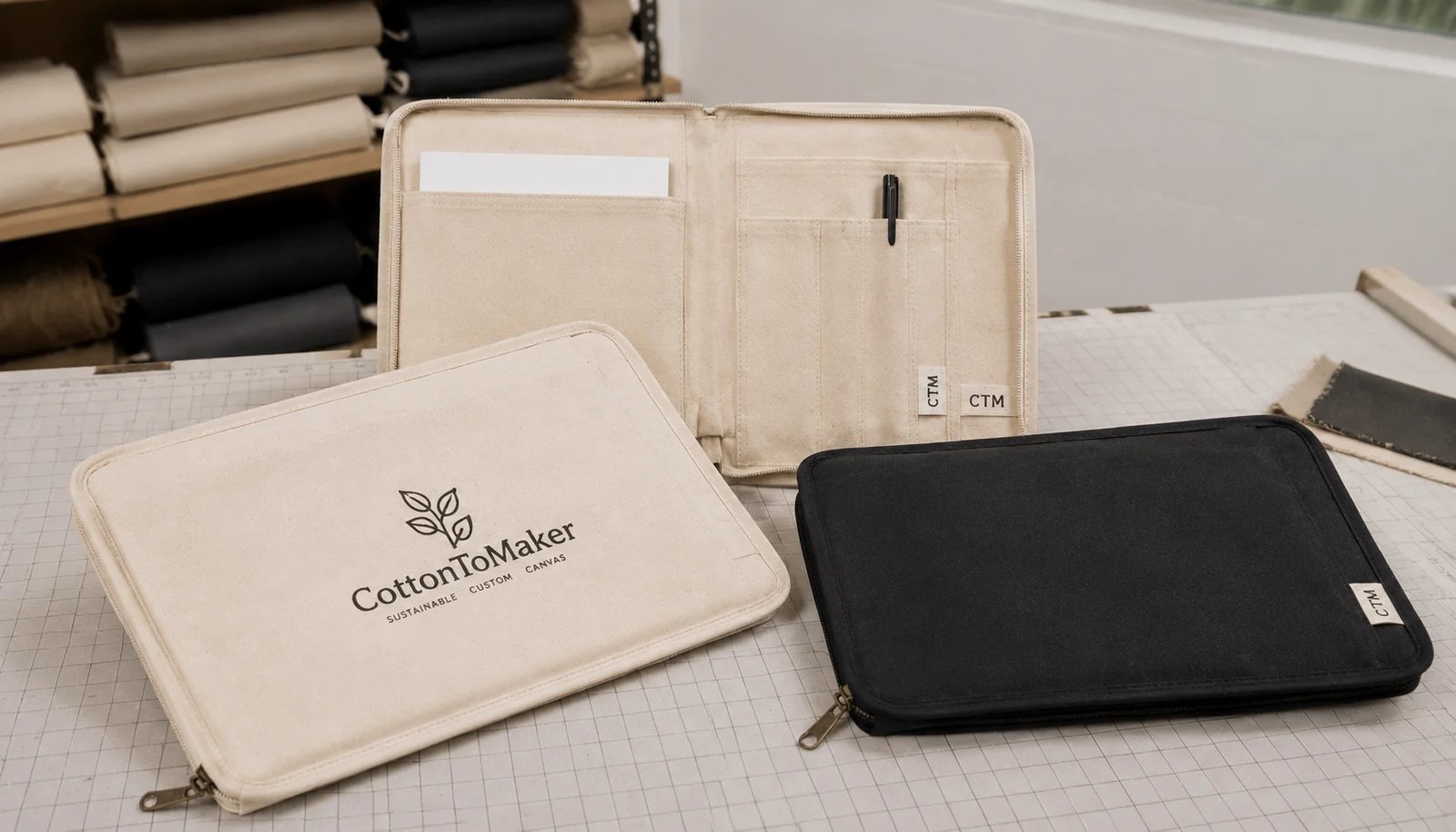
Why material selection is the main cost and quality decision
For canvas zipper portfolios, buyers often spend too much time on the outside look and too little on structure. In practice, the material package decides whether the item feels like a professional document folio or just a soft pouch with a zipper. Natural grocer programs usually want an earthy, practical product that supports brand values, but they also need it to survive repeated handling by store managers, field reps, category teams, or distributor sales staff. That means the right fabric is not only a branding decision. It is also a function, durability, and freight-cost decision.
The most common quoting mistake is to request a canvas portfolio without defining the fabric weight, lining type, and reinforcement. That leaves each factory to fill in the gaps differently. One supplier quotes 10 oz canvas with no foam and a thin zipper. Another quotes 14 oz with lining and interlining. The price gap looks large, but the product is not the same. A useful RFQ has to lock the material build first, then compare decoration, packing, and lead time.
- If the portfolio must hold catalogs, forms, or tablets, structure matters more than front-panel print.
- If the item is a promotional giveaway, lighter fabric may work, but the zipper and corners still need basic durability.
- Material decisions influence not only unit price but also carton weight, print quality, sample speed, and defect rate.
Best canvas weights for natural grocer portfolios
For most zipper portfolio programs, 12 oz to 14 oz canvas is the safe middle range. In GSM terms, that is roughly 407 to 475 GSM. This weight holds shape better than lightweight grocery tote canvas and gives a cleaner, flatter front panel for logos. It also handles stitching around organizer pockets and zipper corners with fewer distortions. If the portfolio is meant to feel substantial in buyer meetings or internal onboarding kits, this range is usually the best starting point.
Lighter canvas, around 8 oz to 10 oz or about 271 to 339 GSM, can work for low-cost programs, but only if you accept a softer body and less formal presentation. Heavy canvas above 16 oz or about 542 GSM can look premium, but it raises freight cost and increases sewing difficulty at the corners, especially once lining and foam are added. For natural grocers, where branding often leans understated rather than luxury, the middle range usually gives the best balance of hand feel, print surface, and logistics.
- 8 oz to 10 oz canvas: lower cost, softer body, suitable for simple zip folios or giveaway kits.
- 12 oz to 14 oz canvas: best all-around range for branded portfolios with pockets and moderate structure.
- 16 oz and above: premium look, higher freight weight, tighter sewing tolerances required.
- Always request both oz and GSM on quotes to avoid supplier interpretation gaps.
Cotton, recycled blends, and cotton-poly: what changes in production
A natural grocer buyer may prefer 100% cotton for obvious brand reasons, but that choice should still be tied to use conditions. Pure cotton canvas usually gives the most natural hand feel and the most familiar texture for eco-positioned merchandise. It also takes water-based screen print well when the surface is reasonably even. The tradeoff is that raw or minimally processed cotton can show more shade variation, pick up stains more easily, and shrink more if washing or humid storage affects the finished goods.
Cotton-poly canvas and recycled-content blends can improve dimensional stability and sometimes reduce visible wear in repeated use. They are practical where teams carry the portfolio in vehicles, warehouses, or store backrooms. But any blended construction needs careful wording if the retail program emphasizes natural fibers. Procurement should make sure the quote states exact fiber content and whether the content applies to shell only or shell plus lining. Misunderstandings here create artwork, packaging, and compliance problems later.
- 100% cotton canvas: strongest natural-material story, good printability, more susceptible to soiling and lot variation.
- Cotton-poly canvas: better stability and often cleaner appearance in use, but less aligned with all-natural positioning.
- Recycled blends: useful for sustainability programs, but recycled claim wording should be documented before packaging print runs.
- Ask whether fabric is greige natural, bleached, yarn-dyed, or piece-dyed because color consistency and lead time differ.
How reinforcement and lining change the feel of the portfolio
A zipper portfolio without reinforcement may look acceptable in photos but disappoint in hand. If the item needs to hold forms neatly or sit flat on a meeting table, some internal support is usually necessary. Common options include nonwoven interlining, light foam, or thin board inserts in selected panels. Foam around 2 mm is a common middle option because it adds body without creating a stiff, cheap binder feel. Reinforcement should be specified by panel location, not only by material type, because a fully reinforced body handles differently from a front-and-back-only structure.
Lining is another area where quote gaps happen. A simple 210D polyester lining offers good cost control, a cleaner interior, and easier wipe-down performance. An 8 oz cotton lining feels more aligned with natural-fiber branding, but it raises cost and can make interior bulk heavier when several pockets are added. Unlined interiors are possible for budget items, but they expose seams and can reduce the perceived value. For most natural grocer programs, lined construction gives a more finished result and better retail acceptance.
- No reinforcement: best only for soft folio styles or low-cost promotional use.
- Nonwoven reinforcement: economical structure improvement for flat portfolios.
- 2 mm foam: balanced shape, better hand feel, common for mid-range branded programs.
- Poly lining: lower cost, practical, cleaner-looking interior.
- Cotton lining: premium natural feel, higher cost and added bulk.
Print methods that suit canvas portfolios without hurting durability
The safest decoration choice for canvas zipper portfolios is usually screen printing on the front panel before final assembly. It works well for one-color and two-color logos, keeps the aesthetic matte, and usually costs less than embroidery or specialty transfers. For natural grocer branding, where logos often use restrained graphics and muted palettes, screen print fits the product. It also avoids the shiny look that can happen with some heat transfers on textured canvas. If the logo is small and understated, a woven side label can be even more durable and visually cleaner.
Embroidery looks premium to some buyers, but it can pull and pucker medium canvas unless the backing and stitch density are controlled. Debossed patches, leather-look labels, and rubber badges may not fit the natural brand positioning unless the design system already uses those materials. The key is to match decoration to the fabric surface and use area. A logo across a heavily flexed fold line or directly over thick reinforcement often cracks, wrinkles, or shifts. Flat, centered front panels remain the safest print zone.
- Screen print: best for simple logos, broad MOQ compatibility, economical setup for repeat orders.
- Woven label: strong for subtle branding and reorder consistency across colorways.
- Embroidery: only if panel tension and backing are tested on sample.
- Heat transfer: use selectively; verify gloss level and adhesion on textured canvas.
- Approve print strike-off on actual fabric color, not only digital artwork.
MOQ logic: reduce variation before negotiating price
Factories can quote almost any combination of body color, lining color, zipper tape, puller finish, and logo treatment, but every extra variation eats efficiency. For a canvas zipper portfolio, MOQ pressure usually appears in dyed fabric lots, custom zipper pulls, and separated print runs. Buyers sometimes focus on hitting a headline MOQ number while overlooking that each color split may fall below practical production efficiency. The result is either a surcharge or a later request to simplify options.
A better approach is to standardize the structural components and vary only the front branding where needed. One body shape, one lining color, one zipper size, and one common zipper tape across programs can support several customer or store-group versions with different prints or labels. This matters for importers and distributors who need flexible assortment planning without carrying too many trim combinations. MOQ should be negotiated around what the factory actually sources in bulk: fabric lots, zipper lots, labels, and cartons.
- Use one shell fabric and one zipper color if testing a new SKU.
- Keep custom metal pullers for larger orders; stock pullers shorten lead time and lower setup cost.
- If multiple logos are required, ask whether the factory can run one base body and split print later in production.
- Clarify MOQ by style, by color, and by logo because suppliers often quote only one of these.
Sample approval: what to test before bulk production
A portfolio sample should be evaluated as a working item, not only as a visual approval. Many buyers approve samples too quickly because the external look seems correct. Then bulk production reveals that the interior pockets do not fit the intended paper size, the zipper catches at the corners, or the item sags when loaded. The sample stage is where these issues are cheapest to fix. A proper pre-production sample should use the actual bulk fabric weight, lining, zipper type, and print method whenever possible.
For natural grocer programs, practical evaluation matters. Teams should insert standard documents, brochures, or tablets that the portfolio is supposed to carry. Open and close the zipper repeatedly. Set the item upright, lay it flat, and stack several units to see if distortion appears. Inspect whether natural canvas shade and print opacity still match the brand look under store lighting and office lighting. A signed sample with swatches attached should become the production reference.
- Verify actual paper or tablet fit, not only nominal dimensions on a tech pack.
- Run repeated zipper cycles and inspect corner stress points.
- Check front print opacity on the actual fabric color and texture.
- Compare sample weight and hand feel against target retail positioning.
- Approve one sealed sample for the supplier and keep one internal golden sample.
Packing details that affect damage rate and landed cost
Packing for zipper portfolios is not just a warehouse issue. It changes freight efficiency, presentation on receipt, and the rate of transit damage. If the product has reinforcement, poor carton orientation can create edge warping or corner flattening. Individual polybags are still the common export solution because canvas attracts dust and moisture marks, and zipper pullers can scratch adjacent units. Some buyers prefer recycled paper wraps or no individual bag to reduce plastic use, but that only works if the carton environment is well controlled and print scuffing has been tested.
Carton quantity should be balanced against gross weight and compression. Overpacked export cartons save a little on carton count but can deform the bottom layers. Procurement should request not just pieces per carton, but also carton dimensions and gross weight. That makes it possible to compare suppliers on freight utilization, palletization, and handling. A cheaper ex-factory price can lose its advantage if the packing is inefficient and increases cubic volume or damage claims.
- Request flat packing layout photos before bulk shipment.
- Common retail-safe pack: 1 piece per polybag, then master carton with consistent orientation.
- For lower-plastic programs, test paper wrap or bag-free packing for print rub and zipper scratching first.
- Set a carton gross weight target practical for manual handling, often below about 15 to 18 kg depending on destination rules.
- If inserting hangtags or barcode labels, define placement to avoid puncturing the outer canvas.
Lead time risks: what usually delays a zipper portfolio order
The critical path for this product is usually fabric readiness, print scheduling, and zipper trim availability. Buyers often assume the zipper is a stock item and harmless, but custom pullers, unusual tape colors, or upgraded sliders can add meaningful time. Fabric dyeing can also become the longest step if the order uses earthy custom shades that require lab dips and approval rounds. If the portfolio uses cotton lining, that inner fabric may need separate dyeing and matching, adding another approval point.
To reduce delay risk, buyers should identify which components are truly custom and which can use stock options. If launch timing matters more than minor aesthetic differences, choose stock zipper pulls, standard lining colors, and a screen print instead of a custom woven patch that needs additional sampling. It also helps to define whether bulk starts after sample approval only, or whether material booking can begin after artwork and color approval. Factories plan capacity differently based on that instruction.
- Likely delay drivers: custom-dyed shell fabric, non-stock zipper tape, custom pullers, revised interior layout, and revised print artwork.
- Typical sample sequence may include proto sample, revised fit sample, then pre-production sample.
- Ask what materials can be booked in advance to protect vessel or delivery timing.
- Avoid late carton-mark changes; they often create preventable shipping holds.
How to compare quotes on more than unit price
When several suppliers quote the same portfolio concept, the comparison should normalize the material build before evaluating cost. A useful spreadsheet compares shell GSM, lining type, reinforcement, zipper size, print method, sample charge, MOQ by color, packaging, carton data, and production lead time. Without that detail, the lowest quote may simply be missing reinforcement, using a lighter shell, or excluding standard inspection and packing. This product category is especially vulnerable to hidden downgrades because portfolio construction details are not obvious in a one-line quote.
Landed cost should also include freight effect. Heavier canvas and thicker reinforcement raise carton weight, while poor nesting efficiency raises carton volume. A supplier quoting a slightly higher unit cost may still win if their pack-out reduces cubic space or if their material build lowers defect risk enough to avoid rework. Procurement teams should calculate at least a rough delivered cost per usable unit, not only ex-factory cost per produced unit.
- Normalize all quotes to the same shell weight, lining, and zipper grade before price comparison.
- Separate one-time costs from repeat-order costs: sample fee, screen setup, custom mold fee, or puller tooling.
- Request carton dimensions and gross weight to estimate freight impact.
- Consider defect exposure: cheaper trim often increases claim rate more than it saves in quote value.
Specification comparison for buyers
| Spec decision | Recommended option | When it fits | Buyer risk to check |
|---|---|---|---|
| Outer canvas weight | 12 oz to 14 oz canvas, about 407 to 475 GSM | Best for reusable sales kits, staff document holders, and private-label portfolios that need structure without board inserts | Below 10 oz often feels too soft for a portfolio format; above 16 oz adds freight weight and can distort zipper sewing if pattern tolerances are loose |
| Fiber choice | Combed cotton canvas or cotton-poly canvas with stable shrink performance | Use combed cotton for a natural, premium hand feel; use cotton-poly when stain resistance and dimensional stability matter more than all-cotton positioning | Open-end yarn canvas may show more slubs and print inconsistency; cotton-poly needs approval if your brand claims natural material |
| Color base | Pre-dyed black, olive, or natural with batch lab dip approval | Suitable for natural grocer programs that want earthy colors and lower visible soil during store or field use | Natural canvas can shade-vary more by lot; dark colors need crocking checks, especially around zipper tape and lining |
| Interlining structure | 2 mm foam or nonwoven reinforcement laminated in panels only | Good when the portfolio must protect forms, onboarding packs, or menu sheets and stay crisp on a table | Full-body heavy reinforcement can make the item bulky and harder to print flat; weak adhesive lamination may bubble after heat exposure |
| Lining material | 210D recycled polyester or 8 oz cotton lining depending brand position | Poly lining works for wipe-clean interiors and lower cost; cotton lining suits premium natural-brand storytelling | Unlined construction can look economical but exposes seam allowance and reduces perceived value; lining color bleed must be tested |
| Zipper system | Nylon coil zipper with metal puller, size 5 for most portfolios | Reliable for daily office or field use, easier to sew around corners than molded tooth zippers | Very cheap sliders fail first; test 200 to 300 opening cycles on pre-production samples and inspect corner puckering |
| Logo decoration | 1-color or 2-color screen print on flat front panel; woven label for low visual noise | Best when logo coverage is moderate and artwork is simple; woven label fits understated natural grocer brands | Large solid prints can crack on heavily flexed areas; heat transfer may look too glossy on rustic canvas unless specifically desired |
| MOQ approach | Start with one body shape, shared lining color, and one zipper color across SKUs | Fits importers testing a new category or distributors building several customer programs from one base spec | Too many color splits push MOQ per color below efficient cutting and dyeing levels, raising unit cost and delaying production |
| Retail packing level | Individual polybag or recycled paper wrap plus export carton by orientation | Polybag suits moisture protection in ocean transit; paper wrap suits lower-plastic programs if container conditions are controlled | No individual protection can cause dusting, zipper scratching, and print scuffing; mixed carton orientation can deform portfolios under stack pressure |
Buyer checklist before sampling
- Define the end use first: staff paperwork holder, promotional leave-behind, retail organizer, or distributor sales kit, because structure and lining requirements change the material choice more than logo design does.
- Specify outer fabric in both oz and GSM, for example 12 oz or about 407 GSM, so quotes from different factories are comparable.
- State whether natural color variation is acceptable on unbleached canvas and set an approval standard with a sealed swatch or lab dip.
- Choose one zipper size and tape color unless sales volume supports color splitting; this protects MOQ efficiency and keeps replacement trims consistent.
- Decide if the portfolio needs rigid feel from foam or board reinforcement, or only a soft folio hand feel with plain canvas and lining.
- Match print method to artwork coverage: screen print for simple logos, woven label for understated branding, embroidery only if fabric weight can support puckering control.
- Approve interior layout dimensions with actual paper sizes, pens, cards, tablets, or brochures before pre-production sample signoff.
- Request packed carton dimensions and gross weight per carton to estimate pallet count and landed freight cost, not just ex-factory unit price.
- Set basic QC thresholds for zipper run, print placement, seam straightness, odor, shade consistency, and loose thread tolerance before production starts.
- Keep one approved golden sample with signed material swatches, zipper sample, print strike-off, and packing method for reorder consistency.
Factory quote questions to send
- What is the quoted outer canvas weight in both oz and GSM, and what is the expected finished weight tolerance after dyeing or washing?
- Is the outer fabric 100% cotton, recycled cotton blend, or cotton-poly blend, and how does that affect shrinkage, print quality, and stain visibility?
- What reinforcement is included inside the panels: none, foam, nonwoven, paper board, or laminated interlining, and in which panels is it inserted?
- What zipper brand or grade are you quoting, what size is the chain, and is the puller stock or custom?
- Which logo method is included in the quote, what is the maximum print area, and how many colors are covered before setup costs increase?
- What is the MOQ by color and by artwork, and can multiple colorways share one material lot or zipper color to reduce surcharge risk?
- Does the sample charge include exact production fabric and trim, or will the pre-production sample differ from the salesman sample?
- What are the carton pack quantity, carton size, gross weight, and whether portfolios are packed flat, nested, or edge-standing?
- What production lead time applies after sample approval and deposit, and which components usually cause delay: fabric dyeing, custom zipper pullers, labels, or print scheduling?
- What in-line and final inspection points do you normally use for zipper portfolios, and can you provide photos of stitch density, lining construction, and corner sewing from recent bulk runs?
Quality-control points to confirm
- Outer fabric GSM should stay within the agreed tolerance, commonly plus or minus 5% for woven canvas unless a different standard is written into the PO.
- Shade consistency must match the approved swatch under standard light; visible panel-to-panel mismatch on one unit is not acceptable for front-facing retail programs.
- Zipper should run smoothly through full open-close cycles without tooth misalignment, tape twisting, or slider drop-off at corners.
- Front logo placement should stay within the approved tolerance, commonly plus or minus 3 mm for labels and plus or minus 5 mm for screen print on cut-and-sew goods.
- Seam lines should be straight and balanced, with no obvious twisting of front and back panels when portfolio lies flat on a table.
- Reinforcement panels must be fully inserted and not exposed at seam turns or zipper ends.
- Interior pockets, pen loops, and card slots must match approved dimensions and fit the actual paper or accessory sizes listed in the spec sheet.
- No strong chemical odor, mildew smell, or excessive starch residue should remain after packing.
- Loose threads, missed stitches, raw edge exposure, and lining puckering around the zipper path should be controlled at final inspection.
- Cartons should protect corners from crushing and keep units clean; mixed sizes or overpacked cartons often deform the portfolios during transit.