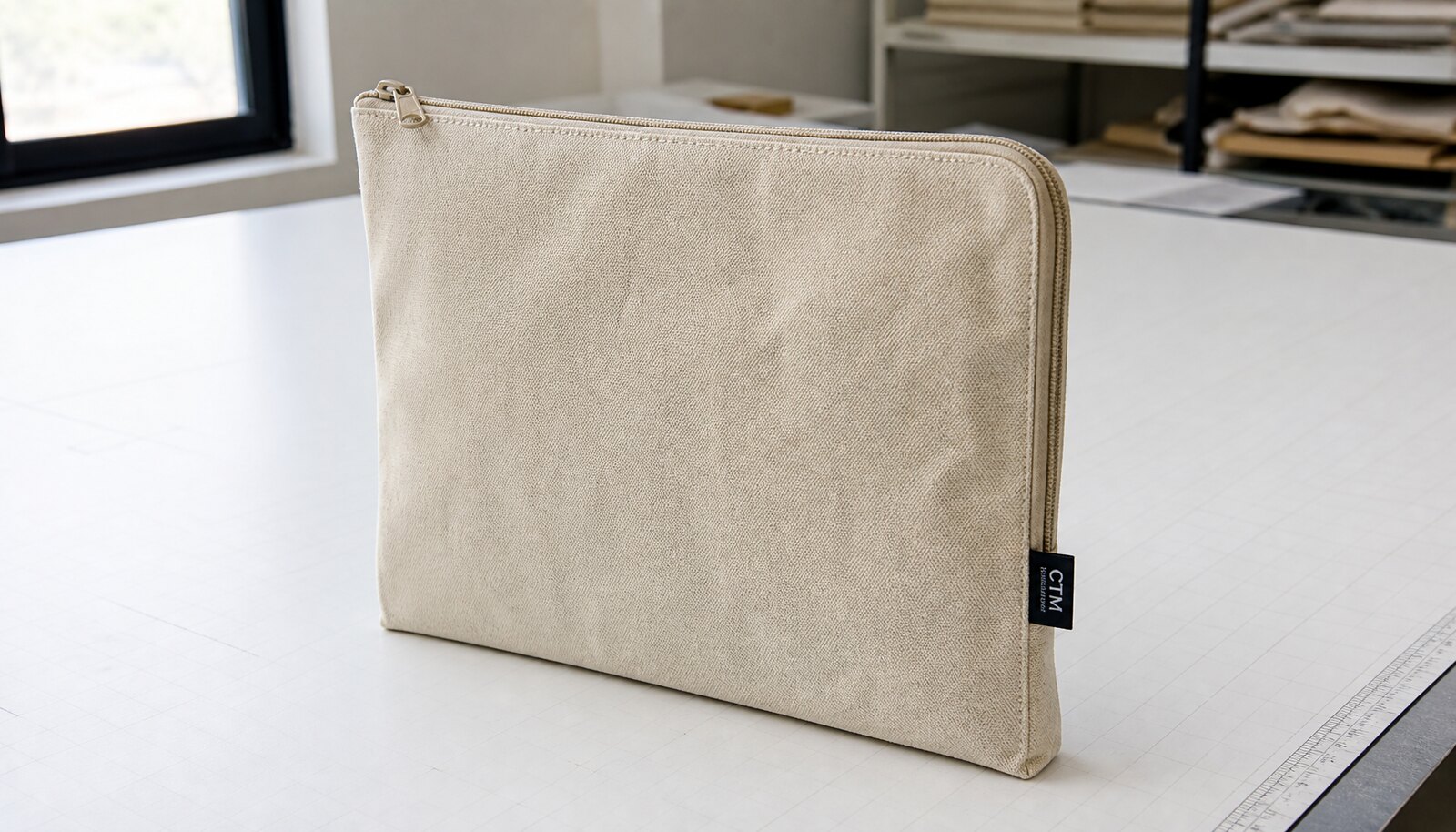
1. Start With The Use Case, Not The Fabric Swatch
Canvas zipper portfolios are usually bought for one of three jobs: carrying documents, presenting branded collateral, or acting as a premium gift that still has daily utility. The material choice changes once you decide which job matters most. A portfolio for executive onboarding needs a cleaner surface, tighter stitching, and a more stable profile than a simple event handout. A portfolio meant to move through trade shows can tolerate a lighter build if the print stays sharp and the zipper survives repeated opening.
The fastest way to get a misleading quote is to describe the product only as a canvas zipper portfolio. A factory will quote very differently if the item is expected to hold papers only versus a notebook, tablet, or folder with pens and inserts. The buyer should define the load, the presentation level, and the expected life of the item. That gives the mill and sewing line enough information to choose the right canvas, lining, reinforcement, and decoration method.
- State the primary load: papers only, notebook and papers, or notebook plus tablet sleeve.
- Define the presentation level: basic giveaway, business gift, or executive pack-in.
- Decide whether the product must stand upright on a desk or can stay soft and foldable.
2. Choose Canvas Weight Based On Hand Feel And Use Cycle
For most corporate programs, 12oz to 14oz cotton canvas is the practical center. In GSM terms, that is usually around 340 to 470 GSM depending on weave density and finishing. This range gives enough body for a zipper portfolio to look intentional, hold a print cleanly, and resist early corner collapse without becoming a heavy carry item. If the gift is supposed to feel premium, 14oz usually reads better than 10oz because the bag keeps its shape longer on a desk or in transit.
Lighter canvas, such as 8oz to 10oz, can work for mailers, conference inserts, or lower-cost welcome kits, but the buyer should accept a softer drape and a higher chance of seam show-through. Heavier canvas, around 16oz, is useful when the portfolio must feel substantial or carry more weight, yet it can complicate folding, increase freight cost, and make screen print registration less forgiving if the fabric is too stiff. The right answer is not the heaviest fabric available. The right answer is the fabric that matches the use cycle and brand position.
- Ask the factory for exact GSM, not only oz weight, because finishing can shift the feel.
- Request the weave density and whether the canvas is raw, bleached, or washed.
- For printed logos, prefer a tighter weave so small text does not bleed or sink.
3. Interior Build, Zipper Grade, And Reinforcement Drive The Real Quote
Many buyers focus on the front panel and ignore the inside construction, but the interior often decides whether the product feels cheap or controlled. A simple unlined portfolio is acceptable for budget gifting, yet the seam edges need clean binding or careful overlock finishing. If the buyer wants a cleaner reveal when the bag is opened, a 210D polyester lining or cotton twill lining is worth the added cost. Lining also hides internal stitch work and gives a better surface for a pocket or pen loop.
The zipper is another area where low quotes hide future complaints. A #5 nylon coil zipper is usually the safest standard for portfolios because it glides smoothly and tolerates daily use. If the portfolio is wider, overstuffed, or expected to survive frequent use, a larger gauge or a stronger slider may be justified. Reinforcement matters too: fusible interfacing, bartacks, and a bottom insert change the stiffness and the long-term shape. These are not decorative extras. They are the reasons one supplier quote lasts and another gets rejected after sample review.
- Require the zipper gauge, slider type, puller material, and stopper detail in the quote.
- For lined products, inspect corner bulk so the portfolio does not wrinkle when closed.
- If the product will hold a tablet, add structure at the bottom and along the zipper track.
4. Print Method Should Match Artwork Complexity And Quantity
Screen printing is still the default choice for most canvas zipper portfolios because it is durable, economical at scale, and gives a clean brand mark on textured fabric. It is the right answer when the logo is one to two colors, the placement is stable, and the artwork has strong edges. Water-based ink gives a softer hand feel and usually sits better on canvas, while plastisol can give stronger coverage but may feel heavier. The important point is not the ink label alone. The factory needs to show that the logo survives folding, abrasion, and packing without cracking or offsetting.
If the artwork has gradients, small text, or photographic detail, the buyer may need to switch to heat transfer or a woven label instead of forcing a screen print. Embroidery is useful for premium positioning, but it can distort thin canvas if the backing is weak or the logo is too detailed. For many corporate gift programs, the best compromise is a simple screen print on the main panel and a small woven side label with the CTM or brand mark. That keeps the front clean and still gives the buyer a premium detail for photography and unboxing.
- Use screen print for bold logos and repeat orders with stable artwork.
- Use woven labels or embroidery when the logo needs a premium finish rather than full-color detail.
- Place artwork away from zipper folds and seam stress points so the print does not crack early.
5. Compare Supplier Routes Before You Compare Unit Price
A direct bag factory with sewing and printing under one roof is usually the strongest option for canvas zipper portfolios. The factory controls the fabric cut, seam construction, zipper insertion, and decoration sequence, so the sample you approve is more likely to match the bulk run. That matters for corporate gifting, where the buyer is judged on consistency, not only on a low invoice. A trading company can help if you need mixed product sourcing or if your internal team wants one procurement contact, but the buyer should expect less visibility into the actual production floor and more risk of spec drift.
Promotional suppliers and stationery vendors can be useful for small campaigns, but they often outsource the bag construction. That creates more handoffs and can hide the real source of defects. The practical rule is simple: if the portfolio has a custom body spec, custom zipper, or custom packing, use a supplier route that can show you the cut-and-sew process and not just the finished sample. MOQ is usually lowest when the factory uses stock canvas colors, stock zippers, and one-color print. Once you move to custom-dyed fabric, special pullers, or more complex packaging, the minimum goes up because each extra variable requires its own setup and sourcing window.
- Use the same spec sheet across supplier routes so you compare real differences, not vague quotes.
- Treat custom fabric color, custom zipper color, and extra print locations as separate MOQ drivers.
- Ask who controls the final inspection: the supplier, a subcontractor, or your own third-party inspector.
6. Read The Quote Line By Line Or The Lowest Price Will Mislead You
A proper quote for canvas zipper portfolios should break out fabric, cutting, sewing, decoration, zipper components, lining, packing, and carton terms. If the supplier only gives a single unit price, the buyer cannot tell where the cost is hiding. The biggest misses usually sit in the setup items: screen charges, embroidery digitizing, color matching, zipper sourcing, special labels, and carton marks. A quote that looks cheap on paper can become expensive once these items are added back in.
For landed-cost comparison, do not stop at the factory gate. Ask how the carton is packed, how many units fit in each carton, and what the folded size does to volume weight. A portfolio with a bulky insert or oversized carton can cost more to ship than a slightly heavier but flatter build. This is why buyers should compare the full quote data, not just the per-piece number. The right vendor is the one who can explain how material, labor, packing, and freight sensitivity interact, especially when the program ships to multiple offices or retail distribution points.
- Compare fabric cost, conversion cost, print setup, packing, and export carton terms separately.
- Request carton dimensions and net/gross weight before approving the quote.
- Check whether the quote assumes a single bulk shipment or multiple drop points.
7. Approve The Sample For Function First, Not Just Appearance
The pre-production sample should use final fabric, final zipper, final print method, and final packing method. A sales sample is useful for visual direction, but it is not enough to freeze the order. Buyers should test the sample for zipper travel, seam alignment, logo position, fold memory, and pocket fit if the portfolio includes internal compartments. If the sample looks good but catches on the zipper track after repeated opening, it is not approved. Function defects get expensive once the bulk lot is in production.
Set clear acceptance criteria before the sample is signed off. For example, dimensions should stay within the agreed tolerance, logo position should not drift, and stitch density should remain uniform on stress points. The sample should also be viewed under regular white light, not only in a bright photo booth, because canvas shade variation is easier to spot in normal conditions. If the buyer needs a premium finish, ask the factory to send both the bulk spec sample and a production sample so the team can see how the final materials behave when the line is fully set up.
- Test zipper smoothness across repeated open-close cycles before approval.
- Compare the sample against the artwork file and not only against a previous bag.
- Approve the exact folding and packing method, because a good bag can still arrive creased or scuffed.
8. Packing And Lead Time Need To Be Designed Into The Program
Packing decisions affect both presentation and damage rate. For distribution to employees or clients, an individual polybag with a size label is usually enough. For premium gifts, a kraft sleeve, tissue wrap, or insert card may make more sense, but each layer adds labor and can change the carton count. The buyer should decide whether the product needs retail-style presentation or warehouse-efficient packing. Those are different goals, and they should not be mixed casually in the RFQ.
Lead time is usually lost in the approvals, not only in sewing. Fabric sourcing, sample revisions, print approvals, and carton booking all add time. A realistic plan should include sample development, material confirmation, bulk production, packing, and export readiness. Seasonal pressure makes the schedule tighter, especially around holidays and year-end gifting windows. If the portfolio is part of a broader gift set, add time for inserts, tags, and any outer box coordination. The safest schedule is the one that assumes at least one correction round before bulk release.
- Specify whether the pack should be retail-ready, warehouse-ready, or direct-mail ready.
- Lock carton marks, unit count, and barcode placement before the production order is released.
- Add buffer time for print approval and fabric re-dye or re-booking if the first lap is off spec.
9. Write The RFQ So The Factory Quotes The Same Product You Need
A strong RFQ for canvas zipper portfolios reads like a production instruction, not a marketing request. It should name the finished dimensions, target load, canvas weight, lining choice, zipper spec, print method, logo file format, packing format, destination, and target ship date. If the buyer wants more than one price point, request separate quotes for each build tier instead of asking one factory to guess the tradeoff. That makes internal budget approval easier and prevents suppliers from substituting materials to hit a target cost.
The most common sourcing mistake is leaving one dimension vague and then discovering it changed the entire build. A slightly wider portfolio may require a different zipper length, different seam allowance, and different carton count. Another common mistake is approving a logo position from a low-resolution mockup and then arguing about placement later. To avoid this, the RFQ should include a spec sheet, a vector artwork file, a packing sketch, and a sample approval rule. The clearer the RFQ, the easier it is to compare quotes on equal terms and the less likely you are to pay for a fix that should have been designed out from day one.
- Attach a dimensioned sketch with internal capacity notes.
- Name the canvas GSM, lining material, and zipper size in the RFQ itself.
- State the approval rule: no bulk release until final sample matches the signed spec sheet.
Specification comparison for buyers
| Spec decision | Recommended option | When it fits | Buyer risk to check |
|---|---|---|---|
| Body canvas weight | 12oz to 14oz cotton canvas, about 340 to 470 GSM | Most corporate gift programs that need a firm hand without feeling bulky | Too-light canvas looks soft and wrinkles fast; too-heavy canvas raises freight and makes folding uneven |
| Interior build | Simple unlined build for budget runs, or 210D polyester or cotton twill lining for premium sets | Use lining when the portfolio will be opened often or needs a cleaner interior finish | Unlined bodies can fray at seam edges; lined builds need tighter sewing control so corners do not bunch |
| Closure system | #5 nylon coil zipper with a smooth metal or self-fabric pull | Standard portfolios for documents, notebooks, and slim devices | Cheap zipper tape, weak sliders, or poor top-stop settings create jams and returns |
| Branding method | Screen print for bold logos, woven label or embroidery for premium positioning | One to two color logos, clear brand marks, and repeatable corporate gifts | Fine text can fill in or crack; embroidery can distort thin canvas if the backing is weak |
| Structure and reinforcement | Fusible interfacing plus corner bartacks and a bottom insert if needed | When the buyer wants a sharper profile or a bag that sits flat on a desk | Over-stiff interfacing makes the portfolio look boxy and can cause puckering after sewing |
| Supplier route | Direct bag factory with sewing and printing under one roof | Medium and high volume orders where consistency matters more than the lowest headline quote | Outsourced printing or zipper sourcing can create color drift, delayed samples, and weak defect control |
| Sample stage | Pre-production sample using final fabric, zipper, print, and packing | Every order before bulk approval | Sales samples often hide shrinkage, shade variation, and zipper feel problems |
| Packing method | Individual polybag with size label, then master cartons with clear carton marks | Mass distribution, warehouse intake, and export shipments | Loose packing scuffs the canvas, absorbs moisture, and creates count errors at receiving |
| Inspection approach | AQL inspection with functional checks on zipper, seams, and logo placement | Any importer that wants a defendable acceptance standard | Visual-only inspection misses zipper failure, weak stitching, and wrong logo position |
Buyer checklist before sampling
- Lock the final use case first: document carrier, notebook portfolio, tablet sleeve, or gift set component.
- Specify the canvas weight in GSM and the weave finish, not just cotton canvas.
- State whether the bag needs lining, interfacing, or a bottom insert.
- Define the zipper size, slider style, and puller material before quoting.
- Provide artwork in vector format and note the exact print method you want evaluated.
- Confirm finished size, usable internal dimensions, and any pocket or pen-loop layout.
- Set packaging needs early, including individual polybag, tissue, barcode label, or gift sleeve.
- Ask the factory to quote sample cost, tooling cost, and bulk price separately.
- Request a pre-production sample with final material and final decoration method.
- Build a shipping buffer for fabric sourcing, print approvals, and carton booking.
Factory quote questions to send
- What canvas weight, weave density, and shrinkage allowance are you quoting?
- Is the zipper stock item or custom sourced, and what size slider are you using?
- Does the quote include lining, interfacing, bartacks, and any internal pockets?
- What print method is included, and how many colors or placements are covered?
- What are the sample charge, tooling charge, and any setup charges for artwork or screens?
- What carton count, carton size, and individual packing method are included in the unit price?
- What is the MOQ by fabric color, print color, and zipper color?
- What lead time applies to sample approval, bulk production, and export packing?
- Which defects are treated as critical during inspection, especially zipper failure and logo misplacement?
- Can you quote the same spec on an FOB basis and a delivered basis so we can compare landed cost?
Quality-control points to confirm
- Check finished dimensions against the approved spec sheet, including usable width and height after zipping.
- Verify canvas shade against the approved lab dip or sealed reference sample under normal white light.
- Inspect stitch quality at stress points: zipper ends, handle joins, corners, and bartacks.
- Run the zipper repeatedly and confirm smooth travel, clean alignment, and secure stops.
- Measure logo placement, size, and color against the artwork approval, with no blur or washout.
- Confirm seam allowance consistency so the portfolio does not twist or curl after packing.
- Check for odor, oil stains, loose threads, needle damage, and fabric contamination before carton sealing.
- Open carton samples to confirm folding method, quantity count, and label accuracy.