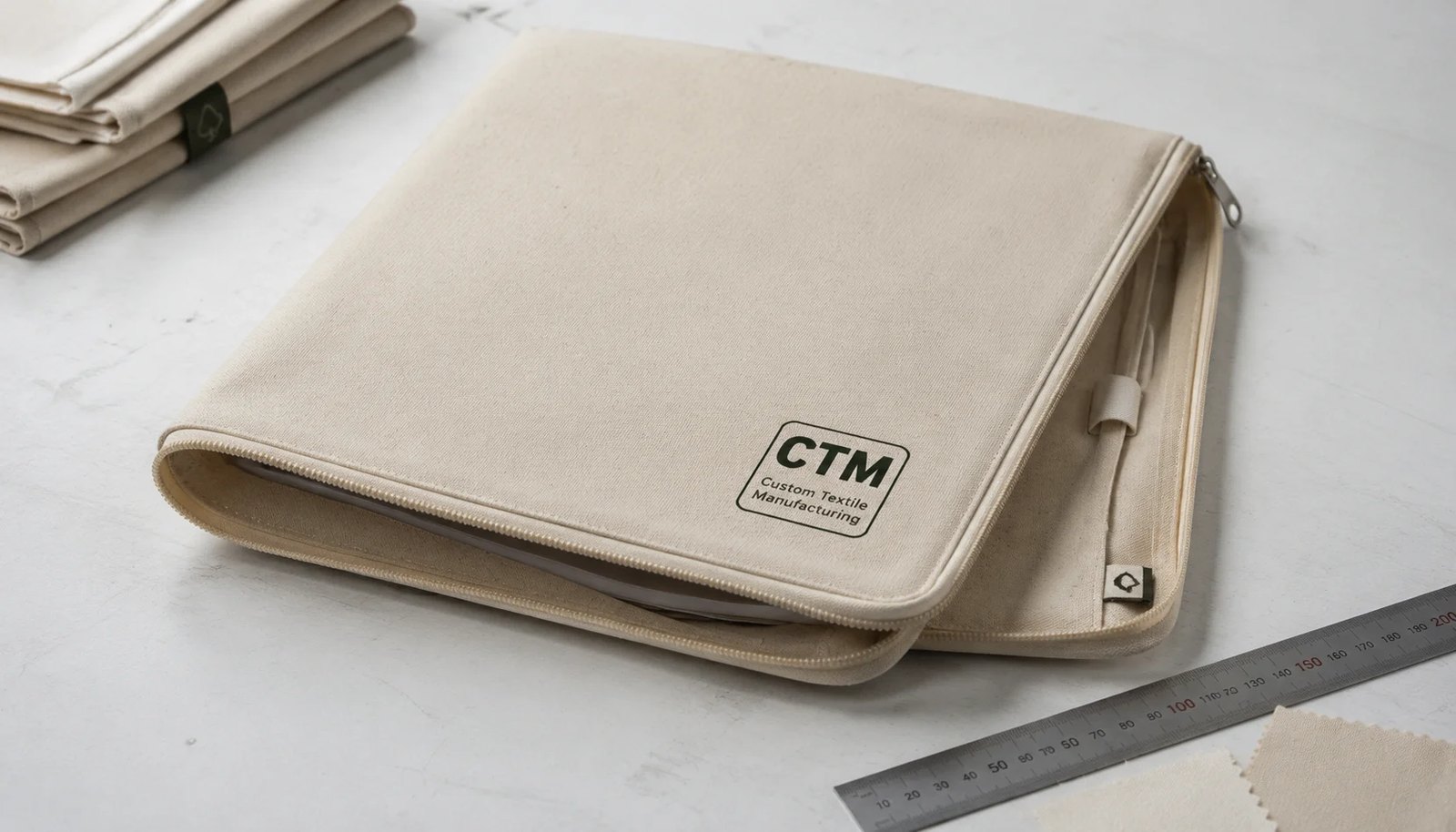
The buying problem: logo placement is not just a graphic decision
A canvas zipper portfolio looks simple on a line sheet, but logo placement controls how the item looks in a store office, vendor meeting, employee kit, or retail giveaway. Natural grocers often want a clean, lower-impact brand presentation: visible enough to identify the store, not so large that the product feels like a disposable promotion. The challenge is that canvas is not paper. The zipper seam, corner radius, fabric shrinkage, panel sewing, and carton pressure can all shift how the logo appears on the finished portfolio.
For procurement teams, the main risk is approving artwork on a flat PDF while the factory produces on a sewn, textured, slightly variable cotton panel. If the RFQ only says “logo centered on front,” two suppliers may quote the same artwork but measure from different references. One may measure from the cut fabric panel, another from the finished zipper seam, and another from the front pocket stitch. The result is inconsistent quotes and preventable sample rounds.
- Use finished product dimensions as the measuring reference, not pre-sewn panel dimensions.
- Decide whether the portfolio is a retail-facing item, an internal office tool, or a supplier kit component.
- Match logo size to the finished bag face after zipper, seam, and pocket construction are complete.
- Treat placement tolerance as part of the product specification, not as a QC afterthought.
Recommended base specification for natural grocery portfolios
For a durable canvas zipper portfolio in the natural grocery channel, a practical starting point is 12 oz cotton canvas, approximately 380-410 GSM. This weight gives a firm hand feel and supports a clean logo print without making the portfolio overly stiff. A lighter 10 oz canvas may reduce cost and carton weight, but it can show more wrinkling around zipper seams and can feel too soft if the buyer expects a document carrier rather than a simple pouch.
Natural unbleached canvas is common for grocers because it fits the organic and low-waste visual direction, but buyers should not expect perfect whiteness or perfectly identical flecks. If the brand requires tight color control, a dyed canvas or bleached cotton may be more predictable. The RFQ should separate fabric color approval from logo color approval because the same green logo ink will look different on unbleached canvas, bleached canvas, and recycled cotton blend canvas.
- Typical finished size for A4 documents: about 350 x 260 mm, depending on zipper opening and seam allowance.
- Typical finished size for US letter documents: about 345 x 250 mm, with confirmation by actual paper insertion test.
- Fabric option for value programs: 10 oz canvas, around 300-340 GSM, when the product is mainly a short-term event folder.
- Fabric option for premium programs: 14 oz canvas, around 430-470 GSM, when structure and retail shelf feel matter more than freight volume.
- Construction detail to state clearly: with or without front pocket, gusset, wrist strap, pen loop, inner divider, or side label.
Logo placement zones that work on canvas zipper portfolios
The safest visible placement is centered on the upper half of the front panel, normally 55-70 mm below the finished zipper seam. This keeps the logo away from the zipper tape and sewing distortion while leaving enough quiet space below. For natural grocers, a horizontal logo often works better than a tall stacked mark because the portfolio shape is usually landscape. If the portfolio includes a front pocket, the logo should either sit fully on the pocket or fully above it; splitting the artwork across a pocket seam looks careless and increases print registration problems.
A lower-right logo can look more retail and less promotional, but it needs careful margin control. Keep at least 35 mm from the side seam and 30-40 mm from the bottom seam, depending on logo size and stitching. Embroidery should have a wider safety margin than print because needle movement can pull the canvas and create puckering. Woven side labels are a good secondary branding option, but they should not replace front logo artwork unless the buyer wants a very subtle presentation.
- Front center placement: best for brand recognition and easiest for QC measurement.
- Lower-right placement: quieter look, but more sensitive to corner sewing and carton pressure marks.
- Side seam label: good for private label or co-branding, but less visible in photos and on desks.
- Interior pocket print: useful for care instructions, reorder codes, or membership messaging.
- Avoid printing across zipper tape, raised seams, folded edges, or thick pocket transitions.
How to size the logo without causing print defects
For a standard A4 or US-letter canvas zipper portfolio, a horizontal logo width of 120-180 mm is usually enough. A small specialty logo may be 80-110 mm wide, especially if placed in the lower corner. A large campaign logo may reach 200 mm, but the buyer should approve a real-size paper print placed on an actual sample before asking the factory to make a screen. When a logo is too large, the eye notices fabric weave, ink unevenness, and any slight rotation more easily.
Fine text is the common failure point. On natural cotton canvas, tiny legal lines, thin taglines, and small icons can fill in or break during screen printing. Keep positive strokes at least 2 mm where possible, and avoid reversed-out text below roughly 3 mm stroke width unless a print strike-off proves it works. If the logo includes a leaf icon with fine veins, simplify the artwork for fabric instead of forcing a paper-grade logo onto a woven surface.
- Use vector artwork in AI, EPS, or clean PDF format; low-resolution PNG artwork should not be the production master.
- Convert fonts to outlines before final approval to avoid font substitution.
- Set a maximum artwork area in millimeters, not only a percentage of product width.
- Approve both logo width and logo height because some suppliers may scale artwork unevenly to fit.
- For multi-color logos, define registration tolerance and whether slight overlap or trapping is acceptable.
Print method choices and what they do to cost
Screen printing is normally the most reliable method for canvas zipper portfolios when the artwork is one to three solid colors. It gives good coverage, manageable unit cost, and stable repeat production. Water-based ink can give a softer feel, which fits natural grocery branding, but it may look less opaque on darker fabric. Plastisol-type inks can be more opaque but may feel heavier and less aligned with a natural product story. The correct choice depends on artwork, fabric shade, and buyer expectations for hand feel.
Heat transfer is useful for full-color artwork, gradients, or very small runs where making multiple screens is not economical. The tradeoff is hand feel and long-term appearance on textured canvas. Embroidery gives a premium look for compact logos but can pucker lighter canvas and is usually not ideal for large grocery wordmarks. Woven labels are stable and clean, but they introduce separate label MOQ, color limitations, and sewing alignment checks.
- Lowest setup complexity: one-color screen print on natural canvas.
- Best for earthy brand color: water-based screen print approved on bulk fabric.
- Best for full-color campaign art: heat transfer, with wash and rub testing.
- Best for small premium mark: embroidery on 12 oz or heavier canvas with backing.
- Best for subtle retail look: woven side label plus small front print or no front print.
- Cost drivers: number of colors, logo size, screen setup, print position count, curing time, rejection allowance, and sample rounds.
MOQ logic: why the logo method may set the real minimum
Many buyers look only at the bag MOQ, but the effective MOQ may come from fabric dyeing, zipper color, label weaving, or print setup. For natural canvas with a one-color screen print, a factory may be comfortable quoting a lower quantity because the fabric is standard and setup is simple. If the buyer requires custom-dyed canvas, custom zipper tape, woven labels, and multiple print colors, the minimum becomes a combined material MOQ rather than a sewing MOQ.
Procurement teams comparing quotes should request the MOQ by component. One supplier may quote 1,000 pieces using stock natural canvas and standard zipper tape. Another may quote 3,000 pieces because they are including custom dyed fabric or a woven label minimum. Neither quote is automatically wrong, but they are not the same specification. Clear MOQ logic prevents surprise surcharges after artwork approval.
- Bag sewing MOQ: quantity the factory needs to run cutting, printing, and sewing efficiently.
- Fabric MOQ: minimum roll or dye lot required if the canvas is not stock.
- Print MOQ: minimum quantity that spreads screen setup and ink mixing cost reasonably.
- Label MOQ: often separate, especially for woven or jacquard labels.
- Zipper MOQ: relevant when zipper tape color or puller design is custom.
- Split shipment risk: leftover labels or fabric may not be usable if artwork changes later.
Sample approval should prove placement, not only appearance
A proper pre-production sample should use actual production canvas, zipper, thread, logo method, and packing. A blank sample is useful for checking size and construction, but it does not prove logo placement or ink behavior. A print strike-off on a loose fabric swatch helps confirm color and coverage, but it does not show how the logo sits after zipper sewing and panel tension. The buyer needs both: a print strike-off and a finished sample when placement matters.
The approval file should include photos with a ruler or measurement notes showing the distance from the finished zipper seam, side seam, and bottom seam. If the portfolio has rounded corners or a front pocket, those features should be included in the measurement drawing. A sealed sample should not be changed verbally; any adjustment after approval needs a revised spec sheet, because the cutting team, printing team, and sewing line may be working from different documents.
- Approve finished size tolerance, commonly plus or minus 5 mm for canvas soft goods.
- Approve logo placement tolerance, commonly plus or minus 3 mm for screen print on a stable front panel.
- Approve print color on fabric, not from a digital screen or paper Pantone book alone.
- Approve zipper function with actual documents inserted, not only with the portfolio empty.
- Approve packing method after confirming ink is fully cured and not offsetting onto polybags or adjacent bags.
QC thresholds for bulk production
Logo QC needs a measurable standard. For screen print, the inspector should measure the artwork position on a defined sample size from finished seams. A practical approach is to measure the first pieces from each printing table setup and then random pieces after sewing. The defect list should distinguish between critical placement errors, minor fabric specks, ink pinholes, and unacceptable smears. Natural canvas will have character, but oil stains, heavy slubs through the logo, and dirt marks on the front face should not pass.
Functional QC is just as important. The zipper should run smoothly without catching the lining or canvas edge. The portfolio should accept the required document size without bending corners. Seam strength should be checked at zipper ends, bottom corners, and any handle or wrist strap attachment. If the product will be used by store managers, field merchandisers, or supplier representatives, the zipper and seams will see repeated use, not one-time gift bag handling.
- Logo rotation: normally no more than 2-3 mm visual skew across the artwork width for standard screen print.
- Print defects: no heavy smears, missing letters, uncured tacky ink, or transfer marks on the front face.
- Fabric face: no obvious stains, needle holes outside seam lines, large dark contamination, or severe creasing through the logo.
- Zipper: open and close at least three full cycles during inspection without catching or splitting.
- Stitching: secure back-tack at stress points and no loose thread crossing the logo area.
- Document fit: insert the specified paper, brochure, or kit contents during final inspection.
Packing choices that protect the logo through freight
Canvas portfolios are often packed flat, which is efficient, but the logo face needs protection. If bags are stacked with zipper pulls pressing into printed panels, the shipment can arrive with dents, pressure marks, or ink abrasion. Individual recycled polybags are common and practical for import handling. Some buyers prefer paper bands or glassine-style bags for sustainability positioning, but these options must still protect the print from rubbing and moisture.
Carton quantity should be chosen by finished size, fabric weight, and whether the portfolio includes inserts. A 14 oz canvas portfolio with a gusset takes more carton volume than a flat 10 oz pouch. Over-compressing cartons may reduce CBM on paper but can create permanent creases and zipper impressions. The quote should include pieces per carton, carton dimensions, gross weight, net weight, and estimated CBM so the importer can compare landed cost, not only unit price.
- Use interleaving tissue or alternating zipper direction when zipper pulls risk marking the logo.
- Do not pack immediately after printing if ink cure time is not complete.
- Keep carton gross weight practical for warehouse handling, often under 18-20 kg where possible.
- Use inner cartons or counted bundles when distributors must allocate stock to many stores.
- Mark master cartons with PO number, item number, quantity, color, and carton sequence.
- For retail or store deployment kits, confirm whether barcode labels, suffocation warnings, or carton routing marks are required.
Lead time risks that affect logo placement programs
A typical production timeline depends on fabric availability, artwork readiness, sample approval speed, and packing requirements. For standard natural canvas and one-color screen print, the fastest path is stock fabric, standard zipper, quick artwork confirmation, print strike-off, pre-production sample, then bulk production. Delays usually happen when the buyer changes the logo size after seeing the first sample, when Pantone color is judged on a monitor, or when the supplier cannot secure the same fabric lot used for approval.
Natural grocers often run seasonal campaigns, new store openings, wellness events, vendor fairs, and employee training schedules. These dates create pressure, but rushing logo approval can increase rejection risk. Build the schedule around decision gates: artwork approval, material approval, pre-production sample approval, production start, in-line inspection, final inspection, and shipment booking. A supplier quote that gives only “30 days production” without sample and material timing is incomplete.
- Artwork preparation: allow time for vector cleanup and placement drawing approval.
- Material preparation: longer if custom dyed canvas, custom zipper, or woven labels are required.
- Sampling: include courier time and buyer review time, not only factory sample-making time.
- Bulk printing: schedule before sewing when flat panel printing is required.
- Final inspection: reserve time for rework if logo placement or zipper function issues appear.
- Export packing and booking: confirm whether the shipment is air, LCL, FCL, or delivered to a consolidator.
Specification comparison for buyers
| Spec decision | Recommended option | When it fits | Buyer risk to check |
|---|---|---|---|
| Front logo position | Centered on upper half, 55-70 mm below zipper seam, with at least 35 mm clear margin from side seams | Best for staff onboarding kits, vendor meeting folders, loyalty program gifts, and visible brand presentation | Logo may look too high after zipper seam allowance if the factory measures from cut panel instead of finished bag |
| Logo size on A4 portfolio | 120-180 mm wide for a horizontal grocery logo; keep fine text above 2 mm stroke width | Works for natural grocer marks with leaf icons, store names, or co-op style typography | Oversized logos can distort over cotton weave and may conflict with zipper pull or front pocket stitching |
| Fabric weight | 12 oz canvas, about 380-410 GSM, with pre-shrunk or controlled-shrinkage fabric | Balanced for retail-quality hand feel without making the folder too bulky for cartons | Lower GSM may wrinkle around print; very heavy canvas may increase freight volume and zipper stress |
| Print method | Water-based or discharge-style screen print for 1-3 solid colors; heat transfer only for complex gradients | Suitable for earthy natural grocery branding and repeat bulk production | Ink shade can shift on unbleached canvas; Pantone approval must be made on production fabric, not paper |
| Logo on side label | Woven cotton side label, 20-30 mm wide, sewn into side seam or zipper end tab | Useful when buyers want a quieter retail look or need co-branding with vendors | Label MOQ and lead time may be separate from bag MOQ; placement can twist if seam allowance is not fixed |
| Interior branding | Small printed care message or private label on inside pocket, away from document contact zones | Fits reusable office kits, supplier welcome packs, or membership enrollment materials | Heavy ink inside can transfer onto paper inserts if curing is rushed or packing starts too early |
| Zipper specification | No. 5 nylon zipper with color-matched tape and metal or molded puller; smooth curve at corners if applicable | Appropriate for repeated store office use and document carrying | Cheap zipper tape can wave on thick canvas; puller plating should not scratch printed logo during packing |
| Packing format | Flat packed in individual recycled polybag or glassine-style bag, then inner carton by 25-50 pieces | Keeps logo surface clean during warehouse handling and retail distribution | Tight bundling before ink cure or without interleaving can leave zipper marks, pressure shine, or print offset |
Buyer checklist before sampling
- Define the finished portfolio size, not only the document size it must hold; include tolerance for A4, US letter, catalogs, or coupons.
- State fabric construction and target weight, such as 12 oz canvas around 380-410 GSM, and whether natural specks are acceptable.
- Provide logo artwork in vector format with Pantone references and note whether color matching is required on natural canvas.
- Mark logo placement from finished edges and finished zipper seam, not from cutting panels.
- Set a minimum clear margin from seams, zipper, corner radius, pocket stitch lines, and side label position.
- Choose print method based on artwork complexity, color count, hand feel, and expected rub resistance.
- Require one pre-production sample using actual bulk fabric, zipper, thread, print ink, and packing method.
- Define acceptable logo placement tolerance, commonly plus or minus 3 mm for screen print and plus or minus 5 mm for sewn labels.
- Confirm whether portfolios will be shipped empty, with inserts, or as part of a kit because this changes packing pressure and carton strength.
- Request carton dimensions, gross weight, net weight, pieces per carton, and estimated CBM with the quote.
Factory quote questions to send
- What canvas weight in oz and GSM are you quoting, and is it dyed, bleached, unbleached, or washed natural canvas?
- Is the quoted logo made by screen print, heat transfer, embroidery, woven label, or another method, and how many colors are included?
- Where will the logo be measured from on the finished portfolio, and what placement tolerance will you hold in bulk production?
- What zipper type, zipper size, puller material, and zipper tape color are included in the price?
- Does the MOQ apply to bag quantity, fabric color, logo design, print color, or label production separately?
- What sample stages are included: blank sample, print strike-off, pre-production sample, and sealed packing sample?
- How many days are needed for material preparation, printing, sewing, final inspection, and export packing after sample approval?
- What packing is included in the unit price, and what is the carton quantity, carton size, gross weight, and estimated CBM?
- What tests or in-line checks are performed for logo adhesion, zipper function, seam strength, stain control, and carton drop risk?
- Which quote items are excluded, such as artwork redraw, mold charge, label setup, inspection fee, inland trucking, or export documentation?
Quality-control points to confirm
- Logo placement measured on finished goods from finished zipper seam and side seams, with documented tolerance before bulk production starts.
- Screen print color approved on the same canvas lot used for production, under daylight or D65-style light conditions.
- Ink cure verified by rub test and tape pull test before packing, especially for dark green, black, and dense white inks.
- Zipper opens and closes smoothly for the full length without fabric catching at corners or zipper end tabs.
- Finished portfolio lies reasonably flat; no twisting caused by uneven fabric tension, zipper sewing, or pocket alignment.
- Seams have consistent stitch density, secure back-tacking, and no loose thread across printed logo area.
- Interior is clean enough for paper documents, with no loose lint, ink transfer, oil marks, metal burrs, or zipper dust.
- Cartons protect the logo face from pressure marks, moisture, and abrasion during sea freight or domestic warehouse handling.