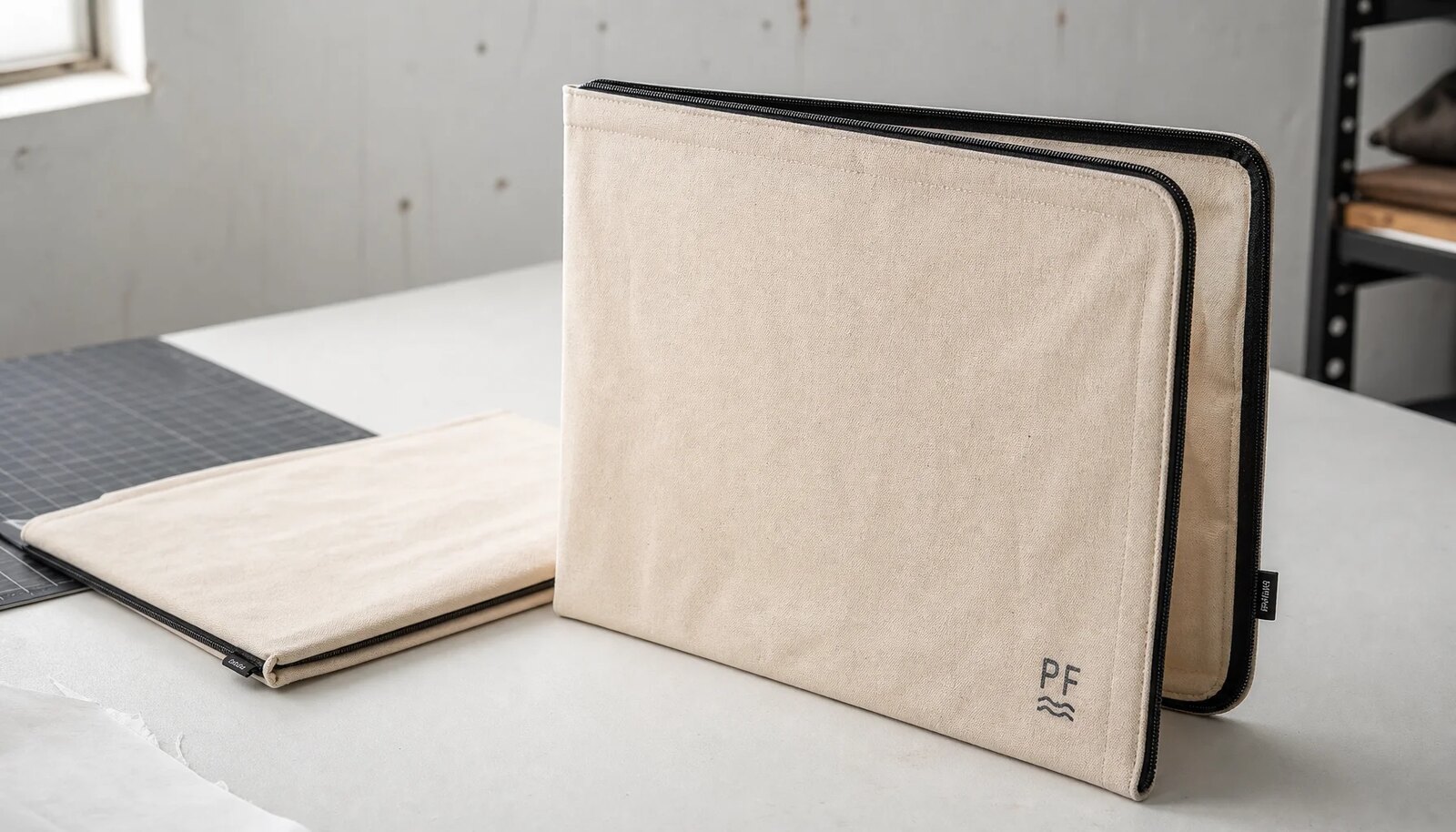
Define the Buying Problem Before Logo Placement
A canvas zipper portfolio for craft fairs is not the same product as a simple flat pouch. Buyers usually need it to hold catalogs, order forms, sample swatches, maker tool cards, retail paperwork, or giftable brand kits. The logo position must work when the item is lying flat on a table, stacked in a booth, or handed to a visitor. If the logo is placed only for a catalog photo, it may look wrong during actual fair use.
The main sourcing mistake is treating logo placement as an artwork detail instead of a construction detail. Zipper location, seam allowance, panel shrinkage, canvas thickness, and packing pressure all affect the final logo. Procurement teams should lock the use case, display method, and contents before asking factories to quote.
- For document use, specify A4 or US letter fit with clearance after sewing, not only outside dimensions.
- For craft kits, measure the thickest insert because zipper portfolios lose usable space near corners.
- For table display, choose a lower-front logo position that remains visible when portfolios are overlapped.
- For premium retail gifting, use smaller front branding plus a woven side label or inside label.
Choose Canvas Weight That Supports the Logo
Canvas weight controls both perceived value and print behavior. For zipper business bags and portfolios, 10-12 oz cotton canvas, roughly 280-340 GSM, is a practical middle range. It has enough body to hold shape on a craft fair table without making the portfolio too stiff around the zipper. Lighter 6-8 oz canvas can reduce cost, but it usually needs lining or reinforcement if the buyer expects a professional portfolio feel.
Heavier canvas is not automatically better. A 14-16 oz body can look premium, but it increases sewing difficulty, carton weight, and crease risk. Heavy fabric also makes corners bulkier, which can shift the front panel during sewing and move the logo slightly from the approved position. If the RFQ does not state both oz and GSM, quotes may not be comparable.
- Economy fair giveaway: 8-10 oz canvas, simple screen print, minimal internal structure.
- Standard branded portfolio: 10-12 oz canvas, reinforced zipper area, clean front logo.
- Premium retail item: 12 oz canvas with lining, inside pocket, woven label, and stronger puller.
- Avoid unspecified terms such as thick canvas, heavy cotton, or premium cloth without GSM.
Place the Logo Around Construction Limits
The safest logo zone is usually the lower front panel, centered horizontally and kept clear of the zipper seam, side seams, and bottom seam. For an A4 or letter-size canvas zipper portfolio, a logo width of 120-180 mm normally gives enough visibility without overwhelming the product. A practical placement is 55-75 mm above the bottom seam, but the exact distance depends on portfolio height and whether the product has a gusset.
Factories prefer to print cut panels before sewing because the surface is flat and registration is easier. This also creates a risk: once the panel is sewn, the final logo can shift if seam allowance, fabric stretching, or zipper attachment varies. For bulk control, the approved sample should include a placement measurement from fixed sewing points, not only a visual mockup.
- Keep artwork at least 25-35 mm away from seam lines on standard canvas portfolios.
- Do not place fine text directly beside zipper tape because sewing tension can create waviness.
- If the portfolio folds or bends in use, keep the logo away from the main fold pressure area.
- For side-label branding, confirm label width, fold type, and insertion seam before sampling.
Match Print Method to Artwork and Canvas Texture
Screen printing is the most stable choice for solid logos, limited colors, and repeat orders. It gives good opacity on natural, black, navy, and dyed canvas when ink and curing are controlled. For craft fair portfolios, screen print also gives a clean commercial look without adding the thickness of embroidery. Buyers should define Pantone references, print size, number of colors, and whether the print needs a base layer on dark fabric.
Heat transfer can handle gradients and small details, but it needs careful testing on coarse canvas. Some transfer films sit on top of the fabric and may crack or peel if the portfolio is flexed heavily. Embroidery works for small marks or patches but can pucker on a large unreinforced front panel. If embroidery is required, add backing or restrict the design to a compact area.
- Use screen print for one to three solid brand colors and repeat wholesale programs.
- Use transfer print for detailed artwork only after wash, rub, and bend checks on the exact canvas.
- Use woven label for subtle retail branding or when several logo versions make printing inefficient.
- Use embroidery only when the panel has enough structure and the stitch count is controlled.
Understand Cost Drivers Behind the Quote
The unit price is affected by more than fabric and logo. Canvas GSM, zipper grade, lining, inner pockets, print color count, screen setup, labor time, and packing format all change the cost. A low quote may use lighter canvas, cheaper zipper tape, no reinforcement, and loose packing. Those savings may not be visible until the buyer receives a flimsy sample or sees zipper complaints from craft fair vendors.
MOQ logic is especially important when the buyer needs multiple brand versions. A factory may quote an attractive price for 1000 pieces, but that may assume one canvas color, one logo, one print color, and one packing method. If the order is split into five logos or several distributor versions, setup charges and production handling can increase quickly.
- Main fabric cost: canvas GSM, dyeing method, wastage, and whether lining is included.
- Logo cost: screen count, ink color count, artwork size, curing time, and reject allowance.
- Sewing cost: zipper installation, corner finishing, pockets, binding, labels, and reinforcement.
- Packing cost: individual bags, paper bands, barcode labels, cartons, desiccants, and carton strength.
Build an RFQ That Produces Comparable Quotes
A good RFQ removes guesswork. Instead of writing canvas zipper portfolio with logo, provide a short technical sheet with finished size, canvas weight, zipper type, logo position, print method, packing, order split, and trade term. This allows factories to price the same product rather than filling in missing details with their own assumptions.
Procurement teams should request quote data in a format that supports landed-cost comparison. Unit price alone is not enough for craft fair distribution because portfolios can be bulky when packed flat. Ask for carton dimensions, pieces per carton, gross weight, and CBM. This helps compare FOB quotes and avoids surprise freight cost after approval.
- Include finished dimensions and acceptable tolerance, for example plus or minus 5 mm.
- State canvas color and whether color must match a Pantone, lab dip, or approved physical swatch.
- Attach vector artwork and mark the logo in millimeters from fixed seams.
- Request price breaks at practical tiers such as 500, 1000, 3000, and 5000 pieces.
- Separate optional upgrades such as lining, pocket, label, custom puller, or retail barcode.
Use Sampling to Prove the Risky Details
A blank sample proves shape and sewing, but it does not prove logo placement. For this product, the pre-production sample should use the final canvas weight, final zipper type, final logo method, and final packing format. If the factory cannot make a fully branded sample before bulk production, the buyer should at least approve a printed strike-off on bulk canvas plus a sewn sample using the same panel layout.
Sample approval should be written, not casual. The approval record should include photos of front, back, zipper, inside, label, print close-up, and packed unit. Measurement notes should record logo distance from bottom seam and side seam. This gives both sides a production reference when the inspection team checks the bulk order.
- Approve fabric hand feel, GSM, color shade, and panel stiffness.
- Approve logo size, ink opacity, edge sharpness, and final position after sewing.
- Approve zipper smoothness, puller finish, corner shape, and seam reinforcement.
- Approve packing pressure because folded or compressed packing can mark printed canvas.
- Reject samples with distorted logo alignment, zipper waviness, or obvious panel twisting.
Set QC Thresholds That Inspectors Can Use
Logo placement needs measurable tolerance. For standard screen printed canvas zipper portfolios, plus or minus 5 mm from the approved sample is a realistic target when panels are printed before sewing. Tighter tolerance may be possible, but it can slow production and raise rejects. If the logo is very close to a seam, tolerance becomes harder to control and more expensive to inspect.
Inspection should combine visual and functional checks. A portfolio can pass print appearance but fail in use if the zipper catches, the corner seam opens, or the canvas stains easily. Define critical, major, and minor defects before production. For craft fair buyers, visible logo defects and zipper failure should be treated as serious because they affect booth presentation and user experience immediately.
- Critical defects: broken zipper, wrong logo, wrong canvas color, unsafe metal burrs, mixed brand versions.
- Major defects: logo off tolerance, ink bleeding, severe stains, skipped stitches, open seams, warped shape.
- Minor defects: loose threads, small approved-range slubs, slight shade variation within accepted standard.
- Functional test: open and close zipper five cycles on sampled pieces and check corner resistance.
- Packing check: verify carton count, logo version separation, barcode labels, and moisture protection.
Control Packing for Craft Fair Distribution
Canvas zipper portfolios are often shipped flat, which protects shape and keeps receiving simple. However, flat packing can still damage the logo if cartons are overfilled or if zipper pullers press into the printed surface. For higher-value retail or distributor programs, use tissue, paper bands, or controlled stacking direction to prevent pressure marks.
Packing should match the buyer's downstream operation. If the portfolios are used for craft fair booth kits, carton quantities of 25-50 pieces are easier to handle than very heavy cartons. If retail buyers need barcode labels or color separation, the packing list must show logo version, fabric color, carton number, and quantity. Poor version control creates receiving disputes even when the product itself is acceptable.
- Use zipper closed position during packing to keep the portfolio shape consistent.
- Avoid folding directly across the printed logo unless the sample proves no crease remains.
- Place pullers away from printed faces or separate layers when pressure marks are likely.
- Confirm carton CBM and gross weight before freight booking.
- Use inner carton labels for mixed logo or mixed color programs.
Plan Lead Time Around Artwork and Material Locks
Lead time is not only sewing time. The real schedule starts when artwork, canvas color, zipper specification, sample comments, and packing are locked. For many canvas zipper portfolio programs, sampling may take one to two weeks depending on print method and material availability. Bulk production timing then depends on fabric stock, print queue, sewing capacity, inspection, and packing.
Schedule risk increases when buyers change logo placement after sample approval. Moving the logo may require new screens, new cut-panel instructions, or a new pre-production sample. If a craft fair date is fixed, the buyer should build a deadline backward from required warehouse arrival, not from factory dispatch. Ocean freight, customs, domestic distribution, and event kit assembly can take longer than production.
- Lock artwork before sample production to avoid repeated screen charges.
- Confirm fabric stock or dyeing time before promising a fair launch date.
- Allow time for sample shipping and comment review, not only sample making.
- Schedule final inspection before balance payment or shipment release.
- Leave buffer for carton relabeling or version sorting if distributors need special packing.
Specification comparison for buyers
| Spec decision | Recommended option | When it fits | Buyer risk to check |
|---|---|---|---|
| Front logo placement | Centered on lower front panel, 55-75 mm above bottom seam, clear of zipper pull path | Best for craft fair retail display where portfolios are stacked, hung, or presented on tables | Logo too close to seams may distort during stitching or disappear when the portfolio is filled |
| Canvas weight | 10-12 oz cotton canvas, roughly 280-340 GSM, with optional lining for premium programs | Suitable for document portfolios, maker kits, catalog packs, and branded craft fair merchandise | Very light canvas collapses on display; very heavy canvas raises freight and may crease around the zipper |
| Print method | Screen print for solid logos; heat transfer for gradients; embroidery only for small reinforced areas | Useful when brand color matching and repeatable logo size matter across wholesale batches | Embroidery on unreinforced front panels can pucker; transfer films may crack if the fabric is coarse |
| Logo size | 120-180 mm wide for A4/letter-size portfolios; smaller 60-90 mm mark for side-label branding | Balances retail visibility with a clean professional look for buyers who resell or gift the item | Oversized marks reduce perceived quality and increase print setup waste during positioning |
| Zipper specification | Nylon coil zipper with color-matched tape and metal or molded puller tested for smooth opening | Best for craft fair use because buyers open and close samples repeatedly at booths | Cheap zipper tape can wave after sewing; weak pullers fail before the canvas wears out |
| MOQ structure | Base MOQ by fabric color and print setup, with tiered pricing at 500, 1000, and 3000 pieces | Helps distributors compare landed cost instead of only unit price | Mixed logo versions below MOQ can create hidden screen charges and packing complexity |
| Packing format | Flat packed in polybag or paper band, 25-50 pieces per carton, zipper closed, logo protected | Works for warehouse receiving, craft fair kit assembly, and retail distributor shipment | Over-compressed cartons can create zipper impressions and permanent fold marks on printed panels |
| Sample approval | Pre-production sample with final logo size, zipper color, canvas GSM, and packing method confirmed | Needed before approving bulk production, especially for new logo position or new canvas color | Approving a blank sample only does not prove print alignment, ink opacity, or seam clearance |
Buyer checklist before sampling
- Define portfolio size by actual contents: A4, US letter, catalog pack, maker tools, or retail kit inserts.
- Specify canvas weight in oz and GSM, not only the word canvas, and note whether lining is required.
- Mark logo position with distance from zipper, bottom seam, side seam, and any gusset or fold line.
- Provide artwork in vector format with Pantone references, maximum print size, and logo version count.
- State zipper type, puller style, zipper tape color, and whether the zipper should match or contrast the canvas.
- Set acceptable logo placement tolerance, print color tolerance, stitching quality, and zipper function standard.
- Confirm MOQ by fabric color, print color, artwork version, and packing configuration before comparing quotes.
- Request a pre-production sample using bulk fabric, bulk zipper, final artwork, and final packing method.
- Define carton quantity, carton dimensions, gross weight target, barcode or label requirements, and anti-crease packing.
- Compare quotes using EXW, FOB, and estimated carton CBM so freight-heavy differences are visible.
Factory quote questions to send
- What canvas oz and GSM are included in the quote, and is the fabric pre-shrunk, washed, dyed, or natural greige cotton?
- What is the exact portfolio size after sewing, and what dimensional tolerance will be used for bulk inspection?
- Where will the logo be placed in millimeters from the bottom seam, side seams, zipper line, and any fold or gusset?
- Which print method is quoted, how many colors are included, and what additional screen, film, or setup charges apply?
- Can the factory print on the cut panel before sewing, or only after sewing, and how does that affect placement accuracy?
- What zipper material, zipper size, tape color, slider material, and puller shape are included in the unit price?
- What MOQ applies per canvas color, per logo version, per print color, and per packing style?
- What sample fee, sample lead time, bulk lead time, and approval deadline are assumed in the quotation?
- What carton packing, carton quantity, carton dimensions, and estimated gross weight are used for freight calculation?
- What inspection standard will be used for logo placement, print defects, zipper function, seam strength, and dirty marks?
Quality-control points to confirm
- Logo placement tolerance should normally be controlled within plus or minus 5 mm from approved sample position for standard screen print.
- Print surface should be smooth, with no obvious pinholes, ghosting, ink bleeding, misregistration, or fabric fibers trapped in wet ink.
- Zipper should open and close smoothly at least five full cycles during inspection without catching the seam allowance or printed panel.
- Finished portfolio size should stay within the agreed tolerance, commonly plus or minus 5-8 mm depending on size and canvas weight.
- Corner seams should be square, reinforced where needed, and free from skipped stitches, loose threads, or exposed raw edges.
- Canvas panels should be checked for stains, weaving slubs beyond approved limit, color shade variation, and press marks near the logo.
- Packed goods should not show heavy folding across the printed logo, zipper imprint marks, moisture, carton crushing, or mixed logo versions.