Start with the procurement risk
A canvas zipper portfolio can look almost too easy in a buyer deck. One rectangle, one zipper, one company logo, one event deadline. Then the sample arrives and the quiet details show up: zipper tape eats into the front panel, the puller rests where the logo was placed, a pocket stitch line runs under the print, or the canvas pulls slightly once the portfolio is filled and zipped. None of these issues is unusual. They are simply the difference between a flat mockup and a sewn product.
For procurement teams, logo placement is not a styling note left to the final proof. It changes supplier comparability, decoration cost, sample timing, inspection criteria, and the risk of brand rejection. If one factory quotes a large centered print on a clean front panel and another assumes a small lower-corner woven label, the two prices are not answering the same brief. If the purchase order says only "logo on front," any later argument about whether the mark is too high, too low, or too close to the zipper becomes subjective.
A useful canvas zipper portfolios logo placement guide for corporate gifting should turn visual preference into measurable instructions. Define the logo width and height. Name the decoration method. Measure placement from stable construction points such as the top seam, side seam, zipper tape, pocket stitch line, or bottom edge. Attach a placement diagram to the RFQ, approve a physical sample, and give the inspection team the same diagram. When the buyer, brand owner, supplier, and inspector all work from the same measurements, fewer decisions are made in a hurry at the end.
- Treat logo placement as a production specification, not a mockup comment.
- Ask for the usable front-panel area before comparing supplier prices.
- Use construction references such as seams, zipper tape, and pocket stitch lines instead of visual centering alone.
- Approve the decorated sample with the portfolio filled and zipped, because contents change how the front panel sits.
Define the portfolio before the logo
Logo placement depends first on the bag itself. A slim document pouch, a padded tablet portfolio, a gusseted organizer, and a structured meeting portfolio do not provide the same decoration surface. A flat A4 document portfolio may offer a broad, uninterrupted front panel. A gusseted style can pull the fabric toward the edges when it is filled. A portfolio with exterior slip pockets may look clean in photos but still have raised stitching under the logo area. Before asking where the mark should go, confirm the finished size, zipper path, gusset, corner shape, pocket layout, and front-panel construction.
Canvas weight should be written in GSM or ounces. For corporate gifting portfolios, 10 oz to 12 oz cotton canvas, roughly 340 to 400 GSM, is a common range when the buyer wants a practical mix of hand feel, printability, and moderate structure. Lighter canvas can reduce cost and shipping weight, but it may wrinkle more easily or show the outline of contents. Heavier canvas can feel more substantial, yet it may require stronger needles, adjusted seam construction, and more careful embroidery backing. Weight alone does not create a firm executive feel. If structure matters, specify lining, interlining, foam, nonwoven, board, or other reinforcement.
The intended contents belong in the product specification. A portfolio holding a few papers behaves differently from one carrying a notebook, pen, business card, tablet, welcome letter, and event badge. If the item will be handed out at a conference, it should still look organized when carried under one arm. If it will ship as part of an onboarding kit, it needs to arrive flat, clean, and ready to present. Contents affect zipper strain, front-panel tension, packing method, and the safe decoration zone.
- State closed size, open size if relevant, gusset depth, zipper path, and corner shape in millimeters.
- Specify canvas weight, lining, interlining, reinforcement, pocket layout, and desired hand feel in the RFQ.
- List the intended contents so the factory can test the filled shape and zipper performance.
- Define structure separately from canvas weight when the portfolio needs a firm presentation.
Map the usable logo area
The safest logo area is usually a flat, uninterrupted section of the front panel. It should sit away from zipper tape, binding, seam joins, curved corners, raised pocket stitching, reinforcement edges, and any place where the zipper puller rests during packing. Common placements include upper center, lower center, lower right, lower left, a sewn side label, or a patch on a clear section of the face. The best choice depends on the gift objective. A centered front logo reads quickly at an event. A small corner label or patch can feel more restrained for client meetings and office use.
Ask the supplier for a measured placement diagram before sampling. The diagram should show the finished front panel, actual safe logo box, zipper tape, seam allowance, pocket lines, gusset folds, curved corners, zipper puller parking position, and any internal reinforcement edge that may affect decoration. It should also separate the maximum decoration area from the recommended repeatable area. The maximum may be technically possible. The recommended area is usually the better basis for bulk production.
Clearance is where many mockups fail. As a practical starting point, keep direct print and heat transfer at least 10 to 15 mm away from zipper tape, binding, seam joins, and raised stitch lines unless a physical sample proves a closer placement works. Embroidery, woven labels, and patches may need more space because frames, presser feet, and sewing paths require working room. Fine taglines, thin rules, and small registered marks need extra caution on textured canvas. They may look sharp on screen and become soft or crowded on fabric.
- Request a front-panel diagram with a measured safe box, not only a rendered mockup.
- Record placement from fixed points, such as 60 mm below the top seam and 45 mm from the right seam.
- Show the zipper puller resting position so hardware does not cover, scratch, or dent the decoration.
- Avoid fine text near zipper curves, seam allowance, pocket stitching, and folds.
Choose the decoration method by artwork
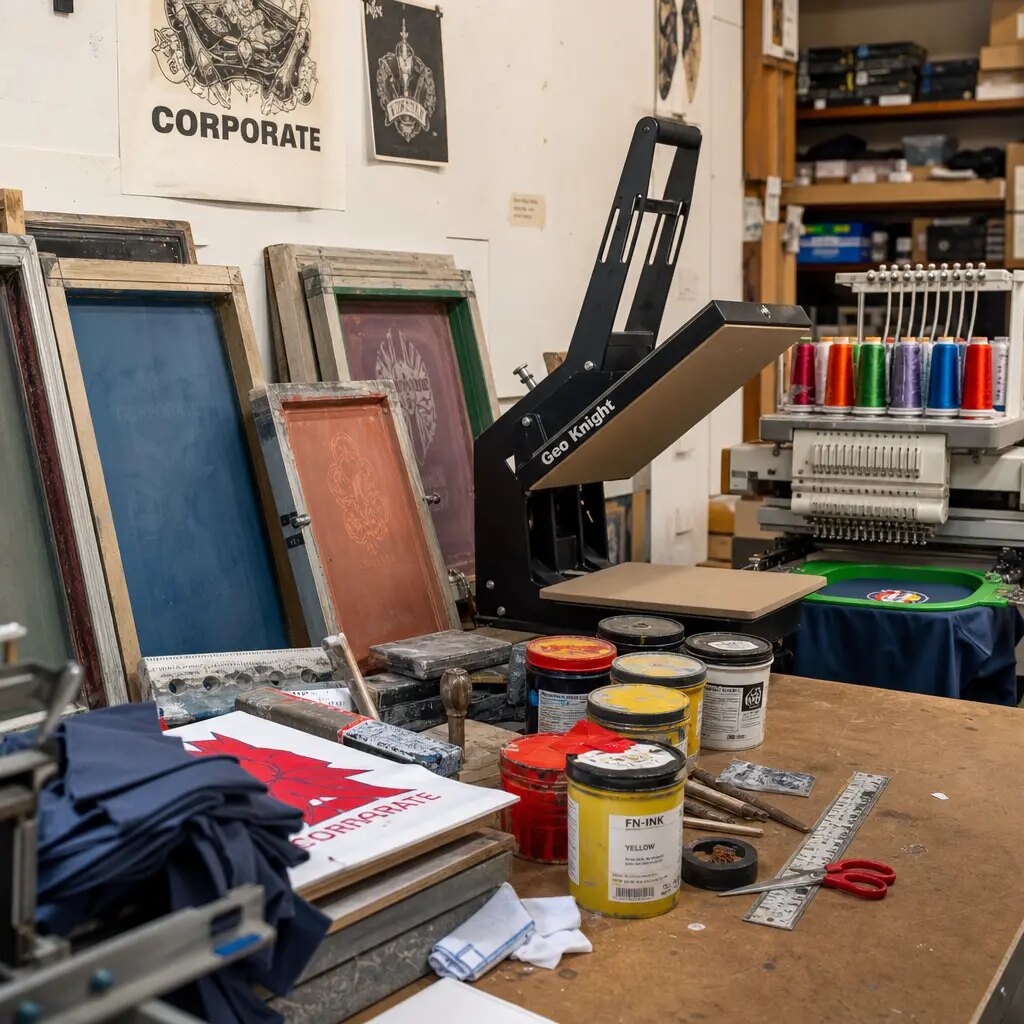
Decoration should be selected around the logo, the canvas, and the order size. Screen printing is often the most practical choice for one-color or two-color corporate marks on a flat canvas panel. It is usually clear, repeatable, and efficient at volume when the artwork has bold shapes. The important test is opacity on the exact canvas shade. White or light ink on black, navy, charcoal, or dark green canvas may need a base layer or adjusted ink system. Natural cotton canvas can also soften edges compared with a digital proof.
Embroidery adds texture and permanence, but it is not automatically better. It works best for simple marks, initials, and logos with limited fine detail. Dense stitching can pucker canvas, especially over panels with lining, pocket layers, or reinforcement underneath. Small letters and taglines may close up. Ask for a digitized stitch preview, then judge a physical sample on the selected canvas weight. Check the front face, reverse side, backing, thread tension, and whether the portfolio still lies flat after stitching.
Labels and patches are useful when the logo needs more control than direct decoration allows. A woven label can keep small detail readable and gives the portfolio a retail-style finish. A fabric patch lets the logo be made on a controlled component before it is sewn to the bag. A PU patch can create a higher-value trim package, but it adds approvals for material, thickness, odor, edge finish, deboss or print depth, color, and sewing alignment. Heat transfer can handle multicolor artwork, gradients, or sponsor graphics, but it should be tested for adhesion, cracking after flexing, visible film edge, gloss level, and abrasion on textured canvas.
- Use screen print for bold spot-color artwork and larger repeat programs.
- Use embroidery for simple logos where texture matters more than tiny detail.
- Use woven labels when the brand mark is small but still needs to read cleanly.
- Use fabric or PU patches when the design calls for a controlled trim component.
- Use heat transfer for multicolor artwork only after testing adhesion and flex on the selected canvas.
Write an RFQ suppliers can price
A request for "canvas portfolio with logo" leaves too many assumptions open. A quote-ready RFQ should include finished dimensions, canvas weight, body color, lining, reinforcement, zipper size, zipper tape color, slider finish, puller style, logo method, logo size, placement reference, order quantity, colorways, packaging, destination, incoterm, and target arrival date. If certain details are flexible, say so. A supplier may be able to use a standard zipper puller or stock lining, while the logo size, canvas shade, and in-hands date remain fixed.
Ask suppliers to separate cost lines where possible. Bag body cost, decoration cost, setup or screen charge, embroidery digitizing, woven label or patch tooling, sample fee, packing upgrade, carton labels, inspection, and freight assumptions should not disappear into one total. This makes comparison more useful. A lower unit price may exclude tissue wrap, protective sheets, insert cards, or gift boxes. Another quote may include custom patch tooling that only makes sense if the order is large enough or likely to repeat.
Artwork files should be production-ready before the sample clock starts. Vector AI, EPS, SVG, or vector PDF files are preferred for screen printing, embroidery digitizing, woven labels, and patch tooling. Pantone references are helpful, but ink, thread, PU, heat-transfer film, and woven yarn will not always look identical on canvas. If the brand guideline includes minimum size, clear space, or a simplified mark for small applications, include that information at RFQ stage rather than after the first sample.
- Ask every supplier to quote the same construction, logo method, and packing standard.
- Break out body, decoration, setup, sample, packing, and freight assumptions.
- Require suppliers to list substitutions, exclusions, and MOQ changes by logo method or colorway.
- Send approved vector artwork and state whether taglines or small marks may be simplified for production.
Approve samples with evidence
Sampling should move from drawing to proof. A digital placement diagram confirms the intended measurements. A sewn and decorated sample confirms how the canvas, zipper, lining, reinforcement, and logo method behave together. For a corporate gifting order, the sample should use the intended canvas shade, logo size, decoration process, zipper tape, slider, puller, sewing thread, lining, and basic packing. If a complete sample is not possible before order confirmation, the supplier should identify exactly which details are representative and which still need approval.
Review the sample the way the recipient will use it. Fill it with the intended papers, notebook, tablet sleeve, insert card, or kit components. Close the zipper. Lay it on a table, then hold it in hand. Check whether the logo appears straight, whether the zipper puller sits against the decoration, whether the front panel ripples, and whether the logo feels too close to a seam or pocket line. Open and close the zipper several times. Look at the logo from normal viewing distance, not only from close inspection range.
The approval record should be more precise than a photo with a thumbs-up. List the accepted finished size, logo width and height, placement measurements, canvas color, canvas weight, zipper and puller details, thread color, lining, label or patch details, packing method, and any corrections required before bulk. Write corrections in millimeters when possible, such as "move logo 8 mm left" or "lower patch 5 mm." The buyer should retain one approved sample, and the factory should keep one as the production reference.
- Approve the measured placement diagram before the decorated sample is made.
- Check the sample filled, zipped, handled, and packed.
- Use millimeter-based corrections instead of vague comments such as "slightly higher."
- Keep the approved sample for inspection, reorder matching, and internal brand review.
Set QC tolerances before bulk
Inspection standards should be written before production begins. For many small to medium front-panel prints, a +/-3 mm placement tolerance is practical. A small woven label or patch near a corner may need +/-2 mm to look intentional. A large logo on a soft canvas panel may require a tolerance that reflects fabric movement after cutting, sewing, and packing. The right number depends on construction and logo size. What matters most is that the buyer, supplier, and inspector agree on it before the first bulk pieces are decorated.
Each decoration method needs its own defect language. Screen print should be checked for opacity, edge sharpness, registration, pinholes, smudges, ghosting, lint, ink buildup, and color bleeding into the canvas texture. Heat transfer should be checked for lifting corners, cracking after panel flexing, adhesive marks, unapproved gloss, and visible film borders. Embroidery should be checked for puckering, thread breaks, loose ends, backing visibility, color, and distortion of the brand shape. Woven labels and patches need checks for alignment, flatness, stitch spacing, corner lift, edge finish, and readability.
QC should inspect the finished gift, not just the logo. A clean print on a portfolio with a rough zipper, skipped stitches, stained canvas, crushed front panel, or sharp puller still fails the recipient experience. Pull samples from multiple cartons and, if relevant, from every artwork version or colorway. Compare bulk pieces against the purchase order, approved sample, and placement diagram. Confirm packing lists, carton marks, destination splits, and quantities so the right logo version reaches the right team or event location.
- Use the purchase order, placement diagram, and approved sample as the inspection standard.
- Define major defects such as wrong artwork, wrong placement, unreadable logo, zipper failure, stains, and damaged packing.
- Inspect decoration, zipper, stitching, shape, trim, packing, and carton marks together.
- Pull samples across cartons, colorways, and department-specific artwork versions.
Control color and material variables
Canvas has a natural look, but procurement still needs controlled specifications. Body color can shift between dye lots, especially on cotton canvas, and the same logo color can look different depending on fabric texture and lighting. If color is brand-critical, ask for a lab dip or material swatch before sampling and define who has authority to approve it. For many corporate gift programs, visual matching to the approved sample may be enough. For stricter brand programs, use a written shade tolerance and keep the approved swatch with the sample set.
Decoration color changes by process. Screen print ink, embroidery thread, woven yarn, PU patch material, and heat-transfer film do not reproduce color in the same way. A Pantone reference is a target, not proof that every material will match perfectly on the finished bag. Approve each color in context: ink printed on the selected canvas, thread stitched through the panel, label sewn to the body, or PU patch attached beside the chosen zipper tape and trim. A patch approved alone on a desk may look different once placed on the finished portfolio.
Material finish can also change decoration performance. Waxed, coated, heavily washed, or water-repellent canvas may reduce ink adhesion or heat-transfer bonding. Loose-weave canvas can make thin print edges look fuzzy. Very dark canvas may show lint, scuffing, and weak light-ink opacity. Light natural canvas may show stains, needle marks, or color transfer from dark trims. These issues can be managed during development. They are much harder to solve after panels have already been printed, stitched, or packed.
- Approve canvas shade, logo color, zipper tape, sewing thread, lining, label, and patch as a complete set.
- Ask whether the canvas is washed, waxed, coated, or water-repellent before choosing decoration.
- Use physical strike-offs for brand-critical colors and high-contrast logos.
- Check light canvas for stains and color transfer; check dark canvas for lint, scuffing, and print opacity.
Specify packing for the gift moment
Corporate gift packing has two jobs: protect the portfolio and support the first impression. A plain individual polybag may be acceptable for budget internal programs. A client-facing gift may need tissue wrap, an insert card, a belly band, a kraft sleeve, a premium paper box, or a protective sheet over the decorated face. Match the packing to the distribution plan. Event handouts need quick unpacking and manageable waste. Direct-to-recipient shipments need stronger protection and a cleaner presentation after transit.
The decorated front face deserves its own packing check. Screen print can scuff against metal sliders, zipper pullers, rough carton walls, or another portfolio. PU patches can dent if cartons are over-compressed. Embroidery can collect lint if packing is loose or dusty. Ask the supplier to show the packed orientation: logo facing inward or outward, zipper puller position, fold direction if any, and whether a tissue or release sheet separates the decoration from hardware. For premium gifts, small packing changes can prevent visible marks on arrival.
Packing also affects landed cost and receiving accuracy. Confirm individual packing type, inner pack quantity, master carton quantity, carton dimensions, gross weight, barcode labels, carton marks, and destination splits before freight is compared. If the order includes multiple logo versions, departments, languages, or recipient groups, carton segregation should be planned before packing begins. Clear carton marks reduce errors at the event warehouse, corporate office, or fulfillment center.
- Specify polybag, tissue, insert card, belly band, sleeve, gift box, or other presentation materials.
- Protect the decorated face from zipper pullers, patch pressure, carton abrasion, moisture, and color transfer.
- Confirm carton dimensions and gross weight before comparing freight options.
- Use carton marks for artwork version, body color, quantity, department, destination, and PO number.
Protect schedule and landed cost
Lead time is often lost in components rather than sewing. Artwork revision, screen setup, embroidery digitizing, custom zipper pullers, woven labels, PU patch tooling, dyed canvas, lab dips, printed insert cards, and gift boxes can each add approval steps. A standard canvas portfolio with one-color screen print can move much faster than a fully custom trim package. Ask each supplier to identify the longest-lead component and the approval deadline that controls the schedule.
A practical timeline separates artwork approval, material swatch approval, strike-off, full decorated sample, buyer review, pre-production confirmation, bulk material purchase, decoration, sewing, packing, inspection, and shipping. Work backward from the required in-hands date, then add time for freight, customs, warehouse receiving, and any kit assembly. Once bulk decoration begins, changing logo placement may mean scrapping printed panels, remaking patches, or reopening a sample round. A clear freeze date protects the buyer as much as the factory.
Compare landed cost as gift-ready cost, not only ex-factory unit price. Include decoration setup, sample rounds, packaging, carton volume, freight, duties where applicable, inspection, warehousing, and fulfillment. A cheaper portfolio may need extra packing to avoid scuffs, or a low-cost decoration method may add delay if the artwork is too detailed for that process. The strongest commercial choice is the one that delivers the approved brand result on time, with inspection risk understood before the purchase order is issued.
- Ask suppliers to name the longest-lead material or process in the quote.
- Freeze artwork, placement, canvas color, trim, and packing before bulk production starts.
- Compare gift-ready landed cost, including setup, sampling, packing, freight, inspection, and fulfillment.
- For rush programs, use standard trims and the simplest decoration method that still meets the brand requirement.
Specification comparison for buyers
| Spec decision | Recommended option | When it fits | Buyer risk to check |
|---|---|---|---|
| Front panel screen print, 1 to 2 spot colors | Best balance of cost, legibility, and repeatability for simple corporate marks | Large corporate gifting runs, conference portfolios, onboarding kits, sales meeting gifts, and internal programs where the logo must read clearly at arm's length | Confirm ink opacity on the exact canvas color, keep artwork at least 15 mm from zipper tape and seams where possible, define placement tolerance such as +/-3 mm, and approve a physical strike-off or decorated sample |
| Woven label sewn at lower front corner or side seam | Best for restrained branding with durable retail-style presentation | Client gifts, finance and legal audiences, partner kits, minimalist brand programs, and portfolios intended for repeated office use | Check label size at actual scale; small woven letters can close up if yarn density is too coarse. Confirm sew line, label fold, fraying control, and +/-2 mm alignment tolerance |
| Embroidery on front panel | Best for tactile branding when the logo is simple and canvas is stable enough | Executive programs, department gifts, alumni programs, monograms, and low-color marks without fine taglines | Verify digitizing, stitch count, backing, thread color, needle size, and puckering. Avoid very small letters, dense fills near seams, and placement over pocket layers |
| Embroidery on a sewn fabric patch | Better than direct embroidery when the bag panel is uneven or too light | Medium to premium programs that want texture but need cleaner logo control than direct stitching on the finished panel | Check patch fabric, merrowed or turned edge, patch alignment, stitch spacing, and whether the patch edge lifts after flexing or packing compression |
| PU patch, debossed, printed, or stamped and sewn on | Best for structured executive gifts and a higher perceived value trim package | Brand-led programs where contrast, edge finish, and leather-like detail are part of the design direction | Confirm PU thickness, backing, deboss depth, colorfastness, odor, edge paint, sew margin, corner radius, and component lead time before committing to an event date |
| Heat-transfer print for multicolor artwork | Best for artwork that cannot be reduced to spot-color screen print | Short campaigns, full-color event marks, gradients, sponsor graphics, and low-to-mid quantity programs | Test adhesion on textured canvas, cracking after flexing, gloss level, abrasion, wash or rub resistance if relevant, and whether transfer film leaves a visible border |
| Small side label plus branded zipper puller | Best when the front face should remain clean | Premium client gifts, board meeting kits, minimalist corporate programs, and portfolios used in formal office settings | The branding may be too subtle for event visibility. Confirm puller mold or tooling cost, MOQ, plating color, sharp edge control, and puller lead time |
| Blank stock portfolio plus local decoration | Best for urgent domestic fulfillment when the existing bag construction is acceptable | Rush events, small batches, regional programs, or last-minute logo changes where freight time matters more than factory-level customization | Measure the actual flat decoration area on the stock item; local decorators may reject panels with seams, internal pockets, zipper interference, waxed finishes, or uneven canvas texture |
| Direct factory custom build | Best control over placement, trim, dimensions, carton packing, repeat orders, and QC documents | Brand-critical orders, larger quantities, recurring programs, or gifts that need custom canvas color, lining, zipper, puller, label, insert card, or carton marks | Ask for a pre-production sample with seam-to-logo measurements and retain it as the inspection standard. Confirm whether the same factory handles sewing and decoration |
Buyer checklist before sampling
- Confirm finished closed size, open size if relevant, gusset depth, zipper path, corner shape, handle or wrist strap if any, and whether the front panel has one continuous flat decoration zone.
- Define intended contents: A4 documents, US letter papers, notebook, tablet, pen, business card, welcome inserts, or multiple kit components. Test the sample filled and zipped.
- Specify canvas weight in GSM or oz, such as 10 oz to 12 oz cotton canvas or the required alternative, plus weave, color, shrinkage or colorfastness expectations, lining, interlining, and reinforcement.
- State whether the portfolio should feel soft, semi-structured, or firm. If structure matters, define foam, nonwoven, board, or fabric reinforcement rather than relying only on canvas weight.
- Provide production-ready artwork in AI, EPS, SVG, or vector PDF where possible, with Pantone references, minimum clear space, approved logo version, and whether small tagline text may be removed.
- Define logo method, finished logo width and height in millimeters, color count, thread or ink references, and placement measured from fixed construction points such as top seam, side seam, zipper tape, or pocket stitch line.
- Ask for a dimensioned placement diagram before sampling, including safe zones, seam allowance, zipper tape, puller parking position, pocket stitching, gusset fold, reinforcement edge, and any internal layer that affects decoration.
- Set practical no-decoration zones: commonly at least 10 to 15 mm from seam joins, zipper tape, binding, and raised pocket stitch lines unless a physical sample proves the placement is repeatable.
- Approve the physical decorated sample with the intended insert inside and zipper closed. Check it on a table, in hand, and from normal viewing distance, not only as an empty flat sample.
- Define logo QC tolerances before production: placement tolerance, color tolerance, print opacity, registration, embroidery puckering, label squareness, patch edge finish, and acceptable thread trimming.
Factory quote questions to send
- What finished size, open size, gusset, canvas weight, weave, lining, interlining, reinforcement, zipper size, zipper tape color, slider finish, and puller style are included in this quote?
- Is the portfolio made from stock material, dyed-to-order canvas, or custom-woven canvas, and what shade tolerance or lab dip process applies?
- What is the exact usable decoration area on the front panel in millimeters, and how far is it from zipper tape, side seams, top seam, bottom seam, pocket stitch lines, gusset folds, and curved corners?
- Will the logo be applied before panel sewing or after the portfolio is assembled, and how does that affect placement tolerance and available decoration area?
- Which decoration method are you quoting, what setup or tooling cost applies, what is the unit decoration charge, and what artwork format do you need for production?
- Can you provide a dimensioned placement diagram on the actual bag pattern before the decorated sample is made?
- Can you provide a strike-off on the same canvas color and texture before the full sample if the logo method is screen print, heat transfer, embroidery, woven label, or PU patch?
- What is the MOQ for this construction and for this logo method? Does a second body color, second logo colorway, or department-specific artwork change the MOQ or setup cost?
- What is the sample lead time after artwork approval, how many sample rounds are included, and what is the cost for extra revisions caused by buyer artwork changes versus factory production issues?
- What is the bulk lead time after written sample approval, and which component has the longest lead time: canvas dyeing, zipper, puller, woven label, patch, embroidery digitizing, printing, packaging, or carton labels?
Quality-control points to confirm
- Logo placement should stay within the approved tolerance. For many small to medium front-panel logos, +/-3 mm is practical; small labels or patches may need +/-2 mm, while larger soft panels may require a realistic agreed tolerance.
- Logo artwork should not cross zipper tape, seam joins, binding, raised pocket stitching, reinforcement edges, or curved corners unless the approved physical sample shows the result and the buyer accepts it as repeatable.
- Screen print edges should be sharp with no smudging, pinholes, ghosting, heavy ink buildup, poor opacity, misregistration, lint contamination, or color bleeding into the canvas texture.
- Screen print ink should pass the agreed rub or tape check if specified. Dark canvas with light ink should be checked for opacity under normal office lighting, not only under bright inspection lamps.
- Heat-transfer decoration should show clean edges, consistent adhesion, no lifting corners, no cracking when the panel flexes, no adhesive residue, and no unapproved glossy halo or film border.
- Embroidery should not pucker the front panel, distort the portfolio shape, expose backing through the fabric, create thread nests on the reverse side, or make small letters unreadable.
- Woven labels should sit flat with square alignment, even topstitching, no fraying, no twisted fold, no loose top or bobbin threads, and readable small text at actual size.
- PU or fabric patches should have even edge finish, consistent deboss or print depth, clean stitch spacing, no lifted corners, no surface scratches, and no color transfer onto light canvas.
- Canvas color, lining color, zipper tape, zipper slider, puller, sewing thread, patch, label, and print or thread color should match the approved sample or the written tolerance across inspected cartons.
- Zipper should open and close smoothly through repeated cycles with no snagging at corners, broken teeth, loose sliders, sharp puller edges, weak puller attachment, or misaligned zipper ends.