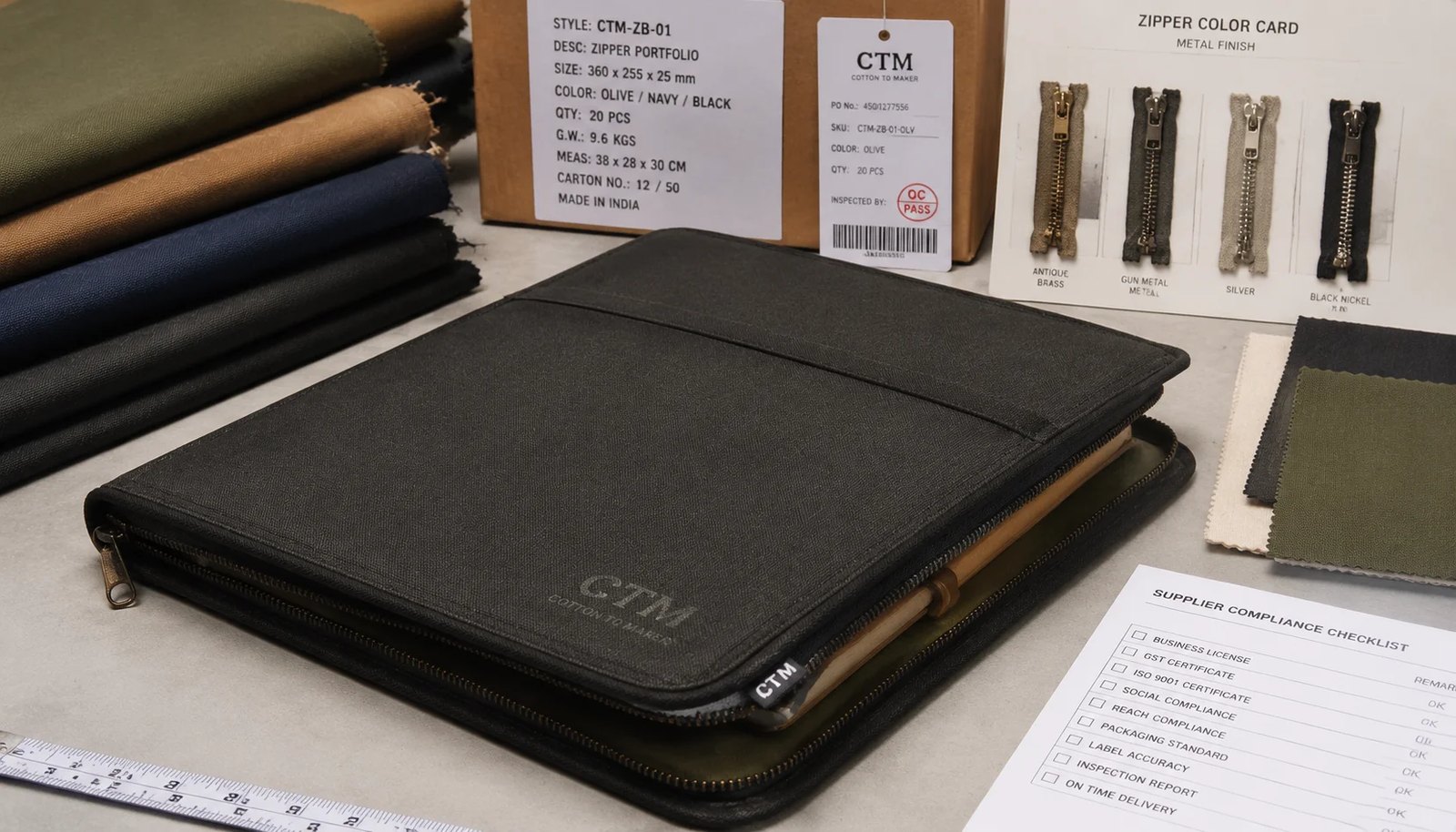
1. Start with the program use case, not the keyword or generic product label
Buyers rarely fail on this category because they forgot to ask for a zipper. They fail because the item name sounds simple while the use environment is not. A canvas zipper portfolio used by a liquor retailer might be an event folder for tasting notes, a district manager document case, a compliance reference folder for store visits, or an onboarding packet assembled by region. Those are materially different jobs, and they do not need the same construction, pocket layout, packing method, or supplier service level.
That is why the phrase canvas zipper portfolios for liquor retailers supplier compliance checklist should be read as a sourcing problem, not a naming exercise. The portfolio itself is usually a general soft good. The compliance burden comes from how it is labeled, packed, routed, documented, and used inside a liquor retail or distributor program.
In practice, buyers should separate two kinds of compliance from the beginning. First is legal or regulatory compliance that may apply to the product or materials in the destination market, such as country-of-origin marking, material disclosure where required, or buyer-required chemical restrictions. Second is operational compliance, meaning the retailer's own receiving, barcode, assortment, routing, artwork, and document-legibility rules. Many orders meet the first and still fail the second.
A useful sourcing brief therefore starts with business context. Who uses the portfolio, what must fit inside, how often it is opened, whether it travels store to store, whether it needs to survive repeated field use, and whether units must arrive pre-sorted for a chain or distributor. If you clarify that first, suppliers can quote the right construction instead of guessing around a broad bag category.
- Define user group: store managers, district managers, field sales teams, distributor reps, onboarding coordinators, or event staff.
- Define frequency: one-day event use, weekly field audits, monthly compliance visits, or daily carry.
- Define inserted contents with actual dimensions and thickness, not generic terms like documents or brochures.
- Define downstream flow: direct to office, direct to stores, through a distributor DC, or through a retailer regional warehouse.
2. Distinguish legal compliance from buyer-specific operational compliance
One weakness in many sourcing discussions is that compliance gets treated as if it only means carton labels and internal paperwork. That is incomplete. For B2B buyers, especially in liquor retail programs, it helps to divide requirements into legal compliance and operational compliance, then assign ownership for each.
Legal compliance is market-specific. For example, country-of-origin marking may be mandatory for imported goods into the United States. If the item is sold or distributed into the EU or UK, buyers may also have internal restricted-substance requirements or packaging-material expectations tied to their vendor manual, even when the product itself is not highly regulated. In Canada or Australia, bilingual or local-language operational labeling may also arise depending on buyer policy, not because the portfolio itself is a controlled beverage package. None of these should be assumed; they must be confirmed against the destination market and customer rules.
Operational compliance is usually where portfolio programs succeed or fail. Examples include a retailer requiring a GS1-compatible barcode format, a distributor requiring outer-carton labels on two adjacent sides, a regional rollout needing cartons sorted by banner or store cluster, or an onboarding program requiring each unit to include the same insert sequence. These rules are not government law, but they are commercially binding if they are written into the PO, routing guide, or vendor manual.
The sourcing implication is simple: ask the buyer team which requirements are legal, which are internal, and which belong to a logistics partner. Then write them separately into the RFQ and approval workflow. This prevents a supplier from claiming full compliance when they only mean they can sew the item and print a basic label.
- Ask for the customer vendor manual, not just a marketing brief.
- Identify which markings are legally required in the destination market and which are customer-specific.
- Confirm whether barcode standards, carton label formats, pallet labels, or packing hierarchies are mandatory.
- Assign ownership: buyer, supplier, freight forwarder, 3PL, or third-party inspector.
3. Choose the right product configuration before comparing suppliers
Procurement teams often jump too quickly to factory versus trader, local versus offshore, or low-cost versus full-service supplier. For this item, the better first comparison is product configuration. The main buying risk is usually that suppliers quote different constructions under the same item name, which makes commercial comparison misleading from the start.
The most relevant variables are structure level, zipper type, organizer complexity, and packing service level. A soft canvas folder with a nylon coil zipper can be perfectly adequate for one-time event use. A semi-structured version with interlining is often better for district managers or repeated field audits because papers insert more cleanly and the portfolio keeps shape over time. A board-supported version may improve presentation and document protection, but it increases carton volume, edge-crush risk, and transit sensitivity. Likewise, a metal zipper may look more premium, but a coil zipper is often more forgiving around corners and easier to run smoothly in daily use.
This is where the comparison table should serve the buyer: not by comparing supplier types, but by comparing product configurations with clear tradeoffs. Once the team selects the target configuration, suppliers can then be evaluated against that same BOM, the same packing assumptions, and the same QC checkpoints.
A practical outcome is that many liquor retail buyers end up choosing a middle path: semi-structured cotton canvas, nylon coil zipper, one or two internal sleeves, standard branding, and receiving-ready carton labels. That configuration is often commercially balanced because it supports repeat use without overbuilding the product.
- Decide structure first: soft, semi-structured, or board-supported.
- Decide zipper first by use case, not appearance alone.
- Add organizer features only if users actually need them; every internal division adds sewing variability.
- Treat retail-ready or route-sorted packing as a configuration choice with cost and lead-time impact.
4. Build a specification sheet that controls real cost drivers
A weak RFQ says canvas zipper portfolio with logo. A usable RFQ controls the variables that actually change cost, performance, and repeatability. For this category, the minimum specification should cover fabric, reinforcement, zipper, dimensions, interior architecture, branding method, labeling, and packing assumptions.
Fabric should be stated as composition plus weight and tolerance, such as 100 percent cotton canvas 12 oz or 400 GSM plus or minus 5 percent. If recycled content or a coated backing matters, say so explicitly. Structure should also be named clearly. Terms like sturdy or premium are too subjective for quotation. Instead specify whether the portfolio is unstructured, interlined, foam-backed, PE-sheet reinforced, cardboard supported, or board-supported, and where each reinforcement is used.
Dimensions must be functional. If the portfolio must hold US letter pages, A4 sheets, permit copies in sleeves, or a small tablet, specify insertion clearance and opening width. A unit may meet its outside dimensions and still fail in use because the pocket mouth is too tight or the zipper path narrows at the corners. Buyers should also define opening angle expectations if users must remove documents repeatedly while standing in stores or at events.
Branding and labels belong in the core spec, not in side emails. State the print or embroidery method, artwork size, placement reference points, and placement tolerance. If internal policy wording or responsible-service messaging appears on the unit, define readability criteria. On textured canvas, this is especially important because fine text can fill in or print unevenly.
Finally, include the assumptions that often cause quote drift: whether the sample should use bulk-intended materials, whether units need barcode labels applied, whether inserts are packed at origin, whether cartons are mixed or sorted, and whether carton labels must follow a retailer or distributor template.
- Attach a dimensioned drawing or marked sample photo.
- Specify material substitutions are not allowed without written approval.
- List all labels: sewn label, origin label, barcode label, carton label, pallet label if required.
- State whether quote should include stock materials only or custom-developed materials.
5. Use a commercial comparison matrix, not just a specification checklist
Many teams understand normalization in theory but still compare quotes in a way that hides cost and risk. A stronger method is to require a commercial comparison matrix that puts every supplier response into the same fields. This turns quote review from opinion into decision support.
For canvas zipper portfolios, the matrix should include at least: ex-works or FOB unit price, MOQ, sample charge, tooling or setup charge if any, lead time to sample, lead time to bulk, fabric specification quoted, zipper specification quoted, labeling cost, route-sorting or barcode application cost, packing cost, carton specification, testing cost, QC ownership, inspection stage commitment, and trade term. Without these columns, a lower unit price may simply mean that the supplier excluded stronger cartons, excluded route labels, used lighter fabric, or assumed no final inspection responsibility.
QC ownership is often missing from quote comparison and should be visible. Does the supplier price include in-line checks, final internal inspection, third-party inspection cooperation, and carton assortment verification? If defects appear, who pays for rework or relabeling before shipment? These are commercial terms, not only quality terms.
The same applies to lead time. Ask suppliers to define the start point. Is lead time measured from deposit, artwork approval, sample approval, or receipt of all label files? Different start points make quoted timelines look better than they really are.
When buyers review offers through this matrix, they can quickly identify whether they are comparing actual equivalents or simply comparing different assumptions.
- Add columns for MOQ, lead time start point, testing cost, and QC ownership.
- Separate one-time charges from recurring per-unit charges.
- Require suppliers to state exclusions in writing.
- Note whether quote assumes one shipment, one barcode, one print position, and one pack method.
6. Example of quote normalization with sample numbers and landed-cost logic
A concrete example makes this easier. Assume three suppliers quote the same target product: a semi-structured 12 oz cotton canvas zipper portfolio, closed size 260 x 350 mm, one inner sleeve, one pen loop, one-color front print, sewn origin label, barcode label on unit polybag, 20 units per carton, cartons sorted by region. Order quantity is 3,000 units.
Supplier A quotes FOB at 4.10 dollars per unit, MOQ 1,000, sample charge 120 dollars, no testing included, barcode label application included, but carton sort by region adds 0.12 dollars per unit. Supplier B quotes FOB at 3.92 dollars per unit, MOQ 3,000, sample free, but uses lighter 10 oz canvas unless upgraded by 0.18 dollars, barcode label application adds 0.05 dollars, and stronger export carton adds 0.07 dollars. Supplier C quotes ex-works at 3.75 dollars per unit, MOQ 2,000, but inspection support, carton sort, and label application are excluded, and inland transfer to port must be added by the buyer's forwarder.
Normalized correctly, the comparison changes. Supplier B is not truly cheaper if upgraded to the required 12 oz fabric and equivalent carton spec; its effective FOB becomes 4.22 dollars before any special handling. Supplier C may still be viable, but only after adding inland logistics, label application, and some allowance for extra coordination. Supplier A, despite the higher visible base price, may become the most stable option if the buyer values fewer moving parts and cleaner receiving.
Buyers should also add downstream handling logic. If a cheaper quote saves 0.10 dollars per unit but causes warehouse relabeling that costs 0.18 dollars per unit in labor and delay, it is not a cheaper program. The same reasoning applies to under-specified cartons that increase damage claims or to mixed-carton packing that creates receiving exceptions.
You do not need perfect landed-cost forecasting to improve decisions. You need enough line-item visibility to compare like with like and enough operational understanding to price the consequences of exclusions.
- Mock comparison fields: base unit, fabric upgrade, label application, route sorting, carton upgrade, testing, inland logistics.
- Normalize all quotes to the same fabric weight, zipper type, and packing method before ranking.
- Use receiving labor and relabeling cost as part of total program cost, not as someone else's problem.
- Record which assumptions remain provisional before issuing the PO.
7. Ask sharper supplier questions and review proof of capability
The best quote questions do more than collect promises. They test whether a supplier understands the category and can document its process. For a first order, you want evidence that the factory can control construction, labels, and packing under repeatable conditions.
Start by asking for a quotation against your exact BOM and pack spec, then ask the supplier to list any deviations. This is more effective than asking whether they can do it. On the construction side, request confirmation of stitch type, stitch density range on major seams, seam allowance, corner reinforcement method, binding tape specification if used, and zipper insertion method. These details matter because a portfolio that looks fine in photos may fail through seam distortion or snagging in the curved zipper path.
On the commercial side, ask whether the factory or a trading company owns final QC decisions, whether a third-party inspection is acceptable, what sample materials will be used, and which records can be supplied before shipment. Trim cards, fabric swatches, barcode proofs, carton label proofs, and first-piece sewing photos are more useful than generic capability brochures.
For repeat business, the question shifts from can you make it to can you repeat it. Ask how the supplier controls fabric lot shade, zipper lot consistency, print placement guides, and packing version control. A portfolio program often looks simple enough to reorder casually, but repeat inconsistencies usually come from these unmanaged details, not from dramatic factory failure.
Good supplier review also means checking what they do not answer directly. Vague responses on carton assortment, label placement, or in-process inspection usually signal risk in operational compliance, even when the sewing capability is acceptable.
- Ask for measurable construction standards, not general quality language.
- Require the supplier to identify deviations from your target spec in one list.
- Request proofs: trim card, barcode proof, carton mark mockup, first-piece photos, and PP sample.
- For repeat orders, ask what process data will be reused and what will be reapproved.
8. Use a staged sample and approval flow to protect bulk production
A first sample is not bulk approval. For canvas zipper portfolios, a staged approval flow reduces the most common sourcing mistakes: sample-room substitutions, artwork surprises on textured fabric, and late discovery of receiving-label errors.
A practical sequence is: artwork proof, material and trim card, sewn prototype, pre-production sample using bulk-intended materials, then shipping mark and packing proof. The prototype stage answers usability questions such as paper insertion, opening angle, pocket accessibility, and pen loop sizing. The pre-production sample answers repeatability questions such as actual fabric hand feel, print clarity on production fabric, zipper run around corners, and the exact labels and polybag layout that will appear in shipment.
This is especially important when the portfolio carries policy wording or internal compliance references. A flat digital proof may look readable, but on heavy canvas the text can lose edge definition or fill in around smaller letters. Likewise, a barcode that scans on a paper mockup may scan poorly if applied over a seam, textured print, or wrinkled polybag.
Approval records should be versioned. If the buyer approves a deviation, such as switching from a board support to lighter interlining or changing the zipper puller finish, that change should be tied to price, lead time, and inspection criteria. Otherwise, small approval shortcuts accumulate and become disputes at final inspection.
Photo approvals are useful, but for first orders they should not replace a physical pre-production sample. The cost of couriering one approved sample is minor compared with the cost of discovering a dimensional or packing failure after production is complete.
- Recommended flow: artwork proof, trim card, sewn prototype, PP sample, label proof, carton proof.
- Test with real inserted contents, not folded scrap paper.
- Version-control every approved change.
- Do not let sample-room substitute materials become accidental bulk standards.
9. Expand QC beyond zipper and dimensions: measurable construction and shipping checks
AQL is only a framework. The value comes from what you actually inspect. For this category, buyers should go beyond zipper movement and overall dimensions and define measurable construction checkpoints that matter in field use and transit.
Stitch density should be specified on main seams and binding areas where practical, because loose stitch density can cause seam opening while overly tight stitching can pucker canvas and distort the zipper path. Seam allowance should be sufficient and consistent, especially where the zipper tape joins curved corners. Stress points such as pocket tops, pen loop attachment, handle points if any, and zipper ends should be back-tacked or reinforced as approved.
Seam strength matters even on a simple folder, particularly if users insert heavier brochures or tablets. Buyers do not always need formal lab seam-strength testing, but they should define practical pass criteria such as no seam grin, no skipped stitches, and no opening under normal hand pull at key points. Hardware finish checks are also relevant when metal pullers, rivets, or snaps are used. Inspect for scratches, flaking plating, burrs, and sharp edges that can mark adjacent units or create handling risk.
Odor and moisture checks should be explicit. Canvas products stored or packed too soon after printing can carry excessive odor, and shipments exposed to humidity can arrive with mildew risk. Add no mold, no mildew odor, and dry packing condition to the final inspection brief. If the route or season raises moisture risk, require polybag sealing level, desiccant only if appropriate, and carton dry-condition checks before loading.
Transit readiness deserves more attention than it usually gets. For board-supported or structured portfolios, define carton stacking limits to avoid edge crush. Add simple carton drop and stack considerations to the packaging review, especially for export shipments. The buyer does not always need a formal ISTA program for a basic item, but should at least validate that cartons hold shape, labels remain readable, and unit presentation does not degrade under normal warehouse stacking.
A strong QC brief therefore covers the product, the unit pack, and the carton as one system. That is what matters in real procurement outcomes.
- Add stitch density, seam allowance consistency, and reinforcement-point checks.
- Inspect hardware finish for burrs, scratches, plating loss, and color inconsistency.
- Include odor, moisture, and mold checks in final inspection.
- Review carton stackability, edge-crush risk, and label durability in handling.
- Treat assortment accuracy and barcode readability as shipment-critical checkpoints.
10. Packing, routing, and receiving compliance often decide the real winner
Many programs that look successful at ex-factory stage fail at the warehouse. This is why packing and routing deserve the same discipline as construction. In liquor retail and distributor environments, the commercial problem is often not whether the portfolio is sewn correctly but whether it arrives in the right quantity, sorted the right way, with the right labels visible to receiving staff.
Start at the unit level. Decide whether each portfolio is packed in a polybag, tissue, paper band, or no individual pack. Consider whether the zipper puller can mark neighboring units, whether printed surfaces need facing protection, and whether inserts are loaded at origin. If a barcode is on the unit bag, specify orientation and scan-facing placement. If the customer wants no excess packaging, confirm what still protects the item from moisture and rubbing in transit.
At carton level, define units per carton, maximum gross weight, carton dimensions, board quality if needed, and exact label placement. For regional or store-specific rollouts, require a carton assortment map and sequence list. Mixed cartons are not automatically wrong, but they are often expensive at receiving if the warehouse was expecting single-SKU or single-region cartons.
It is also useful to distinguish domestic and import routing. Domestic shipments may be more sensitive to pallet labels, retailer routing guides, and appointment-ready carton identification. Import shipments place more weight on accurate packing lists, carton counts, dimensions, gross and net weights, and consistency between physical marks and shipping documents. Neither should be treated as a generic shipping requirement.
For first orders, ask for pre-shipment photos of unit packing, barcode placement, carton marks, and pallet build if relevant. These are low-cost controls with a high prevention value. They catch the problems that most often create chargebacks, receiving delays, and urgent relabeling after arrival.
- Define unit protection, barcode orientation, and whether inserts are packed at source.
- Set carton quantity, weight cap, label position, and region or store assortment logic.
- Differentiate domestic routing-guide compliance from import document accuracy.
- Request pre-shipment photos of cartons and labels on first orders.
Specification comparison for buyers
| Supplier option | What to verify | Commercial advantage | Buyer risk to control |
|---|---|---|---|
| Direct sewing factory | zipper source record, production-line zipper test photos, approved trim card, cutting marker photos, and final open-carton count | Better sample-to-bulk control and faster production feedback | May be weaker on export paperwork or branded packing unless checked early |
| Trading company | Factory name, production photos, trim-source proof, and who owns QC decisions | Can coordinate small mixed orders and extra services | Markup can hide real factory capability and slow defect decisions |
| Specialized bag workshop | zipper gauge, zipper tape width, puller finish, binding tape, corner reinforcement, seam allowance, and document-size tolerance | More practical for detailed construction, trims, and repeat programs | Capacity may be limited during peak seasons |
| Low-price general supplier | 300D-600D polyester, 10-12 oz canvas, or recycled PET with backing stiffness matched to document weight | Useful for simple promotional runs with loose specs | Material downgrades, weak packing, and vague inspection scope can erase savings |
| Retail-ready supplier | flat packing, insert board if needed, SKU bundles, carton weight limit, moisture protection, and barcode visibility | Can handle labels, SKU separation, carton marks, and receiving rules | Higher unit cost must be compared against reduced warehouse work |
| Compliance-focused supplier | Fabric records, labeling review, test plan, and production traceability | Safer for retail programs and repeat brand orders | Documentation claims need evidence, not only sales language |
| Local sample room plus bulk factory | Signed sample, bulk factory handoff, first-piece photos, and deviation owner | Good for complex branding before large production | Sample room quality may not match bulk line unless handoff is controlled |
Buyer checklist before sampling
- Define finished size closed and open in millimeters, including spine or gusset depth if any.
- List exact contents the portfolio must hold: permit copies, SOPs, tasting sheets, menus, brochures, tablets, pens, clipboards, or employee paperwork.
- State use frequency: event-only, onboarding, weekly field visits, or daily management use.
- Specify outer fabric composition and target weight, with tolerance, for example 100% cotton canvas 12 oz or 400 GSM ±5%.
- Specify structure requirement: soft, semi-structured, or board-supported, and identify reinforcement material if used.
- Name zipper construction in the RFQ: nylon coil or metal, size, tape color, teeth finish, slider type, puller style, and smooth-run priority.
- Define interior layout by dimension, not only by feature name: pocket widths, pocket depths, pen loop diameter, tablet sleeve clearance, and opening angle.
- Set branding method, artwork size, placement reference point, and placement tolerance in millimeters.
- If the portfolio carries policy or responsible-service wording, define minimum readable type size and approved artwork file format.
- Define unit labeling: country of origin, style code, customer item code, barcode type, and any required internal SKU or route label.
Factory quote questions to send
- What exact fabric are you quoting, including composition, weave, measured GSM or oz weight, backing, finish, and whether it is stock or custom-made?
- What structure is included in the price: no reinforcement, interlining, foam, PE sheet, cardboard, or rigid board, and where is it used?
- Which zipper are you quoting: nylon coil or metal, size, tape width, slider type, puller finish, and trim source?
- What interior components are included: lining, sleeve count, pocket count, card slots, pen loop, tablet holder, edge binding, and closure stop details?
- What measurable tolerances will you hold for finished size, pocket dimensions, logo placement, panel symmetry, and zipper alignment?
- What is your in-house zipper test method: cycle count, snag criteria, slider security check, and failure definition?
- Can you provide a pre-production sample made from bulk-intended fabric, zipper, print method, labels, and packing materials rather than sample-room substitutes?
- For a first order, what documents can you supply before production and before shipment: material sheet, artwork signoff, trim card, in-line QC report, final report, and carton packing list?
- For repeat orders, which documents remain standard and which can be abbreviated if specification, materials, and routing are unchanged?
- If shipping domestically, what packing and labeling can you support for distributor receiving? If shipping import, what export documents and carton data will you provide?
Quality-control points to confirm
- Use a written inspection plan with defect classification, AQL level, sample size code, and product-specific checkpoints agreed before bulk production.
- Typical baseline for soft goods final inspection can be Critical 0, Major 2.5, Minor 4.0 unless buyer policy requires a stricter plan.
- Sample size should follow the agreed AQL table by shipment quantity; the PO or inspection brief should state the lot size used for selection.
- Critical defects should include wrong item, missing required compliance text, wrong barcode or route label, missing country-of-origin mark where required, mold, broken zipper, sharp exposed hardware, and carton assortment errors that can misroute inventory.
- Major defects should include out-of-tolerance size, unreadable printed policy text, major logo misplacement, zipper snagging or derailment, severe shade mismatch within one unit, missing internal pockets, wrong material, or incorrect carton mark format.
- Minor defects should include loose thread ends within agreed limit, slight natural-canvas slub variation within approved standard, light non-visible print inconsistency, or small cosmetic marks not affecting use or presentation.
- Fabric weight should meet the approved specification tolerance, for example ±5% GSM, verified by supplier record or random test.
- Fabric shade should match the approved standard under agreed lighting, with no obvious panel mismatch and no unauthorized dye-lot mixing within one shipment.
- Natural canvas programs should define acceptable slubs, neps, and slight tone variation so inspectors do not confuse normal fabric character with rejectable stains or oil marks.
- Finished size should meet approved tolerance, for example ±5 mm overall and ±3 mm on pocket openings or insert-critical dimensions.