Plan to the liquor retail calendar, not just the factory calendar
Canvas zipper portfolios for liquor retailers are usually tied to a date that cannot slide much: holiday gift sets, supplier education cycles, chain reset periods, spring and summer tasting programs, new account onboarding, or a staggered state rollout coordinated with distributors. That makes lead-time planning more than a sourcing exercise. The item may be simple, but the launch context is not. A portfolio arriving one week late can miss sales meetings, distributor pickup windows, or store training sessions that were booked months earlier.
This is where many RFQs drift into generic bag-buying language. The useful question is not only, "How many days is production?" The better question is, "What date do stores, distributors, or field teams actually need inventory in hand, and what approvals happen before goods can ship?" In liquor retail, operational timing often depends on who receives the goods first. A central chain DC, a state distributor, and a field-marketing agency all create different packing and labeling demands.
If your program rolls out across multiple states, add time for state-by-state allocation, internal approval chains, and distributor routing instructions. Even when the product itself is non-regulated, the campaign materials inside it may differ by market. A portfolio carrying tasting cards, pricing sheets, or local promotional inserts may need separate assortments, which affects packing speed and final inspection complexity.
- Anchor the schedule to in-warehouse or in-distributor date, not ex-factory date.
- Separate national chain timing from state or distributor timing.
- Treat holiday, year-end, and pre-summer promo windows as high-risk freight periods.
- If inserts differ by state or distributor, plan SKU separation before bulk production starts.
What specifications move fastest, and which ones slow the order down
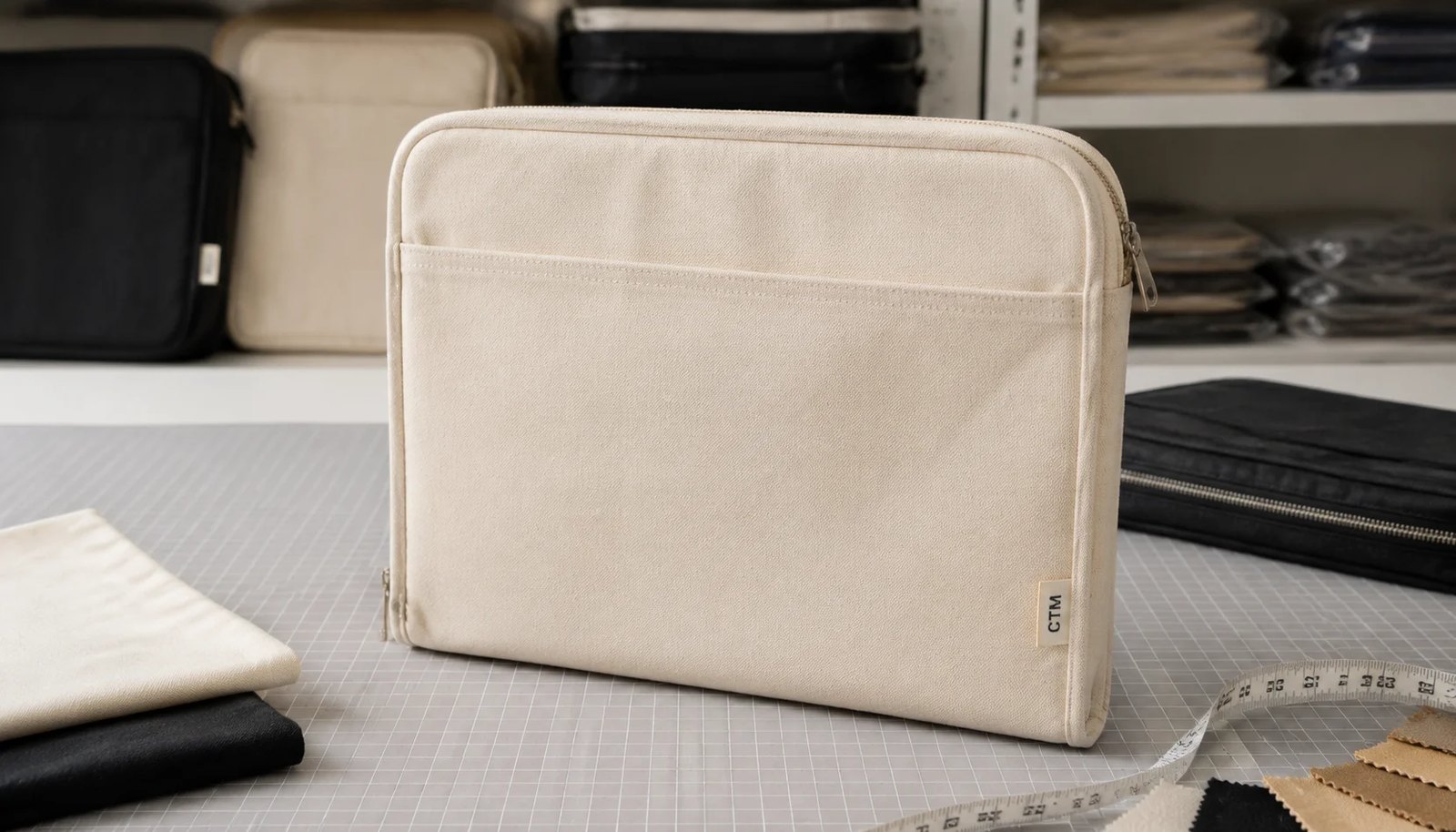
For most liquor retailer programs, the quickest path is a standard-size canvas zipper portfolio with stock natural or black canvas, one exterior logo, a size 5 nylon coil zipper, and simple carton packing. This type of build usually avoids custom dyeing, specialized hardware, and heavy post-sewing packout. Once you add custom brand-color canvas, padded structure, multiple document sleeves, or custom pullers, you are no longer buying a basic promo organizer. You are buying a more complex sewn case with more sourcing points.
A practical body fabric range is 10 oz to 12 oz canvas, roughly 340 to 400 GSM. That range gives enough structure for tasting notes, product sheets, training packets, and account forms without making the portfolio too stiff or freight-inefficient. Lighter canvas can slump or print inconsistently. Heavier canvas can make corners thick, slow down zipper construction, and increase carton cube.
Liquor retail buyers should also think about storage and use conditions. If portfolios will sit in backrooms, travel in rep vehicles, or move between tastings and store visits, a standard nylon coil zipper is often the safest commercial choice. Metal zippers may look premium but can add cost, weight, and occasional corrosion concerns if low-grade plating is used. The feature should match the use case, not just the lookbook.
- Fastest commercial spec: stock canvas, 1 print location, standard coil zipper, bulk carton packing.
- Moderate complexity: stock canvas plus inner sleeve, woven label, or 2-3 color screen print.
- Slower spec: custom dyed fabric, custom hardware, reinforced padding, or destination-specific packouts.
- Use actual insert load to decide structure; many portfolios need light reinforcement, not full padding.
Lead-time ranges by scenario buyers can actually use
Vague timing phrases create planning mistakes. Buyers need scenario-based ranges. After final approvals, a straightforward order in stock natural or black canvas with one-color screen print and simple packing often runs about 18 to 25 calendar days ex-factory. If the same item moves to two- or three-color screen printing, includes a woven label, or adds a simple internal sleeve, a more realistic range is 22 to 30 days.
Once custom dyed canvas is involved, the schedule commonly shifts to about 30 to 40 calendar days because lab dips, shade approval, and dye-lot handling come before bulk cutting. If the project also includes retail-ready unit packs, insert boards, barcodes, and mixed assortments by destination, 26 to 35 days is common even on stock fabric because the back end becomes labor-heavy. A premium build with custom pullers, multiple compartments, or more rigid structure can move into the 35 to 50 day range.
These ranges should be treated as production timing after approvals, not total project timing. Add buyer-controlled time for artwork confirmation, sample review, revision loops, and internal signoff. Add logistics time after ex-factory for inspection booking, trucking, port handling, customs, and final delivery. For liquor retail launches, that post-production stretch often matters more than shaving two days off sewing.
- 18-25 days: stock canvas, 1-color print, simple packing.
- 22-30 days: stock canvas with more print colors, label work, or simple inner organization.
- 26-35 days: stock canvas plus retail-ready packout, barcode labels, insert boards, or mixed assortments.
- 30-40 days: custom dyed canvas with standard construction.
- 35-50 days: custom hardware, padded structure, or multiple internal features.
Distributor, chain, and state rollout constraints that change the RFQ
A liquor retailer order may look like one PO, but operations often split across different receivers. One chain may want all goods delivered to a central DC. Another may require state-level allocation through local distributors. A supplier education program may go to a field-marketing agency for final insertion and re-routing. Each path changes how you should brief the factory.
For example, if a national spirits brand wants the same canvas zipper portfolio body with different front logos for separate distributor groups, that can still be efficient if body material, zipper, and dimensions stay unchanged. But if each group also requires distinct barcode labels, different inserted documents, and different carton marks, your packing complexity rises quickly. The production line may still sew efficiently, yet final sorting and packing become the bottleneck.
This is why buyers should define commercial variants carefully. Ask whether the order is changing by body spec, by branding only, or by final route pack. Factories can often handle multiple print versions better than they can handle multiple last-minute packing versions. In practical terms, keep the sewn product common where possible and move route-specific changes to labels or inserts only if the packing team can manage them cleanly.
- Separate body-spec changes from branding changes and from routing-label changes.
- Use one common construction across regions if speed matters.
- Avoid late addition of state-specific labels after bulk packing has started.
- If cartons are split by distributor, require carton assortment sheets before production release.
Sample approval should prove fit for liquor retail use, not just appearance
A digital proof approves artwork content and location. It does not prove that the portfolio closes cleanly around a stack of tasting sheets, a training booklet, or a branded price card set. A prototype on substitute material can also mislead the buyer, especially if canvas weight, zipper stiffness, or print opacity differ from bulk intent. For a real planning process, use at least two approval gates: artwork proof first, then a pre-production sample made from intended materials.
The PP sample should be tested in the exact operating context. If the item is for account managers or distributor reps, load it with the actual documents it must carry. If it is for holiday gifting support, check whether retail inserts shift or bow the panel. If the program includes state-specific content, test the thickest insert stack, not only the base version. A portfolio that looks neat when empty may distort once filled.
Approvals should be written and consolidated. One of the most common avoidable delays is scattered comments from brand, procurement, sales, and logistics teams. The factory receives mixed feedback, waits for clarification, and the lead-time clock effectively resets. A single approval file with dated comments, revised artwork, and approved packing notes reduces that risk.
- Use digital proof for graphics only; use PP sample for function and construction.
- Test real document fit, especially if insert thickness varies by market.
- Approve the thickest expected insert set, not the lightest one.
- Consolidate comments into one file and one signoff authority before bulk release.
Packing and labeling usually decide whether a smooth order turns messy
Many canvas zipper portfolio orders do not fail in sewing. They fail in finishing. Unit polybags, insert cards, tissue, barcode labels, compliance labels, assortment stickers, and destination-specific carton marks all consume time after the product itself is made. For a distributor DC shipment, simple bulk packing in standard carton counts is usually the fastest and cheapest route. For direct chain programs or gift-ready launches, retail-ready packing can add several days of labor and more inspection points.
Liquor retail also brings routing realities. A national chain may require barcode placement rules, carton labels, or appointment-friendly assortment counts. A distributor may want cartons separated by territory or sales team. If this is not specified early, the factory may pack efficiently for itself but not for your receiving process. Repacking after inspection is one of the fastest ways to lose schedule and create count errors.
Ask for carton dimensions and gross weights during quotation, not after order confirmation. Portfolios with insert boards or stiffer internal supports can increase cube materially. That matters if you later need to split part of the order to air freight. A packout that looked harmless from a unit-cost perspective can become expensive once freight pressure enters the picture.
- Fastest route: bulk carton packing with clear carton marks.
- Slower route: unit polybag, barcode labeling, inserts, and mixed destination assortments.
- Require destination-mark templates before bulk packing starts.
- Request carton cube and weight by pack method during RFQ stage.
How to compare supplier quotes beyond unit price
A useful quote comparison sheet for canvas zipper portfolios should combine product spec, commercial terms, and schedule assumptions in one matrix. Unit price alone hides too much. Two factories can both quote a similar price while one includes 12 oz canvas, woven label, and PP sample deduction, and the other quotes 10 oz canvas with separate sample charge and plain bulk packing. Those are not equivalent offers.
Lead time should be decomposed as well. Ask each supplier for separate timing on artwork proof, PP sample, fabric readiness, printing, sewing, packing, and inspection readiness. Also ask when the lead-time count officially starts. Some factories count from deposit date. Others count from final approval of all artwork and packing files. The distinction matters, especially when your internal stakeholders are slow to approve branding changes.
Commercial practicality matters for liquor retail buyers. If one supplier is slightly cheaper FOB but cannot cleanly manage multiple logo versions or route-separated cartons, the lower price may disappear in admin time, relabeling cost, or missed launch windows. Reliability in variant control is often worth more than a small nominal saving.
- Normalize all quotes to the same GSM, zipper grade, print size, and packing basis.
- Force suppliers to split timing by stage instead of giving one headline number.
- Compare MOQ by artwork version and by packing variation, not just total quantity.
- Check quote validity and whether cotton, dye, or freight volatility triggers repricing.
Build a realistic calendar backward from launch date
The best planning habit is backward scheduling. Start with the date the goods must be available for a store set, distributor handoff, or field training event. Then subtract receiving time, customs or inland handling, freight transit, inspection booking, production, sample approval, and artwork finalization. Only after that should you decide whether the target is realistic.
For many standard orders, the buyer-controlled portion consumes more time than expected. Internal logo approval may take three to five days. PP sample review and comment consolidation can take another three to seven days, especially if several teams are involved. Production then runs in the ranges already discussed. Post-production logistics can easily absorb one to three weeks depending on shipping mode and destination. The result is that a seemingly simple promo item can require six to ten weeks of total planning lead time, even if ex-factory production itself is under a month.
Seasonality should be built into the calendar. Holiday launches, pre-summer selling pushes, and year-end budget-spend programs often collide with freight congestion. If your date is fixed, create a buffer before the campaign launch rather than consuming every day available up to the deadline.
- Create one calendar with owner names for each approval step.
- Use latest-safe approval dates, not only target production dates.
- Add explicit buffer before campaign launch for warehouse intake and distribution.
- Flag holiday and peak-shipping periods early.
QC should include AQL, in-line checks, and carton-condition controls
Quality control on canvas zipper portfolios should not wait until cartons are sealed. A final random inspection is useful, but it is less efficient than catching errors while printing and sewing are underway. The most practical setup is an in-line printing check, an in-line sewing check, and a final random inspection against an agreed AQL.
For many promotional textile items, buyers use an AQL reference such as Major 2.5 and Minor 4.0, with critical defects at zero acceptance. The exact plan can vary by buyer policy, but the important part is agreeing the logic before production begins. Wrong logos, wrong state-routing labels, and missing key components should be treated as critical or major depending on your internal standard because they make goods commercially unusable even if the sewing looks fine. Loose trimable threads, by contrast, are usually minor unless they indicate seam insecurity.
Inspection should also look beyond the product itself. Carton count accuracy, carton sealing, drop resistance for normal handling, and moisture protection matter if the order moves through humid ports or multiple domestic handoffs. A clean portfolio inside a weak or damp carton can still fail the program. For chain and distributor deliveries, carton-mark accuracy is often as important as product appearance.
- Use in-line print checks before full panel runs proceed.
- Check first-off sewn units against approved sample before mass sewing.
- Apply agreed defect classes and AQL at final random inspection.
- Inspect cartons for count, label accuracy, sealing, basic drop handling, and moisture condition.
Freight, Incoterms, and cost tradeoffs buyers should model early
Canvas zipper portfolios are usually suitable for sea freight when the program is planned well. The complication comes when approvals slip and part of the order must move urgently. Since portfolios are relatively light but can become bulky when stiffeners or elaborate unit packs are added, the freight problem often becomes volumetric rather than weight-based. That is why packout decisions belong in early commercial discussions, not only in the final PO notes.
At quote stage, many buyers benefit from seeing at least an EXW and FOB comparison, plus a rough carton-level basis for sea and urgent air planning. You do not need exact freight rates from the factory to make better decisions; you need carton dimensions, approximate gross weights, and honest packing assumptions. That data lets your logistics team model whether a partial urgent batch is commercially tolerable if launch timing compresses.
A split-shipment strategy can work for liquor retail launches, but only if SKU control is already disciplined. If a small priority batch needs to move first, the factory must know which logo versions, which labels, and which destinations are included. Otherwise the split creates more confusion than protection.
- Ask for EXW and FOB if you want a cleaner logistics comparison.
- Request carton dimensions and gross weights with every quote revision.
- Model a small urgent batch before approving bulky retail-ready packaging.
- Only use split shipment if SKU and destination labeling are already locked.
Specification comparison for buyers
| Commercial scenario | Typical ex-factory lead time after approvals | Best fit for liquor retail use | Cost/operational tradeoff | Buyer checks before PO |
|---|---|---|---|---|
| Stock natural or black canvas, 1-color screen print, standard polybag or bulk carton | 18-25 calendar days | Fast distributor meetings, staff training kits, basic brand programs | Lowest risk and usually best cost; limited color differentiation | Confirm canvas is truly in stock, print size included, and lead time starts after PP sample approval |
| Stock canvas, 2-3 color screen print, woven label, simple inner sleeve | 22-30 calendar days | Regional chain rollouts needing a more finished presentation | Moderate cost increase; extra print setup and sewing steps | Check print registration tolerance, pocket dimensions, and whether label run delays sewing |
| Custom dyed canvas, 1-color print, standard zipper, carton packing | 30-40 calendar days | Programs requiring strict brand color matching across multiple banners or banners-by-state | Higher schedule risk from dyeing and shade approval; MOQ pressure may rise | Ask for lab dip timing, shade approval process, and whether bulk starts only after color signoff |
| Stock canvas, photo-heavy heat transfer, insert board, barcode labels, retail-ready unit pack | 26-35 calendar days | Gift-with-purchase packs, holiday promo kits, shelf-backroom presentation needs | Higher finishing labor and more post-sewing bottlenecks | Check transfer adhesion, barcode content approval, and carton cube impact |
| Multi-SKU order with same body but different distributor or chain logos | 24-32 calendar days | Regional distributor groups under one national launch | Can save MOQ if body spec is shared; planning becomes artwork-control heavy | Verify MOQ per artwork version, packing separation, and master carton assortment logic |
| Custom hardware or custom zipper puller, multiple pockets, padded structure | 35-50 calendar days | Premium account gifting or durable field-sales organizer use | Higher unit cost, more sourcing points, slower sewing, larger cube | Confirm hardware sample timing, corrosion expectations, and whether replacement trims are buffered |
| Sea-first plan with small air contingency batch | Production unchanged; freight split planned in advance | Holiday launches and state rollouts where a missed date is expensive | More planning work upfront but better schedule recovery options | Request carton cube, split-shipment labeling rules, and priority SKU list before production |
Buyer checklist before sampling
- Define the use case by channel: store staff kit, distributor sales folder, tasting-event handout, supplier education pack, or gift-with-purchase support item.
- Map the rollout structure: national launch, region-by-region rollout, or state-by-state release driven by local distributor timing and compliance review.
- Lock finished size to actual contents such as price sheets, tasting notes, menu cards, training forms, or clip-in POS documents.
- Specify canvas weight in GSM or oz, color standard, and whether natural, dyed, recycled, or conventional cotton is required.
- State zipper specification clearly: nylon coil size, tape color, puller finish, and whether anti-rust expectation matters for humid backroom storage.
- List all branding points: front print, inside message, side label, hangtag, barcode label, carton mark, and any distributor-specific sticker.
- Clarify variant logic in the RFQ: quantity per colorway, per logo version, per state group, and per destination DC or wholesaler.
- Set sample stages in writing: artwork proof, pre-production sample, and if needed a sealed production reference sample before bulk output.
- Confirm packing route early: bulk pack to distributor DC, retail-ready unit pack, mixed-store assortments, or state-separated cartons.
- Issue measurable QC tolerances for size, print placement, zipper function, document fit, label placement, shade tolerance, and carton integrity.
Factory quote questions to send
- What exact canvas weight are you quoting in GSM and oz, and is it stock fabric, greige fabric to be printed, or custom dyed fabric?
- What is your standard ex-factory lead time for each of these scenarios: stock canvas with 1-color print, stock canvas with 3-color print, and custom dyed canvas?
- How many calendar days do you need separately for artwork proof, pre-production sample, fabric booking, printing, sewing, packing, and inspection readiness?
- When does the lead-time clock start: deposit received, artwork approved, PP sample approved, or all packing files confirmed?
- What is the MOQ by body color, by logo version, by packing variation, and by shipment split if we serve several distributor groups?
- Can you quote FOB and EXW, and if possible provide a carton-based estimate that helps us model sea versus urgent air on part of the order?
- What print size and number of colors are included in the quoted price, and what triggers extra setup charges or extra production days?
- Will the PP sample use the same canvas, zipper, puller, label, and packing materials as bulk, with no substitutions?
- What are your standard finished-size, print-position, and shade tolerances, and do you accept buyer-issued tolerances on the PO?
- Do you perform in-line inspection during printing and sewing, and who signs off first-article panels before full bulk runs?
Quality-control points to confirm
- Use an agreed inspection plan with both in-line and final checks rather than relying only on a finished-goods spot check.
- Set an AQL before production. A common reference for promotional textile goods is Major 2.5 and Minor 4.0, with critical defects at zero acceptance if safety, branding, or routing errors make goods unusable.
- Split inspection stages clearly: printing in-line approval, sewing in-line checks, packing verification, and final random inspection after at least 80 percent of goods are packed.
- Check canvas weight against quoted specification with normal mill tolerance and compare bulk handfeel to the approved PP sample.
- Review fabric shade under consistent lighting against approved standard, especially for black, navy, deep green, or custom brand colors where lot variation shows quickly.
- Measure finished width and height to PO tolerance, for example plus or minus 0.5 cm for standard portfolio sizes unless another tolerance is agreed.
- Test zipper operation repeatedly for smooth run, no bite, no skipped coil, no wave, and clean tape-end finishing.
- Measure print placement from fixed seam or zipper references, not from raw cut edges, and verify opacity and edge clarity against approval sample.
- Check stitch density, seam security, and back-tacking at zipper ends, corners, pocket joins, and any carry points or stress points.
- Inspect binding or turned edges for raw-edge exposure, foam leakage, corner bulk, and visible puckering.