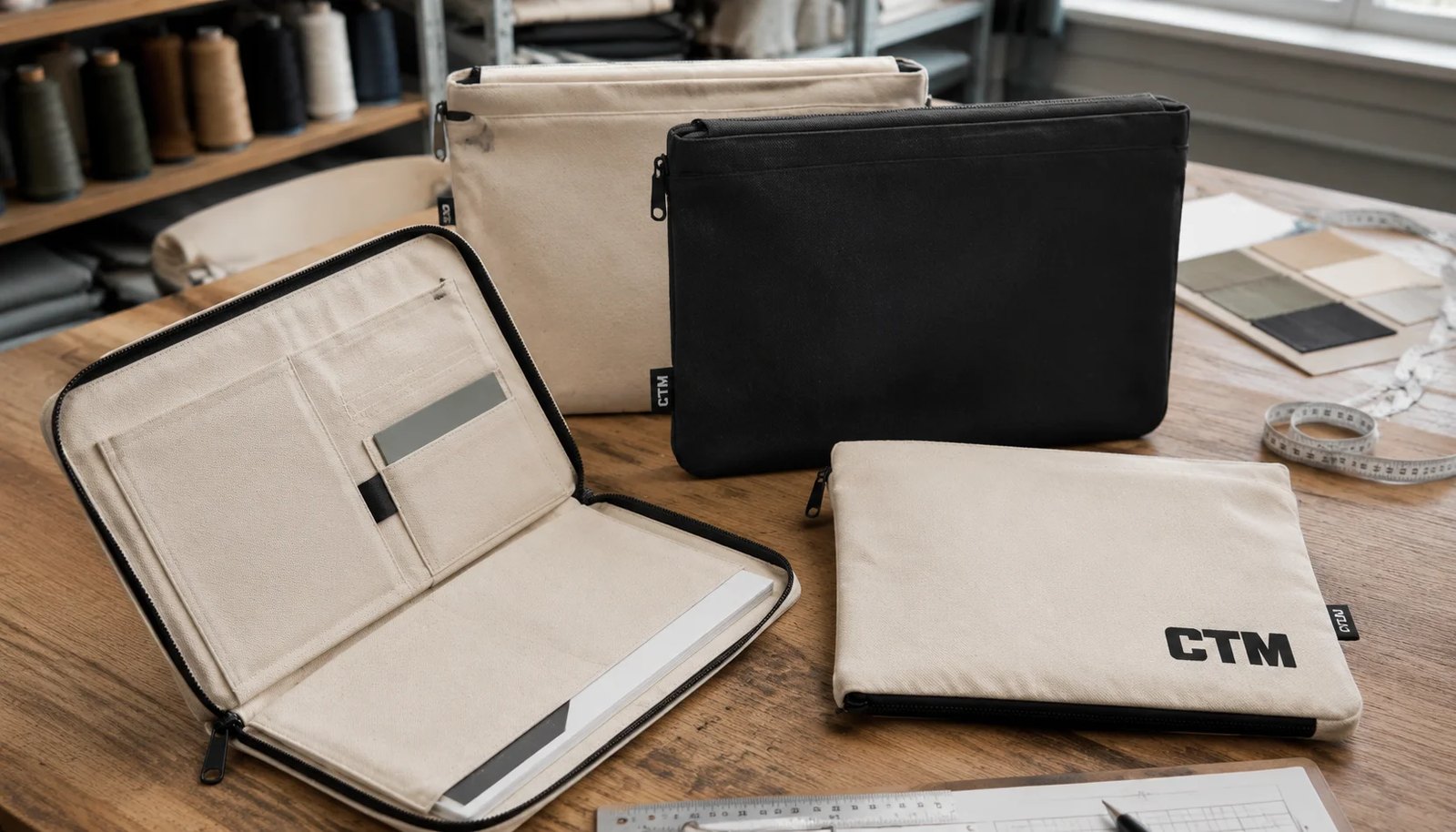
Why lead time breaks down on canvas zipper portfolios
Canvas zipper portfolios look simple, but their lead time often slips because buyers treat them like basic flat pouches. A portfolio usually has a larger cut panel, tighter size tolerance, a zipper running around more than one edge, and one or more inner features such as a document pocket, pen loop, or card slots. Each added function creates another approval point. In liquor retail programs, that matters because these pieces are often linked to fixed dates: distributor meetings, store launches, seasonal gift packs, training rollouts, or brand compliance updates.
The most common planning mistake is counting only sewing days. In reality, the timing starts earlier with artwork setup, canvas sourcing, zipper color matching, sample review, and packaging confirmation. If the logo method changes late or the buyer upgrades from stock zipper pullers to custom-branded hardware, the factory may need another materials cycle. A realistic plan should separate preproduction time from mass production time instead of treating the whole order as one block.
- Short lead time orders fail most often at artwork approval, material booking, or packing confirmation—not at final sewing alone
- Portfolio formats with inside pockets and larger zipper paths take longer than flat promo pouches
- Liquor retail deadlines are usually non-flexible because they connect to promotions, events, or store calendars
Choose the right construction before requesting quotes
If three suppliers quote three different constructions, their prices and lead times will not be comparable. Start with the function. A canvas zipper portfolio for liquor retail can be a document folder for distributor reps, a menu/pricing organizer for sales teams, a tasting event credential pack, or a branded admin portfolio for internal store use. Those use cases affect the material choice and how much structure the item needs. For most practical B2B programs, 12oz to 14oz canvas, roughly 340 to 400 GSM, gives enough body without turning the item into a heavy case.
Over-specifying early can also create cost and delay without adding useful value. A full lining, foam padding, many card slots, or metal zipper all sound premium, but they may not improve daily use for a liquor retailer handling paper inserts and POS material. If the product is meant for repeated field use, focus first on seam strength, zipper reliability, and logo clarity. If it is meant for gift presentation, then interior finish and individual packing matter more.
- Common practical size range: around A4 or letter-fit, depending on documents and inserts
- Recommended canvas: 12oz to 14oz for most portfolio applications; 16oz only when extra stiffness is required
- Use stock components where possible if launch timing matters more than custom hardware
Material and print choices that change both timing and cost
Canvas is not a single commodity. Stock natural canvas can move faster than custom-dyed canvas because dyeing adds another process and color approval. If your brand requires a specific black, forest green, burgundy, or other liquor-category color tone, write whether a close stock shade is acceptable or if lab-dip approval is mandatory. That one line in the RFQ changes the material path immediately. The same applies to shrinkage and handfeel: a softer washed canvas looks good but may introduce panel size variation and slower sampling.
Print method also affects timing. One-color screen print is usually the most efficient for portfolios because the print area is stable and flat enough before final assembly. Heat transfer may help with small multicolor logos, but the buyer should verify adhesion and edge lift on coarse canvas texture. Embroidery, debossed PU patches, or woven labels can work, but each adds another sourcing step or machine setup. In a lead time-sensitive project, simple branding often outperforms decorative complexity.
- Fastest route: stock natural or stock black canvas plus 1-color screen print
- Longer route: custom-dyed canvas, custom zipper tape, woven label, and custom zipper puller
- Screen print usually suits larger logos; woven labels suit smaller discreet branding
- Write logo size and placement in millimeters to reduce sample revisions
MOQ logic for portfolios is driven by materials, not only sewing
Buyers often negotiate MOQ as if the only issue is factory willingness. For canvas zipper portfolios, MOQ is shaped by canvas consumption, print setup, zipper component availability, and packing complexity. A supplier may accept 300 pieces in theory, but if the order needs custom dye, a custom puller, and separate inner insert cards, the quoted unit cost can become poor and the lead time can stretch because material booking is inefficient at that volume.
For most custom portfolio programs, 500 to 1000 pieces per design or colorway is where quotes become more workable. At that level, the factory can manage cutting efficiency, print setup, and carton planning without too much waste. If the buyer needs several logos for different liquor brands under one retail group, it is often better to standardize the bag construction and change only the print or side label. That keeps the production base stable while still allowing brand differentiation.
- Very low MOQ usually means fewer material choices and higher unit cost
- Mixed artwork on the same base construction is often easier than mixed constructions under one PO
- Custom hardware usually has a higher MOQ than standard zipper pullers
- Request price breaks at 500, 1000, 2000, and 5000 pcs to see the real scale effect
How to build a realistic production schedule backward from delivery date
A workable lead time plan should start from the in-warehouse or in-store date and move backward through customs, sea transit, port handling, and ex-factory completion. Only then should you assign factory days. Procurement teams often give factories a ship date without fixing the internal approval calendar, so the factory receives artwork edits after material booking should already be complete. That is where avoidable delays begin.
As an example, a standard custom order with stock canvas, nylon zipper, and one-color print might need separate windows for artwork proofing, physical sample approval, bulk material reservation, production, inspection, and packing. If you add custom dyeing or special trims, those steps need extra buffer. Even if the factory can sew quickly, missing one approval gate by three days can easily turn into a missed vessel because booking cut-offs are not always daily.
- Useful planning stages: artwork approval, preproduction sample, bulk material booking, sewing, final inspection, export packing, vessel booking
- Do not combine sample approval and mass production start into one assumption
- Write latest approval dates in the PO so internal teams understand the schedule impact of delayed feedback
- Keep at least a small buffer before vessel cut-off if the order uses custom-dyed components
Sample approval should cover function, not just appearance
Many sample approvals fail because the buyer signs off based on a photo or a visual mockup of the front panel only. For a zipper portfolio, functionality is equally important. The sample should be tested with the actual paper set, booklet, tablet, or POS inserts that the end user will carry. If the portfolio closes with strain, the problem may not appear until bulk goods are loaded in the field. This is especially common when the buyer adds an inside pocket after the first sample and forgets that the extra layer reduces internal capacity.
A proper preproduction sample should use the same canvas weight, zipper type, print method, and inner structure intended for bulk production. A substitute stock zipper or lighter sample canvas may help the supplier move fast, but it does not reduce buying risk. For programs with multiple approvers, nominate one final decision owner and circulate one marked approval sheet. Conflicting comments from brand, sales, and procurement teams can burn a full week.
- Test with actual insert thickness, not empty sample only
- Measure closed size, internal pocket depth, and zipper opening path
- Review print coverage on real canvas texture, especially for fine lines or small text
- Approve one physical standard sample and attach photos with measured dimensions to the PO
Quality thresholds that prevent the usual bulk claims
Bulk claims on canvas portfolios usually come from four areas: size drift, zipper jamming, print inconsistency, and rough inner finishing. These are manageable if acceptance criteria are written before production starts. A buyer should not rely on vague terms like 'good quality stitching' or 'premium zipper.' Instead, set measurable tolerances for finished dimensions, acceptable print misalignment, and zipper function. If the item will hold standard A4 or letter documents, even a small internal size reduction can make the product unusable.
Liquor retail buyers should also think about handling conditions. Portfolios may be used by sales reps in cars, stores, warehouse offices, or event setups. That means repeated opening and closing, corners rubbing on shelving, and occasional moisture exposure. Durable needle density, reinforced zipper ends, and decent carton protection matter more than decorative details. Final inspection should include both appearance and function sampling.
- Write size tolerances, such as acceptable variance on width and height
- Require zipper run test on sampled units before packing approval
- Specify no visible print cracking, major pinholes, or severe smudging on face panel
- Check internal pocket edge finish to avoid fraying after repeated use
- Use agreed AQL with emphasis on function defects, not cosmetic points alone
Packing decisions can quietly add a week if left too late
Packing is often treated as a final clerical step, but it can become a real production bottleneck. If the buyer adds barcodes, retailer labels, recycled content marks, insert cards, or individual sleeves late in the process, the factory may need new artwork, new materials, or extra labor planning. For simple distributor-use portfolios, bulk carton packing is usually the fastest and lowest-cost option. If the product is meant for retail shelf presentation or premium gifting, individual packaging may be necessary, but it should be defined from the first quote round.
Carton planning also affects landed cost. Canvas portfolios with stiff structures or heavy fabric can increase carton weight quickly, especially if each unit is individually packed. Buyers should request carton dimensions, packed quantity, net weight, and gross weight as part of the quotation. This helps compare not only unit FOB price but also freight efficiency. A slightly cheaper bag may be worse overall if the packing method wastes cube.
- Bulk pack reduces material cost and usually shortens finishing time
- Individual polybags help cleanliness but add labor and plastic consumption
- Retail insert cards, hangtags, or boxes should be quoted and scheduled as separate components
- Request carton specs early to estimate freight cost per piece
How to compare supplier quotes beyond the unit price
A good quote comparison for zipper portfolios should separate material, print, trim, packing, and freight basis. If one supplier quotes a lower price but uses lighter canvas, smaller zipper gauge, or no internal reinforcement, the savings are not like-for-like. Likewise, some suppliers quote with stock zipper pullers and plain polybags while others include custom labels and retail-ready packing. Procurement teams should normalize the offer before choosing.
Lead time reliability also belongs in the quote comparison. A supplier with in-house cutting and sewing but outsourced printing may still be a good option if the print is simple and the workflow is stable. But if both printing and sewing are subcontracted, schedule control becomes weaker. For liquor retail programs tied to launch dates, communication speed and approval discipline can be worth more than a small unit cost gap.
- Compare ex works and FOB, not just one basis across mixed quotes
- Normalize fabric weight, zipper type, logo method, and packing before ranking suppliers
- Request clear stage timing rather than one total lead time number
- Look for omissions: sample charge, mold fee, label cost, carton upgrade, or barcode application
A practical RFQ workflow for repeatable reorders
The strongest buying process is one that makes the second order easier than the first. For canvas zipper portfolios, that means locking a standard specification sheet after the first successful run. Include final dimensions, approved canvas GSM, zipper spec, logo placement, color references, pocket construction, carton packing, and inspection level. A stable spec file shortens future quoting and reduces the chance that a new merchandiser or planner interprets the item differently.
For liquor retailer groups managing multiple brands, keep the base construction fixed and create a controlled variation list for artwork, label, and colorway only. This simplifies forecasting and reduces excess sampling. It also gives suppliers a better chance to hold material continuity over time. If the order cadence is seasonal, share the forecast early so factories can reserve capacity around peak months rather than treating every PO as an urgent exception.
- Issue one master spec sheet after first approval and revise only through formal version control
- Keep brand variation to print or label where possible instead of changing full structure each run
- Share rolling forecasts if the product is tied to annual promotions or trade events
- Record actual production days versus quoted days to improve the next lead time plan
Specification comparison for buyers
| Spec decision | Recommended option | When it fits | Buyer risk to check |
|---|---|---|---|
| Canvas weight | 12oz to 14oz cotton canvas (about 340-400 GSM) | Best balance for branded liquor retailer portfolios holding price sheets, tasting notes, POS cards, or training documents without becoming too heavy | Below 10oz can feel weak at zipper seam and corners; above 16oz may raise sewing defects, carton weight, and transit cost |
| Inner structure | Single-layer body plus one document pocket and pen loop | Works for routine sales kits, compliance paperwork, or distributor meetings where function matters more than luxury presentation | Too many internal compartments increase sewing time, mismatch risk between sample and production, and longer rework if measurements are off |
| Zipper type | Nylon coil zipper #5 with metal puller | Good for smooth opening, lower defect rate, and better availability across color lots during repeat orders | Custom dyed zipper tape can extend material lead time; metal teeth look premium but can jam more easily on thick seams |
| Logo application | 1-color screen print on outer panel or woven side label | Best for liquor retail programs with frequent repeat POs and tighter launch windows | Multi-color print or large full-bleed artwork needs longer proofing and higher print registration control; woven labels require preproduction lead time |
| Sourcing route | Factory-direct supplier with in-house sewing and printing coordination | Fits importers and retail buyers who need one communication line for sample, production, packing, and shipment timing | Trading firms may quote fast but rely on subcontractors, creating weaker zipper color control, slower approval loops, and less visibility on cutting capacity |
| MOQ strategy | Start at 500-1000 pcs per design/colorway if custom print and custom zipper pull are required | Commercially efficient when branding matters and the buyer wants stable unit pricing without very high stock risk | Very low MOQ often causes inflated unit cost, limited material options, and reduced willingness from suppliers to hold color standards for repeat orders |
| Packing format | Individual polybag only if retail cleanliness matters; otherwise bulk pack by 20-40 pcs per export carton | Bulk packing suits distributor and back-room use, reducing material cost and carton cube | Overpacking with insert cards, tissue, and individual boxes can add more schedule steps than buyers expect and may shift a simple bag program into gift-pack complexity |
| Sample route | Digital artwork proof plus one physical preproduction sample from final canvas, zipper, and print method | Best for programs where logo placement, zipper smoothness, and edge construction affect acceptance | Skipping a PP sample often leads to disputes on canvas shade, print handfeel, inside pocket dimension, or zipper pull finish |
| Shipment plan | Split booking with ex-factory target date and latest vessel cut-off already written into PO | Useful for liquor retail seasonal launches, new store openings, or distributor conference deadlines | If only the shipment date is stated, factories may compress QC and packing at the end, increasing defect escape and missed booking risk |
Buyer checklist before sampling
- Define the real use case: sales folder, training portfolio, compliance document pouch, store opening kit, or gift-with-purchase accessory
- Set target canvas weight in GSM or oz, not just 'thick canvas'
- State finished size closed and open, plus whether A4, letter size, tablet, or mixed inserts must fit
- Specify zipper type, zipper color, puller finish, and whether custom pullers are required
- Decide if the inside includes pockets, pen loop, card slots, elastic holders, or a plain lining-free construction
- Choose logo method early: screen print, heat transfer, embroidery patch, debossed PU patch, or woven label
- Write acceptable color tolerance for dyed canvas and logo print appearance
- Request a preproduction sample using final bulk materials before mass cutting starts
- Set packing method by sales channel: bulk export carton, individual polybag, retail insert, barcode label, or inner carton assortment
- Build backward from in-store date to allow artwork approval, sample revision, production, final inspection, and vessel booking
Factory quote questions to send
- What canvas weight do you recommend for this portfolio structure, and what is the actual GSM tolerance in bulk?
- Is the quoted fabric stock greige canvas, dyed canvas, or yarn-dyed material, and how does that affect lead time?
- Will the zipper be nylon coil or metal, what gauge, and is the quoted puller standard or custom molded?
- Does the quote include inside pockets, pen loop, binding, reinforcement tape, lining, and edge finishing, or are these optional extras?
- What print method is included, what is the maximum artwork size, and how many colors are covered in the unit price?
- What is the MOQ by design, by color, and by logo artwork version?
- How many calendar days are needed for artwork proof, sample making, sample revision, bulk production, and packing separately?
- Which components are outsourced and which are done in-house: cutting, sewing, printing, labeling, and packing?
- What carton size, quantity per carton, and estimated gross weight are assumed in the quote?
- Can you quote both ex works and FOB, and provide a breakdown for material, printing, packing, and any tooling charges?
Quality-control points to confirm
- Canvas weight should be within agreed tolerance and feel consistent across bulk lots; random rolls that vary too widely can cause shape inconsistency
- Finished size tolerance should be written, especially width, height, gusset if any, and internal pocket placement
- Zipper must run smoothly through 10 repeated open-close cycles without snagging at seam junctions
- Logo placement should match approved sample location with a measurable tolerance, not visual estimation only
- Screen print should have even coverage, no pinholes in solid areas, and no offset registration drift beyond approved tolerance
- Seam density and backtack points must be consistent at zipper ends, pocket corners, and stress points
- Raw edge hiding, binding tape, and inner construction should match the approved sample to prevent fray complaints
- Woven labels or side tabs must be sewn straight and not caught into zipper seam or folded inside-out
- Carton packing count must match PO assortment and barcode instructions exactly to avoid DC receiving claims
- Moisture protection and carton burst strength should suit sea shipment if the goods are packed in humid-season production months