Procurement Brief: Why Liquor Retail Portfolios Need a Tighter Spec
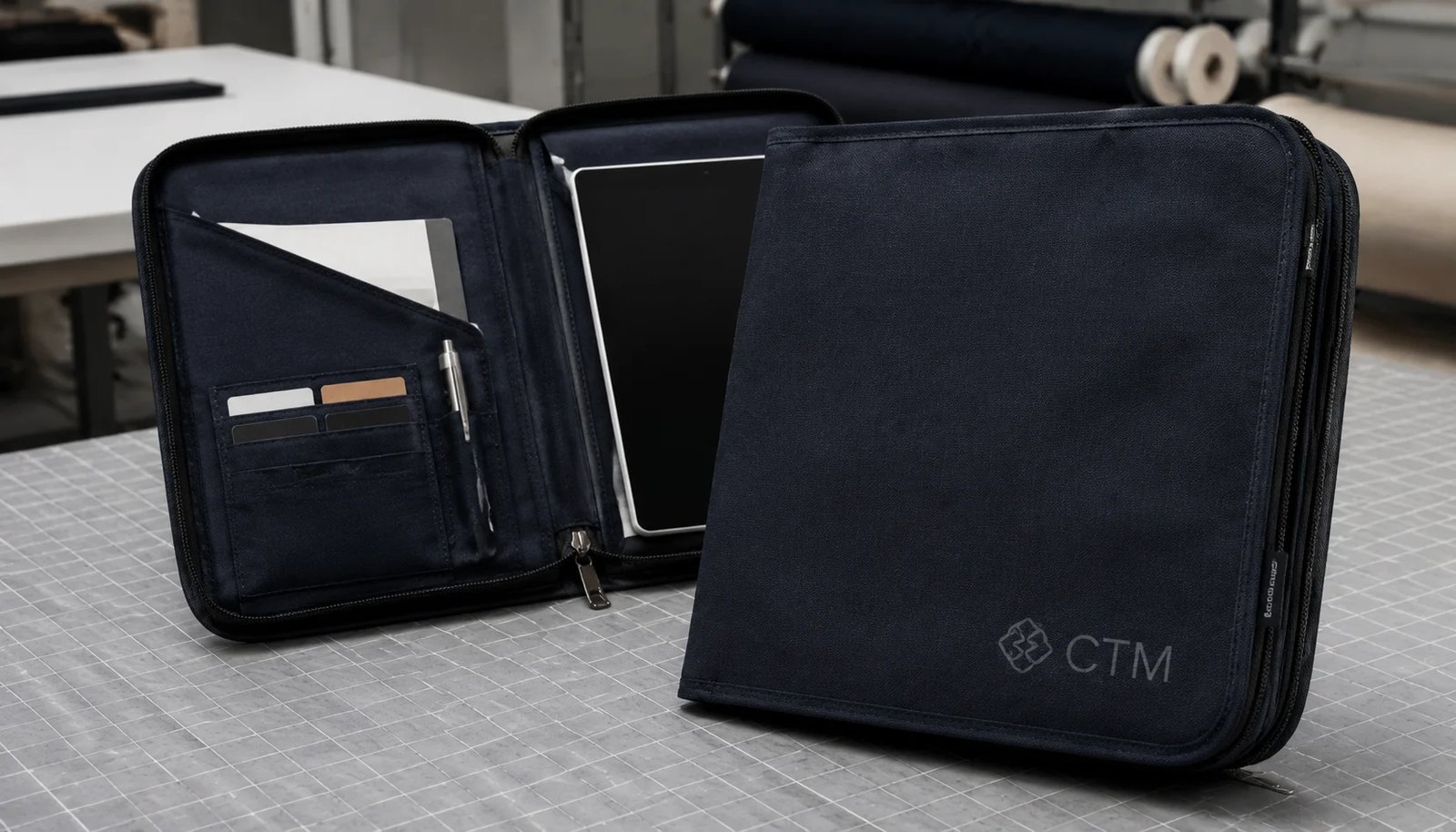
Canvas zipper portfolios for liquor retail programs are not just office folders with a logo. They may sit on tasting tables, move between store managers and distributor reps, hold price sheets or membership forms, and arrive as part of a premium gift-with-purchase set. That environment creates more risk than a standard meeting organizer: dark canvas can show rub marks, liquid exposure can stain untreated fabric, and repeated opening can expose weak zipper ends quickly.
The procurement brief should separate visual goals from working conditions. A short campaign folder for printed tasting notes does not need the same construction as a reusable field kit. A premium GWP piece may carry light contents but still needs clean packing and consistent branding. A store manager portfolio may need better pocket tolerances, stronger corners, and smoother zipper travel because it will be used repeatedly.
Use this article as buying guidance, not a substitute for retailer-mandated lab testing or alcohol-brand compliance protocols. When a chain retailer, corporate brand owner, or importer requires documented methods, those requirements should control. The practical checks below help buyers build a clearer RFQ, compare quotes fairly, and catch obvious durability risks before bulk shipment.
- Define whether the product is for a campaign, daily staff use, distributor sales, loyalty packaging, or premium GWP.
- Treat dark navy, black, burgundy, and forest canvas as higher-risk for visible lint, rub, and shade variation.
- State early whether retailer QA, restricted-substance documents, or formal lab reports are required.
- Do not approve only on appearance; load, zip, rub, pack, and inspect the sample as it will be used.
Start With Load Profile Before Asking for Price
The fastest way to receive misleading quotes is to ask for a 'canvas zipper portfolio' without describing the contents. A factory may quote a lighter unlined shell, while the buyer expects a lined organizer with pockets, pen loop, stronger zipper, and enough structure to sit neatly on a counter. Both products may match the same loose description, but they will not perform or cost the same.
Describe the use case in practical terms. For a tasting event folder, note whether it holds menus, tasting sheets, coupons, and pens, and whether staff will place it near ice buckets or wet glassware. For a distributor portfolio, list sell sheets, pricing documents, business cards, order forms, and any accessories. For a store manager kit, include notebooks, staff checklists, tablets, or operating documents if relevant.
Once the load profile is clear, fabric weight, zipper size, lining, pockets, and reinforcement become procurement decisions instead of guesses. The goal is not to overbuild every order. It is to avoid saving a few cents on a construction choice that later causes zipper strain, warped corners, jammed pockets, or complaints from retail teams.
- List every planned insert, including approximate dimensions, thickness, and loaded weight.
- State the expected reuse period: one event, seasonal campaign, multi-month rollout, or daily staff use.
- Note handling conditions such as tasting counters, back-office drawers, sales calls, store kits, or warehouse distribution.
- Send real inserts or exact drawings to the factory before the pre-production sample is made.
Fabric Choice: Weight, Finish, and Dark-Color Behavior
Canvas durability starts with the fabric specification. Buyers should ask for both ounce weight and GSM because factories and regions may quote differently. As an example guide, 10-12 oz canvas, about 340-410 GSM, can work for light document portfolios. Around 12-14 oz, about 410-475 GSM, is often more suitable for reusable store or distributor kits. Around 14-16 oz, about 475-540 GSM, gives a firmer hand for heavier or more premium builds.
These ranges are not universal standards. A tightly woven 12 oz canvas may feel stronger than a softer 12 oz fabric. Lining can improve structure without moving to the heaviest shell fabric. A washed canvas can feel more premium but may look less crisp and create more variation in printing or measurements. Treated finishes may help with moisture or stain concerns, but they can change hand feel, cost, lead time, and print behavior.
Color deserves special attention in liquor retail. Black, navy, oxblood, charcoal, and deep green are common because they look premium, but they also show lint, chalk marks, abrasion, and shade difference more clearly than natural canvas. If repeat orders are likely, approve a shade standard and ask how the supplier controls dye lots. General color names are not enough for a multi-store rollout.
- Approve bulk-intent swatches, not only a sales card fabric that may not match production stock.
- Record fabric in oz, GSM, weave, finish, color reference, and accepted tolerance band if available.
- Ask whether the fabric is stock dyed, custom dyed, washed, coated, or untreated.
- For dark canvas, review lint visibility, rub marks, shade variation, and color transfer before final approval.
Zipper and Reinforcement Decisions
The zipper is one of the first durability signals a buyer will notice. For standard document portfolios, a No. 5 nylon coil zipper is often a practical commercial option because it curves around corners and keeps bulk under control. For heavier daily-use kits, field sales portfolios, or products carrying tablets and accessories, a No. 8 nylon coil zipper may be more appropriate. The right choice depends on load, corner radius, fabric stiffness, and use frequency.
Do not specify only the zipper number. Confirm coil type, tape color, slider material, puller finish, end stops, and whether the zipper path remains smooth when the portfolio is full. A polished metal puller can make a sample look premium, but the functional risk may sit in weak tape stitching, poor corner sewing, or unreinforced zipper ends.
Reinforcement should be visible in the approved sample and written into the spec. Important points include zipper ends, pocket tops, pen loops, elastic loops, handle tabs if included, and any corners that carry stress when the portfolio is loaded. Bulk production should not rely on a verbal expectation that the factory will reinforce 'as usual.'
- Use No. 5 coil for lighter document portfolios; consider No. 8 for heavier daily-use or high-touch programs.
- Test zipper travel with actual contents loaded, not only on an empty showroom sample.
- Specify bartacks, backstitching, or box stitching at named stress points.
- Include zipper-end reinforcement and corner sewing in the inspection checklist.
Logo Method and Liquor Brand Presentation
Liquor retail branding often includes crests, serif marks, premium minimalist logos, metallic-looking colors, or campaign artwork. On canvas, the branding method should be selected for durability as well as appearance. Screen print is usually efficient for bold flat artwork and moderate color counts. Woven labels and stitched patches can be better for long-life premium programs because they avoid large ink areas on textured fabric.
Heat transfer can work for fine detail, but it should be tested on the actual canvas weight, color, and finish. Textured fabric can reduce edge sharpness or adhesion. Dark canvas may require an underbase to achieve color accuracy, which can increase print thickness and affect rub performance. Metallic ink effects should be evaluated carefully because the visual target may not translate cleanly to canvas.
Placement is another procurement control. A large print on the lower front panel may abrade during packing or table use. Artwork near a zipper curve or fold line may distort. For premium programs, a smaller woven label, leather-look patch, or interior brand mark may create a stronger long-term impression than a large front print that shows wear quickly.
- Request a strike-off on the same fabric color and weight planned for bulk.
- Confirm underbase requirements for dark canvas before locking artwork cost.
- Rub-test printed areas and check for cracking, peeling, transfer, and poor edge definition.
- Avoid placing critical artwork on fold lines, bottom corners, or high-contact areas.
Interior Layout: Useful Features Without Feature Creep
Every interior pocket has a cost and a failure mode. A main sleeve, one or two accessory pockets, and a pen loop are often enough for liquor retail paperwork, tasting sheets, business cards, coupons, and membership forms. More complex interiors can be useful, but each card slot, mesh pocket, elastic loop, tablet panel, or foam insert increases sewing time and tolerance risk.
Pocket dimensions should be based on real materials. A pocket that is only a few millimeters too tight can curl forms, jam cards, or make the zipper difficult to close when the portfolio is loaded. If another vendor supplies inserts, POS sheets, or notebooks, align dimensions before sampling. This is especially important when the portfolio ships pre-packed with campaign materials.
Lining decisions should support the workflow. Polyester lining can make document insertion smoother and reduce friction. Cotton lining supports a natural-material positioning but may add cost and behave differently with moisture. Unlined construction can work for simpler low-load pieces, provided seams are bound cleanly and raw edges do not catch paper or look unfinished.
- Keep the layout tied to actual retail tasks instead of adding pockets for appearance.
- Test with real forms, cards, pens, notebooks, and tablets where applicable.
- Check that full loading does not strain the zipper path or distort corners.
- Inspect lining tension, raw edges, pocket openings, and elastic recovery.
Durability Testing Checklist for Buyer Approval
A practical durability testing checklist should create repeatable buying controls. It should not be presented as a replacement for formal lab testing when a retailer, alcohol brand, or compliance team requires documented methods. Use these checks to screen samples, align expectations with the factory, and guide third-party inspection.
Test zipper function at pre-production stage and again on sampled finished goods. For example, test at least 3 pre-production units and 5 final-inspection units from different cartons or production times where feasible. Load each unit with intended inserts or a documented equivalent. Run 100 open-close cycles for standard commercial use and 250 cycles for heavier daily-use programs. Pass criteria should include no slider breakage, coil separation, severe corner catching, or zipper-end stitch failure.
For seams and reinforcement, focus on zipper ends, pocket tops, pen loops, elastic loops, and handle tabs if included. Apply a controlled pull consistent with the buyer's QC process or a clearly described manual pull if no instrumented method is used. A practical commercial rule may allow no seam opening beyond 3 mm at stress points and no broken stitches that reduce function, but buyer policy should override this if stricter standards apply.
Rub and color-transfer checks are especially important on dark canvas and printed logos. Rub front-panel corners, lower edges, and printed zones with a dry white cloth for 20 cycles and a lightly damp white cloth for 10 cycles. Pass if there is no heavy dye transfer, obvious print peeling, or visually significant damage under normal viewing distance. Slight trace transfer from dark dyed cotton may be commercially tolerable in some programs, but not if it stains inserts, packaging, or hands.
For moisture exposure, apply a small water droplet or lightly damp contact check where the item will be used near tasting counters, wet glassware, or ice buckets. Untreated canvas is not spill-proof, so the question is whether incidental moisture causes unacceptable dye bleed, rings, odor, or surface distortion. If alcohol splash resistance is required, ask for a finish recommendation and documented testing before confirming the order.
For pocket load and packing checks, fill the portfolio with the approved insert set, zip it closed, lift and gently shake it 10 times, then inspect for seam stress and usability. Review at least one packed master carton from pilot packing or early bulk. Confirm piece count, gross weight, compression marks, bent corners, zipper distortion, print offset, and moisture protection.
- Test timing: fabric and print before PPS approval, function on PPS, spot checks inline, and packed-goods review before shipment.
- Example zipper cycles: 100 for standard use and 250 for heavier daily-use programs.
- Example rub check: 20 dry rubs and 10 lightly damp rubs on dark fabric and printed zones.
- Pocket tests should use real inserts or a documented equivalent load.
- Formal lab tests should be used when required by retailer compliance or brand QA standards.
MOQ, Cost Drivers, and Quote Comparison
Canvas zipper portfolios can look similar in photos while differing heavily in cost. The main drivers are fabric weight, stock versus custom-dyed color, zipper grade, lining choice, number of pockets, reinforcement labor, logo method, custom trims, and retail packaging. MOQ often follows the same logic. A stock natural canvas with black No. 5 zipper and one-color print may support a lower MOQ than a custom navy build with matched lining, woven label, No. 8 zipper, and individual gift packaging.
Compare quotes only after locking the main construction choices. A 10 oz unlined portfolio with one pocket is not comparable to a 14 oz lined portfolio with reinforced corners and multiple interior components. Freight also changes with heavier fabric, padding, carton size, and protective packing. A cheaper unit price can lose value if the product ships bulky, arrives creased, or requires repacking before store distribution.
Ask suppliers to show the parts of the quote that may change: sample fees, screen charges, custom label MOQs, zipper color surcharges, packing costs, and fabric dyeing requirements. This lets procurement reduce cost intentionally without removing the feature that protects function.
- Normalize fabric weight, zipper size, lining, pocket count, logo method, and packing before comparing unit prices.
- Ask which trims or colors trigger separate MOQ requirements.
- Include carton size, gross weight, and packing method in landed-cost review.
- Keep setup, sample, trim, and packaging charges visible in the quote.
Sampling, Inspection, and Packing Controls
A strong approval process usually moves through four stages: fabric swatch, logo strike-off, full pre-production sample, and first-bulk-piece or early-line review for larger orders. Each stage should answer a different question. Fabric approval confirms weight, shade, finish, and hand feel. Strike-off approval confirms branding on the real surface. PPS approval confirms construction, function, and measurements. Early bulk review confirms the factory can repeat the sample under production conditions.
Write approvals in measurable terms. Record closed size, open size, pocket dimensions, print location, zipper specification, reinforcement points, and acceptable cosmetic limits. If dark canvas shows some lint or handling marks, define what is acceptable. If moisture behavior is a concern, state whether the product is untreated and accepted as such, or whether further finish testing is required.
Packing should be treated as part of durability. Canvas portfolios can collect dust, absorb humidity, flatten at corners, or deform around the zipper if cartons are overloaded. Many commercial programs use flat packing in polybags or paper wraps, with carton quantities proven by pilot packing rather than copied from another bag style. Carton labels should support warehouse allocation by campaign, store group, color, or SKU.
Final inspection planning should name the AQL, defect classifications, sample size, and carton selection method before the goods are ready. A common commercial example is AQL 2.5 major / 4.0 minor unless the buyer or retailer requires a different standard. Major defects should include zipper failure, missing reinforcement, unusable pockets, severe print transfer, wrong fabric, wrong logo, and packing deformation that affects presentation.
- Approve fabric, branding, construction, and packing separately instead of relying on one attractive sample.
- Keep retained approved samples with both buyer and factory for comparison.
- Pilot pack cartons to confirm quantity, gross weight, compression, and presentation after unpacking.
- Define AQL and major/minor defects before final inspection is booked.
Specification comparison for buyers
| Spec decision | Recommended option | Typical range or control point | When it fits liquor retail use | Buyer risk to check |
|---|---|---|---|---|
| Outer fabric weight | Cotton canvas matched to load and reuse level | Example guide: 10-12 oz / 340-410 GSM for light document use; 12-14 oz / 410-475 GSM for reusable staff or distributor kits; 14-16 oz / 475-540 GSM for firmer premium builds | Tasting sheets and short campaigns can use lighter builds; manager kits, distributor portfolios, and premium GWP usually need a firmer hand | Do not accept 'canvas' alone. Require oz, GSM, weave, finish, color reference, and approved swatch |
| Lining construction | 210D polyester lining, cotton lining, or unlined bound seams | 210D polyester for smoother document insertion; cotton lining for natural-fiber positioning; unlined only for simple low-load designs | Useful when price lists, forms, membership sheets, menus, or POS inserts must slide in and out repeatedly | Interior defects can appear before shell failure. Check lining tension, raw edges, pocket corners, and binding |
| Zipper size | Nylon coil zipper sized to load and corner radius | No. 5 coil for standard document folders; No. 8 coil for heavier daily-use kits or thicker contents | No. 5 suits light paperwork. No. 8 is stronger for field handling, event teams, tablets, or accessory pockets | Confirm slider material, tape color, puller finish, end stops, and corner sewing before bulk |
| Logo method | Screen print, woven label, patch, or tested heat transfer | Screen print for bold marks; woven label or patch for long-life understated branding; heat transfer only after adhesion and rub checks | Liquor brands often use dark canvas, serif marks, crests, metallic tones, or premium minimal branding | Dark canvas may need an underbase. Large prints can crack, scuff, or lose sharpness on textured fabric |
| Reinforcement points | Bartacks, backstitching, or box stitching at stress areas | Zipper ends, pocket tops, pen loops, elastic loops, corners, handle tabs if included | Important for tasting events, distributor meetings, retail staff kits, and repeated opening with loaded contents | Reinforcement shown on a sample can be reduced in bulk unless it is written into the tech pack |
| Interior layout | Limited pockets tied to actual inserts | Common layout: 1 main sleeve, 1-2 accessory pockets, 1 pen loop, optional tablet sleeve or mesh pocket | Works for forms, sell sheets, tasting notes, business cards, coupons, and membership materials | Extra pockets add labor, tolerance risk, and inspection time. Test real inserts before approval |
| Dimensional tolerances | Defined by component, not only overall size | Example controls: finished size +/-5-8 mm; pocket position +/-3-5 mm; print position +/-3-5 mm depending on artwork | Needed when the portfolio must fit standard forms, shelf cards, event menus, notebooks, or inserts made by another supplier | Without tolerances, pocket usability and print placement disputes are hard to resolve |
| Inspection AQL | AQL agreed before production and final inspection | Example commercial baseline: AQL 2.5 major / 4.0 minor unless buyer policy or retailer standard differs | Useful for multi-store rollouts where consistency matters more than a perfect showroom sample | Define major defects clearly: zipper failure, missing reinforcement, unusable pockets, severe print rub, or packing deformation |
Buyer checklist before sampling
- Define the program type: store manager kit, distributor binder, tasting event folder, loyalty pack, premium gift-with-purchase, or POS support item.
- List the real contents: sheet count, notebook size, card quantity, coupons, pen, corkscrew, tablet, sample forms, or other inserts.
- Specify outer fabric by both ounces and GSM, plus weave, finish, color, and whether natural, dyed, washed, or treated fabric is acceptable.
- State whether the product is unlined, lined, padded, structured, or reinforced, and mark each required stress point.
- Choose zipper size by load and use frequency; confirm No. 5 or No. 8, coil type, slider material, tape color, and puller style.
- Set closed size, open size, pocket dimensions, insert fit requirements, and production tolerances before sampling.
- Confirm logo method, print size, position, color standard, and any underbase requirement for navy, black, burgundy, forest, or other dark canvas.
- Ask for a logo strike-off on the same fabric color and weight planned for bulk production.
- Include spill and stain expectations if portfolios will be used near wine, spirits, ice buckets, wet glassware, or tasting counters.
- Decide what must be documented by the factory, third-party inspector, or lab when retailer compliance or alcohol-brand QA standards require formal records.
Factory quote questions to send
- What is the exact outer canvas specification in oz and GSM, and what fabric-weight tolerance applies in bulk?
- Is the quoted canvas stock material or custom dyed, and what MOQ applies by color lot?
- What zipper is included: size, coil type, tape material, slider material, puller finish, and grade level?
- Are zipper-end reinforcements, bartacks, backstitching, and box stitching included in the base quote?
- What interior construction is quoted: lining material, pocket count, pocket fabric, binding method, foam, board, or tablet sleeve?
- Which logo method is included, how many colors and positions are covered, and what setup or strike-off charges apply?
- What MOQ drivers change the price: canvas color, zipper color, lining color, woven label, custom puller, patch, or retail packaging?
- What are your standard tolerances for finished size, pocket position, print position, and carton quantity?
- Can you provide fabric swatches, logo strike-off, blank construction sample, full pre-production sample, and first-bulk-piece approval?
- What in-house checks do you perform for zipper function, seam strength, rub, color transfer, abrasion, packed-carton compression, and moisture exposure?
Quality-control points to confirm
- Verify canvas against the approved swatch for oz/GSM band, weave appearance, color, finish, and hand feel before cutting.
- Measure finished closed size, open size, and key pocket dimensions against approved tolerances during inline and final inspection.
- Check zipper travel on inspected samples when empty and when loaded with intended inserts or documented equivalent weight.
- Inspect zipper-end sewing, corner turning, and tape attachment for skipped stitches, needle damage, waviness, loose threads, or seam grin.
- Confirm bartacks or other reinforcements are present at every approved stress point, not only on some units.
- Evaluate print position, color match, underbase consistency on dark canvas, edge sharpness, rub resistance, and excessive ink buildup.
- Run dry-rub and lightly damp-rub checks on printed zones and dark fabric areas to assess transfer risk before shipment approval.
- Inspect interiors for lining tension, raw-edge control, pocket usability, mesh or elastic attachment, and smooth document insertion.
- Check for stains, oil marks, chalk marks, glue residue, sharp trim edges, and loose thread ends, especially on dark canvas.
- Review packed cartons for piece count, gross weight, corner protection, moisture control, carton marks, and signs of over-compression.