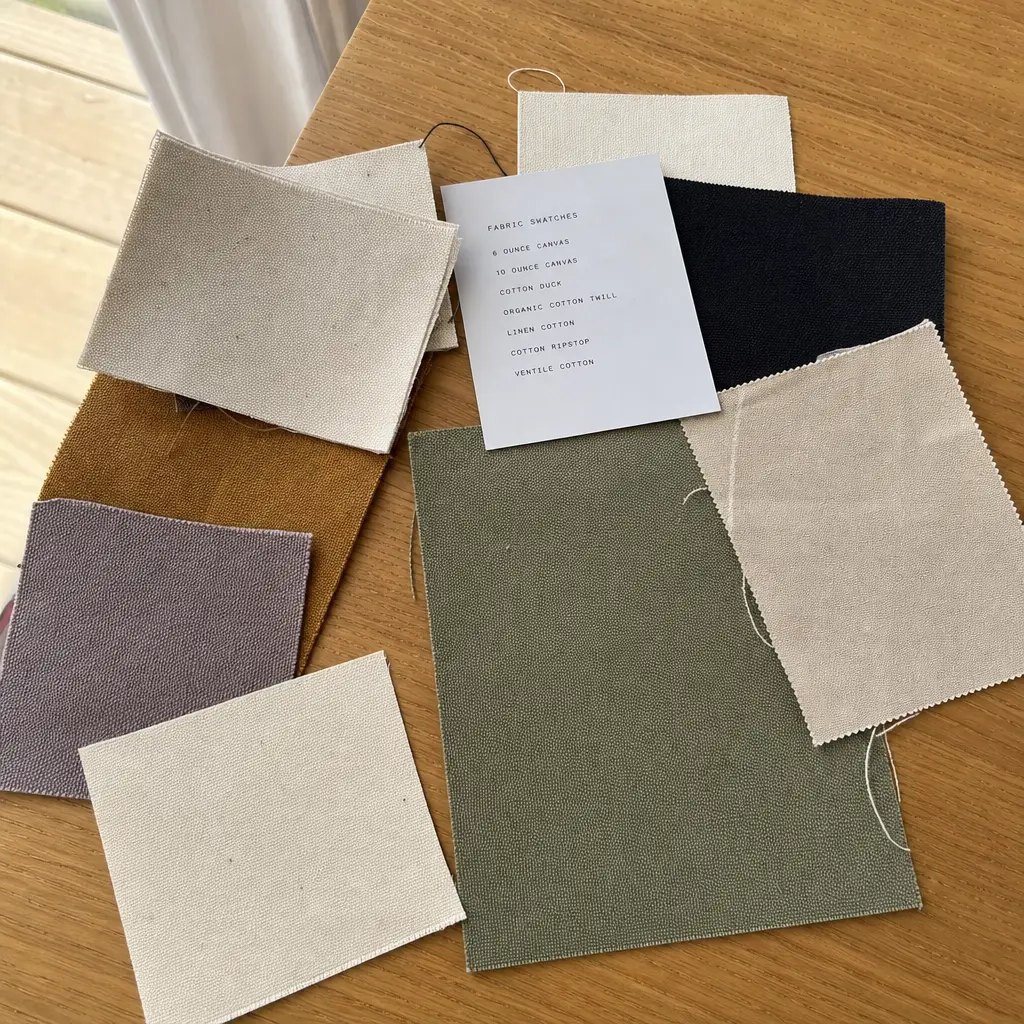
Start From The Event Date, Not The Factory Date
Canvas zipper portfolios for trade show exhibitors are schedule-sensitive products. A late portfolio is not just a late bag; it can miss sponsor kit assembly, booth shipment, registration desk packing, or distributor delivery windows. The first planning mistake is counting backward only from the factory's bulk production time. The correct timeline starts from the day the exhibitor needs the goods usable, then works backward through warehouse receiving, inspection, customs, freight, final packing, bulk production, sample approval, artwork approval, and material purchase.
For a normal customized order using standard canvas and a standard zipper, a practical planning range is often 7 to 10 days for sample development, 2 to 5 days for buyer comments and artwork approval, 20 to 35 days for bulk production after approval, and additional time for inspection, export documents, freight, customs, and domestic delivery. These are planning ranges, not promises. A portfolio with dyed canvas, custom zipper pullers, multiple organizer pockets, or several sponsor logo versions needs more calendar space.
- Set a required warehouse arrival date at least several days before the trade show kit assembly date.
- Add a buffer for sample revision if the first print color, zipper feel, or canvas stiffness is not approved.
- Do not release bulk production against unfinished artwork unless the buyer accepts the risk of reprint or rejected goods.
- Treat public holidays, port congestion, and peak exhibition seasons as real schedule items, not footnotes.
Define The Portfolio Function Before Adding Features
A canvas zipper portfolio can be a simple document pouch, a meeting file holder, a sponsor gift, or a retail-style organizer. Each use leads to a different construction. For trade show exhibitors, the common requirement is usually a flat zipper portfolio that holds brochures, contracts, badges, notebooks, samples, or tablet accessories while showing a clean logo panel. The more internal pockets and layered panels you add, the more sewing time, inspection points, and measurement risk you create.
Before requesting a quote, decide what the portfolio must carry. A4 paper, US letter documents, catalogs, and tablets do not share the same safe dimensions. If the zipper opening is too short, the user bends the documents. If the pocket is too shallow, the insert slides out. If the canvas is too soft, the bag looks tired after one day on a booth table. Good RFQs describe the carrying job in practical terms instead of only saying 'canvas zipper portfolio with logo.'
- For A4 papers, state whether the buyer needs flat insertion with extra clearance for brochures.
- For US letter documents, confirm the finished internal width and height rather than only the outside size.
- For tablet or sample kits, add padding or lining only where it is needed, because full padding changes thickness and packing volume.
- For registration desk giveaways, prioritize easy opening, clean print placement, and stable carton counts.
Choose Canvas Weight With Sewing And Freight In Mind
Canvas weight is one of the biggest drivers of hand feel, cost, sewing behavior, and carton weight. For canvas zipper portfolios, 10 oz canvas can be economical and flexible, but it may lack structure for premium exhibitor kits. A 12 oz to 14 oz canvas, roughly around 390 to 475 GSM depending on the fabric construction, is often a better commercial range. It feels substantial, accepts printing well, and still packs reasonably flat. Heavy canvas above this range can look strong, but it may create bulky seams around zipper ends and raise freight cost.
The buyer should also clarify whether the quoted fabric is natural, bleached, dyed, washed, coated, or laminated. A natural cotton canvas may show seed specks and yarn variation, which can be acceptable for a natural look but not for a clean corporate white logo program. Dyed canvas needs shade control and rubbing checks. Coated canvas may improve stiffness or stain resistance but can affect print adhesion and zipper sewing.
- Use 10 oz canvas only when low cost and light packing matter more than structure.
- Use 12 oz to 14 oz canvas for most trade show document portfolios with a good perceived value.
- Avoid changing canvas weight after sample approval unless the factory makes a new pre-production sample.
- Request fabric weight tolerance in the quote, especially when comparing suppliers using oz and GSM differently.
Match The Zipper To Real Booth Use
The zipper is the moving part that decides whether the portfolio feels reliable. A buyer can approve a nice logo and still receive complaints if the slider catches at the corners or the zipper teeth wave after packing. For most canvas zipper portfolios, a nylon coil zipper is a practical choice because it is flexible, smooth, and easier to sew around fabric edges. Resin or metal zippers can be used for a heavier look, but they add cost and can make the product less flat.
Zipper planning should include the tape color, teeth color, slider finish, puller style, and zipper end reinforcement. When the portfolio has a long zipper opening across two or three sides, the curve and corner area need careful sample review. The slider should move without grabbing loose threads or lining. The zipper tape should sit flat without twisting. If the buyer wants a branded puller, that part may have its own MOQ and tooling time, which can affect the lead time more than the bag itself.
- Specify zipper type, size, color, slider finish, and puller style in the RFQ.
- Test the sample by opening and closing the zipper several times with documents inside.
- Inspect zipper ends for reinforced stitching, because this is where rough use often creates failure.
- Do not assume a custom puller is fast; confirm MOQ, mold charge, and added production days.
Select A Branding Method That Survives Canvas Texture
Canvas is a textured fabric, so branding must be chosen with the surface in mind. Screen printing is usually the most efficient method for simple trade show logos, sponsor marks, and distributor branding with one to three solid colors. It gives good coverage on cotton canvas when the artwork is not too tiny and the ink is cured properly. Heat transfer can handle gradients and fine details, but the buyer should test adhesion and edge lifting. Embroidery can look premium, but it is not always ideal for flat portfolios because dense stitches can pucker the fabric and create a rough back side.
Logo placement needs written dimensions. A print centered on the front panel should have a target position and tolerance, such as plus or minus 5 mm, depending on the design and sewing construction. Buyers often send only a logo file and expect the factory to decide scale. That creates avoidable approval loops. A better approach is to provide a visual layout showing print width, distance from zipper, distance from bottom edge, and whether the logo must remain visible when the portfolio is stacked or displayed on a registration table.
- Use vector artwork for screen printing and give Pantone references for each print color.
- Avoid very thin reversed text on coarse canvas, because ink spread and yarn texture can reduce readability.
- For dark canvas, confirm whether underbase printing is needed for bright logos.
- For heat transfer, require a rubbing and adhesion check on the actual bulk canvas.
Understand MOQ By Material, Print, And Version
MOQ is not only a number printed on a supplier profile. For canvas zipper portfolios, MOQ comes from several places: canvas purchase quantity, dye lot quantity, zipper color availability, print setup cost, cutting efficiency, and the number of logo versions. A factory may accept a low order quantity when using stock natural canvas and a standard black zipper. The same factory may need a higher MOQ for a custom dyed body color, matching zipper tape, special lining, or multiple sponsor logos.
Trade show buyers often need different logo versions for exhibitors, sponsors, or regional sales teams. This is where quote comparison becomes tricky. One supplier may quote a low unit price but charge separate screen setup fees for each logo. Another may quote a slightly higher unit price with more flexible logo splits. The purchasing team should ask for price breaks by total order quantity and by each logo version. This prevents a false comparison between one clean 2,000-piece order and ten separate 200-piece versions.
- List the number of body colors, logo versions, print colors, and delivery locations before requesting final pricing.
- Ask whether MOQ applies per order, per color, per logo, or per shipment.
- Separate fixed charges such as screen setup, sample fee, label setup, and custom puller tooling from unit price.
- For many small logo splits, consider a woven side label plus one shared front print to reduce setup complexity.
Build A Sample Approval Path That Protects Bulk Production
A useful sample is not just a nice-looking prototype. It is a production control document. For canvas zipper portfolios, the approved sample should lock the body fabric, weight, color, zipper, stitching, pocket layout, print method, logo size, print position, and packing style. If any of those items remain open, the bulk order can drift. A buyer should label the approved sample clearly and keep photos, measurements, and written comments in one approval file.
There are different sample stages. A rough construction sample may be enough to confirm dimensions and pocket layout, but it should not be treated as final approval for color or print. A pre-production sample should use actual materials and the final decoration. For deadline event goods, the pre-production sample is worth the extra time because it exposes problems before cutting hundreds or thousands of panels. Once bulk fabric is cut and printed, changes become expensive and slow.
- Measure outside size, zipper opening, document sleeve, pocket depth, and print location on the sample.
- Load the sample with the actual brochure, notebook, badge, or tablet accessory planned for the event.
- Photograph the approved sample under neutral light and mark any allowed changes in writing.
- Do not approve bulk production from a photo alone when color, canvas stiffness, or zipper feel is important.
Set Quote Data So Suppliers Are Comparable
A quote for canvas zipper portfolios should give enough detail to compare real cost, not just unit price. The buyer needs fabric specification, portfolio size, zipper type, print method, number of print colors, MOQ, sample charge, setup charge, production lead time, packing details, carton size, gross weight, CBM, payment terms, and trade term. Without these fields, a cheaper quote may hide weaker canvas, smaller dimensions, lower print durability, or higher freight volume.
For importers and distributors, landed cost matters more than factory unit price. A portfolio that costs slightly less per piece but packs poorly can lose the savings in freight. A heavy canvas choice may be right for a retail gift, but not for a registration kit where cartons move through several warehouses. The RFQ should ask suppliers to quote the same packing method and provide carton data early, so the buyer can calculate freight before approving the final design.
- Require suppliers to state finished product size and allowed tolerance, not only a rough description.
- Compare FOB, EXW, and delivered terms carefully; they do not include the same cost responsibilities.
- Ask for carton dimensions and gross weight at quotation stage, even if they are estimated before sampling.
- Record all optional upgrades separately so the team can see which feature changes the budget.
Plan Packing Around Creases, Counting, And Kit Assembly
Canvas zipper portfolios are usually packed flat, but flat packing still needs control. If the carton is too tight, the front panel can crease and the zipper can press into the fabric. If the carton is too loose, the units shift and scuff during transit. Individual polybags protect the print and make counting easy, but some brands prefer paper sleeves or reduced plastic packaging. The packing method should match the buyer's warehouse process and the trade show's sustainability requirements.
Carton marking is also part of lead time planning. Exhibitor orders may need SKU labels, event names, booth kit references, destination warehouse codes, or carton sequence numbers. These are simple items if provided before production packing starts. They become a problem if requested after cartons are sealed. If the portfolios will be inserted into wider event kits, confirm whether they must arrive bulk packed, master packed by logo version, or pre-sorted by booth or region.
- Use flat packing with print protection when the front logo must stay clean for handout use.
- Confirm pieces per carton, carton dimensions, gross weight, and CBM before booking freight.
- Add silica gel or moisture control for sea shipments during humid seasons or long storage periods.
- Provide carton marks and barcode label requirements before bulk packing begins.
Control Schedule Risk Before It Reaches The Freight Stage
Most late trade show orders do not fail on one dramatic day. They lose two days on artwork, three days on sample comments, four days waiting for zipper color, and a week during holiday congestion. By the time the goods are ready, the buyer is forced into air freight or partial shipment. The better approach is to name each risk early and assign a decision deadline. Canvas zipper portfolios are manageable products when the decision path is clean.
The most common schedule risks are incomplete logo files, unclear print color standards, late sample approval, custom dyed material, custom zipper puller tooling, many logo versions, and changing packing instructions. A practical buyer calendar includes a freeze date for artwork, a freeze date for materials, a sample approval deadline, a bulk inspection target, and a latest vessel or courier handover date. Once those dates are visible, procurement can decide whether to simplify the spec or pay for speed before the order becomes urgent.
- Freeze artwork before the factory orders screens, films, labels, or transfer materials.
- Use standard canvas colors and standard zipper colors when the trade show date is close.
- Book final inspection before packing is fully completed if the shipment deadline is tight.
- Keep a decision log so sponsor changes do not silently reset the production clock.
Specification comparison for buyers
| Spec decision | Recommended option | When it fits | Buyer risk to check |
|---|---|---|---|
| Canvas body fabric | 12 oz to 14 oz cotton canvas, about 390 to 475 GSM before washing or finishing | Good balance for trade show document kits, sponsor giveaways, and sales meeting packs where the portfolio must feel firm but still pack flat | Very light canvas can collapse at the corners; very heavy canvas increases carton weight, sewing tension, and zipper waviness |
| Zipper construction | Nylon coil zipper with smooth slider, reinforced zipper ends, and puller matched to brand color | Best for repeated opening at booths, conference registration desks, and sales calls | Metal zippers look premium but can scratch contents and raise cost; cheap sliders may jam after bulk packing pressure |
| Branding method | Screen print for simple logos, heat transfer for gradients, woven label for subtle long-term branding | Screen print is usually the most stable option for event logos and distributor programs with 1 to 3 spot colors | Thick ink on coarse canvas can crack if not cured well; transfers need adhesion tests on dyed or coated fabric |
| Internal structure | One document sleeve, one business card pocket, and one pen loop unless the buyer needs a custom organizer layout | Keeps sewing time, sampling risk, and inspection clear for most exhibitor use | Too many small pockets slow production, create measurement disputes, and may not match user behavior at a booth |
| MOQ logic | Use the factory's material MOQ and print setup cost to set order breaks, commonly one colorway and one logo per batch | Works for importers consolidating exhibitor orders or distributors selling repeat event programs | Splitting many logo versions below efficient print setup quantities can make the quote look cheap but production unstable |
| Sample approval | Pre-production sample using actual canvas weight, actual zipper, actual print color, and final packing method | Necessary when the portfolio is used for a fixed trade show date and sponsor logo approval is involved | A size-only sample made from substitute fabric does not prove bulk color, stiffness, print coverage, or zipper function |
| Packing plan | Flat packed in individual polybag or paper sleeve, with silica gel if shipping by sea in humid season | Protects the front print panel and keeps portfolios easy to count for booth kit assembly | Over-tight cartons can crease canvas and distort zipper tracks; loose cartons increase freight volume and scuffing |
| Lead time buffer | Plan 7 to 10 days for sampling, 20 to 35 days for bulk production after approval, plus shipping and customs buffer | Suitable for most customized canvas zipper portfolios when fabric and zipper are standard | Logo delays, lab dip changes, zipper color shortages, and holiday closures can consume the buffer quickly |
Buyer checklist before sampling
- Define final trade show date, required warehouse arrival date, and latest acceptable inspection date before requesting quotes.
- State portfolio size, gusset requirement, document capacity, zipper type, canvas weight, color, and whether the bag must hold A4, letter-size, or tablet materials.
- Provide logo files in vector format with Pantone references and mark the exact print position, print size, and tolerance.
- Separate must-have features from nice-to-have organizer pockets so the factory can quote a stable base spec and optional upgrades.
- Request actual material swatches or a pre-production sample using the final canvas, zipper, lining if any, and branding method.
- Set inspection criteria for zipper smoothness, seam strength, print placement, color difference, stains, loose threads, and carton condition.
- Confirm packing method, pieces per carton, carton dimensions, gross weight, carton marks, and whether the portfolio must fit into a wider exhibitor kit.
- Build in approval time for sponsor logos, legal marks, distributor artwork checks, and import documentation.
Factory quote questions to send
- What canvas weight and composition are included in this quote, and is the quoted GSM before or after finishing?
- Is the zipper a nylon coil, resin, or metal zipper, and what slider quality or brand standard is being used?
- What is the MOQ for one body color, one logo design, and one print color, and how does the unit cost change at higher order breaks?
- Are screen setup, printing plate, sample, and artwork adjustment charges included or listed separately?
- How many days are needed for material purchase, sample production, sample revision, bulk cutting, printing, sewing, packing, and final inspection?
- Will the pre-production sample use the exact bulk fabric, zipper, puller, print ink, label, and packing materials?
- What print method do you recommend for this logo on canvas, and what test will you use to check adhesion or rubbing?
- What are the carton dimensions, pieces per carton, gross weight, and estimated CBM for the quoted packing plan?
- Which quality defects are considered critical, major, and minor during your final inspection?
- What information do you need from us before you can lock the production schedule?
Quality-control points to confirm
- Canvas weight within agreed tolerance, with clear confirmation of GSM or ounce rating and whether the fabric has been washed, dyed, or coated.
- Finished portfolio size within agreed tolerance, especially zipper opening width, document sleeve depth, and corner shape.
- Zipper opens and closes smoothly for the full length without catching lining, loose threads, or fabric edge.
- Print color, print position, and print size match approved sample within written tolerance.
- No visible stains, oil marks, broken yarns, needle holes, or heavy creases on the front branding panel.
- Seam allowance and stitch density are consistent at stress points, zipper ends, pocket corners, and handle or side tabs if included.
- Internal pockets fit the intended documents, cards, pens, or inserts without tearing seams during normal loading.
- Each unit is packed cleanly with print protection, barcode or SKU label if required, and correct carton marks.