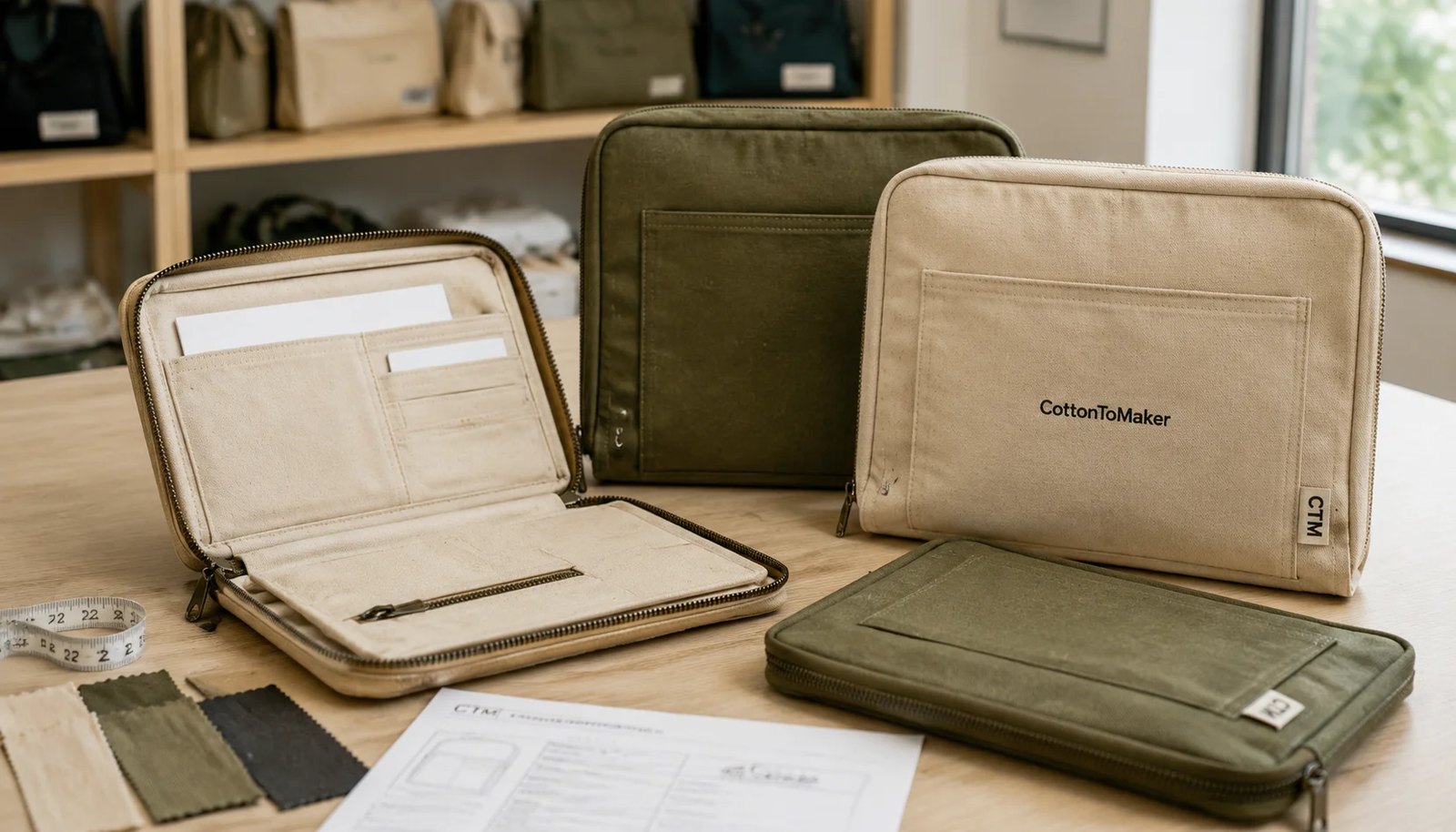
Why lead time slips on this product
Canvas zipper portfolios appear simple because the finished shape is familiar: a cotton case, a zipper, a logo, and perhaps a few internal compartments. In production, they behave differently from flat tote bags. The zipper must sit cleanly around the edge, the outer panel must stay flat enough for printing, and the interior pockets must align with the final closed size. If any of those decisions change after sampling, the factory may need a new pattern, new print screen, or new sewing setup.
For natural grocers, these portfolios are often used for vendor meetings, store operations, new employee kits, wellness education materials, or category review packets. They are usually handled repeatedly by staff and partners, so the buying goal is not just a low unit price. The stronger goal is a spec that can be sourced, sampled, inspected, packed, and replenished without last-minute trim surprises.
- Main schedule risks: fabric availability, zipper trim, print strike-off, PPS approval, and mixed-SKU packing
- Most preventable error: issuing a PO before artwork size, zipper color, and interior layout are final
- Best planning habit: request lead time by stage instead of accepting one broad production estimate
Define the work use before the style
The first procurement question should be what the portfolio must carry. A pouch for vendor price sheets can be simpler than a portfolio for onboarding documents, tablet storage, pen sets, coupons, and store forms. A simple document sleeve can use fewer pattern pieces and fewer sewing operations. A lined organizer with card slots, gusseted pockets, and pen loops creates more sample checkpoints and more chances for measurement disputes.
Reference photos are useful only when paired with required dimensions. Many buyer briefs combine a binder organizer, a laptop sleeve, and a slim document case in one request. That makes suppliers guess, and the quote becomes hard to compare. A better RFQ states the closed size, the paper or device size, the number of internal pockets, and the expected grade of presentation.
- Useful fit standards: A4, US letter, tablet model size, notepad size, or document plus pen set
- Common B2B uses: vendor folder, regional rollout packet, category meeting portfolio, store operations document pouch
- Procurement shortcut to avoid: asking for a quote from images without a written pocket map
Choose fabric with production reality in mind
For most business-use canvas zipper portfolios, 12 oz to 14 oz cotton canvas, roughly 340-400 GSM, is a practical range. It holds shape better after zipper insertion and gives a cleaner surface for a front print. Lighter 8 oz to 10 oz canvas may work for a soft pouch, but it can collapse on a portfolio shape, especially when interior pocket seams pull on the outer panel.
Natural canvas is usually faster than dyed canvas when the supplier has stock fabric available. The tradeoff is shade variation. Cotton flecks, slubs, and slight lot differences can be acceptable for natural grocer branding, but they should be approved as part of the material standard. If the program requires strict brand color control across repeat orders, dyed fabric may be justified, but it adds lab dip approval and fabric preparation time.
- Fastest fabric path: stock natural canvas with approved shade tolerance
- Higher-control path: dyed canvas with lab dip, bulk fabric approval, and added lead time
- Buyer threshold: use dyed fabric only when color consistency is more important than speed
- Specify whether weight is finished fabric weight and whether washing or softening is included
Qualify suppliers before comparing unit prices
A supplier can quote a portfolio without having reliable access to the right canvas, zipper, lining, or sewing line. Procurement teams should verify the production base before treating a low price as comparable. The key questions are practical: Is the fabric stock-supported? Is the zipper available in the required color and size? Does the factory sew zip-around portfolios in-house? Who controls the print shop, label supplier, and final packing?
Supplier qualification also matters for revision ownership. If a factory subcontracts sewing or trim sourcing, a small change to the puller, corner radius, or pocket depth may travel through several parties. That can add days even when everyone agrees on the change. A stronger RFQ asks who owns each step and whether the same team will make the PPS and the bulk goods.
- Verify fabric availability by lot quantity, not only by a swatch photo
- Ask for zipper stock confirmation for tape color, coil color, puller finish, and slider type
- Confirm whether sewing, printing, and packing are in-house or outsourced
- Ask who pays for and controls sample revisions when the change is caused by supplier error
Keep branding decisions production-friendly
A one-color screen print on a flat exterior panel is usually the most efficient branding method for canvas zipper portfolios. It is easy to price, simple to register, and predictable on cotton. Woven labels can add a cleaner retail appearance, but they require artwork approval, label production, and placement control. Embroidery, deboss patches, metallic inks, and custom zipper pullers can be appropriate, yet they should be treated as trim development rather than routine decoration.
Placement is often the bigger issue than method. A print that crosses a seam, sits too close to a zipper curve, or covers a pocket edge can force a new screen or a revised panel. For natural grocer programs, small centered branding or a lower-corner logo usually supports a clean look and protects the schedule. Define placement from fixed seams in inches or millimeters, not by a marked-up photo only.
- Fastest branding: one-color screen print on a flat panel
- Moderate branding: woven side label plus front print
- Schedule adders: custom puller, new woven label, large solid ink print, all-over print, embroidery on structured panels
- Approval requirement: print strike-off on actual canvas before PPS signoff
Plan MOQ around SKUs, not total units
MOQ is shaped by more than the total order quantity. A 3,000-unit order can be efficient if it uses one body fabric, one zipper, one construction, and three print versions. The same total can become slow if it uses multiple body colors, different puller finishes, separate linings, and store-specific packing. Each variation creates material booking, setup, inspection, and carton-control work.
For regional natural grocer programs, the lowest-risk split is to keep the physical product identical and vary only the front print or insert. If different departments need unique branding, consolidate artwork approvals before the supplier opens screens. Late logo additions are more disruptive than buyers expect because they affect print sequencing, carton labels, and sometimes the final assortment plan.
- Lower-risk split: same canvas, zipper, lining, and pockets; different front prints only
- Higher-risk split: different dyed body colors, custom pullers, labels, and pocket layouts
- Ask MOQ by color, by trim, by artwork, and by carton assortment
- Do not approve a mixed-SKU PO without a packing matrix
Use a real sample calendar
A reliable calendar starts from the required in-warehouse date and works backward through freight handoff, final inspection, packing, production, PPS approval, strike-off approval, and material confirmation. For a stock-material order, buyers should still protect at least several business days for internal review. For a custom order, the calendar needs room for lab dips, hardware development, and one realistic PPS revision.
A sample calendar for a stock natural canvas order might reserve week one for artwork, fabric swatch, and zipper confirmation; week two for print strike-off and PPS making; week three for PPS approval and bulk material cutting; weeks four to six for production; and the final week for inspection, packing, and forwarder handoff. A custom dyed or custom puller order should add two to five weeks before bulk production begins. The exact schedule must come from the supplier, but these ranges help buyers decide whether the requested spec fits the launch date.
- Stock order planning target: about 30-50 days after final artwork, deposit, and sample path are clear
- Custom trim or dyed fabric target: about 55-85 days depending on approval speed and material source
- Decision threshold: if delivery is inside 8 weeks, avoid custom pullers and new dyed fabric unless already developed
- Approval rule: one buyer owner should consolidate all PPS comments in a single revision sheet
Control PPS approval tightly
The pre-production sample should be made with the intended bulk construction, not substitute fabric and approximate trim. It should confirm finished size, zipper route, corner shape, print placement, label location, lining, pocket depth, and packing presentation if that affects receiving or retail handling. A photo approval is not enough when dimensions, zipper function, and pocket fit are central to the product.
Revision discipline is one of the easiest ways to protect lead time. Buyers lose days when merchandising, operations, and marketing send separate comments at different times. A single approval owner should collect comments, decide which changes are required, and classify them as pattern, material, print, trim, or packing changes. Pattern and trim changes usually require more time than minor thread trimming or label-position corrections.
- Approve PPS against a spec sheet, approved artwork, and physical material standard
- Fit-test pockets using actual documents or device dimensions
- Require a revised PPS if zipper path, pattern, fabric, puller, or pocket dimensions change
- Do not allow bulk cutting until the PPS approval conditions are written and dated
Make packing part of the RFQ
Packing can add real time at the end of production, which is the worst point to discover missing requirements. A simple lay-flat export pack is faster than individual bagging, barcode labeling, store-specific assortments, or protective interleaving. However, under-specified packing can create receiving claims: crushed corners, print abrasion from zipper pullers, mixed SKUs, unreadable carton marks, or cartons too heavy for warehouse handling.
Natural grocers often need clean warehouse receiving more than decorative retail packaging. A practical packing plan states pieces per carton, maximum gross weight, individual bag requirement, orientation of zipper pullers, carton mark format, barcode label placement, and whether SKUs can be mixed. If portfolios include board inserts or metal hardware, the carton should be reviewed for drop-test suitability so the hardware does not dent nearby units.
- Typical carton range: 20-40 pieces depending on size, stiffness, and packing method
- Use individual bags or tissue only when needed for print protection, barcode control, or warehouse rules
- Set carton gross weight and carton mark requirements before production finishes
- For mixed regional programs, provide the carton assortment matrix with the PO
Write QC criteria before production starts
Quality control should be linked to the lead time plan because unclear standards create late sorting and rework. On canvas zipper portfolios, the usual disputes involve finished size, zipper smoothness, print placement, pocket depth, label position, and visible marks on the front panel. Natural canvas can show minor slubs and flecks, but oil stains, heavy puckering, needle damage, and panel shade mismatch should be defined as defects rather than debated at shipment time.
A practical inspection plan uses AQL sampling, commonly general inspection level II, with critical, major, and minor defects agreed in the PO package. Final inspection should happen when most units are packed but cartons can still be opened and corrected. The inspector should run zipper function checks, measure key dimensions, test print adhesion by the agreed method, verify carton labels, and check assortment counts before the order is released to the forwarder.
- Major defects: zipper jam, broken puller, open seam, wrong print, wrong barcode, pocket too shallow for approved use
- Minor defects: small loose thread, slight allowable slub, minor measurement variation within tolerance
- Critical defects: unsafe metal burr, mold, contamination, or any issue that makes the product unsafe to handle
- Inspection timing: inline check after first finished units and final inspection before freight handoff
Specification comparison for buyers
| Planning stage | Stock-supported natural canvas order | Custom or higher-control order | Buyer decision threshold |
|---|---|---|---|
| Fabric confirmation | 2-5 days for stock swatch confirmation if 12 oz to 14 oz canvas is available | 10-20 days for dyed canvas lab dip, approval, and bulk fabric preparation; longer if weaving is required | Use stock canvas when launch date is fixed inside 8 weeks or shade tolerance is flexible |
| Zipper and puller sourcing | 2-7 days for size 5 nylon coil zipper with stock tape and standard metal puller | 12-25 days for custom puller mold, logo puller, plated finish, or nonstandard tape color | Avoid custom pullers unless branding value is worth at least 2-3 extra weeks |
| Print strike-off | 3-6 days after final vector artwork and print size are approved | 5-10 days if artwork uses tight registration, large solid ink areas, or special inks | Approve strike-off before PPS so print placement does not change after sewing |
| Pre-production sample | 5-10 days for simple zip portfolio with basic sleeve and one-color print | 10-18 days for lining, pen loops, multi-pocket interior, woven label, board insert, or custom trim | Do not release bulk cutting until PPS dimensions, zipper path, and pocket depth are signed off |
| PPS revision round | 3-7 days if comments are consolidated and materials are unchanged | 7-14 days if revision changes pattern, zipper, lining, label, or print screen | Limit revision ownership to one buyer contact and one consolidated comment sheet |
| Bulk production | 18-30 days for a single SKU using stock canvas, stock zipper, and simple print | 30-45 days for dyed fabric, multiple SKUs, custom trim, lining, or complex interiors | Split artwork versions are manageable; split fabrics, trims, and interiors create separate production runs |
| Final inspection and packing | 2-5 days for AQL inspection, carton marking, and standard export packing | 4-8 days when barcode labels, store assortments, protective interleaving, or rework sorting are needed | Book inspection before the last production week, not after cartons are sealed |
| Freight handoff | 1-4 days from passed inspection to forwarder pickup for ready cartons | 3-7 days if carton marks, booking, pallet rules, or export documents change late | Freeze ship-to, carton marks, and delivery terms before production finishes |
| Practical total timeline | 30-50 days after artwork, deposit, and sample path are clear | 55-85 days when fabric dyeing, custom hardware, or several revisions are included | For seasonal natural grocer programs, count backward from in-warehouse date, not ex-factory date |
Buyer checklist before sampling
- Define the business use: vendor packet holder, new store kit, category review folder, wellness educator pouch, or internal operations portfolio
- Confirm finished closed size and required fit for A4 sheets, US letter sheets, tablets, clipboards, pens, coupons, or printed vendor packets
- Specify outer canvas by weight, such as 12 oz to 14 oz or about 340-400 GSM, and state whether finished fabric weight is before or after washing
- Decide whether natural canvas shade variation, cotton flecks, and slubs are acceptable or whether dyed fabric must match a controlled color standard
- Choose unlined, half-lined, or fully lined construction and list every interior feature with dimensions, not only reference photos
- Freeze zipper size, zipper tape color, coil color, puller material, puller finish, and whether the puller is stock or custom
- Attach final vector artwork with print size, Pantone or ink target, position from fixed seams, and placement tolerance
- Request the sample path in writing: fabric swatch, lab dip if dyed, print strike-off, pre-production sample, and approval deadline for each stage
- Ask the supplier to identify which materials are stock-supported and which must be purchased, dyed, woven, molded, plated, or outsourced
- Confirm MOQ by body color, print version, zipper trim, woven label, and final carton assortment so one order does not become several small runs
Factory quote questions to send
- What exact canvas weight in GSM or oz are you quoting, and can you provide a fabric swatch or recent fabric test reference?
- Is the body fabric stock-supported in the required color, or will it be woven, dyed, or purchased after order confirmation?
- How many meters of the quoted canvas and lining are currently available, and is the same lot enough for the full order plus shortage allowance?
- Which zipper size, zipper type, tape color, coil color, and puller finish are included in the price?
- Are zipper pullers stock items, existing molds, or new custom development, and who owns the puller mold or artwork after the order?
- What sewing capability do you have for zip-around portfolios: in-house line, subcontracted sewing, or mixed production?
- Can your line handle the required corner radius, binding, lining, and pocket layout without changing the approved pattern during bulk?
- How many print colors, print positions, and screens are included, and will the strike-off be made on actual bulk canvas?
- Are woven labels, care labels, inserts, hangtags, barcode stickers, and carton marks included or quoted separately?
- Does lead time start from deposit, final artwork, material approval, PPS approval, or receipt of all trims?
Quality-control points to confirm
- Use ANSI/ASQ Z1.4 or equivalent AQL sampling, commonly general inspection level II, with agreed critical, major, and minor defect limits before production starts
- Schedule inline inspection after the first finished units are sewn and final inspection when most goods are packed but still accessible for sorting
- Check finished closed size, zipper path, corner radius, pocket depth, pen loop width, and print position against the approved PPS and written tolerances
- Verify canvas weight against the approved swatch or lab report so bulk material is not quietly downgraded to a lighter fabric
- Run zipper function checks on sampled units, including at least 20 open-close cycles on inspected samples or another agreed cycle count for the program
- Classify zipper jamming, broken puller, skipped teeth effect, open seam, missing pocket, wrong barcode, and unsafe metal burrs as major or critical defects
- Check print adhesion with tape test or rub test appropriate to the ink system, and record whether cracking, peeling, ink spread, or pinholes exceed the approved standard
- Measure woven label location from a fixed seam reference and classify upside-down labels, wrong label, or severe skew as major defects
- Inspect natural canvas appearance under consistent light; oil marks, stains, needle damage, heavy puckering, and visible panel shade mismatch should not be treated as normal slub variation
- Check stitch density, seam alignment, binding coverage, loose threads, and reinforcement at stress points, especially around zipper tape and pocket openings