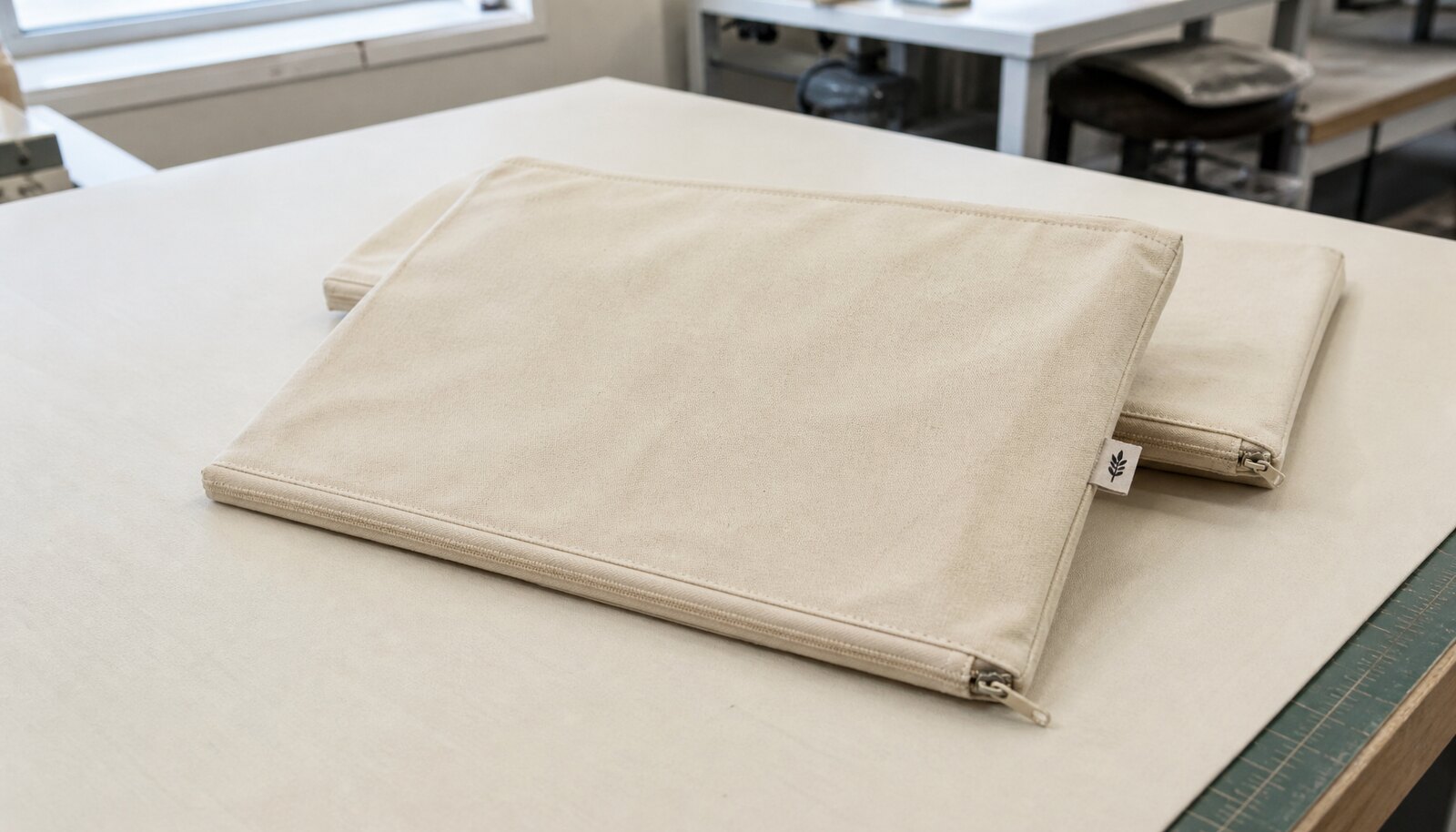
Why Lead Time Slips On Canvas Zipper Portfolios
Most schedule problems start when the buyer treats a canvas zipper portfolio like a simple pouch. In practice, the lead time depends on several linked decisions: canvas weight, zipper type, print method, lining, and carton pack. If any one of those changes after the quote, the supplier may need to reopen material sourcing, reset the cutting plan, or remake the sample. That is why a two-day delay in artwork can turn into a two-week delay in bulk production.
Gift shop programs are especially sensitive because the selling window is narrow. A portfolio that lands after a holiday season, tourist wave, or trade show reset is not just late, it is commercially wasted. The right way to plan is to break the calendar into stages and assign a real owner to each one. If the supplier only gives one total lead time without showing where the days go, the number is not reliable enough to build a retail launch around.
- Freeze the use case first: document portfolio, sales kit, menu holder, or gift item.
- Treat the first quote as a schedule model, not only a price sheet.
- Tie the delivery promise to in-hand date, not ship date.
Lock The Build Spec Before You Request Quotes
Start with the canvas weight, because that drives both appearance and sewing time. A 12 oz or 340 GSM canvas is lighter, lower cost, and usually fine for budget-minded gift shop assortments. A 14 oz or 400 GSM canvas is the safest balanced option for most buyers because it holds shape better and prints cleanly without becoming too heavy. A 16 oz or 450 GSM canvas feels more premium and sits better on shelf, but it can slow stitching, add freight weight, and make carton planning more expensive.
The zipper and decoration choice matter just as much as the fabric. A stock #5 nylon coil zipper is usually easier and faster to source than a metal zipper or a custom color match. For decoration, a one or two color screen print is typically the most predictable option for repeat orders. If the artwork is more complex, a woven label or embroidery may look stronger at retail, but both can add approval steps. Build the spec around what can be repeated, not what looks easiest in a mockup.
- Send a flat sketch with dimensions, seam allowance, and zipper opening length.
- Use vector artwork and identify the exact print position on the panel.
- Decide now whether you need a lining, inside pocket, gusset, or handle.
Pick The Sourcing Route That Matches The Calendar
The fastest route is not always the best route. A stock blank portfolio with local printing can beat a fully custom factory order by weeks, but the tradeoff is weaker control over fabric hand feel, zipper spec, and repeat consistency. A direct factory order gives the buyer the best control over materials and QC, especially if the order is a core item that will be reordered. A trading company can be useful when one team needs to manage mixed SKUs or multiple product families, but the buyer should still know which factory is actually making the bags.
For gift shops, the right sourcing route depends on whether the order is a launch, a replenishment, or a rescue shipment. Launch orders can usually tolerate a full factory timeline if they are placed early. Replenishment orders often benefit from a hybrid plan, with a bulk sea shipment and a small reserve held closer to market. Rescue shipments should be treated as exceptions, because air freight can protect the sell-through window but will quickly erase margin if used as a default sourcing strategy.
- Use direct factory sourcing for stable volume and repeatability.
- Use stock blanks and local print only when the product can accept a simplified build.
- Use a hybrid plan when the buyer needs both margin control and quick restock ability.
Read The Factory Quote As A Production Plan
A useful quote should show the product in pieces, not as one vague total. The best RFQs list canvas weight, fabric width, zipper type, puller style, print method, logo color count, sample fee, MOQ, carton pack, and lead time by stage. If a supplier skips those details, they are either quoting from memory or leaving room to change the price later. A low number on the bottom line means very little if the spec is not fully described.
Compare quotes on the same basis. One supplier may include a stock zipper and blank puller, while another may be factoring in a custom puller and a woven side label. Another may quote a lower price but assume a larger carton pack, which changes freight cost and retail handling. The buyer should ask for the base bag price, then separate lines for print, label, custom puller, lining, and packaging. That lets you remove or add options without restarting the whole sourcing cycle.
- Ask for fabric GSM, zipper spec, and print method in writing.
- Separate one-time setup charges from recurring production cost.
- Ask for MOQ by color and design, not only one total number.
- Confirm carton dimensions and gross weight before comparing freight.
Sample Approval That Prevents Rework In Bulk
The approval sample should be treated as a production reference, not a display piece. It needs to use the final canvas weight, final zipper, actual thread color, and the real print process. If the sample is made with the wrong fabric or a temporary zipper, the bulk order can still fail even if the sample looks attractive. For gift shop buyers, the most common mistake is approving appearance while ignoring how the portfolio opens, closes, and sits on a shelf peg.
The approval step should also lock the details that are easy to miss in a photo. Logo placement, seam alignment, fold direction, interior finish, and zipper travel all matter. Put the actual paper insert or product card into the sample if that is how the item will be displayed. If the supplier needs to revise the sample, keep a written change log so the factory does not revert to an earlier version during bulk cutting or sewing.
- Compare the sample to the signed spec sheet, not to an email photo.
- Test the zipper several times and make sure it does not snag at the seam.
- Check logo centering, edge folding, and the way the item lies flat.
- Confirm carton marks and barcode placement before the bulk run starts.
Where The Calendar Time Is Actually Spent
Lead time is usually consumed by waiting, not by sewing. The first block is material booking, which can be quick if the factory already has greige canvas and stock zippers, or slow if the buyer wants a custom color, a special finish, or a branded puller. The second block is sample approval, which can move fast if the artwork is stable but can drag if the buyer keeps adjusting the print size, the zipper color, or the internal layout. The third block is bulk production, which is where small design changes start to multiply across cutting, printing, stitching, and finishing.
A simple repeat order with stock materials may fit into a three to four week factory window before freight, but a more customized portfolio can easily take longer. The buyer should ask the supplier to break the schedule into stages and identify the slowest item. If the factory cannot tell you whether the delay is in fabric, printing, sewing, or packing, they are not really planning the order. For seasonal gift shop business, that uncertainty is the real risk.
- Material booking is usually the first hidden delay, especially for custom colors.
- Sample approval should be timed before the bulk slot is reserved.
- Packing and final inspection can become the bottleneck if carton specs are not fixed early.
- Freight time still has to be added after the factory finish date.
Packing Decisions That Change Carton Count And Risk
Packing affects both shelf presentation and landed cost. A portfolio packed too tightly can crease the canvas and distort the print, while a loose pack increases carton volume and freight cost. The correct pack depends on whether the item will be sold folded, hung, or included inside a gift set. For gift shops, retail presentation matters, but the warehouse also needs a pack that can be received quickly and restocked without rework.
Lock the retail pack before sewing starts. Define the polybag size, barcode label position, master carton count, and whether desiccant is needed. If the order will ship in mixed colors, make the mix ratio and outer sticker format part of the approval. A clean side label or hang tag is often enough for a retail buyer, and it can be more useful than a full printed insert if the store team wants the product ready for display with minimal handling.
- Agree the fold size so the bag sits flat in the retail pack.
- Keep the carton weight manageable for store teams and warehouse staff.
- Use one carton format across the core program when possible.
- Put SKU, color, and carton count on the same label layout.
QC Thresholds That Stop Gift Shop Returns
Canvas zipper portfolios fail retail for visible reasons, so the inspection focus should be simple and strict. Agree the tolerance band before the first run starts. The logo needs to stay centered in the approved zone, the seams need to be straight, and the zipper must move smoothly without catching at the opening. A product that looks fine in a factory photo but feels uneven in the hand will often be rejected faster by a gift shop buyer than a technically more complex item with cleaner presentation.
The inspection standard should be realistic enough for the factory to execute consistently. Check size, stitch quality, print placement, odor, and carton count on random units from each lot. If the decoration is screen print, add a simple rub check. If the decoration is embroidery or a woven label, inspect the back side for loose threads and trimming quality. The goal is not perfection on paper, it is repeatability on the line and low reject risk at receipt.
- Size should stay within the agreed tolerance on critical dimensions.
- The zipper should open and close without snagging or tooth separation.
- No oil marks, strong odor, or loose threads should be visible on retail units.
- Carton counts should match the packing list exactly before shipment.
Landed Cost Tradeoffs Between Speed And Unit Price
The lowest ex-factory quote is not always the lowest real cost. A lighter 12 oz portfolio may save material, but if it needs extra structure or creates a weaker shelf presentation, the buyer may pay for the mistake later in complaints or markdowns. A 14 oz or 16 oz build can sometimes improve sell-through because the item stands better, prints cleaner, and feels more substantial. The same logic applies to zipper type, decoration method, and packing density.
Compare the quotes on delivered cost, not only unit price. Include freight, duty, inland handling, sample revisions, and the cost of missing the selling window. If the season is fixed, a slightly more expensive but faster route can be the better commercial decision. The real comparison is not which supplier is cheapest on paper, but which one is least likely to create a costly correction after the order is already in motion.
- Calculate landed cost per sellable unit, not only ex-factory cost.
- Separate setup fees from repeat-order costs.
- Fix carton volume before comparing sea versus air freight.
- Price the risk of delay if the launch window is seasonal.
Build A Repeat-Order System For Seasonal Gift Shops
A repeat-order file saves more time than almost any pricing negotiation. Keep the approved sample, final artwork, panel dimensions, zipper code, packing spec, and the latest inspection record in one place. When the same portfolio returns next season, the factory should be able to reproduce it without reopening the whole design discussion. That reduces drift, especially when a buyer changes account managers or when the factory changes line staff.
Seasonal retail also needs a reorder point that respects freight time. If the buyer waits until the display is empty, the replacement order will arrive too late. The better approach is to build a small safety stock or a reserve production plan for the best-selling colorway. That way, the product stays on shelf while the next run is still in motion, and the buyer is not forced into emergency air freight just to protect a gift shop program.
- Archive approved artwork and spec sheets by SKU and colorway.
- Use the same carton and barcode format across repeat runs.
- Review sell-through before peak season, not after it ends.
- Plan a backup transit mode before you need it.
Specification comparison for buyers
| Spec decision | Recommended option | When it fits | Buyer risk to check |
|---|---|---|---|
| Direct factory with reserved line slot | Best for stable reorders with a frozen spec and one clear approval chain | Use when the gift shop program has predictable volume and the delivery window is fixed | Check whether the factory has booked fabric, zipper, and print capacity before promising lead time |
| Trading company with factory sourcing | Useful when one team must manage mixed SKUs or multiple product categories | Use when the buyer wants one PO, one contact, and simpler communication across assortments | Check who actually owns QC, sample signoff, and factory follow-up |
| Stock blank portfolios plus local print | Fastest route for urgent seasonal top-ups if the base bag already matches | Use when the design can accept stock canvas, stock zipper, and a simple logo application | Check color match, print durability, and whether the stock blank matches the approved size |
| Regional converter near the destination market | Good for lower transit time and easier replenishment planning | Use when freight speed matters more than the lowest ex-factory unit cost | Check whether the converter can hold the same fabric weight and zipper spec across reorders |
| Small-MOQ workshop | Best for market tests, pop-up programs, or limited edition runs | Use when the buyer needs low commitment and can tolerate some production variation | Check stitch consistency, panel symmetry, and whether repeat runs will match the sample |
| Sea-freight contract factory | Best for larger seasonal programs where unit cost matters and timing is known | Use when the order is planned well ahead of the launch date | Check port cutoffs, carton readiness, and whether the supplier can finish early enough for vessel booking |
| Air-freight rush supplier | Use only for emergency replenishment or a delayed opening order | Use when the sell-through window is too short for sea freight | Check whether air cost destroys margin and whether packing density is acceptable |
| Hybrid bulk plus local reserve stock | Strong option for recurring gift shop chains with both core and seasonal needs | Use when the buyer wants a stable bulk run and a small replenishment buffer nearby | Check SKU discipline so the local stock does not drift from the factory version |
Buyer checklist before sampling
- Freeze the final size, insert fit, and seam allowance before requesting quotes.
- Choose one canvas weight target, such as 12 oz, 14 oz, or 16 oz, and do not mix specs across quotes.
- Lock the zipper type, puller style, and whether the zipper is stock or custom color.
- Send print files in vector format and confirm spot color count, print position, and approved artwork size.
- State the target MOQ by color and by design, not only the total order quantity.
- Ask for sample fee, sample lead time, and what exactly changes from sample to bulk if needed.
- Confirm carton pack, polybag requirement, barcode label, and master carton dimensions before cutting starts.
- Set a quality tolerance for size, stitch quality, print placement, and zipper function.
- Compare landed cost, not just ex-factory price, including freight, duty, and inland handling.
- Build a reorder calendar with safety stock if the gift shop launch is seasonal or date fixed.
Factory quote questions to send
- What exact canvas weight in GSM and fabric width are you quoting, and is it greige, dyed, or finished canvas?
- Is the zipper stock or custom, and what is the zipper size, puller type, and color process?
- What is the MOQ per color and per design, and can mixed colors share the same production run?
- Which print method are you quoting, how many colors are included, and what setup charges apply?
- What are the sample fee, sample lead time, and bulk lead time by stage, not only the final total?
- What carton pack, inner polybag, and carton dimensions are assumed in the quote?
- What tolerance will you use for size, stitching, logo placement, and zipper function during inspection?
- Which Incoterms, payment terms, and shipping mode are included in the price basis?
Quality-control points to confirm
- Confirm finished dimensions against the signed spec sheet, with a practical tolerance agreed before production starts.
- Inspect seam symmetry, stitch density, and edge finishing on both the front and back panels.
- Run the zipper through repeated open-close cycles to catch snagging, tooth gaps, or puller mismatch.
- Check logo placement, print sharpness, and color consistency against the approved sample under daylight-equivalent light.
- Reject obvious oil marks, broken threads, dirty marks, or fabric flaws that are visible at retail distance.
- Test whether the portfolio lies flat and closes cleanly with the intended insert or paper inside.
- Verify carton counts, barcode labels, and outer marks against the packing list before shipment release.
- Review any odor, moisture, or packing compression issues that could affect shelf presentation on arrival.