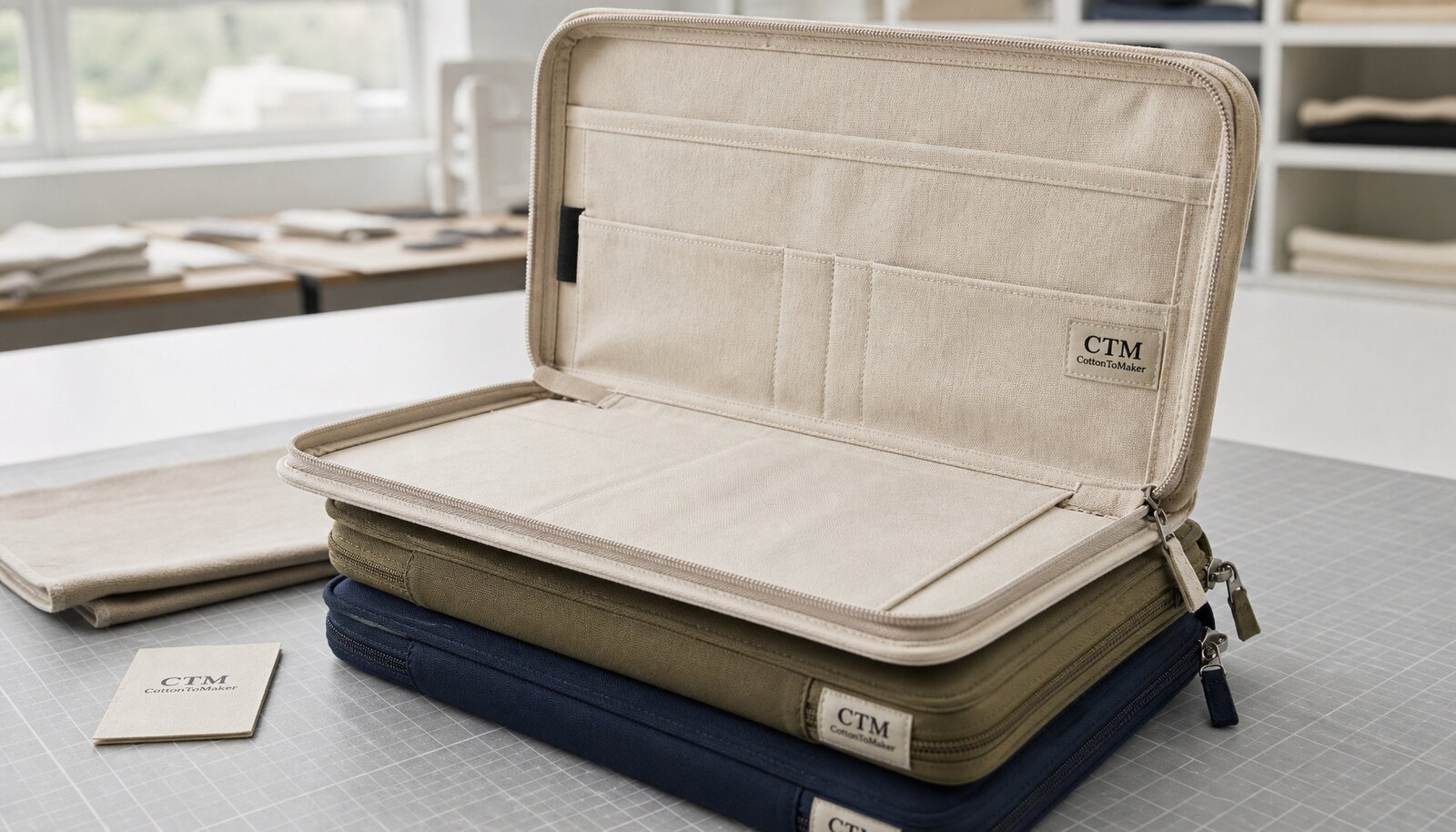
1. Plan Backward From the Real In-Hand Date
For corporate gifting, the deadline is not the date cartons leave the factory. The useful date is when the portfolios are counted, received, kitted if needed, and ready for distribution. A shipment may still need export handoff, freight transit, customs clearance, warehouse receiving, regional allocation, and delivery to offices or event venues.
A practical canvas zipper portfolios for corporate gifting lead time planning guide should separate the calendar into gates. The supplier’s bulk production time is only one part of the schedule. Artwork approval, sample courier time, internal review, inspection scheduling, rework, and packing label approval can consume the same calendar as sewing.
Use the following sample backward calendar as a planning model. Actual dates are supplier- and specification-dependent, but the structure helps procurement identify where compression is possible and where risk increases.
- Stock or catalog body with simple logo: start 4-8 weeks before in-hand date; key gates are stock reservation, artwork proof, decoration, packing, and domestic receiving.
- Semi-custom portfolio using existing pattern with chosen canvas, lining, zipper, and logo: start 7-11 weeks before in-hand date; key gates are sample approval, material booking, decoration approval, inspection, and freight.
- Fully custom build with new pattern, special color, pocket changes, branded puller, or gift box: start 10-16+ weeks before in-hand date; key gates are prototype, revised sample, pre-production sample, input-material MOQ, bulk production, inspection, and export.
- Backward example for an event in Week 0: receive goods in Week -1, final inspection in Week -2, packing completion in Week -3, bulk sewing and decoration in Weeks -6 to -3, materials booked by Week -7, pre-production sample approved by Week -8, prototype or stock sample reviewed by Weeks -10 to -9.
- For fixed event dates, remove complexity before compressing production: use stock canvas colors, standard zipper tape, simple logo placement, and proven packing.
2. Convert the Portfolio Into a Quote-Ready Specification
Canvas zipper portfolios look simple, but small construction choices change cost, lead time, and defect risk. Heavy canvas, lined interiors, deeper pockets, larger zippers, reinforced corners, individual packing, and brand labels all affect material sourcing and line time. Terms such as premium, executive, sturdy, or durable are not enough for comparable quotes.
A quote-ready RFQ should state finished outer dimensions, usable interior dimensions, flat or gusseted construction, canvas weight, composition, color, finish, zipper type, lining, pocket layout, thread, decoration, labels, packing, inspection level, Incoterms, and destination. If the portfolio must fit A4 paper, US letter documents, a tablet, a notebook, brochures, or a gift insert, give the item dimensions and thickness.
Finished size and usable size are not the same. Seam allowance, zipper tape, lining, bound edges, rounded corners, and pocket construction reduce the internal space. For kitted programs, check the wrapped or boxed insert size, not only the bare notebook or brochure size.
Canvas weight should be defined in oz/sq yd or GSM. Many B2B specifications use 12 oz, 14 oz, or 16 oz cotton canvas, but the right choice depends on structure, lining, budget, and freight mode. Heavier canvas can improve perceived substance, yet it may add seam bulk, sewing difficulty, carton weight, and air freight cost.
- Include outer size, usable inner size, zipper opening, pocket count, pocket depth, pen loop size, and flat or gusseted profile.
- Define fabric composition, weight, finish, color reference, shrinkage expectation, and swatch approval process.
- State lining, interlining, reinforcement, binding, thread color, and stitch expectations where structure matters.
- Send a physical insert or dimensioned dummy when fit is critical.
- Ask whether canvas weight is measured before or after dyeing, washing, coating, or laminating.
3. Treat the Zipper as a Performance Part
The zipper is the main moving component, so it should not be described only as zip closure. A rough slider, twisted tape, weak end stop, or fabric-catching corner can make an otherwise acceptable corporate gift feel cheap. For a zipper business bag product, zipper performance is part of the user experience and should be specified before sampling.
A #5 nylon coil zipper is a practical baseline for many flat document portfolios because it is flexible, common, and usually smooth on fabric products. A #8 coil can give a stronger visual impression on larger pieces. Metal zippers may look more premium, but they can add weight, corner bulk, and scratch risk when the portfolio is packed with notebooks, devices, or printed material.
The zipper specification should include size, type, tape color, tooth color, slider finish, puller style, zipper length, and end-stop construction. Reverse coil zippers can create a cleaner outside appearance. Custom pullers may support brand presentation but often add tooling, approval, and MOQ exposure.
Zipper function also depends on sewing. If the stitch line sits too close to the teeth, the slider can snag. If the tape is stretched during sewing, the opening can wave or distort the front panel. Corners require attention because canvas, lining, zipper tape, and seam allowance meet in a tight area.
- Specify #5 or #8, nylon coil, reverse coil, metal, or resin before sampling.
- Approve tape color, tooth color, slider finish, puller style, zipper length, and end stops.
- Review zipper ends, corner movement, tape waviness, slider clearance, and fabric interference on the pre-production sample.
- For event-critical orders, include a 100% basic zipper open-and-close check or an agreed in-line zipper check before packing.
4. Match Branding Method to Canvas, Artwork, and Deadline
Branding is often the schedule risk that appears late. A logo that looks sharp in a PDF can soften on textured cotton canvas. Slubs, weave, absorbency, coating, and fabric color all affect the final result. The right method depends on artwork complexity, color count, quantity, deadline, and acceptable variation.
Screen printing is efficient for solid one-color or two-color marks and is often practical for corporate gifting. Fine lines, small text, gradients, and tight registration need caution. Light ink on dark canvas may require an underbase or extra passes. A strike-off on the actual fabric is more useful than a digital proof.
Heat transfer or digital printing can support multi-color campaign artwork and shorter runs, but adhesion must be checked. Transfers near zipper edges, bend points, or high-flex areas may lift or crack if the film, adhesive, temperature, pressure, and canvas finish are not compatible.
Embroidery, woven labels, and patches can feel more premium, but they add approval steps. Embroidery needs digitizing, thread approval, density control, and puckering checks. Woven labels and patches may have their own MOQs and production lead times. When the deadline is tight, a clean screen print or standard woven label is usually safer than a new custom patch.
- Provide vector artwork, Pantone references, finished logo size, placement from edges or seams, and approved orientation.
- Use screen print for simple marks when speed, cost control, and repeatability matter.
- Use transfer or digital print after rub, fold, and adhesion checks on the exact canvas.
- Define logo placement tolerance in the PO; buyer-defined ranges often fall around +/-3 mm to +/-10 mm depending on logo size and construction.
- Confirm whether setup fees, screens, digitizing, label development, and revised samples are included or separate.
5. Select the Sourcing Route Before Comparing Prices
A low quote only helps if the sourcing route matches the program. Canvas zipper portfolios can come from a direct factory, trading company, sourcing agent, domestic promotional distributor, stock supplier, or fully custom factory build. Each route can be right, but they do not offer the same speed, control, visibility, or MOQ flexibility.
Direct factory sourcing is useful for repeat programs and specifications that need control over canvas weight, zipper sourcing, sewing construction, pocket layout, sample corrections, and packing. It also gives clearer visibility into material booking and production capacity. The buyer must be ready to provide a disciplined brief and make approvals on time.
Trading companies and sourcing agents are useful when the gift program includes several items, such as portfolios, tote bags, notebooks, pouches, pens, or gift boxes. They can consolidate communication, but the buyer should know who controls the factory, who signs off on samples, and who pays for sorting or replacement if inspection fails.
Domestic distributors and stock suppliers may be the fastest route for fixed-date events. They usually work from existing bodies that can be decorated through an established process. The tradeoff is less control over size, canvas weight, zipper style, interior layout, and material origin. Always check a physical sample and live inventory before relying on a catalog image.
- Use direct factories for custom specifications, repeat orders, and stronger sample-to-bulk control.
- Use traders or agents for multi-item programs, but define responsibility for samples, inspection, packing, and rework.
- Use stock suppliers or domestic distributors when speed is more important than customization.
- Verify whether the sample source, bulk factory, and inspection location are the same.
- Compare the route table above for lead-time range, MOQ exposure, and risk level before negotiating unit price.
6. Make MOQ and Price Breaks Explainable
MOQ is not only a sales preference. It often comes from input minimums such as fabric roll length, dye lot, zipper lot, woven label production, patch cutting, carton printing, insert cards, or factory line setup. A supplier may accept a low finished quantity, but the price or schedule may change if materials are not stocked.
Request price breaks using one fixed specification. Ask for 500, 1,000, 3,000, and 5,000 pieces with the same finished size, canvas weight, zipper, lining, branding method, packing, Incoterms, destination, and inspection scope. If one quote quietly changes 16 oz canvas to 12 oz canvas, removes lining, reduces logo size, or excludes individual packing, the saving is not comparable.
Ask suppliers to show adders for common changes: upgraded zipper, extra pocket, lining, custom label, branded puller, gift box, barcode sticker, and regional carton labeling. This lets procurement decide whether the perceived value is worth the cost and schedule impact.
Separate first-order MOQ from repeat-order feasibility. A one-off stock fabric, temporary zipper color, or discontinued portfolio body can create problems for an annual gifting program. Ask whether the factory keeps the pattern, approved sample, print screens, and artwork setup for repeat orders.
- Ask which input drives MOQ: fabric, dyeing, zipper, label, patch, carton, insert card, or line setup.
- Request price breaks at 500, 1,000, 3,000, and 5,000 pieces using the same specification.
- Separate unit price from decoration, setup, tooling, sample, packing, inspection, and export charges.
- Confirm repeat-order feasibility when the program may become annual or regional.
- Treat unusually low MOQ for a fully custom build as a risk signal unless the supplier explains the material plan.
7. Use Sample Approval as the Production Gate
The purchase order is not the strongest production gate. The strongest gate is approval of a sample that truly represents bulk goods. A prototype can confirm shape, pocket concept, and approximate size, but it should not approve final canvas, zipper, logo, lining, or packing unless those details are included.
For canvas zipper portfolios, the pre-production sample should match the final canvas weight, color, finish, zipper type, slider, puller, lining, pocket layout, stitching, thread, decoration, label, and intended packing. If a substitute fabric or temporary zipper is used, record the exception in writing and identify when the final input will be approved.
A normal development path may include a prototype, a revised sample, and a pre-production sample. Urgent projects sometimes combine steps, but the buyer then has less room to correct pocket depth, zipper smoothness, logo scale, panel stiffness, or interior fit. Photos are useful for early comments; physical review matters when hand feel and zipper operation affect gift quality.
Review the sample with real use in mind. Open and close the zipper several times. Insert the notebook, tablet dummy, document set, brochure, or gift item. Measure finished dimensions and logo placement. Check whether corners lie flat, whether the lining catches paper, and whether the zipper pull presses into other kit items.
- Approve a physical pre-production sample for event-critical or brand-sensitive orders.
- Use final fabric, zipper, lining, logo method, label, thread, and packing whenever possible.
- Write sample comments as measurable instructions, such as move logo 15 mm lower or increase pocket depth by 10 mm.
- Do not rely on we will fix in bulk for zipper function, size, logo placement, or material substitution.
- Photograph and label the approved sample so the factory and inspector use the same reference.
8. Define QC, Defects, and Packing Controls Before Bulk Production
Corporate gifts are judged quickly. Recipients notice the logo, front panel, zipper, stitching, and cleanliness almost immediately. A crooked logo, stained canvas panel, rough zipper, or loose thread makes the program look careless even when the item is practical and affordable.
The inspection plan should cover appearance, function, dimensions, branding, materials, workmanship, and packing. It should also define critical, major, and minor defects before production. This reduces debate after goods are finished and helps the factory run in-line checks against the same standard.
Many B2B buyers use AQL-based final random inspection, often with a defined general inspection level and agreed AQL limits. The exact plan should match order value, timing, and risk. Regardless of method, dimensions should be checked against the approved sample and written tolerances. Any tolerance examples should be treated as buyer-defined and specification-dependent, not universal rules.
Packing should be inspected with the product. Canvas zipper portfolios may be bulk packed, individually bagged, tissue wrapped, combined with insert cards, barcode labeled, inner-cartoned, master-cartoned, or placed in gift boxes. Each choice affects labor, inspection time, carton size, and freight. Carton marks, SKU labels, PO numbers, destination labels, and warehouse receiving rules should be approved before packing materials are ordered.
Moisture control matters with cotton canvas. Goods should be fully dry before packing, especially after printing, washing, or humid storage. For ocean freight or humid routes, specify whether desiccants are required. Avoid sealing damp canvas in airtight packaging because odor, mildew, and moisture marks are difficult to correct after arrival.
- Agree on critical, major, and minor defects before final inspection.
- Use measurable tolerances for finished size, zipper opening, pocket depth, logo placement, carton count, and barcode placement.
- Classify unusable zipper, wrong logo, wrong material, severe stain, mold, sharp hardware, or unsafe contamination as serious defects.
- Inspect interiors, pocket seams, lining, pen loops, loose threads, raw-edge control, and zipper corners, not only the decorated front panel.
- Require defect photos, carton photos, packed-unit photos, carton-mark photos, and carton count results in the inspection report.
- Run a packing trial for kits: check insert fit, zipper clearance, barcode readability, carton weight, and whether gift boxes crush or scuff.
9. Compare Risk-Adjusted Landed Value, Not Only Unit Price
The lowest unit price is not always the best procurement outcome. A cheaper quote may use lighter canvas, a smaller zipper, no lining, a basic puller, smaller logo, bulk packing, or an unapproved stock color. Before comparing suppliers, normalize the specification: same size, canvas weight, finish, zipper, lining, branding, logo size, packing, quantity, inspection scope, Incoterms, and destination.
Ask for cost transparency. The quote should separate the product body, decoration, labels or patches, zipper upgrade if any, lining or reinforcement, packing, sample charges, setup fees, tooling, export cartons, domestic transport to the forwarder, and custom accessory costs. The goal is not to negotiate every line separately; it is to understand where cost and lead-time risk sit.
Compare schedules with the same discipline. Separate sample lead time, buyer approval time, material booking, bulk production, decoration, packing, final inspection, rework allowance, and shipment handoff. If one supplier promises a fully custom portfolio on the same calendar as a stock-body logo order, ask for the milestone breakdown.
Freight assumptions can change landed value. Heavier canvas, rigid interlining, larger gift boxes, and low carton density can increase air freight or courier cost. Ocean freight may reduce transport cost but requires more calendar time, stronger cartons, and better moisture planning. Multi-region distribution adds sorting, labeling, and documentation work.
Communication quality is part of supplier value. A supplier that answers technical questions clearly, flags material risks, confirms tolerances, and provides milestone dates is often safer than one offering a low price with vague promises. Corporate gifting orders have fixed dates, visible recipients, and limited room for late correction.
- Normalize quotes to the same specification, quantity, packing, inspection scope, Incoterms, and destination.
- Request line items for body, zipper, lining, reinforcement, decoration, label, patch, packing, sample, setup, carton, and export handling.
- Compare sample lead time, bulk lead time, inspection date, packing completion, rework allowance, and shipment readiness separately.
- Include freight impact from canvas weight, carton dimensions, gift boxes, dimensional weight, and regional allocation.
- Choose the lowest risk-adjusted landed value, not only the lowest ex-factory unit price.
Specification comparison for buyers
| Sourcing route | Best fit | Typical planning range from approved brief | MOQ implication | Risk level and procurement checks |
|---|---|---|---|---|
| Direct factory | Repeat programs, semi-custom specifications, controlled fabric, zipper, sewing, and packing | 7-11 weeks for semi-custom; 10-14+ weeks for fully custom depending on materials and freight | Often higher if fabric dyeing, zipper color, lining, or labels are made to order | Medium. Verify canvas capability, sample-to-bulk control, AQL inspection access, export documents, and who approves rework. |
| Trading company | Multi-item gift kits or buyers needing one coordinator across portfolios, notebooks, pouches, and boxes | 7-12 weeks depending on factory selection, sampling, and material booking | Can consolidate categories, but each component may carry its own MOQ | Medium to high. Confirm whether sample and bulk come from the same factory, who owns defects, and whether costs are itemized. |
| Sourcing agent | Custom projects where the buyer wants local factory search and QC follow-up but keeps specification control | 8-13 weeks; agent may reduce communication delay but not material or sampling time | Depends on selected factory and input materials | Medium. Define agent duties for factory vetting, milestone reporting, inspection attendance, defect escalation, and documentation. |
| Domestic promotional distributor | Fixed-date events, smaller runs, simple logo decoration, and limited customization | 3-7 weeks when blank stock and decoration capacity are available | Usually lower MOQ for stock bodies; customization choices are limited | Low to medium. Verify live inventory, stock reservation, physical sample, decoration capacity, and usable internal size. |
| Stock supplier or catalog body | Simple branded portfolios where standard color, size, zipper, and pocket layout are acceptable | 4-8 weeks including artwork proof, decoration, packing, and domestic receiving | Lower finished-goods MOQ, but stock can sell out before PO release | Low to medium. Check actual canvas hand feel, zipper smoothness, inventory hold policy, carton timing, and re-order continuity. |
| Fully custom build | New pattern, special canvas color, branded puller, custom lining, pockets, gift box, or strict brand standards | 10-16+ weeks depending on prototype rounds, material MOQ, inspection, and freight | Highest MOQ exposure from fabric, dye lot, zipper, labels, patches, boxes, and line setup | High. Require written milestones, approved pre-production sample, change-control rules, inspection standard, and packing specification. |
Buyer checklist before sampling
- Calendar: Start from the required in-hand date, not the factory ship date. Include sample review, production, inspection, rework allowance, freight, customs, receiving, kitting, and final distribution.
- Calendar: Ask suppliers to split lead time into prototype, revised sample, pre-production sample, material booking, cutting, sewing, decoration, packing, final inspection, and shipment readiness.
- Program scope: Confirm quantity, destination, Incoterms, delivery split, and whether cartons ship to one warehouse, regional offices, or event venues.
- Fit: Specify finished outer dimensions and usable internal dimensions. State whether the portfolio must fit A4, US letter, a notebook, tablet, brochure set, or gift-kit insert.
- Fabric: Define canvas weight in oz/sq yd or GSM, composition, color, finish, and whether the fabric is natural, dyed, washed, coated, laminated, organic, recycled blend, or conventional cotton canvas.
- Zipper: Confirm #5 or #8, nylon coil, reverse coil, metal, or resin; tape color; tooth color; slider finish; puller type; zipper length; and end-stop construction.
- Branding: Provide vector artwork, Pantone references, finished logo size, placement from seams or edges, decoration method, and acceptable placement tolerance.
- Price breaks: Request 500, 1,000, 3,000, and 5,000 piece pricing using the same specification, packing, Incoterms, inspection scope, and destination.
- Packing: State whether pricing includes individual bag, recycled bag, tissue, insert card, barcode, inner carton, master carton, desiccant, palletization, carton marks, and export carton quality.
- Freeze gate: Approve fabric swatch, zipper, thread, lining, interlining, pocket layout, logo method, label, carton marks, packing format, and destination labels before bulk cutting.
Factory quote questions to send
- What exact canvas weight is quoted in oz/sq yd or GSM, and is that weight measured before or after dyeing, washing, coating, or finishing?
- What canvas composition and finish are included: 100% cotton, cotton/poly blend, recycled cotton blend, organic cotton, natural greige, piece-dyed, garment-washed, brushed, coated, or laminated?
- What color tolerance will be used for canvas, thread, zipper tape, and lining: Pantone reference, lab dip approval, signed swatch, or agreed shade band?
- What shrinkage allowance is built into the pattern, and what finished-size tolerance will be applied against the approved sample?
- Which zipper is priced: #5 or #8 nylon coil, reverse coil, metal, resin, or water-resistant style, and what tape color, tooth color, slider finish, puller style, end stops, and zipper length are included?
- What thread type, stitch density, bartacks, backstitches, double stitching, binding, or seam tape are included at stress points?
- What lining, interlining, foam, board, or reinforcement is included, and how should finished stiffness compare with the approved sample?
- How many logo colors, screens, embroidery stitches, woven label colors, patch materials, or custom puller details are included in the base quote?
- What are the separate charges for artwork setup, print screens, embroidery digitizing, woven label setup, mold or tooling, sample making, courier sample shipment, and revised samples?
- What is the MOQ for the finished portfolio, and which inputs drive it: fabric meters, dye lot, zipper lot, label lot, carton printing, insert cards, or packaging accessories?
Quality-control points to confirm
- Measure finished outside length, width, gusset if any, zipper opening, pocket depth, pen loop width, document fit, and usable interior dimensions. Buyer-defined tolerances are best; as a planning reference, many flat portfolios use about +/-0.5 cm to +/-1.0 cm depending on size and insert fit.
- Verify canvas weight and hand feel against the signed swatch or pre-production sample. If possible, confirm GSM or oz range from cut remnants and check that washed, coated, or dyed fabric has not been substituted.
- Check fabric shade, weave texture, slubs, stains, oil marks, crease lines, discoloration, coating marks, and odor under consistent lighting. Natural canvas may show minor slubs, but stains and heavy shade variation should be classified before inspection.
- Test zipper function across the full track: smooth travel, no snagging, no split teeth, no twisted tape, no slider misalignment, no loose end stop, and no fabric caught near the zipper seam.
- Open and close inspected units multiple times, especially at corners and zipper ends. For event-critical lots, consider an in-line zipper check or 100% basic open-close check before packing.
- Inspect stitch density, seam straightness, thread tension, skipped stitches, backtacks, bartacks, corner reinforcement, pocket mouths, binding, and raw-edge control.
- Confirm logo size, placement, rotation, registration, color, print coverage, embroidery density, label alignment, and patch attachment against the approved sample. Set the exact tolerance in the PO; common buyer ranges are roughly +/-3 mm to +/-10 mm depending on logo size and construction.
- Rub-test printed, transferred, labeled, or patched areas with dry and light damp rubbing where appropriate, then check for smudging, cracking, film edge lift, glue bleed, thread pull, or color transfer.
- Flex the decorated panel near normal use points to check whether heat transfer film, heavy ink, or patch adhesive fails around zipper edges or portfolio bends.
- Check packing accuracy: unit count, individual bags, insert cards, barcode labels, carton marks, carton strength, desiccants if required, and whether cartons match warehouse receiving rules.