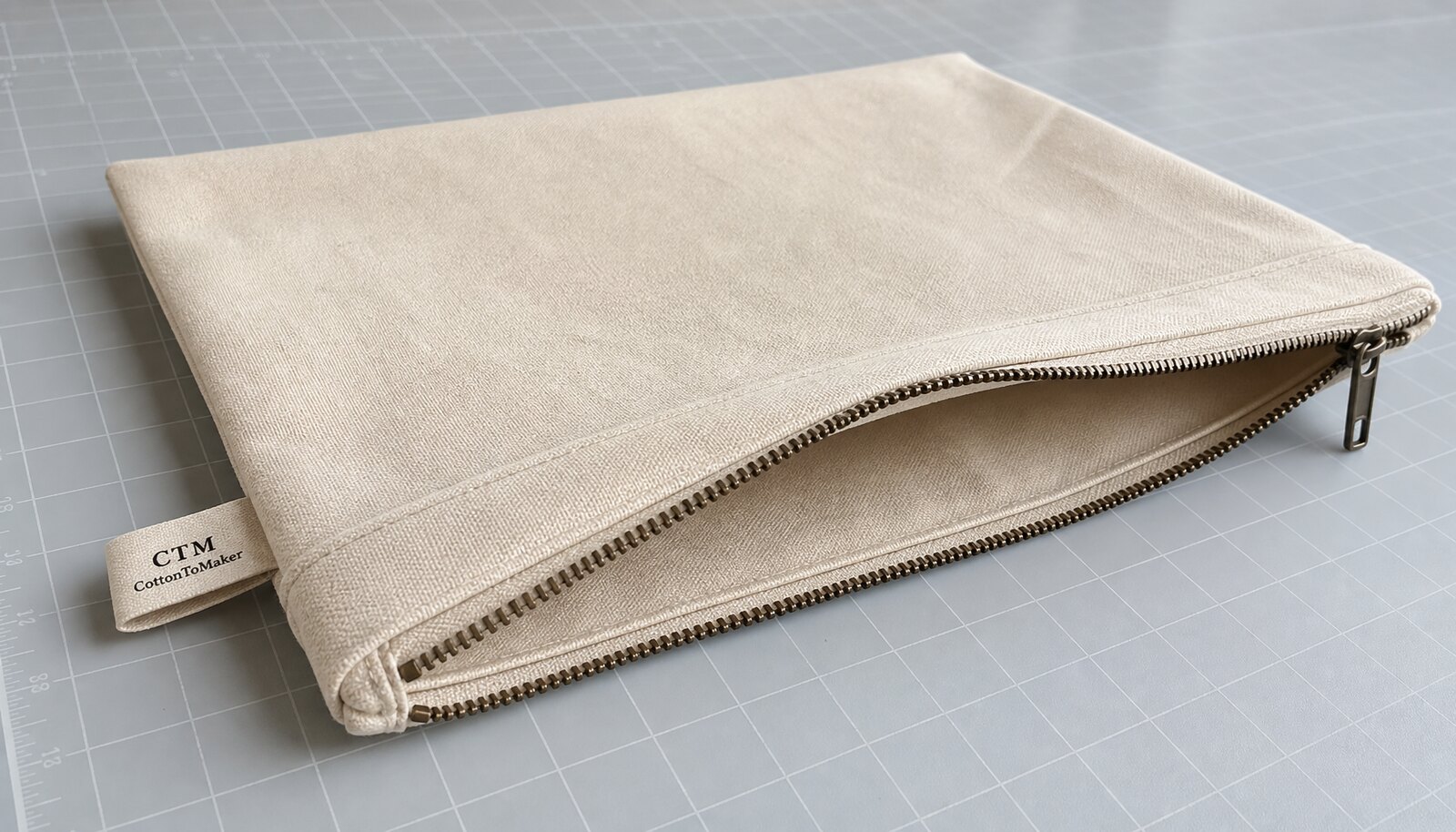
Work Backward From the Real In-Hand Date
For corporate gifting, the purchase order date is not the date that matters most. The useful date is when the finished canvas zipper portfolios must be at the destination, counted, checked, and ready to hand out or ship onward. A factory can finish sewing on schedule and the program can still miss the event because export booking, customs clearance, local courier delivery, final kitting, or internal distribution was never built into the timeline.
Start with the final use date, then work backward. Separate the event date from the warehouse in-hand date, the requested factory ship date, and the latest date for sample and artwork approval. If the portfolios are needed for a conference, employee onboarding kit, sales meeting, client appreciation package, or product launch, leave time at destination for receiving inspection. Cartons may need to be opened, counted, sorted by department, relabeled, or inserted into a larger gift set.
The most common delay is often not the sewing line. It is the time spent waiting for decisions. A supplier cannot responsibly reserve canvas, order zipper tape, make screens, produce labels, or cut panels while size, logo placement, packaging, and delivery addresses keep changing. If the event date is fixed, say so in the first RFQ. A practical supplier can then steer the order toward an existing pattern, stock canvas color, standard zipper, simple logo method, or bulk packing route that fits the deadline.
- Build one planning line for RFQ clarification, sampling, buyer approval, material booking, bulk production, packing, inspection, freight, customs, and destination receiving.
- Do not treat quoted production lead time as total project lead time; production usually starts only after artwork, sample, materials, and commercial terms are cleared.
- Set a written last-change date for artwork, logo placement, packaging, carton marks, and delivery address before bulk materials are released.
Use Lead-Time Ranges Before Price Negotiation
Canvas zipper portfolios can move quickly when the buyer accepts a known factory pattern, available fabric, a standard trim set, a simple logo, and uncomplicated packing. They slow down when the order needs custom-dyed canvas, non-stock zipper colors, custom pullers, multi-color branding, woven labels, gift boxes, insert cards, or shipment splits. A single lead-time number hides too much, so ask each supplier to break the schedule into sample, material, production, packing, inspection, and shipping handoff.
As a working benchmark, an existing-pattern custom-logo order often needs about 5-10 working days for a representative sample or production proof, then about 20-35 working days for bulk production after full approval. These are planning ranges, not guarantees. Quantity, factory loading, material availability, season, and revision rounds all matter. Custom dyeing, special trims, complicated interior organization, presentation packaging, and multiple logo versions can add time.
Freight deserves its own line in the plan. Courier or air may save transit days, but bulky gift packaging can make dimensional weight expensive. Ocean freight may suit larger planned programs, but it needs more calendar time and cleaner paperwork coordination. Compare the full program cost under a planned route, an urgent route, and a rescue route using domestic blanks with local decoration. The lowest ex-factory price is not always the lowest total cost if it forces premium freight.
- Ask suppliers to state lead time in working days and name the trigger: after deposit, after sample approval, after artwork approval, or after material arrival.
- Keep sample time, material time, production time, packing time, inspection time, and transit time as separate blocks in the schedule.
- When one quote is much faster than the others, ask what materials are already in stock and whether the timeline assumes no sample revision.
Write the Specification Like a Production Brief
A canvas zipper portfolio may look straightforward in a catalog image, but the finished product depends on many choices. Finished size, usable internal space, canvas weight, lining, zipper gauge, pocket layout, reinforcement, logo method, and packing all affect price, timing, and inspection. If the RFQ leaves those details open, suppliers will fill the gaps differently. One may quote unlined 12 oz canvas with a standard No. 5 nylon zipper. Another may quote lined 16 oz canvas with internal pockets, a custom puller, and individual gift packing. Those are different products.
Tie the finished size to the actual contents. If the portfolio must hold A4 documents, US letter documents, a tablet, a notebook, a pen, or a full gift set, provide the dimensions and desired clearance. A few millimeters can matter because seam allowance, lining, zipper tape, and binding reduce usable internal space. For a gift set, test the full contents in the sample rather than approving the outside appearance only.
Canvas language needs precision. Ounce ratings can vary by measurement convention and finishing, so it is useful to request both the commercial oz description and the GSM target where possible. A 12-14 oz canvas, roughly 400-475 gsm depending on weave and finish, is common for lighter promotional portfolios. A 15-18 oz canvas, roughly 500-610 gsm, gives a firmer hand and better structure. Heavier fabric can feel more premium, but it may slow sewing, thicken corners, require stronger needles, and increase carton weight.
- State finished width, height, gusset or spine depth, zipper opening length, internal usable size, and intended contents.
- Specify canvas weight, fabric color reference, weave if known, finish, and whether the material is dyed, washed, unwashed, laminated, or backed.
- Define lining, pocket count, pocket size, card slots, pen loop diameter, elastic loops, binding tape, and reinforcement at stress points.
Specify the Zipper and Visible Trims
Zipper specification is a frequent weak spot in portfolio sourcing. Words such as premium zipper, smooth zipper, or metal-look zipper are not inspection standards. For many document-size canvas zipper portfolios, a No. 5 nylon coil zipper is a practical option because it bends around corners and is widely available. Larger portfolios, heavier contents, or designs that place more stress on the closure may need No. 8 or another stronger zipper. The right choice depends on portfolio size, fabric thickness, curve radius, seam construction, and expected load.
The zipper is not just the teeth. Define the tape color, slider finish, puller style, puller length, end-stop method, opening direction, and whether the zipper runs along one edge, two sides, or three sides. A different puller shape may look minor in a rendering, but it can create a separate trim sourcing timeline. For corporate gifts, this detail affects perceived quality as much as function. A mismatched tape color or flimsy puller can make an otherwise acceptable portfolio feel inconsistent.
Other trims need the same discipline. Woven labels, cotton labels, PU patches, leather patches, embroidered patches, elastic loops, binding tape, snaps, magnets, and carton labels may come from different vendors. One delayed trim can hold the entire order even if the canvas body is ready. Ask which trims are standard, which are made to order, and which require separate sample approval.
- Use specific wording such as No. 5 nylon coil zipper, black tape, nickel slider, standard flat puller, and zipper opening around two sides.
- Check zipper action around corners and thick seam intersections, not only along the straight run.
- Approve visible trims before bulk production: zipper puller, label, patch, binding, lining color, elastic, thread, and carton label.
Choose Logo Application for Schedule and Brand Finish
Logo method has a direct effect on lead time and defect risk. A 1-2 color screen print on a flat canvas panel is often efficient for corporate gifting when artwork is final and the print area is away from seams, zipper tape, and heavy folds. Send vector artwork, confirm the logo size, and provide a Pantone, CMYK, or physical color reference. If brand color is important, request a strike-off because canvas texture, fabric shade, and ink opacity can change how a logo reads compared with a digital file.
Screen print is not always the best finish. Very small type, gradients, many colors, metallic effects, or more understated executive branding may work better as a woven label, cotton label, PU patch, leather patch, embroidered patch, or debossed patch. These can look cleaner and reduce ink-related problems, but they add trim sampling, trim MOQ, placement control, edge finish, and sewing decisions.
Write logo placement in measurable language. Front center is too loose for a production order. State the logo width and height, orientation, and distance from finished edges. During QC, measure from the completed portfolio after sewing, not from a cut panel before assembly. For flat applications, a placement tolerance such as +/-3 mm to +/-5 mm is often practical, but it should be confirmed with the supplier before bulk production.
- For screen print, ask for color count, ink type, screen setup charge, curing method, strike-off process, and placement tolerance.
- For labels or patches, ask for trim sample time, bulk trim time, edge finish, stitch method, and placement tolerance.
- Do not approve logo color from a monitor alone when brand consistency matters; use Pantone, a physical swatch, or an approved production strike-off.
Build the Critical Path Around Approvals
A useful lead-time plan shows what controls the earliest ship date. On one order, the critical item may be custom-dyed canvas. On another, it may be woven labels, printed gift boxes, barcode stickers, or a final logo file that has not been released by marketing. Ask the supplier to identify the bottleneck and show which approvals must happen first. Then protect that point in the timeline.
A typical sequence includes RFQ clarification, quotation, sample or proof, buyer approval, material purchasing, trim production, cutting, logo application, sewing, thread trimming, in-line QC, final packing, inspection, and shipping handoff. Some steps can overlap. Stock canvas may be reserved while a print strike-off is under review. But the factory should not cut bulk fabric while size or construction is still being revised, and printed packaging should not start before artwork, barcode data, and carton labeling rules are final.
One decision owner helps. If procurement, marketing, legal, HR, and the event team all send comments separately, the supplier may receive mixed instructions. Collect feedback into one revision sheet and issue one final approval. Each revision should state whether it changes size, construction, logo, color, packing, carton marks, or delivery details. That keeps the production file clean and avoids expensive misunderstandings.
- Request a written schedule with dates for artwork approval, sample approval, material release, packing approval, inspection booking, and shipping handoff.
- Treat logo approval, construction approval, and packaging approval as separate decisions unless one approved sample covers all three.
- For tight schedules, lock the existing pattern, stock fabric, standard zipper, simple print, and bulk packing as early as possible.
Plan Packaging as a Bill of Materials
Packaging is often where corporate gifting schedules drift. The sewn portfolio may be ready, but the order cannot ship because insert cards, sleeves, tissue, gift boxes, barcode labels, stickers, or carton marks are still pending. If the portfolio must arrive presentation-ready, packaging belongs in the first RFQ and the first sample review. A gift-packed portfolio is a different lead-time and freight project from a bulk-packed portfolio.
Create a packaging bill of materials. List the individual polybag or paper sleeve, tissue wrap, silica gel if required, thank-you card, instruction insert, belly band, gift box, sticker, barcode label, inner carton, master carton, carton marks, pallet label, and destination-specific labels. Each item should have an owner, artwork status, approval status, supplier source, and required arrival date. If the portfolio is part of a larger kit, include assembly instructions and the packing sequence.
Packaging changes freight math. Gift boxes increase carton volume and often reduce units per carton. Heavy canvas increases gross weight, while bulky presentation packaging increases dimensional weight for courier and air shipments. Request carton dimensions, gross weight, net weight, units per carton, and estimated CBM before confirming freight. If the buyer needs palletization, retail labels, distribution-center routing labels, or marketplace-style carton marks, those details must be settled before final packing.
- Fast route: individual polybag or paper sleeve, master carton, and simple carton marks.
- Presentation route: tissue, insert card, sleeve or box, barcode, and possible set assembly, with approval time for each component.
- QC should verify the portfolio, insert, barcode, SKU split, carton mark, carton quantity, and packing sequence.
Set QC Standards Before Bulk Starts
Quality control should be defined before mass production, not after cartons are packed. For canvas zipper portfolios, the main inspection points are finished size, fabric appearance, logo accuracy, zipper function, stitching, interior fit, trim attachment, and packing count. Corporate gifts do not need to be inspected like luxury leather goods, but they do need to look consistent and work reliably across the order.
Many B2B buyers use AQL sampling for final inspection and require 100% checks on selected functional points, such as zipper opening and closing. The exact AQL level depends on buyer policy, order value, and risk tolerance. What matters is that the PO or inspection booking states the standard. Critical defects may include unsafe sharp edges, broken zipper, wrong logo, severe contamination, mold, or wrong product. Major defects may include obvious print misplacement, open seams, non-functioning pockets, heavy stains, incorrect packing, or finished size outside tolerance. Minor defects may include small thread ends or slight cosmetic variation within approved limits.
Do not wait until final inspection to see the first bulk pieces. Ask for photos from the first finished units: front, back, inside, zipper corners, logo close-up, lining, label, and packaging. If something is wrong, production can pause before the issue spreads through the run. For repeat orders, compare against the sealed approved sample, final spec sheet, and previous production notes, not a sales image or memory.
- Define size tolerance, logo placement tolerance, stitch requirements, zipper function, fabric defect limits, and acceptable packing variation before bulk production.
- Measure finished units after sewing and packing relaxation, not only cut panels.
- Include packing checks for SKU, logo version, unit count, inner count, master carton count, carton marks, and gross weight spot checks.
Compare Suppliers by Landed Cost and Risk
A procurement buyer should not compare canvas zipper portfolio quotes by unit price alone. A lower price can become more expensive if it excludes packaging, depends on outsourced decoration, misses the ocean freight window, or forces air shipment. A higher quote may be stronger if it uses an existing pattern, controlled trims, realistic scheduling, and cleaner packing. The comparison should show ex-factory price, setup charges, sample charges, packaging cost, freight basis, duties or import assumptions where applicable, inspection cost, and destination handling.
Make suppliers quote the same Incoterm and the same included scope. EXW, FOB, FCA, CIF, DAP, and courier-to-door are not interchangeable. If the quote is FOB, confirm the port, export carton inclusion, and export documentation. If the quote is courier or air, ask whether dimensional weight or actual weight is used and whether duties and taxes are excluded. These are not only accounting details; they affect schedule confidence.
For fixed-date gifting, lateness can cost more than the product savings. Late delivery can require emergency domestic purchasing, split shipments, local repacking, overtime sorting, or missed distribution. Compare at least two scenarios: planned production with economical freight, and urgent production with compressed freight or domestic blanks. That makes the tradeoff visible before the order is already in trouble.
- Compare quotes using the same specification, quantity split, packaging, Incoterm, and delivery destination.
- Request carton CBM, gross weight, net weight, and units per carton before issuing the PO.
- Treat rush freight as a program cost, not a surprise, unless it was deliberately chosen at the planning stage.
Send an RFQ That Produces Usable Answers
A strong RFQ for canvas zipper portfolios should read like a concise production brief. Include product type, intended use, quantity, finished size, internal fit requirement, canvas specification, zipper specification, lining, pocket layout, logo method, artwork files, packaging, destination, delivery deadline, inspection requirement, and requested quote format. If alternatives are welcome, ask for them as separate option lines so the comparison stays clean.
Ask suppliers to expose their assumptions. If the quote uses an existing pattern, request the pattern code and photos of the same construction. If it requires a new pattern, ask for sample cost, sample time, and revision policy. If it assumes stock fabric, ask whether all units will come from one lot and how long the fabric can be reserved. If printing, labels, patches, or gift boxes are outsourced, ask who controls approval and timing.
For repeat corporate gifting programs, turn the first approved order into a master spec. Keep the final dimensions, material references, zipper details, logo file, approved sample photos, packing instructions, carton marks, tolerances, and inspection notes. It will shorten the next RFQ cycle and prevent specification drift when a new buyer, designer, or supplier contact joins the project.
- Use an RFQ table with separate fields for required spec, acceptable alternative, supplier assumption, lead time, and price impact.
- Request a breakdown for sample, setup, unit cost, packaging, cartons, inspection support, freight assumption, and tooling or trim charges.
- End the RFQ with a schedule split: sample days, approval deadline, material days, production days, packing days, inspection days, and shipping handoff date.
Specification comparison for buyers
| Planning decision | Typical B2B range or recommended spec | When it fits | Procurement risk to verify |
|---|---|---|---|
| Order route | Existing factory pattern with custom logo; sample 5-10 working days, bulk production often 20-35 working days after approval | Planned corporate gifting programs, repeat promotional orders, and buyers who can approve one standard portfolio construction | Confirm pattern code, finished dimensions, seam allowance, zipper gauge, lining, and logo placement match the approved sample before bulk cutting |
| Order route | Domestic blank stock plus local decoration; decoration often 3-10 working days after art approval if blanks are available | Rush orders where the buyer accepts available colors, available sizes, and limited customization | Check blank stock is from one production lot; mixed lots can create shade, canvas weight, and dimension variation |
| Order route | Trading company or gift-program consolidator; schedule depends on the slowest subcontracted component | Multi-item gift sets requiring bag, card, box, kitting, and destination labeling under one coordinator | Request the critical path by component: portfolio, insert card, gift box, sticker, carton, and final assembly |
| Canvas fabric | 12-14 oz canvas, approximately 400-475 gsm depending on weave and finish | Budget-sensitive portfolios, event handouts, or lighter document organizers | Require GSM or oz measurement method; cotton canvas ounce ratings are not always converted exactly across suppliers |
| Canvas fabric | 15-18 oz canvas, approximately 500-610 gsm depending on weave and finish | Higher-value corporate gifts needing firmer hand feel and better shape retention | Heavier fabric may require stronger needles, slower sewing, wider turning allowances, and higher carton weight |
| Zipper specification | No. 5 nylon coil zipper for most document portfolios; No. 8 or larger for oversized or heavily loaded styles | Standard A4 or letter-size zipper portfolios carrying documents, notebooks, or light accessories | Confirm zipper tape color, slider finish, puller shape, end stops, and zipper opening length; do not accept 'standard zipper' as a final spec |
| Logo method | 1-2 color screen print; setup typically requires separated vector artwork and a confirmed ink reference | Simple corporate logos, larger quantities, and flat logo areas away from seams and zipper tape | Set print position tolerance, ink color reference, and rub-resistance expectation; late artwork changes can require new screens |
| Logo method | Woven label, cotton label, PU patch, leather patch, or embroidered patch sewn onto the portfolio | Premium gifting, understated branding, or programs where ink cracking and heavy ink hand feel are concerns | Trim sampling and label MOQ can add lead time; confirm label size tolerance and stitch method before production |
| Packing method | Bulk pack in individual polybags or paper sleeves, then master carton; usually fastest | Orders that will be re-kitted, handed out internally, or packed with other items at destination | Define units per inner pack and master carton; corners and zipper pulls need protection from compression |
Buyer checklist before sampling
- Separate the final event date, destination in-hand date, requested factory ship date, and freight handoff date in the RFQ.
- State quantity by color, quantity by logo version, and whether split shipments or mixed SKUs are allowed.
- Define finished size in millimeters or inches, including width, height, gusset or spine depth, zipper opening length, and acceptable size tolerance.
- Specify whether the portfolio must fit A4 documents, US letter documents, a tablet, a notebook, a pen, or a complete gift set; provide insert dimensions if fit matters.
- Lock canvas weight by GSM or oz rating, fabric color reference, weave type if known, and whether the fabric is dyed, washed, unwashed, or laminated/backed.
- Specify lining material, inside pocket layout, pen loop dimensions, card slots, elastic loops, binding tape, and any reinforcement at stress points.
- Confirm zipper gauge, zipper type, tape color, slider finish, puller design, and whether the zipper should open around two sides or three sides.
- Provide artwork as vector files with Pantone, CMYK, or physical color reference; include logo size, placement from finished edges, and orientation on the portfolio.
- Decide the decoration method before pricing: screen print, heat transfer, embroidery patch, woven label, cotton label, PU patch, leather patch, or debossed patch.
- State packaging requirements as a bill of materials: individual bag, tissue, insert card, sleeve, gift box, barcode sticker, carton label, and master carton marks.
Factory quote questions to send
- What exact finished dimensions are you quoting, and what size tolerance will you hold for width, height, gusset or spine depth, and zipper opening?
- Is this based on an existing portfolio pattern? If yes, what is the pattern code, and can you provide photos or a sample of the same construction?
- What canvas weight are you quoting in GSM and/or oz, and is the fabric dyed, washed, unwashed, laminated, or backed?
- What is the expected fabric weight tolerance, color tolerance, and shrinkage risk after any washing or finishing process?
- What lining, binding tape, reinforcement, pocket layout, pen loop, and internal organizer details are included in the quoted price?
- What zipper gauge and type are included: No. 5 nylon coil, No. 8 nylon coil, metal zipper, resin zipper, or another specification?
- What are the slider finish, puller style, tape color, end-stop method, and zipper opening length?
- Which logo method are you quoting, and what artwork format, setup charge, minimum logo size, and placement tolerance apply?
- For screen print, how many colors, screens, ink types, curing steps, and strike-off approvals are included?
- For woven labels or patches, what is the trim MOQ, sample time, production time, and approved stitch method?
Quality-control points to confirm
- Finished dimensions should be measured on the completed portfolio after sewing and packing relaxation; common practical tolerances are often around +/-5 mm for small features and +/-10 mm for main width or height, but the buyer should approve the exact tolerance before production.
- Canvas weight must be checked by agreed method, such as GSM test on cut swatches or supplier mill certificate plus random verification; do not rely only on terms like heavy canvas, premium canvas, or 16 oz look.
- Fabric color should be judged against a sealed physical standard or approved lab dip under consistent lighting, not only against a screen image or email mockup.
- Visible fabric defects should be classified before shipment: oil marks, stains, broken yarns, severe slubs, holes, excessive shade bands, and obvious creases on the logo area should be treated as major or critical depending on severity.
- Zipper function should be checked across the full opening; the slider should move smoothly without catching at corners, splitting behind the slider, exposed sharp edges, missing end stops, or loose pullers.
- Zipper tape should be sewn straight and evenly tensioned; waves near the corners can create a cheap appearance and may cause the portfolio to twist when closed.
- Stitch density should be specified and checked against the approved sample, commonly in stitches per inch or stitches per 3 cm; inconsistent stitch length, skipped stitches, loose threads, and broken backstitching should be classified clearly.
- Stress points around zipper ends, pull tabs, side seams, handles if any, and internal pockets should use reinforcement consistent with the approved sample, such as bartacks, backstitching, binding, or extra seam allowance.
- Logo placement should be measured from finished edges, not cut-panel edges; a practical placement tolerance such as +/-3 mm to +/-5 mm is often suitable for flat prints if the factory confirms capability.
- Screen print should be checked for color, opacity, registration, pinholes, smudges, cracking, hand feel, and adhesion after curing; request a print strike-off when color accuracy matters.