Start with the warehouse-ready date
Craft fair buyers often start with the public event date. That is understandable, but it is not the date procurement should plan around. The stronger deadline is the warehouse-ready date: the day the portfolios must be received, counted, inspected, tagged, sorted, kitted, or released for booth delivery. If cartons arrive two days before the fair, the shipment may look on time on paper and still miss the operational window.
Work backward from the first internal handling step. Add time for domestic transport, receiving appointment, inbound count, SKU verification, barcode scan, kit assembly, local redistribution, import clearance, international freight, origin handling, final inspection, production, PP sample approval, print strike-off, material approval, artwork review, and RFQ clarification. This turns a vague request for fast delivery into a calendar where every approval has an owner and a cutoff date.
For imported bulk orders, a realistic planning window is often 90-120 days from first RFQ to warehouse-ready stock when first-time sampling, custom artwork, and sea freight are involved. Repeat orders can move faster, especially with stock natural canvas, stock zipper tape, one-color screen print, and an approved construction. Still, do not leave approval dates informal. Seasonal craft fair programs compete with other event, retail, and promotional orders, so capacity should be confirmed in writing before dates are promised to internal stakeholders.
- Set the required warehouse-ready date before asking for production lead time.
- Leave time for carton count, SKU check, barcode scan, kit assembly, and local redistribution.
- Ask the factory to quote lead time from a defined trigger, such as approved PP sample, not PO issue alone.
- Add decision deadlines for artwork, fabric, lab dips, strike-offs, packing data, and shipping marks.
- Keep partial air freight as a backup for urgent launch quantities, not as the base plan.
Separate sourcing, production, and freight
A single lead time number can hide a lot. A supplier may quote 45 days, but 45 days from what? Deposit receipt, artwork approval, material booking, PP sample approval, or receipt of packing data all create different calendars. That number may also exclude sample courier time, buyer review, final inspection scheduling, export documents, freight booking, customs clearance, and downstream distribution. B2B buyers should ask for the schedule in phases before committing to a craft fair launch date.
Sampling is usually the first critical path. A fabric swatch confirms weight, hand feel, shade, weave, and finishing, but it does not prove zipper function, lining behavior, print placement, or finished size. A print strike-off proves the artwork on the actual fabric. A first sewn sample proves the construction. A PP sample should pull everything together: final materials or approved equivalents, zipper, label, artwork position, stitch structure, and packing method.
Production then depends on quantity, SKU count, fabric status, zipper availability, printing capacity, sewing line availability, trimming, rework, and packing complexity. Freight depends on origin location, trade term, port schedule, freight mode, customs documents, warehouse appointment, and whether cartons go into storage or straight into kit assembly. When these phases are listed separately, delay becomes visible early enough to manage.
- RFQ clarification: align specs, artwork matrix, destination plan, and supplier assumptions.
- Sampling: include sample making, courier transit, buyer review, revision, and sealed reference approval.
- Material preparation: stock canvas is faster; dyed fabric, zipper tape, labels, and custom pulls add risk.
- Bulk production: cover cutting, printing, curing, sewing, trimming, inline QC, final inspection, and export packing.
- Logistics: include pickup, export clearance, ocean or air transit, import clearance, appointment, and receiving checks.
Specify canvas, not just canvas
The word canvas is too broad for purchasing. Two factories can quote the same zipper portfolio drawing with very different assumptions. One may use 8 oz promotional cotton, another 12 oz cotton canvas, and another a heavier washed canvas. The prices may look comparable, but the product will not feel or perform the same. State fabric weight in both oz and GSM, fabric color, weave expectation, finish, shrinkage control if relevant, and the acceptable appearance range.
For many craft fair portfolios, 12 oz cotton canvas, typically about 380-410 GSM, is a practical baseline. It has more body than light cotton and is still easier to cut, print, sew, and pack than 14-16 oz canvas. A simple giveaway may work with 10 oz after sample review. A retail accessory or protective art-print holder may justify heavier canvas, lining, reinforcement, or gusseted construction. Heavier is not automatically better; it can create bulky corners, zipper drag, needle breakage, higher freight weight, and more visible puckering.
Natural canvas needs visual approval because seed flecks, yarn variation, shade differences, and small slubs are part of the look. Those features may be welcome for a handmade craft aesthetic, but they should match the approved sample. Dyed canvas adds control points: lab dip approval, bulk shade review, and zipper tape matching. If brand color is strict, provide Pantone targets and ask whether the supplier controls shade by visual standard, instrument reading, or both.
- 8-10 oz canvas: lower cost and weight, but limited structure for premium document portfolios.
- 12 oz canvas: balanced starting point for vendor kits, artist packs, event merch, and document holders.
- 14-16 oz canvas: stronger hand feel, with bulkier seams, slower sewing, and higher freight weight.
- Washed canvas: softer hand and lower shrinkage risk, with more casual shade and texture variation.
- Dyed canvas: better color direction, but requires lab dip approval, bulk shade approval, and more lead time.
Engineer the size around real contents
A zipper portfolio should be built around what goes inside it, not just a paper size label. A4 sheets, U.S. letter documents, catalogs, art prints, order forms, postcards, notebooks, and craft kits all have different thickness and handling needs. If warehouse staff must insert hundreds or thousands of kits quickly, a tight fit becomes a labor cost. Send actual dimensions and thickness, especially for sleeved prints, spiral notebooks, thick catalogs, certificate folders, or pre-packed bundles.
A useful starting point is 10-20 mm clearance beyond the largest flat insert, with more room if contents are rigid, sleeved, or stacked. Define what finished size means before sampling: outside seam-to-seam, usable inner space, or flat panel before sewing. For standard flat sewn textile portfolios, plus or minus 5 mm finished size tolerance is more realistic than paper packaging tolerance. If a rigid insert must fit exactly, the factory needs real insert samples or a measured insert specification.
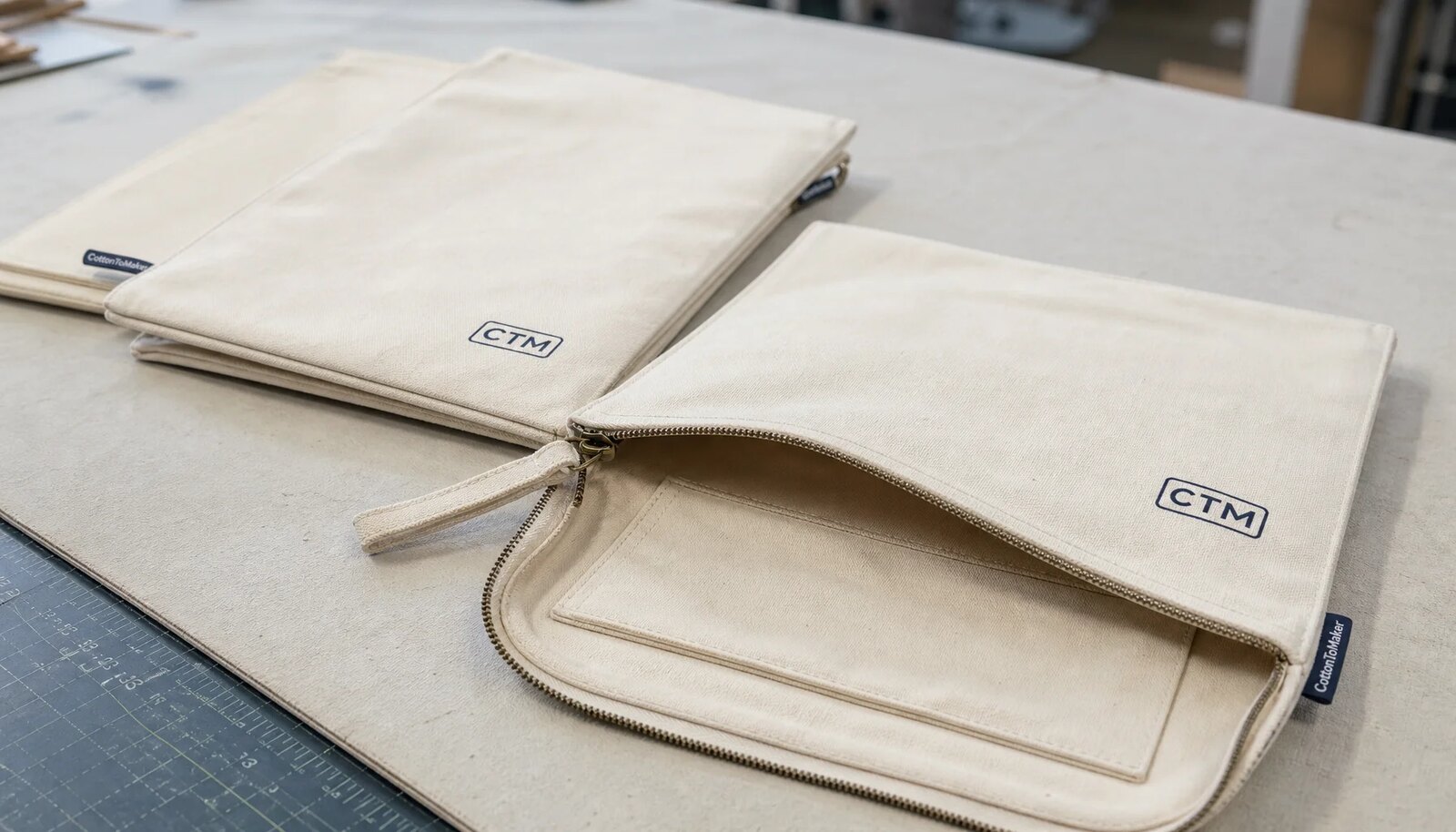
Opening style matters as much as size. A long-side zipper creates a wide opening for documents and art prints. A short-side zipper can suit vertical sleeve use, but may slow insertion of thicker materials. Rounded corners look soft and retail-friendly, yet a tight radius on heavy canvas can cause zipper drag and puckering. Gussets add capacity but change the pattern, sewing steps, carton volume, and landed cost. Freeze lining, divider pockets, pen loops, wrist straps, zipper tabs, and padding before comparing final RFQs.
- Confirm contents by width, height, thickness, and insertion method, not paper size alone.
- Define the finished size measurement point and tolerance before PP sample approval.
- Use reinforced zipper ends or bar-tack style reinforcement for repeated event handling.
- Avoid tight corner radii on 14-16 oz canvas unless proven by a sewn sample.
- Treat lining, gussets, pockets, and padding as schedule and cost changes, not small edits.
Choose zipper details early
The zipper is one of the first things users notice. For A4, letter-size, catalog, and artist print portfolios, a #5 nylon coil zipper is a strong B2B starting point. It is flexible on soft canvas, usually smoother around corners than rigid tooth options, and more substantial than many #3 zippers used on small pouches. The quote should name the zipper size, coil or tooth type, tape material, tape color, slider type, puller shape, puller finish, and zipper end finish.
A weak zipper can turn an otherwise acceptable canvas item into a complaint. A #3 zipper may be fine for compact flat pouches, but it can feel undersized on portfolios opened repeatedly at booths, workshops, and checkout counters. Metal tooth zippers can look premium, yet they may be stiff on soft fabric and can scratch paper inserts or cards. Custom pulls improve branding, but they add approval time, possible tooling, and component minimums. If the craft fair date is fixed, stock pullers and stock tape colors are safer.
Zipper QC should be simple enough to repeat during inline and final inspection. Selected units should be opened and closed across the full length several times. Inspectors should watch the corners, zipper ends, slider alignment, puller strength, and fabric caught near the seam. The zipper should not snag, split, jam, expose sharp edges, or pull loose at the ends. If there is lining, it must not interfere with the slider.
- Specify #5 nylon coil zipper for many standard document and event kit portfolios.
- Use #3 only for smaller, lighter pouches after sample approval.
- Confirm tape color by stock reference or approved standard, not by a general color name.
- Define puller material, finish, shape, branding, and tooling cost before PO issue.
- Inspect zipper function, end security, slider smoothness, and lining clearance during QC.
Plan artwork by SKU
Most craft fair canvas zipper portfolios use screen printing because it works well for simple logos, sponsor blocks, event names, and one to three spot colors. Screen printing on cotton canvas still needs control. Ink deposit, opacity, curing, and fabric movement all affect the result. Send vector artwork, Pantone references, print dimensions, placement drawings, and measurement points. For sewn textile items, plus or minus 5 mm print position tolerance is often more realistic than paper-level placement tolerance.
Transfer printing can handle gradients, illustrations, photographs, and many short artwork versions, but it changes the surface feel. On natural canvas, a transfer may sit on top of the fabric instead of blending into the textile hand. Test it for edge lifting, cracking after folding, rub resistance, and heat sensitivity. Embroidery can work for compact logos, although it may distort lighter canvas or create backing issues inside unlined portfolios. Woven side labels are useful when the base brand stays the same while event names, hangtags, or inserts change.
The artwork matrix can affect lead time as much as the order quantity. Five sponsor logos are five production versions, even if fabric, size, and zipper are identical. Each version may need separate screens, strike-offs, setup, drying space, inspection, SKU labels, and carton separation. Late sponsor changes can stop a line or create rework. For multi-city craft fair programs, many buyers reduce risk by using one base print and localizing with hangtags, insert cards, belly bands, or carton allocation labels.
- Screen print: best for simple event names, sponsor marks, and bold brand graphics.
- Transfer print: useful for full-color art or short runs; test folding, rub, and edge behavior.
- Embroidery: premium for small logos, but risky for large filled areas or thin canvas panels.
- Woven label: efficient for repeat branding across multiple event versions.
- Hangtag or insert card: practical for regional localization without changing the base print.
Calculate MOQ from complexity
MOQ is rarely one clean total. The real minimum may come from fabric purchase, dye lot, zipper tape color, print setup, cutting efficiency, sewing line changeover, label production, barcode application, packing style, or carton separation. A 2,000-piece order with one canvas color, one size, one zipper color, and one logo is far easier to run than 2,000 pieces split across five craft fair logos, two fabric colors, three destination labels, and mixed packing rules.
Ask for a price ladder and a SKU matrix. The price ladder shows volume impact at practical breaks such as 500, 1,000, 2,500, and 5,000 pieces. The SKU matrix shows the cost of complexity by artwork, color, size, label, barcode, and packing method. This matters for distributors, event agencies, museum stores, retail gift programs, and brands supporting several fairs in one season.
If regional personalization is important, consider one common base portfolio with a neutral print or woven label. Then localize with inserts, hangtags, belly bands, or destination carton labels. This can reduce screen setups, simplify sampling, avoid small-lot surcharges, and make the schedule more reliable. Decide this before production begins because inserts and hangtags still change packing labor, carton labels, and inspection requirements.
- Request unit price by quantity break and by number of artwork versions.
- Ask whether fabric color, zipper color, custom puller, woven label, or retail sleeve has a separate MOQ.
- Clarify setup charges for each artwork, print color, screen, color change, and production restart.
- Confirm whether cartons must be separated by SKU and destination or can ship assorted.
- Check whether stock canvas, stock zipper tape, and simpler packing reduce MOQ or lead time.
Use samples as control gates
Sampling is not a sales formality. It is the buyer’s main control system before bulk cutting and printing. A material swatch confirms fabric weight, shade, weave, hand feel, and finishing. A lab dip confirms dyed canvas color before bulk dyeing. A print strike-off confirms ink color, opacity, registration, curing, print hand, and performance on the actual fabric. A first sewn sample confirms size, zipper opening, seam construction, label placement, and real content fit.
The PP sample should be treated as the physical version of the production agreement. It should use final or approved-equivalent fabric, final zipper specification, final artwork size and placement, final label, intended lining or pocket construction, stitch method, and packing format. Once approved, it becomes the sealed reference for production and inspection. Photo approval can save days, but it can also hide zipper drag, fabric stiffness, odor, true shade, ink tackiness, panel twisting, and actual insert fit.
A tight schedule does not mean controls must disappear. Material swatch review and artwork strike-off review can run in parallel. PP samples can move by express courier. Buyer comments can be consolidated within one business day. What should be avoided is approving an incomplete sample while expecting the factory to infer the missing details. Every unresolved point becomes a factory assumption, and assumptions often become disputes at final inspection.
- Material swatch: approve weight, texture, shade, finishing, shrinkage expectation, and natural variation.
- Lab dip: approve dyed fabric color and state acceptable shade range before bulk dyeing.
- Print strike-off: approve Pantone match, opacity, registration, curing, rub resistance, and print hand.
- First sewn sample: verify size, opening, seam structure, label placement, and real content fit.
- PP sample: approve final construction, artwork, zipper, packing, carton marks, and inspection reference.
- Sealed reference: keep one with the factory and one with the buyer, inspector, or receiving team.
Control post-deposit delays
Many lead time problems begin after deposit because the trigger was never defined. Some suppliers count from payment. Others count from artwork approval, lab dip approval, fabric arrival, zipper confirmation, PP sample approval, or complete packing data. The PO should state the trigger clearly. If production is 45 days after PP sample approval, then a two-week artwork delay moves the ship date unless the factory separately agrees to compress the schedule.
Artwork is a frequent bottleneck. Missing vector files, unclear Pantone references, low-resolution sponsor logos, late sponsor changes, unapproved print size, and incomplete placement instructions can stop strike-off approval. Packing data can cause the same problem near shipment. Barcodes, PO numbers, destination codes, carton marks, retail warnings, country-of-origin wording, and warehouse routing labels may all need internal approval before the factory can pack correctly.
Material risk belongs in the pre-deposit conversation. Natural canvas may be available right away, while custom dyed fabric, matching zipper tape, custom metal pullers, private labels, or printed sleeves may not be. During peak promotional and retail seasons, printing tables and sewing lines may already be booked. Buyers with recurring craft fair calendars should share forecast quantities, expected artwork count, and delivery windows early so suppliers can plan fabric and zipper purchasing responsibly.
- Write the production lead time trigger into the PO and supplier confirmation.
- Send vector artwork, Pantone colors, print dimensions, and placement drawings before strike-off work starts.
- Reserve custom fabric, zipper tape, labels, pullers, and packaging before they become the critical path.
- Freeze packing format before bulk sewing ends because carton size and labor planning depend on it.
- Check supplier holidays, peak capacity, port cutoffs, and inspection availability before confirming event dates.
Pack for receiving, not just shipping
Packing affects cleanliness, scuffing, SKU accuracy, freight volume, receiving speed, and retail compliance. Canvas can pick up dust, carton fibers, moisture, and handling marks. Printed portfolios can abrade or transfer ink when units rub together. Individual polybags, recycled polybags, paper sleeves, paper bands, carton liners, and bulk packing can all work. The right choice depends on receiving workflow and defect tolerance, not only unit cost.
Individual packing is usually safer for retail programs, sponsor gifts, vendor kits, and multi-SKU distribution. It protects the surface, helps warehouse picking, and reduces contamination from repeated handling. Bulk packing reduces packaging material and may lower cost, but it increases the risk of scuffing, mixed counts, dirt marks, and receiving confusion. If reduced plastic is a priority, request recycled polybags, paper bands, or carton liners and approve the packing arrangement during sampling.
Carton planning should be part of the RFQ. Heavy canvas portfolios can make cartons too heavy if the pack count is high. A practical manual-handling target is often under 15-18 kg gross weight per carton where possible, though warehouse rules vary. Oversized flat products may increase dimensional weight even if each piece is light. Carton labels should show PO, SKU, artwork version, quantity, carton number, destination, barcode if required, country of origin where applicable, and event date.
- Use individual bags when cleanliness, print protection, barcode picking, or gift presentation matters.
- Use bulk packing only when handling marks and simple receiving are acceptable.
- Request pieces per carton, carton dimensions, gross weight, inner pack count, and carton label layout at quote stage.
- Avoid mixing event artworks in one carton unless the warehouse specifically requests assorted cartons.
- Test packing for scuffing, ink transfer, crushed corners, zipper deformation, moisture, and odor transfer.
Specification comparison for buyers
| Spec decision | Recommended option | When it fits | Buyer risk to check |
|---|---|---|---|
| Fabric weight | 12 oz cotton canvas, typically about 380-410 GSM, with fabric weight tolerance stated in the quote | Most craft fair retail bundles, artist kits, document packs, sponsor gifts, and branded merchandise where the portfolio must feel substantial without being difficult to sew | A quote that says only canvas may hide 8 oz or 10 oz fabric; request oz, GSM, weave, color status, and whether weight is before or after washing |
| Canvas color | Stock natural, black, navy, or other supplier-held colors before custom dyeing | Programs with fixed event dates, moderate quantities, and short approval windows | Custom dyed canvas can add lab dip approval, bulk shade review, and material minimums; natural canvas needs approval for seed flecks, slubs, and shade range |
| Construction | Unlined single-layer canvas with reinforced zipper ends; add lining only when the inside must look retail-finished | Vendor welcome packs, promotional document holders, craft fair merch, and event kits where cost, speed, and weight matter | Lining, gussets, inner pockets, padding, and pen loops change cutting, sewing sequence, inspection points, carton volume, and lead time |
| Zipper type | #5 nylon coil zipper with color-matched tape and metal or molded puller | A4, letter-size, catalog, notebook, and artist print portfolios that are opened repeatedly during events | A #3 zipper may feel weak on larger portfolios; metal tooth zippers can be stiff on soft fabric and may scratch inserts |
| Finished size tolerance | Plus or minus 5 mm for standard flat sewn portfolios; confirm tighter tolerance only after sample review | A4, letter, catalog inserts, art prints, certificates, vendor forms, and craft fair maps | If contents are rigid, sleeved, thick, or pre-packed, send real dimensions and thickness; nominal paper size is not enough |
| Print method | Screen print for 1-3 spot colors; transfer print for gradients, full-color artwork, or many short artwork versions | Most craft fair logos, sponsor marks, event names, and simple merchandise artwork | Screen ink must be cured and rub-tested on canvas; transfers should be folded and rubbed to check cracking, lifting, and edge durability |
| Branding tolerance | Print position tolerance of plus or minus 5 mm from approved reference unless factory confirms otherwise | Textile portfolios where panels can shift slightly during cutting, sewing, and printing | Demanding paper-level placement tolerance can raise rejects; define measurement point, printable area, and acceptable skew before PP approval |
| MOQ logic | Calculate MOQ by fabric color, zipper color, artwork, size, label, barcode, and packing style | Distributor and event agency orders split by regional craft fairs, sponsor versions, or destination cartons | One total MOQ may hide setup fees, small-lot surcharges, fabric minimums, dye minimums, or carton separation labor |
| Packing format | Individual polybag or recycled polybag plus export carton; carton label by SKU, PO, artwork, destination, quantity, and event date | Retail distribution, vendor kit assembly, fulfillment center receiving, and multi-location craft fair allocation | Bulk packing reduces packaging but increases scuffing, mixed SKU risk, dirt transfer, receiving time, and possible print abrasion |
Buyer checklist before sampling
- Define the business use case: document holder, artist kit, vendor welcome pack, sponsor gift, retail accessory, merchandise bundle, or promotional giveaway.
- Set the required warehouse-ready date, then work backward from craft fair setup, kit assembly, inbound inspection, customs, freight, production, sampling, and artwork approval.
- Specify finished size by actual contents, including width, height, thickness, sleeves, catalogs, notebooks, art prints, order forms, postcards, or certificate folders.
- State finished size tolerance, commonly plus or minus 5 mm for flat sewn canvas portfolios, and define whether measurement is outside seam, usable inner space, or panel size.
- Specify canvas weight in both oz and GSM, fabric color, weave expectation, shrinkage control, and acceptance rules for seed flecks, slubs, yarn variation, and natural shade range.
- Decide whether the product is unlined, lined, padded, gusseted, fitted with an inner pocket, reinforced at zipper ends, or built with tabs before requesting final price.
- Define zipper size, coil or tooth type, tape color, puller type, metal finish, zipper opening direction, zipper end finish, and whether custom puller branding is required.
- Provide vector artwork with Pantone references, number of print colors, print dimensions, print position, measurement point, printable area, and position tolerance from seams or zipper edge.
- List the number of SKUs by artwork, fabric color, zipper color, size, label, barcode, packing method, carton mark, destination, and event date.
- Set sampling gates: material swatch, lab dip if dyed fabric is used, printed strike-off, first sewn sample, PP sample, packing sample, and sealed production reference.
Factory quote questions to send
- What canvas weight in oz and GSM is included, what is the tolerance, and is the fabric stock, washed, pre-shrunk, sanforized, dyed to order, or purchased after PO?
- What is the MOQ by finished size, fabric color, zipper color, artwork, print color count, label type, barcode, packing style, and destination carton split?
- Does production lead time start after deposit, artwork approval, material approval, lab dip approval, PP sample approval, or receipt of all packing and shipping data?
- What are the quoted sample lead times for material swatch, lab dip, print strike-off, first sewn sample, PP sample, and revised sample if comments are issued?
- Which zipper specification is included: # size, nylon coil or tooth type, tape material, tape color, puller material, puller finish, slider quality, and zipper end finishing?
- Which print method is quoted, what is the maximum print area, how many colors are included, what curing method is used, and are screen, setup, or color-change charges separate?
- What finished size tolerance, print position tolerance, seam allowance tolerance, stitch density target, and acceptable natural fabric variation standard are used?
- Can you perform or support checks for zipper function, seam strength, print rub, color comparison, odor, moisture risk, carton drop or handling, and final random inspection?
- How many pieces per inner pack and export carton, what carton dimensions, what estimated gross weight, and what carton strength are planned for freight booking?
- Can cartons be labeled by PO, SKU, artwork, event date, destination, carton number, quantity, barcode, and country of origin, and is label creation or application included?
Quality-control points to confirm
- Finished size is within agreed tolerance, commonly plus or minus 5 mm unless otherwise approved, and usable inner space fits the intended A4, letter, catalog, notebook, print, or kit contents.
- Zipper opens and closes smoothly across the full length for repeated cycles, with no catching at corners, loose coil, missing teeth, bent slider, broken puller, sharp edge, or weak zipper end attachment.
- Canvas fabric matches the approved swatch for weight, shade range, texture, hand feel, and acceptable slubs, with no oil marks, weaving holes, mold, mildew odor, severe stains, or excessive lint contamination.
- Print color, opacity, registration, placement, size, edge sharpness, and curing match the approved strike-off or sealed PP sample within the agreed tolerance.
- Printed panels show no wet ink transfer, blocking, tackiness, cracking after normal folding, severe pinholes, unacceptable rub loss, or color shift against natural or dyed canvas.
- Seams at zipper ends, corners, pocket openings, tabs, labels, and stress points have secure stitching, consistent stitch density, backstitching or reinforcement where required, and no skipped stitches or open seams.
- Threads are trimmed, inside seams are clean, labels are straight, corners are even, and the portfolio lies reasonably flat without twisting, severe puckering, panel mismatch, or uneven zipper alignment.
- Lining, if used, is fully caught in seams, cleanly turned, not loose around the zipper, and does not reduce the usable opening below the approved sample.
- SKU separation follows the PO: correct artwork, fabric color, zipper color, barcode, hangtag, insert, carton label, destination allocation, and event date by carton.
- Packing protects the product from scuffing, ink transfer, crushed corners, zipper deformation, moisture, odor transfer, dirt, and mixed counts during normal export handling.