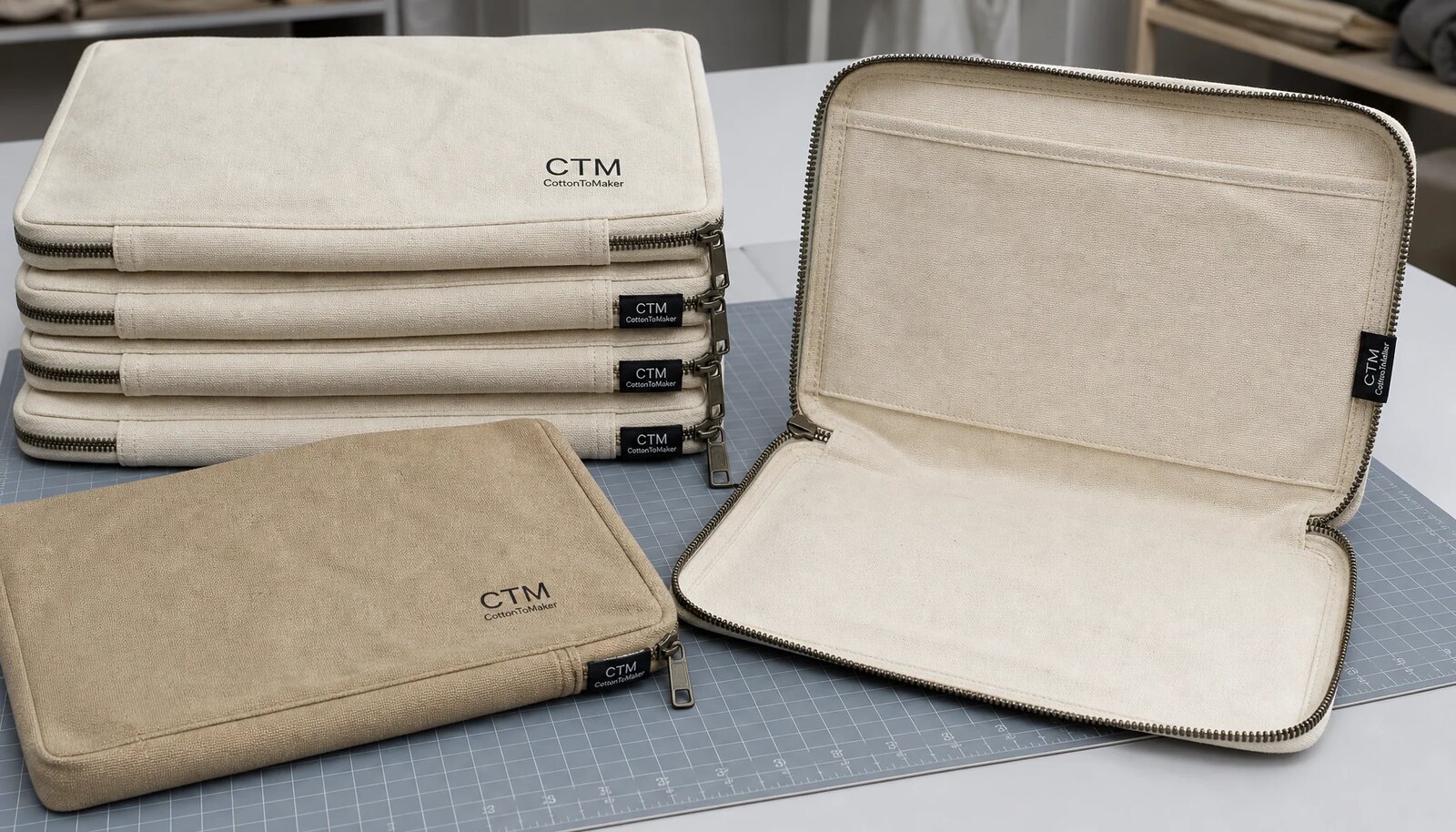
Why MOQ Is a Component Question
A canvas zipper portfolio looks simple, but the factory cost is built from several minimums: canvas roll usage, cutting setup, zipper tape, slider and puller sourcing, print setup, label or hangtag production, sewing time, inspection, packing, and export carton handling. The sewing factory may be able to make 500 pcs, while the custom zipper tape or dyed fabric supplier may require more. That is why an unexplained MOQ rarely helps a hotel buyer make a good decision.
For hotel retail, first orders are often cautious. A resort shop, spa desk, conference team, or boutique hotel group may want 300 to 800 pcs to test sell-through or guest response. The order is small, but the product is still handled like a retail item. Guests will notice rough zipper movement, stained canvas, crooked logos, and weak corners immediately.
The best MOQ negotiation starts by identifying the binding component. Ask the supplier what changes if you use stock canvas, a standard zipper color, a standard puller, one-color print, and flat packing. Once the true constraint is visible, procurement can decide whether to increase quantity, simplify customization, pay a setup charge, or move that feature to the reorder.
- Treat MOQ as the combined result of fabric, zipper, branding, construction, packing, and line setup.
- Ask the factory to name the component that prevents a lower pilot quantity.
- Use stock material and standard accessories before negotiating construction quality downward.
- State whether the order is a pilot, seasonal buy, event order, property launch, or repeatable hotel retail SKU.
Start With the Hotel Use Case
The same portfolio can serve different hotel jobs. A paid lobby retail item needs clean presentation, reliable barcode handling, and consistent front-panel appearance. An in-room welcome document pouch needs document fit and tidy branding more than premium hardware. A spa menu holder may need a softer, calmer natural canvas look. A conference kit needs fast insert loading and enough strength for bulk distribution.
Use case affects size. For A4 inserts, many buyers begin around 340 x 250 mm, but final dimensions depend on insert thickness, seam allowance, zipper opening, and pocket depth. U.S. letter sheets should not simply use A4 dimensions. If the opening is too tight, staff will force documents and stress the zipper. If the item is too loose, it can feel floppy on a retail shelf.
Decide early whether the portfolio is a reusable product or branded packaging. A reusable item needs stronger balance across canvas weight, zipper function, seam strength, and print durability. Branded packaging can be simpler, but it still has to arrive clean and open smoothly.
- Define the use: retail SKU, document pouch, spa menu sleeve, conference kit, amenity pack, or loyalty gift.
- Confirm insert format, insert thickness, finished size, zipper clearance, and pocket depth in millimeters.
- State display method: flat stack, hanging, belly band, polybag, in-room placement, or gift-set packing.
- Confirm whether barcode, hangtag, belly band, or carton-only identification is required.
Specify Canvas Without Overbuying
Fabric is usually the largest MOQ lever. Stock natural cotton canvas is easier to support at low quantity than custom-dyed, washed, coated, printed, or unusual-weave canvas. If the hotel can accept natural, ecru, off-white, black, or another supplier-stock color, the factory has more room to support a pilot run. If the color must match a precise brand shade, the dye house may control the minimum.
Write the fabric spec in both ounces and GSM. Canvas names vary by supplier, so 12 oz should be confirmed by measured GSM on the swatch. For many flat zipper portfolios, 12 oz cotton canvas at about 380-410 GSM is a balanced starting point. It has more body than lighter canvas without creating as much corner bulk, needle marking, zipper waviness, or freight weight as heavier canvas. A 10 oz option can work for budget document pouches. A 14 oz option can feel more premium but should be sampled for bulk and zipper behavior.
Natural canvas also needs a visual standard. Seed flecks, slubs, and shade variation may be normal unless the buyer requests bleached or dyed fabric. Approve physical swatches under neutral light and state the acceptable fleck level before sampling.
- Lowest-MOQ route: stock natural canvas, standard weave, no dyeing, no washing, no coating.
- Balanced route: 12 oz canvas, about 380-410 GSM, one-color print, standard zipper, flat packing.
- Premium route: dyed fabric, heavier canvas, washed finish, lining, custom puller, or upgraded retail packaging.
- For dyed fabric, request lab dip, Pantone target, fabric MOQ, shade tolerance, and lead time before confirming price.
Lock Size and Construction
Quote differences often come from missing construction details. One supplier may include a slip pocket, covered zipper ends, reinforced corners, and individual packing. Another may assume a basic pouch with simpler inside finishing and bulk pack. Both may call the item a canvas zipper portfolio, but the cost and quality level are not comparable.
Turn the product into a short technical specification before price shopping. Include finished width and height, zipper position, opening width, pocket depth, seam allowance, logo coordinates, label position, and inside finishing method. For soft canvas portfolios, plus or minus 5 mm on width and height is a practical starting tolerance. Use plus or minus 3 mm only when the item must fit a rigid insert, tight retail tray, menu board, or exact packaging.
Interior complexity should be intentional. One flat slip pocket is often enough for guest documents, spa menus, stationery sets, or conference materials. Multiple dividers, pen loops, lining, elastic, padding, and card slots add sewing minutes and more alignment risks. Add them only when they support a clear retail price or functional requirement.
- Provide a drawing or marked sample with size, zipper, pocket, seam, logo, and label positions.
- Set finished-size tolerance separately from logo, label, pocket, and zipper-position tolerance.
- Confirm inside seam finish: overlocked, bound, concealed, lined, or matched to approved sample.
- Keep trial-order construction simple unless the added feature improves retail value or hotel operations.
Choose Zippers Carefully
The zipper is a small component with a large effect on perceived quality. Guests notice rough slider movement, tape waviness, sharp pullers, and unfinished ends. For most canvas zipper portfolios, a No. 5 nylon coil zipper is a practical default because it is flexible, common in bag production, and easier to source than many custom metal options at low quantity.
Custom zipper tape color, branded pullers, special plating, and nonstandard slider finishes can all create separate accessory minimums. Standard tape colors such as black, natural, off-white, navy, or gray may be available through normal channels. Custom dyeing or molded pullers may not fit a 300-800 pc test order unless the buyer accepts a surcharge or carries leftover components into future orders.
Do not use zipper quality as the concession. Save MOQ by choosing a standard color or puller, not by accepting unstable tape, weak end stops, or rough movement. Test the approved sample after packing as well, because pullers can dent canvas or mark printed panels when cartons are too tight.
- Default to No. 5 nylon coil zipper unless the brand requires a specific premium look.
- Ask which tape colors, slider finishes, and pullers are stocked before specifying custom hardware.
- Define zipper length, tape exposure, opening direction, covered ends, puller orientation, and reinforcement method.
- Inspect sampled units with at least five open-close cycles and check for catching, separation, waviness, and pressure marks.
Control Branding and Retail ID
Branding is where low-MOQ projects can become expensive quickly. A one-color screen print on stock canvas is usually the cleanest route for hotel logos, spa sub-brands, resort marks, and destination graphics. Multi-color screen printing can work, but each color adds screen cost, registration control, approval time, and rework risk.
Heat transfer may suit fine detail, gradients, small text, or crests that do not print cleanly on textured canvas. It still needs approval for hand feel, edge finish, and durability on the exact fabric. Embroidery can look premium for small marks, but dense stitching may pucker flat canvas, especially on lighter weights or large logos. A small woven side label plus a simple front print often gives enough brand presence without adding too many production variables.
Retail identification should be in the original RFQ. Barcodes may go on a polybag, kraft belly band, hangtag, or export carton. Hangtags and belly bands improve presentation but add printed material MOQs, attachment labor, and another approval path. For multi-property groups, use common label sizes, shared hangtag formats, and one base product wherever possible.
- For pilot MOQ, start with one-color screen print, standard ink, Pantone reference, and realistic logo size.
- For detailed artwork, compare screen print and heat transfer on the approved canvas before confirming the PO.
- For embroidery, approve puckering, backing, reverse-side appearance, and panel distortion on the actual fabric.
- Confirm barcode location, SKU logic, scannability, property version, carton label text, and packing sequence.
Compare Quotes on Equal Terms
A low-MOQ quote includes fixed work that does not disappear because the order is small. The factory still needs to prepare patterns, source materials, cut panels, print logos, allocate sewing operators, inspect zippers, trim threads, pack units, and prepare cartons. At 300 pcs, those steps are spread across far fewer units than at 3000 pcs.
Ask for tiered pricing instead of arguing over one number. Prices at 300, 500, 1000, and 3000 pcs under the same specification show where the cost breaks sit. A drop between 300 and 500 pcs may relate to print setup or cutting efficiency. A higher break may point to fabric roll usage or accessory MOQ. If pricing changes little after 1000 pcs, the item may be more labor-driven than material-driven.
Itemization should explain cost drivers, not audit the factory margin. Ask for fabric, zipper, puller, label, print, sewing, packing, sample fee, setup fee, inland freight to port, and any low-MOQ surcharge. Every quote should also state Incoterm, currency, validity period, packing method, carton data, sample lead time, production lead time, and payment terms.
- Compare only like-for-like quotes with the same size, fabric, zipper, pocket, branding, packing, inspection level, and Incoterm.
- Request price tiers at 300, 500, 1000, and 3000 pcs with setup charges separated.
- Confirm whether paid screens, patterns, label artwork, and approved files can be reused for reorders.
- Keep quote revisions dated and tied to a specification version so changes are not hidden in product descriptions.
Negotiate MOQ Without Weakening Quality
Strong MOQ negotiation gives the supplier flexibility where the guest will not notice and holds firm where the guest will. Do not reduce cost by accepting stained canvas, unstable zipper tape, weak stitching, crooked logos, unsafe pullers, or cartons that crush the product. Those trade-offs damage retail presentation and make reorders less likely.
Better concessions are available. Use stock fabric. Accept a standard zipper tape color. Choose a standard puller. Use one slip pocket instead of several dividers. Share the same base material across property logo versions. Use one hangtag size or belly band format across the group. If replenishment is likely, give a realistic forecast, but do not inflate it into a promise that purchasing has not approved.
Clarify ownership of setup work. If the buyer pays for print screens, pattern development, or label setup, confirm whether those assets are stored for reorders and whether repeat orders avoid duplicate charges. If the factory accepts a lower first MOQ, document exactly which materials, colors, construction details, packing methods, and inspection standards are included.
- Concede on custom color before conceding on zipper function, seam strength, print alignment, or inspection standards.
- Bridge MOQ by standardizing canvas, zipper, label, carton, and packing across multiple hotel logos.
- Use paid setup fees only when they reduce unit cost or protect reorder economics clearly.
- Document every MOQ concession in the quote, purchase order, artwork file, and approved sample record.
Use Samples to Freeze the Spec
Photo approval is not enough for canvas zipper portfolios. The buyer should handle the sample, insert the real documents, open and close the zipper, inspect the logo under normal light, and review the packed presentation. A structured sample process catches problems before bulk cutting or printing makes them expensive.
Start with a fabric swatch to confirm shade, texture, weight, fleck level, and hand feel. Then review a blank construction sample to prove size, stiffness, zipper sewing, pocket depth, seam finishing, and document fit. Next, approve a printed sample for artwork scale, color, edge sharpness, placement, and compatibility with the canvas surface. For hotel retail, a packed pre-production sample is useful because belly bands, hangtags, barcode labels, and tight cartons can change the arrival condition.
Measure the approved sample like a production unit. Record finished width and height, pocket depth, zipper opening, logo coordinates, label placement, zipper straightness, and packing result. Keep one signed sample with the buyer and one sealed sample at the factory. Bulk production should not start until the purchase order, final artwork, packing instruction, and sealed sample match.
- Approve fabric swatch before construction sampling when shade, texture, or fleck level matters.
- Use the real document set to test fit, zipper clearance, pocket access, and corner behavior.
- Request close-up photos of inside seams, zipper ends, puller, corners, labels, and reinforcement points.
- Approve a packed pre-production sample for belly bands, hangtags, barcode labels, tight cartons, or premium presentation.
Define QC Before Production
Quality standards should be written before production starts, not negotiated during final inspection. Hotel retail products are displayed under good lighting and handled closely. A defect that might pass on a free giveaway pouch may be unacceptable on a paid SKU carrying a hotel logo or property name.
Defect classification should cover function, appearance, safety, and packing. Critical defects include unsafe sharp hardware, mold, contamination, wrong product, or a zipper that cannot open. Major defects include wrong size beyond tolerance, serious stains, broken stitches, visible logo misplacement, zipper failure, wrong artwork, wrong barcode, and carton damage that affects sellable units. Minor defects may include small loose threads, slight shade variation within the approved range, or tiny print imperfections not visible at normal viewing distance.
Many buyers use ANSI/ASQ Z1.4 or an equivalent sampling system for final inspection. A common starting point for textile bag orders is critical 0, major 2.5, and minor 4.0 AQL, adjusted by brand risk, selling price, destination requirement, and order size. Inline checks after cutting, after printing, and during sewing are valuable because many issues become harder to fix once panels are assembled.
- Define critical, major, and minor defects before deposit or bulk cutting.
- Check size, pocket depth, zipper alignment, logo placement, label position, fabric shade, and carton labels against the sealed sample.
- Run zipper cycle checks and dry rub checks on sampled units using the agreed method.
- Verify carton count, SKU, logo version, barcode, gross weight, net weight, carton number, destination, and moisture protection.
Specification comparison for buyers
| Decision area | Buyer-ready specification | MOQ lever | Verify before PO |
|---|---|---|---|
| Canvas | Stock 12 oz cotton canvas, about 380-410 GSM; approve actual swatch, not only the named weight | Stock natural or black canvas is usually easier than dyed, washed, or coated fabric | GSM, shade range, fleck level, shrinkage note, hand feel |
| Size and fit | A4 target often starts near 340 x 250 mm; U.S. letter should be sized separately | Oversized panels raise fabric waste; tight tolerances raise rework | Real insert test, finished tolerance, pocket depth, zipper clearance |
| Zipper | No. 5 nylon coil zipper, standard tape color, smooth slider, covered ends | Custom tape, branded puller, or unusual finish can create accessory MOQ | Tape color, slider finish, puller type, zipper length, cycle test |
| Logo | One-color screen print for simple hotel marks; heat transfer for fine detail; embroidery only after puckering test | Extra colors, labels, hangtags, and property versions add setup work | Pantone, placement tolerance, rub test, artwork version control |
| Interior | One main compartment plus one slip pocket; seam finish matched to target price | Dividers, lining, pen loops, and card slots add labor and defect points | Pocket depth, seam photos, raw-edge standard, document-fit check |
| Packing | Flat packed in individual polybag, kraft band, or bulk export pack | Gift boxes, hangtags, belly bands, and barcodes may have separate MOQs | Carton qty, CBM, GW/NW, barcode location, compression marks |
| Inspection | Written defect list and sampling plan; many buyers use ANSI/ASQ Z1.4 with agreed AQL | Clear standards reduce disputes on small orders where defects affect sellable stock | Critical/major/minor defects, size checks, zipper tests, carton labels |
Buyer checklist before sampling
- Define the selling or operating use: paid retail SKU, in-room document pouch, spa menu holder, conference kit, welcome amenity, loyalty gift, or property-opening giveaway.
- State the insert format and thickness, then confirm finished size in millimeters for A4, U.S. letter, menu cards, stationery sets, or mixed guest documents.
- Specify canvas by weight and measured range, for example 12 oz cotton canvas at about 380-410 GSM, with approved shade, fleck level, and hand feel.
- Set size tolerance before sampling: plus or minus 5 mm is practical for many soft canvas items; use plus or minus 3 mm only when fit or retail packaging requires it.
- List zipper details: No. 5 nylon coil or alternative, tape color, teeth color, slider finish, puller type, opening direction, covered ends, and reinforcement method.
- Provide vector artwork, Pantone reference, logo size, placement coordinates from a fixed edge, and a separate list of hotel property logo versions if applicable.
- Separate pilot quantity, reorder quantity, and annual forecast so the factory can quote a realistic MOQ bridge without treating the project as a one-off.
- Request tiered pricing at 300, 500, 1000, and 3000 pcs under the same specification, packing method, currency, and Incoterm.
- Ask the supplier to identify the binding MOQ component: fabric roll, dye lot, zipper tape, puller, woven label, print screen, hangtag, belly band, or carton material.
- Require carton data in the quote: units per carton, carton dimensions, CBM, gross weight, net weight, inner packing, moisture protection, and barcode placement.
Factory quote questions to send
- What MOQ can you support using stock 12 oz natural cotton canvas, standard No. 5 nylon zipper tape, standard puller, one-color screen print, and flat export packing?
- Which component creates the minimum if our pilot target is 300-800 pcs: fabric, dyeing, zipper tape, puller, label, print setup, packaging, or sewing line allocation?
- Can you quote 300, 500, 1000, and 3000 pcs with the same specification, same Incoterm, and setup charges shown separately?
- What actual GSM range will the approved canvas meet, and is the fabric untreated, pre-shrunk, washed, sanforized, dyed, or coated?
- What finished-size, pocket-depth, zipper-position, logo-position, and label-position tolerances can you hold in bulk production?
- What zipper grade or supplier will you use, and how do you inspect slider smoothness, tape waviness, puller burrs, cycle performance, and end-stop strength?
- Will printing happen before or after sewing, and how will you prevent panel skew, ink distortion, zipper-puller marks, and print abrasion during handling?
- What sample sequence is included: fabric swatch, blank construction sample, printed approval sample, packed pre-production sample, and sealed production reference sample?
- What are the estimated carton quantity, dimensions, CBM, gross weight, net weight, carton ply, moisture protection, and inner packing for each quantity tier?
- What lead time applies after artwork approval, sample approval, and deposit, and which item is the critical path: canvas, zipper, print, label, or packing?
Quality-control points to confirm
- Finished width and height should normally stay within plus or minus 5 mm of the approved sample; use plus or minus 3 mm only for rigid inserts, tight displays, or exact retail packaging.
- Pocket depth and opening width must allow the specified documents to slide in without curling, tearing, catching, or forcing the zipper line outward.
- Zipper should open and close smoothly across the full length for at least five manual cycles on sampled units, without catching canvas, separating, bending teeth, or showing rough slider movement.
- Zipper tape should sit flat and straight; waviness, twisting, uneven tape exposure, puckering, poor covered ends, or weak end reinforcement should be classified before bulk production.
- Seam allowance should be consistent, with no skipped stitches, broken stitches, exposed raw edges on visible areas, loose threads beyond limit, or weak reinforcement at stress points.
- Logo position should stay within the agreed tolerance, commonly plus or minus 3 mm from the approved reference point, with no obvious rotation when units are stacked.
- Screen print should pass the agreed dry rub check and avoid serious bleeding, pinholes in solid areas, cracking after light folding, or ink transfer during packing.
- Fabric shade should match the approved batch standard; reject or sort units with obvious front-panel mismatch, oil marks, stains, mildew odor, or contamination.
- Hardware and pullers should have no sharp burrs, plating flakes, rust marks, stained contact points, or edges likely to scratch printed panels during packing or guest handling.
- Packed units should retain flat presentation, with no deep compression marks, zipper dents, permanent fold lines, crushed corners, moisture exposure, or abrasion from hangtags or pullers.