Start With the Real Retail Use
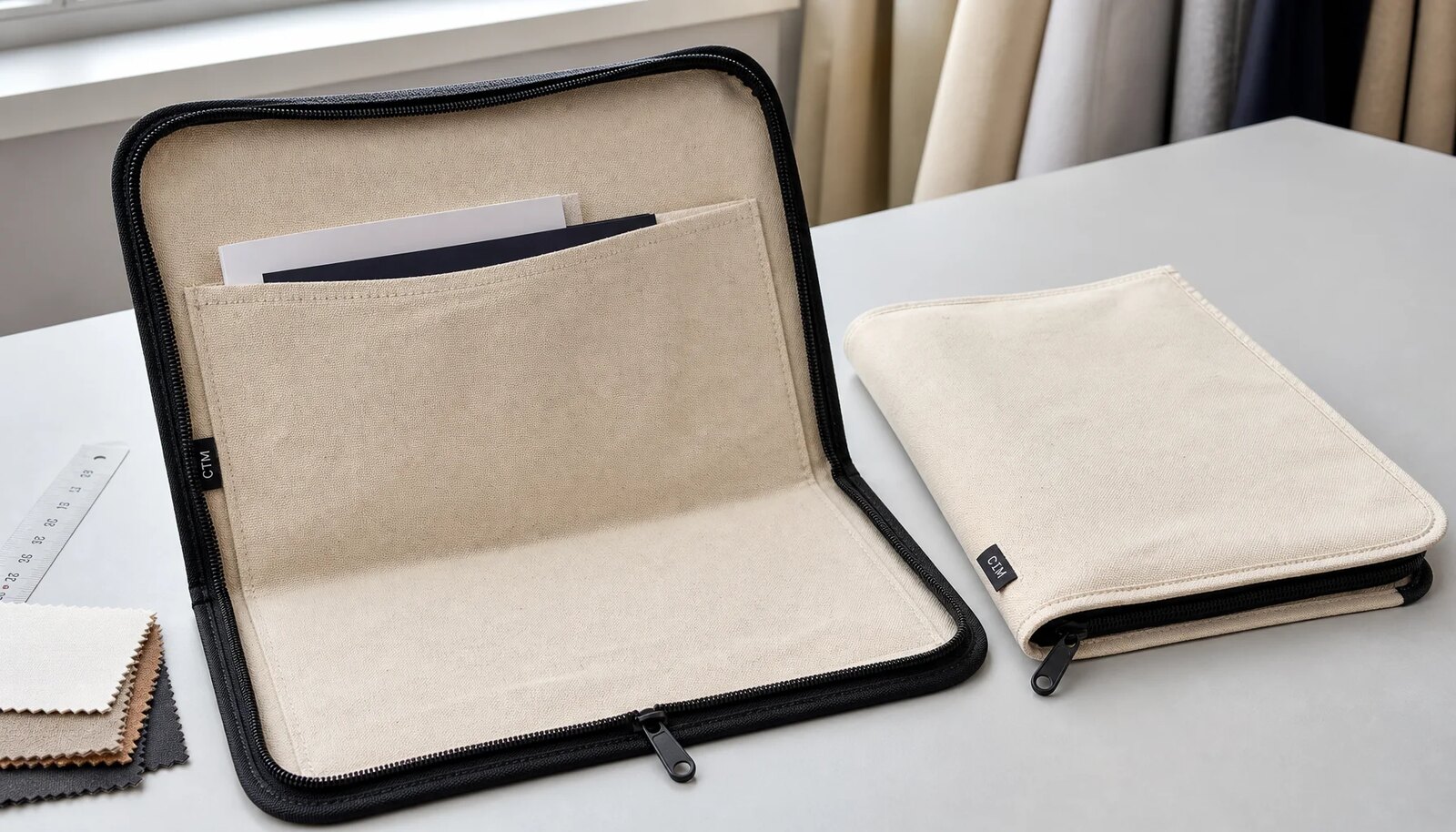
Canvas zipper portfolios for hotel retail are often bought as a simple accessory, but the buying risk sits in the material choice. A portfolio sold in a hotel shop, spa, conference center, or guest welcome area has to look retail-ready on the shelf and still perform as a travel document holder. If the canvas is too soft, the product collapses. If the zipper is too stiff, guests notice it immediately. If the logo is printed in the wrong position, the product looks like an event giveaway instead of a paid retail item.
The cleanest RFQ starts with the contents the portfolio must hold. A hotel may need space for A4 travel documents, US letter papers, a resort map, spa menu, tablet, pen, room key card, or branded stationery. Those contents decide the finished size, panel stiffness, zipper opening, pocket layout, and packing method. Without that information, suppliers will quote a generic zip pouch and the cheapest offer may not match the retail job.
- For A4 documents, allow clearance beyond 210 x 297 mm so corners do not curl inside the zipper track.
- For US letter documents, size the portfolio separately instead of forcing an A4 pattern to work.
- For tablet use, define the tablet model, case thickness, and whether padding is needed.
- For guest welcome packs, test the thickest expected insert set before approving bulk dimensions.
Choose Canvas Weight by Structure, Not Habit
The most common material mistake is specifying canvas only by oz because another product used that number. For zipper portfolios, 10 oz canvas can work for a soft document pouch, but it may lack the body needed for hotel retail display. A 12 oz to 16 oz cotton canvas, roughly 400 to 540 GSM, usually gives a better balance of handfeel, sewing control, and shelf presence. Above that range, the product can become bulky at zipper corners and more expensive to ship.
Buyers should also clarify when the fabric weight is measured. Greige canvas, dyed canvas, washed canvas, and coated canvas can feel different even when the stated oz is similar. A natural canvas portfolio may look premium but can show dirt and oil marks during production. Dyed canvas offers brand control, but lab dip approval and batch shade control become part of the schedule. Recycled cotton blends can support a sustainability story, but the yarn may show more neps and shade variation unless appearance standards are agreed.
- 10 oz to 12 oz: better for lightweight document sleeves and lower freight cost.
- 12 oz to 14 oz: practical middle range for most hotel retail zipper portfolios.
- 14 oz to 16 oz: stronger body for premium shelf presentation and heavier contents.
- Over 16 oz: use only after sample testing zipper corners, sewing thickness, and carton flatness.
Decide Lining and Reinforcement Early
Lining is not just an inside appearance decision. It changes sewing difficulty, pocket strength, product thickness, and the way the portfolio feels when opened by a shopper. A 210D polyester lining is common when the buyer wants cost control and smoother document insertion. Cotton lining feels more natural and supports a premium canvas story, but it may wrinkle more and can increase cost. If the product includes card slots, pen loops, or a document sleeve, lining strength matters as much as outer canvas strength.
Reinforcement should be used carefully. Thin board or nonwoven reinforcement can help a portfolio keep its shape, especially for retail display, but poor board selection creates creased corners after packing. Foam padding may help tablet protection, but it changes the category from document portfolio to soft tech organizer and may require different carton planning. The safest approach is to state the intended stiffness level and approve a physical sample rather than specifying hidden materials blindly.
- Use polyester lining when documents need to slide in easily and price pressure is high.
- Use cotton lining when the buyer wants a natural fiber story inside and outside.
- Use light reinforcement when the front panel must stay flat on display.
- Avoid excessive board thickness if the product will be packed flat in tall export cartons.
Specify the Zipper Like a Main Component
The zipper is the part hotel shoppers handle first, so it should not be treated as a minor trim. For most canvas zipper portfolios, a No. 5 nylon coil zipper is a practical choice because it bends around corners better than many metal tooth options. Metal zipper teeth can look premium, but they add stiffness, weight, and sometimes scratch risk. A matte painted puller, antique brass puller, or branded metal puller can upgrade perceived value without forcing a heavy zipper tape.
Zipper layout also affects cutting and sewing. A full three-sided opening makes document access easy, but it increases the chance of wavy zipper tape if the operator stretches one side during sewing. A top-opening design is simpler and often cheaper, but it may not work for thick inserts. Buyers should request a sample opened and closed repeatedly, then inspect the corners. If the slider jams at the curve on the sample, it will not improve in mass production without changing the pattern or zipper.
- Define zipper size, tape color, slider color, puller shape, and opening direction in the RFQ.
- Test the zipper with the actual documents inside, not only with an empty sample.
- Reject samples with wavy zipper tape, teeth separation, sharp puller edges, or corner jamming.
- For premium retail, consider a custom puller only when the MOQ and tooling cost fit the program.
Match Print Method to Canvas Texture
Canvas is not a flat paper surface. Heavy weave, natural slubs, seams, and panel thickness all affect logo result. Screen printing is usually the most stable option for solid hotel logos, simple resort marks, and one to three color artwork. Heat transfer can handle gradients or detailed graphics, but it may look less integrated with natural canvas and needs adhesion checks. Embroidery can be attractive on some bags, but on zipper portfolios it may create puckering or internal rubbing unless placed carefully.
Logo placement should be decided with the pattern, not after the sample is sewn. Printing too close to the zipper curve, binding, or fold line causes distortion and inconsistent registration. A small woven side label can be a good alternative when the hotel wants subtle branding or when the canvas texture makes fine print risky. For retail programs, the buyer should approve a print strike-off on the actual canvas quality, not on a smooth substitute fabric.
- Screen print: best for solid logos, good cost control, and repeatable bulk production.
- Heat transfer: useful for gradients, small detail, or photographic-style artwork with adhesion testing.
- Woven label: clean option for understated hotel retail branding and lower print defect risk.
- Embroidery: possible for simple marks but needs puckering review on the final panel construction.
Understand MOQ and Cost Drivers
MOQ is rarely only about finished piece quantity. For canvas zipper portfolios, the real minimums often come from fabric dyeing, zipper tape color, printed label production, woven label production, and cutting efficiency. A factory may accept 500 pieces if the canvas is stock natural color and the zipper is standard black. The same design in custom dyed canvas with custom zipper tape and woven labels may need a much higher practical MOQ or carry surcharges.
A useful quote separates the cost drivers instead of hiding everything in one unit price. Procurement teams comparing suppliers should request a breakdown for outer fabric, lining, zipper, printing, labels, inner packing, carton, and sample costs. This does not mean the factory must expose every internal margin, but it helps buyers see whether a price difference is caused by real material differences or by missing items. The lowest quote often excludes retail packing, barcode labeling, or upgraded zipper pulls.
- Stock natural canvas usually supports lower MOQ and faster sampling.
- Custom dyed canvas adds lab dip time, dye lot risk, and fabric MOQ pressure.
- Custom zipper colors can create hidden minimums even when the bag quantity is modest.
- Retail labels, belly bands, hangtags, and barcodes should be quoted before purchase order approval.
Set Sample Approval Gates
For a hotel retail portfolio, one sample is usually not enough if the order includes custom fabric, custom print, and retail packing. A better workflow uses material swatches first, then a construction sample, then a printed pre-production sample, and finally a packed sample if carton appearance matters. This sequence prevents the buyer from approving a beautiful photo while missing fabric stiffness, zipper feel, lining strength, or packing deformation.
Sample comments should be written as measurable corrections. Instead of saying the portfolio should feel more premium, state that the canvas should be upgraded from 12 oz to 14 oz, the zipper puller should change from plastic to antique brass metal, or the front panel should include light reinforcement. Photos are useful, but final approval should be based on physical handling. The sample should be loaded with the intended documents and left closed for a period to see whether corners bend or zipper tape waves.
- Approve fabric swatch for color, handfeel, thickness, odor, and surface slubs.
- Approve blank sample for size, pocket layout, zipper route, and stiffness.
- Approve printed sample for logo size, color, placement, rub resistance, and edge clarity.
- Approve packed sample for flatness, scuffing, barcode position, and carton compression.
Define QC Thresholds Before Production
Quality control works best when the buyer and factory agree on defect definitions before cutting. For canvas zipper portfolios, critical defects include broken zipper, wrong logo, wrong fabric, mildew, strong odor, sharp metal burrs, and incorrect retail barcode. Major defects include visible shade mismatch, warped panels, skipped stitching, loose lining, severe print defects, and zipper waviness that affects use. Minor defects can include small thread tails, tiny natural canvas slubs within the approved standard, or slight internal wrinkles that do not affect retail appearance.
Measurement tolerance should match the construction. A flat portfolio can often be controlled within plus or minus 5 mm on length and width, but padded or reinforced designs may need a more realistic tolerance. Stitching standards should cover stitch density, backstitch security, seam allowance, and binding width. The buyer should also define how many zipper cycles are tested during inspection and whether the test is done empty or with the intended contents inside.
- Use AQL inspection with separate critical, major, and minor defect definitions.
- Measure finished size after the product is packed and relaxed, not stretched by hand.
- Inspect zipper operation around corners on a loaded sample from bulk production.
- Check logo position against a measurement from panel edges, not only by visual judgment.
Plan Packing for Shelf Condition
Packing is a material decision because canvas changes shape under pressure. If portfolios are stacked too tightly, zipper tracks can leave impressions on neighboring units and corners can bend. If cartons are too loose, the products shift during transport and scuff against each other. Hotel retail buyers also need clean presentation: barcode label position, hangtag location, belly band tightness, and polybag clarity affect how quickly the goods can move from carton to shelf.
For many programs, flat packing in an individual recycled polybag or paper wrap works well. A paper belly band can look more retail-friendly, but it must be tested for movement and corner rubbing. Desiccant may be needed for humid shipping lanes or rainy-season production, especially with natural cotton canvas. Carton weight should stay practical for warehouse handling; a carton that is too heavy can crush lower layers and increase claims risk.
- Request carton dimensions, gross weight, net weight, and pieces per carton in the quote.
- Use an inner paper sheet or protective layer if zipper pulls can mark adjacent units.
- Keep retail barcode labels on a flat, scannable surface with consistent placement.
- Approve a packed carton sample when the product has reinforcement, thick pullers, or paper bands.
Protect the Schedule and Landed Cost
Lead time should be built from approval milestones, not from a vague production promise. A realistic schedule may include artwork review, fabric swatch approval, lab dip if dyed, blank sample, print strike-off, pre-production sample, bulk material preparation, cutting, sewing, inspection, packing, and export booking. If the factory says production takes 30 days, the buyer should clarify whether that starts after deposit, after artwork approval, after material approval, or after pre-production sample approval.
Landed cost comparison should include more than unit price. A heavier canvas may improve retail value but increase carton weight and freight. A custom metal puller may upgrade the product but add tooling and MOQ. A cheaper zipper may reduce first cost but raise inspection failure risk. Importers and distributors should compare the full route: factory price, sample cost, packing cost, inland freight, export carton cube, inspection cost, duty basis, and destination handling.
- Add schedule buffer for custom dyed canvas, custom zipper tape, woven labels, and retail packaging.
- Compare quotes using the same Incoterm, packing method, carton quantity, and material specification.
- Request estimated CBM per 1,000 pieces before confirming freight budgets.
- Do not approve bulk cutting until the pre-production sample and artwork placement are signed off.
Specification comparison for buyers
| Spec decision | Recommended option | When it fits | Buyer risk to check |
|---|---|---|---|
| Outer canvas weight | 12 oz to 16 oz cotton canvas, roughly 400-540 GSM before washing or finishing | Hotel retail portfolios that need structure, shelf presence, and repeat handling without feeling like luggage | Very light canvas may wrinkle and collapse; very heavy canvas may raise freight cost and make zipper corners bulky |
| Canvas finish | Natural, dyed, or lightly washed canvas with controlled shrinkage tolerance | Gift shop, conference, spa, or in-room retail lines where texture supports a premium handmade look | Unwashed natural canvas can shrink or skew after finishing; dyed lots need lab dip and bulk shade approval |
| Lining material | 210D polyester for cost control or cotton lining for a more natural retail story | Polyester suits volume programs; cotton lining suits boutique hotel retail and higher perceived value | Dark lining can transfer dust or color; thin lining can tear near pen loops and document pocket edges |
| Zipper type | No. 5 nylon coil zipper with metal or matte painted puller | Most A4, letter-size, and tablet portfolio formats needing smooth opening around corners | Oversized metal teeth add cost and stiffness; weak sliders fail before the canvas body fails |
| Print method | Screen print for solid logos, heat transfer for gradients, woven label for understated branding | Hotel logo, resort mark, event artwork, or co-branding with a retail partner | Printing across seams or near zipper curves causes distortion; metallic inks need rub and adhesion checks |
| Internal structure | Document sleeve, card slots, pen loop, and optional thin board reinforcement | Retail buyers who want a useful travel organizer rather than a flat pouch | Too many compartments slow sewing and increase defect points; stiff board can crease if packed under pressure |
| MOQ logic | Start from fabric color, print method, lining, and zipper color rather than only finished quantity | Importers comparing quotes across factories and trying to avoid hidden surcharges | A low quoted MOQ may still carry extra dyeing, zipper, label, or cutting losses charged separately |
| Packing method | Individual recycled polybag or paper belly band, then flat export carton with moisture control | Hotel retail where barcodes, shelf handling, and clean presentation matter | Over-compressed cartons create zipper waves and bent corners; loose cartons increase scuffing and freight cube |
| Supplier route | Direct bag factory for customized build; trading company only if consolidating multiple hotel retail SKUs | Direct sourcing fits repeated zipper portfolio programs; consolidation fits mixed towel, pouch, tote, and stationery orders | Trading margin can hide material substitutions; direct factories still need clear artwork, tolerance, and packing instructions |
Buyer checklist before sampling
- Define finished size by actual contents: A4, US letter, tablet, menu card, welcome documents, or conference materials.
- State canvas weight in oz and approximate GSM, and clarify whether the weight is before or after dyeing, washing, or coating.
- Approve fabric handfeel, shade, shrinkage, and odor on a pre-production sample, not only from a photo.
- Specify zipper size, tape color, puller material, puller shape, and opening direction with a physical reference if possible.
- Place logo artwork away from zipper curves, seam allowances, and fold lines; include Pantone or CMYK references where relevant.
- Set construction expectations for seam allowance, binding width, corner shape, lining attachment, pocket depth, and reinforcement points.
- Require a packed sample to review carton height, product flatness, barcode position, retail label visibility, and moisture protection.
- Request quote data by line item: fabric, lining, zipper, print, label, inner packing, carton, sample fee, tooling, and inland freight if included.
- Confirm inspection standard, AQL level, acceptable measurement tolerance, and critical defects before mass production starts.
- Build schedule buffer for lab dips, print strike-offs, zipper sourcing, packing approval, and destination-side retail launch dates.
Factory quote questions to send
- What canvas weight do you recommend for this finished size, and is the quoted weight measured before or after dyeing or washing?
- Is the canvas stock fabric, custom dyed fabric, or made-to-order greige fabric, and what MOQ applies to each route?
- Which zipper size, slider grade, puller material, and tape color are included in the quote?
- What lining fabric is included, and can you provide tear strength or at least a physical swatch for approval?
- Which print method is priced, how many colors are included, and what is the maximum safe print area away from seams and zipper curves?
- Are woven labels, care labels, barcode stickers, hangtags, and retail belly bands included or quoted separately?
- What sample stages are included: material swatch, blank sample, printed sample, pre-production sample, and packed sample?
- What are the estimated cutting loss, sewing wastage, and over/under shipment tolerance for this order quantity?
- How many pieces fit per export carton, what is the estimated carton size and gross weight, and will products be packed flat or folded?
- What lead time starts after deposit, artwork approval, material approval, or pre-production sample approval?
Quality-control points to confirm
- Finished size tolerance should normally be controlled within plus or minus 5 mm for portfolio panels unless the design uses thick padding or board.
- Canvas shade should match the approved swatch under standard light; visible panel-to-panel shade difference on the same unit should be rejected.
- Zipper must open and close smoothly around corners for repeated cycles without slider jamming, tape waviness, or teeth separation.
- Logo print should pass dry rub testing by hand and show no obvious pinholes, ghosting, cracking, or misregistration at normal viewing distance.
- Seams, binding, and pocket edges should show even stitch length, no skipped stitches, no loose thread tails over 10 mm, and no broken backstitch.
- Internal pockets should hold the intended documents or cards without tight insertion, warped lining, or exposed raw edges.
- Each packed unit should remain flat, clean, odor-free, barcode-readable, and free from crushed corners after carton packing.
- Critical defects include broken zipper, wrong logo, wrong fabric color, mildew, strong chemical odor, sharp metal burrs, and incorrect retail labeling.