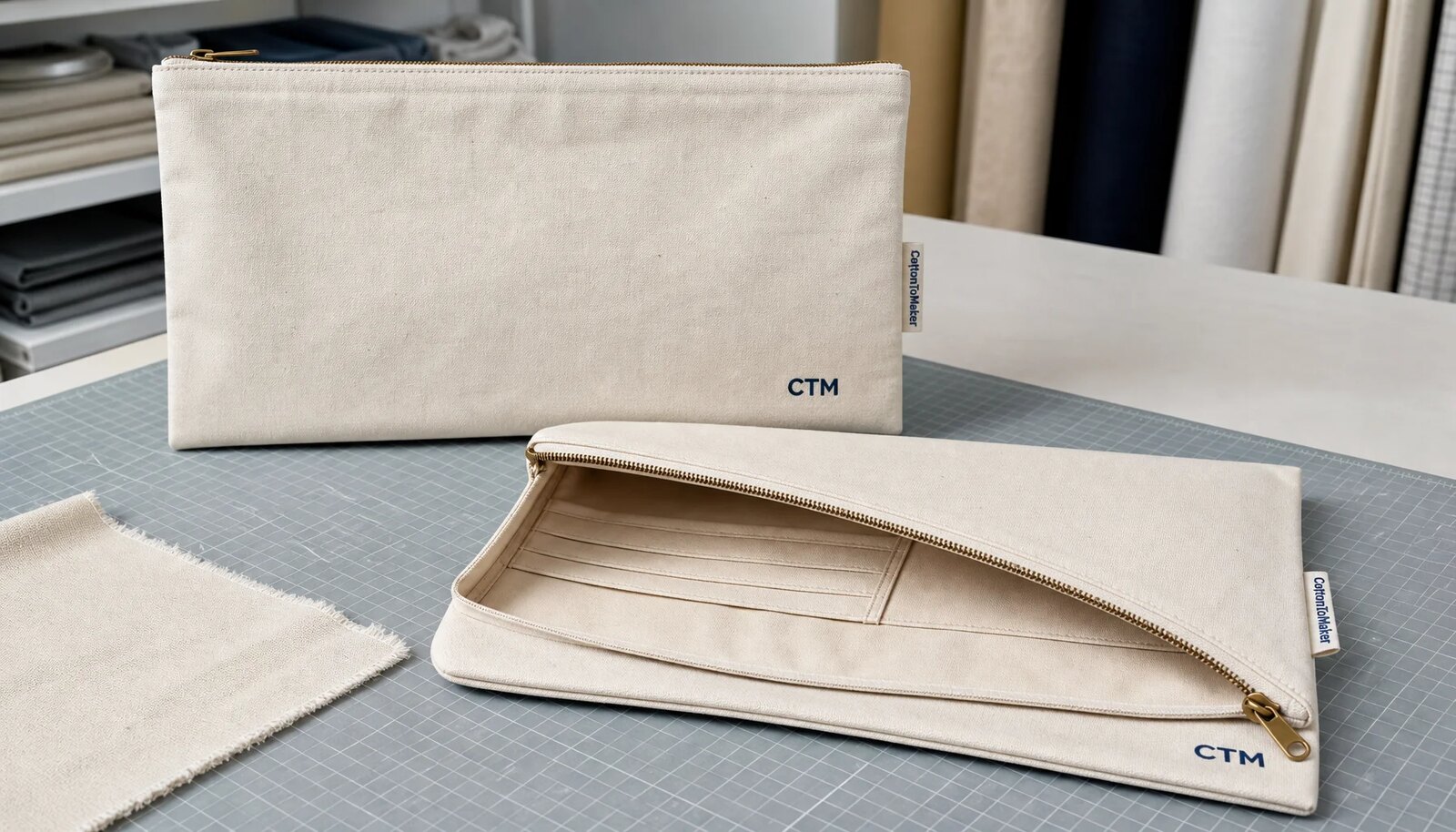
Start the Calendar at Approval, Not Inquiry
For canvas zipper portfolios for hotel retail lead time planning, the first calendar rule is simple: production time starts after approvals, not after the first email. A factory cannot safely cut fabric because a buyer requested a quote, shared a concept image, or received internal budget approval. The clock should begin only after the specification, artwork, physical sample, packing method, commercial terms, and deposit are approved.
This matters because a canvas zipper portfolio is not just a flat pouch with a logo. It can include lined panels, organizer pockets, zipper installation, binding, interlining, screen printing, woven labels, hangtags, barcode stickers, and retail packing. One late decision can block the next step. A changed pocket depth may affect usable space. A new logo position may require printing panels before sewing. A different zipper puller may change packing protection. The product looks straightforward, but the production sequence has dependencies.
For a standard order using stock natural canvas, standard lining, a No. 5 nylon coil zipper, and one-color screen print, a practical early plan is 7-10 days for the first counter sample, 2-5 days for buyer review, 3-7 days for a revised sample or print strike-off, and 25-40 days for bulk production after final approval. Add time for final inspection, packing release, export documents, and forwarder handover. A safer procurement window is 45-60 days from approved pre-production sample to ex-factory for standard printed goods, before ocean freight, air freight, customs, warehouse receipt, and property distribution.
Custom work stretches the schedule. Custom dyed canvas may require lab dips, bulk dyeing, shade checks, and shrinkage control. A molded logo puller, debossed patch, embroidery program, custom zipper tape, retail gift box, or multiple property logos can add two to four weeks depending on supplier capacity and approval speed. If the hotel launch date is fixed, simplify the product early. The sewing line rarely recovers time lost to slow artwork, unclear packing, or unfinished sample comments.
- Use the approved pre-production sample date as the bulk production trigger, not the RFQ, PO draft, or first quote date.
- Build the schedule backward from warehouse need-by date, property delivery date, hotel opening, conference, or retail reset.
- Separate supplier production time from buyer-side review time for merchandising, brand, procurement, operations, and legal approval.
- Record ex-factory, forwarder handover, vessel or air departure, customs clearance, warehouse receipt, and property delivery as separate milestones.
- Put the latest safe artwork approval date and sample approval date into the RFQ so suppliers can flag timing risk before quoting.
Define the Portfolio Before Pricing
The term canvas zipper portfolio can mean several products. One buyer may imagine a slim document pouch. Another may expect a padded tablet sleeve, organizer folder, travel document holder, meeting stationery case, or hotel amenity kit carrier. These versions may look similar in a catalog image, yet they differ in fabric yield, pocket labor, zipper handling, carton volume, and inspection risk. A vague RFQ that says canvas zipper portfolio with logo almost always produces quotes that are hard to compare.
Start with the use case and the contents. A portfolio for A4 documents needs different usable space than one for US letter paper. A tablet sleeve needs clearance, padding, and zipper protection so the slider does not scratch the device. A meeting portfolio may need a document sleeve, pen loop, business card pockets, and a notebook pocket. A resort gift shop item may need fewer internal features but stronger shelf presentation, a clean hangtag location, and tighter front-panel logo control.
A production-ready specification does not have to be long, but it must remove assumptions. Include outside dimensions, usable internal dimensions, zipper opening length, thickness, seam allowance if known, pocket depth, stitch color, lining color, zipper tape color, puller style, print position, label position, and packing format. If the hotel will insert a welcome letter, spa brochure, room key sleeve, branded notebook, or conference agenda before resale or gifting, send the insert size and thickness. Fit should be proven on the physical sample, not guessed from outside dimensions.
- State dimensions in millimeters or inches and identify whether each measurement is outside edge, zipper opening, pocket depth, or usable internal space.
- Specify whether the style is flat, gusseted, padded, organizer, binder-style, or travel-document format before comparing suppliers.
- List target contents such as A4 documents, US letter paper, 11 inch tablet, notebook, business cards, pen, key sleeve, hotel map, or welcome materials.
- Provide front, back, inside-left, inside-right, side thickness, zipper puller, label, hangtag, barcode, and carton marking instructions in one controlled spec sheet.
- Avoid price comparisons where one quote assumes lining and pockets while another assumes a plain canvas sleeve.
Lock Materials, Weight, and Construction
For most hotel retail zipper portfolios, 10 oz to 12 oz cotton canvas is a sensible starting range. In GSM terms, that is roughly 340-410 GSM, depending on weave, yarn count, finishing, and whether the fabric is washed. This range usually gives enough body for a paid retail item without making the zipper area too bulky. Lighter 6 oz or 8 oz canvas can reduce cost, but it may wrinkle around the zipper, feel less structured on the shelf, and read more like a giveaway pouch. Heavier 14 oz or 16 oz canvas can support a premium look, but it brings thicker corners, greater needle pressure, more thread tension risk, higher carton weight, and possible zipper waviness.
The outer fabric is only part of the build. A portfolio may use cotton lining, polyester lining, non-woven interlining, light foam, board reinforcement, binding tape, or layered pocket panels. Every layer changes pattern size, sewing sequence, packed thickness, and usable internal space. A stiff board can make a sample look crisp but may curl or create hard edges after transit. Foam can protect a tablet, but it can also reduce capacity if the pattern is not adjusted. Heavy canvas pocket panels can create thick seam intersections that are difficult to sew cleanly.
Do not approve fabric by weight alone. Two 12 oz canvas qualities can feel different because of weave density, yarn texture, finishing, dyeing, and washing. Natural canvas may show seed flecks and slubs; that can suit a relaxed hotel retail look, but it can interfere with small logos. Dyed canvas may vary by lot, so the shade standard should be physical. Washed canvas can shrink, soften, and change finished dimensions. Ask whether the quoted material is stock or made to order, and require bulk fabric to be checked against the approved swatch before cutting.
- Use 10 oz canvas for cost-sensitive meeting portfolios when the structure is simple and the zipper path is not heavily stressed.
- Use 12 oz canvas for most retail portfolios needing a firmer handfeel, better shelf presence, and more durable front-panel appearance.
- Use 14 oz or heavier canvas only after checking corner bulk, zipper smoothness, needle marks, seam waviness, packed weight, and carton deformation.
- For organizer styles, specify lining such as 150D-210D polyester or cotton and confirm whether pockets use lining, canvas, or a lighter pocket fabric.
- For tablet use, test padding thickness with the actual device or dummy insert and confirm that zipper closure remains smooth.
Specify Zippers and Hardware Precisely
Zipper choice affects retail handling, customer satisfaction, and inspection results. A No. 5 nylon coil zipper is often the balanced option for canvas zipper portfolios because it sews smoothly, works on straight or gently curved openings, and is less likely to scratch inserts than many decorative metal tooth zippers. Resin and metal zippers can be used for specific looks, but they bring tradeoffs in weight, stiffness, corner behavior, and burr inspection.
The RFQ should define zipper gauge, tape color, slider color, puller material, puller shape, end stop, opening direction, and zipper length. If the buyer wants a brass-color look, clarify whether the requirement is true metal teeth or only a brass-color slider on nylon coil tape. Those are different constructions. A hotel retail product can keep the smoother function of nylon coil while using a plated metal slider and puller for appearance. If the portfolio will hold tablets, documents, or polished accessories, inspect every metal touchpoint for sharp edges.
Zipper problems are costly after assembly. A slightly wavy zipper may be tolerated on a casual pouch, but on a retail portfolio it can signal weak sewing control. A zipper that catches lining at the corner creates complaints. A puller that marks natural canvas during transit can make clean stock look used. The pre-production sample should be opened and closed repeatedly when empty and filled. Bulk inspection should include zipper cycling after packing because carton compression can shift fabric and expose catching points.
- State No. 5 nylon coil zipper when smooth function is the priority; specify metal only when the decorative look justifies the extra inspection risk.
- Define slider finish, puller material, puller size, logo puller requirement, tape color, opening direction, and whether the zipper is one-way or two-way.
- Check zipper opening length against the target insert; outside portfolio size does not guarantee usable access.
- Require pullers to be free of burrs, rust, plating flakes, sharp corners, and edges that can mark natural canvas or scratch tablets.
- Add zipper cycle testing to inspection rather than relying only on visual zipper alignment.
Choose Branding That Fits Canvas
Branding should be chosen around fabric texture, artwork detail, order quantity, and approval timing. Screen printing is usually the most practical method for canvas zipper portfolios when the logo has one to three solid colors and clean shapes. It works well for hotel names, resort icons, destination marks, and simple retail graphics. Still, ink on canvas does not behave like ink on coated paper or a digital mockup. Fine lines, small serif type, pale ink, and metallic effects need physical testing.
Woven labels are useful when the buyer wants consistent repeat branding, a subtle retail look, or a small mark that is less affected by fabric slubs. Embroidery can look premium, but it may pucker the front panel if stitch density, backing, and panel sequence are not controlled. Patches made from cotton, cork, leather, or imitation leather can elevate the product, yet they add tooling, sewing steps, edge finish checks, and lead time. Custom metal plates and custom zipper pullers should be treated as hardware projects with their own sample approval and defect checks.
Hotel brand guidelines often include Pantone references, minimum clear space, logo distortion rules, and approved color combinations. Share those rules at RFQ stage, not after the first sample. If multiple hotel properties need unique logos, ask whether each version requires a separate setup charge, separate MOQ, separate inspection lot, or separate packing mark. Small artwork changes can delay production when screens, embroidery programs, woven labels, or patches need to be remade.
- Use screen print for bold hotel marks, solid-color artwork, front-panel graphics, and one to three color logos.
- Use woven labels for repeat programs, small brand marks, lower visual risk on textured canvas, and multi-property replenishment.
- Use embroidery only after stitch-out approval on final canvas construction, including backing and reverse-side appearance.
- Use debossed patches, metal plates, or custom pullers only when the buyer accepts tooling, longer sampling, and extra QC checks.
- Approve a print strike-off on the actual canvas quality before bulk printing, especially for pale ink, metallic ink, fine type, or natural canvas.
Plan MOQ and Price Breaks Realistically
MOQ is driven by upstream material and process minimums, not only by the sewing factory's appetite for an order. Stock canvas, standard lining, standard No. 5 zipper, and screen print can support lower pilot quantities because materials are easier to source and cutting loss is manageable. Custom dyed fabric, custom zipper tape, special lining color, molded puller, woven label, patch branding, or printed retail box can raise MOQ because mills, zipper suppliers, label makers, and packaging vendors have their own minimums.
For a hotel retail test, the safest structure is often a standard base product with customized logo, hangtag, label, or belly band. This lets the buyer test sell-through, retail price, guest response, and property handling without tying up too much inventory. If the brand value depends on a custom canvas color, custom puller, or premium patch, plan for a higher minimum, a longer sample path, and more inspection points. The goal is not simply the lowest MOQ. The better question is which custom elements create enough retail value to justify the commitment.
Price breaks should be requested against the same specification at every tier. Otherwise the buyer may compare a 300-piece quote based on stock fabric against a 1000-piece quote based on custom dyed fabric, or a basic packing quote against a retail-ready barcode packing quote. Ask the supplier to show what changes at 300, 500, 1000, and 3000 pieces. Also ask which component controls the MOQ: canvas, lining, zipper, puller, print, woven label, patch, box, or carton mark. That answer makes negotiation clearer and reduces late surprises.
- Pilot order structure: stock canvas, standard zipper, standard lining, screen print, simple individual packing, and basic hangtag or belly band.
- Medium customization: stock fabric with woven label, upgraded puller, printed hangtag, barcode sticker, property carton mark, and defined packing photos.
- High MOQ structure: custom dyed canvas, custom zipper tape, special lining, molded logo puller, debossed patch, retail box, or many logo versions.
- Request price tiers at 300, 500, 1000, and 3000 pieces using the same specification, packing method, and trade term.
- Ask whether approved patterns, artwork files, fabric standards, and QC references can be retained for repeat hotel retail replenishment.
Use Samples to Prevent Production Drift
Samples should prove function, not just appearance. A useful canvas zipper portfolio sample confirms fabric handfeel, finished size, zipper movement, pocket usability, print color, logo placement, stitching quality, lining fit, and packed shape. Many production issues begin when a buyer approves a blank construction sample and later adds print, labels, patches, retail packing, or insert requirements. Those changes can alter sewing sequence, surface tension, bulk, and inspection criteria.
The first sample can be a counter sample used to confirm structure and general dimensions. If substitute materials are used, the supplier should identify them clearly. A pre-production sample should use production fabric, production zipper, final lining, final pocket layout, approved branding, and final or near-final packing. Approval wording should be controlled. Do not write approved for production if logo color, zipper, lining, pocket dimensions, or packing remain open. Approve only the confirmed points and list the exact revisions needed.
Hotel buyers should test the sample with real contents. Insert the notebook, document, card, pen, tablet, room key sleeve, menu, map, or welcome materials that the product must hold. Close the zipper while filled and check whether the puller scratches canvas or catches lining. Pack the sample for 24 hours using the proposed packing method, then inspect corner dents, wrinkles, zipper impressions, odor, and barcode visibility. Measure and photograph the approved sample so the supplier, inspector, and buyer are all using the same reference.
- Measure outside size, usable internal space, zipper opening length, pocket depth, logo position, seam margin, and packed thickness on the physical sample.
- Test fit with actual inserts rather than relying on nominal A4, US letter, or tablet dimensions.
- Rub the printed logo with a dry white cloth and a slightly damp cloth to screen for weak curing or ink transfer.
- Open and close the zipper at least 20 times on the sample while empty and filled.
- Pack the sample for 24 hours and review zipper pull marks, crushed corners, wrinkles, barcode position, and shelf presentation.
Build Quotes Around Landed-Cost Inputs
A useful B2B quote needs enough detail for procurement to compare suppliers accurately. The main cost drivers are canvas weight, fabric finish, lining, interlining, zipper specification, pocket count, logo method, quantity, packing, inspection requirements, and carton volume. Two portfolios with the same outside size can carry very different costs if one includes organizer pockets, padding, woven labels, barcode packing, or a custom puller. A quote with only unit price and delivery time is not enough for sourcing control.
Logistics data should be collected before supplier selection. A lower unit price can disappear once inefficient carton packing, high gross weight, excess CBM, or warehouse repacking labor is included. For retail distribution, barcode labels, hangtags, belly bands, carton marks, property-level sorting, and packing photos may be required. These details belong in the RFQ so the supplier quotes the actual service level. If a distributor warehouse has carton weight limits, label rules, pallet height limits, or no-mixed-SKU rules, share them before the packing plan is calculated.
Commercial terms also affect comparison. EXW, FOB, CIF, and DDP prices cannot be compared without adjustment. Payment terms, sample charges, print setup charges, mold charges, inspection fees, document charges, and local transport to port may change the landed cost. The quote should state validity period, quoted currency, trade term, assumed approval start date, and the impact of artwork or packing changes after approval. For hotel retail, schedule reliability and quote completeness are often worth more than a small unit-price difference.
- Request unit price by quantity tier, sample cost, revised sample fee, print setup, mold charge, packing charge, inspection support, and document cost where applicable.
- Request carton dimensions, pieces per carton, gross weight, net weight, estimated CBM, and recommended shipping mode for each quantity tier.
- Confirm whether individual bag, paper band, tissue, puller protection, hangtag, barcode label, carton mark, and packing photos are included.
- Compare trade terms consistently; do not compare EXW against FOB or DDP without adding inland freight, export handling, duty, and destination costs.
- Ask the supplier to state which approval date is required to keep the quoted ex-factory date.
Set QC Standards Before Cutting
QC standards should be agreed before fabric cutting and bulk printing. For canvas zipper portfolios, inspection must cover function, dimensions, appearance, branding, packing, and carton accuracy. General appearance checks are not enough because many failures are functional: zipper catching at corners, lining blocking the opening, pocket seams opening, pullers scratching fabric, or inserts not fitting. These defects may not show in a single front-view photo.
A practical inspection plan can use general AQL sampling for workmanship and appearance, with product-specific checks added for zipper cycles, seam strength, pocket fit, print adhesion, barcode scan, and carton count. Buyers often use General Inspection Level II for finished goods, but the exact AQL level and defect classification should be confirmed in the PO or quality agreement. Define critical and major defects clearly. Broken zippers, wrong logo, wrong size, severe stains on the front panel, strong mildew odor, sharp metal burrs, incorrect barcode, mixed SKU, and carton shortages should not be treated as minor cosmetic issues.
In-line inspection is valuable because zipper and pocket defects are easier to correct before final assembly. Print position can be checked before sewing if panels are printed flat. Lining twist and pocket placement can be caught before the final seam is closed. Final inspection should open cartons from different parts of the packed lot, not only the top cartons. Inspectors should measure size, cycle the zipper, inspect seams, check stains and shade, compare logo to the approved sample, scan barcodes, verify carton marks, and confirm packing dryness.
- Define critical, major, and minor defects in the PO before production starts.
- Use approved physical sample, approved print strike-off, fabric swatch, and packing sample as inspection references.
- Classify broken zipper, wrong logo, wrong size, severe stain, sharp burr, strong odor, incorrect barcode, and mixed SKU as major or critical depending on buyer policy.
- Check hidden areas such as pocket interiors, zipper ends, lining corners, pen loops, label seams, and backstitch points.
- Require final inspection after packing but before shipment release, with cartons selected from different parts of the packed lot.
Pack for Retail and Distribution
Packing is part of the hotel retail product, not a minor afterthought. A canvas zipper portfolio can leave the sewing line clean and still arrive with crushed corners, zipper pull impressions, dust transfer, moisture odor, or barcode damage if the packing method is weak. Individual polybags protect against dirt and moisture, while paper belly bands or glassine bags may suit buyers that prefer a lower-plastic retail presentation. If minimal packaging is used, the export carton must provide stronger protection against rubbing, moisture, and compression.
Carton planning needs a balance between protection, handling, and freight cost. Too many pieces per carton can deform the lower layer and create heavy cartons. Too few pieces per carton increases CBM and freight expense. For many flat portfolios, 25-50 pieces per carton may be practical, but the correct number depends on finished size, padding, zipper puller, and carton strength. Buyers should request the proposed packing layout, carton dimensions, gross weight, net weight, and photos before mass packing. If manual handling is expected, carton gross weight is often best kept around 15-18 kg unless the buyer approves otherwise.
Hotel retail distribution adds more details than basic export protection. Gift shop staff may need barcode labels facing outward, hangtags that do not cover the logo, property-level carton marks, or SKU separation by launch wave. Distributor warehouses may reject mixed cartons or require scannable labels on specific carton panels. A hotel group may need cartons split by property. These instructions affect labor and lead time. Freeze packing before final production closes because relabeling or repacking natural canvas products increases handling marks and shipment risk.
- Use tissue, puller sleeves, or protective sheets when metal pullers may mark natural canvas during transit.
- Avoid vacuum compression because it can create permanent wrinkles, bent corners, and zipper impressions.
- Confirm barcode readability, hangtag position, belly band fit, and shelf presentation on a packed pre-production sample.
- Keep cartons dry, clean, correctly marked, tape-sealed, and strong enough for the agreed stacking and handling conditions.
- Request packing photos before final shipment release, especially for multi-property hotel or distributor orders.
Specification comparison for buyers
| Procurement decision | Practical specification target | Best-fit hotel retail use | Tolerance or sourcing risk to control |
|---|---|---|---|
| Finished size | State outside dimensions, usable internal space, target insert size, portfolio thickness, and zipper opening length; common tolerance is +/-5 mm unless engineered tighter | Gift shop stationery sets, conference retail, front-desk travel document cases, in-room welcome folders | If only A4, letter, or tablet compatibility is stated, seam allowance and zipper opening may reduce usable space |
| Outer canvas | 10 oz to 12 oz cotton canvas, roughly 340-410 GSM before washing or special finishing | Most retail zipper portfolios needing structure without excessive corner bulk | Below 8 oz may collapse or wrinkle near zipper; above 14 oz can create thick corners, needle marks, higher carton weight, and zipper waviness |
| Lining and reinforcement | 150D-210D polyester, cotton lining, or light interlining; foam only when tablet protection is required | Organizer portfolios, notebook sleeves, amenity kits, travel wallets, higher-value retail items | Too much reinforcement can reduce internal capacity, create wavy seams, and change packed shape |
| Zipper | No. 5 nylon coil zipper with smooth slider and plated or molded puller; color matched to canvas, lining, or brand trim | Frequent retail handling, repeated opening tests, curved or corner zipper paths | Decorative metal teeth can scratch inserts, feel stiff around corners, add weight, and require sharper burr inspection |
| Internal layout | One main compartment plus document sleeve, pen loop, and two to four card pockets when organizer function is needed | Meeting guests, hotel loyalty merchandise, conference stores, property welcome kits | Too many pocket layers increase sewing labor, seam bulk, and risk of blocked zipper closure |
| Logo method | Screen print for one to three solid colors; woven label for repeat branding; embroidery or patch only after sample testing | Resort logos, hotel group retail programs, corporate meeting portfolios, distributor SKUs | Fine type, pale inks, metallic inks, and embroidery density must be approved on actual canvas, not on a digital proof |
| MOQ planning | 300-500 pcs for stock canvas with standard zipper; 1000+ pcs often needed for custom dyed canvas, custom zipper tape, molded puller, or special retail packaging | Pilot retail orders, opening gifts, seasonal replenishment, distributor catalog launches | Low MOQ quotes may omit packing, use substitute material, or rely on split-lot fabric shade |
| Sample route | Counter sample, print strike-off, then pre-production sample using production fabric, zipper, lining, logo, and packing | Any paid retail item, multi-property hotel program, or product with inserts | A blank or photo-only sample cannot validate zipper function, logo color, pocket usability, odor, or packed shape |
| Packing | Individual bag or paper band, zipper pull protection, barcode if required, then 25-50 pcs per export carton depending on size and weight | Hotel gift shops, distributor warehouses, property-level storage, retail shelves | Underpacking causes dust marks and corner dents; overpacking raises CBM, freight cost, and unpacking labor |
Buyer checklist before sampling
- Define the sales channel: hotel gift shop, in-room retail, front-desk travel accessory, conference kit, loyalty gift, spa boutique item, or distributor catalog SKU.
- State finished outside size, usable internal size, zipper opening length, portfolio thickness, and tolerance; specify whether A4, US letter, tablet, notebook, room key sleeve, cards, or welcome inserts must fit.
- Specify outer canvas weight in oz and GSM, fabric finish, lining fabric, interlining or padding, zipper gauge, slider material, puller style, stitch color, edge binding, and pocket layout.
- Provide vector artwork with Pantone references, logo size, print position from two edges, acceptable color variation, brand clear-space rules, and whether property-level logo versions are required.
- Separate the dates for RFQ issue, counter sample, strike-off, revised sample, pre-production sample, approval, deposit, bulk start, inspection, ex-factory release, freight booking, warehouse receipt, and property delivery.
- Request unit price by tier, sample charge, print setup, mold charge if any, packing cost, inspection support, carton marking, barcode application, and document handling as separate quote lines when possible.
- Request carton dimensions, gross weight, net weight, pieces per carton, estimated CBM, suggested HS code, loading estimate, and palletization recommendation if the shipment enters a hotel group or distributor warehouse.
- Approve a physical pre-production sample before bulk cutting when using custom print, custom dyed canvas, embroidery, patch branding, custom puller, padding, special lining, or retail packaging.
- Set AQL level, defect classification, zipper cycle test, seam strength check, print rub check, shade standard, odor standard, metal burr inspection, pocket fit test, barcode scan test, and carton condition requirements in the PO.
- Confirm whether the quote includes individual packing, export carton, hangtag, barcode label, carton mark, silica gel if used, document pouch, packing photos, and final inspection cooperation.
Factory quote questions to send
- What exact canvas weight are you quoting in oz and GSM, and is the fabric greige, natural, dyed, washed, brushed, enzyme washed, coated, or otherwise finished?
- Is the quoted fabric stock or made to order, and what shade standard will control bulk color against the approved swatch or sample?
- What lining fabric, interlining, foam, or reinforcement is included, and what thickness or denier are you using for each internal component?
- Is the zipper No. 5 nylon coil, resin, or metal, and what tape color, slider material, puller material, end stop, and zipper length tolerance are included?
- What MOQ applies for stock canvas and standard zipper, and how does MOQ change for custom dyed canvas, custom zipper tape, special lining, logo puller, woven label, patch, or retail box?
- How many calendar days are required for counter sample, print strike-off, revised sample, pre-production sample, bulk cutting, sewing, in-line inspection, final inspection, packing, and ex-factory release?
- Does the quote include screen printing on production fabric, ink matching, screen or film charge, one printed sample, and one artwork revision if needed?
- What finished size tolerance, zipper opening tolerance, seam allowance, pocket position tolerance, logo placement tolerance, and print color tolerance will you commit to in production?
- What packing is included: individual bag, glassine bag, paper belly band, tissue sheet, puller protection, hangtag, barcode sticker, silica gel, master carton, carton mark, and palletization?
- What carton size, pieces per carton, gross weight, net weight, estimated CBM, and loading recommendation are assumed for each quoted quantity tier?
Quality-control points to confirm
- Finished outside size should normally be controlled within +/-5 mm for retail zipper portfolios; tighter tolerance should be engineered into the pattern and proven during sampling.
- Usable internal space should be checked with the real target insert, not only by measuring outside dimensions, because lining, padding, zipper tape, and seam allowance reduce capacity.
- Zipper should open and close smoothly for at least 20 manual cycles on sampled pieces, with no skipped coil, loose slider, sharp puller edge, uneven tape, fabric catching, or corner hesitation.
- Zipper length and opening should match the approved sample closely enough to insert the target document or tablet without forcing; state a practical tolerance such as +/-5 mm in the PO if critical.
- Logo placement should match the approved sample within +/-3 mm for small logos and +/-5 mm for larger front-panel artwork unless another tolerance is agreed in writing.
- Print should pass a basic dry rub and damp rub check on sampled pieces with no obvious ink transfer, flaking, poor curing, blurred edges, or unacceptable color shift from the approved strike-off.
- Seams at zipper ends, corners, pocket openings, pen loops, label attachments, pull tabs, and any handle points should have secure backstitching with no open seams, skipped stitches, or loose threads longer than 5 mm.
- Canvas panels should be free from visible oil marks, mildew odor, water stains, mixed shade panels within one piece, severe slubs in the logo area, and heavy wrinkles caused by packing pressure.
- Metal sliders, rivets, snaps, logo plates, or pullers should have no sharp burrs, plating flakes, rust marks, or edges that can scratch tablets, documents, or the canvas surface.
- Internal pockets should fit the intended card, pen, notebook, room key sleeve, document, or tablet without curling the insert, blocking the zipper, or reducing the main compartment below the approved usability standard.