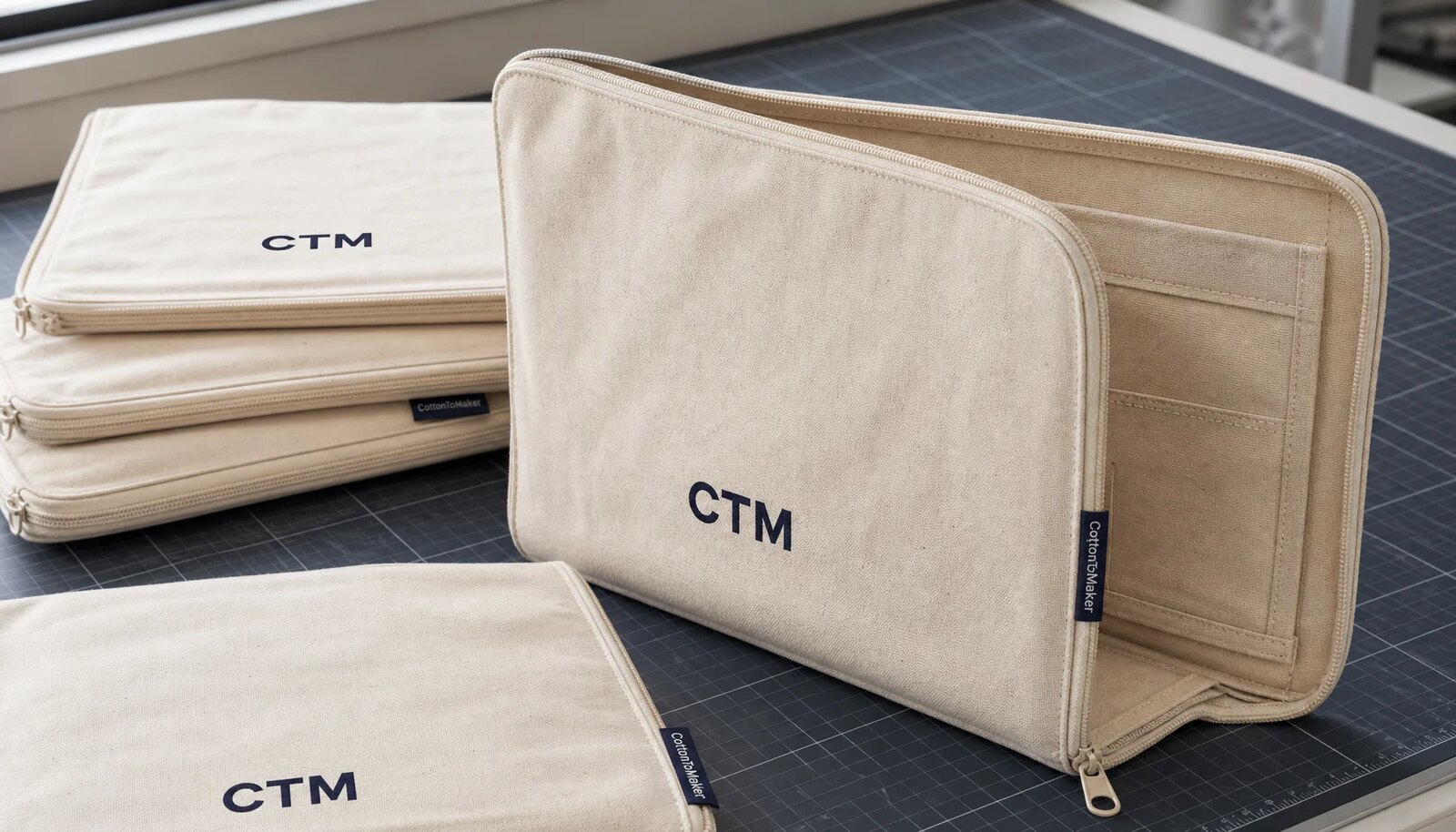
Start with the hotel retail use case
Canvas zipper portfolios for hotel retail often get quoted under one simple product name. In practice, buyers use them in very different ways. One property may need a guest welcome document case for check-in. Another may sell the item in a boutique with stationery inside. A conference hotel may use it for agenda sheets, vouchers, lanyards, maps, and sponsor inserts. The outside can look almost identical, yet the correct size, zipper opening, logo position, retail packing, barcode location, and carton count can be completely different.
That is why the first RFQ should not begin with only a photo and a target price. A boutique buyer may care most about shelf presentation, clean logo printing, hangtag alignment, and a barcode that faces outward. A hotel group distribution center may care more about fixed carton quantity, scan-ready labels, SKU separation, and carton marks that match its receiving system. An event procurement team may put delivery date and low rework risk above everything else because the goods must arrive before an opening, seasonal launch, or conference date.
The strongest brief starts with contents and handling. If the portfolio must hold A4 documents, US letter pages, a spa menu, a tablet, or a stack of vouchers, send the actual dimensions and thickness. If hotel staff will insert materials locally, the zipper opening must allow fast, repeated handling. If the item must arrive retail-ready, then the individual packing and barcode orientation are part of the product specification. A canvas zipper portfolios for hotel retail carton packing plan is not just a logistics note; it protects the saleable condition of the item.
- Define the exact channel: hotel boutique, resort gift shop, property stockroom, hotel group DC, event handout, or e-commerce replenishment.
- List the contents by size, thickness, and quantity instead of saying documents or welcome pack.
- State whether the portfolio is sold empty, sold with inserts, packed as a guest amenity, or used internally by hotel staff.
- Confirm whether retail tags, barcode labels, belly bands, or hangtags must be applied at the factory.
- Decide whether the carton plan is optimized for freight efficiency, retail protection, warehouse receiving speed, or a balance of all three.
Write a quote specification that removes assumptions
Supplier quotes become hard to compare when the specification is too loose. One factory may price 12 oz unlined natural canvas with a standard zipper and simple bulk packing. Another may price 14 oz lined canvas, No. 5 zipper, a print strike-off, individual barcode packing, and export carton marks. Both quotes may say canvas zipper portfolio, but they are not the same product and they will not create the same receiving result.
Finished size needs more precision than many teams expect. External size is not internal usable size. Seam allowance, zipper tape, lining, pocket stitching, turning method, and pressing all reduce the space available for documents. A portfolio described as A4 may still feel tight if the zipper opening is narrow. US letter paper should be specified separately because A4 and letter are different dimensions. If the portfolio is meant to hold a tablet, use the exact device measurement and include the case thickness if guests or staff will use one.
Tolerances should be realistic, written down, and measurable. For flat canvas zipper portfolios, +/-5 mm on finished length and width is a common working target. If the design includes padding, washing, heavy seam bulk, or rigid inserts, confirm whether that tolerance still works. Logo placement may require a tighter control, often +/-3 mm to +/-5 mm from an agreed reference point. Pocket placement, label placement, zipper opening width, carton count, and barcode position should also be defined when they affect function or warehouse receiving.
A good RFQ also separates the base unit from setup and packing costs. Screen charges, heat-transfer plates, custom puller molds, woven label setup, barcode label printing, hangtags, and special carton printing can change the true landed cost. Listing these items separately makes internal approval easier and helps the buyer repeat the order without renegotiating every detail.
- External finished size after sewing and pressing.
- Internal usable size measured after seam allowance, lining, and zipper tape are included.
- Zipper opening width, not only total zipper length.
- Canvas oz, approximate GSM, finish, color standard, and approved appearance limit.
- Zipper specification, puller specification, lining, pockets, seam finish, thread, and reinforcement.
- Artwork size, print method, color reference, print tolerance, and minimum clearance from seams.
- Individual packing, barcode location, carton count, carton marks, carton dimensions, gross weight, and inspection standard.
Select canvas by hand feel, structure, and load weight
Canvas weight shapes both the retail impression and the logistics result. For zipper business bags and flat portfolios, 12 oz to 16 oz cotton canvas is the practical range for most hotel retail programs. A 12 oz canvas, often around 380-410 GSM depending on weave and finish, keeps the item flexible and cost-conscious. A 14 oz canvas, often around 450-480 GSM, gives a stronger hand feel while staying manageable for printing, sewing, and carton loading. A 16 oz canvas, often around 500-540 GSM, feels more premium but adds seam bulk, carton weight, and zipper-corner difficulty.
Heavier fabric is not automatically better. Thick canvas can create bulky corners where zipper tape, seam allowance, lining, and folded fabric meet. It may show stronger needle marks, especially on darker dyed fabric. It can also reduce the number of pieces per master carton before the carton becomes too heavy or begins to bulge. If a buyer wants a premium 16 oz portfolio, the sample should be reviewed with final zipper, final lining, and final packing, not as a loose unprinted prototype.
Finish matters as much as weight. Natural cotton canvas may show seed flecks, small slubs, and shade movement. That look can suit a relaxed resort retail program, but the acceptable range must be approved so final inspection is not subjective. Dyed canvas supports closer brand color direction, but it may require higher MOQ, lab dip approval, and repeat-lot shade discussion. Washed canvas softens the hand feel, yet it can shrink, twist, or vary more in final size. Coated or laminated canvas may improve soil resistance, but print adhesion and heat-transfer compatibility should be tested on the exact surface.
For procurement, ask the supplier to quote both oz and GSM where possible. Oz descriptions can vary between suppliers, and finishing can change the measured hand feel. Keep a fabric swatch, print strike-off, and sealed pre-production sample as the reference set for bulk inspection.
- 12 oz canvas: useful for lighter document holders and value programs where flexibility and cost matter.
- 14 oz canvas: often the most stable choice for hotel retail portfolios because it balances feel, sewing, print, and carton count.
- 16 oz canvas: appropriate for premium programs when the buyer accepts heavier cartons and more careful zipper corner control.
- Natural canvas: approve shade, flecks, slub level, and acceptable panel-to-panel variation.
- Dyed canvas: require lab dip, bulk swatch, color tolerance, and repeat-order shade discussion.
- Washed canvas: measure and approve final size after washing or finishing, not from greige or cut fabric dimensions.
Treat the zipper as a performance specification
The zipper is the part guests touch first. A portfolio can have beautiful canvas and a clean logo, but if the zipper catches, waves, scratches the front panel, or feels weak, the product immediately feels lower grade. For most A4 or letter-size canvas zipper portfolios, a No. 5 nylon coil zipper is the practical default. It is smoother and more flexible than many metal options and looks more proportional on 12 oz to 16 oz canvas than a smaller No. 3 zipper. Metal teeth can work for a more elevated look, but they add weight and need more protection during packing.
The quote should identify zipper size, tape width, tape color, coil or teeth type, slider type, slider finish, puller material, puller dimensions, and end reinforcement. Pullers can be standard metal, cotton cord, leather-like tab, rubber molded, or custom branded. Standard pullers keep MOQ and lead time lower. Custom pullers improve private-label presentation but may require mold cost, minimum trim quantity, and a separate approval sample. Cord pullers can reduce carton pressure marks, while hard metal pullers may need interleaving or consistent orientation away from printed panels.
Zipper sewing is a recurring QC risk. If the tape is stretched during stitching, the zipper can wave. If seam allowance is too bulky near the stop, the slider may jam. If the lining is loose, it can enter the zipper path. Stress points at zipper ends should be backstitched, bar-tacked, or otherwise reinforced according to the approved sample. Avoid accepting a quote that says standard zipper without showing exactly what standard means.
Functional testing should not stop at the salesman sample. Open and close inline and final samples several times, check both corners, inspect the end stops, and confirm the puller is secure. Sample-room sewing can be cleaner than bulk production, so the same checks need to appear in final QC.
- Specify No. 5 nylon coil zipper for most flat canvas portfolios unless the design requires another type.
- Confirm tape color by swatch, not only by color name such as natural, beige, navy, or black.
- Define slider finish: antique brass, nickel, black nickel, matte black, painted color, or other approved finish.
- Confirm puller material, size, logo direction, and whether custom tooling is required.
- Require reinforcement at zipper stress points and clean seam allowance around the zipper path.
- Check that hard pullers cannot press directly into the printed logo during carton storage.
Keep the internal layout useful, not overloaded
A simple internal layout is often the most reliable one. For hotel retail, the strongest base construction is usually one main zip compartment with an optional inner slip pocket. It can hold documents, stationery, vouchers, welcome cards, maps, and light retail inserts without adding unnecessary labor or carton thickness. Every extra pocket adds cutting, stitching, seam bulk, inspection points, and possible size inconsistency.
Pocket design should follow the real contents. A voucher pocket may need only a shallow slip section. A stationery set may need a deeper pocket so cards do not fall out when the portfolio is opened. A tablet version may require padding or a divider, but padding changes the product from a flat document portfolio into a thicker business bag. That affects zipper choice, sewing method, carton count, CBM, and sometimes the retail price position.
Lining should also be chosen deliberately. Unlined canvas can look natural and keeps packing thinner, but the inside still needs a clean finish. Raw edges should be controlled by binding, overlocking, turning, or another approved method. Cotton lining gives a softer premium feel, though it may wrinkle or shrink. Polyester lining can be easier to wipe clean, which may suit hospitality operations, but it can feel less natural and may catch near zipper seams if cut or sewn poorly.
Buyers should request an internal fit test using the real insert set. A product can measure correctly and still feel awkward if the opening is too narrow, the pocket mouth is too tight, or the lining collapses into the zipper path. Check the final sample both empty and filled because thickness changes how the portfolio closes.
- Use one main zip compartment for the most consistent production and packing.
- Add one inner slip pocket only when it serves a defined use, such as vouchers, cards, stationery, or brochures.
- Specify pocket depth, width, top-edge finish, and placement tolerance.
- For tablet versions, confirm device size, padding thickness, elastic or divider need, and corner protection.
- For unlined portfolios, define how inner seams and raw edges are finished.
- For lined portfolios, check wrinkles, shrinkage, zipper catching, and reduced usable space.
Control branding before bulk cutting
Hotel retail products live or die on presentation. A canvas portfolio may pass basic sewing inspection and still fail commercially if the logo is crooked, shifted, scuffed, too close to the zipper, or inconsistent from unit to unit. Screen printing is usually the best method for solid hotel logos, resort names, and simple destination graphics. It is economical, repeatable, and easy to inspect on cotton canvas. Heat transfer is useful for fine detail or multi-color artwork, but edge adhesion and surface compatibility must be tested. Embroidery can feel premium for small marks, yet large embroidery may pucker the canvas and distort a flat panel.
The artwork file should include exact print size, placement reference, color reference, and tolerance. Key artwork should usually stay at least 15-25 mm away from zipper teeth, side seams, bottom folds, pocket stitch lines, and corner curves where the design allows. Printing before sewing can give a smoother print surface, but cutting and sewing must hold the position accurately. Printing after sewing may reduce panel alignment risk, but seams and zipper bulk can create uneven pressure. The factory should propose the production sequence and prove it on the pre-production sample.
Color control on canvas is not the same as color control on coated paper. Cotton texture, natural shade, pigment absorption, and surface treatment all affect the final look. A digital mock-up is not enough for approval. Approve a print strike-off on the selected canvas in the correct artwork size and color. If the order has multiple canvas colors, each colorway may need its own print test because ink can look different on natural, black, navy, or dyed fabric.
Packing can damage branding after production is complete. Hard pullers, metal sliders, face-to-face print contact, tight polybags, and overfilled cartons can create rub marks or pressure marks. A good print approval includes a packed sample review, especially for hotel retail shipments that may spend weeks in cartons before reaching the shelf.
- Use screen print for solid one-color or two-color hotel logos and destination artwork.
- Use heat transfer for fine detail or multi-color graphics only after adhesion and edge tests on actual canvas.
- Use embroidery for small marks away from zipper bulk, heavy seams, and fold lines.
- Approve print strike-off on the final fabric, not only a digital rendering.
- State print position tolerance, usually +/-3 mm to +/-5 mm depending on artwork and panel size.
- Check packed samples for print transfer, zipper pull impressions, scuffing, and pressure marks.
Build MOQ and price tiers around real inputs
MOQ for canvas zipper portfolios is not determined only by sewing quantity. It is driven by fabric availability, zipper sourcing, trims, branding, labels, packaging, and production scheduling. A stock natural canvas portfolio with a standard zipper and one-color screen print may be realistic at 300-500 pieces, depending on factory capacity and material stock. The same portfolio with dyed canvas, custom zipper tape, molded logo puller, woven side label, printed lining, retail hangtag, and special carton marks can move into a higher MOQ and longer lead time.
Buyers should separate the MOQ for each input. The sewing factory may accept 300 units, but the fabric mill may require more meters for a dyed lot. The zipper supplier may have a minimum for custom tape color. A molded puller may require tooling and a larger trim run. Woven labels and hangtags may have separate setup charges and minimum quantities. When these details are hidden inside a single quote, procurement teams cannot see why the price changes after sample approval.
Price tiers are useful for hotel groups testing a retail program. Ask for the same specification at 300, 500, 1000, and 2000 pieces, with setup charges shown separately. This gives the buyer a cleaner view of pilot cost versus rollout cost. If replenishment is expected, ask whether the same natural canvas shade, dyed color, zipper tape, and puller can be repeated, and what tolerance applies to later lots. Exact repeat color should not be assumed without a new swatch review.
For a first order, avoid over-customizing unless the brand value justifies the extra risk. Stock canvas, a standard zipper, and clean screen printing often deliver a better pilot profile than multiple custom trims. Once the hotel retail program proves volume, custom trims can be added with a clearer cost case.
- Low MOQ is most practical with stock canvas, standard zipper tape, standard puller, standard lining, and simple screen print.
- Higher MOQ is likely for dyed canvas, custom zipper color, branded molded puller, woven label, printed lining, or special retail packaging.
- Request setup charges separately from unit price so internal approvals are cleaner.
- Quote multiple quantity tiers using the exact same construction and carton packing plan.
- Ask what trim substitutions are allowed, if any, and require written approval before use.
- For repeat programs, keep swatches and sealed samples so future lots can be compared fairly.
Approve samples in stages, including the packed unit
A loose sample on a desk is not enough for hotel retail procurement. Many failures only appear when the portfolio is branded, filled, packed, stacked, and handled. Zipper pullers can dent front panels. Tight bags can curl corners. Barcodes may face the wrong direction. Hangtags can cover the logo. Cartons may bulge when the planned count is too high. A complete approval process checks the product as the hotel, distributor, or 3PL will actually receive it.
A practical sample path includes a fit sample, print strike-off, pre-production sample, and packing trial. The fit sample checks finished size, internal usable space, zipper path, pocket depth, and whether the intended contents slide in easily. The print strike-off checks color, edge clarity, adhesion, placement, and appearance on the selected canvas. The pre-production sample locks final fabric, zipper, puller, lining, label, thread, stitch method, and print. The packing trial confirms individual packing, barcode position, carton quantity, carton dimensions, product orientation, gross weight, and carton marks.
Sample approval should create a reference system. The buyer should keep one sealed approved sample, and the factory should keep a matching sealed sample for production. If the buyer uses a third-party inspector, that inspector should have access to the approved standard or detailed photos and measurements. Any change after approval, even a small change such as zipper tape color, thread shade, barcode format, or carton count, should be confirmed in writing.
Timing matters. Do not approve bulk cutting before the pre-production sample is accepted. Do not wait until all cartons are sealed to discover the packing plan was never tested. A modest packing trial can prevent expensive sorting, repacking, and missed ship dates.
- Fit sample: confirm size, internal opening, contents fit, pocket function, zipper path, and flatness.
- Print strike-off: confirm logo color, edge definition, adhesion, artwork size, and placement on final fabric.
- Pre-production sample: approve final canvas, zipper, puller, lining, pocket, label, stitching, and branding.
- Packing trial: approve individual bag or sleeve, barcode face, hangtag position, carton count, product orientation, and carton marks.
- Reference control: keep sealed samples at buyer and factory side for production and inspection comparison.
- Change control: require written approval for every material, trim, branding, or packing change after sign-off.
Create the carton packing plan early
The carton packing plan should be decided before mass production ends. Canvas zipper portfolios are flat, but they can still be damaged by pressure, inconsistent stacking, and hardware contact. A zipper puller can imprint on a printed panel. Corners can bend if bags are too tight or cartons are overfilled. Heavy canvas can compress unevenly. If cartons are packed with mixed orientation or variable count, receiving teams may face slow counting, SKU confusion, and inventory mismatch.
For many A4 or letter-size flat portfolios, 20-40 pieces per master carton is a useful starting range. The final count depends on portfolio size, canvas weight, lining, padding, hardware, individual packing, and the buyer's gross weight limit. A 12 oz unlined portfolio may pack more efficiently than a 16 oz lined version with metal pullers. The carton should close without force, remain square after sealing, and avoid pressure lines on the product after storage.
Orientation should be standardized. All portfolios should face the same direction, and zipper pullers should be positioned consistently. If the logo is printed on the front panel, avoid placing hard pullers directly against that logo area. Paper interleaving, tissue, sleeves, or belly bands can protect higher-value retail goods, but unnecessary packaging increases CBM and handling cost. For plastic-free programs, test whether paper packing gives enough rub protection during carton movement.
Carton marks should match the buyer's receiving process. At minimum, include PO number, item code, product description, color, size, quantity, carton number, gross weight, net weight, and required country-of-origin information where applicable. If the hotel group, distributor, or 3PL scans cartons, confirm whether barcode labels are needed on individual units, inner cartons, master cartons, or all three levels. A carton packing plan is complete only when it protects the item and supports warehouse receiving.
- Use fixed carton quantity for all full cartons and mark any short final carton clearly.
- Keep all portfolios in the same orientation so counting and pressure distribution are consistent.
- Place zipper pullers away from printed logo areas or use protective interleaving where needed.
- Check that individual bags or sleeves do not bend corners or wrinkle canvas panels.
- Confirm carton L x W x H, pieces per carton, gross weight, net weight, total cartons, and total CBM.
- Use export cartons strong enough for the route, weight, and stacking conditions.
- Approve carton marks and barcode placement before cartons are printed or labeled.
Define QC standards before inspection day
Quality control should cover the product, the retail packing, and the export carton. If an inspection only checks loose pieces from the top of cartons, it may miss pressure marks, barcode errors, wrong carton counts, crushed bottom pieces, and mixed SKU cartons. Procurement buyers should define inspection level, sampling method, defect classification, and corrective action before production starts. Many importers use ANSI/ASQ Z1.4 or ISO 2859-1 sampling, but the exact level and AQL limits should be agreed by the buyer, supplier, and inspection party.
Defect classification should be written in plain operational terms. Critical defects include safety, contamination, or compliance problems such as sharp metal burrs, mold, mildew, foreign matter, wrong required warning label, or an incorrect product that cannot legally or commercially be sold. Major defects include zipper failure, wrong size outside tolerance, incorrect logo, severe print damage, open seams, serious stains, wrong barcode, mixed SKU carton, wrong carton quantity, or a missing required retail tag. Minor defects may include small thread tails, slight slubs within the approved standard, or tiny cosmetic issues that do not affect saleability.
Functional checks are essential. Inspectors should open and close the zipper several times, insert the intended documents or dummy contents, check whether lining catches, and inspect zipper end reinforcement. They should compare canvas shade and print placement with the approved sample, measure external and internal dimensions, and review seam quality. For print, agreed tests may include dry rub, tape pull, scratch check, folding check, or packing pressure review, depending on the method.
Packing inspection should be treated as part of final QC. Check individual bag size, barcode readability, hangtag position, product orientation, carton quantity, carton marks, carton condition, and whether products show pressure marks after being packed. Final inspection should be scheduled after goods are packed but early enough to allow rework. If inspection happens too close to vessel cutoff or a hotel launch date, the buyer has less room to correct problems.
- Set the sampling method, AQL level, and defect definitions before production begins.
- Measure finished size, internal usable size, zipper opening, pocket depth, and logo placement.
- Check zipper smoothness, slider security, end reinforcement, puller finish, and lining clearance.
- Inspect seams for skipped stitches, puckering, open corners, needle damage, loose threads, and raw edges.
- Inspect canvas for shade jump, stains, holes, oil marks, rust marks, mildew, and unacceptable slubs.
- Test print for color, position, adhesion, rub resistance, cracking, lifting, and pressure marks.
- Check packing for barcode scan, hangtag orientation, bag fit, product direction, carton count, and carton marks.
Specification comparison for buyers
| Spec decision | Procurement-ready recommendation | Typical range or tolerance | Buyer risk to check |
|---|---|---|---|
| Canvas body fabric | Use 12 oz to 16 oz cotton canvas, with GSM, finish, color standard, and shrinkage status written into the PO | 12 oz about 380-410 GSM; 14 oz about 450-480 GSM; 16 oz about 500-540 GSM before heavy washing or coating | Quotes using only oz may not be comparable; confirm actual GSM, weave, color standard, and whether the fabric is natural, dyed, washed, coated, or pre-shrunk |
| Finished size and usable size | Specify external finished size, internal usable size, zipper opening width, and any document or tablet dummy used for checking | Finished length/width tolerance commonly +/-5 mm; logo placement commonly +/-3 mm to +/-5 mm after approval | A portfolio described as A4 or letter size may not actually fit those contents once seam allowance, lining, and zipper tape reduce the opening |
| Zipper type | Use No. 5 nylon coil zipper for most flat A4/letter portfolios, with tape color, slider finish, puller type, and end reinforcement defined | No. 5 coil is common for A4/letter portfolios; No. 3 may look weak on heavy canvas; metal teeth need extra packing protection | Low-grade zipper tape can wave after sewing; sliders may catch lining or loose threads; hard pullers can mark printed panels inside cartons |
| Lining and inner construction | Choose unlined for simple rustic retail, cotton lined for a softer premium feel, or polyester lined when wipe-clean function matters | Inner seams should be bound, turned, or cleanly overlocked; pocket depth should be specified in mm | Loose lining, bulky seams, and shallow pockets reduce usable space and can cause zipper catching during guest use |
| Branding method | Use screen print for solid logos, heat transfer for multi-color or fine detail, and embroidery only for small marks away from zipper bulk | Artwork clearance from seams and zipper should usually be at least 15-25 mm where design allows | Printing too close to seams can distort; heat transfer may lift on textured canvas; embroidery can pucker flat panels |
| Retail packing | Define individual bag, paper sleeve, belly band, hangtag, barcode label, and the barcode face orientation on the packed unit | Individual bag should fit without bending corners; barcode scan test should be done on the final packed sample | Wrong barcode face, oversized bags, hidden hangtags, or loose desiccants can create receiving delays and retail rework |
| Master carton loading | Use fixed carton count, consistent orientation, protected zipper pulls, and carton size confirmed before bulk completion | Many flat A4/letter portfolios start at 20-40 pcs per master carton, adjusted by fabric weight, lining, hardware, and gross weight | Overpacked cartons cause zipper impressions, corner bending, print transfer, carton bulging, and inconsistent warehouse counts |
| Carton strength and marking | Use export cartons suitable for route and weight, with PO, SKU, color, size, quantity, carton number, GW, NW, and origin if required | Confirm carton L x W x H, total cartons, gross weight, net weight, and CBM before shipment | Missing or inconsistent carton marks can stop hotel DC receiving, create relabeling cost, or mix SKUs across properties |
| MOQ logic | Separate base product MOQ from customization MOQ for dyed fabric, zipper tape, pullers, labels, hangtags, and cartons | 300-500 pcs may fit stock canvas plus simple print; 800-1000+ pcs often applies to custom trims or dyed fabric | A low MOQ quote may rely on stock substitutions, weaker packing, simplified zipper, or unapproved trim colors |
Buyer checklist before sampling
- Define the exact use case: hotel boutique retail item, guest welcome document case, conference kit, spa menu wallet, stationery pack, tablet sleeve, or amenity organizer.
- List actual contents by size and thickness, including A4 paper, US letter paper, vouchers, brochures, maps, notebooks, tablets, key cards, hangtags, or retail inserts.
- State external finished size, internal usable size, zipper opening width, pocket depth, and whether the portfolio must lie flat when empty.
- Set tolerances in the purchase order: finished size, logo placement, pocket placement, label placement, carton count, and barcode position.
- Specify canvas in oz and approximate GSM, plus weave, color, finish, shrinkage status, and approved appearance standard for flecks, slubs, shade, and hand feel.
- Confirm whether natural canvas shade variation is acceptable, and keep an approved swatch or sealed reference sample for final inspection.
- Lock zipper size, tape width, tape color, teeth type, slider finish, puller style, puller logo if any, zipper end stop, and reinforcement method.
- Define lining material, seam finishing, inner pocket construction, seam binding, label placement, and thread color before approving the pre-production sample.
- Provide artwork files, Pantone or other color references, logo size, print method, print position, and clearance from zipper seam, side seam, bottom fold, and corner radius.
- Ask for a print strike-off on the actual bulk canvas, not only a digital mock-up or paper color proof.
Factory quote questions to send
- What canvas weight, actual GSM, yarn count or fabric construction, color, and finish are included in the quoted price? Is the fabric raw finished, washed, dyed, coated, laminated, or pre-shrunk?
- What fabric shrinkage tolerance is expected after washing or finishing, and is the quoted size measured before sewing, after sewing, after pressing, or after final packing?
- What are the external finished dimensions, internal usable dimensions, zipper opening width, pocket depth, and agreed finished size tolerance?
- Which zipper specification is included: coil size, tape width, tape color, slider model, slider finish, puller material, puller size, puller logo, zipper stop, and end reinforcement?
- Is the portfolio unlined, cotton lined, or polyester lined, and how are the inner seams finished: raw, overlocked, bound, turned, or covered by lining?
- What stitch type, stitch density, thread material, thread color, seam allowance, and reinforcement method will be used at zipper ends and high-stress corners?
- Is printing done on cut panels before sewing or on finished goods after sewing, and what logo placement tolerance can be maintained in bulk production?
- What is the minimum safe print distance from zipper teeth, side seams, bottom fold, corner radius, pocket stitching, and label seams for this design?
- Which print tests can be performed on the selected canvas, such as dry rub, wet rub if relevant, tape pull, scratch check, folding check, or packing pressure check?
- Are artwork screens, heat transfer plates, custom zipper puller molds, woven label setup, hangtag setup, barcode labels, UPC/EAN label printing, or carton printing charged separately?
Quality-control points to confirm
- Finished external size should stay within the agreed tolerance, commonly +/-5 mm for length and width on a flat canvas portfolio unless inserts require tighter control.
- Internal usable size and zipper opening width should be checked with the intended document, stationery pack, or tablet dummy, not only measured from the outside.
- Canvas weight should be checked against the approved specification by GSM or supplier fabric report, with shade compared to the approved swatch under consistent lighting.
- Natural canvas flecks, slubs, and shade variation should match the approved appearance standard, with no oil stain, rust mark, mildew, weaving hole, or visible contamination.
- Zipper should open and close smoothly at least several cycles during inspection without catching lining, seam allowance, loose thread, or zipper end bulk.
- Zipper ends should be backstitched or bar-tacked as approved, with no open corners, unsecured stops, broken teeth, weak slider attachment, or exposed sharp metal.
- Pullers should match approved material, finish, size, and logo orientation, with no burrs, plating scratches, weak cord knots, loose molded parts, or color mismatch.
- Seams should be straight and secure, with no skipped stitches, needle cuts, puckering, uneven seam allowance, open seams, or loose thread tails beyond the agreed limit.
- Inner pockets should match approved depth and placement, with clean top edge, secure side seams, and no distortion that reduces document fit.
- Logo position should match approved artwork within agreed tolerance, usually +/-3 mm to +/-5 mm for hotel retail orders depending on print size and panel layout.