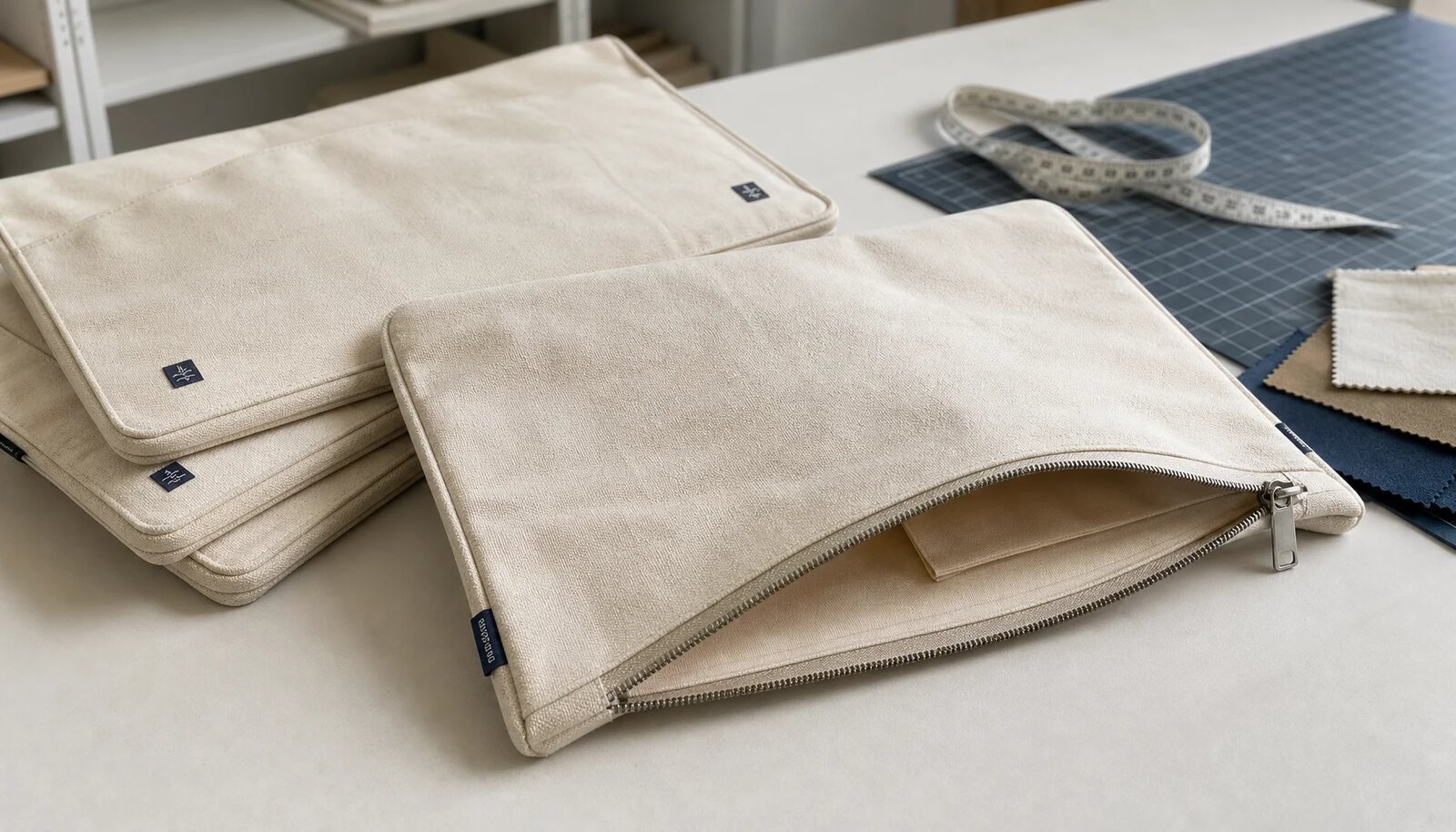
Start With the Hotel Use Case
A canvas zipper portfolio can look simple on a quotation sheet, yet it carries several jobs in hotel retail. It may sit on a resort boutique shelf, hold guest documents at check-in, bundle spa forms and menus, support a conference desk, or become part of a branded welcome kit. Those uses overlap, but they do not need the same construction. A retail item needs stronger shelf presence. An operations item needs dependable capacity and zipper function. A distributor program needs clean repeatability across SKUs, cartons, and reorders.
That is why procurement should define the buying use case before asking for unit prices. If the RFQ only says wholesale canvas zipper portfolios for hotel retail, suppliers may quote different products while using similar language. One factory may price a thin unlined document pouch. Another may include 12 oz canvas, lining, a #5 zipper, screen print, label, hangtag, barcode sticker, and individual packing. Both quotes can look reasonable until the samples arrive.
The best starting point is a short commercial brief. State where the portfolio will be sold or used, what price position it must support, what contents it must carry, and how much branding guests should see. This gives the factory enough context to recommend fabric weight, zipper gauge, lining, logo method, packing, and MOQ without stripping out details just to make the first price look low.
- Hotel boutique retail: prioritize handfeel, shelf presentation, clean interior finishing, logo accuracy, barcode control, and low visible defects.
- Welcome kit or loyalty gift: prioritize odor control, consistent brand color, neat packing, and reliable appearance when the item is opened by a guest.
- Front desk document holder: prioritize usable size, zipper smoothness, seam durability, carton efficiency, and easy staff handling.
- Conference or event program: prioritize lead time, print placement consistency, SKU separation, and fast bulk distribution.
- Distributor wholesale order: prioritize repeatable bill of materials, carton data, landed cost, and reorder continuity.
Lock Size, Opening, and Capacity
Sizing is where many canvas portfolio orders go wrong. Buyers often ask for an A4 portfolio, assuming the product will fit A4 documents easily. A factory may interpret that as external finished size. Another may quote the pattern size before sewing. A third may make a sleeve that fits one loose sheet but not a document stack, folder, tablet case, menu, or amenity insert. For procurement, the RFQ should separate finished external dimensions from internal usable dimensions.
A4 paper is about 21 x 29.7 cm, but the portfolio needs extra clearance. Seam allowance, zipper tape, lining thickness, fabric bulk, corner radius, and zipper stops all reduce usable space. Many buyers start near 34 x 25 cm finished size for A4 document use, yet that should be tested against the real contents. If the portfolio must accept a tablet, notebook, guest folder, or several spa forms, send the actual object dimensions and thickness to the supplier.
The zipper opening deserves its own line in the specification. A portfolio can be wide enough on a ruler but frustrating to use if the opening is short or the corner shape blocks insertion. Round corners look softer but reduce usable entry space. Square corners may carry papers more efficiently but need clean sewing at stress points. Gussets increase capacity, but they add cost, bulk, and more measurement points. Approve the sample with the contents inside, not empty on a table.
- Quote finished external width x height measured flat after sewing, pressing, and packing recovery.
- State internal usable width x height and the minimum clearance required beyond the contents.
- Specify zipper opening length and whether contents must insert without bending, angling, or forcing the corners.
- Define square, rounded, boxed, or gusseted corners because each option changes capacity and sewing complexity.
- Use realistic tolerance, commonly +/- 5 mm on flat portfolios unless tighter control is agreed and priced.
- Send physical content dimensions for tablets, folders, document packs, menus, stationery sets, or amenity inserts.
Choose Canvas Weight and Finish Carefully
Canvas weight shapes the first impression. It also affects sewing speed, zipper behavior, carton weight, and cost. Light 8 oz cotton canvas may work for a simple promotional pouch, but it often lacks the body expected for hotel retail. A 12 oz cotton canvas, typically about 380-410 GSM depending on yarn count, weave density, and finishing, is a practical starting point for many wholesale canvas zipper portfolios. It feels more substantial without making every corner bulky.
Heavier canvas is not automatically a better buy. A 14-16 oz fabric can feel premium, but it may create thick seam allowances, swollen zipper ends, slower production, higher needle breakage risk, and heavier export cartons. Add lining, padding, or internal pockets and the total thickness rises again. The sample should prove that the zipper sits flat, corners recover after packing, and the finished item still feels appropriate for a hotel shelf rather than overbuilt.
Color and finish need the same discipline. Natural canvas fits resort, spa, travel, and casual luxury programs, but it can show seed flecks, slubs, and shade variation. Those marks may be acceptable, even desirable, if approved in advance. Dyed canvas gives stronger color direction but brings dye-lot variation and may require lab dips. Washed canvas feels softer but can shrink, distort, and absorb ink differently. Recycled cotton blends may support a sustainability brief, but they still need checks for strength, lint, shade consistency, and documentation requirements.
- Request composition, oz, GSM, weave description, finishing, and whether the stated weight is before or after finishing.
- Approve natural flecks, slubs, and shade range with physical swatches rather than supplier photos only.
- Ask for lab dips when dyed fabric must approach a hotel brand color, and define visual tolerance or delta if your program uses one.
- Confirm shrinkage and distortion risk for washed, dyed, or recycled fabrics before approving finished size.
- Test print absorption and edge sharpness on the actual canvas lot whenever possible.
- Check carton weight impact before upgrading to very heavy canvas across large wholesale quantities.
Specify Zipper and Hardware Details
The zipper is the part guests touch first, so it cannot be an afterthought. For soft cotton canvas portfolios, nylon coil zippers are often the safest wholesale choice. They flex around corners, keep weight low, and sew more cleanly than rigid metal teeth on flat soft goods. A #5 nylon coil zipper is a balanced option for medium canvas portfolios. A #3 zipper can work for lighter slim sleeves. Metal teeth can look premium, but they add weight, can feel stiff, and may scratch printed panels during packing.
A usable zipper specification includes more than the word quality. State the zipper type, gauge, tape color, tooth color, slider finish, puller style, puller length, and end-stop method. Puller selection affects both presentation and risk. A standard metal puller keeps cost efficient. A fabric pull tab can reduce noise and scratching. A branded molded or metal puller may improve the retail look, but it may also require tooling, higher MOQ, longer sampling time, and repeat-order planning.
Test zipper performance in realistic conditions. Open and close the sample empty, then fill it with the intended documents or accessories and repeat the test. Watch the corners. Listen for roughness. Check whether the lining, loose thread, zipper tape, or contents catch in the slider. Stack several units as they would be packed and see whether the puller presses into the printed logo or leaves marks on the next portfolio.
- Define zipper type, gauge, tape color, tooth color, slider finish, puller style, puller length, and end-stop treatment.
- Use nylon coil for most canvas portfolios unless metal teeth are required for a specific brand look.
- Check slider smoothness, puller strength, zipper-end security, and tape alignment during sample approval.
- Reject sharp puller edges, slider wobble, broken teeth, loose stops, rough tape, and twisted zipper corners.
- Confirm branded puller tooling cost, MOQ, sample lead time, and repeat-order availability before committing.
- Test carton stacking to ensure pullers do not dent, scratch, or rub against printed panels.
Match Interior Build to Price Point
Interior construction should match the sales channel. An unlined canvas portfolio can be right for cost-sensitive document kits, simple guest collateral, or operational use, but only if internal seams are controlled. Overlocked or bound seams should look neat and should not shed loose threads into the portfolio. If guests will open the item in a boutique before buying it, an unfinished-looking interior can weaken the perceived value quickly.
A lining gives a cleaner retail impression and can protect contents from loose canvas fibers. Common options include lightweight polyester such as 190T, cotton, or poly-cotton. Polyester is smooth and efficient. Cotton can feel more natural, but it may add bulk and bring shrinkage considerations. The lining must be anchored correctly. If it sags, twists, bubbles, or floats into the zipper path, the portfolio will feel cheap even when the outer canvas is good.
Pockets and organizers should earn their place. A flat pocket, card sleeve, divider, pen loop, or elastic band can turn the item into a travel organizer or conference portfolio, but each feature adds sewing operations, measurement tolerances, inspection points, and panel distortion risk. If the hotel program does not need internal organization, a clean flat interior is often stronger than underbuilt compartments. If pockets are required, specify what each pocket must hold and how it will be measured.
- Use unlined construction for cost-sensitive document holders only when inside seams are clean and controlled.
- Use lining for boutique retail, premium welcome gifts, or any program where guests inspect the interior closely.
- Specify lining material, color, weight, seam method, and how the lining is anchored away from the zipper.
- Define pocket quantity, pocket dimensions, opening direction, stitch reinforcement, and tolerance before quoting.
- Avoid adding compartments unless they support the target retail price or operational use.
- Check filled samples for lining sag, pocket distortion, zipper catching, and uneven panel shape.
Control Logo Method and Placement
Hotel branding often works best when it is clean and restrained. A small logo placed accurately can look more premium than a large graphic that feels promotional. Screen printing is often the most practical wholesale method for one-color or two-color hotel logos on canvas because it balances cost, repeatability, and opacity. Still, the print must be approved on the selected fabric. Textured cotton can break fine lines, absorb ink unevenly, and soften sharp edges.
Other decoration methods can be useful when the brand brief requires them. Heat transfer and digital print support gradients, multiple colors, and detailed artwork, but buyers should check handfeel, adhesion, edge quality, and saturation on natural canvas. Some transfers can feel too plastic for hospitality retail. Embroidery can look elevated, but it may pucker flat panels unless backing, stitch density, and placement are controlled. Woven patches, woven side labels, and branded tabs can suit boutique programs, though they add sewing steps and placement tolerances.
Placement should be measured, not guessed from a mockup. State the logo size and distance from the left seam, bottom seam, zipper edge, or center line. For repeat orders, keep the vector file, print color reference, approved ink or thread notes, and a ruler photo of the approved sample. This is especially important when an order repeats months later, moves to a new fabric lot, or runs across several hotel properties.
- Use screen print for solid logos, simple type, and one-color or two-color hotel branding.
- Approve heat transfer or digital print only after checking handfeel, adhesion, edge quality, and saturation on canvas.
- Use embroidery or woven patches when the premium effect justifies stabilization, added sewing, and inspection.
- Provide vector artwork, Pantone or brand color references, logo size, and minimum line thickness.
- Define placement with measured distances from seams or center line rather than a rendered mockup only.
- Keep ruler-reference photos and artwork notes for repeat-order matching.
Compare MOQ and Quotes Like-for-Like
MOQ is rarely driven by total units alone. A supplier may support 500-1000 pieces when the order uses stock natural canvas, stock zipper color, a standard puller, one print color, and simple packing. The same supplier may need a higher MOQ for custom dyed canvas, custom zipper tape, branded pullers, woven patches, multiple hotel logos, separate destinations, or barcode-level SKU splits. Ask which choices are driving MOQ before assuming the supplier is being rigid.
Quote comparison also needs a controlled spec sheet. One price may include an unlined body, basic zipper, and bulk carton packing. Another may include 12 oz canvas, lining, #5 nylon zipper, screen print, woven side label, hangtag, barcode sticker, individual protective bag, and export carton. The second quote may be higher because it is actually closer to the hotel retail requirement. Procurement should separate base unit price, optional add-ons, setup charges, tooling, sample fees, packing costs, and freight assumptions.
SKU complexity can turn a simple order into a difficult one. A 1,000-piece order with one logo is not the same as 1,000 pieces split across five properties, three zipper colors, two labels, and separate carton marks. Each split adds setup, line clearance, packing separation, and inspection work. For a first order, standardize materials where possible. Customize the visible elements guests care about most, then add more versions once the base product is proven.
- Compare quotes using the same size, canvas GSM, zipper grade, lining, logo method, label, and packing.
- Ask suppliers to separate base price, add-on costs, setup charges, sample fees, tooling, and repeat-order assumptions.
- List quantity by logo, colorway, barcode, destination, and carton mark before requesting final pricing.
- Confirm whether custom fabric, zipper tape, pullers, labels, or hangtags change MOQ or lead time.
- Use carton CBM and gross weight to compare landed cost, not only ex-factory unit price.
- Keep a spec sheet version number so all suppliers quote the same revision.
Approve Samples in the Right Order
Sampling should confirm construction before decoration. A blank structure sample lets the buyer test fabric handfeel, finished size, usable space, zipper action, lining, pocket layout, corner shape, and seam finishing. At this stage, focus on measurements and function. A perfect logo on the wrong body does not help. Once the structure is approved, move to a printed pre-production sample to confirm artwork size, placement, print quality, retail packing, and final workmanship.
Use the sample the way the hotel will use the product. Insert the intended paper stack, tablet, menu, folder, notebook, or amenity set. Open and close the zipper repeatedly, especially around corners. Stack several pieces and check whether pullers press into printed panels. Review the print under normal indoor retail lighting, not only bright factory lighting. If dyed canvas, lining, transfer print, adhesive label, or new packing is used, keep one sample sealed for a short period and check odor when opened.
Sample approval should be documented like a production control file. Record measured dimensions, zipper opening, internal clearance, pocket size, fabric details, lining notes, artwork proof, print placement, packing method, and any approved deviations. Keep one sealed approval sample for final inspection and one working sample for handling tests. During bulk inspection, compare production against the approved sample and written tolerance, not against memory or a digital mockup.
- Approve a blank construction sample before approving logo and retail packaging.
- Measure external size, internal usable space, zipper opening, pocket size, and logo position on the sample.
- Photograph key measurements with a ruler and store them with the purchase order.
- Test filled-use performance, zipper cycling, stacking pressure, odor, and packing recovery.
- Approve print strike-off or pre-production sample before bulk printing or cutting when logo risk is high.
- Keep sealed approval and working samples for inspection reference.
Plan Packing and Hotel Receiving
Packing protects the product and prevents receiving problems. Natural canvas can pick up carton dust, moisture marks, and abrasion during transport. Zipper pullers can scratch printed panels or create pressure marks if goods are packed too tightly. If the order goes to a hotel shop, distributor warehouse, event venue, or fulfillment center, packing must support both product protection and operational control.
Individual polybags offer strong export protection, especially for natural canvas and mixed warehouse handling. Some hotel brands, however, prefer reduced plastic. Alternatives include recyclable bags, paper sleeves, kraft belly bands, hangtags, or plastic-free bulk packing. Separate export protection from retail presentation. A portfolio might ship in a protective recyclable bag and then be displayed with a paper band after receiving. If plastic-free packing is required, test abrasion, dust, and moisture risk before approving carton-only packing.
Carton planning affects freight quotes, warehouse labor, and error rate. Heavy canvas, lining, and gussets reduce pieces per carton and increase gross weight or CBM. Over-tight bundling can leave creases that do not recover well. Multi-property programs need clear carton marks by logo, color, barcode, destination, and purchase order. A good product can still fail operationally if cartons are mixed, mislabeled, overweight, or missing receiving data.
- Define individual packing: polybag, recyclable bag, paper sleeve, belly band, hangtag, or no individual pack.
- Confirm inner bundle quantity, master carton quantity, carton dimensions, net weight, gross weight, and CBM.
- Control orientation or interleaving so zipper pullers do not contact printed panels.
- Avoid compression, tight strapping, or damp packing conditions that can crease or mark canvas.
- Separate hotel logos, colorways, barcodes, and destinations with clear carton marks and packing lists.
- Approve barcode position, retail sticker data, country-of-origin marking, and hangtag attachment before mass packing.
Set QC Before Bulk Production
Quality control should be agreed before the factory cuts bulk fabric. If the purchase order only says canvas zipper portfolio, the supplier may treat visible issues as normal variation. Hotel retail buyers usually need a tighter standard because guests handle the product directly. Stains, odor, mold risk, crooked logos, wavy zippers, loose threads, sharp hardware, and wrong carton marks can cause rejection even when the portfolio technically opens and closes.
Classify defects clearly. Critical defects can include mold, unsafe sharp hardware, wrong hotel logo, wrong SKU, severe odor, or a size that prevents the intended use. Major defects can include zipper failure, visible front-panel stains, severe print skew, broken seams, lining caught in the zipper, incorrect barcode, or wrong packing. Minor defects may include small thread ends, slight shade variation within the approved range, or internal cosmetic issues that do not affect use or retail appearance.
Inspection should cover materials, measurements, workmanship, function, appearance, and packing. Final random inspection can catch many problems, but in-line checks are better for preventing mass defects. Zipper sewing, logo placement, and lining attachment should be checked early because they are difficult to repair after final assembly. For larger or higher-risk orders, use an agreed AQL level with a zipper-portfolio-specific checklist, approved sample photos, and written tolerances.
- Define critical defects such as mold, unsafe hardware, wrong logo, wrong SKU, severe odor, or unusable size.
- Define major defects such as zipper failure, visible stains, severe logo skew, broken seams, lining catch, or wrong packing.
- Define minor defects such as small thread ends or slight approved shade variation.
- Inspect finished size, usable capacity, zipper function, seam security, logo placement, print quality, lining, odor, and carton marks.
- Use approved samples, ruler photos, and written tolerances as inspection references.
- Request corrective action if in-line photos show repeated zipper waves, print misalignment, stains, or mixed SKUs.
Specification comparison for buyers
| Spec decision | Recommended option | When it fits | Buyer risk to check |
|---|---|---|---|
| Outer fabric weight | 12 oz cotton canvas, typically about 380-410 GSM depending on yarn count, weave density, and finishing | Good starting point for hotel boutiques, welcome kits, front desk document packs, conference retail, and resort shops that need structure without bulky sewing | Below 10 oz can feel too promotional and collapse when empty; above 16 oz may create thick zipper corners, slower sewing, more needle breakage, and heavier cartons |
| Finished size and usable opening | Quote both finished external size and internal usable space; for A4 papers, many buyers begin near 34 x 25 cm with at least 10-15 mm clearance beyond the contents | Useful when one SKU must hold guest documents, spa menus, event programs, stationery, maps, or a slim tablet sleeve | A nominal A4 description can become too tight after seam allowance, lining, zipper tape, corner radius, zipper stops, and normal sewn-goods tolerance |
| Size tolerance | Set measurable tolerance before sampling, commonly +/- 5 mm on width and height for flat sewn portfolios; functional pockets may need +/- 3-5 mm | Works for most cotton canvas portfolios where fabric movement and manual sewing are expected | Very tight tolerance can raise rejection rate and cost; no tolerance lets undersize or visibly uneven pieces pass as acceptable |
| Zipper type | Nylon coil zipper, usually size #5 for a balanced portfolio or #3 for lighter slim sleeves, with a smooth slider and secure end finishing | Nylon coil flexes around canvas corners, keeps weight low, and is easier to sew than rigid metal teeth on flat soft goods | Cheap sliders, misaligned tape, rough pullers, loose stops, or lining caught in the zipper path cause complaints quickly |
| Lining construction | Unlined with clean overlock or bound seams for economy; 190T polyester, cotton, or poly-cotton lining for a cleaner retail interior | Unlined fits lower-cost document kits; lined fits boutique shelves, premium welcome gifts, travel organizers, and higher retail price points | Loose lining can catch in the zipper; unlined canvas can shed fibers or look unfinished if seam finishing is not specified |
| Logo method | Screen print for simple 1-2 color hotel logos; heat transfer, digital print, embroidery, woven patch, or woven side label when artwork and brand position justify it | Screen print is often the most repeatable wholesale method for solid logos on cotton canvas | Fine type can fill in on rough canvas; heavy ink can crack at fold points; embroidery can pucker flat panels without backing and stitch-density control |
| Internal organization | One flat pocket, card sleeve, divider, or elastic loop only when the use case and target retail price support the labor | Useful for conference portfolios, loyalty gifts, resort document kits, and travel accessory programs | Every pocket adds sewing operations, measurement points, inspection time, and risk of uneven panel shape or lining distortion |
| Packing method | Individual protective bag for export, optional paper belly band or retail sleeve, size-separated master cartons, and clear SKU/carton marks | Protects natural canvas during freight and makes hotel retail receiving easier | No individual protection can lead to dust, abrasion, zipper scratches, transfer marks, and mixed-logo receiving errors |
| MOQ logic | Calculate MOQ by fabric color, zipper color, print setup, label type, packing, and quantity per hotel logo, not only by total units | 500-1000 pieces can be practical for stock natural canvas, stock zipper, one print color, and simple packing; custom dyed materials usually raise MOQ | Too many logo versions or colorways create hidden screen charges, packing errors, inefficient sewing batches, and harder inspection |
Buyer checklist before sampling
- Define the commercial use first: boutique retail, welcome kit, front desk document holder, conference pack, spa program, loyalty gift, distributor resale, or event merchandise.
- List the exact contents to be carried: A4 documents, menus, spa forms, room collateral, maps, tablet with case, notebook, stationery, amenity cards, or small travel accessories.
- Specify finished external width and height, internal usable width and height, zipper opening length, corner shape, seam allowance assumption, and measurement tolerance.
- Confirm fabric composition, yarn type if needed, canvas weight in oz and GSM, color, weave, finishing, shrinkage expectation, shade tolerance, and acceptable natural flecks or slubs.
- State whether the portfolio is unlined, lined, bound, overlocked, padded, reinforced, gusseted, or built with pockets before comparing prices.
- Define zipper type, gauge, tape color, tooth color, slider finish, puller style, puller length, zipper-stop method, and smoothness requirements on empty and filled samples.
- Send vector artwork with print size, color reference, minimum line thickness, logo placement measured from seams, and repeat-order matching requirements.
- Decide whether packing must solve export protection, retail display, barcode control, warehouse receiving, plastic-reduction policy, or all of these at once.
- Request a blank structure sample before artwork sampling, then approve a printed pre-production sample before bulk cutting or printing.
- Set written QC criteria for critical, major, and minor defects including stains, odor, mold, slanted sewing, loose threads, zipper failure, print skew, wrong SKU, and packing errors.
Factory quote questions to send
- What canvas composition, weight in oz and GSM, yarn count or weave description, finishing method, shrinkage range, and shade tolerance are included in the quote?
- Is the quoted size the finished external size, internal usable size, or pattern size before sewing, and what width/height tolerance applies in bulk production?
- What is the recommended clearance for the buyer's stated contents, and will the sample be tested with the same paper stack, folder, tablet, or amenity set?
- Which zipper gauge and type are quoted, and can you provide photos or samples of tape, teeth, slider, puller, end stop, and stitching before approval?
- Does the quoted price include lining, binding, inner pocket, card sleeve, divider, woven side label, printed neck label, hangtag, barcode sticker, retail sleeve, and individual packing?
- Which logo method is quoted, how many colors are included, what is the maximum print area, what minimum line thickness is safe on the selected canvas, and what artwork file is required?
- What separate MOQ applies for natural canvas, dyed canvas, washed canvas, custom zipper tape, custom puller, woven label, multiple logos, separate destinations, and SKU splits?
- What sample fees and lead times apply for blank structure sample, print strike-off, pre-production sample, top-of-production sample, shipment sample, and sample revisions?
- When does production lead time officially start: deposit, material approval, artwork approval, pre-production sample approval, or final packing approval?
- What carton size, pieces per carton, net weight, gross weight, and CBM should be used for freight quotes and hotel warehouse receiving?
Quality-control points to confirm
- Finished external width and height should stay within the agreed tolerance, commonly +/- 5 mm for flat cotton canvas portfolios unless a tighter tolerance is approved and priced.
- Internal usable space must fit the stated contents after seam allowance, lining thickness, fabric bulk, zipper stops, and corner radius are included.
- Zipper must open and close smoothly across repeated cycles without catching lining, loose thread, corner seams, zipper tape, or contents inside the portfolio.
- Zipper tape should sit evenly with no obvious waviness, twisted corners, skipped stitches, open zipper-end seams, loose stops, broken teeth, or slider wobble.
- Logo placement should match the approved ruler photo within the agreed tolerance, commonly +/- 3-5 mm for print position on flat panels when practical.
- Print quality should show acceptable opacity, registration, edge definition, color match, and adhesion with no obvious bleeding, pinholes, contamination, cracking, or scorch marks.
- Canvas should be free from oil stains, mildew, mold odor, heavy dirt, water marks, unexpected dark weaving defects, and packing dust visible under normal retail lighting.
- Seams at zipper ends, corners, pocket openings, labels, and stress points need secure backstitching, bartacking, or clean locking according to the approved sample.
- Lining, if used, should not twist, bubble, sag, fray, show raw edges, or extend into the zipper path when the portfolio is filled.
- Hardware should have consistent finish with no sharp burrs, rust marks, plating discoloration, loose pullers, or edges that scratch the printed front panel.