Start with the job the portfolio must do
Canvas zipper portfolios are often written up as a generic branded accessory, but trade show buyers need something more specific: a soft-sided carrier that can protect papers, handouts, product sheets, sample cards, or small presentation sets while moving quickly through a booth. The product may be handed to visitors, used by sales staff, or packed into a larger kit. Those use cases do not need the same fabric weight, pocket layout, or zipper build, so the first procurement step is defining the actual task rather than the category name.
A portfolio for booth handouts can be simple. It may need to look neat, stay flat in a stack, and survive a few openings during the show. A portfolio for field sales or account meetings has a tougher job: it may carry documents every day, get tossed into another bag, and need to keep its shape after repeated use. That difference changes everything downstream, from fabric weight to seam reinforcement to the type of zipper pull the supplier should source.
The buyer should also define the contents before asking for a quote. A4 sheets, letter-size documents, thick catalogs, foam sample cards, or a slim device kit all create different thickness and closure pressure. The usable internal size matters more than the outer size on the drawing. If the internal width is too tight, the portfolio will look correct in a mockup and still fail in real use once the seam allowance and lining are added.
Trade show portfolios sit in a narrow design band. If the shell is too light, the piece looks cheap and wrinkles at the corners. If it is too heavy, the portfolio becomes stiff, bulky, and awkward to pack with the rest of the event kit. The right spec is usually the one that balances hand feel, protection, and shipping weight, not the one that sounds most premium in a quote.
For procurement teams, the best internal brief is short but specific: what the portfolio must carry, how often it will be used, whether it must lie flat or open wide, and how important presentation is relative to durability. Once that is clear, the supplier can recommend a fabric weight and structure that fit the task instead of overbuilding the item or cutting corners.
This category gets easier to buy when the use case is spelled out in one sentence. For example: “A zipper portfolio for trade show exhibitors that holds A4 sales sheets, a brochure set, and one pen, with a clean logo face and a bulk-friendly packing format.” That is the kind of brief a supplier can quote accurately.
- Define the real contents before you ask for pricing.
- State whether the portfolio is for booth handouts, sales meetings, or long-term field use.
- Use usable internal dimensions, not only outer dimensions.
- Match the build to the load and the handling pattern.
- Keep the brief specific enough that the supplier cannot interpret it too broadly.
Use fabric weight as a functional decision, not a branding slogan
Fabric weight is one of the few specifications buyers can use to narrow the product quickly, but it only helps if the number is tied to the right construction. For canvas zipper portfolios, the practical buying range is usually 10oz to 14oz depending on the use case. A 10oz shell can work for lighter handout portfolios, while 12oz to 14oz is a safer band when the item needs more body, better shape retention, and better resistance to corner collapse.
The weight itself is not the whole story. Canvas can be reported in ounces or GSM, and the comparison only makes sense if the supplier states the measurement basis. Finished fabric, washed fabric, greige fabric, and post-print fabric may not match one another exactly. If buyers do not ask what was measured and when, two quotes that look identical can actually describe different material behavior.
Fabric finish matters almost as much as weight. A stabilized or pre-shrunk canvas is usually better for a portfolio that must keep its dimensions after cutting and sewing. If the fabric is not controlled, the finished piece can shift after printing, pressing, or humidity exposure. That becomes a problem when the portfolio must fit a standard document size or align with a branded layout.
Heavier canvas improves body, but it also affects cutting effort, seam bulk, zipper handling, and shipment weight. A very heavy shell can look strong in a sample and still be wrong for a trade show program if it makes the portfolio hard to close or adds too much freight cost. This is why the best buyers ask the supplier to explain the tradeoff instead of simply asking for the thickest available fabric.
A useful rule for procurement is to link fabric choice to the amount of handling the portfolio will see. If the product will be held once and handed out, a lighter shell may be enough. If it will be opened repeatedly, carried across the show floor, and reused after the event, a firmer and better-controlled canvas is usually worth the extra cost. The fabric choice should match the lifecycle, not just the first impression.
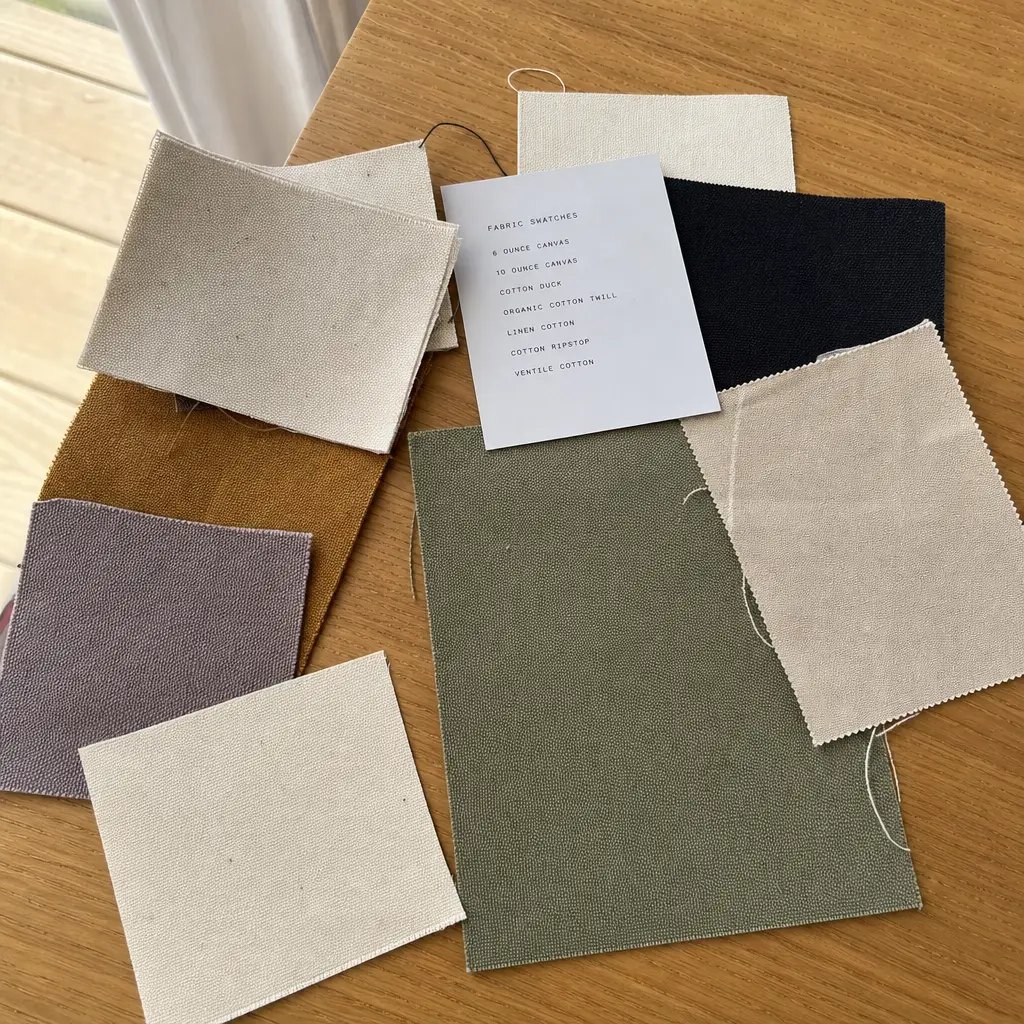
When suppliers quote canvas, ask for a swatch and the exact route used to finish it. A washed or stabilized fabric can feel different from a raw cloth at the same nominal weight. Ask the supplier to note whether the sample comes from the same lot the bulk order will use. That prevents the common problem where the sample feels right but the bulk run is cut from a different material behavior.
The most useful fabric question is not “What is the best canvas?” It is “What canvas weight and finish will keep this portfolio functional, printable, and repeatable for our event program?” That question gets you a usable answer rather than a generic material pitch.
- Use 10oz–12oz for lighter handout portfolios and 12oz–14oz for most trade show programs.
- Ask whether the weight is quoted in GSM, oz, or both, and what basis was used.
- Prefer stabilized or pre-shrunk canvas when repeat ordering matters.
- Do not compare suppliers until they state the same measurement basis.
- Request a swatch from the same material route used for bulk production.
Specify the portfolio around what will go inside
A good portfolio spec starts with the contents, not the outside shape. For trade show exhibitors, the internal layout usually needs to hold flat documents, folded brochures, sample cards, and maybe a pen or note card. If the buyer starts with a sketch of the bag instead of the contents, the supplier may overbuild the product with pockets that do not help the user and create extra sewing points that can fail later.
For a simple exhibitor kit, one main compartment and one slim pocket may be enough. That keeps the portfolio clean, easy to sew, and easy to pack. If the kit includes more than paper, the buyer should specify what must fit without bending or forced closure. That could include a stack of flyers, a product card deck, a small notebook, or an insert tray. Each item affects gusset depth and pocket placement.
The zipper portfolio should also be tested in the closed state, not only while open. A bag that looks generous when empty may become tight once the contents are inside, especially if the canvas is heavy or the zipper stops sit close to the edge. Buyers should ask the supplier to show the filled sample with the intended load. If the zipper track curves, buckles, or strains at the corners, the structure needs adjustment before bulk production.
Internal dimensions matter more than many first-time buyers expect. A finished outer size may look large enough, but once seam allowances and lining are included, the usable width can shrink enough to make A4 sheets drag or catch. The procurement spec should tell the factory whether the portfolio must fit A4, letter, or legal paper, and whether the contents are sleeved or loose. A portfolio that is too tight looks like a quality issue even when the sewing is technically correct.
The layout should also reflect how the item is used on the show floor. If staff will open it quickly while speaking with visitors, the inside should be simple and easy to understand. If the product is meant to support sales follow-up after the event, the buyer may want a more organized inside with a document sleeve, pen loop, or card pocket. Those additions are useful only when they support the actual workflow.
For many programs, the best portfolio is the least complicated one that still fits the contents correctly. Extra pockets are not automatically better. They increase sewing time, create more points for variation, and can make the portfolio bulkier than needed. A buyer who defines the contents clearly will usually get a cleaner, more cost-effective design.
- List the exact contents the portfolio must carry.
- Confirm usable internal dimensions after seams and lining are added.
- Test the sample closed with the real load inside.
- Add pockets only when they support the actual workflow.
- Keep the interior simple unless the use case demands more organization.
Compare quotes on the full spec stack
Two quotes for a canvas zipper portfolio can look similar while describing very different products. One may use a lighter canvas, a basic zipper, and a simple print. Another may use stabilized fabric, a better slider, reinforced seams, and cleaner packing. If the comparison only shows unit price, procurement can easily choose the wrong supplier for the same-looking item.
The best comparison method is to force every supplier to quote the same stack of details: fabric weight and finish, zipper type, print method, internal layout, sewing standard, packing method, and inspection criteria. When those items are aligned, price differences become meaningful. Without that alignment, one quote can be cheaper simply because it excludes parts of the job that the buyer assumed were included.
This is especially important for branded trade show programs. Buyers often need the portfolio to look controlled from across the booth, but also hold up during repeated use. That means the comparison should include visible details such as logo method and zipper pull style as well as hidden details like seam reinforcement and label attachment. A lower price may hide a thinner shell or a weaker closure that would not survive a second order.
Quote clarity also reduces internal debate. Marketing usually wants the strongest visual result. Procurement wants cost and timing. Operations wants easy receiving and low damage risk. A line-item quote lets all three groups see what changes when the price moves. If the supplier only sends one number, nobody can tell whether the difference comes from the fabric, the print, or the packing standard.
A useful buyer habit is to ask which items are stock and which are custom. Stock fabric, stock zipper, and stock packaging usually keep costs and lead time down. Custom dye, custom lining, custom pullers, or special inserts add process steps and may create separate minimums. If the supplier does not identify those break points, the quote is not yet usable for procurement review.
Treat substitutions carefully. An approved equivalent should be documented against the original target and signed off before bulk production. A cost-down option is a different build and should be priced as such. A temporary substitute should only be accepted when the original material is unavailable and the buyer has approved the swap in writing. That keeps reorders from drifting over time.
The most decision-useful quote is the one that makes it easy to answer one question: are these suppliers actually quoting the same portfolio? If the answer is yes, the remaining choice is much easier. If the answer is no, the first job is to fix the spec sheet, not to negotiate harder.
- Compare only after aligning fabric, zipper, print, sewing, packing, and QC.
- Ask which items are stock and which are custom.
- Watch for hidden charges such as screens, transfers, labels, inserts, or carton marks.
- Treat substitutions as approval items, not silent changes.
- Require the supplier to state what is excluded as clearly as what is included.
Choose a sourcing route that fits the event timeline
Trade show programs usually have a fixed date, which means sourcing needs to match the calendar instead of the other way around. For a canvas zipper portfolio, there are three practical routes: stock, semi-custom, and fully custom. The right choice depends on how much visual control the buyer needs and how much time is available before the event.
Stock sourcing is the fastest route. It works when the buyer needs a simple branded carrier, the timeline is tight, or the event calendar does not allow a long sample cycle. The tradeoff is less control over fabric color, zipper match, or interior layout. Stock can be perfectly valid if the branding brief is simple and the buyer accepts those limits in writing.
Semi-custom is often the strongest fit for trade show exhibitors. The base pattern stays stable, which helps with fit and repeatability, but the buyer still controls the logo, the fabric weight, the zipper color, and the main layout. That gives the program a more branded feel without pushing every component into a custom sourcing path. For many buyers, semi-custom is the best balance of speed, control, and repeat-order stability.
Fully custom makes sense when the portfolio is part of a premium event experience, a distributor gift, or a long-life sales tool. It gives the buyer the most control, but it also brings more design review, more sample approval time, and more risk around material sourcing. The mistake is asking for custom-level control while expecting stock-level lead time. The calendar usually exposes that mismatch very quickly.
Whatever route you choose, keep the approval trail clean. The buyer should retain one sealed reference sample and the factory should keep one as well. Label both with the revision date, fabric spec, zipper spec, and artwork version. If those references are not controlled, later reorder discussions can become subjective and slow.
Ask the supplier where the true bottleneck sits. For one program, it may be fabric booking. For another, it may be zipper sourcing or print setup. A supplier that understands the route can tell you which feature is most likely to affect the schedule. That answer helps the buyer decide where to simplify and where to protect the brand presentation.
A simple but correct portfolio that arrives on time is usually better than a complex one that misses the show. For a trade show buyer, the sourcing route should be chosen to protect the event, not to chase the most elaborate specification on paper.
- Use stock when speed is the priority and customization is limited.
- Use semi-custom for most trade show programs that need brand control.
- Use fully custom only when the brand payoff justifies the extra lead time.
- Keep one sealed reference sample on each side.
- Ask the supplier to identify the most likely schedule bottleneck before PO release.
Treat zipper details as part of the product, not an accessory
The zipper is a core functional part of the portfolio, and buyers should quote it like one. For this category, a nylon coil zipper is usually the safest default because it is flexible, runs smoothly on a soft canvas body, and does not add excessive bulk. But even when the type is standard, the construction details still matter: coil size, tape color, slider grade, puller shape, and end-stop method all affect how the finished piece feels and how reliably it closes.
The wrong zipper spec can make an otherwise decent portfolio feel cheap. A slider that catches, a puller that feels flimsy, or a tape color that clashes with the canvas can undermine the whole product. Buyers should ask whether the zipper is stock or custom sourced and whether the supplier has tested the exact closure on the target fabric weight. A zipper that works in a catalog description is not necessarily the same zipper that works on a finished canvas body.
Pull direction matters more than many buyers expect. If staff will open the portfolio one-handed on a booth table, the puller should be easy to grip and position. If the item will be held in a tote or packed into event kits, the slider should stay low-profile and not snag. The small details make the product easier to use, which matters when the portfolio is handled many times in a day.
The zipper ends are a common stress point. Ask the factory how they finish the stop area and how they test the zipper after sewing. If the seam enters the zipper area poorly, the closure may wave, buckle, or split over time. That is why a supplier should check both the zipper itself and the way it is installed into the canvas shell. A good component can still fail if the sewing is careless.
If the portfolio has a premium positioning, buyers may be tempted to specify a decorative zipper pull or a metal puller. That can work, but it should be evaluated for weight, noise, finish durability, and the risk of scratching adjacent items in the kit. Decorative does not always mean better in a trade show carry item. Practical use should still lead the spec.
The buyer should also ask for zipper cycle testing on sample pieces. Even a simple check of several open-close cycles can reveal tension problems, tape twisting, or a misaligned stop. That test is quick, cheap, and more informative than judging the zipper from a loose component bag. In this category, smooth closure is a real quality marker.
If the supplier cannot explain the zipper spec clearly, the quote is incomplete. A proper spec should identify the zipper family, size, tape color, slider type, and whether the puller finish matches the approved sample. That level of detail makes reorders much safer.
- Default to a nylon coil zipper for most canvas portfolios.
- Ask for coil size, tape color, slider type, puller finish, and stop detail.
- Check how the zipper is sewn into the body, not just the component itself.
- Cycle-test the sample several times before approval.
- Avoid decorative zipper parts unless they support the real use case.
Make logo decisions on a sewn sample, not a mockup
Logo control is where many trade show portfolio orders start to drift. A flat artwork proof can look clean, but the finished bag has seams, folds, zipper tape, and canvas texture that change the way the logo reads. For procurement, the useful question is not whether the artwork file looks right; it is whether the sewn portfolio will present the brand cleanly in real handling.
Screen print is usually the best fit for simple corporate logos, repeat orders, and cleaner unit economics. It tends to be the most practical option when the artwork is one or two colors and the buyer needs a stable result across many units. Heat transfer is useful when the run is smaller or the design contains more color complexity. Embroidery or a patch can create a premium feel, but it also adds thickness and can distort a lighter shell if it sits too close to a seam or zipper end.
The buyer should specify the logo size and placement using reference points the factory can actually measure. “Centered on the front” is not enough. The spec should say how far the logo sits from the top edge, side seam, or zipper start. That reduces interpretation and makes inspections much easier. It also helps the supplier place the mark where seam bulk will not interfere with the visual result.
Canvas weave affects print readability. Fine lines, tiny text, or reversed knockouts can close up when printed on a textured surface. That is why the sewn sample matters. Ask the supplier to print on the actual canvas weight and show the assembled product, not just a swatch. A good mockup can hide problems that the sewn sample will reveal immediately.
Color control should be tied to a physical target whenever possible. A digital file is not enough if the product has to be reordered or matched across teams. Buyers should ask the supplier what reference will be retained for later runs and how they will manage color consistency across production lots. That is especially important when the portfolio is part of a larger branded event system.
For recurring programs, keep the print process data. Screen count, ink reference, transfer settings, or embroidery digitizing files should be retained. Those records make future reorders safer and reduce the chance that the logo changes slightly from one event cycle to the next. If the supplier cannot retain the process information, the buyer may face a full re-approval on the next purchase.
If the mark is important to the brand, approve it under real conditions: actual fabric, actual sewing, actual zipper, and actual fold. That is the only way to see whether the logo works as a product detail, not only as an image file.
- Use screen print for simple logos and repeatability.
- Use heat transfer only when the artwork complexity supports it.
- Place logos using measurable reference points, not vague descriptions.
- Approve the logo on a sewn sample made from the real material.
- Retain process data for reorders so the print does not drift.
Build the sample process to prove function and fit
A useful sample process for canvas zipper portfolios should prove more than appearance. The sample needs to show material hand feel, size accuracy, zipper behavior, pocket fit, and logo placement together. That is the only way to know whether the portfolio will work as a trade show tool rather than just a photographed sample. Buyers should treat the sample as a function test, not only as a design approval.
The most practical test is to load the sample with the actual contents it will carry. Put in the brochure stack, paper size, notebook, or sample cards and close the zipper. If the portfolio strains, bulges, or binds, the pattern needs adjustment. This is the stage to change gusset depth, pocket position, or internal width. Waiting until bulk production begins is how avoidable defects become expensive.
The sample should also be judged in hand. Does it lie flat? Does it close smoothly? Does the zipper pull feel easy to grip? Does the shell hold its shape when the portfolio is full? These questions matter because trade show items are handled quickly, often in crowded spaces and under time pressure. A product that functions well in hand will usually perform better on the booth floor.
Approval should be tied to a specific revision. Keep one sealed reference sample at the buyer side and one at the factory, both labeled with the same version, date, fabric, zipper spec, and print method. If later issues arise, that reference lets both sides compare against the agreed baseline instead of relying on memory. This is especially important when the buyer has multiple internal reviewers or more than one event team.
If the portfolio will be used in more than one market, test the strictest case. A product that fits one location’s paper size or packing workflow may not work in another. The sample should represent the final destination, not the easiest version of the project. That keeps the buyer from approving a bag that fails once the real contents are packed.
Ask the supplier to note the fabric lot, zipper spec, print method, and sample date on the record. Those details make troubleshooting possible later. If the bulk order changes, the team can tell whether the issue started with material substitution, process variation, or sewing quality. Good sample records save time when the production path needs to be traced.
The sample process is not a formality. For this category, it is the best chance to catch fit, function, and finish problems before they hit the event calendar.
- Test the sample with the real contents inside.
- Judge closure, fit, and hand feel together.
- Keep a sealed reference sample on both sides.
- Label the sample with revision date, fabric, zipper spec, and print method.
- Use the sample to adjust fit before bulk production starts.
Use QC checkpoints that match factory reality
Quality control for canvas zipper portfolios should be specific enough that a factory can inspect against it and a buyer can reject against it. Generic checks like “good quality” are not enough. The QC plan should name the risks that actually happen in this product category: wrong fabric weight, uneven print placement, weak zipper function, loose stitching, size drift, dirty packing, and component substitution.
Fabric checks should verify the agreed weight and finish, not just the color. If the order calls for stabilized or pre-shrunk canvas, the factory should confirm that the fabric route matches the approved sample. Buyers should ask for a tolerance band that is tied to the agreed target. A practical discussion band is often around ±5% for fabric weight, but the factory’s own method and acceptance rules should be written into the spec. The point is to stop a supplier from substituting a noticeably lighter or looser cloth and calling it acceptable.
Size control should focus on the usable internal dimension, because that is what determines whether the portfolio works in the field. The buyer should define where the measurement starts and ends, whether it is taken after pressing, and what tolerance is allowed. For smaller portfolios, a control target around ±5 mm is often practical; for larger pieces, ±8 mm may be more realistic if the shell has body and seam movement. Whatever the number, it needs to be agreed before production starts.
Zipper testing should be simple and real. The inspected units should be opened and closed multiple times to check for catching, tape twist, misaligned stops, or slider drag. A supplier can state a cycle count in the inspection plan, and the buyer should ask to see the pass/fail criteria. For this product, the closure is not cosmetic; it is a core function. If the zipper is rough, the whole portfolio feels unreliable.
Print inspection should look at placement, opacity, and edge quality on the assembled product. A logo that is centered on paper can still look wrong once the bag is sewn and folded. The buyer should define the placement reference points and ask the factory to measure against them. If the print sits near a seam or zipper, the tolerance should be tighter because the visual error is easier to notice.
Stitching should be checked at stress points, especially around zipper ends and pocket joins. Buyers should ask inspectors to look for skipped stitches, uneven stitch length, loose threads, and weak back-tacks. The stitch standard does not need to be over-engineered, but it should be written down so the factory knows what “acceptable” means. For brand-facing event items, sloppy thread work is often the difference between a usable product and a rejected one.
Packing QC matters as much as product QC because the goods must arrive clean and countable. Cartons should be dry, sealed, correctly labeled, and matched to the packing list. If the supplier uses polybags, inserts, or silica gel, those details should be checked too. An otherwise good portfolio can still fail receipt if the carton marks do not match the PO or the quantities do not reconcile.
The buyer should ask for issue-by-issue inspection rather than a vague final pass. That means fabric, print, zipper, stitch, size, color, accessories, and packing are checked separately. If the factory uses an inspection report, it should show defect counts by category, not only an overall pass/fail statement. That gives procurement a much better picture of whether the order is truly under control.
The most useful QC system is one the supplier can actually run on the floor. If the criteria are too abstract, they will not be used. If they are too vague, they will not protect the buyer. The goal is a short, clear standard that catches the real failure modes for canvas zipper portfolios without turning the process into paperwork theater.
- Write QC around the real failure modes: fabric, print, zipper, stitching, size, and packing.
- Check the actual fabric route against the approved sample.
- Measure usable internal size, not just outer dimensions.
- Use repeated zipper cycles to catch binding or twist.
- Require issue-by-issue inspection results, not only a pass/fail summary.
Plan packing and labeling for receiving, not just shipping
Packing is a quality issue because it determines whether the portfolio arrives clean, countable, and ready for the event team. A simple polybag is often enough for canvas zipper portfolios, but the buyer should define whether each unit also needs a barcode label, insert card, silica gel, or retail hangtag. Those items affect both presentation and warehouse handling, so they should not be left to the factory’s default method.
Carton planning deserves early attention because portfolios are soft but bulky when stacked. A carton count that looks fine in the factory can become awkward at receiving if the cartons are too heavy, too large, or badly labeled. Ask the supplier for carton dimensions, gross weight, and count per carton before freight is booked. That lets the logistics team check pallet fit and warehouse limits before the shipment is locked in.
Carton marks should be detailed enough that receiving can sort without opening every box. Style number, color, quantity, PO reference, and destination are usually the minimum useful fields. If the order is for multiple event dates or multiple DCs, the carton label should show that too. The clearer the mark, the fewer receiving errors and the less time spent reconciling the shipment later.
Avoid mixed cartons unless the warehouse explicitly requests them. Mixed packing can complicate receiving and make shortage claims harder to resolve. If mixed SKU packing is unavoidable, the buyer should define the exact mix rule in writing and get the warehouse to confirm that the format is acceptable. The goal is to make the goods easy to count, not to save a small amount of packing labor and create a bigger receiving problem.
Protection is part of packing too. A zipper pull can scuff another unit, a dark canvas can show rub marks, and a printed face can shift in the carton if the stack is too tight. If the portfolio has a premium finish or dark color, simple protection like tissue, a divider, or a softer inner bag can be worth the extra material. Those small choices reduce damage complaints and make the goods booth-ready on arrival.
The PO should state exactly when final packing happens. If packing occurs before final QC, the supplier needs a clear process for removing rejects and replacing them. If packing occurs after QC, the carton count must still match the accepted quantity. Either way, the buyer should not rely on generic “export packing” language. That phrase is too broad to protect a trade show program.
Receiving teams care about speed and accuracy more than factory convenience. A good packing spec makes the shipment easy to count, easy to store, and easy to distribute to the show team.
- Specify unit bagging, carton count, and label content in the PO.
- Ask for carton dimensions and gross weight before freight booking.
- Avoid mixed SKUs unless the warehouse accepts them.
- Use protection inside the carton when scuffing is a risk.
- Make carton marks readable without opening every box.
Specification comparison for buyers
| Spec decision | Recommended option | When it fits | Buyer risk to check |
|---|---|---|---|
| Fabric weight | 10oz–12oz for light handout kits; 12oz–14oz for most trade show portfolios; 14oz+ only when structure matters more than packability | Use 10oz–12oz when the portfolio mainly carries papers and a slim brochure set; use 12oz–14oz when it must keep its shape, protect inserts, and survive repeated booth use | Ask whether the quoted oz/GSM is for finished fabric, greige fabric, washed fabric, or post-print fabric; do not compare suppliers unless the measurement basis is the same |
| Fabric finish | Pre-shrunk or stabilized canvas with a defined wash route and a passed press/relax test | Programs that must reorder later and still match the first run in size, hand feel, and logo placement | Request shrinkage data from the actual fabric route and confirm whether the surface has been enzyme-washed, stone-washed, heat-set, or left raw |
| Zipper construction | Nylon coil zipper with matched tape, tested slider, and clean end-stop detail | Most zipper portfolios because it flexes well on soft canvas and is less bulky than stiffer zipper types | Confirm coil size, tape color, puller shape, slider grade, and whether the zipper is stock or custom sourced |
| Logo method | Screen print for simple corporate marks; heat transfer for small runs or multicolor artwork; embroidery or patch only when the branding brief supports added bulk | Choose based on artwork complexity, brand position, and how often the item will be handled at the booth | Require a sewn sample because a flat proof does not show how the mark behaves across seams, folds, and canvas texture |
| Internal layout | One main compartment plus one slim document sleeve or pen slot | Best for exhibitor kits, sales decks, and sample carriers where fast access matters more than complex organization | Ask for usable internal dimensions and check real paper fit after seams, lining, and zipper allowance are added |
| MOQ route | 300–500 pcs per design/color for standard builds; higher if the order needs custom dye, custom lining, or special trim | Good starting point for first buys when the supplier already stocks the base fabric and zipper | Clarify MOQ by design, size, color, and artwork version so split orders do not trigger surprise re-pricing |
| Sampling path | Pre-production sample built with actual bulk fabric, zipper, print method, and trim | Any order with logo placement, pocket changes, or a new fabric weight | Make sure the sample uses the same materials the bulk order will use, not a generic stand-in |
| Packing spec | One piece per polybag, carton count fixed, outer marks aligned to PO, and mixed SKUs only if requested | Export orders, warehouse intake, and event-kit distribution | Confirm carton dimensions, gross weight, barcode format, and whether retail-ready inserts or silica gel are required |
Buyer checklist before sampling
- Confirm finished size, zipper length, and whether the portfolio must fit A4, letter, or legal documents; ask the factory to state usable internal dimensions, not only the outer size.
- Lock the fabric weight in GSM or oz and note the measurement basis: finished, washed, greige, or post-print.
- Define logo method, size, placement, print colors, Pantone targets, and no-print zones near seams, zipper tape, and corners.
- Specify lining, pocket count, pen loop, gusset depth, reinforcement points, and whether the portfolio must lie flat when closed.
- Request a physical pre-production sample made with the actual bulk material and actual zipper spec before approving mass production.
- State packing requirements, carton limit, barcode needs, carton-label language, and whether retail hangtags, inserts, or silica gel are needed.
- Ask for lead time by stage: sample, material booking, production, QC hold, packing, and dispatch.
- Compare quotes only after aligning the full spec: fabric, zipper, logo method, sewing standard, packing, and acceptance criteria.
Factory quote questions to send
- What exact canvas weight, weave, and finish are you quoting, and is that weight measured before or after washing, printing, or heat-setting? Please state the unit and the acceptable variation.
- Which print method is included, what setup charges apply, and how many logo colors are included in the unit price? If there are screen, plate, transfer, or digitizing fees, list them separately.
- What zipper spec are you using, including coil size, tape color, slider type, puller style, and stopper detail? Is it a stock zipper or a sourced custom component?
- What is the MOQ by design, by color, by size, and by artwork version? If the first order is split across colors or variants, how does pricing change?
- What are the sample stages, sample charge, sample lead time, and whether the sample charge is refundable against bulk order?
- How do you pack each portfolio, how many pieces per carton, and what master carton dimensions, net weight, and gross weight should we expect?
- What defect standard do you use for sewing, print alignment, stain control, color consistency, and zipper function during final inspection?
- What is the full production timeline after sample approval, and which step is most likely to delay the shipment if materials arrive late?
- Can you share the material source, zipper spec sheet, and carton loading plan before we confirm the PO?
- If the target fabric is unavailable, what approved substitutions would you propose, and how would you disclose the change before production starts?
Quality-control points to confirm
- Fabric weight should be checked from the agreed test basis and compared to the approved target, not guessed by hand feel alone. A practical acceptance band for procurement discussions is usually around ±5% of the agreed weight target, but the supplier should state the actual factory limit and test method on the spec sheet.
- Finished size should be measured after pressing and relaxation, with the same orientation used on the approved sample. For smaller portfolios, a typical control target is ±5 mm; for larger formats, ±8 mm may be more realistic if the canvas has visible body and seam allowance movement. The buyer should define the exact tolerance in the PO.
- The zipper must open and close smoothly through repeated cycles with no tooth skip, wave, twist, or stopper failure. Ask the factory to cycle-check sampled units at least 10 times during final inspection, and to reject any piece that binds, catches, or opens under light pull.
- Logo placement should be measured from fixed reference points such as top edge, side seam, or zipper start, not from the visual center of the bag. A 2–3 mm placement target is reasonable for simple prints on a stable panel, but the supplier should define the actual tolerance for each artwork size and placement zone.
- Print quality should be checked for edge sharpness, opacity, alignment, and rub resistance on the actual canvas type. Buyers should ask for an approved sewn sample because the same print can read differently once it crosses seams, folds, or stitched edges.
- Stitching should be even at stress points such as zipper ends, pocket corners, gusset joins, and pull-tab attachments. Inspectors should look for skipped stitches, loose threads, back-tack consistency, and visible needle damage on the fabric surface.
- Color control should be tied to a physical swatch or a recognized reference, not only a screen file. If the order is split across lots, the buyer should ask how the factory will keep dye lot and print lot consistency within the same shipment.
- Zipper tape color, slider finish, puller style, labels, and inserts should match the approved reference sample. If any of those items are changed, the factory should disclose the substitution before bulk production, not after packing.
- Cartons should be clean, dry, count-checked, and labeled to the PO. Receiving should be able to match carton marks, style number, color, and quantity without opening every carton.
- Final packing should be verified against the packing list so the carton count, piece count, and destination labels all reconcile. If mixed SKUs are allowed, the buyer should state the exact mixing rule in the PO and the warehouse should confirm it can receive that format.