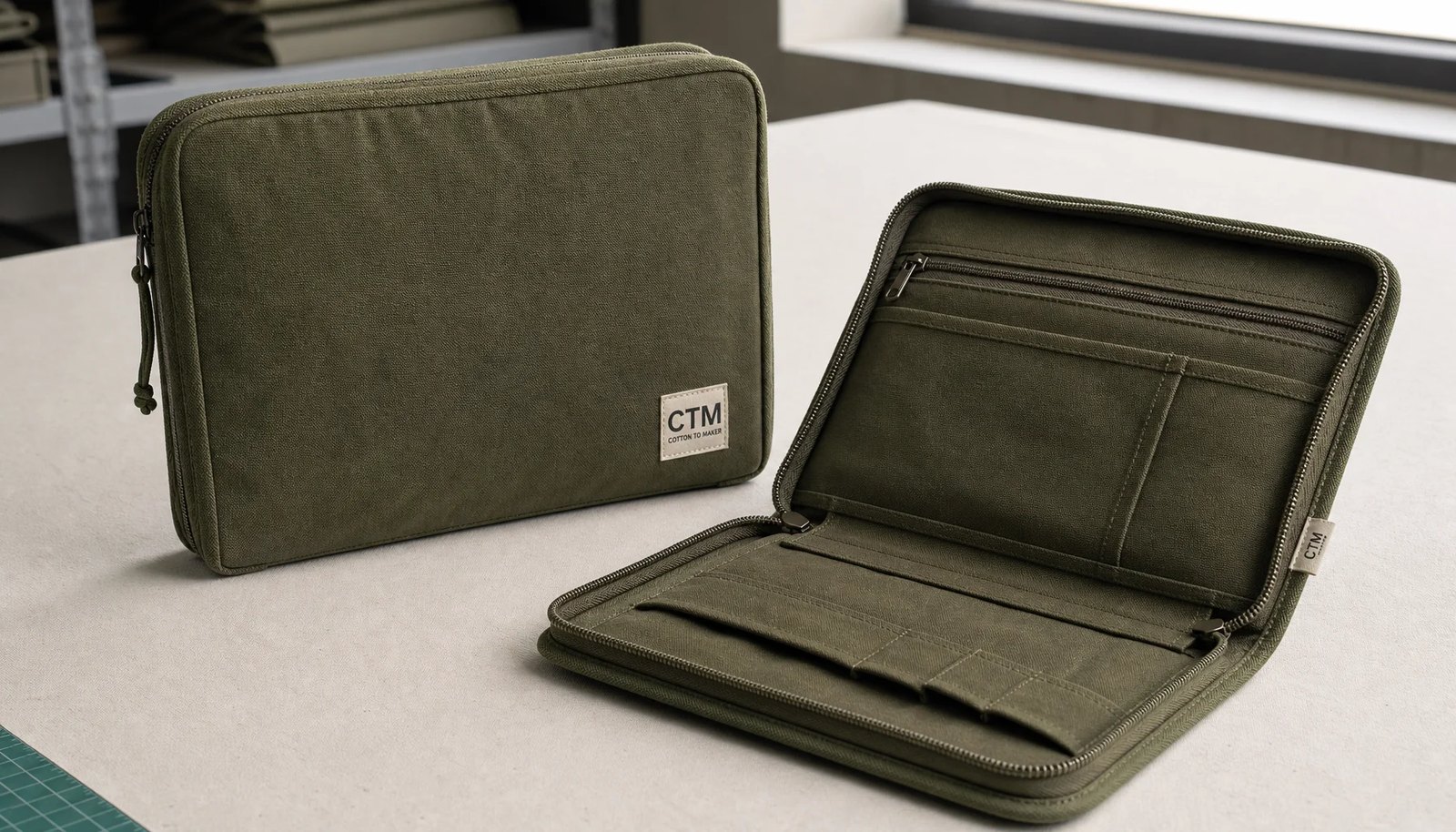
Start With the Kit, Not the Logo
Canvas zipper portfolios for trade show exhibitors fail for predictable reasons. The zipper binds after the bag is overfilled, the body collapses after a few event days, the branding rubs away in transit, or the inside layout looks neat on screen but turns bulky on the booth floor. If the brief starts with the artwork, the supplier optimizes the sample for appearance instead of the handling path.
Start with what the portfolio will carry and how it will be used. A show-day kit is opened in a hotel room, packed at a booth, carried through a venue, and repacked repeatedly. That cycle exposes weak zipper ends, poor seam reinforcement, and decoration that cannot survive abrasion from other items in a tote or carry-on. Buyers who define the workflow first get a build that performs like field equipment instead of a presentation prop.
The useful brief is plain: what must this portfolio survive before it reaches the meeting room? Usually that means carton compression, baggage vibration, repeated opening and closing, one-handed access, and contact with hard or sharp-edged items. Once the factory understands that use case, it can make rational choices on fabric, zipper, reinforcement, and internal layout instead of overbuilding one part and weakening another.
- Define the contents and the handling path before asking for a quote.
- Treat zipper smoothness, seam strength, and decoration durability as functional requirements.
- Use the event workflow as the real use case: carry, open, present, repack, repeat.
Translate Contents Into Size and Closure Load
The first sizing decision is whether the portfolio will actually hold the planned contents without straining the zipper line or becoming a flat sleeve. Specify the document format, any tablet size, the target stack thickness, and whether the bag must close with a notepad or sample cards inside. A piece that fits letter-size paper in theory can still fail once seam allowance, zipper tape, and interior panels are added.
Write the size in three layers: finished external size, usable internal opening, and gusset depth if one is needed. If you only give outside measurements, the factory may trim the interior to protect sewing margins. If the portfolio must hold brochures, contracts, and a tablet, say so clearly. A 10-inch tablet and a flat paper stack do not need the same geometry, and they do not fail in the same way.
Keep the internal layout simple unless the kit truly needs more structure. One main compartment, one flat sleeve, and one pen loop are enough for most trade show use cases. Add pockets only when they solve a specific receiving or presentation problem. Every extra panel adds sewing time, another tolerance point, and another chance that the portfolio becomes too rigid to close cleanly.
A good approval method is to place the actual contents on the table and build the spec around the stack height, width, and closure path. That makes the request concrete and reduces the chance of approving a beautiful mockup that cannot close when the real sales kit is inside.
- State the document format and tablet size if they matter.
- Define usable internal opening, not only the outer width and height.
- Use a shallow gusset only when the contents need expansion.
- Keep the pocket layout as simple as the use case allows.
Lock Fabric, Zipper, and Reinforcement as One Build
For many programs, a mid-weight canvas is the practical starting point, but the right choice is the one that passes your loaded-closure and seam tests, not the one that sounds premium in a catalog. A lighter body can work for flat document use or price-sensitive programs if the sample stays stable after handling. A heavier body is worth paying for when the portfolio needs visible structure, carries heavier inserts, or must hold up through multiple events without looking soft. Fabric weight alone is not the answer; weave tightness, finish, and reinforcement matter just as much.
The zipper spec should be written as clearly as the fabric spec. A nylon coil zipper is usually the safest starting point because it runs smoothly and is easier to sew around corners. Move to a larger series only when the load profile or zipper length justifies it. Metal can look premium, but it adds noise, weight, and corner friction. On a portfolio that gets opened quickly in a crowded booth, smooth travel often matters more than visual drama.
Reinforcement keeps a good-looking sample from becoming a field failure. Bar-tacks at zipper ends, strong seam finishing, and optional board inserts help the bag hold shape and resist repeated loading. The right package depends on how often the bag is packed flat, how much hand pressure it sees, and whether it is stacked during shipping. Buyers should ask the supplier to show where reinforcement lives in the pattern, not just to promise that it exists.
Do not let the supplier separate these choices into unrelated line items. Fabric, zipper, reinforcement, and trim interact. A light body with a large zipper and no reinforcement can look fine in a sample but perform badly once it is filled. A balanced build uses the lightest combination that still protects the contents and survives the event cycle.
- Use the lightest fabric that still passes loaded-closure, seam, and handling checks.
- Use a nylon coil zipper unless the load or brand position justifies a change.
- Specify bar-tacks, binding, and any insert material in the drawing, not only in the notes.
- Ask whether trim color and zipper tape come from locked stock or can be substituted later.
Separate Supplier Types and Risk
The same portfolio can produce very different results depending on the supplier route. A direct factory usually gives the best control over fabric, trim, decoration, and packing. A trading company can still work when it owns the spec flow and you need one export desk for multiple categories, but it adds another layer of margin and can blur responsibility if the order needs adjustment. A stock supplier is only useful when the logo, color, and pack format already match what they can ship without rework.
The key sourcing question is who controls the details. Ask who actually makes the product, who owns QC, and who approves substitutions. If the quote comes through a middle layer, make the factory name part of the commercial discussion. For repeat orders, the issue is not just who can quote the lowest number; it is who can reproduce the same zipper feel, print placement, and seam finish on the second and third order without drift.
Trim control deserves special attention because it is where many bags quietly change. A supplier may hold the canvas but swap the zipper series, puller style, or tape color if those parts are not locked. That can create a shade mismatch, a different hand feel, or a zipper that behaves differently under load. If the supplier cannot show a part number or trim card tied to the sample, the buyer does not really have a controlled build.
Compare offers only after the spec is frozen. Keep fabric, zipper, artwork file, pack format, and carton assumptions identical across bids. If a supplier changes any of those inputs, the quote is no longer apples-to-apples. The most useful supplier is the one that can explain the price movement in plain language and point to the real cost drivers without hiding behind a generic rate sheet.
- Direct factory: best for custom control and repeat orders.
- Trading company: useful for consolidation, but clarify QC ownership and the actual factory.
- Stock route: only makes sense when your brand requirements match available inventory.
- Compare the same Incoterm, pack format, decoration method, and trim spec.
Use a Durability Checklist That Mirrors Event Handling
A useful durability test for a trade show portfolio does not need theatrics. It needs to mirror the handling path the product will actually face. Start with a baseline check: measure the sample, photograph it, and confirm that the artwork, zipper, and seam layout match the approved drawing. Then run the tests in the same order every time so results can be compared across samples and suppliers.
Begin with zipper cycling. On 3 pre-production samples, open and close the zipper 100 times each. Pass if the slider runs smoothly, the puller stays attached, and the track does not snag at the corners. Fail if the slider jams, the tape starts to buckle, or the zipper requires extra force after the cycle count. For a first article, this single test often reveals the most important field risk.
Next, test loaded closure. Fill the portfolio with the actual content stack plus any agreed insert weight and confirm that it still closes without force. Carry it, set it down, and open it with one hand the way a busy exhibitor would. Pass if the pull tab is easy to grip and the opening angle is usable. Fail if the bag springs shut, flares open awkwardly, or strains the zipper line. The point is not maximum load; it is repeatable use with a realistic kit.
Add compression, rub, and impact checks when the order is for a show date or a repeat program. Hold the packed sample flat under a normal carton load for 24 hours, then check for warped corners, zipper distortion, or seam shift. If the decoration is printed, add 20 dry-cloth rub passes and 10 fold-open cycles on the branded area. For transit-risk orders, a face-drop and corner-drop from about 1 m on 3 samples is a practical buyer-side screen. Keep the thresholds written into the approval notes so the factory knows what passed and what did not.
- Cycle 3 samples for 100 open-close cycles each before bulk approval.
- Check loaded closure and one-hand use with the actual sales kit.
- Use a 24-hour compression hold to reveal warped corners and zipper distortion.
- Add a 20-pass dry-cloth rub check when the decoration is printed.
- Treat any seam split, zipper snag, or unreadable logo as a fail condition.
Choose Decoration for Wear, Not Just for the Mockup
Canvas can accept several decoration methods, but the best method depends on how the portfolio will wear in real use. Screen print is usually the right option for simple logos and higher-volume programs because it is efficient and can reproduce cleanly when the artwork is not too detailed. A woven label or sewn patch is often safer when abrasion resistance matters more than a large printed area, because the mark stays readable after folding and transit friction.
Embroidery is not automatically the premium answer. On heavier canvas, it can create stiffness or puckering, especially if the logo sits close to a seam or zipper path. Heat transfer can be acceptable for short-term event stock, but it should only be used when the buyer accepts the durability tradeoff and the supplier can show a sample that survives handling. The right method is the one that survives the intended number of event cycles, not the one that photographs best on a prototype.
Artwork discipline matters as much as the method. Ask for vector files, define the placement window, and keep the logo away from corners and fold lines. If the art must cross a stitched panel, get the supplier to confirm the risk before approval. For multi-color printing, define the maximum color count and ask whether extra colors change setup or unit cost. Decoration is part of the structure because it affects yield, setup, and rejection risk.
- Use screen print for simple logos and volume orders.
- Use a woven label or sewn patch when abrasion resistance matters.
- Use embroidery only if the placement and fabric thickness support it.
- Keep artwork away from zipper corners and stress seams.
Approve the Sample Like a Production Part
A sample should answer production questions, not just design questions. Request a pre-production sample made with the final fabric, final zipper, final puller, final decoration method, and final packing. If the supplier sends a blank prototype first, treat it as a size check only. It cannot validate print registration, stitch quality, zipper feel, or the way the portfolio behaves once fully assembled and loaded.
The approval record should be specific. Mark the acceptable logo placement, pocket depth, zipper orientation, and allowable tolerance on a drawing or sample sheet. Keep one approved physical sample as the golden sample if the program will repeat. That gives both sides a reference for dimensions, hand feel, and finishing details when bulk production starts. Without it, teams often argue about what was agreed after the fact, especially if artwork or packaging changes on a later order.
Check the inside as carefully as the outside. Look at seam finishing, thread trimming, corner construction, and internal alignment. Measure the portfolio flat and with the intended contents inside. Confirm that the zipper pull force is reasonable, the zipper tape is straight, and the gusset does not twist under normal loading. A portfolio can look fine externally while hiding a pocket that steals capacity from the main compartment.
If the supplier wants to move from sample to bulk quickly, require written sign-off and a change-control rule. Any later change to canvas weight, zipper model, packing, or decoration method should trigger a new approval, not a silent substitution. That discipline protects both schedule and quality.
- Use a final-material pre-production sample for sign-off.
- Measure the portfolio both flat and loaded if the contents matter.
- Mark logo position, pocket depth, and stitch tolerance on the approval record.
- Retain a golden sample for repeat production and dispute resolution.
Put QC Gates and Defect Rules in the PO
Quality control for canvas zipper portfolios should be simple to execute and strict enough to catch the mistakes that matter. Start with incoming material checks: canvas weight, color lot, zipper model, and any printed trim or label. Then move to in-process checks on sewing consistency, especially around zipper ends, corners, and reinforcement points. Final inspection should verify that the product matches the signed sample and that stitching, print, and dimensions fall within the agreed window.
Defects should be classified in advance so everyone knows what is acceptable. A major defect is usually a zipper that snags, a seam that splits, a logo that is misplaced, or dimensions that no longer fit the intended contents. Minor issues are usually cosmetic, such as slight thread variation or a small mark that does not affect use. If the supplier uses AQL or an internal inspection method, ask them to state the threshold in the purchase order instead of assuming both sides mean the same thing.
The most useful QC data is measurable. Ask for stitch density on load-bearing seams, finished size against the approved drawing, and a clear note on any repair or rework performed during production. If the factory can share inline photos of zipper installation and corner reinforcement before the full lot is sewn, you can catch systematic issues early, when the cost of correction is low.
Inspect random cartons from different positions in the stack, not only the easiest box to reach. Compression damage, crushed corners, and moisture issues often hide in the middle or bottom of a pallet. A meaningful QC gate should also check packing counts and outer marks so receiving can reconcile the shipment without reopening every master carton.
- Check canvas, zipper, labels, and print before sewing volume starts.
- Verify stitch density, bar-tack placement, and thread trimming in process.
- Classify major and minor defects before production starts.
- Inspect cartons from top, middle, and bottom positions, not only the outside layer.
Specify Packing and Carton Rules Up Front
Packing changes the actual risk profile of the order. Individual polybags make warehouse receiving easier, protect printed surfaces, and reduce scuffing, but they add material and labor cost. Bulk packing can lower unit cost, but it increases abrasion risk and can create count errors if the factory does not have a disciplined counting method. For a trade show program, the right answer depends on whether the bags are going straight to distribution, to a fulfillment center, or directly to event staff.
Carton specification matters more than many buyers expect. Ask for carton count, carton size, gross weight target, and outer mark format before production starts. If the portfolio has a structured body or a decoration that can mar easily, make the supplier explain how the inner stack is protected. A low-cost carton that crushes during transit can erase any saving from a cheaper factory quote.
Receiving should also be part of the packing plan. If your warehouse needs barcode labels, case packs by event, or mixed assortment counts, those instructions belong in the PO, not in a side email. The buyer should know whether cartons can be stacked without damaging the product, whether the packaging protects the zipper pullers, and whether the factory will sample carton positions from the top, middle, and bottom of the lot.
- Choose individual polybags when scuff protection or count control matters.
- Use bulk pack only if the receiving workflow is simple and the risk is acceptable.
- Confirm carton count, carton size, and outer mark format before bulk starts.
- Ask how the zipper pullers, corners, and decoration are protected in transit.
Compare Landed Cost, Not Unit Price
The best request gives the supplier enough detail to quote honestly and gives the buyer enough structure to compare offers cleanly. Include the final size, fabric spec, zipper spec, decoration method, pack format, carton count, and shipment term. Then ask each supplier to separate unit price, setup cost, sample cost, packing cost, and any special handling. If one quote is lower but hides print setup or packaging changes, the deal is not better; it is just less transparent.
Landed cost is where the real decision lives. Add freight, duty, receiving labor, and any expected rework or repacking into the comparison. A quote that looks cheaper at the factory gate can become more expensive if it requires air freight to recover schedule or if the packed goods arrive with zipper damage and need sorting. Timing risk matters too. If the product is for a show date, a late shipment destroys the business value of the purchase.
The decision usually comes down to three questions. Does the factory understand the use case? Can it reproduce the same zipper, seam, and print quality on repeat orders? And can it explain the price movement when you change fabric weight, decoration, or packing? If those answers are clear, the quote is actionable. If they are vague, the risk belongs in the scorecard, not in the margin.
The most reliable supplier is usually the one that can repeat the spec back in plain language. If their response restates the dimensions, material callouts, testing method, and packing rules without confusion, they probably understood the order. If they keep changing terms or asking you to approve substitutions after the quote, treat that as a control issue, not a communication style.
- Ask for a quote split by body, decoration, packing, and setup where possible.
- Compare the same Incoterm, the same pack format, and the same decoration method.
- Build landed cost with freight, duty, receiving, and likely rework in mind.
- Reject quotes that do not explain the main cost drivers.
Specification comparison for buyers
| Spec decision | What to specify | Factory capability to confirm | Risk signal if not controlled |
|---|---|---|---|
| Production route | Direct factory for custom repeat programs; trading company only if it owns the spec and QC flow; stock supplier only for bridge orders | Named factory, in-house or tightly managed sewing line, and a single owner for sample approval | Ghost factory risk, weak accountability, and spec drift on repeat orders |
| Fabric control | Finished fabric weight, weave, finish, color lot, and shrinkage allowance | Documented incoming fabric inspection or mill traceability for the canvas used in the sample | Weight drift, shade mismatch, or a soft hand feel that changes after the first run |
| Zipper and trim control | Zipper series, slider type, puller style, tape color, stop style, and label/binding color | Trim cards or part numbers tied to the actual sample, plus a substitution approval rule | Cheaper zipper swaps, mixed trim lots, snagging corners, or shade mismatch |
| Decoration method | Screen print, woven label, sewn patch, or embroidery with exact placement window | A placement template, registration tolerance, and a method that matches the wear level | Artwork placed across seams, puckering, or branding that rubs off after handling |
| Sample and change control | Final-material pre-production sample, signed golden sample, and change log | Version control on artwork, trim, and packing; no silent substitutions | The bulk run matches a photo, not the approved part |
| Packing and cartonization | Individual polybag or bulk pack, carton count, outer mark format, and moisture protection | Standard packing method with a count check and carton spec already in the quote | Scuffing, count errors, crushed corners, or receiving delays |
Buyer checklist before sampling
- List the exact contents first: brochures, contracts, notebook, tablet, sample cards, or a mixed sales kit.
- State the maximum loaded thickness, not just the product names, so the factory can size the closure correctly.
- Write finished external size, usable internal opening, and gusset depth in the brief.
- Lock the fabric spec as finished weight, weave, finish, and color, and ask whether weight is quoted before or after finishing.
- Specify the zipper series, slider type, puller style, and tape color in the same line.
- Choose the decoration method before quoting and define the exact artwork size and placement window.
- Ask for a pre-production sample in final materials, not only a photo or a blank mockup.
- Request a golden sample with dated approval notes if the program will repeat.
- Confirm carton pack count, carton size, outer marks, and whether individual polybags are included.
- Ask the supplier to split body, trim, decoration, packing, and setup cost if the quote allows it.
Factory quote questions to send
- What finished fabric weight, weave, finish, and color lot are included in the price, and what tolerance do you hold on the fabric roll?
- What finished dimensions, usable opening, seam allowance, and gusset depth are you quoting?
- Which zipper series, slider type, puller attachment, stop style, and tape color are included in the sample and in bulk?
- Is the quote for blank goods or decorated goods, and how many print colors, embroidery stitches, or label operations are included?
- What is the MOQ by body color, zipper color, and artwork version?
- What sample fee applies, and are screens, embroidery digitizing, plates, or other setup items billed separately?
- Can you provide a pre-production sample in final materials before bulk begins, and what is the approval turnaround?
- What are the lead times for sample, approval, bulk, and shipment, and which approval step can move the schedule?
- What packing method is included, and what is the carton pack count, carton size, and gross weight target?
- Which Incoterm is quoted, and which local charges are excluded from the price?
Quality-control points to confirm
- Confirm fabric weight, weave, finish, and color against the approved swatch before sewing volume starts; reject visible shade shifts or thin spots.
- Measure finished dimensions on a minimum of 5 samples per colorway, or 2% of the lot when the run is larger, and hold the drawing tolerance you approved; use +/- 5 mm unless your spec is tighter.
- Verify logo placement on the same sample set and keep critical artwork within +/- 3 mm of the approved window.
- Cycle the zipper on 3 pre-production samples for 100 open-close cycles each; pass only if the slider runs smoothly, the puller stays attached, and there is no corner snag, tape separation, or tooth damage.
- Run a loaded-closure check with the actual sales kit plus any agreed insert weight; pass only if the portfolio closes without force, opens one-handed, and does not spring open or distort the zipper line.
- Pull a seam and bar-tack inspection on at least 5 pieces per line start, then spot check the lot for skipped stitches, loose thread tails, or incomplete reinforcement.
- Perform a face-drop and corner-drop check on 3 samples from about 1 m if the buyer needs a transit check; pass only if seams stay intact, the zipper still functions, and the body does not distort enough to stop closure.
- If the decoration is printed or transferred, run 20 dry-cloth rub passes and 10 fold-open cycles on the branded area; pass only if the mark remains legible and the edge does not crack or lift.
- Inspect 3 cartons from top, middle, and bottom positions for count accuracy, outer marks, carton crush, moisture, and odor; receiving should not need to reopen the full shipment to reconcile counts.