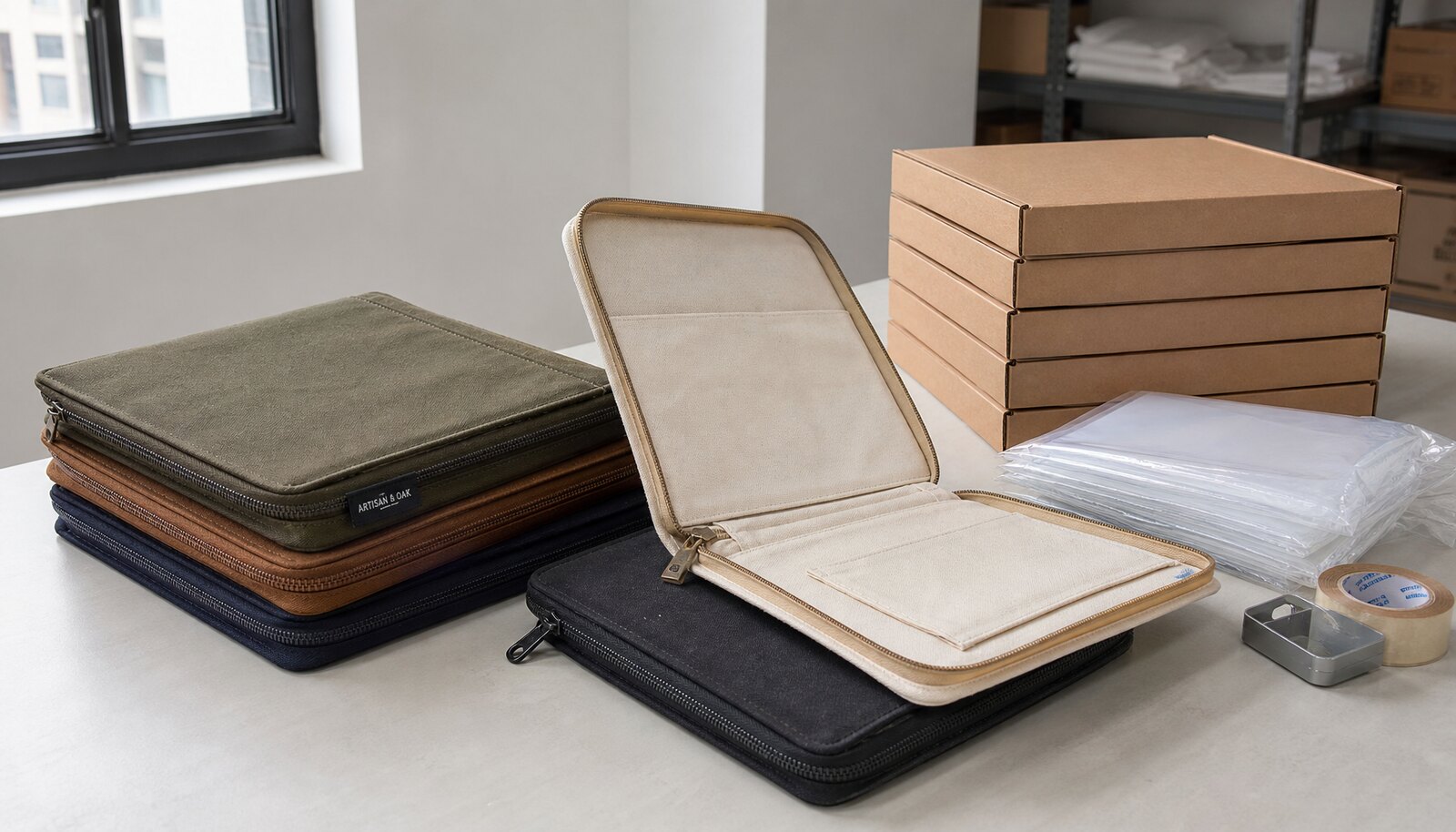
Why the carton packing plan matters as much as the portfolio itself
When buyers source canvas zipper portfolios for gift shops, it is easy to focus on the visible product details and treat packing as a secondary line item. That approach usually fails after the first shipment. The portfolios may approve cleanly as a sample, but if the carton is too weak, the fill count is too aggressive, or the fold direction is inconsistent, the goods can arrive with crushed corners, scuffed print, and zipper distortion. For a gift shop program, presentation is part of the product value, so a damaged carton is not just a logistics issue; it is a resale problem.
A carton packing plan does three commercial jobs at once. First, it protects the product from transit damage. Second, it gives the buyer a comparable basis for supplier quotes, because one factory may quote a tight packed carton while another quotes a loose and risky one. Third, it helps warehouse teams receive and count the goods faster because the carton marks, quantity logic, and orientation are already standardized. If the plan is clear from the RFQ stage, the buyer can judge landed cost more accurately and avoid hidden repacking expense later.
For this category, the packing plan should be written into the product spec, not left as a shipping note. That means the buyer should define the canvas weight, zipper spec, print method, carton quantity, inner packaging, and accepted carton test basis before approval. If any one of those moves later, the quote should be re-issued so the comparison remains clean.
- Treat packing as part of the product specification, not as an afterthought.
- Use the same packing basis when comparing two or more suppliers.
- Require photos and carton dimensions before approving bulk production.
Start with the right canvas portfolio spec, not just a pretty mockup
Canvas zipper portfolios for gift shops are usually sold on appearance, but they are bought successfully on structure. In practical sourcing terms, the common sweet spot is 10 oz to 12 oz cotton canvas, roughly 340–410 GSM after finishing. That range gives enough body for the item to hold its shape on a shelf, take print cleanly, and survive repeated use without feeling flimsy. If the buyer wants a more premium handfeel, a slightly heavier canvas is possible, but freight cost, stitching resistance, and carton weight all rise quickly.
The size spec matters just as much as the fabric. Many buyers say they need a portfolio, but the end use may actually be an A4 document carrier, a stationery gift envelope, a souvenir pouch, or a branded flat set sleeve. If the internal depth is too shallow, the sample can look elegant when empty and then fail once brochures, note pads, cards, or other inserts are loaded. Buyers should always specify finished size, usable internal depth, zipper opening length, seam allowance, and whether a gusset is needed. For gift shop replenishment, that information is more useful than a loose description like “medium size.”
If the item needs pockets, card slots, or a pen loop, those features should be costed and sampled early. Each extra component changes sewing sequence, packing flatness, and carton count. A buyer that approves a simple blank portfolio and later adds a pocket is not making a small change; it can change the whole packing method and delay the order.
- 10 oz canvas: lower cost, lighter freight, adequate for simple logo programs.
- 12 oz canvas: stronger shelf presence and better structure for premium gift shop retail.
- Gusseted build: better for thicker inserts, but it needs a more careful carton layout and weight check.
Print method should be decided before the quote is judged
Print is not a decorative afterthought on canvas zipper portfolios; it is one of the main cost and quality drivers. For a simple one- or two-color logo, screen print is usually the most practical route. It works well on canvas, has a reasonable setup cost, and usually gives the most retail-friendly result for gift shops. If the design is small or the order is not large enough to justify screen setup, heat transfer can be acceptable, but only if the buyer approves the finish on the same canvas texture and not on a smoother substitute material. Embroidery can deliver a premium impression, but it is generally best for compact logos because large embroidered areas can stiffen the panel and distort the portfolio shape.
The main procurement risk is comparing artwork proofs instead of production methods. A design that looks sharp in PDF can blur or appear heavier than intended on coarse canvas. Buyers should specify print size, print location, number of colors, Pantone references where relevant, and the allowed placement tolerance in millimeters. It is also important to ask whether printing is done before or after sewing. Pre-sewn printing may give cleaner panel alignment, while post-sewn printing can reduce waste in some factories but may add placement risk around seams and zipper edges.
For repeat orders, buyers should also ask about print durability in practical terms. A simple rub check is usually more useful than a vague assurance of quality. If the print is expected to survive retail handling, ask the supplier to show how the surface behaves after light flexing and dry wipe testing on the approved sample.
- Screen print: best for simple logos, repeat retail orders, and cleaner unit economics.
- Heat transfer: useful for small runs or multicolor art, but it must be approved on the real canvas surface.
- Embroidery: premium look, but higher cost and more chance of panel distortion on larger logos.
MOQ, raw material sourcing, and what can quietly change your price
MOQ on this product is usually driven by fabric cutting efficiency, print setup, and the supplier’s carton packing routine. A factory can often quote a standard canvas color and standard zipper color more competitively because those materials are already in routine use. Once the buyer requests a custom color, a special zipper puller, a lining change, or a different pack count, the cost rises in more than one place. It is not just the material itself; it is also line changeover, cutting waste, and packing labor. That is why two quotes with the same unit price can still be very different in actual landed cost.
For gift shop buyers, the safest first order is often a standard fabric and zipper combination with branded print and a carton count the warehouse can receive easily. If the supplier offers a very low MOQ, verify whether that comes from pre-stock fabric, outsourced printing, or a willingness to use loose packing that shifts risk to the buyer. Low MOQ is useful only when the supplier can still hold the specification, packing count, and inspection standard. Otherwise, the buyer is paying for flexibility with hidden quality risk.
A buyer should also ask whether the supplier is quoting from greige cloth, dyed cloth, or finished canvas. That answer matters because shrinkage, handfeel, and print behavior can differ materially. If the supplier cannot explain the raw material route clearly, the order is exposed to spec drift.
- Standard fabric and zipper combinations usually give the best MOQ efficiency.
- Custom zipper pulls, lining, or unusual colors often increase setup and packing cost.
- Low MOQ should still come with clear carton count, QC threshold, and sample approval rules.
How to compare suppliers without being misled by a low unit price
A simple unit price comparison is not enough for canvas zipper portfolios for gift shops. One supplier may quote a lower price by using thinner canvas, a weaker zipper, or a carton count that makes packing efficient only on paper. Another may quote a slightly higher price but include better carton stiffness, a cleaner print process, and a more realistic piece count per carton. If the goods are for retail presentation, the second quote can be the better commercial choice because it reduces damage claims and repacking time.
The most reliable comparison route is to normalize the quote. Put the same GSM, same zipper type, same print method, same finished size, and same packing count into every quote request. Then separate out unit cost, setup cost, print cost, inner packing cost, and export carton cost. This makes it easier to see whether one supplier is genuinely cheaper or simply hiding cost in a different line. Buyers should also ask for the carton size, gross weight, and loading quantity per carton because the shipping cube can influence freight much more than the product itself.
For first-time procurement, it is also wise to compare supplier behavior, not only price. Does the factory answer questions about tolerance bands? Can it provide a photo of the packed carton? Will it separate production from packing in the quotation? A supplier that answers in precise terms is usually safer than one that only says the product is “good quality” and “fast delivery.”
- Normalize every quote to the same spec before judging price.
- Ask for separate lines for product, print, packing, and carton cost.
- Use carton size and gross weight as part of the cost comparison, not just as shipping data.
Supplier routes: direct factory, trading company, or mixed production
Direct factory sourcing is usually the best route when the buyer needs repeatability, defined QC, and full control over the carton packing plan. A factory can usually commit more clearly on fabric, print sequence, and carton loading because it controls the sewing line. The trade-off is that the buyer has to be precise. If the RFQ is vague, the factory may assume details that do not match the retailer’s needs, and the sample may appear “acceptable” while still being wrong for the intended shelf display.
A trading company can be useful for urgent orders, small mixed assortments, or buyers who need help consolidating multiple items into one shipment. The trade-off is transparency. The buyer should verify who actually makes the product, who prints it, and who packs it. If the trading layer cannot identify the factory or explain the inspection step, the risk is that the product changes hands without the buyer knowing where tolerances were lost. For this category, the carton plan is especially important because a middleman may quote the portfolio correctly but leave packing to a different subcontractor.
A mixed route can sometimes be valid: direct factory for the portfolio and a separate specialist carton supplier if the carton specification is unusual. But if that route is used, the buyer should ensure one party is clearly responsible for final packed condition. Otherwise, defects become hard to assign and rework becomes slow.
- Direct factory: best for repeat programs and stable packing control.
- Trading company: useful for small or urgent orders, but verify the actual maker and packer.
- Mixed route: workable only if one party owns the final packed-carton result.
A procurement comparison table is only useful if it has measurable checks
The table below is more useful when the buyer uses it as an RFQ scoring tool rather than a general guide. For each sourcing route or supplier option, ask for the measurable check beside the quote: actual GSM, zipper type, print method, carton dimensions, compression basis, and defect handling policy. If the supplier cannot provide the measurement or test basis, the buyer should treat that line item as unverified. That is usually where hidden cost enters.
A practical sourcing scorecard does not need to be complicated. It just needs to force the same questions every time: what is the pack count, how is the carton built, what is the carton size, what is the accepted tolerance, and what happens if the packed sample fails? The more the buyer can tie the quote to a measurable pack standard, the easier it becomes to compare alternative suppliers on a true commercial basis.
- Use the same scorecard for every supplier, even for repeat buys.
- Do not accept missing carton dimensions or missing packing photos on a commercial quote.
- Record any tolerance exceptions in writing before sample approval.
Sample approval should cover the product and the carton build together
One of the most common buying mistakes is approving the portfolio sample and ignoring the packed carton. For a flat retail item, the packed sample is part of the product. The buyer should review the blank sample or material swatch first, then the printed pre-production sample, and then a full carton-packed reference sample with the exact agreed piece count and inner protection. If the product looks good in hand but the carton count crushes the edges or shifts the print, the approval is incomplete.
A more reliable sample workflow is simple. Step one: confirm fabric handfeel, weave, and GSM by swatch or blank sample. Step two: approve print on the actual canvas weight, not on a substitute. Step three: inspect a sewn sample with zipper operation, seam finish, and any pocket or gusset details. Step four: approve one fully packed carton with marks, count, and gross weight. If any one of those steps changes later, the supplier should re-submit the sample instead of assuming the old approval still applies.
For repeat orders, keep one approved packed carton sample in-house if possible. That makes later inspections faster and gives the buyer a reference for fold orientation, pack count, and product flatness. It is much easier to reject a deviation when the business keeps one physical approved reference rather than relying only on a photo in an email thread.
- Approve fabric before print.
- Approve zipper function before mass sewing starts.
- Approve one full packed carton before final shipment release.
Carton packing plan: piece count, carton size, and compression control
Packing is where many portfolio programs become unstable. Buyers often assume that because the item is flat, it can be packed densely without consequence. In reality, overpacking is a frequent cause of zipper scuffing, corner crushing, and permanent creasing. Underpacking wastes cube and increases freight cost. The correct answer depends on size, canvas weight, lining, gusset thickness, and whether each piece is polybagged. A carton that is too tight can deform the product; a carton that is too loose lets the goods slide and rub.
The buyer should request carton dimensions before confirming bulk. A common practical export carton for this category might fall in the broad range of around 40 x 30 x 35 cm for medium-volume packing, but the exact size must match the finished portfolio and pack count. For larger A4-style portfolios or gusseted builds, carton depth often needs to be reduced or the count lowered so the top layer does not compress the zipper edge. Gross weight should also stay manageable for warehouse handling; many buyers prefer cartons that do not become awkward to lift or re-stack, even if the shipping line allows heavier weight. The real target is not “as many as possible.” It is the highest count that keeps the goods flat, clean, and consistent.
A good carton plan normally includes an inner polybag when retail cleanliness matters, separator tissue or interleaf if the printed surface is delicate, and clear carton marks on two sides. If the buyer uses mixed SKU cartons, the rule should be to keep one SKU per carton whenever possible. Mixed cartons are possible, but they are more likely to create receiving errors and shelf replenishment issues.
- Ask for carton dimensions, gross weight, and load photo before bulk approval.
- Set the piece count based on flatness and product protection, not only on freight cube.
- Use inner polybags and clear carton marks when the product is retail-facing.
QC thresholds buyers can actually use in the factory and at receiving
A useful QC plan needs pass/fail rules, not just general quality language. For canvas zipper portfolios, fabric weight should stay within about plus or minus 5% of the approved finished GSM unless another tolerance is written into the approved sample record. Finished dimensions should generally stay within about plus or minus 0.5 cm for smaller items and plus or minus 1.0 cm for larger formats, provided the product still functions correctly. Zipper operation should be smooth through the full travel path without snagging, and the puller should not twist or detach under a reasonable hand pull.
Print control is equally important. The buyer should approve an artwork position, then check that the printed image stays within the allowed placement window on the actual sewn item. For simple logo work, a light rub check is often more useful than a vague color statement. If the ink transfers heavily or cracks after light flexing, it is not ready for retail handling. Stitching should be even, with no skipped stitches, no visible seam openings at stress points, and no long loose thread tails on the visible side.
Carton QC should be just as concrete. The carton should not visibly collapse when stacked, and the supplier should be able to state the board grade or compression basis. Buyers do not need a laboratory report for every order, but they do need enough information to know the carton can survive transport. For freight-sensitive or export-heavy orders, request one packed carton drop check or equivalent handling confirmation and keep the result in the approval file.
- Fabric weight: target agreed GSM with about +/- 5% tolerance unless otherwise approved.
- Size tolerance: roughly +/- 0.5 cm for smaller formats, +/- 1.0 cm for larger formats.
- Zipper: no snagging, wave, or corner drag on full open/close.
- Print: no heavy rub transfer, no major ghosting, and no visible seam distortion.
- Carton: clear marks, stable stack behavior, and no obvious compression collapse.
Specification comparison for buyers
| Spec decision | Recommended option | When it fits | Buyer risk to check |
|---|---|---|---|
| Canvas fabric weight | 10 oz to 12 oz cotton canvas, around 340–410 GSM finished weight | Gift shop assortments that need a premium feel without becoming too heavy in shipping | Ask whether the GSM is measured before or after finishing; clarify shrinkage allowance and whether the weave softens after wash/heat processing |
| Lining choice | Unlined for basic retail, or light TC/poly-cotton lining for better interior finish | Price-sensitive programs, stationery kits, or gift sets that need a cleaner interior look | Lining can hide sewing issues; inspect seam allowance, zipper tape tie-off, and stitch backtack on the unlined sample too |
| Zipper type | Nylon coil zipper with matching puller; #5 is common for this product class | General retail use and smoother mass production | Ask for zipper brand, tape width, pull force target, and cycle expectation; reject any sample that skips, catches, or ripples at the end stops |
| Print method | Screen print for 1–2 spot colors; heat transfer for small runs or multicolor art; embroidery only for compact premium logos | Gift shop branding where logo clarity matters more than photographic detail | Approve artwork on the same canvas weight, then test rub resistance and edge sharpness; coarse canvas can distort fine lines |
| Portfolio closure | Single zipper around three sides, or top zipper with gusset when interior capacity matters | A4/letter inserts, souvenir paper goods, notepads, or flat accessory sets | A shallow profile can look neat empty but fail when filled; verify usable internal depth after stitching and zipper tape insertion |
| MOQ route | Standard fabric/color with logo print and carton-sharing on the first order | First orders, seasonal testing, or distributor trial programs | Low MOQ often shifts cost into setup and packing; ask for separate charges so the true landed cost is visible |
| Carton packing method | Inner polybag plus export carton with fixed quantity per carton, clear carton marks, and controlled compression | Long-distance shipping and mixed-SKU gift shop replenishment | Loose packing causes corner crush, zipper scuffing, and count errors; require carton size, gross weight, and loading photos before approval |
| Supplier type | Direct factory for repeat programs; trading company only for small mixed orders or urgent sourcing windows | Buyers who need control of spec, QC, and packaging | Verify who actually makes the product, who prints it, and who packs it; trading quotes may hide subcontracted steps and change tolerances |
| Artwork placement | Center-front logo or corner mark with 1-color or 2-color print | Gift shops where branding should stay tasteful and retail-friendly | Large full-panel prints can distort at seams and increase reject rates; ask for print placement tolerance in millimeters |
Buyer checklist before sampling
- Confirm finished size, usable internal depth, zipper opening length, and whether the portfolio must hold A4, letter-size, or notepad inserts.
- Lock the fabric weight in GSM and request a measured swatch or photo of the same canvas weave under the same finishing process.
- Specify print method, artwork size, Pantone reference, and acceptable registration tolerance on the actual canvas surface.
- State whether the portfolio needs a lining, pocket, pen loop, gusset, or card slot before RFQ release.
- Set carton quantity, inner polybag requirement, carton board grade, and outer carton strength target before sampling starts.
- Request blank sample, pre-production sample, printed approval sample, and one packed carton sample before mass shipment.
- Ask for zipper cycle check, seam inspection, and carton photo proof showing quantity count, carton marks, and stacking orientation.
- Document the approved spec version, sample photos, and any tolerance exceptions in one buyer sign-off sheet before PO release.
Factory quote questions to send
- What is the exact fabric construction, yarn count if available, and GSM after finishing? Please state whether the GSM is measured before or after print and washing/heat treatment.
- What zipper type, size, and brand will you use, and what is the expected pull performance or cycle expectation before shipment?
- How many pieces per master carton, what is the internal carton size, what is the gross weight, and what carton board specification will be used?
- Which print method is included in the quote, what is the setup charge, how many colors are included, and what is the registration tolerance on the finished fabric?
- What sample stage is included: blank sample, pre-production sample, printed approval sample, or packed carton sample?
- What is the lead time for sample, production, carton preparation, and packing after approval, and at what point is the packing count locked?
- What replacement or rework policy applies if print placement, zipper function, stitch quality, or carton damage fails inspection?
- Can you separate unit price, print cost, packaging cost, inner packing cost, and export carton cost so landed cost can be compared accurately?
- Who is responsible for final carton drop-test confirmation, and can you provide packed carton photos before booking shipment?
- Which documents can you provide to verify your factory status, quality system, and prior export experience for this product category?
Quality-control points to confirm
- Fabric weight should stay within about +/- 5% of the agreed finished GSM unless the supplier has disclosed a different approved tolerance in the signed sample stage.
- Finished size tolerance should generally stay within +/- 0.5 cm for small portfolios and +/- 1.0 cm for larger formats, unless the approved drawing states otherwise.
- Zipper should run smoothly through full opening and closing without snagging, wave formation, or corner drag; reject any sample that requires visible force to close.
- Zipper puller should feel secure, with no loose pull tab, twisting, or partial detachment during a simple hand pull test.
- Stitching should be even, with no skipped stitches, no seam opening at stress points, and no loose thread bundles longer than roughly 5 mm on visible edges.
- Print should sit within the approved artwork area, with no major ghosting, no obvious color shift from the strike-off, and no visible cracking after light flexing.
- For simple logo work, ask for a rub check on the printed area using a dry cloth and reject any sample that transfers heavy color under light wiping.
- Cartons should be tested for packing stability: no overstuffing, no empty void that allows shifting, and no corner exposure after normal warehouse handling.
- Packed cartons should show clear marks for SKU, color, quantity, gross/net weight, carton number, and purchase order reference on at least two sides.
- Pre-shipment inspection should open random cartons from multiple master cases and confirm consistent fold direction, count accuracy, and polybag presence where specified.