Define The Field Use First
Canvas zipper portfolios are often bought as simple document pouches, but farmers market programs use them harder than an office giveaway. Vendors may carry permits, tax forms, insurance certificates, price cards, menu sheets, laminated signs, order forms, sponsor inserts, badges, pens, and small catalogs from a vehicle to a stall every week. The portfolio may sit under a folding table, inside a tote, or in a vendor onboarding box.
That use case changes the sourcing standard. The product needs to stay flat enough for documents, open quickly during setup, resist dust and light handling moisture, and survive repeated zipper pulls. A loose folder can bend papers. An open tote pocket can spill. A zippered canvas portfolio gives the organizer or sponsor a controlled branded surface and gives the vendor an item that can remain useful after the first market day.
Before asking for a canvas zipper portfolios for farmers market vendors bulk pricing plan, write the business purpose in one sentence. A practical vendor kit may prioritize reliable construction, stock canvas, and a clean one-color print. A sponsor premium may need heavier canvas, a woven label, and a cleaner interior. A resale item may require barcode labels, hangtags, and stricter cosmetic inspection.
- Define the channel: onboarding, staff operations, sponsor gift, resale, wholesale bundle, or event merchandise.
- Measure the largest real insert before choosing the portfolio size.
- Separate must-have performance details from optional upgrades.
- Treat zipper function, corner strength, and clean branding as core requirements.
Build A Spec Suppliers Can Price
A strong RFQ starts with measurable details. Give finished outer width and height, inner usable dimensions, gusset depth if any, zipper opening length, zipper direction, pocket layout, corner shape, and closure position. If the portfolio must hold US letter paper, include clearance so paper corners do not curl. If it must fit inside a kit box or tote, state the maximum outer dimension.
Fabric weight drives unit cost, sewing behavior, freight weight, and perceived value. For many recurring market programs, 12 to 14 oz cotton canvas is a practical baseline because it gives enough body for documents and printing while remaining workable at zipper corners. Suppliers may describe similar weights in gsm, often around 407 to 475 gsm for common finished canvas references, but the supplier should state its own mill measurement and tolerance.
A 10 oz canvas can work for lightweight seasonal promotions or short-term document sleeves. Expect less structure, more wrinkling, and greater risk of print distortion on looser weaves. A 16 oz canvas can feel more premium, but it should be trialed because heavy fabric can create bulky zipper ends, slower sewing, needle damage, and stiff corners.
Avoid broad terms such as rugged, premium, thick, eco, or natural unless they are supported by a specification. Ask whether the fabric is natural, bleached, dyed, washed, pre-shrunk, water-repellent, untreated, or blended. Ask whether weight is measured before or after dyeing, washing, coating, or calendaring.
- Specify finished size, usable inner size, zipper opening, gusset, pocket layout, and corner shape.
- State canvas weight in both oz and gsm where possible.
- Ask whether fabric weight is before or after finishing.
- Request supplier-dependent tolerances instead of assuming universal gsm conversions.
Specify The Zipper Completely
For most canvas portfolios, a No. 5 nylon coil zipper with polyester tape is a practical default. It runs smoothly in soft-goods construction, is widely sourced, and is less rigid than many molded-tooth options. Still, the zipper line needs more detail than gauge alone.
The quote should identify tape color, tape material, slider type, puller material, puller finish, zipper length, top stop, bottom stop, end reinforcement, and pull direction. A zipper can look acceptable in a product photo while failing in use because the tape is inserted unevenly, the stop is weak, or the puller scratches a printed panel during packing.
Zipper corners deserve a physical check. Put the intended contents inside the sample, close the portfolio, and open it repeatedly from both normal and awkward angles. If the puller catches at the corner or the tape waves after filling, the construction needs adjustment before bulk cutting.
- Use No. 5 nylon coil as a dependable starting point unless the design requires another zipper.
- Confirm tape color, slider finish, puller, stops, length, and end reinforcement.
- Test repeated open-close cycles on samples, not only appearance.
- Check puller burrs, zipper-end bulk, tape waviness, and panel scratching.
Choose Construction Around Contents
Construction is where similar-looking quotes become different products. An unlined portfolio with overlocked seams is usually the simplest and most cost-controlled build. It can be suitable for vendor document kits if the interior is clean, edges are stable, and fabric shedding is controlled. Bound seams add a cleaner interior. A full lining improves presentation but adds cost, labor, inspection points, and possible shrinkage or puckering issues.
Pocket design should be functional. A single flat pocket may be enough for permits, checklists, badges, or payment notes. Multiple card slots, pen loops, mesh pockets, tablet sleeves, elastic holders, or divider panels should only be added when the buyer can name and measure what they hold. Every added feature increases sewing time and creates another place for misalignment or usability problems.
Stress points need a written standard. Zipper ends, pocket corners, side seams, pull tabs, and any strap or handle attachment should match the sealed sample. Stitch density, seam allowance, backstitching, bartacks, and binding should be agreed before production. Too few stitches can weaken seams; too many can perforate heavy canvas and make corners stiff.
- Use unlined construction for cost-controlled document kits when interior cleanliness is acceptable.
- Use bound seams or lining for resale, sponsor premiums, or cleaner presentation.
- Add pockets only after assigning each pocket a real content purpose.
- Specify reinforcement at zipper ends, pocket corners, and other pull points.
Compare MOQ And Price Tiers
Bulk price is shaped by more than quantity. Fabric yield, trim availability, decoration method, sewing minutes, packing format, carton count, inspection requirements, and production changeovers all affect the unit cost. Stock natural canvas with a stock zipper and one-color screen print usually supports lower MOQ than custom dyed canvas with matching zipper tape, woven labels, branded pullers, and retail packing.
Useful quote tiers might be 300, 500, 1,000, and 3,000 pieces, but the best breakpoints are the ones that match the forecast. The goal is to understand what changes at each tier. A lower price may come from fabric purchasing, cutting efficiency, setup amortization, label MOQ, line efficiency, carton utilization, or a different freight assumption.
MOQ must be tied to variants. A supplier may quote 500 pieces but mean 500 pieces per fabric color, per artwork, per zipper color, or per packing version. Farmers market programs often split quantities across location names, sponsor marks, seasonal logos, or colorways. Confirm the split before issuing the PO.
Ask for a line-item quote: blank portfolio, decoration, label, setup, sample fee, branded puller tooling, individual packing, inner cartons, export cartons, carton labels, barcode application, inspection, documents, and freight basis. This makes reorders easier to audit because setup charges should not repeat unless artwork, labels, tooling, or screens must be remade.
- Request tiered pricing at realistic forecast quantities.
- Define MOQ by color, size, artwork, zipper color, puller, label, and packing version.
- Compare landed cost and risk, not only ex-factory unit price.
- Confirm overage and shortage allowance before PO approval.
Select Branding For Canvas
Canvas is a useful brand surface, but it is not smooth coated paper. The weave, shade, washing, and fabric weight affect decoration. A logo that looks sharp on a mockup may soften on textured canvas. Bright ink can shift against natural cotton. Physical strike-offs or pre-production samples are important when color and placement matter.
Screen printing is usually the most practical choice for one- to three-color artwork. It is cost-efficient at volume and can look strong on a tight weave. Buyers should provide artwork files, color count, Pantone references where needed, print size, and placement from edges. The approval should include ink cure and practical rub resistance, especially if portfolios are stacked or packed with pullers facing printed panels.
Woven labels, side labels, and sewn patches work well when the brand wants a durable or understated mark. They introduce their own details: size, fold type, backing, thread colors, edge finish, label MOQ, sewing thread, and placement tolerance. Digital printing and heat transfers can support complex sponsor artwork, but they should be chosen because the artwork requires them, not because they sound flexible.
- Use screen print for simple logos and cost-controlled repeat orders.
- Use woven labels or patches for durable, subtle branding.
- Approve decoration on the actual canvas color and finish.
- Write logo and label placement tolerance in inches or millimeters.
Choose The Right Supplier Route
A direct cut-and-sew factory is usually stronger when the buyer needs custom construction, stable reorders, and technical answers. The factory should explain cutting tolerance, zipper insertion, seam allowance, decoration sequence, in-line inspection, final inspection, and packing flow. This route fits private-label programs, association kits, and recurring seasonal buys.
A trading company can be useful when it adds communication, sampling management, export support, or soft-goods category consolidation. The risk is opacity. If the trader cannot identify the factory, name subcontracted processes, or confirm that bulk production will use the same materials as the pre-production sample, the buyer has less control when problems appear.
Stock blank suppliers and local decorators are useful for urgent launches or low-risk tests. The limitation is repeatability. Fabric shade, zipper pullers, dimensions, and pocket layouts may change from batch to batch. For a pilot, that may be acceptable. For a long-term vendor program, custom production provides better control.
- Use direct factories for custom builds, repeat programs, and tighter process visibility.
- Use trading companies when factory identity and corrective-action responsibility are documented.
- Use stock blanks for fast pilots where exact reorder matching is less important.
- Keep sample origin, production location, and subcontracted steps in the quote file.
Control Samples Before Bulk
Sampling should answer two questions: does the portfolio work, and can the supplier repeat it? A first prototype can confirm size, zipper direction, pocket layout, gusset, logo position, and general hand feel. It may use substitute fabric or stock trims if the supplier states that clearly. That sample helps design decisions, but it should not be treated as production approval.
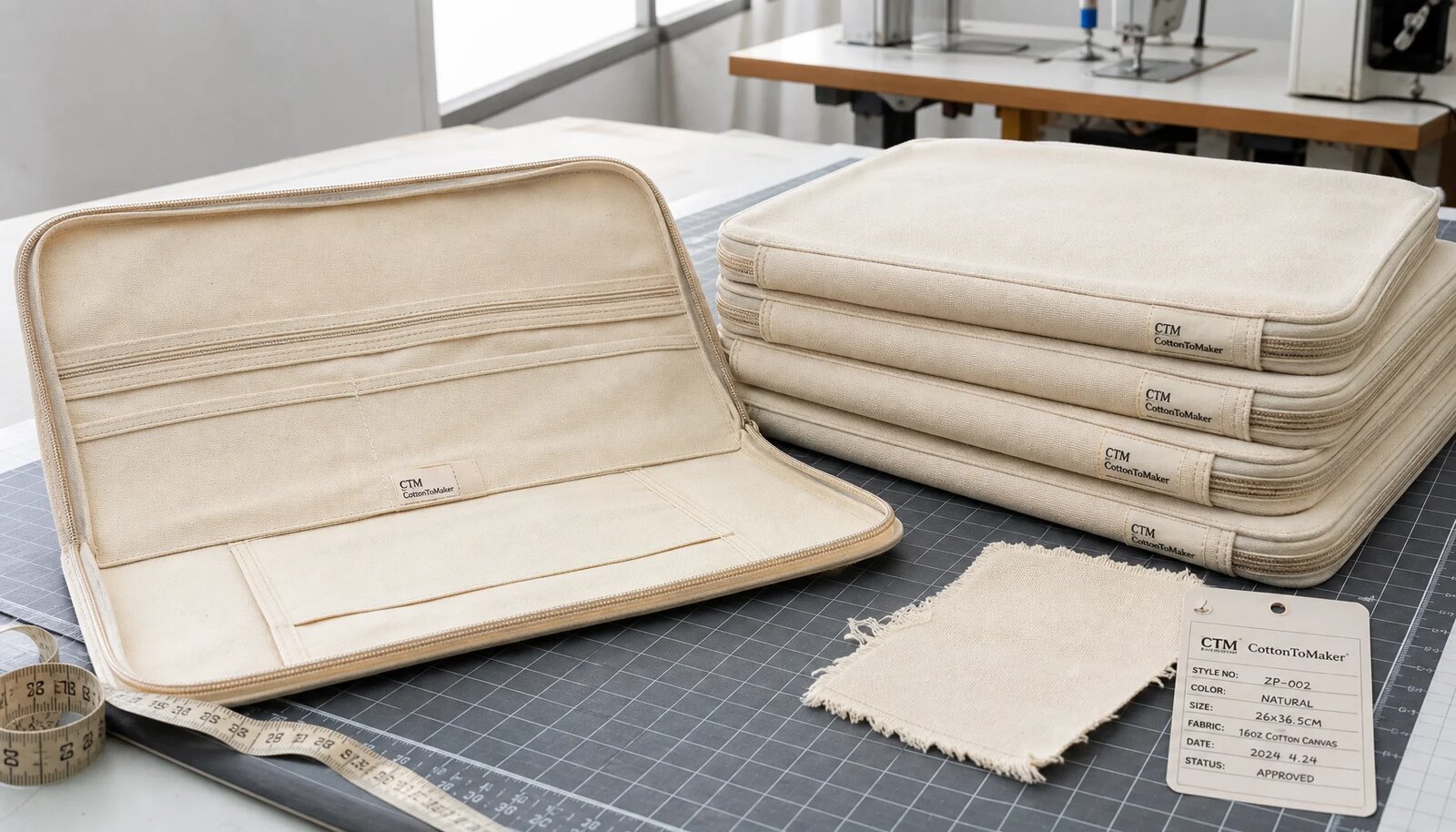
The pre-production sample is the true gate. It should use the intended canvas weight and finish, zipper tape, slider, puller, thread, binding or lining, label, decoration method, and individual packing. Review it against the measurement sheet, artwork sheet, and packing plan. Put the intended documents inside. Check whether corners bend, papers catch, the zipper pull scratches the panel, or the pocket layout feels awkward.
A sealed golden sample should be kept for the buyer file, factory line, and final inspection. Tag it with item code, version, approval date, fabric reference, zipper reference, decoration method, thread color, label version, packing method, and tolerance sheet. Photos help communication, but they do not replace the physical standard for fabric hand feel, zipper movement, print texture, and seam construction.
- Use prototypes for layout decisions and pre-production samples for approval.
- Require intended fabric, zipper, thread, branding, seam finish, and packing in the approval sample.
- Seal a golden sample and reference it in the PO and inspection plan.
- Require written approval for fabric, trim, decoration, or packing substitutions.
Write QC Around Failure Modes
A useful QC plan is specific to how this item can fail. Canvas zipper portfolios can have uneven fabric weight, shade variation, stains, heavy slubs, mildew odor, zipper snagging, loose pullers, weak zipper ends, skipped stitches, seam fray, crooked labels, print scuffing, interior lint, sharp trim fragments, and packing creases. A broad visual check is not enough.
Incoming material inspection should happen before cutting. The factory should check canvas weight from the actual lot, surface condition, shade range, finish, and practical shrinkage or crocking risk. Zippers should be checked for length, tape color, slider finish, puller security, stops, and smooth operation. Labels, patches, thread, and packing materials should be compared with the approved trim card or sample.
For final inspection, many buyers use sampling terminology aligned with ISO 2859-1 or ANSI/ASQ Z1.4, often referred to commercially as AQL inspection. The exact inspection level and accept/reject limits should be set by the buyer or inspection provider. For this product, define critical, major, and minor defects before inspection. Wrong logo, wrong fabric color, broken zipper, detached puller, open seam, severe stain, mildew odor, sharp fragment, wrong barcode, or wrong carton quantity should not be treated as cosmetic issues.
Where testing is required, use recognized methods instead of vague promises. Depending on the order, buyers may request colorfastness or crocking checks such as AATCC 8 or ISO 105-X12, seam or tensile references such as ASTM D5034 for fabric strength, or buyer-specific zipper cycling checks. Not every market kit needs lab testing, but the RFQ should state whether visual inspection alone is enough.
- Inspect fabric, zippers, labels, and packing materials before cutting.
- Use written tolerances for dimensions, zipper length, logo placement, and label placement.
- Operate sampled zippers repeatedly and check stress points under light tension.
- Define critical, major, and minor defects before the inspector arrives.
- Use recognized test methods when performance claims need verification.
Plan Packing, Lead Time, And Reorders
Packing is part of the product. A basic vendor kit may need clean individual packing and an item sticker. A retail or ecommerce program may require barcode labels, hangtags, inner packs, carton labels, and a dust-free presentation. A distributor may want fixed inner quantities so receiving teams can count and allocate quickly. These details belong in the RFQ because they affect cost and inspection.
Most canvas zipper portfolios should be packed flat unless folded packing has been tested and approved. Folding can crease the front panel, bend document corners, distort the zipper line, or damage the print. If the puller rests against the printed panel, the packing method should prevent abrasion through sleeve orientation, tissue, puller positioning, or alternating stack direction.
Lead time has many gates: artwork approval, material sourcing, sample making, sample shipment, buyer review, revisions, bulk fabric purchase, cutting, decoration, sewing, in-line inspection, final inspection, packing, freight booking, export documents, customs clearance, inland delivery, receiving, and kitting. Work backward from the required in-hand date, not the factory completion date.
Reorder control starts with the first PO. Assign an item code and preserve the fabric reference, zipper reference, puller type, label artwork, thread color, print method, packing method, carton count, and golden sample date. If the supplier cannot guarantee the same trim later, require advance notice and replacement approval. The best bulk pricing plan is not only cheaper; it is clear enough for the next buyer to reorder without drift.
- Specify individual packing, inner packing, barcode labels, carton marks, and carton quantity.
- Pack flat unless folded packing passes appearance, print, and zipper checks.
- Build the calendar from the in-hand date through samples, production, inspection, freight, and receiving.
- Document the approved standard so reorders do not change fabric, zipper, label, or packing.
Specification comparison for buyers
| Buying decision | Lower-cost route | Higher-control route | What to verify before PO |
|---|---|---|---|
| Supplier model | Stock blank supplier or trading partner for fast pilots and limited customization | Direct cut-and-sew factory for custom dimensions, repeat orders, private label, and tighter process visibility | Factory identity, sample origin, subcontracted steps, responsibility for corrective action, and whether bulk matches the approved sample |
| Fabric weight | 10 oz cotton canvas for lightweight seasonal document pouches where freight cost matters | 12 to 14 oz cotton canvas for most vendor kits; 16 oz only after zipper-corner and sewing trials | Supplier-stated oz and gsm, whether measured before or after finishing, lot tolerance, shrinkage, shade range, and surface defects |
| Zipper build | Stock No. 5 nylon coil zipper with standard tape and puller | Specified No. 5 nylon coil zipper with confirmed tape color, slider finish, puller, stops, and end reinforcement | Smooth operation, zipper length, tape insertion, puller burrs, stop security, repeated open-close checks, and corner tension |
| Interior finish | Unlined with clean overlock or bound critical edges | Fully bound seams or lining for resale, sponsor premiums, or cleaner presentation | Fray control, loose fibers, lining shrinkage, pocket usability, seam allowance, puckering, and interior dust |
| Branding method | One-color screen print or standard sewn label | Pantone-controlled screen print, woven label, patch, or approved digital method for complex artwork | Artwork size, placement tolerance, ink cure, rub resistance, label fold, thread colors, and bulk match to strike-off |
| MOQ and tiers | 300 to 500 pcs may be possible with stock fabric and stock trims, depending on supplier | 1,000 pcs or more may be required for custom dyed canvas, custom zipper tape, branded pullers, special labels, or retail packing | MOQ by color, size, artwork, zipper color, puller, label, packing version, and total PO quantity |
| Packing | Flat polybag or paper wrap with item sticker | Retail-ready packing with barcode, hangtag, inner packs, carton labels, and controlled stack direction | Carton quantity, carton size, gross weight, crease prevention, moisture control, barcode accuracy, and receiving count method |
| Cost comparison | Lower unit price may come from stock materials, fewer pockets, simpler packing, or looser tolerance | Higher unit price may buy better trim control, cleaner inspection, approved materials, and reorder stability | Compare landed cost, setup charges, sampling, inspection, freight basis, defect risk, and reorder cost, not unit price alone |
Buyer checklist before sampling
- Define the channel: vendor onboarding kit, staff operations pouch, sponsor premium, resale product, wholesale bundle component, or event merchandise.
- List the real contents: permits, tax forms, laminated signs, price cards, menus, order sheets, badges, pens, catalogs, sponsor inserts, or a tablet in its sleeve.
- Specify finished outer width, finished height, inner usable dimensions, gusset depth if any, zipper opening length, zipper direction, pocket layout, corner shape, and closure position.
- State canvas weight in oz and gsm, and ask whether the quoted value is measured before or after dyeing, washing, coating, calendaring, or other finishing.
- Name the fabric finish: natural, bleached, dyed, washed, pre-shrunk, water-repellent, untreated, recycled cotton blend, or other supplier-supported option.
- Define the zipper: type, gauge, tape material, tape color, slider finish, puller material, puller shape, stop construction, zipper length, and end reinforcement.
- Provide artwork files with color count, Pantone or thread references, size, placement from edges, label fold type, and acceptable placement tolerance.
- Set MOQ by fabric color, artwork version, size, zipper color, puller type, label version, packing version, and total order quantity.
- Ask suppliers to separate blank unit cost, decoration, label, setup, sampling, packing, carton, inspection, documentation, and freight assumptions.
- Request quote tiers that match the forecast, such as 300, 500, 1,000, and 3,000 pieces, and ask what material or process changes at each tier.
Factory quote questions to send
- What exact canvas weight are you quoting in oz and gsm, and is it measured before or after dyeing, washing, coating, calendaring, or finishing?
- What tolerance can you support for fabric weight, finished measurements, zipper length, logo placement, and label placement?
- Is the canvas natural, bleached, dyed, pigment dyed, washed, pre-shrunk, water-repellent, untreated, or treated with any anti-mildew or surface finish?
- Can you provide fabric composition, weave type, shrinkage guidance, and any available colorfastness or rubbing data for dyed canvas?
- Which zipper type, gauge, tape material, tape color, slider, puller, puller finish, top stop, bottom stop, and end reinforcement are included in the quoted price?
- Is the zipper tape stock or custom, and does a custom tape color change MOQ, sample lead time, bulk lead time, or unit price?
- Is MOQ calculated per fabric color, artwork version, size, zipper color, puller style, label version, packing version, or total PO quantity?
- What is included in the unit price, and what is billed separately for samples, print screens, digital setup, woven label setup, branded puller tooling, carton labels, barcodes, export documents, inspection, and freight?
- Will the pre-production sample use the same fabric, zipper supplier, thread, decoration method, label backing, seam finish, and individual packing planned for bulk?
- What inspection plan do you recommend, and can you support AQL sampling terminology aligned with ISO 2859-1 or ANSI/ASQ Z1.4 if our buyer requires it?
Quality-control points to confirm
- Canvas weight is checked from the same lot used for bulk cutting, with actual oz or gsm recorded against the approved tolerance.
- Fabric surface is clean, evenly woven, and free of stains, holes, heavy slubs, shade bands, mildew odor, coating marks, or defects across logo areas.
- Dyed canvas is reviewed for shade consistency and practical crocking risk before decoration and final packing.
- Finished width, height, gusset depth, pocket dimensions, zipper opening length, and corner shape are measured against the approved tolerance sheet.
- Logo placement, label position, artwork size, and color are checked against the approved artwork sheet and physical strike-off or pre-production sample.
- Zipper tape is inserted straight, zipper ends are secure, stops are fixed, slider movement is smooth, and pullers do not catch, scratch the panel, or detach under light manual tension.
- Sampled zippers are opened and closed repeatedly during inspection, including around corners and zipper-end stress points.
- Stitch density, seam allowance, backstitching, bartacks, binding, and pocket reinforcement match the sealed golden sample.
- Corners, pocket mouths, zipper ends, and side seams are checked under light tension for skipped stitches, weak seams, puckering, needle cuts, and seam slippage.
- Screen print, transfer, patch, or woven label is checked for color, registration, edge sharpness, adhesion, cracking, curing, and rub resistance.