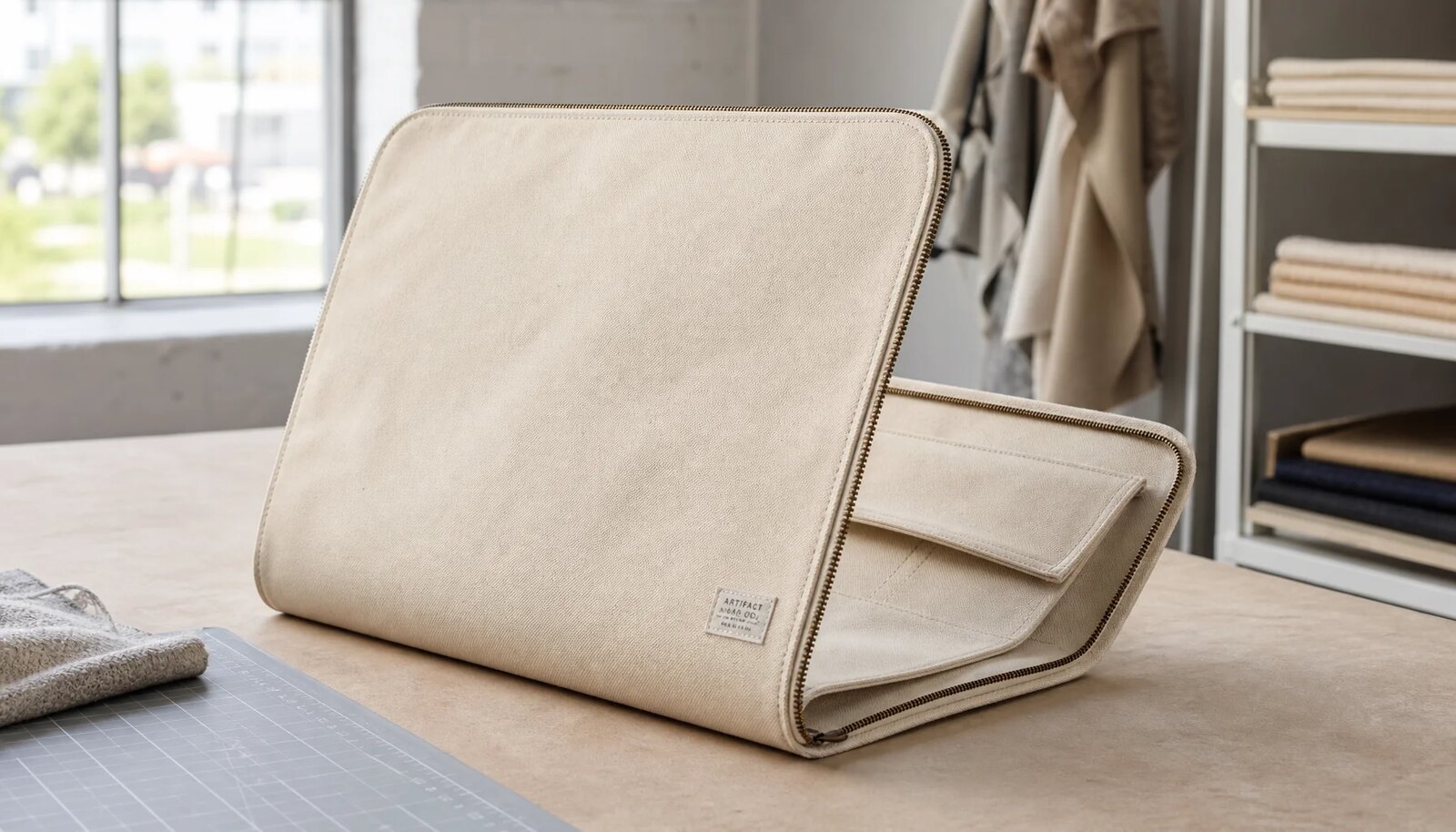
Why print proofing matters on sewn portfolios
Canvas zipper portfolios for event planners are handled like tools, not display pieces. They move from meeting rooms to vendor visits, from hotel ballrooms to site walks, and from the buyer's desk into tote bags, briefcases, and client handoffs. The product has to look clean after repeated opening and closing, but it also has to work as a functional organizer. That combination is what makes proofing important. A logo can look acceptable in a flat artwork file and still fail once it lands on a sewn panel with a zipper running through the structure.
For B2B procurement, proofing is not just about approving graphics. It is about confirming that the full construction can carry the brand without distortion, show the logo clearly, and repeat the same result across the order. That means checking panel tension, seam placement, zipper clearance, and the usable print area before bulk production starts. If the artwork is approved too early, the factory may have to protect the sewing process first and the brand second, which is the wrong order for a client-facing item.
- Treat the portfolio as a sewn product first and a print surface second.
- Check the logo against seam lines, zipper tape, pockets, and binding before approving.
- Use actual material when the logo is small, detailed, or positioned near construction lines.
Start with the job to be done, not the decoration
The best RFQs begin with use case, because the use case drives every other decision. A portfolio for client presentations has a different burden than a folder for vendor packets, welcome kits, or on-site registration. If the buyer needs A4 or letter-size inserts, the internal clear opening matters more than the overall outside dimensions. If the bag must carry brochures, notepads, pens, or business cards, the pocket layout and zipper closure need to be designed around that load, not guessed after the fact.
Event planners also judge the item on how it behaves in front of a client. The portfolio needs to open smoothly, close flat, and keep its shape on a conference table. If the design will be reused across multiple programs, the sourcing team should think in terms of repeatability, not one-off appearance. A functional spec makes the quote easier to compare, reduces back-and-forth, and prevents the common problem where a factory quotes a nice-looking sample that cannot actually hold the planned inserts.
- Write down what the portfolio must carry in real life.
- Confirm whether the spec is for A4, letter, or a custom insert kit.
- Tell the supplier whether the item is for meetings, handouts, or reusable event distribution.
Lock the body spec before judging the logo
The fabric and build change how the logo looks, so the body spec has to be stable before artwork approval. Canvas weight affects drape, panel stiffness, print sharpness, and how much the zipper line pulls the front panel into shape. For most event-planner portfolios, 14-16 oz canvas, or about 380-450 gsm, is a practical middle ground. It gives enough body to feel intentional without becoming bulky when the portfolio is stuffed with printed materials.
If the buyer wants a cleaner silhouette or a more premium hand, a light interfacing and 210D polyester lining can help the body hold its shape and hide seam allowances. That is useful when the portfolio is opened often in client meetings, because the inside finish matters almost as much as the outside impression. The zipper spec should be treated with the same seriousness. A No. 5 nylon coil zipper with an auto-lock slider is usually the safest default for frequent use because it is durable, predictable, and less likely to snag on inserts than a more decorative closure.
- Choose fabric weight before decoration so the print is judged on the real body.
- Use lining and interfacing when the portfolio will carry brochures, tablets, or dense inserts.
- Keep zipper and puller choices simple on the first order unless the buyer has a premium presentation target.
Choose the decoration method by logo complexity and service life
Canvas has texture, and texture is both the appeal and the problem. It gives the portfolio a durable business-bag look, but it can also make fine artwork harder to hold. Screen printing is the most common choice for simple logos because it is efficient on bulk runs and usually gives the best cost control. It works well when the logo uses one or two flat colors, has strong shapes, and does not depend on very fine spacing. Once the artwork becomes dense, the weave can start to break up the edges and cause filling, bleeding, or poor legibility.
If the buyer expects repeated reuse, a woven patch, sewn label, or embroidery may be a better fit. These methods often survive handling better than a direct print, but they also change the visual character of the portfolio. That is not a cosmetic detail; it is a procurement decision. A patch can look more premium but requires edge control and attachment approval. Embroidery adds texture and durability, but thread pull and backing choice matter. The right method is the one that fits the logo, the canvas, and the way the portfolio will actually be used.
- Use screen print for simple logos and predictable color counts.
- Use a sewn patch or woven label when the buyer wants a more durable or premium finish.
- Avoid fine text if the canvas weave cannot hold it cleanly at the approved size.
Write an RFQ that lets suppliers quote the same build
A clean RFQ should force every supplier to price the same product. Break out the blank bag cost, decoration cost, sample cost, packing cost, and any charge for extra colors, extra placements, or special packaging. If a supplier sends only one total number, procurement cannot see where the cost sits or where risk may be hiding. That matters because some vendors quote a low unit price and recover margin later through sample fees, artwork revisions, repacking, or freight assumptions that were never stated clearly.
The quote should also show whether the supplier is quoting a real build or a placeholder spec. Canvas weight, zipper type, lining, and print method all move the cost and the lead time. For B2B buyers, the goal is not to chase the cheapest line item. The goal is to compare same-spec offers on the same basis, then choose the route that gives the lowest landed risk. In this category, a slightly higher unit price can be the cheaper result if it avoids rework, reproofing, or missed event dates.
- Ask for a line-by-line quote so setup charges and decoration costs are visible.
- Compare route, not just price: factory direct, trading company, or local decoration on blanks.
- Watch for hidden costs in sampling, carton overage, artwork revisions, and repacking.
Build a proof package the factory can actually execute
The proof package should give the factory enough detail to place the artwork once and place it correctly. Include a vector file, finished bag size, logo dimensions in millimeters, the exact print location measured from seams or zipper tape, Pantone references if color matching matters, and any label or patch requirement. If the artwork includes small text, reversed type, or thin rules, ask for a magnified proof. Those are the features that usually look fine on a screen and fail on woven canvas.
A useful proof flow starts with a digital layout, then moves to a material strike-off or print proof, then to a pre-production sample using the actual zipper, canvas, and trim. That sequence reveals the real interaction between artwork and construction. It also creates a paper trail that procurement can use later if there is a dispute over placement or shade. If different teams approve the product, the proof package should make clear who signed off on art, who signed off on construction, and who signed off on packing.
- Include measurements from seams and zipper tape, not just from the panel edge.
- Specify whether the logo must be centered visually or centered by sewing dimensions.
- Require the sample to use the final zipper color and any side label or patch.
Use sample approval to test fit, function, and appearance together
A sample is only useful if it reflects the bulk build exactly. The safest standard is to require the same canvas weight, the same zipper type, the same thread color, the same lining, and the same label construction that will be used in production. If the sample is lighter, softer, or assembled with a different zipper, the buyer is approving a shape that may not survive the actual order. On a portfolio with a visible logo, even small construction differences can shift the front panel enough to make the brand mark look off-center when the zipper is closed.
The approval checklist should be simple and measurable. The logo should be centered within the agreed tolerance, the color should match under daylight or D65 light, the zipper should run smoothly from end to end, and the seams should lie flat after the bag is loaded with actual paper. If the item is meant for client-facing work, close the sample and view it at arm's length on a flat surface. That is where uneven topstitching, warped panels, or a crooked zipper usually become obvious.
- Reject samples that use different fabric or zipper construction from the bulk spec.
- Test the sample with real inserts, not an empty shell.
- Take approval photos under neutral light so later disputes are easier to settle.
Set measurable quality-control points before production starts
Inspection on this item should focus on what buyers and end users can see immediately. Placement, stitch quality, zipper action, and panel symmetry matter more than hidden construction details because those are the failure points that affect presentation. If the portfolio is part of a branded event kit, a small defect can make an entire carton look inconsistent, even if every piece functions well enough. A clear QC standard protects both brand image and receiving efficiency.
The most useful QC documents are the approved sample, a measurement sheet, and a defect list. Inspectors should compare logo position, logo color, panel shape, seam behavior, zipper smoothness, and carton labeling against the approved reference. If the order includes multiple colors or logo versions, each variant must be checked on its own. Mixing variants in the same inspection lot can hide a problem until the shipment is already at the warehouse.
- Measure placement against the approved sample, not against memory.
- Check zipper action on every carton or defined sampling plan, not just one bag.
- Separate QC for each color and logo version if more than one variant is ordered.
Pack for events, not just for freight
These portfolios are often handed out, not just shipped, so packing has to support the receiving plan. If the buyer intends to distribute the bags at a trade show or conference, the supplier should confirm whether the order ships bulk packed, polybagged, tissue wrapped, or kitted with inserts. Clean packing makes counting and distribution easier, but too much packaging can crease the print, press fresh decoration into another surface, or add volume that the buyer does not need.
Carton planning should mirror the warehouse flow. Each SKU should be clearly separated, carton labels should match the purchase order, and pack counts should be easy to verify on arrival. If the order includes multiple colors or logo versions, keep them segregated by carton unless mixed cartons were explicitly approved. Mixed cartons create receiving delays, make sampling of defects harder, and can cause distribution errors when the event team is under time pressure.
- State whether the portfolio ships empty or kitted with inserts.
- Keep colors and logo versions separated unless mixed cartons are explicitly approved.
- Use carton labels that match SKU, color, pack count, and PO number exactly.
Control lead time, MOQ, and reorder risk before the PO is released
The schedule for a custom portfolio is usually driven by artwork, sample approval, and material availability, not just sewing time. A realistic timeline should include artwork confirmation, sample making, bulk production, final inspection, and shipping. The actual duration depends on seasonality, order size, number of colors, and whether the supplier has to source a special zipper, label, or lining. If the buyer is working backward from an event date, the quote should show timing by stage so there is no ambiguity when the calendar gets tight.
MOQ and reorder planning should be set early because they affect both price and continuity. If the portfolio will be reordered for annual conferences or recurring programs, ask whether the factory can hold the canvas roll, zipper tape, artwork file, or approved sample for a repeat run. A new lot of canvas or zipper tape can change the look slightly even when the spec stays the same. For repeat buyers, consistency is usually worth more than a small savings on the next shipment.
- Ask for stage-by-stage timing: proof, sample, bulk, inspection, and dispatch.
- Hold the key inputs if the portfolio will be reordered every season or every event cycle.
- Treat color consistency as part of the reorder plan, not just the initial approval.
Specification comparison for buyers
| Spec decision | Recommended option | When it fits | Buyer risk to check |
|---|---|---|---|
| Sourcing route | One cut-and-sew factory that owns sewing, decoration coordination, and final QA | Best for repeat event programs, custom logo placement, and fewer handoff errors | Split ownership between sewing and printing can create color drift, placement disputes, and late-stage rework |
| Fabric weight / GSM | 14-16 oz canvas, about 380-450 gsm | Good balance for folders that carry papers, brochures, and a pen without feeling flimsy | Light canvas can show weave distortion and print bleed; very heavy canvas can add bulk and raise freight cost |
| Finished size tolerance | Target +/-5 mm on overall width and height for simple rectangular builds | Works when the portfolio must fit A4, letter, or a standard insert pack | If the internal clear opening is not defined, the bag can meet outside dimensions and still fail the insert fit test |
| Inner structure | Light interfacing with 210D polyester lining | Useful when the portfolio must hold a clean shape or protect documents from seam marks | Unlined bodies can look soft at the edges and expose seam allowances after printing |
| Zipper spec | No. 5 nylon coil zipper with auto-lock slider | Reliable for frequent opening at events and office use | Metal zippers and oversized pulls can snag inserts, add cost, and change the visual weight of the front panel |
| Print method | Screen print for simple logos, woven or sewn patch for premium durability | Best when the logo is flat-color, medium size, and needs repeat consistency | Fine text, gradients, and thin rules can fill in on coarse canvas weave; hairlines under about 0.25 mm are risky |
| Logo placement | Front panel center or lower corner with 15-20 mm safety from seam lines and zipper tape | Works for standard brand visibility and cleaner print geometry | Artwork that crosses seams, zipper tape, or pocket edges can distort and rework more often |
| MOQ strategy | One fabric color, one zipper color, one print location for the first order | Best for launch orders and program tests before a larger annual run | Mixing colors, sizes, and logo versions can multiply setup charges and slow sampling |
| Packing route | Bulk pack by SKU, usually 25-50 pieces per carton depending on size and weight, with simple inner polybag or tissue only if needed | Fits warehouse receiving, distributor resale, or event kit assembly | Retail-style inserts and complex kitting increase carton volume and can scuff fresh print; cartons over about 15-18 kg are harder to handle manually |
Buyer checklist before sampling
- State the finished size, the internal usable opening, and whether the portfolio must fit A4, letter, or a specific insert pack.
- Tell the supplier how the product will be used: proposal folder, vendor packet, welcome kit, client presentation holder, or reusable event kit.
- Lock the fabric weight in oz or GSM, plus whether you want a soft hand, stiff body, brushed finish, or washed look.
- Provide vector artwork and specify the print method, Pantone target, acceptable logo size, and placement in millimeters from seams and zipper tape.
- Define zipper color, zipper gauge, slider style, and whether the puller should be plain, logoed, or metal.
- Say whether the portfolio needs a lining, pen loop, document sleeve, business card pocket, or notepad insert.
- Require a digital proof, strike-off, or pre-production sample using the actual fabric, zipper, and trim spec.
- Ask for quote separation for blank bag cost, printing setup, sample charge, packing, carton labels, and any extra placement.
- Specify the packing format: bulk packed, polybagged, or kitted with inserts and event materials.
- Confirm lead time by stage: artwork proof, sample, production, inspection, and ex-factory date.
Factory quote questions to send
- What fabric weight, weave, finish, and cutting allowance are you quoting, and what shrinkage or size variation should we expect after sewing?
- Which zipper type, zipper tape color, slider style, puller finish, and zipper gauge are included in the quoted spec?
- Can you break out the price for blank bag, print setup, sample, packaging, carton labels, and any extra logo area separately?
- Will the sample use the same canvas, thread, zipper, lining, and label construction as bulk production?
- How do you control print registration and placement when the logo sits near a seam, zipper tape, or pocket edge?
- What is the MOQ by color, by logo version, by size, and by packaging method?
- How many days do you need for artwork confirmation, sample making, bulk production, inspection, and final packing?
- What inspection standard do you use for print alignment, seam quality, zipper function, and carton count?
- Can you hold fabric, zipper tape, artwork, or print screens for a reorder program so the next run matches the first?
- What carton count and pack method do you recommend if the buyer plans to distribute portfolios at events?
Quality-control points to confirm
- Logo placement stays within the approved tolerance, typically within 5 mm on large panels and tighter on small marks.
- Print color matches the approved reference under daylight or D65 light, with no obvious banding, haloing, pinholes, or patchiness.
- The logo edges remain sharp enough to read at arm's length, with no filling-in of small text or thin rules.
- Seams around the zipper and side panels lie flat, with no twisting, puckering, skipped stitches, or exposed seam allowances.
- Zipper runs smoothly from end to end without snagging, splitting, or wave distortion in the tape.
- Finished size matches the approved spec after sewing, especially where lining or interfacing changes the body shape.
- No oil marks, loose threads, needle damage, scorch marks, or adhesive bleed appear through the print area or front panel.
- Carton labels, pack counts, and SKU codes match the PO, with no mixed colors or mixed logo versions unless approved.
- Insert pockets, pen loops, and business card slots are centered and functional if they are included in the spec.
- Corners and edges are consistent from bag to bag, with no visible asymmetry that would make the portfolio look off-center when closed.