Start With the Product, Not the MOQ Number
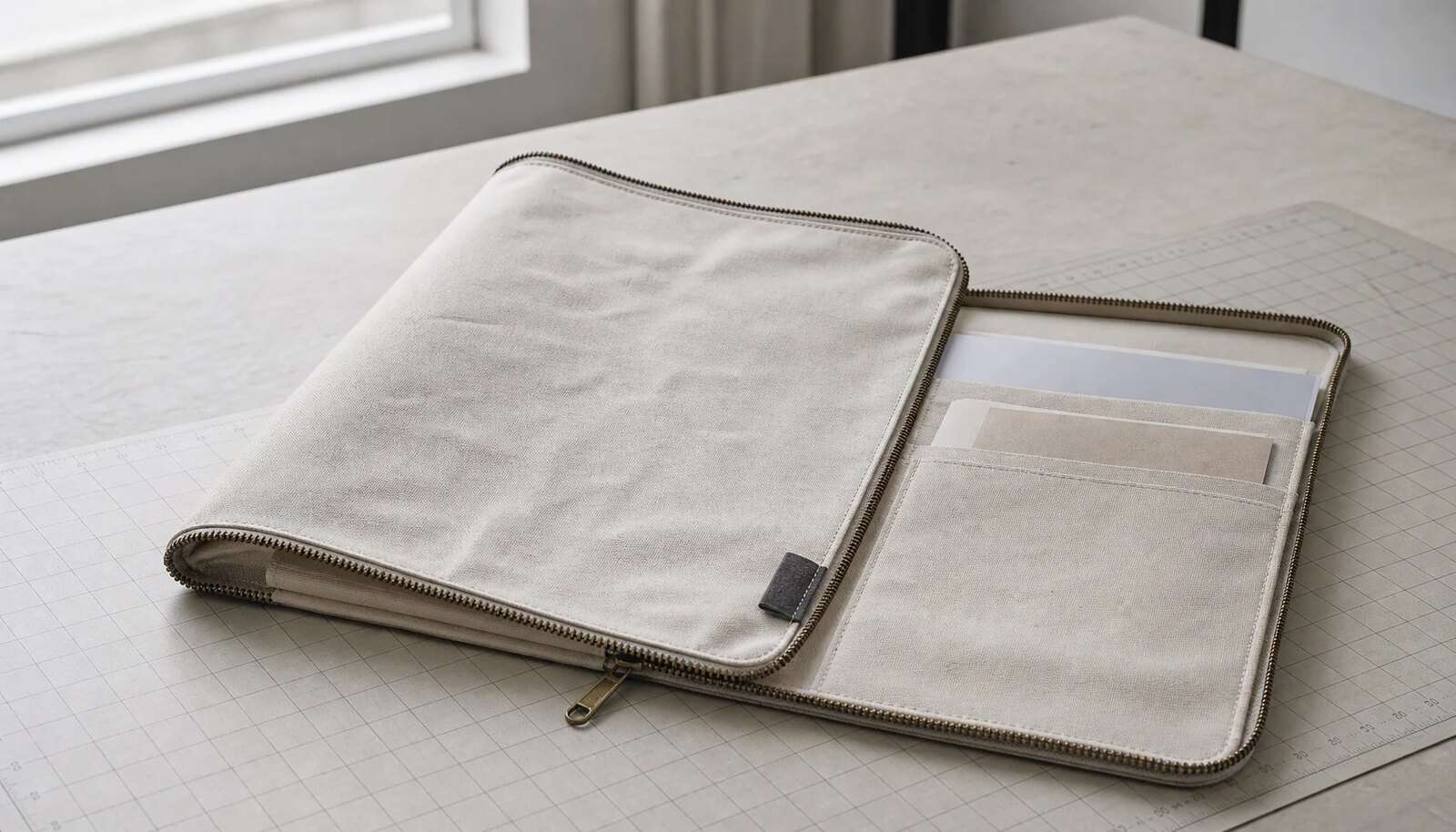
Canvas zipper portfolios look straightforward in a catalog: a flat canvas case, a zipper, a logo, and a few interior pockets. In production, they behave like a custom soft-goods item. The order touches fabric purchasing, cutting yield, zipper sourcing, sewing sequence, logo application, trimming, pressing, packing, carton loading, and inspection. Any one of those steps can create a minimum order quantity, a setup charge, or a lead-time limit. A useful canvas zipper portfolios for event planners MOQ negotiation guide should therefore begin with the product reality, not with a demand for the lowest possible number.
Event planners use these portfolios in moments that are visible to clients, sponsors, venues, and internal teams. They may carry proposals, production schedules, contracts, venue maps, badge packets, swatches, pens, tablets, agenda booklets, or VIP welcome materials. If the zipper sticks during a client meeting or the front panel arrives stained, the item feels cheap even when the procurement price was low. The better negotiation target is the lowest order quantity that still supports the required presentation standard.
The quickest way to lose leverage is to send a vague request to several suppliers and compare the returned numbers as if they describe the same product. One supplier may price 12 oz natural canvas, a stock zipper, one-color screen print, one inner sleeve, and bulk packing. Another may assume 16 oz dyed canvas, a woven label, custom puller, multiple pockets, and individual polybags. The product name may match. The production cost will not.
- Treat MOQ as the result of fabric, trim, branding, sewing complexity, packing, and schedule.
- Ask suppliers to identify the exact component or process driving the minimum.
- Compare quotes only after size, canvas weight, zipper, logo, pockets, and packing are normalized.
- Use the first order to prove construction quality before expanding colors, logos, or pocket variants.
Translate the Event Use Case Into Measurements
Before talking about MOQ, define what the portfolio must physically hold. Phrases such as premium client kit, conference folder, or planner organizer are too loose for production. State whether the item needs to fit A4 sheets, US letter documents, legal-size contracts, a 10-inch tablet, a 13-inch laptop sleeve, badge inserts, lanyards, venue maps, menu cards, sample swatches, or a bound event booklet. Then measure the thickest intended pack. A sample that closes cleanly when empty may strain at the zipper once the real event contents are loaded.
Separate outside dimensions from usable internal space. The outside measurement includes seam allowance, turned edges, zipper tape, corner construction, and gusset depth. The usable internal document area is what the planner experiences when inserting papers quickly at a registration desk or before a client meeting. For A4 or US letter sheets, leave clearance so documents do not rub against the zipper seam. If tabs, dividers, or booklet spines are part of the kit, measure them. If legal-size documents are required, do not assume a standard portfolio can stretch to fit.
Expected life also changes the specification. A one-day internal event can often use a lighter, simpler build if contents are thin. A client-facing planning folder used across months of meetings needs better structure, cleaner finishing, and smoother zipper travel. A venue sales team may want a restrained logo and a polished document sleeve. A production agency may need deeper utility pockets and stronger corners. Procurement should turn these different workflows into dimensions, materials, and tolerances before asking for a lower MOQ.
- List every expected content type and the maximum loaded thickness.
- Specify outside size, usable internal document area, gusset depth, and pocket depth separately.
- Test samples with the real event kit, not only blank paper.
- Remove extra pen loops, card slots, or dividers unless they support a real workflow.
Build a Spec Sheet Suppliers Can Price Cleanly
A strong spec sheet lowers supplier uncertainty, and lower uncertainty helps MOQ discussions. The document does not need to be complicated, but it should be specific. Include finished size, usable internal size, canvas weight, fabric color, zipper size, zipper tape color, slider and puller type, pocket layout, logo method, logo placement, packing method, carton requirement, and inspection standard. If two suppliers receive the same spec and still quote very different MOQs, you can ask a sharper follow-up: what part of this requirement is causing the minimum?
For canvas, use an actual GSM range instead of relying only on an ounce label. In many bag applications, 12 oz canvas is commonly around 340-370 GSM before certain finishing steps, while 16 oz canvas is often around 430-470 GSM. Actual weight can vary by mill, finishing, and measurement method, so ask the factory to state the range being quoted. Also confirm whether the fabric is natural, dyed, washed, coated, pre-shrunk, or heat-set. Those details affect shrinkage, handfeel, shade approval, print clarity, and sometimes the MOQ itself.
For the zipper, write the details into the spec. A No. 5 nylon coil zipper is a practical starting point for many canvas zipper portfolios because it bends around corners and is widely available in standard colors. It is not automatically the best answer for every project, but it keeps the first quote grounded. Specify tape color, slider finish, puller style, zipper path, and opening length. A contrast tape, uncommon color, metal tooth zipper, or branded puller may add a separate trim MOQ even when the finished portfolio quantity is not high.
- Use measurable values: dimensions, GSM range, pocket depth, logo size, and placement tolerance.
- Ask whether the quoted canvas weight is measured before or after finishing.
- Keep the first order to one fabric color and one zipper color when MOQ is tight.
- Avoid generic zipper wording; define size, tape, slider, puller, and travel requirement.
Identify the Choices That Push MOQ Up
MOQ usually rises when the supplier must purchase or set up something that cannot be shared with other orders. Dyed canvas is a common driver. A factory may have natural canvas in stock, but a custom event color may require a fabric-lot minimum from the mill. Zipper tape can behave the same way. A standard black, natural, or navy tape may be easy to source. A precise brand color may require a minimum length from the zipper supplier.
Branding components can also create hidden minimums. One-color screen print with bold artwork is often easier to manage than multi-color registration on textured canvas. Fine type, hairline marks, gradients, and large solid ink areas can raise risk because canvas texture affects edge clarity and ink coverage. Woven labels and patches can look durable and refined, but they may bring their own label MOQ, thread color limits, and approval timeline. Custom pullers add another component minimum and sometimes tooling.
Interior complexity is the quieter cost driver. One full document sleeve is usually simple. Multiple dividers, card slots, pen loops, elastic retainers, padding, contrast binding, and zippered interior pockets add cutting pieces, sewing operations, alignment checks, and QC points. For many event planner orders, one main sleeve plus one or two flat utility pockets covers the practical need without turning the item into a high-labor organizer.
- Fast MOQ triggers include dyed fabric, uncommon zipper tape, woven labels, custom pullers, and retail packaging.
- Labor increases with dividers, card slots, pen loops, padding, contrast binding, and interior zipper pockets.
- One logo version is easier to negotiate than split artwork for several event teams.
- Ask what the MOQ becomes with stock canvas, stock zipper tape, and one standard logo placement.
Choose the Right Sourcing Route for the Order
Direct factory sourcing is usually strongest when the portfolio is custom and repeat orders are likely. A factory with in-house cutting and sewing can explain how fabric yield, line setup, construction time, and QC affect the minimum. It may still outsource printing, woven labels, zipper trim, or fabric dyeing, but you can see where the real constraints sit. Direct sourcing also keeps the approved sample close to the people responsible for bulk production.
A trading company can be the right choice when the event program includes several related products: canvas zipper portfolios, cotton totes, badge pouches, drawstring bags, notebooks, or kit inserts. The value is coordination. You may get one communication channel, consolidated invoicing, export paperwork, and combined shipment planning. The risk is visibility. Ask whether the actual production factory has reviewed the spec sheet, sample timeline, and inspection standard. A commercial quote that has not been checked by the factory can move after sampling.
Domestic decorators or print shops work well for rush events, pilots, and quantities below offshore factory minimums, as long as a stock blank is acceptable. They can shorten lead time and simplify local decoration. They usually have less control over canvas weight, zipper grade, pocket dimensions, and future repeatability. If you plan to move from a domestic pilot to factory production later, keep the physical sample and document where it differs from the intended custom version.
- Use direct factories for custom construction, repeat programs, and clearer production control.
- Use trading companies when multi-SKU coordination is worth the added margin.
- Use domestic decorators for urgent or low-quantity pilots using acceptable stock blanks.
- Require every route to quote against the same written specification.
Use Quote Tables to Reveal the Real Tradeoffs
A useful quote request makes the supplier show the conditions behind the number. Ask for unit price, MOQ, sample fee, setup fee, logo method, canvas weight, zipper specification, packing method, lead time, and delivery term. Then ask for price breaks at realistic quantities such as 300, 500, 1,000, and 2,000 pieces using the same construction. Without that control, you may receive one quote for the cheapest simplified version and another for a more durable custom build.
Alternate quote lines are especially helpful. Ask the supplier to price 12 oz natural canvas versus 16 oz natural canvas with all other details unchanged. Compare stock zipper tape versus custom color tape. Compare one-color screen print versus woven label. Compare bulk packing, individual polybag, and barcode polybag with insert card. This format shows whether the MOQ is driven by fabric, zipper trim, branding setup, packing labor, or general factory policy.
Be explicit about commercial assumptions. State whether freight is included, which delivery term is requested, whether inspection cost is included, and how overruns or underruns will be handled. Soft-goods factories sometimes request a small shipment tolerance because fabric cutting and QC rejection can affect final count. If the event budget, storage space, or distribution plan is strict, the purchase order should state whether extra units may be shipped and how they will be invoiced.
- Request price breaks for the same spec at realistic quantities.
- Use alternate lines to isolate canvas weight, zipper choice, logo method, and packing.
- Separate sample fee, setup fee, tooling, packaging, inspection, and freight assumptions.
- Agree overrun and underrun handling before issuing the purchase order.
Make Branding Production-Ready
Logo instructions need more than a file attachment. Provide vector artwork, color references, final print size, placement measurements, and acceptable tolerance. For many canvas products, logo placement tolerance around plus or minus 3 mm is a reasonable starting point for discussion, but the factory must confirm what is realistic for the construction and print method. Placement should be measured from defined edges, seams, zipper lines, or panel centers, not described only as lower right or centered.
For screen print, ask about ink system, curing method, print area, number of colors, color tolerance, registration tolerance, and rub resistance. Textured canvas can soften fine logo edges, so review small type and thin lines carefully. If brand color is important, request a print strike-off on the actual canvas or on a material close enough to show how the texture affects coverage. A color that looks accurate on paper may shift on natural or dyed canvas. Large solid ink areas also need attention because poor curing can lead to cracking, tackiness, or transfer.
For woven labels and patches, define size, fold type, edge finish, thread colors, background color, and stitch position. Thread matching is not the same as ink matching, and small lettering may lose clarity in a woven structure. Labels can give the portfolio a more finished feel, but they do not automatically make the order easier. Ask for label MOQ, sample lead time, thread color limits, and whether unused labels can be held for reorders. If several event teams need different branding, a paper insert may be a cleaner first-order variable than changing the sewn label.
- Send vector artwork, logo size, color references, and measured placement.
- Use a print strike-off when color accuracy or fine detail matters.
- Define curing, rub resistance, registration, and placement tolerance before bulk printing.
- Confirm woven label MOQ, readability, and approval timing before choosing labels for a low-MOQ order.
Treat Sampling as the Main Control Point
Samples are procurement evidence, not souvenirs from the sales process. A stock sample shows general workmanship, but it may use different canvas, zipper trim, pockets, or packing. A counter sample shows how the supplier interprets your spec. A pre-production sample should use the actual canvas, zipper, pocket layout, logo method, and packing planned for bulk. For a custom canvas zipper portfolio, the pre-production sample is the one that should unlock bulk cutting and sewing.
Measure the sample before approving it. Check outside width and height, usable internal document area, gusset depth, pocket depth, zipper opening length, logo size, and logo placement. Load it with the intended event contents and close the zipper several times. Watch for corner strain, zipper drag, panel distortion, documents catching on seams, and pockets that collapse or gape. Lay the empty portfolio flat to see whether it twists. If it needs careful handling at sample stage, bulk production will not magically feel smoother.
Document every decision. Keep one approved golden sample with the final spec sheet, artwork, material swatches, logo approval, packing reference, and any written tolerance agreement. If the supplier proposes a similar fabric, equivalent zipper, adjusted logo color, or changed packing material, require written approval and, where needed, a revised swatch or sample. Similar is not an inspection standard.
- Distinguish stock sample, counter sample, and pre-production sample in the timeline.
- Approve the sample only after measuring it and loading it with real event contents.
- Reject unresolved material, zipper, logo, or pocket substitutions before bulk production.
- Keep a golden sample for first-piece review and final inspection comparison.
Set Inspection Standards Before Cutting Starts
Quality control should match how event planners actually use the product. A generic bag inspection may miss the problems that matter most: documents snagging inside pockets, zipper waviness around corners, crooked logos, front-panel stains, packing pressure marks, or portfolios that do not lie flat. Define critical, major, and minor defects before production starts. The factory then has a practical standard, and final inspection is less likely to become a debate.
Critical defects should include unsafe sharp trim, wrong artwork, severe contamination, broken zipper closure, or missing major components. Major defects should include wrong size outside tolerance, wrong canvas or zipper color, zipper snagging, open seams, missing pockets, crooked logo visible at normal viewing distance, severe front-panel stain, and packing that damages the product. Minor defects may include a small loose thread, slight approved shade variation, or a tiny print speck that is not visible during normal use. The exact classification can change by buyer risk level, but it should be written.
For soft goods, finished-size tolerances are often discussed around plus or minus 3-5 mm depending on construction, while logo placement may be discussed around plus or minus 3 mm when feasible. The supplier should confirm what it can hold. Zipper function should be checked across units from multiple cartons, not only top-of-carton samples. Packing inspection should include carton dryness, count accuracy, shipping marks, carton strength, and whether the portfolios show creasing after loading.
- Define critical, major, and minor defects before production starts.
- Set dimensional and logo-placement tolerances in writing.
- Inspect zipper function, seam security, print quality, stains, pocket usability, and carton condition.
- Pull inspection samples from different cartons and, when possible, different production batches.
Control Packing and Lead Time Early
Packing can protect the order or quietly damage it. Canvas zipper portfolios can crease, warp, or show pressure marks if packed badly. A metal puller pressed against the front panel may leave a visible dent or shine mark. Cartons packed too tightly can distort corners and bend zipper tape. Cartons packed too loosely can let units shift and damage edges or pullers. The quote should state individual polybag, tissue or insert board if needed, desiccant, barcode label, carton quantity, carton dimensions, gross weight, net weight, and carton marks.
Event orders often move quickly once they arrive. Poor packing creates extra labor at the worst time: sorting, repacking, steaming, relabeling, or rejecting damaged pieces close to the event date. Carton marks should match the receiving plan, especially when portfolios are split by city, sponsor, department, venue, or registration category. If barcodes are required, confirm label position and scan readability. If the portfolio will be inserted into a larger kit, decide whether it should arrive flat, folded, bagged, or bulk packed for assembly.
Lead time should be broken into stages. Ask for material booking, lab dip or swatch approval, sample making, sample revision, bulk cutting, logo application, sewing, inline QC, final inspection, packing, and shipment handoff. Some steps can overlap, but many cannot begin until approvals are locked. Late artwork changes, zipper color changes, or carton-mark changes can disrupt a small order as much as a large one. For event-driven procurement, the cleanest path is a narrow first order, early approvals, and written control of the few details that matter most.
- Confirm individual packing, carton count, carton size, carton weight, and shipping marks before comparing final quotes.
- Protect front panels from zipper pressure marks, moisture, and carton compression.
- Break lead time into material, sample, approval, production, QC, packing, and shipment stages.
- Freeze artwork, fabric shade, zipper color, and packing format before bulk production.
Specification comparison for buyers
| Spec decision | Recommended option | When it fits | Buyer risk to check |
|---|---|---|---|
| Sourcing route | Direct factory with in-house cutting, sewing, and print coordination | Best for repeat programs, custom pocket layouts, tighter construction control, and clearer MOQ negotiation | Confirm which processes are truly in-house. Printing, woven labels, zipper pullers, and fabric dyeing are often outsourced, and each outsourced step can add its own MOQ or lead time. |
| Sourcing route | Trading company with verified factory backing | Useful for multi-SKU event kits, export coordination, consolidated invoicing, or one contact across related bag products | Require the actual production factory to review the spec sheet before final quote. A trader quote that is not factory-confirmed can change after sampling. |
| Sourcing route | Domestic decorator or print shop using stock blanks | Good for pilots, rush events, or quantities below offshore factory minimums | Check that the stock blank matches the required canvas weight, zipper size, interior capacity, and future reorder plan. Decoration speed does not guarantee product consistency. |
| Canvas weight | 12 oz canvas, commonly around 340-370 GSM before finishing | Suitable for agenda folders, proposal packs, registration kits, and lighter document loads | Ask for actual GSM tolerance, shrinkage after finishing, shade variation limits, and whether the quoted weight is before or after washing, dyeing, coating, or calendaring. |
| Canvas weight | 16 oz canvas, commonly around 430-470 GSM before finishing | Better for premium client kits, repeated use, heavier documents, tablet sleeves, or structured presentation folders | Heavier canvas increases corner bulk and sewing stress. Confirm needle size, stitch tension, zipper alignment around corners, and acceptable panel waviness. |
| Fabric finish | Natural or undyed canvas | Works for neutral branding, lower color approval risk, and a more material-forward look | Natural canvas can show slubs, seed flecks, and shade variation. Define what is acceptable on front-facing panels before production. |
| Fabric finish | Dyed canvas matched to a brand or event color | Useful when the portfolio is part of a coordinated event kit or corporate identity program | Dyed fabric may trigger fabric-lot MOQ, lab-dip approval, and shade-band control. Ask whether shade tolerance is visual, Delta E based, or supplier standard only. |
| Print method | 1-color or 2-color screen print | Most practical for low-to-mid MOQ orders with bold logos and repeatable placement | Confirm ink type, curing method, print area, registration tolerance, rub resistance, and whether the quote includes one side or two sides. |
| Print method | Woven label, woven patch, or stitched side label | Good for a durable brand mark, textured finish, and reduced large-area ink risk | Label production may have its own MOQ. Confirm label size, fold type, edge finish, thread color limits, stitch placement, and label approval timing. |
Buyer checklist before sampling
- Define the intended contents in measurable terms: A4, US letter, legal-size sheets, tablet size, brochure thickness, pen count, badge packets, sample cards, or booklet spine thickness.
- Set outside dimensions, usable internal document area, gusset depth, zipper opening length, pocket depth, and finished-size tolerance before requesting final MOQ.
- Choose one canvas weight, one fabric color, one zipper size, one zipper tape color, one logo method, and one packing method for the first order unless variants are essential.
- Ask whether MOQ applies per fabric color, per zipper tape color, per artwork, per print color count, per woven label design, per packing version, or per total purchase order.
- Request fabric details by actual GSM range, weave, finish, color approval method, shrinkage expectation, and acceptable visible defects on front-facing panels.
- Specify zipper details: No. 5 nylon coil or other size, tape color, slider finish, puller type, zipper length, top-stop method, and smooth-travel requirement.
- Send vector artwork, PMS or brand references, print size, placement dimensions from edges, and placement tolerance such as plus or minus 3 mm for logo position.
- Require a pre-production sample made with the intended canvas, zipper, pockets, logo method, and packing, not only a stock sample in a similar style.
- Test the sample loaded with the real event kit contents and check whether the portfolio lies flat, closes without strain, and does not distort at corners.
- Ask for separate quote lines or notes covering sample fee, print setup, label cost, custom puller tooling, packaging, inspection, and freight assumptions.
Factory quote questions to send
- What is the finished portfolio MOQ, and what lower-level MOQs apply to fabric color, zipper tape color, logo version, woven label, custom puller, and packaging?
- Which canvas weight are you quoting by actual GSM range, and is that weight before or after dyeing, washing, coating, or other finishing?
- What fabric shrinkage, shade variation, and visible slub or weaving-defect standard will you use for front-facing panels?
- Is the fabric stock, made-to-order, dyed-to-order, or cut from an existing roll, and what fabric roll minimum applies?
- Which zipper are you quoting: coil size, tape width, tape color, slider material, puller type, finish, and zipper length around the portfolio?
- Is the zipper trim standard stock or custom sourced for this order, and what happens if we reorder after the first fabric or zipper lot is used?
- What logo method is included in the base unit price, how many colors are included, what print area is included, and what setup fee is separate?
- For screen print, what ink system and curing method will be used, and what are your placement, color, and registration tolerances?
- For woven labels or patches, what is the label MOQ, lead time, thread color limitation, edge finish, and sample approval process?
- Can you quote the same construction in 12 oz and 16 oz canvas so we can compare unit price, MOQ, carton volume, and sewing risk?
Quality-control points to confirm
- Finished outside width, height, gusset depth, pocket depth, and zipper opening length must stay within the agreed tolerance, commonly plus or minus 3-5 mm for soft goods unless a tighter tolerance is approved by the factory.
- Usable internal document area must fit the stated paper size or event kit contents without the zipper seam, gusset, or pocket stitching reducing capacity below requirement.
- Zipper must run smoothly from end to end with no snagging, skipped teeth, broken sliders, loose top stops, open seams near zipper ends, or visibly wavy zipper tape.
- Zipper puller must be secure, correctly finished, free from sharp edges, and able to withstand normal manual pulling without detaching during inspection sampling.
- Main seams, pocket seams, zipper-end seams, and stress points must have consistent stitch density, secure back-tacking where needed, and no popped stitches, skipped stitches, or unraveling thread tails.
- Logo must match approved artwork size, color target, placement, registration, edge sharpness, and curing quality within agreed tolerance, commonly plus or minus 3 mm for placement on soft canvas.
- Screen print must show no obvious cracking, ink transfer, under-cured areas, pinholes in critical logo areas, heavy bleeding, or unacceptable registration shift between colors.
- Woven labels or patches must be the approved size, color, fold, edge finish, and position, with secure stitching and no frayed edges or rotated placement.
- Canvas front-facing panels must be free from oil stains, dirt, thread contamination, severe slubs, broken yarns, dye streaks, shade patches, and obvious weaving defects outside the approved standard.
- Natural canvas variation must be judged against approved swatches or golden sample so normal slubs are not confused with severe defects after production.