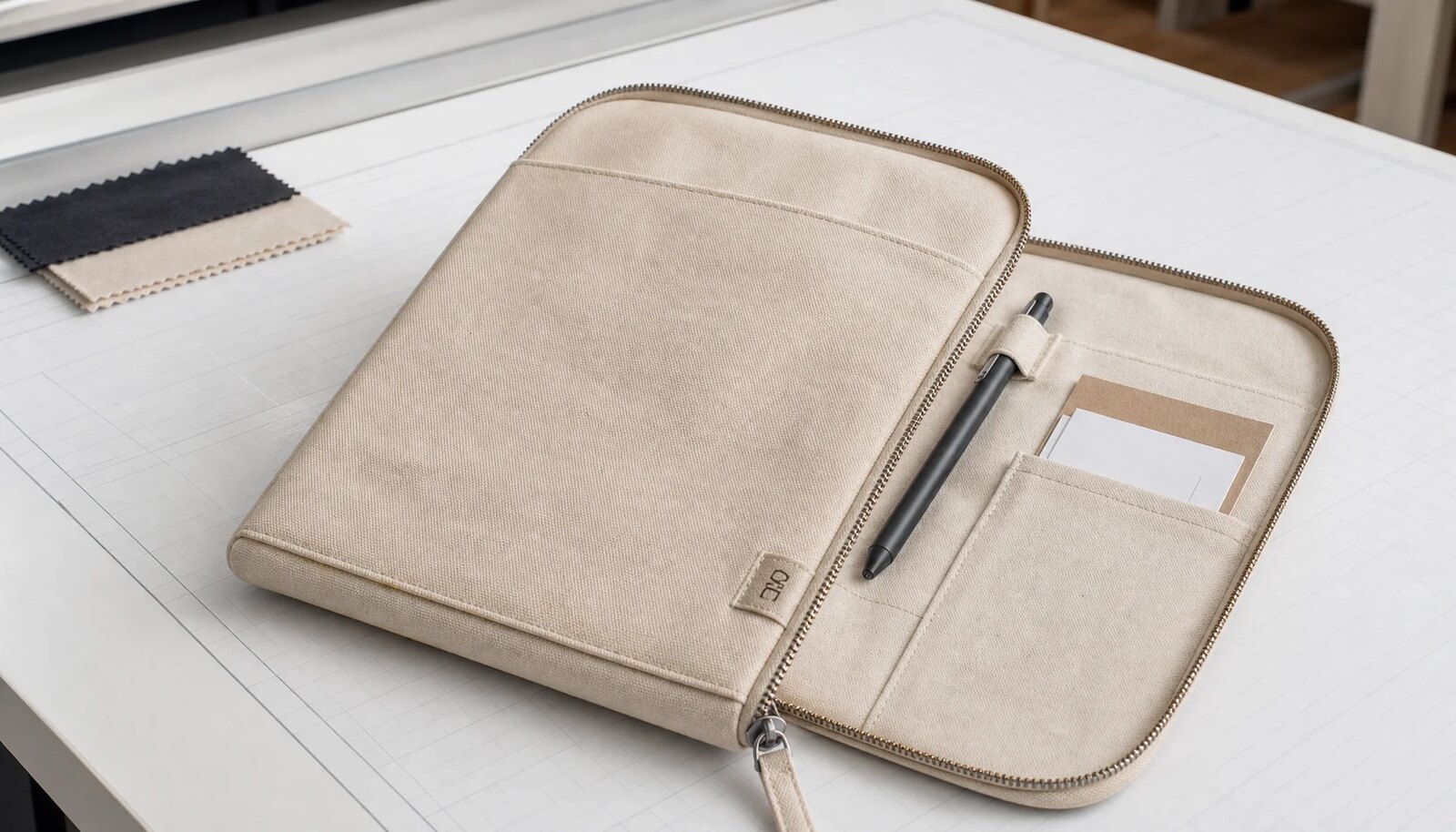
Treat logo placement as a sourcing specification
For canvas zipper portfolios, logo placement is a procurement decision, not only a design preference. It affects cutting, panel reinforcement, printing setup, sewing sequence, inspection, packing direction, and sometimes MOQ. A logo that looks balanced on a flat mockup can shift once the zipper tape, seam allowance, lining, corner radius, pocket layer, and internal documents are added. Event buyers reduce rework when they put placement into the RFQ as a measured production requirement.
The product has to work in practical event conditions. A planner may carry contracts, rooming lists, floor plans, sponsor material, staff schedules, badges, pens, and client handover documents in the same portfolio. The logo may need to be visible at registration, discreet in a client meeting, or durable enough for reuse after the event. Those are different sourcing briefs. A large front-panel mark supports visibility. A lower-corner mark looks quieter. A side label works for subtle repeat branding. A custom zipper pull can feel premium, but it adds component approval.
The risk appears when the logo choice is separated from handling. Portfolios are zipped, stacked, filled, slid into cartons, passed across tables, carried under the arm, and sometimes overpacked before an event. A back-panel print may rub more than a front print. A low-corner patch may sit on a fold line. A side label may disappear when the item is carried inside a tote. A strong canvas zipper portfolios for event planners logo placement guide begins with the real use case, then turns that use case into measurable specs.
- Decide whether the logo must be visible during the event, subtle after the event, or mainly present during unboxing.
- Put placement, logo size, color count, and decoration method in the RFQ before suppliers quote.
- Measure logo position from fixed finished-product references, not from a digital mockup alone.
- Avoid placing logos across fold lines, zipper ends, thick seam intersections, or areas stretched by internal pockets.
Lock the body construction before artwork approval
Logo placement depends on the portfolio body. For many B2B event programs, 12 oz to 16 oz cotton canvas, roughly 407 to 542 gsm, is a practical sourcing range. A 12 oz canvas can suit lower-cost staff kits or short-term event handouts. A 14 oz canvas usually gives better structure without becoming too heavy. A 16 oz canvas can create a firmer premium feel, but it may raise unit cost, carton weight, needle wear, sewing time, and freight impact.
Ask whether the quoted fabric weight is greige weight or finished weight. Cotton canvas can change after dyeing, washing, brushing, lamination, coating, or backing. A supplier may quote 14 oz canvas, but the final hand feel can be softer after washing or stiffer after lamination. This matters for logo control. Softer canvas can ripple under screen print. Heavier canvas can make embroidery pull harder. Laminated or backed panels may improve print flatness but can change folding behavior and sewing tension.
Finished size also drives placement. A4 documents need different proportions than US letter papers, and both may need extra clearance if the portfolio is expected to hold dividers, badges, lanyards, pens, or a tablet. If an internal sleeve is sewn behind the logo area, the outer panel may show ridges or stiffness. If the portfolio has a gusset, the visual center can move when it is filled. Procurement should approve the product architecture first, then approve logo position on the actual construction.
- Use 12 oz to 14 oz canvas for lighter kits and 14 oz to 16 oz when shape retention matters more.
- Confirm finished size, document format, gusset depth, and internal pocket layout before final placement approval.
- Ask whether the front panel includes lining, backing, lamination, foam, or reinforcement.
- Require the supplier to state whether fabric weight is before or after finishing.
- Check whether the decoration area is a single flat panel or a panel interrupted by pocket seams.
Define measurable logo zones
A practical placement map divides the portfolio into lower-risk and higher-risk zones. The lower-risk area is usually the flat front panel with enough clearance from seams, zipper tape, pocket edges, and fold lines. This zone is best for direct screen print, heat transfer, small patches, or woven labels. Higher-risk areas include corners, zipper ends, side seams, folded edges, thick binding, and areas over internal pocket stitching. These zones can still carry branding, but they need tighter sample review and more explicit tolerances.
For front-center logos, measure from the finished panel, not from the fabric piece before sewing. A centered mark can mean centered on the front panel, centered between zipper tape and bottom edge, or centered on an exterior pocket. Those are not the same. A useful RFQ drawing should show the logo box width and height, plus its distance from top edge, side edge, zipper tape, and bottom edge. For many simple front prints, 25-40 mm clearance from seams and zipper tape is a practical starting point, subject to portfolio size and factory advice.
Lower-corner placement needs the same discipline. Specify the side, the logo size, and the distance from the side and bottom edges. Do not rely on words like small or discreet. A 35 mm high mark may look subtle on a large A4 portfolio but too dominant on a compact letter-size sleeve. Side labels need fold length, visible length, seam allowance, label width, and exact insertion point. Inside logos need the same location details because pockets, lining, and divider panels can shift during sewing.
- Front center: strongest visibility, best on a stable flat panel with controlled print opacity.
- Lower corner: quieter appearance, but check fold direction, rub exposure, and contrast.
- Side label: durable and subtle, but visibility depends on how the portfolio is carried.
- Inside print: useful for internal identification, weak for sponsor exposure.
- Packaging-only mark: flexible for neutral inventory, but not permanent after unboxing.
Choose the decoration method by risk, not habit
Screen print remains the most common method for canvas zipper portfolios because it is practical for simple one-color and two-color logos on flat panels. It is usually easier to inspect than detailed embroidery and usually faster than custom hardware. Buyers should confirm ink type, curing process, print size, color count, whether an underbase is needed on dark canvas, and whether the print can tolerate the approved packing fold. Large solid logos need special attention because uneven ink deposit and panel waves are more visible.
Heat transfer can give sharper edges on some artwork, especially when the design has small detail, but it must be tested on the exact canvas finish. Transfers can feel more film-like and may show an edge on textured cotton. Embroidery adds texture and perceived value, but it is not ideal for fine sponsor text, small date lines, gradients, or very detailed event logos. Dense embroidery can pull the panel, distort corners, and make the portfolio less flat when filled. Ask for stitch count, backing method, thread colors, and a real embroidery sample before approval.
Woven labels, PU patches, and custom zipper pulls are stronger when the buyer wants a branded product rather than a large promotional print. Woven labels handle small detail better than embroidery, but they carry separate label MOQ and color limits. PU patches need material, edge, stitch, adhesive if used, and attachment-strength approval. Custom zipper pulls can look polished, but they may require mold fees, plating or color approval, and pull-strength checks. For date-driven events, these additional approval points must be visible in the schedule.
- Use screen print for visible, simple, cost-controlled front-panel branding.
- Use heat transfer only after confirming adhesion and edge appearance on the exact canvas.
- Use embroidery for simple logos with adequate line weight, not small sponsor lists.
- Use woven labels for subtle detail and repeat branding when label MOQ is acceptable.
- Use patches or custom pullers when the timeline can absorb component sampling and tooling.
Build the RFQ like a production brief
A weak RFQ produces quotes that cannot be compared. If one supplier assumes 12 oz natural canvas, a basic #5 nylon coil zipper, no lining, one-color print, and loose bulk packing, while another assumes 16 oz dyed canvas, lining, reinforced pocketing, custom puller, and individual polybags, the unit prices are not measuring the same product. The RFQ should list finished size, canvas weight and finish, zipper specification, internal organization, logo method, logo size, logo placement, packaging, target quantity, inspection requirement, and delivery deadline.
Artwork instructions should be numeric and visual. Attach vector artwork when possible, such as AI, EPS, or PDF. Add a placement drawing with dimensions in millimeters. State whether the supplier may adjust line thickness, simplify small text, or scale the logo for production. If brand owners must approve any change, say that before sampling. For Pantone color, request a strike-off on the actual fabric. A Pantone reference alone is not enough because natural canvas, dyed canvas, and washed canvas all influence color appearance.
Ask for alternates when stakeholders are still deciding. A useful comparison might request three options: front one-color screen print, woven side label, and debossed PU patch. For each option, ask for MOQ, setup cost, sample cost, sample lead time, bulk lead time, unit price, and any component constraints. This turns logo placement discussion into a sourcing decision with visible tradeoffs.
- Request product cost, setup cost, sample cost, packaging cost, inspection cost, and freight estimate separately when available.
- Ask for price breaks at realistic quantities, not only the largest target quantity.
- Require the supplier to identify which components are stock and which are made to order.
- Ask what changes trigger a re-sample, new screen, new tooling, or new MOQ.
- Put tolerances and sample approval requirements into the purchase order or production sheet.
Use samples to test the real event load
The sample stage should verify the complete portfolio, not only the logo appearance. A pre-production sample should use the quoted canvas weight, final color, zipper, thread, lining or backing, internal pocket layout, logo method, logo placement, and packing direction. If the factory sends a substitute fabric or approximate placement, it can help review general direction, but it should be marked as reference only. It should not become the final bulk approval standard.
Test the sample with the actual event contents. Insert the intended A4 or letter documents, sponsor sheets, badges, lanyards, pens, tablets, or client packets. Zip the portfolio closed. Check whether the front panel stays flat, whether the logo still looks aligned, whether the zipper catches, whether the corners twist, and whether internal pockets create ridges under the logo. This is the moment to discover that a centered logo looks too low once the portfolio is filled or that a patch is too close to the zipper path.
Keep approval records clear. Photograph the approved sample from the front, back, inside, zipper edge, logo close-up, and packed orientation. Measure the logo from fixed edges and record the result. Seal or mark one physical approved sample for final inspection comparison. If the buyer approves only by phone photo, color, texture, logo angle, and print opacity become harder to dispute later. Written approval should state what is approved and what remains open.
- Request a strike-off before a full sample when logo color, ink opacity, or fine detail is uncertain.
- Reject final approval if the logo moved without an updated drawing and written confirmation.
- Review print, zipper, stitching, panel shape, pocket function, odor, and packing together.
- Treat changes in fabric, zipper, logo method, placement, or folding method as new approval points.
- Keep one approved physical sample available for production and inspection reference.
Set tolerances and defect rules before bulk production
Quality control is stronger when pass-fail rules are measurable. For logo placement, define the reference point and tolerance in millimeters. Depending on construction and method, buyers often use a tolerance such as plus or minus 3 mm for simple front-panel prints and plus or minus 5 mm for more complex sewn constructions, but the agreed tolerance should come from the supplier's production capability and the buyer's brand needs. Also define whether logo angle is measured against the top edge, side seam, or zipper tape.
Print quality must be judged on the actual canvas. Cotton canvas has slubs, texture, and absorbency variation. The approved standard should say whether slight weave show-through is acceptable. Inspect opacity, pinholes, edge definition, smudging, cracking after gentle flexing, and ink transfer inside the polybag. For dark canvas, confirm underbase use. For natural canvas, define acceptable flecks and slubs because natural cotton variation can be normal but still visually noticeable near a logo.
Workmanship standards should cover the whole product. Inspect stitch density, skipped stitches, thread tails, seam puckering, zipper tape alignment, puller attachment, inner pocket shape, panel symmetry, stains, odor, and packed appearance. Classify defects so the factory understands what can block shipment. A broken zipper, wrong logo, unsafe sharp hardware, or unusable construction should be critical. Visible logo misplacement, print cracking, wrong pocket layout, heavy puckering, and wrong packing orientation are usually major. Small thread tails or minor canvas slubs within the approved standard may be minor.
- Define critical, major, and minor defects in writing before inspection.
- Use an approved sample, placement drawing, and measurement tool during inspection.
- Check dimensions, zipper function, logo placement, logo angle, print quality, stitch quality, fabric appearance, packing, carton marks, and quantity.
- Record whether inspection is inline, final random inspection, or both.
- Clarify AQL level if used, and state who pays for rework or reinspection after failure.
Control color, contrast, and artwork detail
Artwork that works on paper may fail on canvas. Fine lines, small type, tight letter spacing, gradients, halftones, and reversed-out details can lose clarity on textured fabric. Event logos often include dates, venue names, sponsor names, or small secondary marks. Before approving the layout, ask the supplier for the minimum printable stroke width and minimum readable text height for the chosen method on the chosen canvas. If the mark is not legible at the intended size, increase the size or simplify the artwork before sampling.
Color control is more complex on cotton canvas than on coated paper. Natural canvas has a warm base tone that can shift ink appearance. Dyed canvas can vary between fabric lots. Washed canvas can soften both body color and print edge. Pantone references are useful, but they are not a guarantee of fabric appearance. Request a lab dip for dyed canvas when color is important and a logo strike-off on the actual fabric before final sample approval. Review under daylight or D65 lighting when possible.
Contrast should match the event use case. A tone-on-tone lower-corner logo can look polished for executive client meetings but may disappear at a busy registration desk. A large high-contrast front print can support sponsor visibility but may feel too promotional for post-event reuse. Procurement should ask stakeholders where the portfolio will be seen: public check-in, staff operations, sponsor gifting, venue walkthroughs, client presentation, or long-term office use. That answer should drive size, color, method, and placement.
- Avoid fine sponsor text on coarse canvas unless a strike-off proves it remains readable.
- Approve logo color on the actual fabric color and finish, not only on a digital proof.
- Ask whether an underbase is needed for light ink on dark canvas.
- Define acceptable color variation against the approved strike-off or sealed sample.
- Confirm whether production artwork changes require brand-owner approval before sampling.
Protect the logo through packing and fulfillment
Packing is part of the product specification because it affects the logo when cartons are opened. If the portfolio is folded across the print, the mark can crease, crack, or show pressure lines before use. If units face different directions inside the carton, event kit assembly becomes slower. If inserts, zipper pulls, or patches press against the printed panel, they can leave marks during transit. Buyers should approve packing with the same seriousness as the sample.
Define fold direction and logo orientation. Ideally, the logo should face outward consistently and avoid hard creases. If carton size requires folding, ask whether a larger carton, lower carton quantity, tissue sheet, or insert board would better protect the decorated area. The right answer depends on unit value, event deadline, and repacking cost at destination. For premium sponsor kits, avoiding destination rework can be more important than saving a small amount on carton volume.
For multi-logo orders, carton control is essential. Agency buyers may order the same portfolio body for several clients or sponsor tiers. Mixed cartons can create fulfillment errors even when the product quality is acceptable. Carton marks should identify SKU, body color, logo version, quantity, carton number, purchase order, and destination when needed. Packing lists should match the PO by logo version, not only by total quantity.
- Approve the exact fold direction and require the same direction in bulk.
- Keep creases away from printed logos, patches, labels, and custom pullers whenever possible.
- Specify individual polybag, warning text if needed, tissue, insert board, belly band, hang tag, and carton marks.
- Require carton-level separation for multiple logo versions or event versions.
- Ask whether inserts are placed inside each portfolio at factory or packed separately for local kitting.
Compare landed cost, MOQ, and schedule together
Unit price alone is not enough for canvas zipper portfolio sourcing. A lower price may reflect lighter canvas, weaker zipper tape, fewer internal pockets, no lining, smaller logo area, looser placement tolerance, cheaper packing, or missing setup charges. Normalize quotes before comparison. The useful comparison is same size, same canvas weight and finish, same zipper, same internal layout, same decoration method and size, same packing, same inspection plan, and similar freight assumptions.
MOQ should be reviewed by component. A supplier may accept a low MOQ for blank bodies but require higher quantities for dyed canvas, custom woven labels, PU patches, screen print versions, custom zipper pullers, or special zipper tape colors. Multi-logo event programs often create hidden MOQs because each client logo may need a separate screen, label run, patch setup, or sample approval. Ask for MOQ by body color, logo version, decoration method, and hardware design.
Schedule should be broken into decision points. Ask for artwork review time, strike-off time, sample production time, sample shipping time, material preparation, component production, bulk cutting, printing, sewing, packing, final inspection, and freight. A one-color print on stock canvas can move faster than a custom puller or patch. For event-driven procurement, the key question is not only the quoted production days. It is which late approval, outside component, or failed sample can delay delivery.
- Compare quotes only after matching fabric, zipper, logo method, internal layout, packing, and QC assumptions.
- Separate setup charges, sample charges, tooling, unit cost, packing, inspection, and freight where possible.
- Ask which components are stock and which are made to order.
- Build buffer for artwork revisions, sample shipping, color approval, inspection, and final freight.
- For fixed event dates, choose the simplest decoration method that satisfies visibility and brand requirements.
Specification comparison for buyers
| Spec decision | Recommended option | When it fits | Buyer risk to check |
|---|---|---|---|
| Front panel logo | One-color or two-color screen print, centered on the finished front panel with 25-40 mm clearance from zipper tape, seams, and fold lines | Best for registration desks, sponsor tables, planner work sessions, venue walkthroughs, and programs where the brand must be visible while the portfolio is in use | Large print areas show panel waves, uneven ink deposit, and placement drift more clearly; require a fixed-edge placement drawing and a print adhesion check on the actual canvas |
| Lower corner logo | Small screen print, woven patch, or tonal mark placed 25-35 mm from side and bottom edges unless the sewing construction requires more clearance | Fits executive kits, venue packets, client handover folders, and portfolios intended for reuse after the event | Low marks can land on packing folds or table-rub zones; check contrast, fold direction, and rub resistance before bulk approval |
| Debossed PU patch | Stitched patch or heat-applied patch positioned away from zipper stops, high-flex corners, and thick seam intersections | Useful for premium planner kits, sponsor gifts, and lower-ink designs where the body should look cleaner than a promotional giveaway | Patch material, adhesive if used, stitch tension, edge finish, heat setting, and pull strength must be approved; patches can wrinkle the panel if backing is weak |
| Woven side label | Narrow woven label inserted into a side seam or lower binding with a defined fold length and seam allowance | Good for long-term brand programs, neutral agency inventory, multi-client event kits, and subtle retail-style branding | The label may be hidden under the arm or inside another bag; label MOQ, color count, and approval lead time can be separate from the body MOQ |
| Zipper pull branding | Custom metal, molded PVC, rubber, or PU puller with logo emboss, deboss, engraving, or molded mark | Fits premium programs where the buyer wants a functional brand detail without a large body logo | Tooling, plating or color approval, pull strength, corrosion resistance, and nickel-related requirements can add lead time compared with print |
| Inside pocket print | One-color print, woven label, or care-style brand label on an internal pocket, divider, or lining panel | Appropriate for internal event teams, planner onboarding kits, client handover packs, or portfolios that should remain neutral externally | Hidden branding does not support sponsor visibility; interior print can also rub against papers or tablets if ink cure is weak |
| Back panel logo | Medium print or label on the reverse side with clearance from edges, zipper tape, and any handle or strap attachment | Useful when the front panel is reserved for a clean look, name label, patch, or inserted documents | Back panels rub against chairs, tables, carts, and other bags; require stronger rub and abrasion checks than a protected interior mark |
| Branded insert or sleeve | Printed belly band, paper insert, hang tag, carton insert, or removable sleeve instead of permanent body decoration | Fits low-MOQ trials, agency buyers serving multiple end clients, or neutral stock that will be decorated later | Packaging is often discarded during kitting; the brand impression may not remain after first use and must be included in packing labor calculations |
| Dual-brand placement | Primary client or event logo on the front plus a smaller sponsor, supplier, or organizer mark inside, on a side label, or on a puller | Useful for conferences, sponsor tiers, venue partnerships, and agency-managed merchandise programs | Artwork approval can slow down because two brand owners must sign off on hierarchy, size, color, placement tolerance, and sample appearance |
Buyer checklist before sampling
- Confirm finished portfolio size in millimeters, usable internal document size, gusset depth if any, and whether the item must hold A4 paper, US letter paper, tablets, pens, badges, lanyards, schedules, contracts, or seating plans.
- Specify canvas weight in oz and gsm, and state whether the figure is greige fabric weight or finished weight after dyeing, washing, brushing, lamination, coating, or backing.
- Define fabric construction details available from the supplier: plain weave or duck canvas, yarn count if known, shrinkage expectation, color process, and whether the canvas is raw, dyed, washed, enzyme washed, brushed, laminated, or lined.
- State logo position in millimeters from fixed references such as top edge, side seam, zipper tape, bottom edge, pocket edge, or finished panel centerline; avoid only using terms such as centered, lower right, small, or near the zipper.
- Define logo size, color count, Pantone targets, acceptable color tolerance, minimum line thickness, minimum text height, and whether artwork may be thickened or simplified for textured canvas production.
- Choose the decoration method before comparing quotes: screen print, heat transfer, embroidery, woven label, PU patch, zipper pull branding, inside label, or removable packaging only.
- Specify zipper type, zipper size, zipper tape color, slider and puller material, opening direction, end stops, and whether metal components require nickel-free, anti-rust, plating, or coating confirmation.
- Define internal organization: sleeve pocket, business card pocket, pen loop, tablet sleeve, elastic strap, file divider, mesh pocket, document divider, lining, or no internal compartments.
- Ask whether the portfolio must stay flat when filled; if yes, request reinforcement, lining, panel backing, or heavier canvas, and test the sample with the intended inserts.
- Request packing details including individual polybag style, warning text if needed, carton quantity, carton dimensions, gross weight, carton marks, SKU label, barcode, insert handling, and logo-facing fold direction.
Factory quote questions to send
- What canvas weight in oz and gsm are you quoting, and is that weight before or after dyeing, washing, lamination, backing, or other finishing?
- What fabric construction and finish are included: plain cotton canvas, cotton-poly canvas, duck canvas, brushed canvas, washed canvas, lined canvas, or laminated canvas?
- What finished portfolio size, seam allowance, zipper length, gusset depth if any, and usable internal document size are included in your quote?
- What zipper specification is included: coil or metal, size such as #5 or #8, tape color, slider material, puller style, end stops, and opening direction?
- Which logo placement is included in the base quote, and what changes if the logo moves closer to a seam, zipper tape, patch edge, pocket edge, or fold line?
- What decoration method are you pricing, and what setup charge, screen charge, digitizing charge, mold charge, label charge, or tooling charge applies if artwork changes?
- What is the MOQ by body color, canvas finish, logo method, logo placement, zipper color, woven label design, patch design, and custom hardware design?
- How many pre-production samples are included, what is the sample lead time after artwork approval, and what sample cost is refundable against the bulk order?
- Can you provide a measured placement drawing showing distance from fixed edges and a production tolerance in millimeters for logo position and angle?
- What tolerances do you apply for finished size, logo position, logo angle, color variation, and carton quantity, and can these be written into the proforma invoice or production spec?
Quality-control points to confirm
- Logo position tolerance should be defined in millimeters from a fixed reference point such as top edge, side seam, zipper tape, bottom edge, pocket edge, or finished panel centerline; visual centering alone is not enough for inspection.
- For most fabric portfolios, a practical placement tolerance is often plus or minus 3 mm for simple front-panel print and plus or minus 5 mm for larger sewn constructions, but the final tolerance must be agreed with the factory before production.
- Logo angle should be checked against the panel edge; visible tilt beyond the agreed tolerance should be classified as a major defect when it affects shelf appearance or brand presentation.
- Print opacity should cover the canvas texture to the approved level without unacceptable pinholes, uneven ink deposit, heavy ridges, cracking at fold points, bleeding into the weave, or transferred ink inside the polybag.
- Artwork details such as small text, thin lines, registration gaps, and reversed-out areas should be checked on real canvas before bulk because textured fabric can close fine gaps and weaken legibility.
- Stitching around the zipper, corners, pocket openings, labels, and reinforcement points should show even SPI, no skipped stitches, no loose thread tails, and no puckering that distorts the logo area.
- Color variation should be checked against an approved strike-off or sealed sample under daylight or D65 lighting, not only under warehouse LEDs or phone photos.
- Zipper must open and close smoothly through repeated manual cycles without catching the lining, seam allowance, zipper tape ends, puller attachment, or nearby logo patch edges.
- Canvas panels should be checked for slubs, stains, dye streaks, skew, odor, excessive shrinkage, and uneven washing, especially when using dyed or washed cotton canvas.
- Patch, woven label, and zipper pull branding should be checked for alignment, edge finish, attachment strength, color consistency, and sharpness of small logo details.