Start with the event workflow, then price the product
Canvas zipper portfolios for event planners are not one standard item with one standard price. A registration portfolio may hold a program, a badge card, and a sponsor insert for one afternoon. A staff planning version may carry floor plans, contracts, run sheets, access passes, pens, and a tablet-style insert across several event days. Both may be called a canvas zipper portfolio on a quote sheet. They should not be sourced from the same vague spec.
Procurement teams get better bulk pricing when they describe the job the portfolio must perform before asking for a number. Who will use it? What will it carry? Will it be opened twenty times a day by staff, handed once to attendees, mailed in advance, or placed inside a welcome kit? Those answers influence canvas weight, zipper strength, pocket layout, logo method, carton packing, and inspection points.
The keyword phrase canvas zipper portfolios for event planners bulk pricing plan points to the real issue: the pricing plan only works after the product is measurable. If the RFQ says custom canvas zipper portfolio and little else, each supplier fills the gaps differently. One may quote 8 oz fabric, another 12 oz. One may include lining and two pockets. Another may price a single unlined sleeve. The spreadsheet may look tidy, but the prices are not comparing the same thing.
Begin with the handling path. A portfolio that ships by parcel to VIP guests needs stronger packing protection than one delivered by pallet to a venue. A portfolio stacked at registration may need a front logo that is visible in piles. A portfolio going into a kit box needs dimensions that avoid crushed corners. This is unglamorous work, but it is where many late cost and quality surprises are prevented.
- Name the recipient group: attendees, sponsors, speakers, staff, executives, sales teams, or internal planners.
- List exact contents by size and approximate thickness, including A4, US letter, brochures, badges, pens, floor maps, contracts, or tablet inserts.
- State whether the item is single-event, multi-city, annual-repeat, retail-style, or intended for long-term reuse.
- Explain distribution: mailed in advance, packed in welcome kits, handed out at registration, staged on seats, or shipped to multiple venues.
Turn the idea into specs a factory can build
A useful RFQ turns a product idea into construction details. Finished size should be stated as width by height by gusset, where a gusset is needed. The zipper opening, pocket depth, and logo position should be shown on a simple drawing. A4 and US letter are close enough to cause mistakes but different enough to matter: A4 is 210 x 297 mm, while US letter is 216 x 279 mm. If the portfolio barely clears one format, the other may crease or resist the zipper.
Add internal clearance instead of making the document size the product size. For many document portfolios, procurement can specify at least 10 to 15 mm beyond the largest document edge, then ask the factory to confirm the finished pattern. If brochures, badges, or folded floor plans sit inside the same pocket, measure the stack thickness too. A portfolio that works for ten sheets may strain with a complete event packet.
Canvas weight is a major cost driver. Many reusable event portfolios sit in the 10 oz to 12 oz range, roughly 340 to 410 GSM depending on weave and finish. Lighter 8 oz to 10 oz canvas, roughly 270 to 340 GSM, can suit high-volume or one-day programs if seams and pocket loads are controlled. Heavier canvas may feel more substantial, but it can create bulky corners, slower sewing, larger needle holes, heavier cartons, and higher freight cost.
Ask for composition and finish, not weight alone. Cotton canvas, recycled cotton canvas, cotton-poly canvas, natural canvas, dyed canvas, washed canvas, laminated canvas, and untreated greige fabric do not behave the same way. Natural canvas can show seed flecks, slubs, and shade movement. Dyed canvas needs a color standard. Washed canvas may feel softer, but size variation can increase. These details should be decided before sample approval, not debated after bulk goods arrive.
- Specify finished size and internal clearance, not only document size.
- Use canvas weight in oz and GSM, with an allowed tolerance such as plus or minus 5 percent if the supplier can support it.
- Define fabric composition, finish, color target, lining, and whether natural slubs or shade variation are acceptable.
- Require a construction drawing showing zipper path, pocket dimensions, seam allowance, reinforcement points, and logo placement.
Choose zipper and pocket details for actual use
The zipper is a working part of the portfolio. For bulk canvas portfolios, a No. 5 nylon coil zipper is often a practical baseline because it is flexible, packs flat, and tends to move more smoothly around corners than many stiff alternatives. It is also less likely than metal teeth to mark documents. Still, buyers should specify zipper tape color, tape width if critical, slider material, puller finish, end-stop reinforcement, and corner construction.
Corner shape deserves attention. A zipper that moves easily on a straight sample strip can catch once sewn around a tight portfolio corner. If the design wraps around two or three sides, review the corner radius on a loaded sample. Ask the supplier what they recommend for smooth travel, then test it. A beautiful portfolio that takes two hands to close at check-in will not feel premium in use.
Metal zippers can look more upscale, but they are not automatically better for event document cases. They add weight, can feel rigid on flat products, and may mark nearby materials. For executive programs, a metal slider, custom puller, woven label, or patch can often create a higher-end impression without changing the entire zipper chain. If custom pullers are proposed, tooling, MOQ, lead time, and approval drawings should be quoted separately.
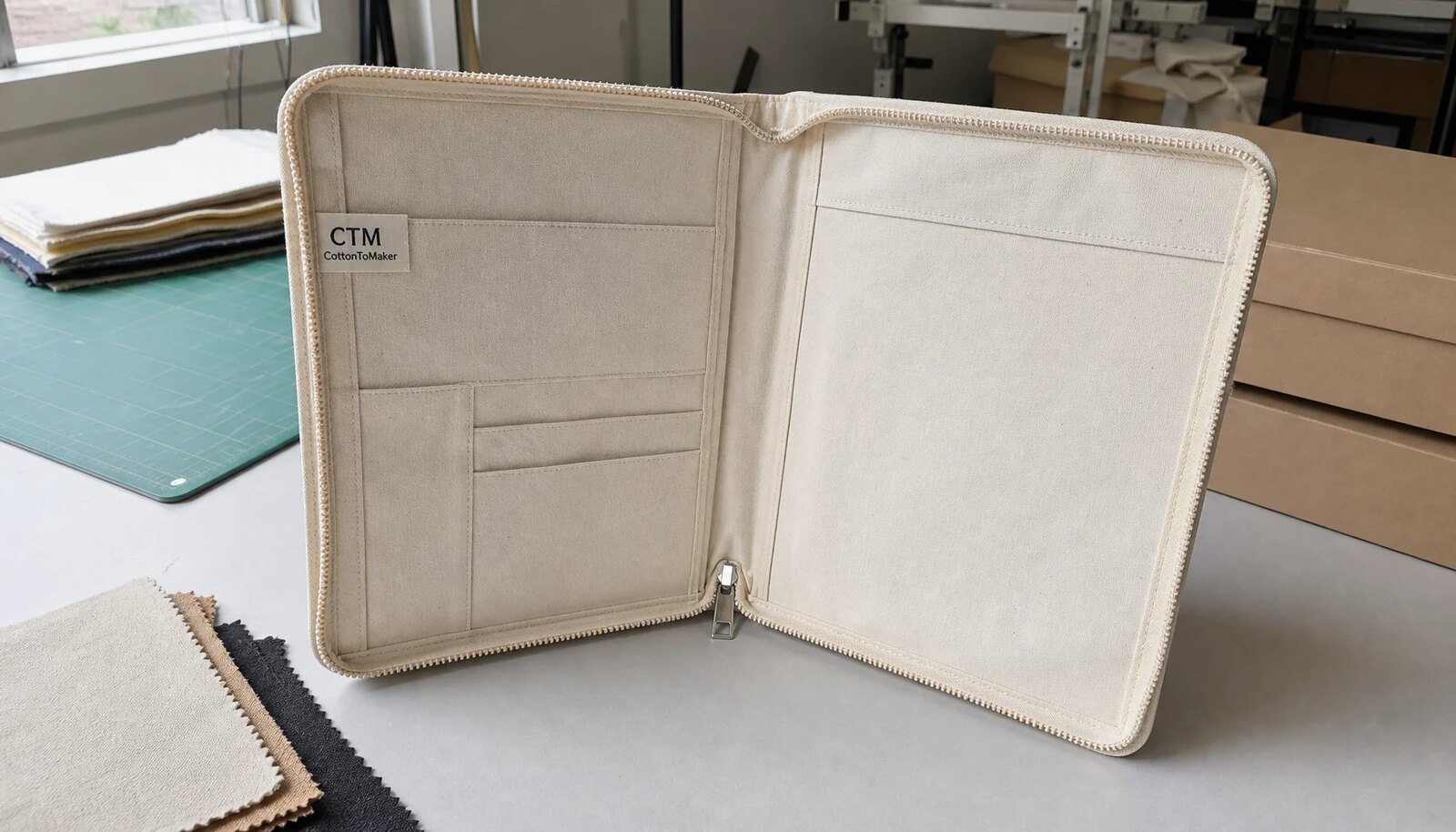
Pocket design should be practical. One main sleeve plus one or two flat pockets is often more useful than an interior full of small compartments. Every extra pocket adds sewing time, seam bulk, possible distortion, and another measurement to inspect. Pen loops, card slots, elastic holders, and dividers should earn their place. Load the sample with the real agenda pack, brochure bundle, badge envelope, floor plan, and pen. Then zip and unzip several times. That test tells the truth quickly.
- Use No. 5 nylon coil zipper as a practical baseline unless the brand or durability requirement justifies another option.
- Specify slider, puller, tape color, end stops, tape width, and corner construction in the RFQ.
- Tie pocket count and dimensions to real contents; avoid decorative compartments that add cost without use.
- Test zipper closure on a loaded sample, not an empty portfolio.
Build a bulk pricing plan that reveals cost drivers
Bulk pricing should be requested in tiers because the cost curve is rarely straight. At 500 units, sample development, cutting preparation, decoration setup, and production planning are spread across a smaller order. At 1,000 units, the factory may gain better cutting efficiency. At 3,000 or 5,000 units, fabric purchasing, sewing-line balance, decoration setup, and packing flow may improve further. One quantity quote hides where those improvements begin.
For event planning purchases, quote tiers of 500, 1,000, 3,000, and 5,000 units usually make sense. They cover pilot events, regional meetings, multi-city programs, and annual buys. If attendance is uncertain, ask for a committed price at the most likely quantity and an option price at the next tier. That gives procurement room when registration numbers move late, which they often do.
One-time charges should be separated from unit cost. Screen setup, sample development, woven label setup, patch molds, custom puller tooling, and special packing setup may affect the first order but not every reorder. On the other side, a low unit price can be misleading if it excludes cartons, inner wrap, barcode labels, carton labels, export documents, or inspection support. A usable quote shows first-order cost, repeat-order cost, and assumptions behind both.
Ask suppliers to explain the reason for each price break. A credible answer may mention fabric roll quantity, cutting yield, decoration setup spread, sewing efficiency, or carton planning. Procurement does not need the factory's full cost sheet, but it does need enough information to know whether a price reduction is tied to real production efficiency or simply an unverified promise.
- Request the same construction at 500, 1,000, 3,000, and 5,000 units.
- Show unit price, setup charges, sample fee, tooling, packing, and carton cost as separate lines.
- Ask for first-order and reorder pricing when artwork and materials remain unchanged.
- Require the quote to state Incoterm, shipment point, lead time, carton count, gross weight, and CBM estimate.
Compare supplier routes by control and accountability
There are three common sourcing routes: factory-direct production, trading company coordination, and local decoration of imported blanks. Each can be the right answer in the right situation. The mistake is comparing them only by headline price. Procurement should compare control, timeline, customization, defect ownership, and the ability to repeat the same product later.
Factory-direct sourcing is usually strongest when the buyer needs a custom size, defined canvas weight, specific pocket layout, controlled logo placement, or repeat program consistency. The correction loop is shorter because pattern, cutting, sewing, decoration coordination, inspection, and packing can be managed closer to production. The buyer still needs a disciplined spec sheet. Factories quote what is written, and missing details become assumptions.
A trading company can help when the event program includes several products under one PO: portfolios, totes, pouches, lanyards, badge holders, apparel, and printed inserts. This can reduce admin work for a busy procurement team. The risk is distance from the production floor. Ask who the factory is, who approves the preproduction sample, who owns rework, and whether the same factory will be used for reorders.
Local decoration can be useful for urgent events or low quantities. A decorator may apply a logo to imported blank zipper portfolios faster than a custom factory can produce them. The limitation is simple: the blank is already built. Printing cannot fix weak seams, poor zipper travel, shallow pockets, thin canvas, or the wrong finished size. Inspect the blank with real contents before approving decoration.
- Use factory-direct sourcing for custom construction, repeat programs, and higher QC control.
- Use trading companies for multi-product event kits, but require factory transparency and defect ownership.
- Use local decoration for urgent or low-volume jobs after inspecting blank construction.
- Do not compare custom production with decorated blanks unless fabric, zipper, pocket, packing, and QC assumptions are aligned.
Select branding that matches artwork and inspection needs
Branding creates many quote gaps because the logo method is often treated as an afterthought. Screen printing can be efficient for one- to three-color flat artwork on canvas. It is less suitable for gradients, tiny sponsor copy, very fine lines, or artwork expected to look like a smooth digital mockup. Canvas texture affects ink edge, coverage, and hand feel. Approve the look on the actual fabric, not only in a PDF proof.
Heat transfer may support more detailed artwork, but buyers should ask about edge feel, cracking risk, adhesion, and how the transfer behaves when the portfolio bends. Embroidery can add texture, although it may distort lighter canvas and may show backing depending on the design and lining. Woven labels and patches are often cleaner for recurring programs or understated executive branding. Custom zipper pullers can be subtle and useful, but tooling and MOQ must be visible in the quote.
Color control should be practical. If sponsor guidelines require a Pantone target, state the number and approve a strike-off or preproduction sample. If exact matching is not critical, closest commercial match may save time and cost. Natural canvas can shift logo appearance because the base fabric is not pure white. For light or bright colors, discuss ink opacity, white underbase, and print coverage before production.
Logo placement should be inspected with measurements, not just taste. State the distance from the left edge, right edge, bottom edge, zipper seam, or centerline. Define acceptable rotation and placement tolerance in millimeters where possible. Small variation is normal on sewn goods, but the allowed range should be agreed before production. Otherwise, every carton becomes a debate.
- Use screen print for simple flat logos and repeatable bulk work.
- Use woven labels, patches, embroidery, heat transfer, or branded pullers when the artwork or finish goal calls for it.
- Define color standard as Pantone target, approved lab dip or strike-off, closest match, or factory standard.
- Inspect logo placement by edge measurement, orientation, and rotation against the approved sample.
Approve samples with final materials and clear tolerances
A sample should prove the factory can make the product being ordered. It should use final canvas weight, final fabric color, final zipper, final lining if any, final pocket layout, final decoration, and final packing whenever possible. If a component is substituted, label the sample preliminary. Bulk production should not start until final components are approved or the buyer has accepted the risk in writing.
Review the sample like a working tool. Measure width, height, gusset, zipper opening, pocket depth, pen loop width, card slot size, and logo position. Load it with the actual event materials. Zip and unzip it several times. Place it into the intended carton, mailer, or kit box. Check whether documents curl, pockets pull, the zipper strains, or the body collapses. The sample may look excellent empty and still fail the event workflow.
Tolerances should be realistic for soft sewn goods. Exact dimensions on every unit are not practical, especially after sewing, turning, pressing, and packing. Still, the portfolio must fit the intended contents. Set tighter tolerances for critical functional features such as document sleeve size, zipper opening, and logo position. Allow broader tolerances only where they do not affect function or brand presentation.
Keep physical reference samples. The buyer should retain one approved sample, and the factory should keep one matching sample on the production floor. Mark the sample with date, version, PO reference, fabric details, logo method, and packing approval. Photo approval helps with communication, but it cannot confirm fabric weight, odor, zipper smoothness, seam feel, or loaded-pocket performance.
- Require a preproduction sample with final canvas, zipper, pockets, decoration, and packing for custom or high-visibility orders.
- Record sample measurements and note which dimensions are critical to function.
- Test the loaded sample with actual contents and intended carton or kit packaging.
- Keep buyer and factory reference samples clearly marked with version and approval date.
Control packing, labels, and freight data before production ends
Packing belongs in the sourcing plan, not at the end of production. Canvas can scuff, crease, absorb odor, or pick up dirt if packed loosely. Individual polybags protect against moisture and handling marks, but they may conflict with sustainability goals. Paper wrap or paper bands can reduce plastic, but the supplier still needs a plan to prevent abrasion and contamination. For printed portfolios, the decorated face should be protected from rubbing or ink transfer.
Carton details should appear in the quote. Ask for units per carton, carton dimensions, net weight, gross weight, total carton count, and estimated CBM. This information affects freight cost, warehouse receiving, and venue handling. Overly heavy cartons are hard for event teams to move. Loose cartons allow portfolios to shift and bend. Over-compressed cartons can leave crease marks, especially on natural or washed canvas.
Labeling should be settled before packing starts. Cartons may need event name, PO number, SKU, color, quantity, destination, carton number, pallet number, or barcode. Individual portfolios may need barcode stickers, insert cards, hang tags, or no visible labels. These tasks add labor and should be quoted. Late label decisions often mean cartons must be reopened, which adds handling risk and can slow dispatch.
For multi-destination programs, ask whether the factory can pack by destination. If 2,000 portfolios ship to four cities, destination-level packing and carton labels can save time for the event team. If the portfolios go into larger welcome kits, confirm flat or folded dimensions early so the kit assembler can plan box size, count, and loading sequence.
- Specify individual packing: polybag, paper wrap, paper band, bulk pack, or kit-ready format.
- Request carton quantity, carton size, gross weight, net weight, carton count, and CBM in the quote.
- Define carton labels, barcode rules, insert cards, destination sorting, and pallet requirements before production ends.
- Inspect cartons for count, moisture, compression marks, label accuracy, and clean orientation of the portfolios.
Build the timeline from approvals, materials, and QC
Lead time should be counted from final approval, not from the first inquiry. A realistic schedule includes artwork review, sample production, sample shipping, sample approval, material booking, cutting, sewing, decoration, in-line checks, final inspection, packing, dispatch, and transit. If the order uses dyed canvas, custom zipper tape, woven labels, patches, custom pullers, or special packaging, those components may drive the calendar more than sewing time.
The most common schedule risk is unresolved approval. Missing vector artwork, late sponsor changes, unclear color standards, pocket revisions, and undecided packing instructions can leave production half-approved. Procurement should create a short approval matrix naming who signs off on construction, artwork, color, packing, and shipment. Event dates are fixed. The product schedule has to work backward from that reality.
Material availability should be confirmed before the supplier promises a firm dispatch date. Natural cotton canvas may be available quickly, while a specific dyed shade or matching zipper tape may need sourcing time. Large orders can require multiple fabric rolls, which raises shade-control requirements. Ask when materials will arrive, when cutting will start, and whether production stops if incoming fabric inspection fails.
Inspection and rework need space in the calendar. Final inspection after packing can catch count and carton issues, but construction problems are easier to correct during production. For larger orders, request milestone updates at material arrival, cutting start, first sewing output, decoration start, final inspection, and packing completion. These updates are not ceremony. They create chances to correct problems while correction is still possible.
- Count lead time from final sample approval, final artwork, and material confirmation.
- Break the timeline into sample, material, cutting, sewing, branding, inspection, packing, dispatch, and transit.
- Confirm custom component timelines for dyed canvas, zipper tape, woven labels, patches, pullers, and inserts.
- Build buffer for sample revision, QC rework, export documents, and freight schedule changes.
Evaluate quotes by landed cost and risk-adjusted value
The lowest ex-factory price is not always the lowest total cost. A complete comparison includes unit price, sample fee, setup charge, tooling, decoration, packing, carton cost, inspection, domestic freight, export documents, international freight, duties, taxes, destination handling, relabeling, and kit assembly impact. If one supplier quotes EXW and another quotes FOB or CIF, the numbers are not directly comparable.
Force every quote into the same template. Include quantity tier, canvas weight, composition, finish, zipper type, pocket layout, logo method, packing format, Incoterm, lead time, sample policy, setup charges, overrun tolerance, carton data, and inspection standard. This turns assumptions into visible decision points. It also helps internal stakeholders understand why two prices differ.
Risk matters because event deadlines are unforgiving. A shipment that arrives late, smells bad, has jammed zippers, or fails to fit the sponsor inserts can cost more than the savings from a cheap quote. Evaluate whether the supplier can explain the specification, provide a final-material sample, document inspection steps, and support correction before shipment. A slightly higher unit price may be the better buy if the process is controlled.
Overruns and underruns should be addressed before the PO. Custom sewn goods can have small quantity variation because of material yield, inspection rejection, and handling. The buyer should state whether exact quantity is required or whether a small overrun and underrun range is acceptable. For fixed attendee counts, the minimum usable quantity may matter more than avoiding a few extra pieces.
- Compare quotes using the same Incoterm, construction spec, packing method, and delivery assumption.
- Separate first-order cost from reorder cost by isolating tooling, setup, and sample charges.
- Include inspection, freight data, duties, taxes, and kit assembly impact in the landed-cost view.
- Treat vague all-in quotes as incomplete until inclusions and exclusions are listed.
Specification comparison for buyers
| Spec decision | Recommended option | When it fits | Buyer risk to check |
|---|---|---|---|
| Source model | Factory-direct supplier with cutting, sewing, decoration coordination, final inspection, and export packing control | Repeat event programs, exact branding, custom pocket layouts, controlled samples, and tighter correction loops | Confirm which processes are in-house and which are subcontracted; request the production factory name, inspection responsibility, and correction process in writing |
| Supplier alternative | Trading company managing one or more factories under a single PO | Multi-item event kits that combine portfolios, totes, pouches, lanyards, badge holders, apparel, or printed inserts | Require factory transparency, approved reference samples, production photos, defect ownership, and a named quality contact |
| Short-lead option | Local decorator applying logos to imported blank zipper portfolios | Low-volume pilots, urgent events, simple logo jobs, or orders below factory MOQ | Inspect the blank before decoration; poor zipper travel, weak seams, thin canvas, or unsuitable pocket size cannot be corrected by printing |
| Canvas body | 10 oz to 12 oz cotton canvas, often around 340 to 410 GSM depending on weave and finish | Reusable attendee folders, sponsor packets, staff planning portfolios, and client-facing registration kits | Ask for quoted GSM or oz, tolerance, composition, shrinkage expectation, shade standard, and whether the fabric is greige, dyed, washed, laminated, or untreated |
| Value canvas body | 8 oz to 10 oz canvas, often around 270 to 340 GSM, with reinforced seams and controlled pocket load | High-volume internal events, one-day attendee packets, and cost-sensitive programs | Check body collapse, transparency over inserts, seam puckering, stitch density, zipper stress, and whether the portfolio still fits the intended contents after loading |
| Premium or heavy canvas | 12 oz to 16 oz canvas, usually requiring stronger needles, slower sewing, and more freight allowance | Executive events, repeated staff use, heavier kits, or retail-style presentation | Confirm the zipper can turn corners smoothly, seams are not bulky, needle holes are acceptable, and carton weights remain practical for venue handling |
| Zipper system | No. 5 nylon coil zipper with matching tape, smooth slider, reinforced ends, and puller attachment tested during inspection | Most bulk portfolios because it is flexible, packs flat, and avoids sharp metal teeth against documents | Ask for zipper tape width, slider material, puller finish, end-stop method, corner radius, and open-close cycle test target |
| Interior layout | One main sleeve plus one or two flat pockets, with optional pen loop or card slot only when needed | Agendas, contracts, badges, brochures, floor plans, sponsor inserts, planner notes, and staff documents | Every pocket adds sewing time and distortion risk; require pocket dimensions, seam allowance, reinforcement points, and a real loading test |
| Branding method | Screen print for simple artwork; woven label, patch, embroidery, heat transfer, or zipper puller for specific finish goals | Screen print fits flat one- to three-color logos; labels and patches suit executive programs and recurring branded kits | Confirm print area, Pantone or closest-match standard, placement tolerance, abrasion risk, setup charges, and whether decoration is included in the unit price |
Buyer checklist before sampling
- Define the event use case: attendee registration folder, sponsor kit, speaker packet, staff planning portfolio, executive welcome set, sales meeting folder, or reusable operations binder.
- State the finished size in width by height by gusset, and name the document standard: A4, US letter, legal-size contracts, tablet insert, badge pack, brochures, or mixed contents.
- Give a target internal clearance, such as at least 10 to 15 mm beyond the largest document edge, so papers slide in without forcing the zipper.
- Specify canvas weight in oz or GSM, composition, acceptable tolerance, color target, shrinkage expectation, lining requirement, and whether the canvas is natural, dyed, washed, laminated, or untreated.
- Define acceptable fabric variation before quoting: shade range, visible slubs, stains, odor, hand-feel target, and whether multiple fabric lots may be mixed in one shipment.
- Lock the zipper type, zipper size, tape color, tape width, slider material, puller style, end-stop reinforcement, and corner construction.
- State the expected zipper function test, such as smooth open-close travel on sampled units and no broken pullers, detached sliders, jammed teeth, or failed end stops.
- Define the interior layout with pocket count, pocket dimensions, pen loop, card slot, divider, gusset depth, elastic holder, or sleeve position instead of saying customized pockets.
- Set practical sewing expectations: stitch density range, seam allowance, bartack locations, acceptable loose thread length, and whether exposed raw edges must be bound or overlocked.
- State logo method, artwork size, placement, file format, Pantone or closest-match standard, number of colors, print hand feel, and acceptable placement tolerance.
Factory quote questions to send
- What exact canvas weight are you quoting in oz and GSM, and what tolerance do you allow at incoming fabric inspection?
- Is the quoted canvas 100 percent cotton, recycled cotton, cotton-poly blend, organic cotton, or another composition, and what documentation can you provide if required?
- Is the fabric natural, bleached, dyed, washed, coated, laminated, or pre-shrunk, and what shrinkage or shade variation should we expect?
- Will cutting, sewing, decoration, inspection, and packing be completed in one facility, or will any step be outsourced?
- What finished size are you quoting, and what measurement tolerance do you use after sewing, turning, pressing, and packing?
- What internal document clearance is included for A4 or US letter contents, and what is the maximum recommended loading thickness?
- Which zipper size, zipper type, tape width, slider material, puller finish, end-stop method, and tape color are included in the price?
- How many zipper open-close cycles do you normally test during inspection, and what zipper defects trigger rework or rejection?
- What stitch density, seam allowance, needle size, thread type, and reinforcement points are included in the quoted construction?
- What interior pockets, pen loops, gussets, dividers, label seams, or card slots are included, and what changes would increase the unit price?
Quality-control points to confirm
- Measure finished width, height, gusset, zipper opening, pocket depth, pen loop width, card slot size, and logo position on selected units against the approved spec sheet.
- Check incoming canvas weight by roll, record GSM or oz result where possible, and compare color, finish, odor, stains, slubs, and weaving faults before cutting.
- Confirm whether multiple fabric rolls or dye lots are used, then check shade consistency within each carton and across cartons under consistent light.
- Test zipper travel from end to end on a sampling basis, including corner movement, slider smoothness, puller attachment, end stops, tape alignment, and loose threads near the zipper path.
- Load the portfolio with intended contents such as A4 sheets, US letter packets, badges, brochures, floor plans, or a tablet-sized insert, then zip and unzip it several times.
- Inspect stitch density, seam allowance, bartacks, corner reinforcement, loose threads, skipped stitches, needle holes, open seams, and seam puckering.
- Check that interior pockets are correctly placed and functional; loaded pockets should not distort the portfolio so severely that the zipper becomes difficult to close.
- Compare logo placement to approved artwork using edge margins, centerline, orientation, and rotation checks rather than visual judgment only.
- Rub-test printed areas during inspection to catch uncured ink, transfer marks, cracking, smearing, poor adhesion, or unacceptable hand feel on textured canvas.
- Verify woven labels, patches, zipper pullers, hang tags, inserts, and barcode labels against the approved sample and packing list.