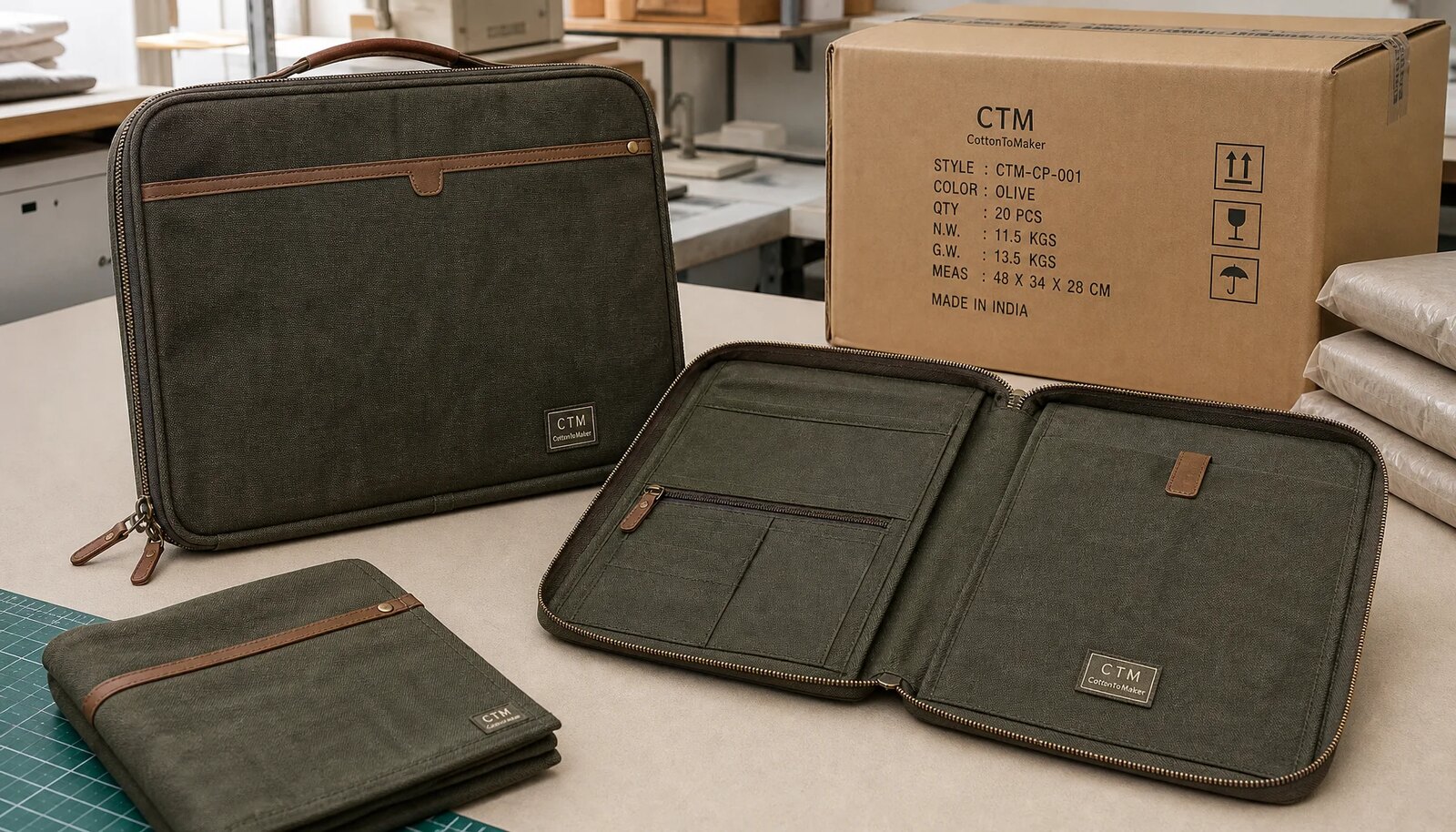
Set the shipping profile before you approve the look
A desk sample does not tell you whether a canvas zipper portfolio will move efficiently through your shipping chain. Corporate gifting programs can follow very different routes: one pallet to a central warehouse, split cartons to regional offices, direct delivery to an event venue, or later repacking into a welcome kit. Each route changes what matters. A warehouse order may prioritize a stable carton footprint and clean pallet stacking. A kit-assembly order may care more about exact outer dimensions so the portfolio fits a second box without rework. If the supplier receives only artwork and product size, it will optimize the item itself, not the shipment.
Start the RFQ with four commercial facts: destination, incoterm, freight mode, and receiving method. Then add any warehouse limits on carton size or gross weight. This prevents a common sourcing gap where a supplier quotes an attractive unit price using a dense carton pack that your 3PL later rejects for handling or relabeling reasons. For canvas zipper portfolios used in corporate gifting, shipping carton planning is not a back-office detail. It is part of the product brief because the pack method affects surface marking, cube, labor at receipt, and final presentation when the gift is unpacked.
- State whether cartons will be pallet-received, floor-loaded, parcel-forwarded, or reopened for kitting after import.
- If multiple destinations are involved, ask upfront whether carton marks must show warehouse code, SKU, color, and count.
Define capacity with a real load list, not a generic size claim
Canvas zipper portfolios vary from flat document sleeves to organizer styles that must close over a notebook, charger, cable, cards, and a pen. Those are different products, even if the outside dimensions look similar on paper. Buyers should send the supplier a short load list with the actual items, their measurements, and any non-negotiable fit rule such as 'must zip closed over one A5 notebook plus one charger and one cable pouch.' External dimensions alone are not enough because seam allowance, zipper tape, lining, and internal pockets reduce usable space. A supplier can meet the outside size and still ship a portfolio that feels too tight in everyday use.
Ask for a loaded sample photo and confirm the thickest closed point, not just the flat empty measurement. If the portfolio must close smoothly without force, write that requirement into the approval notes. This matters for shipping as well as usability. Once the load list requires a gusset, wider opening, or deeper pocket build, the packed thickness increases and the carton plan changes. Buyers who define fit with real contents early make it much harder for vendors to quote an underbuilt style and easier to compare landed cost on equal assumptions.
- Separate empty dimensions from usable internal dimensions and from loaded thickness in the RFQ.
- If the gift set includes branded notebooks or devices, send those reference items or exact dimensions during sampling.
Lock fabric and trim decisions that change packed cube
Fabric weight is a commercial variable, not just a style choice. A 12 oz canvas body may be enough for slim document-focused use and can reduce freight mass. A 14 oz body may present better on the front panel and resist show-through from interior structure, but it adds material weight and often increases packed thickness. Ask for the finished weight, not only the nominal fabric name, and require a stated tolerance so quotes are comparable. Also clarify whether the canvas is washed, softened, coated, or pre-shrunk. Those treatments affect hand feel, crease behavior, and dimensional stability, which in turn affect how consistently pieces nest in a master carton.
Interior and trim choices deserve the same discipline. A light lining can improve presentation and reduce snagging, but board inserts, foam, organizer pockets, elastic holders, and reinforced seams all add labor and cube. Branding method also changes packing behavior. A flat screen print tends to stack more cleanly than a thick patch or raised embroidery. Zipper details matter as well: a low-profile nylon coil zipper with a smooth puller is generally easier to pack tightly than a bulkier puller that can press into the next unit. If the buyer wants a premium puller finish or layered patch, confirm that decision against a packed sample, not only a tabletop photo.
- Do not compare supplier pricing until fabric composition, finished weight, finish, and all internal components are frozen in writing.
- Flag any raised trim, heavy puller, or thick patch as a potential compression mark risk during carton testing.
Write an RFQ that removes hidden assumptions line by line
A strong RFQ for canvas zipper portfolios should let three different suppliers quote the same build with minimal interpretation. At minimum, include external dimensions, usable internal dimensions, load list, canvas specification, lining requirement, zipper detail, logo method, quantity breaks, destination, shipping term, and required packing data. If any of those fields are missing, the vendor will fill the gap using its own default. That is how one offer becomes unlined with a lighter zipper, another includes reinforcement and a safer pack, and the buyer ends up comparing numbers that do not describe the same product.
Ask suppliers to break out cost adders instead of hiding them inside one all-in price. Decoration setup, sample charge, puller wrap, insert card, desiccant, export carton, and palletization should be visible as separate lines when they materially affect cost. This makes later value engineering possible without rewriting the entire brief. It also gives you a practical place to set measurable tolerances. If finished size tolerance is +/- 5 mm, logo placement is +/- 3 mm, and carton count must match the packing list exactly, write those rules into the RFQ or attachment. Broad phrases such as 'good quality' or 'centered logo' invite avoidable disputes.
- Use one quotation sheet for all bidders so cost fields, pack assumptions, and exclusions can be reviewed side by side.
- Require every supplier to state what is excluded, especially testing, inland delivery, palletization, and replacement spares.
Use a three-stage sample path instead of one final sample
For this product category, a single approval sample is not enough when timing, presentation, and freight all matter. The first checkpoint should confirm the base material and decoration appearance. That can be a fabric swatch, color dip, or print strike-off depending on the artwork. Its purpose is simple: lock the canvas color, hand feel, and logo appearance before sewing labor is added. If those basics are wrong, there is no value in moving straight to a fully made sample.
The second checkpoint is the decorated pre-production sample. This proves the pattern, dimensions, usable opening, zipper travel, stitch quality, and branding placement on the actual build. It should be reviewed with the intended contents inserted, not only as an empty shell. If the program involves multiple colorways or more than one logo version, confirm whether all versions share the same packed thickness and carton plan or whether one version needs different protection.
The third checkpoint is the packed carton sample. This is the stage that many teams skip and later regret. Ask the supplier to pack the product exactly as proposed for bulk, using the real fold, polybag, desiccant if specified, unit orientation, and export carton. Then open it after transit-style handling or a short hold period and inspect for puller marks, print transfer, edge rub, and shape loss. A packed sample is often the fastest way to discover that a portfolio which looks correct on a table is too aggressively compressed for shipment.
- Tie every sample approval to a revision date, consolidated comments, and photos so bulk production follows one clear record.
- If a sample is approved with conditions, move those conditions into the PO and packing instruction sheet immediately.
Do the carton math yourself before you compare offers
Carton planning becomes useful only when buyers convert it into numbers they can compare. The basic formula is simple: carton CBM equals length x width x height in centimeters divided by 1,000,000. Once you know the carton CBM, multiply it by the number of cartons required for the order quantity. Do this for every quote at the same order volume and incoterm. Without that step, a lower unit price can hide a less efficient pack that increases ocean, air, or warehouse cost after the PO is placed.
A simple example shows why this matters. Supplier A proposes 25 pieces per master carton at 48 x 36 x 26 cm. That carton is 0.0449 CBM, so 1,000 pieces require about 40 cartons and roughly 1.80 CBM. Supplier B quotes a slightly cheaper unit price but only fits 20 pieces per carton at 50 x 38 x 30 cm. That carton is 0.0570 CBM, so 1,000 pieces require 50 cartons and about 2.85 CBM. The difference is about 1.05 CBM on the same order quantity before you consider extra unloading, pallet positions, or a larger storage footprint.
Run the same comparison on gross weight and handling practicality. A dense carton that reduces cube is not automatically better if it exceeds your warehouse lift preference or causes pressure marks in the bottom layer. Ask whether the supplier's quantity per carton is measured from an actual packed sample or estimated from a generic template. When the order is time-sensitive, round-off matters too. If pack count does not divide cleanly into the PO quantity, confirm how the final partial carton will be built and labeled instead of discovering count confusion at receiving.
- Calculate CBM, carton count, and gross shipment weight on your own sheet rather than relying on a supplier summary line.
- Re-run the carton math whenever the sample adds pockets, thicker trims, or extra protection materials.
Engineer export packing for humidity, handling, and receiving speed
Do not accept 'standard export packing' as a complete answer. For canvas zipper portfolios, the unit pack and master carton build both affect arrival condition. Ask for the exact unit folding orientation, whether the puller faces inward, the polybag type, and whether desiccant is included for sea freight or humid storage. If a supplier proposes tissue, divider sheets, or puller sleeves, confirm that those items solve a proven issue from packed-sample review rather than adding cost by habit. For the carton itself, request the board construction and outer dimensions instead of vague language. A buyer cannot evaluate compression resistance, stacking, or label space from the phrase 'export carton' alone.
Receiving efficiency is the second half of packing design. Cartons should carry the PO reference, SKU, color, quantity, gross weight, and destination code if goods are split across locations. If pallets are used, ask for the planned layer pattern and whether the carton footprint creates stable stacking without overhang. If the shipment will be floor-loaded, ask how many cartons can be stacked safely and whether any orientation arrows are required. These details are small on paper but expensive to correct after production. A clean packing plan reduces recounts, relabeling, and manual sorting when the goods land.
- Set a maximum gross carton weight and carton size if your warehouse or 3PL has handling rules.
- Avoid mixed-SKU master cartons unless the downstream operation specifically benefits from them.
Inspect both presentation quality and pack integrity
Inspection for a corporate gift should reflect what the recipient sees first. On a canvas zipper portfolio, that usually means the front panel, logo area, zipper line, and overall shape. Define presentation defects with commercial clarity: off-center logo, visible puckering, print edge blur, patch tilt, stains, uneven trim, and thread residue should not be left to interpretation. If the buyer would reject a logo shifted more than 3 mm or a finished size outside +/- 5 mm, that tolerance should appear in the approval sheet and inspection brief. The factory, third-party inspector, and buyer need the same visual standard.
Function and packing must be checked with equal discipline. Inspectors should test zipper travel on sampled units, verify internal pockets do not block the stated contents, and confirm lining edges are secure. Just as important, they should open cartons from top, middle, and bottom positions because compression problems rarely show only on the first layer. Weigh cartons, confirm counts, read the marks, and compare carton dimensions to the approved pack spec. If you use AQL, state the level in advance and define which issues are critical, major, or minor for this item. A generic bag inspection standard may miss defects that matter on a presentation-sensitive gift.
- Use a defect photo sheet during approval so terms like 'puckering' or 'print transfer' mean the same thing to every party.
- Inspect a mix of loose units and packed units, because some problems appear only after compression and storage.
Keep accountability clear when several parties touch the order
The smoothest program is one where the same organization controls cutting, sewing, decoration, and final export packing, or where one party clearly owns the final result. That does not mean a trader or consolidator is wrong. It means the chain of responsibility must be visible before you award the order. Ask for the named production site, decoration site, and final packing site. If the portfolio is made in one factory, printed in another, and packed with other gift components elsewhere, each handoff creates another place for count errors, surface damage, or carton changes to enter the process.
This matters most when a canvas zipper portfolio is only one part of a broader gifting kit. In that case, ask who owns the final approved sample, who signs the carton layout, who issues the final packing list, and who pays for shortages or relabeling discovered at destination. Those are not legal details to sort out later. They affect whether problems are solved quickly or debated across multiple vendors after the campaign date is already fixed. Procurement teams should choose the route that keeps accountability shortest and most documentable, not simply the route with the smallest headline unit price.
- Put shortage liability, carton-mark approval, and replacement responsibility in writing before deposit or bulk start.
- If buying through an agent, still ask for the actual final-pack location and who physically seals the export cartons.
Release bulk only after one final control sheet ties sample to shipment
The final administrative task should be simple but strict: turn every approved decision into one revision-controlled control sheet. That file should show the approved sample photos, measured product size, usable internal dimensions, load-list confirmation, fabric specification, color reference, zipper details, logo artwork and placement, unit packing method, quantity per carton, carton dimensions, carton marks, and shipping term. The purpose is to remove the phrase 'as discussed' from the project. Anyone reviewing production, inspection, or receiving should be able to confirm the order from one current record instead of searching through old messages.
Before shipment release, request final packed-carton photos, measured carton dimensions, gross weights, and a draft packing list that matches the original quotation and approved carton plan. If the supplier proposes any substitution, such as a lighter canvas, different zipper puller, alternate patch base, or different carton size, require written approval before it enters bulk. This last checkpoint is where shipping carton planning becomes real control instead of a good intention. It links the approved product to the delivered shipment and closes the most common gap in corporate gifting orders: a correct sample followed by a different commercial pack.
- Issue one approval package that covers product, decoration, packing, carton marks, and shipping assumptions together.
- Do not release bulk or final payment on verbal confirmation of packing changes; require updated written specs.
Specification comparison for buyers
| Decision area | Recommended baseline | When to upgrade or change | Buyer risk to verify |
|---|---|---|---|
| Shipping profile | One SKU, one destination, fixed carton footprint and carton marks | Change the plan if goods will be kitted, parcel-shipped, or split across regional warehouses | Confirm receiving limits, label format, and whether mixed-SKU cartons are allowed |
| Canvas spec | 12 oz to 14 oz cotton canvas with written weight tolerance and an approved color standard | Go lighter only for slim document sleeves; go heavier only if loaded thickness and presentation require it | Do not compare quotes unless composition, finished weight, and finish are matched |
| Interior build | Light lining with limited reinforcement only at stress points | Add board, foam, gusset, or organizer pockets only if the load list requires them | Each added layer changes sewing time, packed thickness, and units per carton |
| Branding method | 1-color or 2-color screen print for flat logos; woven label for fine detail without large ink coverage | Use patch or embroidery only when artwork and panel stiffness justify the extra height and handling | Raised trims can imprint adjacent units in a compressed master carton |
| Zipper and puller | #5 nylon coil zipper with a low-profile puller and matched tape color | Upgrade finish or add puller wrap only when packed-sample review shows rubbing or scratching | Bulky pullers reduce nesting efficiency and can mark the next unit |
| Unit packing | 1 piece per polybag with the puller turned inward; add desiccant for sea freight or humid storage | Add tissue or a puller sleeve only if packed-sample review shows scuffing or print transfer | Unpriced packing extras can change carton fill rate and landed cost |
| Master carton | Fixed export carton size with a buyer-set gross weight limit, such as 12-15 kg if warehouse handling requires it | Change footprint only when a style version cannot lie flat without pressure marks | Ask for carton board construction, outer dimensions, and measured gross weight, not just 'standard export carton' |
| Carton math example | 25 pcs in a 48 x 36 x 26 cm carton = 0.0449 CBM per carton, or about 1.80 CBM per 1,000 pcs | If the build adds pockets or thicker trims, re-run the math before PO approval | A quote with 20 pcs in 50 x 38 x 30 cm rises to 2.85 CBM per 1,000 pcs |
| Sourcing route | Direct factory or one final-pack owner with named responsibility for product and carton accuracy | Use a consolidator only when multiple gift SKUs need one combined shipment | Confirm who approves the final packing list, shortage count, and carton marks before loading |
Buyer checklist before sampling
- Define the distribution model first: one warehouse, multiple DCs, event delivery, or later kitting into a mailer or welcome box.
- List the real contents the portfolio must hold, including notebook size, charger, cables, pen, cards, and any target loaded thickness.
- Freeze both external dimensions and usable internal dimensions, because zipper seams and lining reduce actual capacity.
- Lock canvas composition, finished weight in gsm or oz, acceptable weight tolerance, color reference, and any wash, coating, or pre-shrink treatment.
- Specify every build detail that affects cube: lining, foam, board insert, gusset, pockets, elastic loops, labels, and reinforcement tape.
- State zipper size, coil type, tape color, puller finish, and whether the puller must be wrapped or turned inward in packing.
- Define the logo method, artwork size, Pantone reference if needed, placement coordinates, and acceptance tolerance such as +/- 3 mm.
- Request unit packing, carton quantity, outer carton dimensions, net weight, gross weight, CBM per 1,000 pieces, and pallet pattern if relevant.
- Approve three sample stages where risk justifies it: material or print strike-off, decorated pre-production sample, and packed carton sample.
- Set written pass/fail rules before bulk starts, including size tolerance, zipper function, shade match, count accuracy, carton marks, and spare policy.
Factory quote questions to send
- What exact canvas composition, finished weight, and weight tolerance are included in this quote, and is the fabric washed, coated, or pre-shrunk?
- Does the quoted body include lining, interlining, foam, board, pockets, elastic holders, or any reinforcement tapes, and where are they used?
- Which zipper size, coil type, tape material, and puller finish are priced, and are any zipper parts sourced from a nominated supplier?
- What decoration method is included, how many print colors or stitch count are priced, and what adhesion or rub check do you use before bulk?
- What are the approved finished dimensions and the usable internal opening after zipper seam allowance is considered?
- What is the exact unit packing method, including polybag style, desiccant, tissue, insert card, puller protection, and folding orientation?
- How many units go in each master carton, what are the outer carton dimensions, what are the net and gross weights, and what is the CBM per 1,000 pieces?
- What carton board construction is used for export, and what pallet pattern or maximum stacking height do you recommend for this carton size?
- Which sample stages are included, what does each stage prove, how long does each step take, and can you provide a fully packed carton sample?
- If printing, labels, or final export packing are subcontracted, who owns QC, shortage liability, and the final signed packing list before shipment?
Quality-control points to confirm
- Verify fabric composition, finished weight, shade, and hand feel against the approved sample and written specification, not against a generic canvas standard.
- Measure external size and usable internal opening on inspection samples, then run a live fit test with the actual notebook or document set named in the PO.
- Check logo position, size, and color against the approved artwork with the written tolerance, such as +/- 3 mm for placement if that is the commercial rule.
- Inspect print, patch, or embroidery for smudging, edge lift, thread breaks, color mismatch, and visible distortion when the portfolio is fully zipped.
- Run at least 10 open-close zipper cycles on sampled units and confirm smooth travel, secure stops, and no snagging on lining, tape edges, or loose threads.
- Review stitch density, seam allowance, bartacks, trimmed threads, raw-edge coverage, and front-panel puckering on both the outside and inside.
- Open cartons from top, middle, and bottom positions to check whether compression has caused puller marks, bent corners, print transfer, or shape loss.
- Inspect for stains, oil marks, dye migration, odor, broken yarns, needle damage, and shade variation that show clearly on natural or light canvas.
- Confirm unit packing completeness: correct polybag, desiccant if specified, insert card, puller orientation, pack count, and carton-side barcode or destination label.
- Verify carton dimensions, gross weight, carton board condition, shipping marks, and total shipment count against the approved packing list before release.