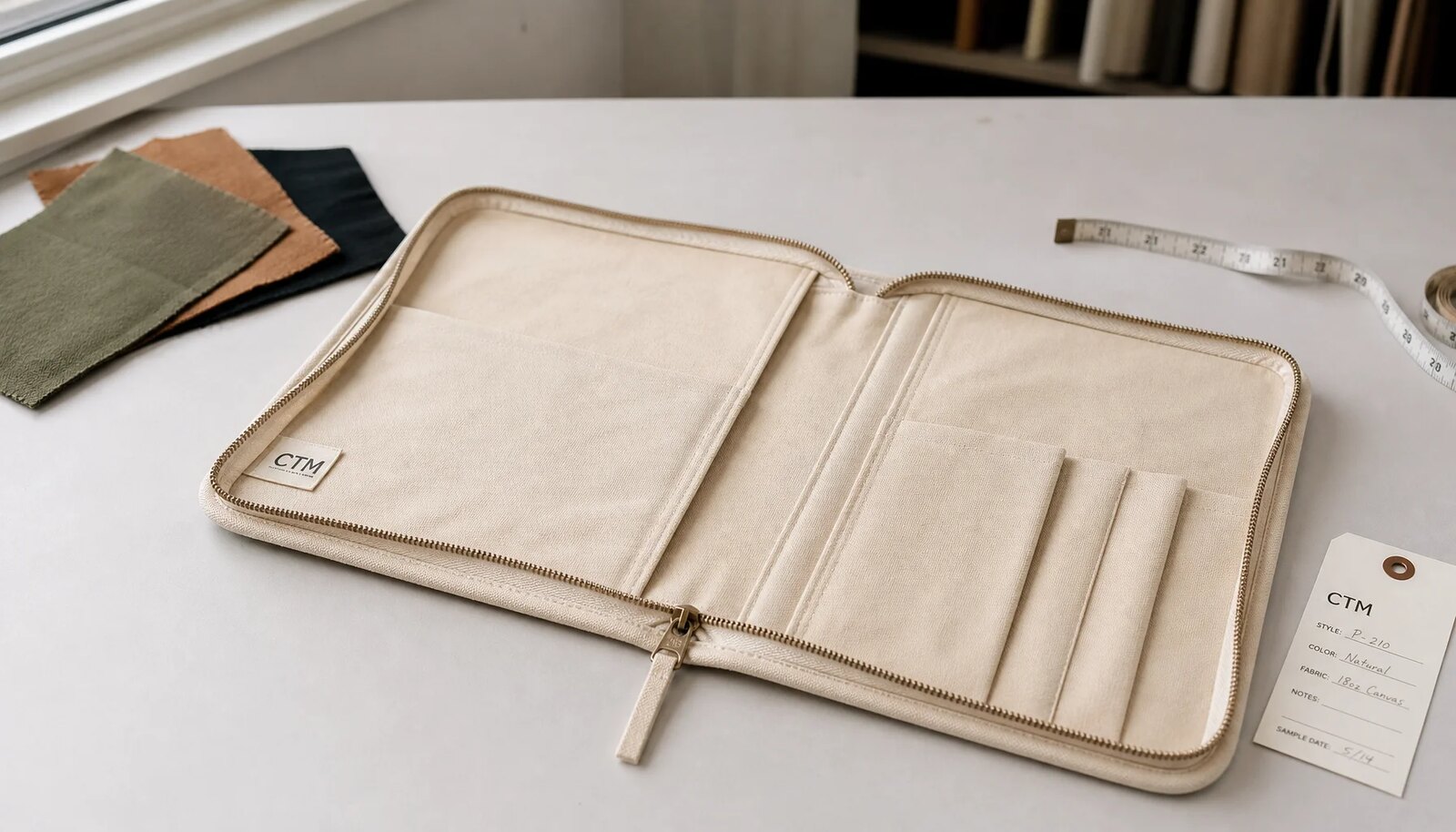
1. Why This Small Product Creates Big MOQ Friction
A canvas zipper portfolio looks simple until the spec has to become a repeatable factory order. Farmers market vendors use it as working storage, not as a decorative pouch. It has to hold permits, order sheets, receipts, invoices, pens, cash sleeves, and sometimes a phone or slim tablet. That means the buying decision is about fit, durability, and pack-out discipline, not just about a branded face panel.
MOQ pressure appears because the product bundles several setup points into a small item. Fabric weight, zipper size, zipper tape color, pull style, lining, pocket count, reinforcement, decoration method, and retail packing all create work for the factory. If any of those details stay vague, the supplier fills the gap with a standard assumption. Two quotes can look close on price while describing different products, and that is where procurement teams lose time.
The scale risk is easy to miss because the item is small. A vendor notices immediately if the zipper catches at the end stop or if the canvas feels limp after a day at the stall. A buyer who treats this like a low-complexity accessory usually ends up with a product that misses fit, durability, or repeat-order stability.
- Define the real use case before asking for price: paperwork, cash handling, tablet storage, or resale packaging.
- Lock the finished size first, because size drives fabric yield and cutting efficiency.
- Treat the item as a daily-use organizer rather than a promotional pouch with a zipper added late.
- Decide whether the first launch needs to look retail-ready, warehouse-ready, or both.
2. Freeze the Product Spec Before Price Talk
A clean quote starts with a boring spec. For a portfolio used every market day, 12 oz canvas is a practical baseline. It gives the item enough body without turning it into a rigid folder. Move to 14 oz when the product needs more structure, better abrasion resistance, or a cleaner stand-up feel on a counter. A lighter body can work for a pilot, but once pockets and decoration are added, it can start to feel underbuilt.
The zipper is not a throwaway component. A #5 nylon coil zipper is a practical default because it balances smooth travel, durability, and sourcing consistency. The real quote driver is not just size; tape color, pull style, and stop finish matter too. A larger pull is easier to grab in a busy stall. A smaller pull may look cleaner for retail, but it can be harder to use quickly when the vendor is moving through cash, receipts, and invoices all day.
Size needs to be defined against the contents, not against the bag category. A portfolio that must hold A4, Letter, or legal sheets should be drawn from the insert outward, not guessed from a standard case dimension. If the internal layout includes a slip pocket or tablet sleeve, the opening length, seam allowance, and fold behavior need to be fixed before anyone starts pricing. Otherwise the factory will optimize for its own standard, not for the buyer's loading pattern.
- Use 12 oz canvas as the baseline and move up only if the portfolio needs more body or wear resistance.
- Keep the first version to one size, one zipper color, and one internal layout unless there is a clear reason to expand.
- Specify the zipper pull for handling comfort, not just appearance.
- State whether the lining is functional or decorative, because that changes sewing time and cost.
- Write the document or insert size into the spec so the factory does not guess between A4, Letter, and legal.
3. Choose the Supplier Route and Region With Intent
The supplier route changes the quote shape as much as the BOM does. A direct factory is usually the best fit when the program needs repeatability, a custom size, and a clean path from sample to reorder. A factory can tell you what its fabric roll minimums, trim minimums, and sewing capacity actually are, which makes the MOQ easier to trace. A trading company is useful when the buyer wants one contact for multiple SKUs, but only if it can identify the real production source and keep the bill of materials stable.
Regional sourcing nuance matters here. China usually gives the deepest ecosystem for canvas, zippers, woven labels, and small-run print work, which helps when the build needs several small components to match cleanly. Vietnam, India, Pakistan, and other sewn-goods hubs can be competitive when labor structure or garment capacity is the main advantage, but trim sourcing may need more lead time and tighter approval discipline. Nearshore suppliers are useful when revision speed matters more than the lowest unit price, but their material pools are often smaller and their price breaks are less aggressive.
The selection criteria should be specific. Ask who cuts, who sews, who packs, and who signs off on final inspection. Ask whether the factory keeps the same canvas supplier across reorders or switches by availability. Ask to see a similar product, not a generic company brochure. If the same build cannot be repeated six months later without spec drift, the source is a development shop, not a stable supply base.
- Use a direct factory when the program needs control over material, trim, and repeat orders.
- Use a trading company only if it can name the actual factory and keep the BOM fixed.
- Use nearshore production when shorter revision loops matter more than the lowest unit cost.
- Ask whether cutting, sewing, finishing, and carton packing are all in-house or partially outsourced.
- Check whether the supplier can quote the same build again in the next season without re-development.
4. What Actually Moves MOQ, and How to Push It Back Down
MOQ is rarely one number. It is the sum of fabric roll usage, trim minimums, cutting markers, decoration setup, and pack-out labor. A factory can usually absorb a simple logo more easily than a custom zipper pull or a special zipper tape color. It can also handle one body size far more efficiently than three sizes that need separate layouts, separate labels, and separate packing instructions. Once the hidden costs are visible, the negotiation becomes practical instead of theatrical.
For a canvas zipper portfolio, the rough range matters more than a single floor. A stock blank with simple decoration may start around 100-300 pieces. A simple custom build with one size, one zipper, and one logo method often lands around 300-500 pieces. Add lining, a more complex pocket map, or a sewn label and the practical floor often moves to 500-800 pieces. Once special hardware, contrast stitching, or multiple pockets enter the design, 800-1,500 pieces is a normal production reality. These ranges are starting points, not promises, but they are more useful than a vague yes or no.
If MOQ lands above target, the first move is to simplify the platform, not to argue with the factory. Ask for the same body in one color and one zipper color. Ask whether a stock zipper pull or stock canvas can replace custom trim. Ask if the first order can be a pilot run with a second release order already named. A factory will often reduce risk when the buyer makes the follow-on volume visible.
- Trade color variety for lower MOQ; one body color and one zipper color usually help more than aggressive price pressure.
- Separate blank cost from decorated cost so setup burden is visible.
- Ask whether label, zipper pull, lining, and packing inserts each have their own minimums.
- Use stock canvas or stock zipper colors before asking the factory to absorb custom setup.
- If the launch is uncertain, ask for a pilot plus a scheduled release order instead of one oversized commitment.
5. Build Choices That Matter in Daily Use
Material selection affects both quote stability and field performance. The buyer does not need the heaviest canvas on the market; the right weight is the one that holds shape without making the item overbuilt. A 12 oz body is a practical middle ground for a portfolio that carries documents and small tools. A 14 oz body makes more sense when the item needs a firmer hand, better abrasion resistance, or a cleaner sit on a shelf or counter. If the portfolio is washed or brushed, expect the hand feel and final size to shift, and account for that before approval.
The zipper is the main functional part of the product. A #5 nylon coil zipper is usually the safest starting point because it is smooth, common, and easy to reorder. Metal or molded options can work, but they raise the chance of color mismatch, noise, or sourcing delays if the supplier needs a different trim line. Pull shape matters too. A larger pull helps when the user is opening the case with one hand during a market transaction; a smaller pull may look cleaner but can be less practical in real use.
Pocket layout is where a simple portfolio becomes a different product. One main document sleeve plus a pen loop is easy to price and inspect. Add a front slip pocket, card slots, and an internal device sleeve, and sewing time rises quickly. More important, every added layer changes fold behavior, zipper clearance, and the way the item sits when loaded. If the program needs MOQ discipline, keep the layout tied to real use cases rather than a wishlist of features.
- Use one body size and one internal layout for the first launch whenever possible.
- Choose a zipper style that matches the handling pattern, not just the visual style.
- State whether the canvas is raw, washed, brushed, or enzyme treated so finished dimensions are not guessed.
- Keep pocket count tied to actual vendor workflows, not to feature creep.
- Ask whether any interfacing, binding, or reinforcement changes the MOQ or lead time.
6. Sample Builds That Prove Function, Not Just Appearance
A sample should prove use, not just show a pretty exterior. The normal path is a development sample, then a pre-production sample after materials are booked, and finally a sealed sample that becomes the production reference. That sequence matters because a canvas zipper portfolio can look fine flat on a table and still fail once it is filled, folded, and zipped repeatedly. A development sample should check the basic dimensions and pocket logic. The pre-production sample should verify the actual fabric, zipper, trim, and pack-out. The sealed sample is the one that should govern production.
Small problems are usually the expensive ones. A zipper that runs smoothly on an empty sample may catch when the portfolio is full. A pocket that looks generous in a photo can shrink once seam allowance is consumed. A logo can look centered on a flat panel and still drift visually once the canvas pulls around a zipper line or fold. If the contents are known, test with the actual inserts, not with a sheet cut by eye. That is the easiest way to expose fit errors before bulk fabric and trim are locked.
Sample costs should be discussed before anyone approves the first round. For a simple canvas portfolio, a first development sample often lands around $40-$80 if the factory already has the material in hand. If custom trim, a woven label, or print setup is needed, the first sample can move to roughly $80-$150. Some suppliers credit that cost back against production, some do not. After two revisions, the project is no longer a quick sample; it is a re-engineered item, and that should trigger a fresh cost review.
- Open and close the zipper repeatedly on a filled sample, not just on an empty one.
- Insert the actual document or device set, not a generic sheet.
- Approve the fold, barcode, and retail presentation at the same time as the sewing construction.
- Mark acceptable deviation in writing so the production sample is judged against a fixed reference.
- Ask whether the first sample charge is credited back if the order is placed.
7. Quote Questions That Expose the True Cost
A useful RFQ removes ambiguity instead of inviting a low number. Every supplier should quote against the same BOM, the same packing standard, and the same quantity breaks. One line item for a blank shell and another for a decorated retail piece makes the comparison easier. So does asking for the same finished size, zipper spec, and pocket map across all suppliers. If one quote quietly assumes a different lining or a simpler pocket structure, the low bid is not a real bid.
The quote should separate unit cost from setup and support items. Sample charges, print screens, woven label development, zipper color changes, barcode labels, carton marks, and extra retail packing labor all affect landed cost. Ask for the actual factory location, the actual shipping term, and the carton data. Ask what is locked after sample approval and what can still move. If the supplier cannot explain that in itemized terms, the quote is still a sales estimate, not a production offer.
The most useful escalation question is simple: what would you change to bring the MOQ down without changing the visible product too much? That answer reveals how the factory thinks. A strong supplier will point to one or two real levers such as stock canvas, stock zipper color, fewer pockets, or mixed-color packing. A weak supplier will answer with a generic promise and no tradeoff.
- Request price breaks at multiple quantities, not just one launch point.
- Ask for carton size and CBM so freight does not erase a small ex-factory saving.
- Compare blank and decorated versions separately so tooling and print setup are visible.
- Insist that the supplier identify any assumed substitutions before the quote is approved.
- Keep the quote format identical across suppliers so no one wins by hiding scope.
8. QC Limits That Match Production Reality
A buyer-friendly QC plan needs measurable limits, not just a promise to inspect carefully. For a first production run, a common starting point is AQL 2.5 for major defects, AQL 4.0 for minor defects, and zero tolerance for critical defects, using a normal sampling plan such as ANSI or ASQ Z1.4 general level II. That framework is familiar to factories and gives procurement a shared language. The key is defining what counts as major, minor, and critical for this specific product.
For a canvas zipper portfolio, major defects include a zipper that jams on three consecutive open-close cycles, a seam opening greater than 2 mm on a load-bearing edge, a visible stitch skip longer than 10 mm, a pocket that no longer fits the approved insert, or a logo placed outside the approved window. Minor defects include short loose threads, small cosmetic shading differences that do not affect use, or a packing flaw that does not damage the product. Critical defects are the ones that make the item unsafe or unusable, such as a broken needle fragment, a zipper that separates, or a seam that opens enough to drop contents.
Failure examples should come from real production behavior. If the pocket spec ignores seam allowance, the finished opening can shrink enough to block the intended insert. If the factory approves color by photo instead of physical swatch, the bulk lot may drift more than expected. If the packed fold presses the zipper slider against the face panel, the shipment can arrive with visible marks that look like abrasion. QC should catch those outcomes before shipment, not after the goods hit the warehouse.
- Use an AQL plan that separates major, minor, and critical defects.
- Set a measurement tolerance for size, pocket depth, and logo location.
- Add a zipper cycle test and a seam stress check before shipment.
- Inspect both the front and inside finish so edge binding and seam ends are not missed.
- Require the factory to record the approved sample reference used during final inspection.
9. Packing and Cartons Can Make or Break the Shipment
Packing looks secondary until the first shipment arrives creased, scuffed, or difficult to receive. For retail programs, the buyer may need an individual polybag, a barcode label, a tissue insert, and a clean fold that displays the logo well. For distributor or B2B receiving, bulk packing often makes more sense because it lowers labor and cuts packaging waste. The right answer depends on where the product is going, who is opening the cartons, and how much rework happens after receipt.
Canvas behaves differently from synthetic fabric. It can hold a crease if the fold is too tight, and zipper hardware can rub the face panel if the pack orientation is wrong. Carton count, carton strength, and the placement of the pull all matter. If the zipper slider sits against the front print during transit, the carton may leave marks that look like abrasion even when the sewing is fine. If the product is meant to hang or sit on a retail shelf, the pack should preserve that presentation instead of forcing a warehouse-only fold.
Packing also has to match the buyer's warehouse workflow. Some teams want a fixed inner count so receiving and picking stay simple. Others want loose bulk in a master carton to reduce opening labor. Neither choice is automatically right. What matters is that the supplier knows whether the shipment is going to a retail shelf, a fulfillment center, a distributor warehouse, or a direct market program that repacks later. Destination labeling rules can also change the spec, especially when barcode format, carton marks, or warning labels are controlled by the receiving market.
- Choose a fold that protects the logo and keeps zipper hardware from rubbing the face panel.
- Match inner pack count to the buyer's warehouse workflow, not just the factory's preferred bundle size.
- Specify carton marks, barcode placement, and carton count before production starts.
- Add moisture protection if the route or storage conditions are humid.
- Confirm that the pack style does not change final dimensions or distort the portfolio shape.
10. The Real Negotiation Is Landed Cost and Risk
The lowest ex-factory quote is not always the best buy. A buyer who focuses only on unit price can miss freight, duties, inland delivery, relabeling, and the cost of a weak sample that forces rework. Heavier canvas raises carton weight and can increase shipping cost. A special zipper color or woven label can create trim waste if the supplier has to buy more than the project needs. The real comparison is total landed cost per sellable unit, not just the number on the quote line.
MOQ negotiation should also be tied to inventory risk. A smaller order can cost more per unit, but it protects the buyer from sitting on the wrong size, wrong pocket layout, or wrong logo placement. A larger order can lower the unit price, but it also ties up cash and raises the penalty if sell-through is slower than expected. For farmers market vendor programs, demand is real but not perfectly predictable. That makes a mid-sized pilot run with a clear reorder path more sensible than forcing the cheapest possible unit price on a quantity the market has not yet validated.
If MOQ is still above target, there are only a few practical levers. Use stock canvas instead of a custom shade. Keep one zipper color instead of two. Remove one pocket or one lining step. Accept mixed-color packing if the end customer can handle it. Split the order into a pilot and a release, with the second batch priced in advance if the first lot passes inspection. If none of those levers works, the right move is often to switch to a closer stock platform rather than force a custom build that will never reorder cleanly.
- Compare at least three quantity breaks using the same spec.
- Include freight, duty, inland delivery, and relabeling in the comparison.
- Keep a reorder option in the plan so the first run does not have to carry the entire season.
- Avoid giving up construction quality just to win a small ex-factory price improvement.
- Treat the lowest MOQ quote as a signal to check what was simplified, not as proof of better sourcing.
Specification comparison for buyers
| Option | Typical MOQ / sample benchmark | Lead-time profile | Best fit | Tradeoff to watch |
|---|---|---|---|---|
| Direct factory, stock canvas base | MOQ often starts around 100-300 pcs for a blank or lightly decorated run; first sample is often $20-$50 if the base material is already in stock | About 10-20 days for simple decoration and packing, depending on trim availability | Launch tests, seasonal programs, or a quick proof of demand | You usually inherit the stock size, pocket layout, and zipper spec unless the base already matches closely |
| Direct factory, standard custom build | MOQ often sits around 300-500 pcs; first sample commonly $40-$80 when canvas, zipper, and trim are standard | About 25-35 days after pre-production approval | Repeatable programs with one size, one zipper, and one logo method | A vague brief turns into factory assumptions, which can distort cost, fit, and final appearance |
| Direct factory, custom trim build | MOQ often moves to 500-1,000 pcs once custom zipper pulls, woven labels, or special tape colors are added; first sample can run $80-$150 | About 30-45 days after approval | Retail-ready versions with branded details and a firmer hand | Trim minimums can sit above the product MOQ and quietly raise inventory risk |
| Regional nearshore workshop | Prototype lots can start around 50-200 pcs; sample costs often $40-$100 depending on revision count | About 15-30 days for a development sample | Fast revision cycles and short replenishment programs | Material variety and trim sourcing can be narrower, and unit price is usually higher |
| Trading company with a named factory | MOQ usually lands around 500-1,000 pcs; sample costs often $60-$120 depending on who is paying the factory | About 30-45 days if the factory slot is already open | Buyers managing multiple SKUs or needing one contact point | Markup and scope drift are harder to see unless the actual factory, BOM, and sample-credit policy are disclosed |
| Higher-complexity custom build | MOQ often moves to 800-1,500 pcs once lining changes, multiple pockets, contrast stitching, or special hardware are added | About 35-50 days after approval | Premium retail versions or items that carry tablet-sized contents | Each added feature increases sewing time, inspection points, and the chance of a separate trim minimum |
Buyer checklist before sampling
- Finished size drawing with width, height, zipper opening length, and any gusset or pocket depth
- Target insert size such as A4, Letter, legal, or a specific device and folder stack the portfolio must hold
- Canvas weight in oz and GSM, plus the finish state: raw, prewashed, brushed, or enzyme treated
- Zipper specification with size, tape color, pull style, stop finish, and whether a branded puller is required
- Decoration method, artwork size, Pantone reference or physical swatch, and exact logo placement measured from fixed edges and seams
- Pocket map with actual use cases: receipts, pens, cards, cash sleeves, phone, slim tablet, or none
- Reinforcement points for corners, stress areas, and any seam that will take repeated handling
- Sample path from development sample to pre-production sample to sealed approval, with the approver named at each step
- Packing spec for retail or bulk, including fold direction, polybag, insert card, barcode label, carton count, and master carton marks
- Target MOQ plus the next two quantity breaks you want quoted so the supplier cannot hide setup costs
Factory quote questions to send
- What is your MOQ by body color, zipper color, and decoration method for this portfolio?
- Can you quote blank and decorated pricing separately at 300, 500, and 1,000 pieces?
- What canvas weight and GSM are included in the quote, and what tolerance do you allow on fabric weight and finished size?
- Which zipper size, tape type, pull style, and stop finish are included, and are substitutions allowed after sample approval?
- Which parts of the build are in-house, and which are outsourced to a trim, print, or packing partner?
- What is the first sample charge, and what portion is credited back if the order is placed?
- What is the usual lead time after pre-production sample approval at each quantity break?
- What packing standard is included in the quoted price, and what changes add labor cost?
- What overrun or underrun tolerance do you work to, and how is it handled on shipment?
- What QC standard do you use for sewing, print, carton pack, and final inspection?
Quality-control points to confirm
- Canvas weight matches the approved swatch or lab spec, with any visible lot variance flagged if it moves beyond the agreed tolerance
- Color is even across body panels and does not show obvious shade shift between bolts, panels, or paired parts
- Finished dimensions stay within the buyer-approved range; a practical starting point is +/-3 mm on small dimensions and +/-5 mm on larger panels, with tighter limits if the portfolio must fit a rigid insert
- Pocket openings stay tight enough to hold the intended insert without forced bending, gap slippage, or a distorted opening line
- Zipper opens and closes smoothly across repeated cycles on a filled unit, with no catch at the corner, tape twist, or teeth separation; a failed zipper on three consecutive cycles is a practical reject point
- Topstitching stays straight on visible edges and does not wander more than the approved visual tolerance on zipper lines, pocket corners, or logo areas
- Logo placement stays inside the approved window; for small marks, keep placement within about +/-3 mm, and for larger placements use a tighter visual standard if the mark sits close to a seam or fold
- No skipped stitch runs longer than 10 mm, no seam opening greater than 2 mm on visible load-bearing seams, and no loose thread tails longer than 10 mm on finished exterior panels
- Corner reinforcement and stress points hold under a loaded lift test without seam pop, puckering, or fabric distortion
- Print coverage is even, with no bleeding, smudging, major registration error, or cracking after flexing if the decoration method uses ink