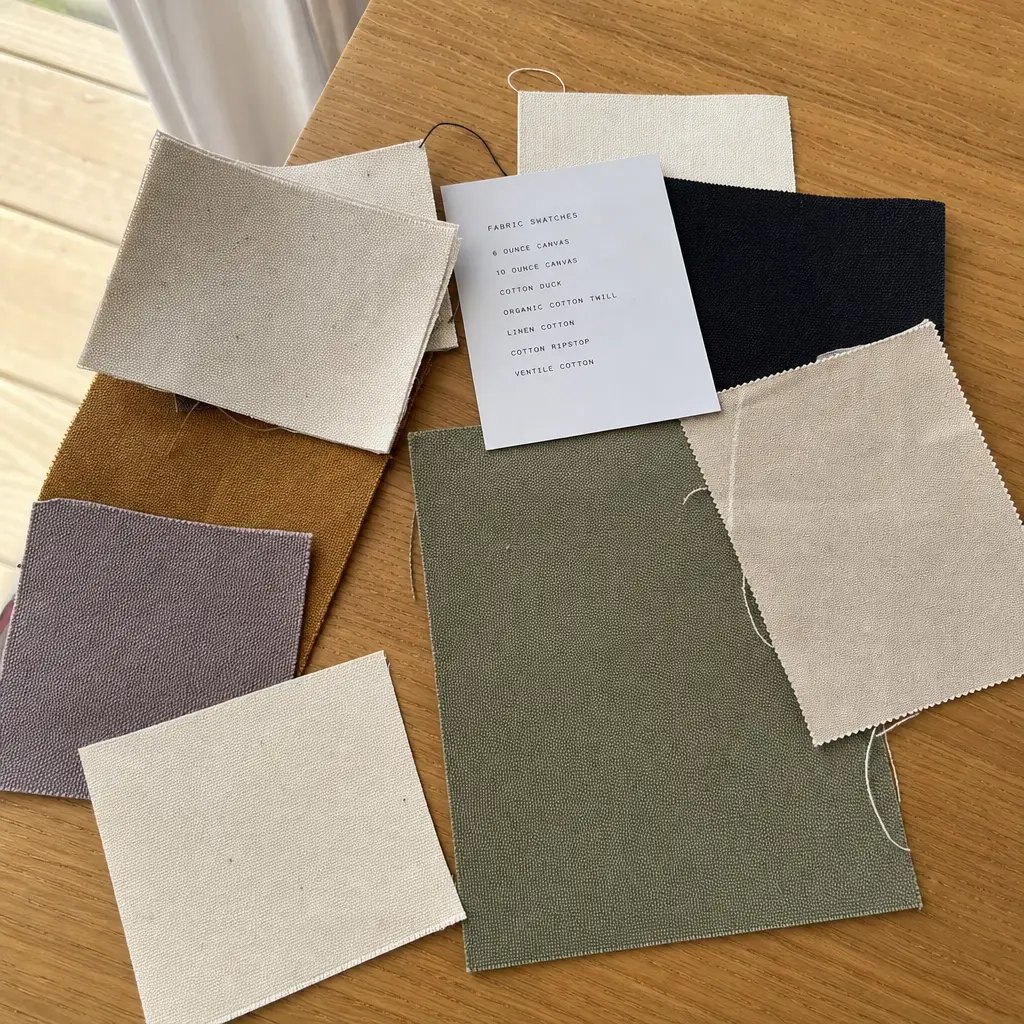
Start With Use, Not Just Fabric Weight
Canvas zipper portfolios sit between stationery, soft goods, and branded campus merchandise. That mix makes them easy to describe in a catalog but easy to misquote in production. One supplier may price a soft canvas sleeve with a zipper. Another may price a lined organizer with a document pocket, pen loop, support board, barcode label, and retail packing. The product name can be identical while the commercial value is very different.
For university bookstores, the first question is what the portfolio must carry. A law school certificate folder, an orientation packet, A4 international materials, a letter-size notebook, and a slim tablet all change the pattern. The buyer should define both the outside dimensions and the usable interior dimensions after sewing. Binding, zipper tape, lining, and support layers all eat into the interior space.
Fabric weight is still central, but it should not be treated as the whole specification. A 10 oz canvas with lining and interlining can feel more structured than a 12 oz canvas with no support. A 16 oz canvas can look substantial but may slow zipper travel around corners if the pattern is too tight. Start with the intended use, then select the fabric weight, lining, zipper, and structure as one build.
- Define the insert before requesting quotes: letter, A4, certificate, notebook, tablet, or orientation packet.
- Ask suppliers to quote the same construction, not only the same product name.
- Use finished interior measurements for approval, inspection, and receiving decisions.
- Treat canvas weight as one part of the build alongside lining, support, zipper, binding, and pocket layout.
- Approve a loaded sample before bulk production, especially for three-sided zipper openings.
How To Compare 10 oz, 12 oz, 14 oz, And 16 oz Canvas
Canvas is often quoted in ounces per square yard, while many mills and production teams also use GSM. Put both units in the RFQ. This avoids conversion assumptions and makes it easier to compare offshore and domestic offers. Also state whether the weight is measured before or after dyeing, washing, coating, or finishing, because those steps can change the final hand feel and measured weight.
For a university bookstore portfolio, 10 oz canvas is usually a value route. It can work when the target retail price is tight, but it normally needs lining, interlining, or support board to avoid a limp product. Around 12 oz, or roughly 380-410 GSM, is often a useful first sampling point for a balanced retail item, but it is not a guaranteed best choice. The right answer still depends on size, structure, insert load, zipper path, and retail positioning.
Heavier 14 oz and 16 oz canvas can create a premium feel for alumni, executive education, law school, or business school merchandise. The tradeoff is more stress on sewing, corners, and cartons. Thick fabric layers at a rounded zipper corner can create drag, especially when lining and binding are added. Ask for a sample with the actual corner radius and zipper construction before committing to bulk.
- 10 oz canvas: value option; specify reinforcement if the item must feel like a portfolio rather than a pouch.
- 12 oz canvas: practical first sample for many bookstore programs; confirm by hand feel and loaded function.
- 14 oz canvas: premium but still manageable when seam allowance and zipper radius are engineered well.
- 16 oz canvas: substantial; inspect corners, zipper travel, needle marks, and carton weight closely.
- Always pair oz and GSM with composition, finish route, and accepted bulk tolerance.
Composition, Finish, And Color Control
Fabric composition should be written by percentage. Cotton canvas gives the natural texture many campus buyers expect, especially for heritage school marks and neutral bookstore assortments. Polyester-cotton canvas can improve dimensional stability and may help control cost or shade consistency, depending on the supplier and material market. Recycled cotton or recycled blends can be useful, but any claim should be supported by documentation and matched to label and hangtag language.
The color route changes both lead time and risk. Natural canvas is typically simpler to source and easy to print with dark inks. Bleached canvas gives a cleaner ground for bright logo colors but may show dirt and handling marks more quickly. Piece-dyed or pigment-dyed canvas can help match a campus palette, but it adds shade approval, crocking, shrinkage, and lot-control questions. Washed canvas feels softer but may introduce more variation in size and shade.
If school color accuracy matters, plan for swatch or lab dip approval before a full pre-production sample. Pantone references help for logo ink, but canvas texture changes color perception because ink sits on a woven surface. For dark fabric or pigment-dyed canvas, include rub and crocking checks so color does not transfer to paper sleeves, labels, or nearby goods in cartons.
- State composition by percentage on the RFQ and purchase order.
- Ask whether the quoted canvas is natural, bleached, yarn dyed, piece dyed, pigment dyed, washed, or coated.
- Approve bulk swatches when fabric color is tied to a school standard or merchandise collection.
- Check shrinkage after dyeing, washing, or finishing because finished size and zipper alignment can shift.
- Do not publish recycled, organic, or water-repellent claims without supplier documentation suitable for the claim.
Lining, Pockets, And Interior Structure
A good portfolio feels organized when opened, not just sturdy when closed. The interior specification should include lining material, lining color, pocket layout, pocket depth, pen loop width, card pocket size, interior label, edge finishing, and stress reinforcement. Without those details, quotes may exclude the very features that make the item useful to students, faculty, conference attendees, and gift buyers.
A 210D polyester lining is common for standard interiors, while 300D can make the inside feel firmer and more durable. These are not mandatory baselines for every order; they are practical options to sample against the intended price point. The key is to specify the interior rather than let each supplier choose. Loose lining, exposed raw edges, shallow pockets, and weak pocket corners make a portfolio feel low-grade even when the outer canvas is heavy.
Support board or interlining should be described clearly. A semi-structured portfolio may only need light interlining. A certificate or tablet-oriented item may need board support in selected panels. If board is used, confirm approximate stiffness, placement, edge clearance, and whether the board shifts inside the panel. Inspectors should check the product after loading because board movement and lining tension are often invisible in flat photos.
- Define outside size and usable interior size separately.
- Specify lining material, lining color, pocket layout, card slot, pen loop, and interior label placement.
- Use bartacks at pocket corners, pen loop ends, and zipper-end stress points.
- State whether the build is soft, semi-structured, interlined, or board-supported.
- Test with actual paper, certificate, folder, notebook, or tablet dimensions before approval.
Zipper And Corner Performance
The zipper is the working part of the product. For many canvas zipper portfolios, a No. 5 nylon coil zipper is a practical option because it can bend around rounded corners more smoothly than many rigid tooth zippers. That does not mean every project must use it, but it is a sensible benchmark for comparing supplier proposals. Metal zippers can look premium, yet they add weight and may be less forgiving at corners.
The RFQ should define zipper size, type, tape color, slider finish, puller shape, opening direction, end treatment, and whether the portfolio opens on two sides or three sides. A three-sided opening improves access for documents and tablets but needs more zipper length and better sewing control. A two-sided opening can be simpler and less costly, but loading may feel tighter.
Zipper testing should happen on loaded samples. Paper, notebooks, or a tablet mockup change panel tension and can expose corner friction that an empty sample hides. During inspection, cycle the zipper several times and watch for skipped teeth, slider separation, tape waviness, lining catch, and hard turns at the corner. Heavier canvas often needs a larger corner radius and more consistent seam allowance.
- Define zipper size, tape color, slider finish, puller style, opening direction, and end stop.
- Test zipper function with the intended insert inside the portfolio.
- Inspect corner radius before approving 14 oz or 16 oz canvas builds.
- Confirm tooling cost, approval timing, finish tolerance, and MOQ for custom pullers.
- Reject samples where the lining catches in the zipper path or the zipper waves around corners.
Logo Method And Campus Brand Approval
Most canvas zipper portfolios for bookstores use screen printing because many school marks are one to three solid colors. Screen print can be efficient and durable, but canvas texture affects edge sharpness. Fine borders, small type, detailed seals, and mascot art can fill in or break apart. A digital proof is useful for layout but not enough for final production approval when artwork is detailed.
Heat transfer may reproduce complex artwork more sharply, though it changes the surface feel and can look less natural on canvas. Embroidery can feel premium but may pucker lighter fabric and add backing inside the panel. Woven labels or side labels are useful for subtle branding, collection names, or artwork too small for direct printing. The right logo method depends on artwork complexity, fabric texture, target retail price, and campus licensing rules.
Build brand approval into the schedule. University marks may need bookstore, licensing, department, or brand office approval before production. Late artwork changes can delay screens, transfers, labels, printed samples, and bulk release. Send vector files, Pantone references, print size, placement, color count, and any licensed-art requirements at the start of the quote process.
- Screen print: strong for bold logos, department names, and simple mascot art.
- Heat transfer: useful for detailed marks; test adhesion, edge lift, and hand feel.
- Embroidery: premium option; inspect puckering, backing exposure, and stitch distortion.
- Woven label: clean choice for small artwork, collection marks, or subtle branding.
- Require a print test on actual canvas for seals, fine lines, small text, and strict school colors.
MOQ, Pricing, And Lead-Time Drivers
MOQ is shaped by materials and setup, not just sewing labor. A standard natural canvas portfolio with a basic screen print may be available at lower quantities than a custom-dyed portfolio with special zipper tape, molded puller, multiple artwork versions, and retail packaging. Instead of accepting one broad MOQ statement, ask which component creates the minimum.
A quote should separate the unit price from setup charges. Screen charges, sample fees, mold fees, Pantone matching fees, custom label charges, barcode label labor, and special packing can change the real landed cost. A lower unit price can be misleading if the construction is thinner, the lining is missing, the zipper is lower grade, or the supplier has excluded retail-ready labeling.
Lead time also needs practical detail. Fabric in stock, standard zipper tape, available lining color, simple artwork, and plain packing usually move faster. Custom dyeing, lab dips, licensing revisions, molded pullers, multiple SKU labels, and third-party inspection windows extend the calendar. For offshore production, add time for export packing, freight booking, customs paperwork, and destination receiving. For domestic production, unit cost may be higher, but communication, sampling, replenishment speed, and smaller runs may be advantages worth pricing.
- Ask whether MOQ applies per fabric color, artwork, zipper tape, lining color, puller, label, or packing version.
- Compare landed cost, not only ex-factory unit price.
- Request sample fee, screen charge, mold fee, label charge, packing cost, carton data, and estimated freight weight.
- Identify lead-time drivers before order placement: fabric availability, dyeing, artwork approval, trim sourcing, inspection, and shipping.
- Compare offshore and domestic offers by total calendar, reorder flexibility, audit comfort, communication speed, and landed cost.
Supplier Evaluation Beyond The Quote
A capable supplier should explain construction choices, not only return a price. Ask what similar zipper portfolio builds they have produced, which fabric weights they can source consistently, how they control shade and GSM, and which zipper suppliers they use. The answer does not need to include confidential customer names, but it should show technical familiarity with canvas, lining, zipper corners, and retail packing.
Audit criteria should match the order risk. For larger or repeat bookstore programs, ask about quality management, incoming material checks, needle control, metal contamination prevention where relevant, worker safety practices, subcontracting policy, production capacity, and corrective action process. If production is subcontracted, the buyer should know which facility is cutting, printing, sewing, packing, and storing finished goods.
Domestic and offshore suppliers can both be appropriate. Offshore production may offer stronger pricing, broader material sourcing, and larger capacity, especially for planned seasonal programs. Domestic production may help with smaller runs, faster sampling, easier communication, or urgent replenishment. The best choice depends on calendar, budget, SKU complexity, compliance needs, and tolerance for freight variability.
- Ask who controls cutting, printing, sewing, packing, and final inspection.
- Request photos or records of incoming fabric checks, inline inspections, and final QC reports.
- Confirm whether the supplier allows third-party inspection before shipment.
- Ask how they prevent material substitution on reorders.
- Review communication quality during sampling; unclear sample communication often predicts bulk production friction.
Sample Approval And Production Records
Sampling should move in stages. A rough construction sample can confirm size, layout, pocket position, and zipper access. A print strike-off can test logo detail on the chosen canvas. The pre-production sample should use actual fabric, actual lining, actual zipper, actual logo method, and intended packing when practical. That sample becomes the production reference.
Measure the sample as the inspector will measure bulk goods. Record outside dimensions, usable interior dimensions, pocket depth, pocket opening, pen loop width, zipper length, print size, print position, label placement, fabric weight, and finished sample weight. Load the portfolio and close the zipper. Check whether the panels bow, corners distort, board shifts, or the zipper drags.
Keep approval records clear. One sealed sample should remain with the supplier and one with the buyer, distributor, or inspection team. Approval emails should list any accepted deviations and any corrections required before bulk. If the supplier changes zipper tape, lining color, fabric lot, print size, label placement, or packing format after approval, the record should be updated before production continues.
- Approve swatches or lab dips before full sampling when color or finish matters.
- Use a blank construction sample before logo testing if the interior layout is new.
- Approve a printed pre-production sample before bulk printing or cutting.
- Record measurements, fabric weight, logo placement, zipper behavior, and packing details.
- Keep sealed approval samples for inspection and reorder comparison.
QC, Packing, And Bookstore Receiving
Quality control should cover appearance, measurement, function, and packing. Classify defects before production. Critical defects may include unsafe hardware, mold, severe odor, contamination, or the wrong university mark. Major defects may include zipper failure, incorrect size, missing pocket, open seam, wrong fabric, unacceptable stains, or badly crooked print. Minor defects may include small loose threads, minor trimming issues, or slight slub variation within the approved standard.
Many B2B buyers use an AQL inspection plan for soft goods, with zero tolerance for critical defects and agreed limits for major and minor defects based on the buyer's quality policy. The inspector should pull cartons from different positions, measure goods, cycle zippers, inspect seams, confirm logo placement, scan barcodes, and compare carton data to the packing list. Fabric GSM should be checked from the bulk lot when possible.
Packing affects retail readiness. Canvas can collect lint, dust, moisture, and carton abrasion. Individual polybags, recycled polybags, paper sleeves, belly bands, hangtags, or no individual bag may all be acceptable depending on the bookstore's receiving and sustainability preferences. Define SKU labels, barcode placement, country-of-origin marking, color names, carton quantity, carton marks, gross weight, and whether mixed-SKU cartons are allowed.
- Fabric QC: GSM, shade, odor, stains, slubs, finish consistency, and crocking risk.
- Function QC: zipper cycles, corner smoothness, slider strength, pocket seam pull, pen loop security, and board stability.
- Logo QC: artwork version, opacity, color, placement, edge sharpness, registration, and rub resistance.
- Sewing QC: stitch density, seam allowance, bartacks, thread breaks, loose threads, binding, and corner shape.
- Packing QC: barcode scan, SKU match, country of origin, carton quantity, carton marks, gross weight, and packing list accuracy.
Specification comparison for buyers
| Spec decision | Recommended option | When it fits | Buyer risk to check |
|---|---|---|---|
| Outer canvas weight | 10 oz, 12 oz, 14 oz, or 16 oz canvas stated in both oz per square yard and GSM | Use the weight as a starting point, then confirm lining, interlining, board support, zipper size, and finished dimensions | Fabric weight alone does not define structure; a lined 10 oz portfolio may feel firmer than an unlined 12 oz build |
| Balanced bookstore build | 12 oz canvas, about 380-410 GSM, with agreed tolerance, lining, and a No. 5 nylon coil zipper | Often a practical first sample for letter-size or A4 bookstore portfolios, orientation programs, alumni shops, and department merchandise | Treat this as a sample baseline, not a universal rule; confirm hand feel, usable interior size, zipper travel, and target retail price |
| Value build | 10 oz canvas, about 300-340 GSM, with lining, interlining, or light support board | Useful when the buyer needs a lower price point or a lighter promotional item that still functions as a document portfolio | If reinforcement is removed, the item may wrinkle, collapse at corners, or look closer to a pouch than a retail portfolio |
| Premium build | 14-16 oz canvas, about 450-540 GSM, with reinforced binding and a larger zipper corner radius | Fits executive education gifts, law school stores, business school merchandise, alumni assortments, or higher retail price points | Heavy canvas can increase sewing difficulty, carton weight, zipper friction, and corner distortion |
| Fabric composition | Cotton canvas for natural texture; cotton-poly canvas when stability, color control, or cost is more important | Cotton suits heritage campus branding; blends can suit larger repeat programs that need steadier dimensions | Composition affects shrinkage, print absorption, care language, fiber claims, and supplier comparability |
| Finish and color route | Natural, bleached, yarn dyed, piece dyed, pigment dyed, washed, or water-repellent finish stated on the RFQ | Important for school color matching, print contrast, hand feel, and production calendar planning | Dyeing, washing, or coating can affect GSM, shade, odor, crocking, shrinkage, and print adhesion |
| Zipper specification | No. 5 nylon coil zipper with defined tape color, slider finish, puller style, opening direction, and end treatment | A common functional choice because coil zippers handle curved corners better than many rigid tooth options | Approve zipper function on a loaded sample; empty-sample zipper travel can hide corner friction |
| Interior construction | 210D or 300D polyester lining, document sleeve, card pocket, pen loop, and bartacked stress points | Good for students, faculty, conference attendees, orientation packets, and bookstore gift buyers | Loose lining, shallow pockets, raw edges, weak bartacks, and board movement are frequent failure points |
| Branding method | Screen print for bold 1-3 color logos; heat transfer, woven label, or embroidery when artwork demands it | Screen print is often efficient for campus marks at bookstore quantities | Fine-line seals, small type, and mascot detail need a print test on the actual canvas, not only a digital proof |
Buyer checklist before sampling
- Define the finished outside size and usable interior size for the exact insert: US letter, A4, certificate, notebook, orientation packet, tablet, or folder set.
- Specify canvas weight in both oz per square yard and GSM, and state whether the measurement is before or after dyeing, washing, coating, or other finishing.
- Set a bulk fabric weight tolerance in the purchase order, such as about +/-5% for GSM when appropriate, and confirm how the supplier measures it.
- State fabric composition by percentage, including cotton, recycled cotton, polyester-cotton, or other blends, and require it to match the quote, sample tag, and production record.
- Confirm the color and finish route: natural, bleached, yarn dyed, piece dyed, pigment dyed, washed, or water-repellent finished.
- Decide whether the portfolio should be soft, semi-structured, interlined, or board-supported before comparing supplier prices.
- Confirm lining material, lining color, support board, document sleeve, pocket depth, pen loop, card slot, interior label, and pocket reinforcement before sampling.
- Approve zipper size, zipper tape color, slider finish, puller style, zipper end treatment, opening direction, and corner radius on a loaded physical sample.
- Send vector artwork with Pantone references, print size, print position, color count, licensing requirements, registration tolerance, and placement tolerance.
- Ask for a logo test on the actual canvas weight and color if the artwork includes a university seal, small type, thin borders, detailed mascot art, or multiple school colors.
Factory quote questions to send
- What canvas weight are you quoting in oz and GSM, and is the GSM measured before or after dyeing, washing, coating, or finishing?
- What bulk fabric weight tolerance can you hold, and can you provide fabric weight records from the production lot?
- What is the exact fabric composition by percentage, and is any recycled content included in the quoted material?
- Is the canvas natural, bleached, yarn dyed, piece dyed, pigment dyed, washed, or water-repellent finished?
- What shrinkage tolerance, shade tolerance, and lot-to-lot color control do you use for this canvas route?
- Which order element drives MOQ: fabric color, artwork, zipper tape color, lining color, custom puller, label, or packing version?
- Which zipper size, zipper type, slider material, slider finish, puller style, zipper tape color, and zipper opening direction are included?
- Does the price include lining, support board or interlining, document pocket, pen loop, card pocket, edge binding, interior label, and bartack reinforcement?
- Which print method is included, how many print colors are included, and are screen charges, artwork charges, Pantone matching fees, mold fees, or sample fees separate?
- What is the sample schedule, bulk lead time, peak-season capacity, inspection window, and ship-ready date after artwork and material approval?
Quality-control points to confirm
- Measure fabric GSM from bulk material and compare it with the approved sample and purchase order tolerance.
- Verify fabric composition and finishing route against the quote, especially when cotton, recycled cotton, cotton-poly blends, or water-repellent finishes affect price or labeling.
- Check shade lot, fabric odor, stains, slubs, weave consistency, crocking risk, and finish consistency where relevant.
- Measure finished outside dimensions and usable interior dimensions after sewing, because binding, zipper tape, lining, and support layers reduce internal space.
- Test the portfolio with the intended insert size so it is not technically within dimension but functionally too tight for paper, certificates, notebooks, or tablets.
- Open and close the zipper at least five times on sampled units to catch corner snagging, slider separation, skipped teeth, lining catch, and uneven zipper tape tension.
- Inspect the zipper path around corners because thick canvas, lining, binding, and board support create the most friction there.
- Inspect print opacity, placement, Pantone match, edge sharpness, registration, rub resistance, and correct artwork version on actual canvas texture.
- Pull test pocket seams, pen loop seams, zipper-end bartacks, and pocket corner reinforcement because these points often fail before the main canvas panel.
- Review lining for puckering, loose fabric, exposed raw edges, glue marks, board movement, uneven pocket openings, and trapped threads.