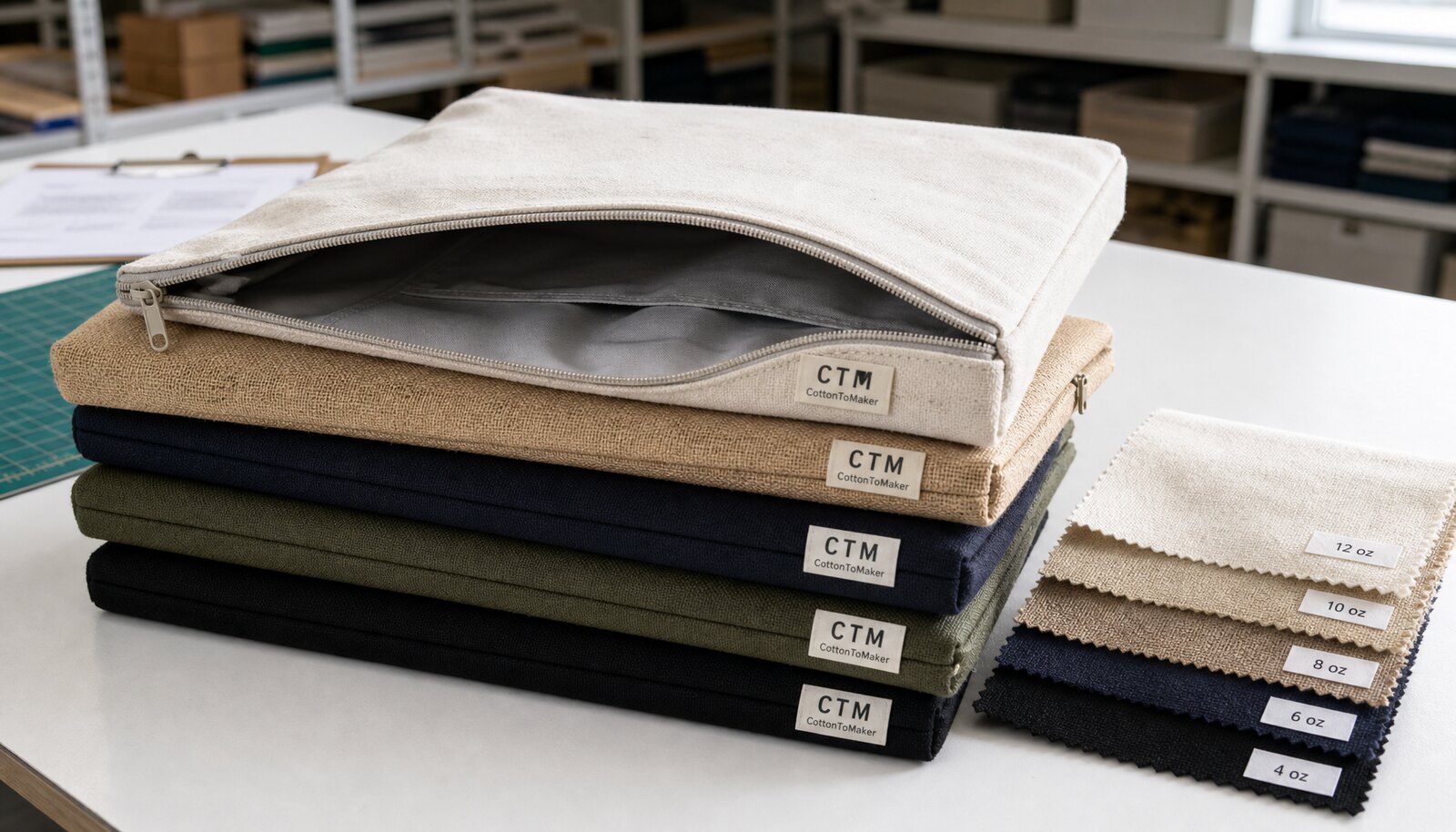
Why fabric weight matters more than the catalog photo
For canvas zipper portfolios sold through gift shops, fabric weight is not a background specification. It changes how the product sits on a shelf, how it feels in hand, how the zipper behaves, and whether buyers read it as a retail-ready item or a cheap accessory. Two portfolios can look similar in a product photo and still perform very differently once they are sewn, lined, packed, and handled by store staff. A lighter shell may lower the quote, but if the portfolio loses shape at the corners or looks soft after the zipper is installed, the retail impression falls quickly.
The right fabric weight depends on how the store plans to sell the item. If the portfolio is meant to carry notebooks, brochures, or stationery in a museum shop, the buyer usually wants a flatter face, a clean zipper line, and enough body to stay neat when displayed upright. If the portfolio is positioned as an impulse add-on at a lower price point, the buyer may accept a softer build, but only if the stitching, zipper tape, and packing keep it from looking unfinished. In other words, the job is not just to choose canvas weight. The job is to match the fabric to the retail promise.
Procurement teams should treat fabric weight as one lever in a larger construction system. Lining weight, zipper gauge, seam allowance, and packing format all influence the final result. A 12 oz portfolio with solid construction can look more premium than a poorly controlled 16 oz version. That is why the best RFQ does not ask for a generic “canvas portfolio” quote. It asks for a specific retail use case, a target weight range, and the exact components that create the finished look.
- Use fabric weight to set the product tier before discussing artwork or packing.
- Treat the zipper portfolio as a finished retail item, not as a simple sewn pouch.
- Ask suppliers to quote the same construction across multiple fabric weights so the tradeoff is visible.
Practical GSM ranges and what they do to the finished portfolio
A useful starting point is to work from the shelf outcome you want and then map that to fabric weight. Around 300 to 340 GSM, or roughly 10 oz to 12 oz canvas, gives a lighter hand and lower material cost. It is workable for straightforward gift shop items, but the shell can ripple if the portfolio is oversized or if the lining is too thin. Around 350 to 450 GSM, or about 12 oz to 14 oz, is the most balanced range for many retail programs because it gives more body without making the item feel heavy or expensive to ship. Above that, you move into premium structure, where the portfolio behaves more like a desk accessory than a soft organizer.
GSM alone is not enough to judge performance. Yarn density, weave tightness, finishing, coating, and dye method all affect how the fabric behaves under sewing pressure. Two fabrics with the same nominal weight can respond very differently when a zipper is attached. A looser weave may print acceptably but fray at cut edges or distort after packing. A coated canvas may feel richer in hand but can become less forgiving at the fold lines near the zipper. If the supplier only quotes a weight with no technical sheet, ask for the construction details before you compare prices.
The best way to evaluate fabric weight is to compare samples with the same zipper, lining, and logo treatment. That isolates the effect of the shell. If the lighter option saves money but needs a thicker insert or extra packing to look acceptable, the savings may disappear. If the heavier option adds only a small amount to unit cost but improves shelf presence and reduces the chance of returns or store complaints, it may be the better procurement decision.
- Ask for GSM plus weave type, fabric width, and finishing notes.
- Request clarity on whether the quoted weight is raw fabric or finished fabric.
- Compare the final sewn sample, not just loose fabric swatches.
How to choose between 10 oz, 12 oz, 14 oz, and 16 oz
The most useful decision is not which fabric is strongest. It is which fabric supports the target price, display setting, and brand image. Ten ounce canvas is usually the floor for retail-facing portfolios unless the design is compact and the buyer accepts a soft structure. It can be used for low-price gift shop programs, but the construction must be controlled tightly or the item will read as underbuilt. Twelve ounce is often the safest commercial starting point because it offers a reasonable balance of body, print performance, and freight efficiency. Fourteen ounce creates a more premium hand feel and usually improves the corners, especially when the portfolio carries inserts, stationery, or a small notebook. Sixteen ounce is only worth it when the buyer needs an obvious premium feel and can absorb the extra cost of weight, stiffness, and shipping.
Heavier fabric is not automatically better. In a zipper portfolio, the opening and closing action matters as much as shell body. If the fabric is too rigid relative to the zipper tape, seam allowance, or insert thickness, the mouth can warp and the puller can catch. That is a common failure mode in overbuilt samples: they look strong, but they do not close cleanly when packed with content. Buyers should therefore compare shell stiffness, zipper gauge, seam turn, and insert material together. A well-balanced 12 oz portfolio can outperform a badly proportioned 16 oz version in both appearance and function.
A practical sourcing rule is to start most gift shop programs at 12 oz to 14 oz, then move up or down only with a clear commercial reason. If the difference between 12 oz and 14 oz is small, the better body often pays for itself through a cleaner shelf look. If the jump to 16 oz pushes the product into a higher freight bracket, larger carton, or tighter zipper performance, the landed cost and risk can rise faster than the selling price can justify.
- 10 oz: lowest cost, softer hand, higher risk of a cheap look.
- 12 oz: balanced option for many gift shop assortments.
- 14 oz: stronger shelf presence and better body for moderate price lift.
- 16 oz: premium structure, but check zipper smoothness and carton weight.
Print method, lining, and zipper details can erase or preserve your savings
Buyers often focus on canvas weight and miss the effect of print method and internal components. A lighter canvas with poor zipper tape, weak lining, or overcomplicated decoration can cost more in rework and complaints than a mid-weight portfolio built properly. For simple logos, screen print is usually the cleanest commercial choice because it is durable, cost-efficient, and easy to repeat. If the artwork is small, highly detailed, or multi-color, transfer print or embroidery may be needed, but every added process step increases the chance of variation. In many gift shop programs, a clean one-color print on 12 oz or 14 oz canvas will sell better than a decorative treatment that fights the texture of the fabric.
Lining selection matters for the same reason. A lightweight polyester lining can protect the inside and keep costs down, but if it is too thin, the shell may show seam lines and the portfolio can feel underbuilt. A cotton-poly lining usually gives a better balance between price and hand feel. If the portfolio is meant to hold printed brochures or stationery, the lining should also be clean enough that it does not shed or snag. The zipper should be treated as a structural component, not a commodity line item. Zipper tape width, puller finish, stop quality, and track smoothness all affect how the product feels in use. A supplier who changes zipper source between the sample and the bulk run can change the user experience without changing the quoted price.
For quote comparison, ask the supplier to separate the construction cost as much as possible. One line should cover the shell fabric, another the lining, another the zipper, then printing, inserts, and packing. That level of transparency helps procurement spot where the quote is being compressed. A lower price may simply mean thinner lining, a cheaper puller, or a narrower zipper tape. Those shortcuts are hard to see in the first sample and much easier to notice after the goods are in store.
- Simple logo print on mid-weight canvas is usually the cleanest retail choice.
- Keep the zipper specification identical between sample and bulk.
- Ask for a separated cost build to expose hidden tradeoffs in the quote.
Sourcing routes: direct factory, trading company, or local decorator
The best sourcing route depends on how much control you need over fabric weight, print consistency, and schedule risk. Direct factory sourcing is usually the strongest option for repeat orders because it gives the buyer tighter control over materials, cutting, sewing, and packing. It also makes it easier to compare multiple fabric weights using the same production line. Trading companies and sourcing agents can be useful when you are still testing the market or need help gathering options from several factories. The tradeoff is that you must work harder to confirm who actually makes the portfolio and whether the sample reflects the true production line.
Local decorators can sometimes help with very short runs, but they often lack the sewing consistency needed for a retail portfolio. This matters because a zipper portfolio has more failure points than a flat printed tote. The zipper line, corner reinforcement, and panel alignment all need to be controlled. If the vendor only manages decoration and outsources sewing, your quality conversation becomes more complicated. The quote may look simple, but the line between responsibility for sewing, print, and packing can be blurry.
A smart procurement approach is to use the same tech pack and the same acceptance criteria across all supplier types. Ask each supplier to specify the exact fabric weight, zipper type, lining material, and packing format. Then compare not just price, but also how clearly the supplier explains the process. A source that can name the factory, show the sample route, and document the bulk line is usually easier to manage than one that only offers a generic price and a polished photo.
- Direct factory sourcing is best for repeat orders and spec control.
- Trading companies are useful for market scanning, but the production source must be named.
- Local decorators can work for short runs, but sewing consistency may be limited.
How to set MOQ logic without creating dead stock
MOQ is not simply a factory number. It is the result of fabric procurement, printing setup, trim booking, sewing labor, and packing efficiency. If you ask for a custom canvas zipper portfolio with multiple colors, multiple print locations, and special lining, the factory has to hold more material and spend more time on setup. That is why a quote that looks reasonable at first can become expensive when the order is split into too many versions. For gift shops, the inventory risk is often more expensive than the per-unit savings from a highly customized build.
The easiest way to negotiate MOQ is to reduce the variables before you negotiate price. Keep the fabric color fixed unless color is central to the retail concept. Keep the zipper and lining standard unless there is a clear brand reason to change them. If the range needs several sizes, consider whether one shared construction can be adapted across sizes by changing only the dimensions and artwork. That keeps fabric purchasing simpler and reduces the chance that one style will become a dead stock problem while another sells through. In a seasonal retail program, simplifying the build is often more valuable than squeezing the last cent out of the unit price.
A practical MOQ conversation should start with the carton plan and reorder expectation. If the supplier knows the sell-through window, they can suggest a quantity that fits their cutting efficiency without forcing you into excess stock. If they cannot explain how the MOQ was calculated, the number may be a negotiating tactic rather than a real production threshold. Ask whether the MOQ changes by print color, zipper color, or lining color, because those variables often matter more than the outer shell itself.
- Ask for MOQ by color, logo version, and size.
- Reduce build complexity before pushing for a lower MOQ.
- Tie MOQ to carton plan and expected reorder timing.
Sample approval: what the pre-production sample must prove
A pre-production sample is only useful if it reflects the exact build that will go into bulk production. For canvas zipper portfolios, the sample should use the final fabric weight, the actual zipper tape and puller, the final lining, and the same print or embroidery method planned for the order. If the supplier sends a hand-finished sample in a different fabric or with a temporary zipper, you are not approving the product that will arrive in stores. You are approving a prototype that may never match the bulk run.
The sample review should start with basic physical checks. Measure the finished size, open and close the zipper repeatedly, inspect the logo under normal retail lighting, and check whether the portfolio lies flat without waviness. If the item needs a rigid insert, test whether the insert improves presentation without pushing the zipper line out of alignment. If the sample only looks right when it is heavily stuffed, the retail version may disappoint on the shelf. For gift shops, appearance in a flat or lightly filled state matters more than how the item behaves when overpacked.
It is also worth reviewing more than one sample if possible. Canvas can vary by loom and dye lot, and a single clean unit can hide inconsistent cutting or stitching. If the factory can provide one sample for visual approval and another for basic stress checks, that gives a better view of process stability. Do not approve from a photo alone. Request actual physical approval or a detailed video that shows zipper motion, seam finish, and size measurement against a ruler or template.
- The sample must use final fabric, final zipper, final lining, and final print method.
- Measure and test the sample before approval.
- If the portfolio includes an insert, check zipper alignment with the insert installed.
Comparison table: what to ask different supplier types before you award the job
Buyer teams often compare suppliers only by unit price, but the useful comparison is broader. A direct factory, a trading company, and a local decorator can all quote a canvas zipper portfolio, yet each one carries different control points and risks. The table below helps procurement teams see where the quote is strong, where it is thin, and what documentation should be requested before the purchase order is released. The goal is not to choose the cheapest option on paper. The goal is to choose the source that can hold the spec through bulk production, inspection, and shipping.
When you compare suppliers, keep the same dimensions, same target fabric weight, same zipper spec, and same packaging format. If those variables change, the pricing is not comparable. Ask each supplier to provide technical proof, not just a catalog style photo. A serious supplier should be able to explain fabric source, zipper source, packing method, and inspection plan. If they cannot, the buyer takes on more of the production risk without being compensated for it.
- Compare suppliers using the same tech pack and same target weight.
- Ask for proof of the actual production source, not only a sales quotation.
- Use documentation quality as a proxy for process control.
Packing, carton load, and shipping damage risk
Packing is where many portfolio programs lose value. A well-made canvas zipper portfolio can still arrive creased, scuffed, or dirty if the packing is too loose or the carton plan is too aggressive. For gift shops, first impression matters immediately, so the packing method should protect the front panel and keep zipper pullers from scratching the fabric. Individual polybags are common, but they should not be so tight that they create compression marks. If the product is meant to feel premium, a simple insert card or tissue wrap may be worth the extra cost because it improves presentation without changing the construction.
Carton load should be planned alongside fabric weight. Heavier canvas increases carton weight and can change freight cost and handling risk. If the carton is packed too tightly, the items at the bottom can crease. If it is too loose, the goods can shift and scuff. Ask for carton dimensions, gross weight, and unit packing count early in the quotation stage so you can estimate landed cost before the order is locked. This is especially important for seasonal retail buying, where a late arrival or damaged carton can affect the whole program.
For store receiving, the best packing spec is the one that protects appearance without making unpacking annoying. Gift shop staff do not want to steam or re-fold products after arrival. A clean, repeatable packing format lowers the chance of store-level complaints and makes reorders easier to receive, count, and shelve. If the portfolio is a premium item, ask the supplier to show how they prevent zipper pulls from rubbing against adjacent units during transit.
- Protect the visible front panel from zipper-pull scratches and carton pressure.
- Request carton size and gross weight before confirming the order.
- Choose packing that protects the product without creating difficult unpacking for store staff.
Lead time, production milestones, and where delays usually start
Lead time for canvas zipper portfolios is often limited less by sewing speed than by material readiness. The factory may have sewing capacity but still wait on the correct canvas weight, zipper component, or artwork approval. A buyer who only gets a single lead-time number may not see that sample approval, color matching, and trim booking are the real bottlenecks. For that reason, the quote should break out sample lead time, pre-production confirmation, and bulk production time instead of giving one total estimate.
The schedule becomes more fragile when the buyer requests custom fabric weight, special lining, a nonstandard zipper puller, or additional packaging. Each custom element creates one more point where the order can pause. If the portfolio is tied to a store launch or seasonal event, ask for a dated milestone plan that shows artwork lock, sample sign-off, material booking, cutting, sewing, final inspection, packing, and shipment booking. That way, procurement can manage the timeline instead of reacting after the date slips.
A useful red flag is a supplier who promises a short lead time but cannot explain what happens at each stage. Another red flag is when sample approval is treated as a formality rather than a release gate. Good suppliers can tell you which stage is most likely to delay the order and what they need from the buyer to keep it moving. That level of specificity is more valuable than a general promise to deliver quickly.
- Separate sample lead time from bulk lead time.
- Ask for stage-by-stage milestones, not only a single delivery estimate.
- Identify the approval step that most often delays the order.
Specification comparison for buyers
| Buyer scenario | Recommended fabric / build | Why it works | What to inspect before PO |
|---|---|---|---|
| Entry-price gift shop line | 10 oz to 12 oz canvas with standard lining and simple zipper pull | Keeps landed cost controlled for impulse or add-on retail, especially when the item is sold flat with minimal handling | Check whether the finished portfolio still holds its shape after zipper installation; require seam allowance and zipper tape specs in writing |
| Mainstream gift shop assortment | 12 oz to 14 oz canvas with balanced lining and moderate structure | Usually the best middle ground for shelf presence, durability, and price; a safer default for most retail buyers | Confirm finished size tolerance, zipper travel, logo placement, and whether the sample matches bulk fabric lot |
| Premium stationery or museum shop | 14 oz to 16 oz canvas with cleaner edge finishing or light insert | Improves hand feel and visual body, which supports a higher retail price when the product is displayed with notebooks or stationery | Test zipper smoothness on the final thickness; watch for puckering at the mouth and corner bulk near the zipper ends |
| Custom-brand or high-detail logo program | 12 oz to 14 oz canvas with consistent weave and controlled print surface | Enough body for branding without making the artwork fight the fabric texture | Demand a strike-off on actual production fabric; fine text and thin lines need a real sample, not a generic print proof |
| Cost-led promotional buy | 10 oz canvas with standardized trims and simplified packing | Can meet tight budget targets if the supplier controls cutting and sewing tightly | Inspect for bagginess at corners, loose threads, uneven piping, and any zipper drag caused by soft shell fabric |
| Multi-supplier sourcing comparison | Same size and trim spec across 2 to 3 fabric weights | Lets procurement isolate the true cost and quality effect of fabric weight rather than changing too many variables at once | Ask each supplier to quote identical zipper size, lining, print method, and packing format so the comparison is fair |
Buyer checklist before sampling
- Confirm finished size, gusset depth, zipper length, and whether the portfolio must fit A4, letter, or legal pads.
- Specify target canvas weight in GSM or oz and state whether that number is raw fabric or finished fabric after dyeing, coating, or washing.
- Define the exact retail use case: flat stationery organizer, brochure carrier, document holder, or gift-shop add-on item.
- Lock the zipper spec: zipper size, tape width, puller finish, stop type, and whether the same zipper must be used in sample and bulk.
- Require a pre-production sample made with final fabric, final lining, final zipper, and the final print method.
- Set acceptance criteria for size tolerance, seam allowance, stitch consistency, color variation, and logo placement.
- Choose packing format in advance: bulk pack, individual polybag, insert card, tissue wrap, barcode label, or gift-ready packaging.
- Ask for carton dimensions, gross weight, carton count, and whether cartons need retail barcodes or only shipping marks.
- Request production lead time, sample lead time, and a milestone schedule that shows where approval delays can occur.
- Ask who controls each process step in-house and which steps are outsourced, especially printing, embroidery, and final packing.
Factory quote questions to send
- What is the exact canvas weight in GSM or oz, and is that figure measured before or after finishing such as washing, coating, or dyeing?
- Does the quoted unit price include the outer canvas, lining, zipper, puller, piping or binding, and any internal insert?
- Which zipper brand, zipper size, tape width, and stop style are included in the quote?
- What is the MOQ per color, per logo version, and per size?
- Can you produce a pre-production sample using the exact fabric lot, zipper, lining, and print method that will be used in bulk?
- What are your standard tolerances for finished size, stitch count, seam allowance, logo position, and panel alignment?
- If the portfolio includes an insert, what material, thickness, and cut tolerance are used?
- How are goods packed for export, and what are the standard carton quantity, carton dimensions, and gross carton weight?
- What is the production lead time after sample approval, and which steps most commonly delay shipment?
- Which parts of production are in-house and which are subcontracted? Please name the actual factory if you are quoting as a trading company or sourcing agent.
Quality-control points to confirm
- Measure finished size after sewing and packing, not just cut size, because lining and zipper tension can pull the portfolio smaller.
- Set an acceptable size tolerance in the PO. For most retail portfolios, a practical working tolerance is usually within ±3 mm to ±5 mm for critical dimensions, unless the design is unusually complex.
- Inspect seam allowance at stress points near the zipper ends, corners, and any handle or tab attachment. Ask for a minimum seam allowance and check that it is held consistently on the sample and first production lot.
- Check zipper action repeatedly on sample units and during final inspection. The zipper should run smoothly, align cleanly at the ends, and not skip teeth, jam, or snag on the lining.
- Run a simple cycle check on the sample: open and close the zipper several times under normal hand pressure. If the puller catches when the portfolio is slightly full, the design may be too tight.
- Compare logo position against a physical master or approved strike-off. Canvas texture can shift print edges, distort fine text, or change embroidery density.
- Set a color tolerance standard before production. If using natural or dyed canvas, request a reference swatch and define what shade variation is acceptable across panels and reorder lots.
- Inspect stitching for skipped stitches, loose thread ends, uneven topstitching, puckering, and corner bulk. Retail-facing panels should not show casual sewing marks.
- If the product uses an insert, confirm the insert sits flat and does not bow the zipper line or force the shell out of shape. Check with and without the insert where possible.
- Review carton compression risk. Perform a simple pressure and drop check on sample packed cartons, especially for heavier 14 oz to 16 oz builds that can crease under stacking.