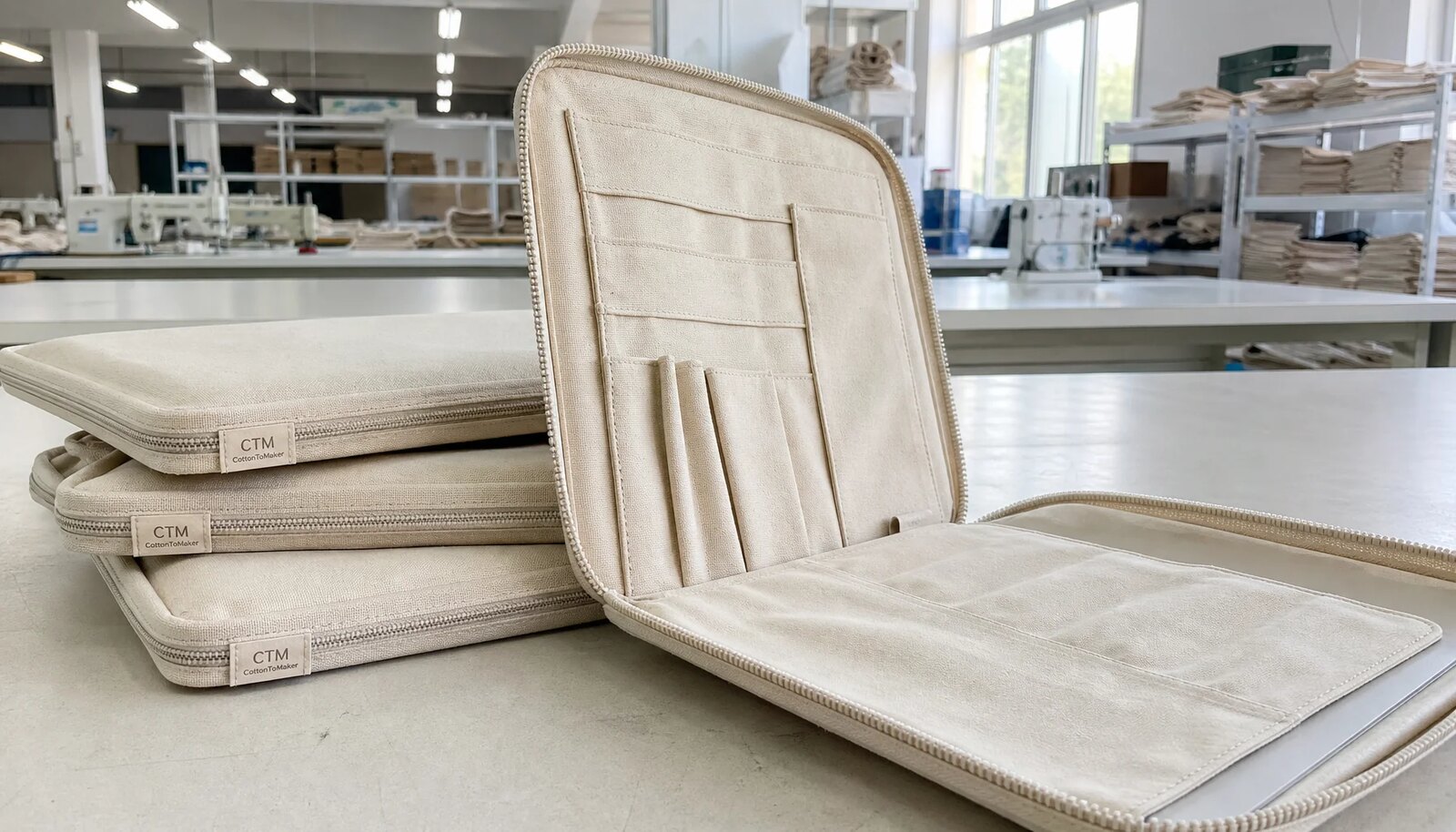
Why this product needs more than a pouch spec
A farmers market vendor does not use a zipper portfolio the way an office worker uses a document sleeve. It may sit beside a cash box, move from a storage tote to a folding table, collect damp receipts, hold wholesale forms, and get opened repeatedly during a busy morning. The vendor may pull it with one hand while holding a product sample in the other. By the end of the day, the portfolio is often packed again with papers, cards, pens, and small tools still inside.
That rhythm changes the sourcing brief. The item is still simple, but it is not casual. A good-looking empty sample can pass an early review and still disappoint in use if the canvas collapses, the zipper drags around the corners, the pockets are too tight, or the logo panel puckers after decoration. Farmers market vendors need something presentable in front of customers and sturdy enough for repeated setup, storage, and transport.
For B2B procurement teams, the goal is not to buy the heaviest canvas available. It is to align fabric weight, zipper gauge, pattern shape, lining, seams, reinforcement, and decoration so the finished product behaves well when loaded. That is why a useful canvas zipper portfolios fabric weight guide for farmers market vendors should make supplier quotes comparable, not merely describe material options.
Repeat orders are where vague specs usually show their weakness. A first shipment may look acceptable because everyone remembers the approved sample. Six months later, the reorder may arrive in a slightly different canvas shade, with a tighter zipper path, thinner lining, or a logo placed lower on the panel. Written control points help prevent that drift.
- Treat the portfolio as a working booth organizer, not a generic giveaway pouch.
- Define the actual contents before choosing fabric weight or pocket layout.
- Use one RFQ version so suppliers price the same construction and packing.
- Keep the approved sample, fabric swatch, trim card, and BOM linked to the purchase order.
Canvas weight ranges that fit vendor programs
Canvas weight is often quoted in ounces, while many factories and fabric mills also work in GSM. As a practical reference, 10 oz canvas is about 340 GSM, 12 oz is about 405 GSM, and 14 oz is about 475 GSM. These conversions are useful, but they do not tell the whole story. Buyers should always ask whether the stated weight refers to greige fabric before dyeing, finished fabric after dyeing, washed fabric, or coated fabric. The number can shift as the fabric is processed.
For most farmers market vendor portfolios, 10–12 oz canvas, about 340–405 GSM, is the best starting range. It gives the product enough body for order pads, price cards, receipts, pens, business cards, folded flyers, and light flat samples without making the portfolio bulky. It is also easier to sew cleanly around zipper corners than heavier canvas, which helps in bulk production.
When the portfolio needs to carry a tablet, thicker catalogs, sample cards, retail-ready vendor kit inserts, or heavier branded presentation materials, 12–14 oz canvas can make sense. The handfeel is more substantial, the face panel holds shape better, and premium branding such as embroidery or a woven patch may look more balanced. The tradeoff is seam thickness. Corners, zipper ends, and pocket stacks need better sewing control.
Below 10 oz, canvas can still work for a light document pouch where price is the main driver. It may wrinkle more, show outlines of contents, and feel less structured when lifted. Above 14 oz, the fabric can become stiff for a zip-around portfolio unless the pattern, corner radius, binding, gusset, and zipper are engineered for that thickness. More weight does not automatically mean better quality; it can simply make the product harder to close.
- Use 10–12 oz / 340–405 GSM for the most balanced vendor organizer spec.
- Use 12–14 oz / 405–475 GSM for premium or heavier-load designs with upgraded construction.
- Avoid below 10 oz unless the use is paper-only and cost-sensitive.
- Ask every supplier to state the fabric weight basis: greige, finished, washed, or coated.
Fabric finish, weave, and shade control
Two canvas fabrics can share the same GSM and still behave differently. A tight 10 oz weave may feel more stable than a loose 12 oz weave. Washed canvas feels softer but can bring more shrinkage and shade variation. Coated canvas may improve wipeability, yet it can affect needle marks, odor, folding, and print adhesion. The RFQ should describe the fabric route, not only the word canvas.
Natural cotton canvas is common for farmers market programs because it fits local, agricultural, handmade, and produce-adjacent branding. It also varies. One lot may read cream; another may lean yellow, gray, or oatmeal. That is normal for natural canvas, but it still needs control. If brand appearance matters, approve a physical swatch and agree on a practical shade tolerance with the supplier before bulk cutting.
Dyed canvas gives a more deliberate brand color, but it adds lab dip approval, dye-lot management, rub resistance checks, and reorder questions. If the portfolio will be stored in vehicles, handled outdoors, or placed near packaging, flowers, soil, or produce, ask about color transfer. Dark dyed canvas with a light logo needs ink opacity checks. A light outer canvas with a dark lining may need migration review under humid storage conditions.
Shrinkage deserves an early conversation. If the factory cuts finished fabric directly, the buyer needs finished-dimension tolerances. If the fabric is washed after sewing, the pattern must account for that movement and the logo method must survive the process. For most B2B portfolio programs, post-production washing adds variation and cost; use it only when the handfeel or look is truly part of the product value.
- Specify weave and finish: natural, dyed, unwashed, washed, brushed, coated, waxed, or water-resistant.
- Request lab dips for dyed canvas and approved swatches for natural canvas programs.
- Ask how shrinkage is measured and how finished dimensions are controlled.
- Check rub resistance and color transfer when using dark, coated, washed, or transfer-decorated canvas.
Capacity starts with the pattern
A finished size such as 10 x 13 inches is not enough to judge whether a portfolio will work. Usable capacity is reduced by seam allowance, zipper tape placement, lining, binding, pocket thickness, interlining, and corner shape. A portfolio that looks large enough for letter-size papers may feel tight once it includes pen loops, a tablet sleeve, a receipt pocket, and a stitched logo patch.
Procurement teams should start with the contents. List the maximum paper size, order pad thickness, receipt book dimensions, number of pens, business card stack, tablet model, sample card size, and any small accessories such as tags, calculator, charger, or price labels. Then set the internal dimensions, zipper opening, pocket depths, pocket widths, and gusset depth if needed.
Unlined construction is the simplest route. It can work well for durable document carry and cost-controlled programs. Lining makes the portfolio feel more finished and protects contents from rough seams, but it adds cutting, sewing, inspection, and material cost. Lined construction can also hide internal seam quality, so QC has to check more than the outside appearance.
Pockets should earn their place. Pen loops that are too narrow force the seam. Card pockets that are too deep make cards hard to retrieve. A tablet sleeve needs a stated device size and clearance for a slim case if that is expected. Every pocket adds thickness, and thickness can push into the zipper path. The sample should be tested full, zipped, reopened, and emptied before approval.
- Set usable internal measurements, not only outside dimensions.
- Build the pattern around the maximum loaded thickness, not the empty sample.
- Specify unlined, lined, padded, semi-structured, or pocketed construction clearly.
- Check whether pockets reduce zipper movement or deform the front panel when loaded.
Zipper and sewing construction details
The zipper is often the first component to reveal a weak specification. For most canvas zipper portfolios, a No. 5 nylon coil zipper is the practical default. It is flexible, widely available, cost-efficient, and usually smoother around corners than metal zippers in this type of construction. A No. 3 zipper may be too light for heavier canvas or frequent opening. A larger zipper can work for rugged designs, but it may look bulky on a slim portfolio.
The quote should name the zipper type, gauge, tape width, tape color, slider material, slider finish, puller style, top stops, and zipper-end construction. A zipper-end tab or reinforced fabric stop can prevent the slider from pulling against the seam. Square corners need special attention because sharp turns and thick intersections can create snag points. Rounded corners can improve travel, but only if the zipper tape is sewn evenly.
Sewing details should match the canvas weight. Heavy fabric with light thread can look underbuilt. Dense stitching can perforate canvas and create a tear line. Loose stitching may gap under load. Buyers do not always need to dictate every machine setting, but they should ask what thread size, stitch density, needle size, and seam finish the factory recommends for the quoted fabric weight.
The most important reinforcement points are zipper ends, top corners, gusset joins, pocket mouths, handle tabs if used, label attachment points, and areas pulled during opening and closing. Reinforcement can be bar tacks, folded tabs, box stitching, binding, seam tape, or extra fabric layers. The aim is targeted strength, not unnecessary bulk.
- Specify No. 5 nylon coil zipper unless the load or design calls for another gauge.
- Confirm tape width, puller, slider finish, stops, end tabs, and corner path.
- Ask the factory to state thread, needle, stitch density, and reinforcement method.
- Test zipper movement through corners and seam stacks while the portfolio is loaded.
Branding choices on canvas
The portfolio may be used in front of shoppers, wholesale buyers, market managers, and retail partners, so the decoration method matters. A logo that looks fine on a flat digital mockup can behave very differently on natural canvas, dyed canvas, washed canvas, or coated canvas. Texture, shade, and fabric movement all affect the final result.
Screen printing is usually the strongest value for simple one- or two-color logos. It works well on flat panels and repeat orders, but buyers should check ink opacity, edge sharpness, registration, placement, and rub resistance. Small type can break up on textured canvas. Light ink on dark fabric needs extra attention because weak opacity can make the mark look dull or inconsistent.
Embroidery gives a more premium look for smaller marks, monograms, or badges. It generally performs better on 12 oz or heavier canvas than on very soft lightweight canvas, though puckering is still possible if stitch density is too high. Large embroidery on a flexible face panel can distort the shape of the portfolio and affect how it lies flat. If the portfolio is lined, confirm whether the embroidery backing is covered.
Woven labels and patches are useful when direct decoration is difficult to control across fabric shade variation. A label can keep branding consistent on natural canvas reorders. Patches add perceived value, but they bring edge finishing, stitching, placement, and thickness considerations. Heat transfer can support complex artwork or shorter runs, but it should be checked for bending, rubbing, and cracking because the portfolio flexes during use.
- Use screen print for clean logos, controlled pricing, and repeatable bulk orders.
- Use embroidery for premium small-area branding when the fabric can support the stitch load.
- Use woven labels or patches when logo consistency matters across canvas lots.
- Approve decoration on the actual bulk fabric, not a substitute swatch.
RFQ structure for comparable quotes
A strong RFQ removes guesswork. Start with intended use, target contents, order quantity, destination market, and whether the portfolio is a giveaway, internal vendor tool, retail item, or event kit component. Then move into measurable details: dimensions, usable capacity, canvas specification, finish, lining, pocket layout, zipper, decoration, reinforcement, packing, inspection, and documents required before shipment.
Quote comparison should separate costs that often get buried. Fabric weight affects material cost and sewing speed. Dyed canvas adds lab dip and dye-lot control. Lining adds fabric, cutting, sewing, and inspection. Pockets add labor. Custom zipper pulls, woven labels, embroidery, individual polybags, barcodes, insert cards, and retail cartons can all change setup charges or unit price.
For many buyers, it helps to request a base version and a premium version. The base version might use 10–12 oz natural canvas, unlined construction, a standard No. 5 nylon coil zipper, one-color screen print, and bulk packing. The premium version might use 12–14 oz dyed canvas, lining with selected pockets, woven label or embroidery, upgraded puller, and individual polybag with barcode. This gives procurement a real cost ladder.
Ask suppliers to list exceptions in writing. If the MOQ cannot support custom dyed canvas, state the substitute. If the quoted zipper tape is standard rather than custom-matched, state it. If packing is bulk instead of individual polybag, state it. A low bid is useful only when the buyer can see exactly what is included.
- Include use case, contents, specs, decoration, packing, QC, and delivery terms.
- Ask for setup charges separately from recurring unit price.
- Request base and premium versions with clear construction differences.
- Require written exceptions instead of broad confirmation language.
Supplier route, MOQ, and pilot orders
A direct factory is often the best route when the buyer has a clear specification and expects repeat orders. Direct communication makes it easier to align fabric purchasing, cutting, decoration, sewing, packing, and inspection. It also helps explain cost changes. A price increase may come from heavier canvas, slower sewing, lining labor, smaller MOQ, special packing, or trim changes.
A sourcing partner or trading company can still be practical when the buyer is building a larger vendor kit, managing mixed SKUs, or coordinating several factories. The buyer should ask who makes the portfolio, whether decoration is handled in-house or outsourced, and who controls final inspection. If the production factory changes after sampling, the approved sample may no longer represent the bulk process.
MOQ should be reviewed by component, not only by finished piece count. A supplier may accept 500 pieces for natural canvas with standard zipper and screen print, but require more for custom dyed canvas, special zipper tape, custom puller, woven label, or multiple lining colors. Splits matter too. A 2,000-piece order across four colors and two logos may behave like eight small production runs.
For first programs, a pilot order is usually a smart discussion if budget and timing allow it. A range of 500–1,000 pieces per style or color can be realistic in some routes, but the true MOQ depends on material availability and factory setup. Keep the first run focused: one or two colors, standard zipper, one decoration method, and a pocket layout that is easy to inspect. Add complexity after vendor feedback confirms what is useful.
- Ask who performs cutting, decoration, sewing, packing, and inspection.
- Set MOQ by style, color, logo, trim, lining, and packing format.
- Use pilot orders to validate capacity, zipper feel, vendor feedback, and reorder plans.
- Reduce first-run complexity before adding custom pulls, multiple colorways, or retail packaging.
Sampling and approval checkpoints
Sampling should be treated as a controlled step, not a formality. A digital mockup can confirm approximate logo location and proportions. A photo sample can help screen obvious issues. Neither proves fabric handfeel, zipper smoothness, pocket fit, loaded capacity, or the way the panel behaves after decoration. Important custom orders need a physical pre-production sample made as close to bulk production as possible.
The sample request should state what must be production-correct. For a canvas zipper portfolio, that usually includes outer canvas weight and finish, lining if any, zipper gauge and puller, thread color, pocket layout, reinforcement points, logo method, label placement, and packing. If substitute fabric or substitute zipper is used, call it a development sample rather than a pre-production approval.
Once approved, the sample should be labeled with date, PO reference, material version, artwork version, and any accepted deviations. The buyer and supplier should keep matching references when possible. If the factory changes fabric lot, zipper source, lining, logo process, or packing after approval, the buyer should be notified before production continues.
Approval should include a loaded test. Place the stated contents into the portfolio, close the zipper fully, reopen it, remove the contents, and inspect the face panel, pockets, corners, and zipper tape. If the design is semi-structured, measure it before and after loading. An empty sample that looks tidy has not yet proven the product will work for vendors.
- Separate development samples from pre-production samples.
- Approve production-correct materials, trims, decoration, and packing before bulk cutting.
- Label and retain the approved sample as the final inspection reference.
- Perform loaded-fit and zipper-cycle tests before signing off.
QC, packing, and lead-time control
Quality control should cover material, dimensions, construction, function, appearance, and packing. Before cutting, inspect fabric rolls for weight, shade, defects, and finish consistency. During production, check zipper insertion, pocket placement, stitch density, reinforcement, seam finishing, and logo process. Final inspection should include measurements, logo placement, zipper operation, loaded fit, thread trimming, cleanliness, and packed-unit condition.
Defect severity should be defined before shipment. Critical defects include wrong product, wrong logo, broken zipper function, unsafe sharp components, or dimensions that prevent intended use. Major defects include open seams, severe stains, missing pockets, obvious shade mismatch, severe logo misplacement, nonfunctional pockets, or zipper snagging that affects normal use. Minor defects may include small loose threads, slight shade variation within tolerance, or tiny marks that do not affect use or presentation. If AQL is used, put the inspection level and acceptance limits in the PO or QC checklist.
Packing is part of quality. Canvas can crease, scuff, absorb moisture, or show pressure marks from zipper pulls. Bulk packing is efficient for B2B distribution, but units should not be compressed so tightly that hardware dents the front panel. Individual polybags, barcode labels, insert cards, and retail cartons add labor and inspection points. Ask for packed-unit photos, carton quantity, carton dimensions, gross weight, carton marks, and moisture protection before shipment release.
Lead time should be broken into milestones: artwork confirmation, lab dip if dyed, material booking, sample production, sample approval, bulk cutting, decoration, sewing, finishing, packing, inspection, and dispatch. A custom order often needs several weeks after final approval, and special components can extend that timeline. The purchase order should tie the production clock to final approval of materials, artwork, trims, and packing, not just deposit date.
- Use written QC criteria for fabric, dimensions, stitching, zipper, logo, loaded fit, and packing.
- Define critical, major, and minor defects before final inspection.
- Ask for packed-unit and master-carton details before freight planning.
- Freeze BOM, artwork, trim, and packing before bulk cutting starts.
Specification comparison for buyers
| Spec decision | Recommended option | When it fits | Buyer risk to check |
|---|---|---|---|
| Fabric weight for paper and light booth use | 10 oz canvas, about 340 GSM | Order pads, receipts, price cards, business cards, pens, folded flyers, and light flat samples | Can feel under-structured if the portfolio is oversized, unlined, or expected to carry a tablet |
| Fabric weight for standard vendor organizer use | 10–12 oz canvas, about 340–405 GSM | Most farmers market vendor programs that need a durable but flexible branded organizer | Confirm whether weight is greige, finished, or washed; do not compare quotes unless the measurement basis is clear |
| Fabric weight for premium or heavier contents | 12–14 oz canvas, about 405–475 GSM | Tablet sleeves, catalogs, sample cards, retail-ready vendor kits, and heavier branded presentation programs | Thicker corners need suitable needle, thread, seam allowance, zipper gauge, and slower sewing control |
| Fabric above typical portfolio range | 14 oz+ canvas, about 475 GSM+ | Special rugged designs, structured cases, or very premium handfeel where bulk is acceptable | May be too stiff for clean zipper travel unless pattern, gusset, binding, and corner construction are engineered for it |
| Fabric finish | Unwashed dyed or natural canvas with approved swatch and shade tolerance | Repeat B2B programs where consistency, print placement, and carton-to-carton appearance matter | Natural canvas and dye lots can shift; set a practical shade tolerance and keep a signed reference sample |
| Interior structure | Unlined for basic documents; lined or semi-structured for organized vendor kits | Unlined fits cost-sensitive programs; lined fits tablet, pens, receipts, wholesale sheets, cards, and tags | Pockets can steal usable capacity, block zipper movement, or create pressure points if not load-tested |
| Zipper choice | No. 5 nylon coil zipper for most portfolios; upgrade if load or fabric thickness requires it | Flexible zipper travel around corners, good cost control, and practical repair/replacement availability | Ask for zipper tape width, slider type, puller, top stops, end reinforcement, and open-close cycle testing |
| Decoration method | Screen print for simple logos; woven label or embroidery for premium marks; heat transfer for complex artwork | Screen print suits clean logos and repeat orders; woven labels help control brand appearance across fabric shades | Fine text, ink opacity, embroidery puckering, heat-transfer cracking, and color matching must be checked on actual bulk fabric |
| MOQ strategy | Pilot 500–1,000 pcs per style/color where feasible; scale after vendor feedback | First program launch, new colorway, seasonal kit, or untested pocket layout | Low MOQ may force stock canvas, standard zipper colors, limited trims, or higher unit cost from setup charges |
Buyer checklist before sampling
- Define the use case in practical terms: market booth paperwork, wholesale order capture, tablet carry, customer receipts, sample cards, seed packets, price sheets, pens, calculator, phone charger, or small POS accessories.
- List the actual contents by size and thickness, including tablet model if relevant, maximum paper size, pen count, receipt book size, sample pack thickness, and whether the portfolio must close when fully loaded.
- Specify finished product dimensions, usable internal dimensions, zipper opening width, gusset depth if any, pocket depth, pocket width, and seam allowance target.
- State canvas composition, weave, fabric weight in oz and GSM, and whether the quoted weight is greige, dyed, finished, washed, or coated fabric weight.
- Set a practical fabric weight tolerance, such as +/-5% when the mill can support it, and ask how the supplier records roll weight before cutting.
- Define fabric finish: natural, dyed, unwashed, washed, brushed, waxed, coated, or water-resistant finish, and ask how it affects shrinkage, shade, handfeel, print adhesion, and needle marking.
- Choose the structure level: soft unlined pouch, lined organizer, padded tablet portfolio, semi-structured case, or reinforced retail-style portfolio.
- Specify lining material and approximate GSM if used, plus pocket construction, binding, interlining, elastic loops, label placement, and whether raw seams are allowed inside.
- Define zipper type, gauge, tape color, slider finish, puller style, top stops, zipper-end tab, corner construction, and whether the zipper must pass smoothly around curved or squared corners.
- Select the decoration method for the first quote only: screen print, embroidery, woven label, leather or PU patch, heat transfer, zipper pull logo, or combined branding.
Factory quote questions to send
- What exact canvas are you quoting: composition, weave, oz weight, GSM, finish, color, and fabric supplier or mill reference if available?
- Is the fabric weight measured before dyeing, after dyeing, after washing, after coating, or on finished production fabric ready for cutting?
- What production tolerance do you control for fabric weight, shrinkage, and shade, and how is this checked before cutting starts?
- Can you provide a fabric swatch, color lab dip if dyed, and a reference card for natural canvas shade variation?
- What finished product dimensions and usable internal dimensions are included in the quote, and what dimensional tolerance will you inspect against?
- Which zipper type and gauge are included, such as No. 5 nylon coil, and what are the tape width, slider material, slider finish, puller style, and top-stop details?
- How will you reinforce zipper ends, top corners, gusset joins, pocket openings, label areas, handle tabs, or any point that receives pulling force?
- What stitch type, stitch density, thread size, needle size, and seam finishing method do you recommend for the quoted canvas weight?
- Can you quote unlined, lined, and semi-structured versions using the same outer canvas so we can compare cost, weight, thickness, and user value?
- Which logo method is included, and what are the artwork limits for small text, fine lines, ink opacity, embroidery density, backing, and color matching on this canvas?
Quality-control points to confirm
- Confirm canvas weight against the approved spec in oz and GSM before cutting, and record whether the measured fabric is finished, washed, or coated.
- Inspect fabric rolls for shade variation, weaving slubs, oil marks, stains, weak selvedge, loose weave, excessive neps, heavy creasing, coating streaks, and obvious roll-to-roll mismatch.
- Check shrinkage and fabric behavior if the product uses washed canvas, coated canvas, heat transfer, heavy embroidery, or tight dimensional tolerances.
- Keep the approved pre-production sample as the physical reference for fabric handfeel, color, zipper smoothness, pocket layout, stitch density, logo placement, and packing.
- Measure finished dimensions, usable internal dimensions, pocket depth, zipper opening, gusset depth, logo placement, and label placement against written tolerances.
- Test zipper travel through repeated full open-close cycles, including corners and thick seam intersections, with sampled units loaded to the intended maximum contents.
- Reject zipper defects such as splitting, slider sticking, broken top stops, loose pullers, exposed zipper teeth at ends, twisted zipper tape, or zipper tape sewn too close to the teeth.
- Inspect stitching for skipped stitches, broken stitches, loose thread nests, uneven topstitching, incorrect stitch density, needle cuts, open seams, and exposed raw edges where they are not approved.
- Review reinforcement at zipper ends, pocket mouths, gusset corners, tabs, handles, label attachment points, and any seam that receives tension when the portfolio is loaded.
- Check screen print for placement, registration, ink coverage, opacity, edge sharpness, pinholes, rubbing resistance, color consistency, and ink migration on textured canvas.