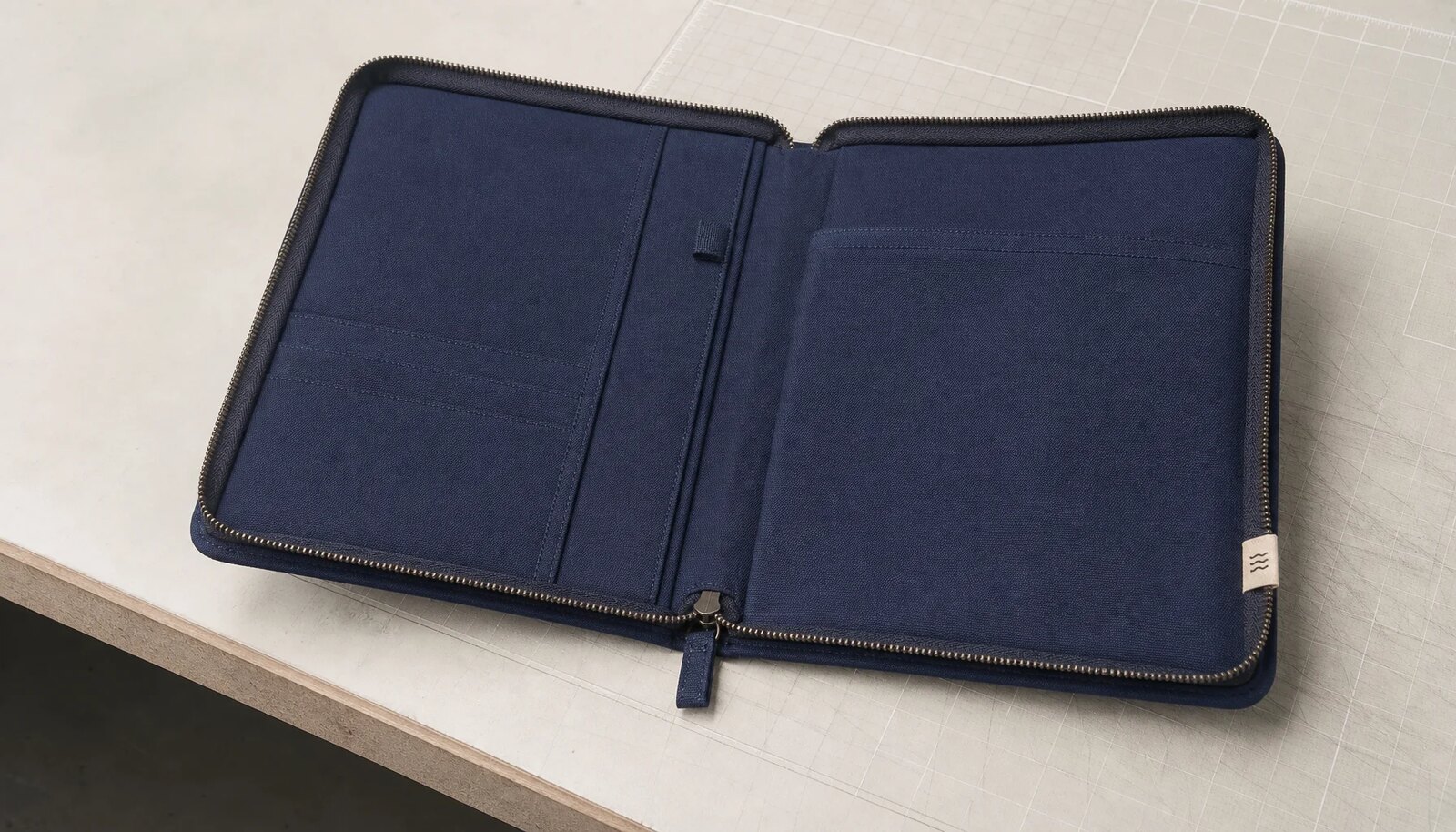
Start with the event load, not the fabric number
A strong canvas zipper portfolio specification begins with the job the item must do at the event. Fabric weight matters, but it is only one part of a working build. A portfolio used as a paper-only conference handout can be lighter and simpler than a portfolio carrying a workbook, charger, sponsor inserts, a tablet sleeve, or confidential meeting materials. Before asking a supplier for 8 oz, 10 oz, or 12 oz canvas, procurement should define how the portfolio will be packed, carried, opened, displayed, reused, and shipped.
For event planners, the practical risk is approving an attractive empty sample that fails when the real kit is loaded. A flat portfolio can look clean on a sample table, then distort when a notebook and brochures are inserted. A zipper can glide smoothly when empty, then snag at the corner once the inside pocket is filled. A document sleeve can seem adequate until staff try to insert materials quickly at a hotel or convention center. The RFQ should therefore include the planned contents, approximate filled thickness, and any repeated-use expectation.
The receiving environment also changes the build. Portfolios shipped to a single corporate office can be checked and kitted centrally. Portfolios shipped to multiple venues need clearer carton labels and stricter destination control. Items handed out at registration need fast staff handling and clean presentation. Items given to executives need better shape retention, more controlled decoration, and fewer visible finishing flaws. The best sourcing conversation is not simply about price per unit; it is about matching the construction to the event workflow.
- Define the use case as attendee handout, speaker kit, VIP gift, sales folder, retail-adjacent item, or roadshow kit.
- List contents by size, thickness, and estimated weight so the supplier can judge zipper stress and pocket depth.
- Ask the factory to test the sample while filled, not only while empty.
- Set presentation expectations early because a reusable client gift needs different tolerances than a short-term paper holder.
Translate ounces and GSM correctly
Canvas weight is commonly quoted in ounces, but international suppliers may also use GSM. Both can be useful, but only if the buyer knows what is being measured. In canvas sourcing, ounce weight often refers to ounces per square yard, while GSM means grams per square meter. A rough conversion is 1 oz per square yard equals about 33.9 GSM. In practice, an 8 oz canvas is often around 270 GSM, 10 oz around 340 GSM, and 12 oz around 407 GSM. Finishing, dyeing, washing, coating, and supplier measurement practices can shift the actual number.
The most important sourcing detail is whether the quoted weight is for greige fabric, finished dyed fabric, washed fabric, coated fabric, or the production-ready material after all finishing steps. A supplier may quote a familiar canvas weight, but the finished hand feel and body can differ from another supplier using the same label. For fair quote comparison, ask for both GSM and ounce weight on the finished fabric that will actually be cut into portfolios.
Procurement should also set a realistic tolerance. Textile weight is not usually controlled to a single exact number across every roll. A buyer may specify a target finished GSM with an acceptable range, such as target 340 GSM with a small agreed tolerance, depending on the supplier's capability and fabric source. The tolerance should be written before bulk approval. Without it, a factory and buyer may disagree later about whether a lighter-feeling production lot is acceptable.
- Use GSM for cross-supplier comparison and ounces for familiar canvas shorthand.
- Ask whether the number is measured before or after dyeing, washing, coating, or finishing.
- Require the supplier to state the actual finished production fabric weight, not only the marketing name of the canvas.
- Set an agreed weight tolerance and compare production fabric to the sealed approved sample before cutting.
Compare 8 oz, 10 oz, and 12 oz for event buying
Most canvas zipper portfolio programs for events fall into three useful ranges. Around 8 oz, typically about 270-300 GSM depending on finish, is a cost-controlled choice for light-duty conference materials. It is easier to pack, usually less expensive, and suitable when the portfolio carries paper inserts for a short event window. The tradeoff is structure. Thin panels wrinkle more easily, large printed areas can look less crisp on a moving fabric surface, and the zipper edge may show puckering if sewing tension is not controlled.
Around 10 oz, often about 340-370 GSM, is the most versatile range for many B2B event portfolios. It gives better body than 8 oz without pushing the item into a heavy gift category. It supports a #5 nylon coil zipper in many designs, works with screen print, woven labels, and basic interior pockets, and still packs reasonably for export. For training sessions, sponsor kits, sales meetings, and speaker folders, 10 oz is often the most balanced starting point.
Around 12 oz, often about 400-430 GSM, moves the portfolio toward a premium presentation. It can sit flatter on a meeting table, feel more substantial in hand, and support heavier inserts. The buyer should expect more scrutiny on sewing quality because thick canvas, lining, zipper tape, pockets, and reinforcement layers can all meet at the corners. Heavier fabric can improve perceived value, but it also increases carton weight, sewing difficulty, and the visibility of needle marks or seam bulk.
The procurement decision should combine fabric weight with finished dimensions, zipper type, lining, decoration, and packing. A well-made 10 oz portfolio can outperform a poorly controlled 12 oz version. A light 8 oz build can be perfectly appropriate if the event use is short and contents are light. Fabric weight is a decision point, not a quality guarantee.
- Choose 8 oz for budget paper packs, short event windows, and simple one-color decoration.
- Choose 10 oz for reusable meeting portfolios, speaker kits, training folders, and balanced cost-performance programs.
- Choose 12 oz for VIP gifts, heavier contents, structured presentation, and retail-adjacent expectations.
- Judge the loaded, zipped, decorated sample rather than relying on fabric weight alone.
Specify zipper construction as a controlled component
The zipper is one of the most-used parts of a canvas zipper portfolio, so it should be specified as carefully as the fabric. For most soft canvas portfolios, nylon coil is the practical default because it is flexible, cost efficient, and suitable for curved or corner zipper paths. A #5 nylon coil zipper is common for mid-weight portfolios because it gives enough strength and presence without feeling oversized. Lighter builds may use #3 coil if contents are light, while heavier or premium builds may still use #5 but with better reinforcement and a stronger puller.
Reverse coil, metal, and molded plastic zippers can all be considered, but each changes the product. Reverse coil gives a cleaner exterior line, though it must be tested on the exact portfolio shape. Metal teeth can look premium but add weight and may be less forgiving on tight corners. Molded plastic teeth can be durable for some bags, but they may feel too casual or bulky for a portfolio. The RFQ should state zipper type, size, tape color, slider finish, puller style, zipper length, and zipper path.
Zipper-end reinforcement is a frequent weak point. Users pull hardest at the start and end of the zipper path, especially when the portfolio is filled. Reinforcement can include bartacks, folded fabric end tabs, captured seam construction, binding, or additional patching depending on the design. The buyer does not need to prescribe the factory's entire sewing method, but should require a clear reinforcement approach and inspect it on the sample and bulk goods.
Zipper tape color is also a visual control item. Tone-on-tone tape hides minor waviness and gives a cleaner business look. Contrast tape can be intentional, but it makes alignment flaws more obvious. Slider finish and puller style should match the event audience. A plain puller may be acceptable for attendee kits, while a fabric tab, shaped puller, or branded puller can improve usability and presentation on premium orders. Custom pullers often add MOQ, tooling, and lead time, so they should be priced separately.
- Specify zipper type, size, tape color, slider finish, puller style, length, and path.
- Test the zipper over corners and through full loaded closure, not just on an empty sample.
- Require zipper-end reinforcement for reusable portfolios and heavy insert kits.
- Ask whether custom pullers, special zipper tape, or metal finishes change MOQ and lead time.
Match decoration to fabric surface and buyer expectations
Decoration should be chosen for the canvas surface, the order quantity, and the event audience. Screen printing is often the safest bulk choice for simple one-color or two-color logos. It is cost efficient, readable, and suitable for many 8 oz, 10 oz, and 12 oz canvas portfolios. The buyer should still watch for fine lines, small text, large solid ink blocks, ink curing, and registration. Canvas has texture, so artwork that looks sharp in a digital mockup may print with softer edges on fabric.
Embroidery, woven labels, and stitched patches can be better for reusable or premium programs. A woven side label gives a quiet retail-style detail. A stitched patch can create a more substantial brand mark. Embroidery can work well, but thinner canvas may need backing and careful stitch density to avoid puckering. These methods can look more durable than a large print, but they introduce their own tolerances for placement, color, edge finish, and inside comfort.
The RFQ should define logo size, placement, color reference, decoration method, setup charges, and approval stage. For screen print, ask for the ink color reference and whether the supplier will provide a strike-off on the actual canvas weight and shade. For woven labels, confirm label dimensions, fold type, edge finish, thread colors, and sewing position. For patches, define material, backing, stitch color, and corner finish. For embroidery, define thread colors, stitch area, backing, and whether the inside will be covered or exposed.
Physical approval matters. A digital proof confirms layout, but it cannot prove ink adhesion, fabric show-through, stitch tension, label straightness, or actual color on dyed canvas. Bulk production should be compared to a decorated physical sample, preferably a pre-production sample made with production-equivalent materials. This is especially important for sponsor logos, executive programs, and private-label reorders where brand consistency is visible.
- Use screen print for simple high-volume event logos where cost and readability matter.
- Use woven labels, patches, or embroidery when the portfolio needs a reusable or premium feel.
- Avoid tiny text, gradients, thin lines, and oversized solid ink blocks unless proven by a strike-off.
- Set placement tolerance, such as center position and distance from edge, before production begins.
Control dimensions, pockets, lining, and loaded closure
Interior layout should be built around measured contents, not generic feature lists. A document pocket for loose agendas does not need the same depth as a notebook sleeve. A tablet pocket needs device dimensions and, if required, padding thickness. A pen loop needs a target pen diameter. A business card slot needs opening direction and card size. If the event kit includes sponsor brochures, chargers, badge inserts, or a workbook, the supplier should receive dimensions and approximate thickness for each item.
Every internal component changes how the portfolio closes. A lining improves the inside finish and protects contents from raw seams, but it adds material and sewing steps. A board insert can help the portfolio sit flat, but it increases stiffness and may create carton compression issues. Elastic loops and mesh pockets can be useful for accessories, but their stitch points must be strong enough for repeated use. A pocket placed too close to the zipper path can catch the slider or create a bulge at the corner.
Finished dimensions should be specified with tolerance. The buyer may define the closed size, open size, pocket depth, zipper opening, and spine or gusset thickness. Tolerances should be realistic for sewn textile products, but written clearly enough for inspection. For example, a buyer may allow a small dimensional variance while treating a zipper that cannot close around the specified contents as a functional defect. The sealed sample should show the approved size and interior layout.
Pattern changes are schedule events. If the pocket depth, pen loop position, notebook sleeve size, or zipper path changes after sampling, the factory may need to revise the pattern and produce another sample. For fixed-date events, this can be more important than the unit cost difference. Procurement should freeze contents and layout before pre-production approval whenever possible.
- Send measured contents or physical substitutes during sample development.
- Specify closed size, open size, pocket depth, sleeve size, pen loop diameter, and zipper opening.
- Check that pockets do not interfere with zipper travel when the portfolio is filled.
- Treat layout changes after sampling as potential lead-time changes.
Build an RFQ that produces comparable quotes
A useful RFQ makes suppliers quote the same product. Without a controlled specification, one supplier may quote 8 oz canvas with no lining, another may quote 10 oz with a different zipper, and a third may exclude decoration setup or barcode packing. The lowest unit price may simply reflect a lighter build or missing services. A clean RFQ separates product body, decoration, trims, packing, sampling, freight terms, and optional upgrades.
For canvas zipper portfolios, the RFQ should include finished size, target fabric weight, composition, color, zipper specification, interior layout, decoration method, packing method, quantity, delivery date, and destination split. It should also state whether the buyer requires a stock item, a custom color, private-label trims, or a repeatable production standard. If exact specifications are not finalized, ask suppliers to quote a base option and clearly priced alternatives, such as 8 oz versus 10 oz, print versus woven label, or unlined versus lined.
MOQ should be broken down by component. A supplier may accept a low order quantity for stock canvas and standard zipper tape, but require a higher quantity for custom-dyed fabric, custom pullers, woven labels, special lining, or multi-version artwork. Event planners should ask which items are stock, which require purchasing commitments, and which have waste or overage requirements. This prevents late surprises when a design approval triggers a higher minimum.
Quote comparison should also include tolerances and inspection. Ask suppliers what they can hold for fabric weight, finished dimensions, color shade, logo placement, label placement, and carton count. A supplier that gives clear tolerances and approval stages may be easier to manage than a supplier that answers only with a unit price. Procurement buyers need a quote that can become a purchase order, sample standard, and QC checklist.
- Ask suppliers to itemize product body, decoration, trims, packing, setup charges, and freight assumptions.
- Break MOQ down by fabric color, artwork version, zipper color, label, lining, puller, and packing method.
- Request clear tolerances for fabric weight, dimensions, shade, logo placement, and label placement.
- Compare quotes only after confirming the same construction and included services.
Use sampling stages to reduce bulk risk
Sampling is not one step. A reference sample can confirm the general shape, size, and construction direction. A material swatch or trim card can confirm canvas color, fabric weight, zipper tape, slider finish, lining, thread, label, and patch materials. A decoration strike-off can confirm print, embroidery, woven label, or patch execution on the actual canvas surface. A pre-production sample should then combine the approved materials, construction, decoration, and packing approach.
For higher-risk orders, the pre-production sample should be made with production-equivalent materials. If the final order will use 10 oz dyed canvas, #5 nylon coil zipper, lining, document pocket, woven side label, and individual polybag packing, the sample should reflect those details. A sample made from substitute fabric or a different zipper can be useful for early shape review, but it should not become the final approval standard unless the substitution is clearly accepted.
The approved sample should be sealed and retained as the inspection standard. The buyer, supplier, and any third-party inspector should know which sample controls bulk production. Approval notes should include accepted deviations, such as a slight shade difference already approved or a revised label position. Without written approval notes, final inspection can become subjective, especially when multiple brand or event stakeholders were involved.
Sample testing should be practical. Load the portfolio with the planned contents, close the zipper, open it repeatedly, stack several pieces, and check whether corners deform. Review the print or label after handling. If the event team will pre-stuff thousands of units, test how quickly materials slide into the pockets. A small usability issue at sample stage can become a labor problem during event preparation.
- Use reference sample, trim card, strike-off, pre-production sample, and sealed sample where risk justifies it.
- Make final approval on production-equivalent materials whenever possible.
- Record approval notes so factory, buyer, and inspector use the same standard.
- Test the sample loaded, zipped, stacked, and handled before releasing bulk production.
Set QC tolerances before production starts
Quality control for canvas zipper portfolios should begin with incoming fabric inspection. The factory should check actual GSM, shade, surface defects, odor, slubs, stains, holes, crease marks, coating irregularities, and shade bands before cutting. If the fabric is wrong, cutting and sewing only multiply the problem. Production fabric should be compared with the approved sample under consistent lighting, and any accepted shade range should be documented.
During production, inspectors should check stitch quality, seam allowance, corner symmetry, zipper alignment, pocket placement, lining smoothness, and reinforcement points. Zipper portfolios concentrate stress at the corners, zipper ends, pocket openings, and pull points. A cosmetic-only inspection is not enough. Sampled units should be opened and closed repeatedly, including through corner transitions and while loaded with equivalent contents. A zipper that snags, splits, or catches on the lining should be treated as a functional defect.
Decoration QC needs a physical standard. Screen print should be checked for size, placement, color, registration, curing, dry rub performance, smearing, cracking, and pinholes. Woven labels should be checked for size, color, weave clarity, edge finish, and straight placement. Embroidery should be checked for thread color, loose threads, stitch density, puckering, and backing. Patches should be checked for edge finish, adhesion if applicable, and sewing consistency.
Before shipment, final QC should include packing verification. Check pieces per carton, carton count, SKU, artwork version, destination code, barcode, hangtag, polybag decision, carton marks, and packing list. For event orders, packing errors can be as damaging as product defects because attendee counts, venue receiving windows, and sponsor versions are fixed. Inspection criteria should define critical, major, and minor defects so shipment decisions are not improvised at the end.
- Record fabric GSM and compare shade before cutting begins.
- Check loaded zipper function, seam strength, corner shape, and pocket placement during production.
- Compare all branding to the approved physical sample, not only the digital artwork.
- Verify carton labels, destination splits, carton quantities, and packing list before release.
Plan packing, freight, and delivery around the event date
Packing choices affect product condition, sustainability goals, warehouse handling, and event setup. Individual polybags protect against dust and scuffs and make distribution easier, but they add plastic, labor, and cost. Bulk packing reduces packaging but may allow rubbing, crease marks, or zipper impressions. Tissue, belly bands, hangtags, barcode stickers, and inner cartons may be useful for retail-adjacent programs. The buyer should decide packing before final quote comparison because it changes unit cost and labor.
Carton planning matters for canvas portfolios because fabric weight and internal structure affect cube and gross weight. Too many pieces per carton can crush corners, deform zipper lines, or mark printed panels. Too few pieces can waste freight space. Ask the supplier for carton dimensions, pieces per carton, net weight, gross weight, and stacking advice. Heavier 12 oz canvas portfolios with lining and pockets may change freight economics enough to affect the final sourcing decision.
Multi-destination programs need especially clear packing control. If portfolios are split by city, venue, language, sponsor, department, or attendee tier, carton labels should show the correct destination code and carton range. Packing lists should match those codes. A correct product shipped to the wrong venue still creates a failure for the event team. For roadshows, franchise events, and sales meetings, carton coding should be treated as part of the product specification.
Lead time should be broken into stages: material sourcing, dyeing or fabric purchasing, sample making, sample transit, decoration setup, bulk cutting, sewing, inspection, packing, and freight handoff. Custom fabric colors, woven labels, custom pullers, special zipper tape, and complex interiors can add time before sewing starts. For fixed event dates, freeze artwork, fabric shade, zipper color, label position, and internal layout before pre-production approval. Late changes are often more dangerous than a slightly higher unit price.
- Approve packing format, pieces per carton, carton dimensions, gross weight, and carton marks before production finishes.
- Use destination codes and carton-range control for multi-city or multi-version events.
- Compare landed cost, not just unit price, because fabric weight and carton cube affect freight.
- Build the timeline by stage and freeze artwork and construction before pre-production approval.
Specification comparison for buyers
| Spec decision | Recommended option | When it fits | Buyer risk to check |
|---|---|---|---|
| Budget conference handout | 8 oz canvas, approximately 270-300 GSM finished weight, #3 or light #5 nylon coil zipper, unlined body, one-color screen print | High-volume attendee packs carrying agenda sheets, badge cards, a thin notebook, or light paper inserts for a short event window | Panels may wrinkle, corners may collapse, print may distort on large solids, and the zipper tape can pucker if sewing tension is not controlled |
| Standard reusable event portfolio | 10 oz canvas, approximately 340-370 GSM finished weight, #5 nylon coil zipper, optional lining, document pocket, screen print or woven side label | Speaker kits, training events, sales meetings, sponsor packs, and customer folders expected to be reused after the event | Confirm loaded closure, zipper corner glide, logo placement tolerance, seam straightness, and shade consistency between sample and bulk |
| Premium executive or VIP gift | 12 oz canvas, approximately 400-430 GSM finished weight, lining, reinforced zipper ends, structured corners, woven label, stitched patch, or embroidery | Board meetings, incentive events, distributor gifts, investor meetings, and higher-touch client presentation kits | Thicker seams need stronger sewing control; inspect corner bulk, needle marks, zipper-end reinforcement, carton compression, and freight weight |
| Stock rush program | Stock canvas portfolio, standard fabric color, standard nylon coil zipper, simple logo decoration, supplier-confirmed inventory | Last-minute regional events, small pilots, replacement orders, and fixed-date meetings where speed matters more than exact material control | Stock lots can vary; verify actual GSM, shade, zipper color, available quantity, decoration capacity, and delivery date in writing |
| Private-label repeat program | Controlled fabric lot, approved trim card, fixed label position, barcode packing, carton coding, and retained sealed sample | Brands, distributors, and agencies that need repeatable appearance across reorder cycles | Lock tolerances for fabric weight, shade, finished dimensions, logo placement, label placement, and carton marks before production |
| Multi-destination roadshow | Export packing split by city, venue, language version, department, sponsor, or branch code with carton-range control | Trade show tours, franchise meetings, sales roadshows, and distributed corporate events shipping to multiple receiving teams | Correct product in the wrong carton can still fail the event; packing lists, carton labels, and destination codes need final inspection |
| Custom interior layout | Pattern-room sample with measured notebook sleeve, tablet pocket, pen loop, card slot, document divider, or accessory pocket | Programs that must carry a specific workbook, tablet, charger, brochure set, sponsor insert, or sales kit | Every pocket adds thickness; test loaded closure and confirm that pockets do not interfere with zipper travel |
| Sustainability-sensitive event | Natural or dyed cotton canvas with documented fiber content, minimal packaging plan, and clear polybag decision | Corporate events with procurement rules around material disclosure, plastic reduction, reuse value, or supplier documentation | Avoid vague eco claims; request material composition, fabric finish, packaging format, and any available supplier documentation without overstating certification |
| Retail-adjacent or resale channel | Consistent fabric shade, clean finishing, hangtag or barcode option, inner packing, carton marks, and stricter cosmetic QC | Museum shops, brand stores, sponsor merchandise tables, paid conference merchandise, and corporate stores | Surface defects, crooked labels, inconsistent folds, and carton crush become more visible when the item is displayed or sold |
Buyer checklist before sampling
- Define the event role first: attendee handout, speaker kit, VIP gift, training pack, sponsor portfolio, sales folder, retail-adjacent item, or multi-city roadshow kit.
- List the actual contents with dimensions and estimated weight: notebook size and thickness, brochure count, agenda pages, pen diameter, badge card, charger, tablet, insert board, or sponsor materials.
- State finished fabric weight in both GSM and ounces, and require the supplier to identify whether the number is measured before or after dyeing, washing, coating, or finishing.
- Request fabric composition, weave description, color standard, finish, expected shade tolerance, and whether one fabric lot will be reserved for the whole order plus cutting waste.
- Lock finished portfolio dimensions with tolerance, such as length, width, spine or gusset thickness, pocket depth, and zipper opening length.
- Specify zipper type, zipper size, tape color, slider finish, puller style, zipper length, zipper path, and zipper-end reinforcement method.
- Define internal construction: lining, document pocket, notebook sleeve, tablet pocket, pen loop, card slot, divider, elastic holder, mesh pocket, board insert, or raw-edge binding.
- Specify decoration method, logo size, placement tolerance, color reference, thread colors, label dimensions, patch backing, and whether a strike-off is required on production fabric.
- Ask for a pre-production sample made with production-equivalent fabric weight, zipper, lining, pocket layout, decoration, trims, and packing method.
- Approve the sample while loaded with actual or equivalent event contents, then open and close it repeatedly before signing off.
Factory quote questions to send
- What is the finished canvas weight in GSM and ounces, and is the measurement taken before or after dyeing, washing, coating, or finishing?
- What fabric composition and weave are you quoting, such as 100% cotton plain weave canvas, cotton-poly blend canvas, or another construction?
- What tolerance can you hold for finished fabric weight, finished dimensions, shade, logo placement, and label placement?
- Will production use the same fabric lot as the approved pre-production sample, and can you reserve enough fabric for the full order plus cutting waste?
- What color standard will be used for the canvas shade, zipper tape, thread, lining, print ink, label, or patch?
- Is the zipper nylon coil, reverse coil, metal, or molded plastic, and what zipper size, tape width, slider finish, and puller style are included?
- How are the zipper ends reinforced: bartack, folded end tab, binding, seam capture, additional fabric patch, or another method?
- What exactly is included in the unit price: canvas, lining, pockets, zipper, puller, print, label, patch, hangtag, polybag, carton, barcode, and destination labeling?
- Which decoration method are you pricing, and what setup charges apply for screens, embroidery digitizing, woven labels, patches, custom pullers, or color matching?
- Can you produce a strike-off or label sample on the actual canvas weight before the full pre-production sample?
Quality-control points to confirm
- Measure and record actual fabric GSM from the production lot before cutting, using the same basis stated in the RFQ and sample approval.
- Compare production fabric shade, hand feel, weave, finish, and surface texture against the approved sample under consistent lighting.
- Inspect incoming fabric for slubs, holes, stains, oil marks, shade bands, odor, coating irregularities, and hard crease marks before panel cutting.
- Confirm cutting direction and panel alignment so weave direction and shade remain consistent across front, back, gusset, lining, and pocket panels.
- Check finished portfolio dimensions against approved tolerances, including overall length, width, pocket depth, zipper opening, and spine or gusset thickness.
- Test zipper movement for at least 20 open-close cycles on sampled units, including the corner transition and closure while loaded with equivalent contents.
- Check zipper tape sewing for skipped stitches, wavy alignment, puckering, loose threads, slider obstruction, and weak zipper-end reinforcement.
- Verify logo size, color, placement, registration, and orientation against the approved physical sample rather than only the digital artwork file.
- Run dry rub and light scratch checks on printed areas to identify ink flaking, smearing, poor curing, or weak adhesion before packing.
- Inspect embroidery, woven labels, or patches for loose threads, crooked placement, frayed edges, incorrect colors, backing issues, and rough inside finish.