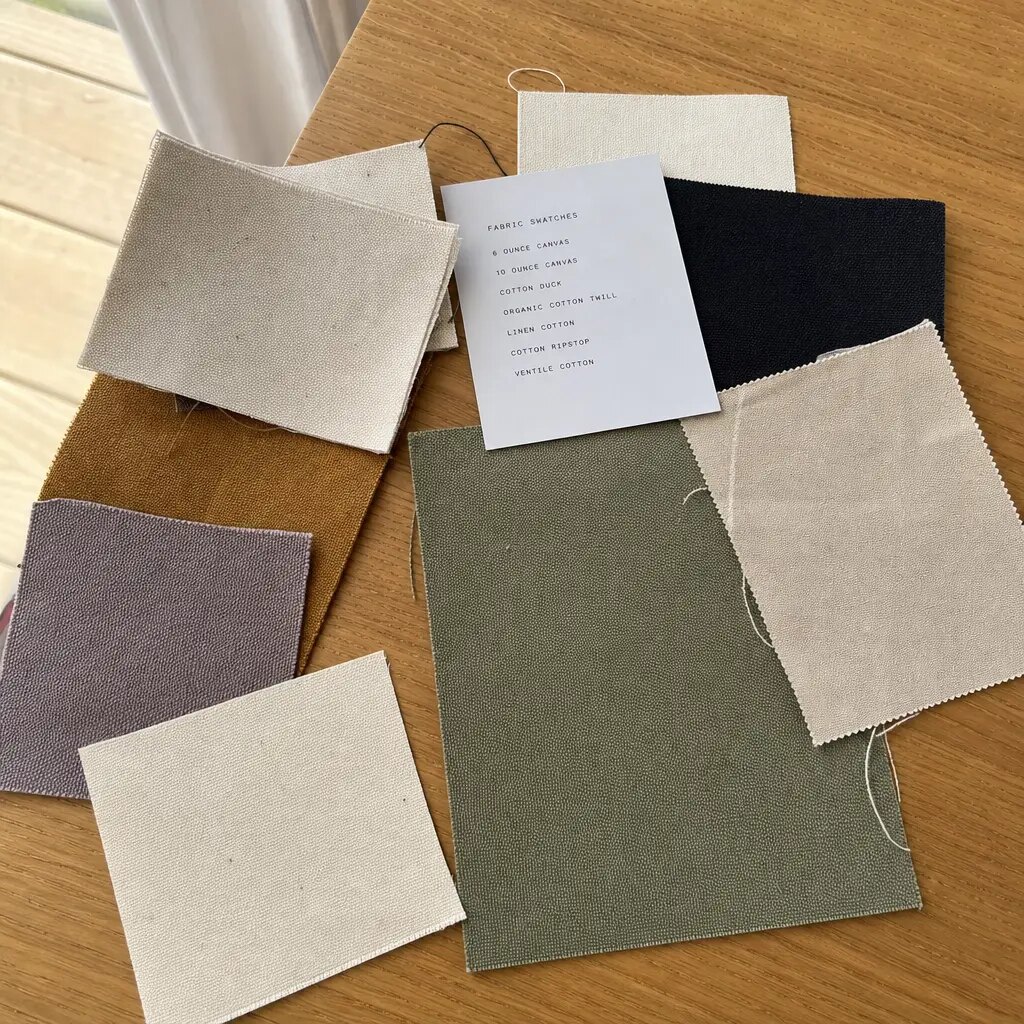
Decide fabric weight before comparing quotes
Canvas zipper portfolios look straightforward, but fabric weight changes the whole build. It affects panel flatness, logo sharpness, zipper setting, sewing speed, carton weight, and how the product feels when a wholesale buyer or retail team opens it. If the RFQ only says cotton canvas zipper portfolio, every supplier will fill in the blank differently.
One factory may quote a soft 10 oz shell with no lining. Another may assume a finished 12 oz canvas with cotton lining. A third may include board inside the panels and a heavier zipper. Those are not comparable offers. The buyer sees three prices, but the products have different structure, weight, function, and risk.
For eco apparel brands, the strongest starting point is usually practical: natural or documented cotton canvas, a reusable hand feel, controlled construction, and no unnecessary component complexity. The goal is not the heaviest fabric. The goal is a portfolio that presents documents cleanly, zips smoothly, carries the intended load, and passes inspection without avoidable rework.
- Fabric weight affects print quality, zipper smoothness, seam bulk, carton weight, and inspection results.
- Light canvas can work, but usually needs lining, fusing, or insert support to avoid a limp result.
- Heavy canvas can feel premium, but it raises corner bulk, zipper waviness, needle strain, and freight cost.
- Finished GSM is the safest buying reference because dyeing, washing, coating, and preshrinking can change the fabric actually cut for production.
- Quote comparison should lock GSM, lining, insert, zipper, branding method, and packing before unit prices are judged.
Oz and GSM: use both, but control finished GSM
Canvas is often described in ounces, but procurement teams should also require GSM. Ounce terminology is familiar in the bag industry, yet suppliers may use it inconsistently. Some mean greige fabric before finishing. Others mean finished fabric. Some use local shorthand that does not convert cleanly. GSM, or grams per square meter, is easier to inspect when everyone agrees it is measured after finishing.
For many branded zipper portfolios, the most useful default is a 12 oz canvas build with a target of 360-390 GSM finished. If the market or mill standard produces a wider band, the RFQ can allow 340-410 GSM only after swatch approval. That range balances structure, printability, sewing efficiency, and manageable carton weight better than very light unlined fabric or very heavy canvas with bulky seams.
Lighter weights around 230-300 GSM can suit press mailers, launch packs, or soft document sleeves when lower weight matters. Heavier weights around 400-540 GSM can support premium presentation kits, but only after the full construction is sampled with the actual zipper and inserts. A swatch alone does not show corner behavior or zipper resistance.
- 230-300 GSM: lighter mailer or soft sleeve; best with lining, fusing, or stabilizer if structure is expected.
- 300-340 GSM: relaxed accessory range, useful when a softer canvas feel is acceptable.
- 340-410 GSM: practical midweight range for most branded canvas zipper portfolios.
- 360-390 GSM finished: recommended default target for a 12 oz procurement spec.
- 400-540 GSM: premium hand feel, but higher risk at zipper turns, thick seams, stitch tension, and carton weight.
- Write tolerance clearly, for example: 12 oz canvas, target 360-390 GSM finished, acceptable bulk tolerance ±5% against approved swatch.
Choose weight by the portfolio’s job
A document holder, tablet sleeve, press mailer, and showroom sales kit are different products. Before selecting weight, define what the portfolio must carry and how it should behave when opened, filled, zipped, packed, shipped, and reused.
Outer fabric alone will not keep a large panel flat. A 10 oz canvas with lining and a 1.2 mm recycled board insert may present line sheets better than a 16 oz unlined shell. A soft retail stationery accessory may deliberately avoid board because a relaxed natural hand is part of the design. The correct construction depends on the use case, not the highest weight in the swatch book.
Opening style is also important. A top-zip sleeve has fewer stress points. A three-side zipper portfolio opens flatter and looks more professional, but it needs square panels, stable zipper tape, controlled corners, and consistent seam allowance. Tablet-compatible styles need padding, zipper clearance, abrasion protection, and device-fit testing.
- Document and swatch holder: 12 oz canvas plus lining and board or fusing for panel support.
- Retail stationery accessory: 12 oz canvas may stay softer if relaxed structure is acceptable.
- Press or onboarding mailer: 8-10 oz canvas can work when weight and mailing thickness matter.
- Tablet portfolio: define padding, device clearance, zipper protection, and abrasion risk; do not rely on GSM alone.
- Three-side zipper portfolio: prioritize zipper gauge, corner construction, panel squareness, and seam allowance control.
- Sales kit: test with the real paper stack, swatch cards, trim cards, or product inserts before approving bulk.
Eco material claims need evidence, not just a natural look
Natural cotton canvas fits many eco apparel brands because it is matte, tactile, reusable, and easy to brand simply. But natural appearance is not documentation. Natural undyed cotton, certified organic cotton, recycled cotton blend, and cotton-poly canvas are different material routes with different evidence, costs, and performance.
If a claim appears on a product page, hangtag, sales deck, or retail package, agree the documentation route before production. Acceptable evidence may include a current scope certificate for the supplier where relevant, transaction certificate or chain-of-custody document where the claim requires it, recycled-content certificate or declaration supported by test or supplier documentation, fiber composition test report, mill certificate, or signed supplier declaration for non-certified composition claims. The correct route depends on the exact wording of the claim.
Recycled cotton blends can be commercially useful, but they should be validated by swatch and sample. They may show more neps, slubs, shade variation, or lower tear strength depending on the yarn. Organic cotton can support stronger marketing language only when the supply chain documents match the claim. If documents are not confirmed, keep wording conservative.
- Do not write eco canvas as the technical spec; state fiber composition, certification need, and document route.
- For organic claims, request relevant scope and transaction documentation where applicable to the chain of custody.
- For recycled claims, request recycled-content evidence and confirm whether the claim is supplier-declared or certified.
- Approve acceptable slub, nep, shade, and surface irregularity using physical swatches.
- Confirm whether fabric is undyed, dyed, washed, preshrunk, coated, calendered, or finished another way.
- Keep one approved fabric swatch and one approved pre-production sample as sealed references for inspection.
Printing must be approved on the chosen canvas
Water-based screen print is common for eco apparel brands because it can look soft, matte, and integrated with natural canvas. It is not equally successful on every cloth. A tighter 12 oz canvas usually holds cleaner edges than open-weave lightweight canvas or coarse heavy duck. Fine serif letters, thin line art, and small reversed text show problems first.
Discuss artwork and fabric together during quoting. A supplier may print a clean logo on a generic sample panel, then struggle on the selected bulk canvas. The safest checkpoint is a strike-off on the approved fabric or actual bulk fabric before production panels are printed.
Dark canvas adds opacity risk. Navy, black, forest, and deep olive may need an underbase or a different decoration route. Alternatives include plastisol, transfer, embroidery, woven label, printed patch, or leather-alternative patch. Each changes cost, hand feel, MOQ, lead time, and durability, so the method should be locked before PO.
- Water-based screen print suits one-color or two-color branding on natural or light canvas.
- Avoid very fine lines below about 0.4-0.5 mm unless the printer confirms repeatability on the selected canvas.
- Request print strike-off on the approved GSM and color, not a smoother substitute.
- Define logo size, location, color reference, placement tolerance, and acceptable opacity.
- Keep print away from seam allowance, zipper distortion zones, fold lines, and high-friction corners.
- Classify poor curing, crocking, bleeding, skew, poor opacity, and registration failure as inspection defects.
Zipper, lining, and inserts drive function
The zipper is a primary functional component, not a minor trim. If it catches at corners, bites the canvas, or feels wavy under the hand, the product feels defective even when the body fabric is attractive.
Nylon coil zippers are usually the safest choice for canvas zipper portfolios because they tolerate curved routes and sewing variation better than rigid teeth. A #5 coil zipper is a practical default for standard document portfolios. A #8 coil may be needed for larger, thicker, or heavily loaded constructions. Metal teeth can look premium, but they require careful testing because they add weight, can scratch contents, and may distort at thick corners.
Quote comparisons often break down at the lining and insert level. An unlined shell, cotton-lined shell, fused shell, foam-padded shell, and board-structured portfolio are different products. Inserts can make a portfolio feel more professional, but they need clearance from zipper seams and corners. If they are cut too large or not secured, they can telegraph through the canvas, shift, buckle, or block the zipper.
- Default zipper: #5 nylon coil for standard portfolios; test #8 for larger or thicker builds.
- Specify zipper tape color, slider finish, puller type, puller size, slider direction, end stops, and reinforcement.
- Define lining material, color, GSM, and whether it is loose, fused, bound, or seam-caught.
- For structure, specify 1.0-1.5 mm recycled board, EVA, foam, or fusible interlining as applicable.
- Check insert clearance so board or foam does not create corner lumps or block the zipper path.
- Require zipper function testing across straight runs, corners, and thick seam joins.
MOQ, lead time, and commercial terms
The hidden MOQ is often a component, not the sewing line. Body canvas, zipper tape, custom pullers, lining, labels, patches, retail packaging, and printed inserts may each carry their own minimum. A factory may agree to sew a lower quantity, while the mill or trim supplier requires more material than the order consumes.
For a first run, the efficient route is usually stock natural canvas, stock zipper tape close to the desired shade, a standard puller, and simple logo application. This can still look premium when proportions, stitching, print, and packing are controlled. It also avoids lab dips, zipper tape dyeing, puller tooling, and long trim approvals.
Ask suppliers to quote a stock-material version and a customized version. The stock version shows the fastest route to market. The custom version can include dyed canvas, exact zipper matching, branded puller, printed lining, retail packaging, or custom cartons. Separate the unit price from all one-time and first-order charges.
- Request Incoterms clearly: EXW, FOB named port, CIF, DAP, or DDP if available.
- Confirm payment milestones, such as deposit, sample approval, pre-shipment balance, or credit terms if already established.
- Separate sample fees, courier fees, screen charges, strike-off fees, puller molds, tooling, and artwork charges.
- Ask whether sample or tooling fees are refundable or credited after bulk order placement.
- Confirm carton quantity, carton size, net weight, gross weight, and volumetric weight before PO.
- Ask for lead time by stage: swatch, strike-off, pre-production sample, bulk material, sewing, inspection, and shipment booking.
Compare quotes by construction, not just unit price
A low unit price can hide lighter fabric, a smaller zipper, no lining, thinner board, loose packing, or no print strike-off. A quote matrix should lock the construction before comparing suppliers.
Start with the same finished size, canvas GSM, fabric finish, lining, insert, zipper, print method, pocket layout, and packing method. Then require each supplier to state deviations. If one supplier quotes 280 GSM canvas and another quotes 380 GSM canvas, they should not be compared as equivalent offers.
Landed cost also matters. Heavier fabric and board inserts increase gross weight and can reduce units per carton. Lighter goods may ship more efficiently, but if they arrive creased or fail the hand-feel expectation, savings disappear. Freight assumptions should be visible during quote review, not discovered after production.
- Normalize size, GSM, lining, insert, zipper, branding, pockets, and packing before ranking prices.
- Require suppliers to list inclusions, exclusions, and substitutions.
- Ask for carton dimensions, units per carton, gross weight, net weight, and volumetric weight.
- Check whether quoted price includes inspection support, export carton, inner packing, labels, and document handling.
- Separate repeat-order unit price from first-order charges.
- Flag any quote that does not identify insert material for a structured portfolio.
Sample approval should simulate real use
The pre-production sample is the last inexpensive checkpoint before bulk cutting. Do not approve it from a front-view photo. Open it flat, fill it, zip it repeatedly, measure it, and let it rest after packing.
Common sample issues often worsen in bulk: zipper tape waviness, corner lumps, print drifting into seam allowance, exposed raw edges, loose lining, board edge visibility, panel twist, and over-compressed packing. If the sample uses substitute fabric, zipper, lining, board, or print ink, record exactly what is approved and what remains pending.
A stronger approval file includes three references: approved fabric swatch, approved print strike-off, and full pre-production sample. For higher-value programs, keep one sealed sample with the buyer, one at the factory, and one with the inspection partner.
- Check actual or approved-equivalent GSM and fabric texture.
- Zip and unzip through the full path, especially corners and thick seam joins.
- Load the real paper stack, swatch cards, trim cards, or tablet dummy.
- Measure closed size, opened size, spine depth, pocket dimensions, and zipper route.
- Inspect logo opacity, edge sharpness, placement, registration, curing, and hand feel.
- Check lining sag, fusing bubbles, insert shifting, board telegraphing, and corner bulk.
- Approve packing method, carton quantity, and compression level before bulk packing.
QC plan for canvas zipper portfolios
Canvas zipper portfolios fail differently from simple totes. The key risks are panel twist, zipper bite, bulky corners, visible insert edges, print skew, zipper tape waviness, poor flatness, and packing deformation. Inspection should combine visual, dimensional, functional, and packing checks.
Use a written AQL plan. A common B2B starting point is ANSI/ASQ Z1.4 or ISO 2859-1, General Inspection Level II, with AQL 2.5 for major defects and AQL 4.0 for minor defects; critical defects should not be accepted. The actual sample size depends on lot quantity and the selected inspection table, so it should be calculated before inspection, not guessed on the warehouse floor.
Functional testing should be practical and defined. During sample approval, require a zipper cycle check such as 50 full open-close cycles on the approved construction. During final inspection, require repeated zipper checks across the sampled units, including corners and thick joins. For retail durability programs, add a higher-cycle lab test if the buyer’s standard requires it.
Packing should be inspected as seriously as the product. Over-compression can crease canvas, distort board, mark printed panels, and bend zipper corners. Carton checks should include carton strength, label accuracy, units per carton, moisture protection, gross weight, and a buyer-defined or ISTA-style drop check when transit damage is a known risk.
- Set AQL level, sample size method, major/minor/critical defect definitions, and reinspection rules before production.
- Check finished GSM from random panel cuttings where possible and compare with the approved swatch.
- Measure body dimensions, pocket sizes, logo placement, spine depth, and zipper route against tolerance.
- Treat zipper catching, fabric bite, broken slider, separated coil, severe waviness, and sharp exposed ends as major defects.
- Reference ISO 105-X12 or AATCC 8 for rubbing/crocking checks on dyed canvas or printed areas where color transfer risk matters.
- Inspect stitch density, skipped stitches, loose threads, bartacks, seam allowance, and reinforcement at stress points.
- Check panel flatness after unpacking rest, ideally 24 hours for structured portfolios.
- Review carton drop or transit checks for crushed corners, print transfer, zipper deformation, and board distortion.
Specification comparison for buyers
| Spec decision | Recommended option | When it fits | Buyer risk to check |
|---|---|---|---|
| Default body fabric | 12 oz cotton canvas, typically 360-390 GSM finished, acceptable production band 340-410 GSM only if approved by swatch | Best starting spec for eco apparel brand document portfolios, sales kits, showroom folders, and reusable onboarding packs | Confirm the supplier quotes finished GSM, not greige weight; approve bulk fabric swatch and set inspection tolerance before cutting |
| Lightweight route | 8-10 oz canvas, usually about 230-300 GSM finished, with lining, fusing, or thin board if structure is required | Press mailers, low-weight launch packs, soft document sleeves, or courier-sensitive programs | Unlined light canvas can wrinkle, collapse at corners, show seam allowances, and feel underbuilt after compression packing |
| Structured premium route | 14-16 oz canvas, commonly about 400-540 GSM finished, with zipper gauge and corner construction engineered for bulk | Distributor presentations, showroom tools, and higher-value retail stationery accessories | Heavy fabric increases zipper waviness, corner lumps, skipped stitches, carton weight, and reject risk if not sampled as a complete build |
| Canvas construction | Tight-weave cotton or cotton-rich canvas with controlled shrinkage, panel skew, shade, and surface defect standard | Cleaner panels, sharper printing, more stable finished dimensions, and better repeatability in bulk | Open weave or excessive slubs can create logo feathering, panel twist, shade mismatch, and inconsistent hand feel |
| Sustainability evidence | Natural undyed cotton with composition statement, organic cotton with transaction/certificate route where claimed, or recycled cotton with recycled-content evidence | Eco apparel programs that need responsible material language without overcomplicating the first order | Do not print organic, recycled, or low-impact claims unless documentation route is agreed and the claim matches the supplied evidence |
| Printing method | One-color or two-color water-based screen print on approved canvas, with strike-off before bulk | Natural or light canvas portfolios needing a soft brand mark and efficient repeat production | Fine lines under 0.4-0.5 mm, small reversed text, dark fabric, rough texture, or tight registration may need artwork changes or another branding method |
| Closure choice | #5 nylon coil zipper for standard portfolios; #8 nylon coil for larger, thicker, or heavily loaded designs after testing | Most three-side zipper portfolios and document cases where smooth function matters more than decorative teeth | Metal zippers can look premium but may scratch contents, distort on corners, add weight, and jam at thick seams |
| Inside structure | Cotton lining plus 1.0-1.5 mm recycled board, EVA, foam, or fusible interlining where flatness or protection is required | Portfolios carrying papers, swatch cards, trim cards, tablets, sales sheets, or retail inserts | Poor insert clearance can create edge telegraphing, buckling, shifted boards, corner lumps, and blocked zipper paths |
| Commercial route | Quote both a stock-material first run and a customized route with dyed canvas, matched zipper tape, custom puller, or retail packaging separated | Lets buyers compare speed, MOQ, cash exposure, and brand value | Custom components add lab dips, tooling, sample charges, higher MOQ, longer lead time, and more approval checkpoints |
Buyer checklist before sampling
- Define the use case: document holder, tablet sleeve, sales kit, onboarding pack, press mailer, showroom tool, distributor kit, or retail stationery accessory.
- Use a default RFQ spec of 12 oz cotton canvas, 360-390 GSM finished target, with 340-410 GSM only if accepted by approved swatch and written tolerance.
- Clarify whether the quoted fabric weight is greige, dyed, washed, coated, calendered, preshrunk, or finished; finished GSM is the inspection reference.
- State fiber composition and claim route: conventional cotton, certified organic cotton, recycled cotton blend, cotton-poly blend for stability, or other documented material.
- Request evidence for any sustainability claim used on product pages, hangtags, cartons, sales decks, or retail packaging.
- Define finished closed size, opened size, spine or gusset depth, zipper route, pocket sizes, and the exact document or device the portfolio must hold.
- Set tolerances, commonly ±5 mm for main body dimensions and ±3 mm for small pockets, logo placement, and critical alignment points.
- Specify zipper type, gauge, tape color, slider finish, puller type, puller size, slider direction, end stops, and reinforcement at zipper ends.
- State lining, fusing, foam, EVA, recycled board, pockets, pen loops, card slots, dividers, mesh panels, elastic organizers, and attachment methods.
- Require carton quantity, carton dimensions, net weight, gross weight, packing format, polybag or paper wrap choice, and compression limit before PO approval.
Factory quote questions to send
- What is the quoted canvas composition, weave, finish, and finished GSM range? Is the stated oz weight based on greige or finished fabric?
- Can you quote the recommended 12 oz build as 360-390 GSM finished target, and identify whether any production tolerance outside that range is expected?
- Is the body fabric stock or custom woven/dyed? What MOQ, lab dip lead time, bulk fabric lead time, wastage allowance, and shade approval process apply?
- Can you provide labeled swatches for 8 oz, 10 oz, 12 oz, and 14 oz options showing composition, finished GSM, finish, available colors, and sustainability documentation route?
- What shrinkage tolerance do you control in warp and weft, and under what test condition is it measured?
- What colorfastness to rubbing/crocking and color transfer standard do you control for dyed canvas, especially against light linings, documents, or apparel samples?
- What lining, fusing, foam, EVA, recycled board, or support material is included in the price? State GSM or thickness and exact placement.
- Which zipper type, gauge, tape material, slider style, puller type, end stop construction, and reinforcement are included? Is the puller stock or custom?
- How will zipper ends, spine points, and thick corners be built to prevent catching, puckering, broken stitches, fabric bite, or seam failure?
- What stitch type, stitch density, thread, needle size, seam allowance, binding method, and bartack locations are planned for bulk production?
Quality-control points to confirm
- Use ANSI/ASQ Z1.4 or ISO 2859-1 single normal sampling unless another plan is agreed; a common starting point is General Inspection Level II with AQL 2.5 for major defects and AQL 4.0 for minor defects, with critical defects not accepted.
- Confirm the actual sample size from the lot quantity using the agreed AQL table before inspection; do not use an informal fixed sample count unless written into the PO.
- Finished fabric GSM should match the approved standard within tolerance, checked from random bulk body-panel cuttings where possible, not only mill paperwork.
- Canvas composition and sustainability documentation should match the purchase order, especially where organic cotton, recycled cotton, or other external claims are used.
- Front panels should be free from obvious oil marks, weaving bars, shade streaks, holes, repairs, severe creases, and excessive slubs beyond the approved natural-canvas standard.
- Fabric shade should remain within the approved shade band; obvious panel-to-panel mismatch on front, back, spine, pocket, or zipper tape should be classified by agreed severity.
- Finished dimensions should meet tolerance for closed size, opened size, spine or gusset depth, pocket size, organizer sections, and document-fit areas.
- Panels should lie flat after unpacking rest, ideally 24 hours for structured styles, without twisting, severe corner curl, bowed edges, board distortion, or shifted insert position.
- Zipper function should be checked across the full path. For production approval, define a practical cycle expectation such as 50 open-close cycles on sample approval and functional zipper checks during final inspection; higher-cycle lab testing can be added for retail durability programs.
- Zipper should not catch at thick seam joins, bite fabric, separate, skip coils or teeth, expose sharp ends, or require excessive force around corners.