Start with the event distribution problem
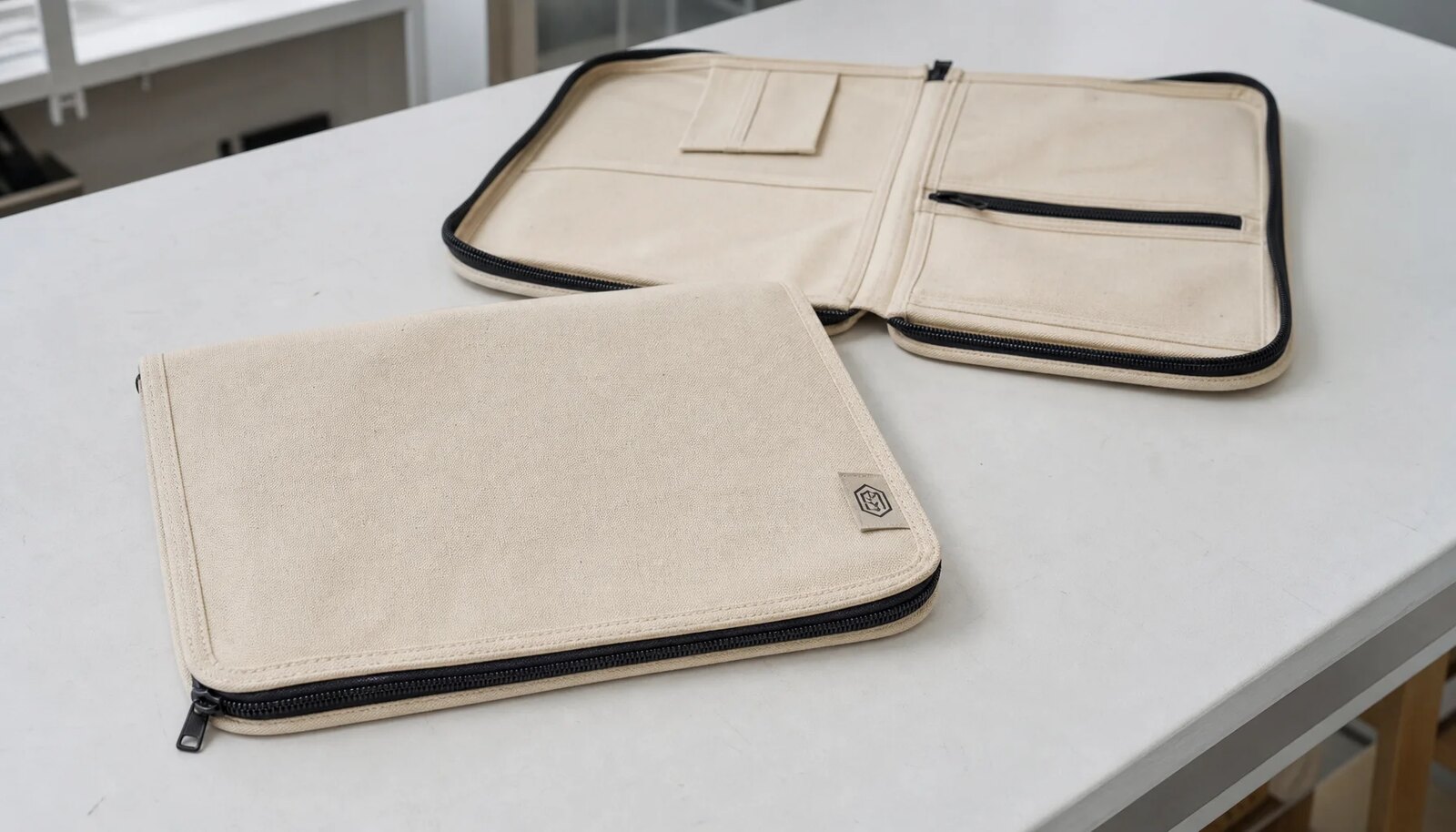
Canvas zipper portfolios for event planners look straightforward on a sample table. They are fabric document organizers with a zipper, pockets, and a logo. In procurement, though, the item is part of a moving event operation. A portfolio may travel from factory to forwarder, from forwarder to a fulfillment center, from fulfillment center to a hotel dock, and then into registration counters, sponsor rooms, staff kits, or VIP welcome bags. That is why shipping carton planning should appear in the first RFQ, not in a rushed email after production is finished.
The right case pack depends on how the event team will receive and distribute the goods. A 1,000-piece order packed 50 per carton creates 20 cartons, which may be efficient for freight and warehouse counting. The same order packed 25 per carton creates 40 cartons, which may cost more to handle but can be easier to split across rooms, cities, attendee types, or sponsor allocations. Neither plan is automatically correct. The useful plan is the one that fits the receiving process without wasting freight volume or slowing down event setup.
For accurate B2B sourcing, ask suppliers to quote the portfolio and the carton together. A unit price without pieces per carton, carton dimensions, gross weight, and packing method is only a partial quote. Carton data affects dimensional weight, pallet count, LCL volume, courier charges, warehouse labor, damage risk, and count verification. The phrase canvas zipper portfolios for event planners shipping carton planning may sound narrow, but it captures the real buying problem: the product has to be made well, packed sensibly, labeled clearly, and delivered in a way the event team can use.
- Define the final receiving point before approving the case pack.
- Ask whether cartons will be opened by warehouse staff, venue staff, registration staff, or a third-party fulfillment team.
- Compare suppliers using unit price plus carton dimensions, gross weight, case count, and packing method.
- Treat missing carton data as an RFQ gap, even when the product sample looks acceptable.
Translate the event kit into product dimensions
Portfolio size should start with the actual event contents, not with a generic sample. A registration kit with a letter-size agenda, venue map, badge holder, sponsor flyer, and pen needs different dimensions from a speaker kit with contracts, notepads, a tablet, and a thicker booklet. International programs may need A4 compatibility. North American programs often start with letter-size paper. Legal documents, folded floor plans, rigid badge sheets, or thick printed booklets can change the requirement more than the outside dimensions suggest.
Avoid specifying only the outer size from a reference item. Inside usable space is what protects the event materials. Seam allowance, zipper curve, binding, pocket construction, lining bulk, and corner radius all reduce the room available for paper. A portfolio listed as 13 by 10 inches may still feel tight if the zipper opening is narrow or the inside pocket depth is short. Ask the factory to confirm outside size, inside usable size, pocket depth, and zipper opening width in millimeters. Small differences matter when staff must insert hundreds of agendas quickly.
The RFQ should include an insert list with maximum length, width, and stack thickness. If the portfolios ship empty to the venue, test the empty product and empty carton. If the factory or fulfillment center will pre-pack agendas, sponsor cards, or notebooks, test the filled product and filled carton. Loaded portfolios can bow, strain the zipper, increase carton height, or change the gross weight enough to affect freight. A carton estimate based on flat empty units may not hold once the event kit is real.
- List every item the portfolio must hold, including maximum length, width, and stack thickness.
- Request outside size, inside usable size, pocket depth, zipper opening width, and folded thickness.
- Specify whether samples and carton estimates should be tested empty or filled with the buyer's insert set.
- Mark optional features separately from required features so suppliers can price alternates clearly.
Specify canvas in measurable terms
Canvas weight is a helpful starting point, but it is not a full specification. Many event portfolios use 12oz cotton canvas because it balances structure, cost, decoration performance, and carton efficiency. In many supplier conversions, 12oz canvas is roughly around 400 to 430 gsm, but buyers should confirm the supplier's actual gsm rather than assuming every ounce rating converts the same way. A heavier 14oz or 16oz canvas can improve perceived structure. It can also increase sewing difficulty, folded thickness, carton volume, and dimensional freight.
Procurement teams should specify fabric composition, weight, tolerance, finish, and color control. A practical line might read: 100 percent cotton canvas, 12oz nominal, supplier to confirm gsm, plus or minus 5 percent weight tolerance, natural undyed finish, no severe slubs or stains on visible panels. If the canvas is dyed, add a Pantone reference or approved physical swatch, and ask whether the fabric is piece-dyed, pigment-dyed, washed, coated, or otherwise finished. Those choices affect shade variation, hand feel, shrinkage, scuff visibility, and logo performance.
Lining and interlining deserve the same attention. A 12oz outer canvas with a light polyester lining can feel cleaner inside than a heavier unlined body. A non-woven backing or light interlining can add structure but may increase fold thickness. Binding tape can improve edge finish but adds bulk near corners. For carton planning, the most useful number is not fabric weight alone. It is the finished folded thickness of the actual approved construction, including pockets, lining, zipper tape, labels, patches, and reinforcement.
- Request canvas weight in both oz and gsm where possible.
- Define an incoming fabric tolerance, such as plus or minus 5 percent, if that is acceptable for the program.
- Approve fabric color by physical swatch for bulk orders, not only by screen image.
- Ask for finished folded thickness after lining, pockets, zipper, binding, and logo trim are included.
Control zipper construction before sampling
The zipper is the main working part of the portfolio. Strong canvas does not help much if the zipper catches at the corner, twists under tension, or feels weak in the hand. For many document portfolios, a No. 5 nylon coil zipper is a sensible default because it is flexible, widely available, cost controlled, and able to follow curves better than many heavier tooth zippers. A No. 3 zipper can feel small on a larger portfolio. A No. 8 zipper may be unnecessary unless the item is oversized, heavily loaded, or designed to show a larger closure.
A useful quote identifies zipper size, coil or tooth type, tape material, tape color, slider material, finish, puller style, and end-stop construction. These details affect appearance, operation, and packing risk. A painted metal slider can chip or scuff light canvas. A large metal puller can look premium but press into nearby units when stacked. A fabric loop puller may reduce scuffing, but it still needs clean stitching and enough pull strength. If the brand wants a custom puller, ask for mold cost, MOQ, approval sample, and lead time because custom trims can become the timing bottleneck.
Zipper geometry should be checked on the actual sample, not only discussed in the spec sheet. Three-sided zipper openings are convenient for document access, but a tight corner radius or uneven sewing tension can cause drag. A top-only zipper is simpler and often easier to sew, but it may not open wide enough for fast insertion of event documents. QC should include repeated open-close testing from different cartons. For a date-critical event, zipper feel is not a small detail; it determines whether the portfolio can be packed and used without frustration.
- Write No. 5 nylon coil zipper, or the selected alternative, directly into the spec sheet.
- Approve zipper tape color, slider finish, puller shape, and end-stop construction before bulk ordering.
- Test zipper movement around corners with the actual canvas, lining, and pocket construction.
- Use protective packing when zipper hardware can rub against light canvas or printed logos.
Match decoration to artwork risk
Decoration is often where quote differences become visible. A one-color screen print can be efficient for medium and large runs with bold logos, sponsor marks, or event names. It still needs clear specifications: ink type where relevant, print size, color reference, print location, placement tolerance, and whether printing happens before or after sewing. Printing before sewing can give better panel access, but cutting and sewing must keep the artwork centered. Printing after sewing may be limited by seams, zipper bulk, and uneven surface height.
Woven labels, patches, heat transfers, and embroidery each have a place. A woven label can handle small type better than some canvas prints, but it adds label MOQ and sewing placement tolerance. A patch can create a more finished look, yet edge finish and attachment strength matter. Heat transfer can reproduce fine detail, but adhesion, cracking, texture compatibility, and edge lift should be tested on the actual canvas. Embroidery may look strong on thicker constructions, although it can pucker the fabric or make small lettering hard to read.
The RFQ should include vector artwork, color references, maximum logo size, location from fixed seams or edges, and an approval sequence. For higher-risk artwork, request a strike-off before the complete pre-production sample. A strike-off is faster and cheaper to revise than a sewn sample. It also prevents a familiar sourcing problem: the portfolio body is acceptable, but the selected logo method cannot reproduce the artwork cleanly at the requested size.
- Use screen print for bold marks with limited color count and adequate stroke width.
- Use woven labels or patches when small type, repeat consistency, or multi-color branding is more important.
- Test heat transfers for adhesion, edge lift, cracking, and texture compatibility on the actual canvas.
- Define logo placement tolerance in millimeters from fixed seams, zipper edge, or portfolio edge.
Build carton math from real packed dimensions
Carton planning starts with how the finished item folds and stacks. The buyer needs finished size, folded size, packed thickness, individual bag size, pieces per carton, carton dimensions, net weight, and gross weight. A portfolio may look flat on a sample table but behave differently in a stack of 30 or 50 units. Zipper hardware, pocket seams, labels, patches, and folded corners create uneven pressure points. If the carton is too tight, goods may arrive with curled corners, compressed zipper tracks, or scuffed logos. If the carton is too loose, freight volume rises and cartons may crush more easily.
There is no universal case pack for canvas zipper portfolios. A soft, empty 12oz portfolio may work at 40 or 50 units per carton if gross weight and dimensions remain manageable. A structured 16oz portfolio with multiple interior pockets, a patch, or a large puller may be better at 20 to 30 units per carton. Carton weight should also match the receiving team's handling limit. Many buyers prefer manually handled cartons below about 15 to 20 kg, but the exact limit should come from the buyer's warehouse, venue, courier, or safety policy.
Ask whether carton dimensions are estimated or physically tested. A supplier estimate is useful early in RFQ comparison, especially before a sample exists. Final approval should come from a packed sample carton or documented packing test after the pre-production sample is approved. If the buyer changes canvas weight, adds a pocket, switches to a larger puller, or pre-packs printed inserts, the carton plan should be recalculated. The carton is part of the specification, not a leftover production decision.
- Request carton dimensions in centimeters or inches and weight in kilograms or pounds.
- Confirm whether carton data is estimated, based on a similar item, or tested with the approved sample.
- Set a maximum carton gross weight that matches the receiving environment.
- Recheck carton count if the product or insert set changes after sampling.
Use a quote table that exposes logistics cost
A supplier quote should make assumptions visible. Buyers often compare unit price first, but the lower unit price may not produce the lower landed cost if the carton is larger, the gross weight is higher, or the packing format creates more handling labor. A clear logistics table lets procurement, freight forwarders, and event operations teams work from the same facts. It also reduces late surprises when the factory is ready to ship and the freight quote no longer matches the first estimate.
The quote table should include SKU, color, logo version, finished size, folded size, units per inner bag if used, units per master carton, carton dimensions, net weight, gross weight, carton material, carton mark, and destination split. For courier shipments, dimensional weight can exceed actual gross weight, so carton dimensions are just as important as scale weight. For LCL or pallet freight, stackability, carton strength, moisture protection, and pallet pattern become more important. For air freight, both volume and gross weight can affect budget.
For multi-venue events, add allocation columns. If 1,200 portfolios ship to three cities, the factory should know whether each city receives full cartons only, exact counts, mixed cartons, or separate SKUs. Exact counts can require carton-level picking and extra labor. Full-carton allocation is simpler, but it may require extra stock at each destination. The buyer should decide this before packing begins, rather than letting the factory choose the easiest production arrangement.
- Use one quote table format across all suppliers so pricing and logistics assumptions are comparable.
- Ask for carton marks that match the buyer's allocation plan, not only the factory's SKU code.
- For courier shipments, compare dimensional weight with actual gross weight before approving cartons.
- For pallet freight, request pallet quantity, stack height, pallet pattern, and label-facing direction.
Separate MOQ, setup, and mixed-SKU costs
MOQ for canvas zipper portfolios can come from several places. Fabric may have a dye-lot or roll minimum. Zippers may have a color, tape, slider, or puller minimum. Woven labels, patches, custom pullers, and printed cartons can each carry their own setup or minimum. A supplier who says the MOQ is 500 pieces may be simplifying a more complex cost structure. Procurement should ask which component controls the minimum and what changes at each quantity tier.
Mixed SKUs are common in event programs. The buyer may need the same natural canvas body with different sponsor logos, or different colors for staff, speakers, VIP guests, and general attendees. If only the logo changes, the factory may combine cutting and sewing, then split decoration and packing. If canvas color, size, zipper color, lining, or pocket layout changes, each version may require separate material control and production setup. The quote should show whether MOQ applies per total order, body style, fabric color, artwork, or destination pack.
Setup charges should be visible when the program may repeat. Screen charges, heat-transfer setup, label tooling, custom puller mold cost, sample fees, carton label setup, and special packing labor can be hidden inside the unit price, but transparency helps buyers compare suppliers and plan reorders. One-time charges should not automatically repeat unless artwork, mold, screen, label, or packaging changes. For annual conferences and recurring client programs, this distinction can materially improve procurement accuracy.
- Request price breaks at 300, 500, 1000, 3000, and 5000 pieces or the quantities relevant to the program.
- Ask whether MOQ is per order, per color, per artwork, per body style, or per destination split.
- Separate recurring unit costs from one-time setup, tooling, screen, mold, or sample costs.
- Confirm whether mixed logos can share the same body production run.
Approve samples with QC and packing evidence
Sample approval should test function, not just appearance. The buyer should open and close the zipper repeatedly, insert the actual documents, check pocket usability, verify logo placement, and inspect how the portfolio folds. If the product will be used at registration, staff should be able to fill it quickly and attendees should be able to open it without fighting the zipper. If it will be mailed, couriered, or shipped across multiple venues, it should survive the intended packing method without print rub, hardware marks, or corner deformation.
A complete approval file includes the physical sample, fabric swatch, zipper reference, lining material, artwork proof, logo strike-off, measurement sheet, construction notes, packing method, and carton data. This file becomes the standard for bulk inspection. If the approved sample uses one zipper and bulk production uses another, or if the case pack changes after approval, the buyer loses control. Require written approval for substitutions in canvas lot, zipper puller, lining, thread, logo method, pocket layout, carton size, or packing method.
Photos can support timing, but they do not replace a production-like sample for higher-volume or date-critical orders. Photos cannot fully show zipper drag, canvas hand feel, fabric thickness, print adhesion, or stack compression. If time is short, use staged approvals: fabric swatch and zipper trim first, artwork strike-off second, pre-production sample third, and packed-carton photos with measurements before shipment. This keeps the process moving while still documenting the quality points that cause real event problems.
- Test the sample with the real agenda, badge sheet, notepad, sponsor insert, or tablet.
- Measure outside size, inside usable size, pocket depth, zipper opening width, and folded thickness.
- Approve the individual bag, separator, fold direction, and master carton at the same time as the product.
- Keep a sealed approval sample for pre-shipment inspection comparison.
Inspect before shipment release
Pre-shipment inspection should cover material, construction, function, decoration, and packing. For material, inspect canvas weight where possible, fabric shade, stains, weaving defects, and visible panel mismatch. For construction, check seam alignment, stitch density, zipper ends, binding, corners, pocket openings, label attachment, pen loops, and reinforcement points. For function, open and close zippers on samples from multiple cartons, especially around corners and end stops. A portfolio can pass a quick visual check and still fail when it is used.
Decoration inspection should be based on the approved sample and measurable tolerance. Screen print checks include edge clarity, ink coverage, color consistency, registration, smudging, and placement. Woven label checks include orientation, centering, edge finish, and stitch security. Heat transfer checks include adhesion, edge lift, cracking, and surface compatibility. Embroidery checks include puckering, thread breaks, density, and small-letter legibility. Put these checks in the purchase order or inspection brief so the supplier sees the pass or fail standard before production.
Packing inspection is equally important. Count units per carton, verify inner bags or separators, measure representative cartons, and weigh representative cartons. Carton marks should match the PO, SKU, color, logo version, destination, count, and sequence number. If goods are palletized, inspect pallet pattern, stack height, stretch wrap, corner protection if required, and label visibility. If goods ship by courier, check carton strength, tape method, and individual handling risk. A well-made portfolio in a weak or mislabeled carton can still disrupt the event schedule.
- Use an inspection checklist that covers product and carton details together.
- Sample units from different cartons and different points in the production run.
- Photograph carton marks, inner packing, carton dimensions, and gross weight before shipment release.
- Do not release shipment until product counts and destination carton labels match the packing list.
Specification comparison for buyers
| Procurement decision | Typical B2B specification | Quote detail to request | Buyer risk to control |
|---|---|---|---|
| Sourcing model | Direct factory production with custom size, pocket layout, logo, and export carton plan | Factory profile, production photos, sample schedule, carton pack sheet, inspection availability, incoterm, and named production site | A low unit price can hide weak documentation, loose tolerances, unclear packing responsibility, and late carton changes |
| Sourcing model | Trading company managing factory production and export coordination | Named factory location or audit documents where available, itemized quote, sample ownership, trim approval process, and packing approval process | The buyer may receive vague fabric names, substituted trims, or carton data copied from another style |
| Sourcing model | Domestic decorator using imported blank portfolios | Blank brand or source, available case pack, decoration capacity, print proof timing, replenishment rules, and carton relabeling options | Fast turnaround may come with limited size control, higher unit cost, inconsistent blank lots, and less freedom over carton dimensions |
| Fabric weight | 12oz cotton canvas, often about 400 to 430 gsm depending on supplier conversion | Actual gsm test method, allowed weight tolerance such as plus or minus 5 percent, finish, color lot, lining, and shrinkage status | Nominal ounce weight alone does not confirm hand feel, panel stiffness, folded thickness, or carton volume |
| Fabric weight | 14oz to 16oz cotton canvas for more structure or heavier insert sets | Gsm, folded thickness, sewing test, needle size, lining or interlining, reinforcement method, and confirmed carton count | Higher weight can increase sewing defects at corners, dimensional freight, and carton handling weight |
| Zipper | No. 5 nylon coil zipper with matching or contrast tape and standard metal or plastic slider | Zipper size, tape material, slider finish, puller type, pull strength target, color reference, corner radius, and end-stop method | Generic zipper wording allows substitutions that affect feel, durability, scuffing, and opening speed during event packing |
| Logo method | One-color screen print, woven label, patch, heat transfer, or embroidery based on artwork | Artwork file type, Pantone or thread color, print area, placement tolerance, strike-off approval, bulk approval standard, and rub or adhesion test | Fine type, small registration marks, weak adhesion, or poor placement can create visible rejects even when sewing is acceptable |
| Packing format | Flat pack in individual polybag or paper wrap, then master carton | Bag size, separator use, fold direction, units per carton, carton dimensions, net weight, gross weight, carton mark, and destination split | Unapproved packing can deform corners, scuff canvas, rub printed logos, confuse receiving teams, or trigger higher freight charges |
| Carton specification | Single-wall or double-wall corrugated carton selected by route, weight, and handling risk | Board grade or bursting or edge-crush strength where available, carton size, tape method, drop handling expectation, pallet pattern, and label format | Weak cartons can crush in courier networks or LCL handling even if the portfolios pass product QC |
Buyer checklist before sampling
- Confirm the finished outside size, inside usable document size, zipper opening width, folded thickness, and whether the portfolio must fit letter, A4, legal, notepad, tablet, lanyard cards, badge sheets, sponsor inserts, or pre-packed event materials.
- Specify canvas in measurable terms: cotton or blend, weight in oz and gsm, accepted tolerance, finish, color reference, lining, interlining, binding tape, and any wash or anti-shrink process.
- Lock the zipper specification before final pricing: size, coil or tooth type, tape material, tape color, slider finish, puller style, end stops, corner radius, and minimum acceptable zipper smoothness.
- Define pocket layout with a drawing or annotated sample, including usable pocket depth, opening direction, pen loop width, card slot count, tablet sleeve size, seam allowance, and stress-point reinforcement.
- State the logo method, artwork file format, color references, maximum imprint area, location from fixed seams, placement tolerance in millimeters, strike-off process, and bulk approval standard.
- Request a quote table that separates unit price, sample fee, screen or tooling fee, label setup, custom zipper or puller cost, packing labor, carton marking, and freight-related documentation charges.
- Ask for carton dimensions, pieces per carton, net weight, gross weight, carton material, individual bag or separator details, pallet quantity if relevant, and whether dimensions are measured after final packing.
- Confirm whether the quoted case pack is based on empty portfolios, flat portfolios with no inserts, folded portfolios, or fully packed event kits containing printed materials.
- Specify whether the order ships bulk-packed, retail-ready, venue-sorted, sponsor-sorted, attendee-category sorted, palletized, courier-ready, LCL-ready, FCL-ready, or carton-only for a fulfillment center.
- Set measurable QC rules for fabric shade, fabric weight, size tolerance, zipper operation, stitch density, thread trimming, logo registration, pocket dimensions, carton count, carton labels, and gross-weight variance.
Factory quote questions to send
- What is the exact canvas composition and weight in both oz and gsm, and what incoming fabric tolerance do you apply during inspection?
- Is the fabric natural, bleached, dyed, pigment-dyed, washed, or coated, and can you provide a swatch from the same lot planned for bulk production?
- What is the measured thickness of the finished portfolio when empty and when packed with the buyer's sample insert set?
- Which zipper is quoted, including size, coil or tooth type, tape material, tape color, slider material, slider finish, puller style, end-stop method, and supplier grade?
- What lining, interlining, pocket fabric, binding tape, thread type, stitch density, reinforcement, and seam allowance are included in the quoted construction?
- What are the finished outside dimensions, inside usable dimensions, zipper opening width, pocket depths, folded dimensions, and size tolerance?
- What is the unit price at 300, 500, 1000, 3000, and 5000 pieces, and which specification changes at each price tier?
- Which costs are one-time tooling or setup charges, and which costs repeat on every order or every artwork version?
- Which print or logo method is included, how many colors are included, what color standard is used, and what is the approved logo placement tolerance?
- Can mixed artwork versions share the same cutting and sewing run, and what extra cost applies for each logo, label, carton mark, destination label, or packing split?
Quality-control points to confirm
- Canvas weight should match the agreed oz or gsm specification within the written tolerance, commonly plus or minus 5 percent if no stricter standard is agreed, and bulk panels should show no obvious shade mismatch, stains, weak thin spots, severe slubs, holes, or weave gaps.
- Finished measurements should be checked against the approved sample and spec sheet, including outside size, inside usable size, pocket depth, zipper opening width, and folded thickness; tolerances should be written, such as plus or minus 5 mm for major dimensions when suitable for the design.
- Zipper function should be tested on units from multiple cartons, with repeated open-close checks around corners and ends; reject conditions include snagging, skipped coil teeth, slider twisting, puller looseness, tape waviness, exposed sharp ends, and uneven zipper tension.
- Zipper pullers and sliders should be checked for scuff risk against light canvas and printed panels, especially when units are bulk stacked; protective paper, puller wrapping, or bag orientation should be used when needed.
- Stitching should be even at zipper ends, pocket openings, binding, corners, labels, pen loops, and reinforcement points, with no skipped stitches, broken threads, loose bar tacks, open seams, raw edges, or long untrimmed thread tails.
- Stitch density should be consistent with the approved sample; if the buyer requires a number, define stitches per inch or per centimeter on the spec sheet rather than relying on a general instruction such as neat stitching.
- Interior pockets should match the approved layout, usable depth, opening direction, seam strength, and edge finish so papers, badge sheets, and inserts do not catch on rough seams or unfinished tape.
- Logo quality should be checked against the approved strike-off or sealed sample for color, scale, location, edge clarity, registration, adhesion, label orientation, embroidery puckering, and heat-transfer edge lift.
- Bulk production should be compared with the sealed pre-production sample for fabric hand feel, fabric shade, zipper color, thread color, lining quality, pocket layout, fold thickness, logo scale, and overall construction before final packing begins.
- Individual bags, tissue, release paper, or separators should prevent zipper sliders, pullers, and printed surfaces from rubbing during compression, container movement, courier handling, or pallet stacking.