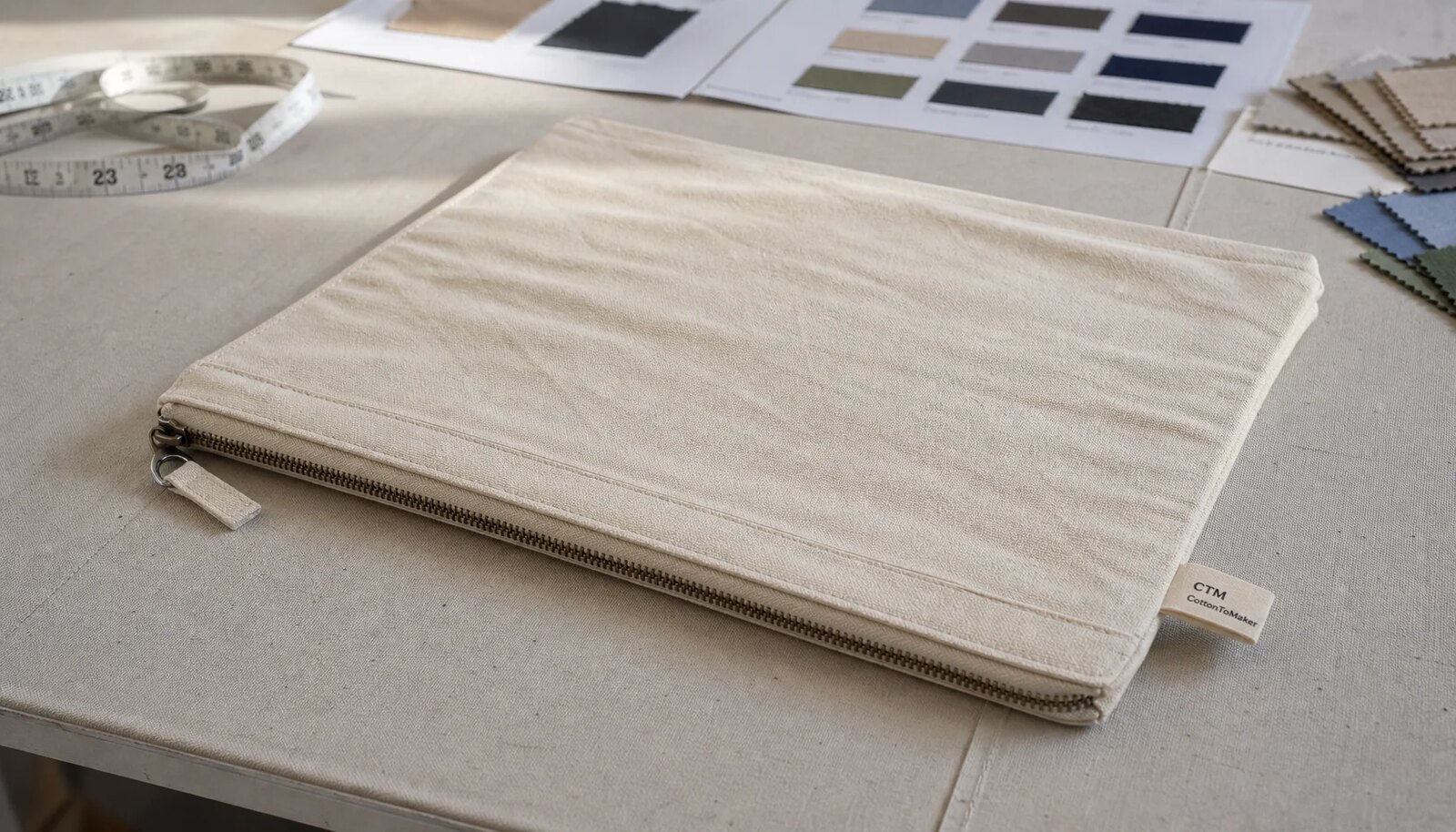
Start MOQ negotiation with a measurable product definition
For canvas zipper portfolios, MOQ is rarely a random number. It is usually built from fabric roll buying, trim minimums, cutting yield, decoration setup, sewing line changeover, inspection time, and packing configuration. If the RFQ says only canvas zipper portfolio for an eco apparel brand, each supplier has to invent the missing specification. One may quote a thin flat document pouch, another may quote a lined business portfolio with a metal zipper and internal pocket. Both quotes can look valid, but they are not comparable.
A procurement buyer should begin with the intended job of the portfolio. Eco apparel brands often use this product for wholesale buyer appointments, market week packets, retailer onboarding documents, press material, sales team tools, or trade show follow-up kits. Those use cases look similar in a catalog photo but perform differently in real handling. A one-time trade show giveaway can be simpler than a sales representative portfolio that is opened every week and loaded with line sheets, lookbooks, and fabric swatches.
The most effective MOQ negotiation is not simply asking the factory to lower the number. It is asking what specification choices create the minimum and then simplifying the right areas. A strong base spec may use one stock canvas color, 14 oz cotton canvas, one-color screen print or a standard sewn label, stock nylon coil zipper, unlined interior, and standard export carton packing. Premium options can then be quoted separately, such as metal zipper, document pocket, woven label, or custom puller. This gives the buyer a real cost map instead of a vague yes or no.
- Use one spec version number across RFQ, sample comments, purchase order, and QC checklist.
- Write the product use case before features: appointment kit, sales folder, press pack, retailer onboarding pack, or giveaway.
- Separate mandatory construction from optional upgrades so the supplier can quote controlled alternatives.
- Ask the factory to explain the MOQ driver: fabric, zipper, label, printing, sewing changeover, packing, or a combination.
- Do not compare unit prices until canvas weight, zipper type, logo method, interior construction, and packing are normalized.
Define finished size by real contents, not by paper format alone
A4, Letter, or portfolio size is not enough for production. A finished canvas zipper portfolio must include space for seam allowance, zipper tape, corner turning, document thickness, and the buyer’s actual contents. A portfolio that fits a single sheet of paper when empty may become too tight when loaded with a 6 mm lookbook, order forms, stickers, swatch cards, or a slim tablet sleeve. The zipper needs enough clearance to close without forcing the corners or bending the contents.
The RFQ should state finished dimensions in width x height, plus thickness allowance or gusset if applicable. For flat un-gusseted portfolios, buyers should still define the expected loaded thickness. If the design includes an inner pocket, the pocket opening and usable depth must be measured separately from the outside dimensions. A pocket that looks neat on the sample may be too shallow for a price list or too tight for repeated document insertion.
Size tolerance should be written before bulk production. For many flat sewn canvas goods, +/-5 mm for width and height is a practical discussion point, but the final tolerance depends on design, fabric behavior, and construction. If the logo is close to an edge or zipper, placement tolerance may need to be tighter than the overall sewing tolerance. Buyers should avoid approving only a visual mockup because a digital mockup does not account for fabric thickness, seam turn, shrinkage, or zipper path.
- State the real content load: number of sheets, catalog thickness, swatch card dimensions, tablet sleeve size, or insert bundle thickness.
- Define usable zipper opening, not only outside width.
- For inner pockets, specify opening width, pocket depth, and whether contents must sit fully inside.
- Check whether the portfolio should lay flat, open like a folder, or operate as a pouch.
- Write size tolerance in millimeters or inches and apply it during sample approval and inspection.
Choose canvas weight, weave, and finish with sourcing accuracy
Canvas weight is one of the first points that should be converted into measurable terms. In bag sourcing, cotton canvas is often described in ounces per square yard. Approximate gsm equivalents help buyers compare quotations: 12 oz is about 407 gsm, 14 oz is about 475 gsm, and 16 oz is about 542 gsm. Actual values can vary by supplier, finish, and measuring method, so the quote should state both the nominal oz and the supplier’s gsm reference. A reasonable fabric weight tolerance should be agreed, often around +/-5% to +/-7% unless the program requires tighter control.
For eco apparel brand portfolios, 12 oz canvas can work for lighter promotional document packs and lower-cost first runs. 14 oz is often a balanced starting point because it offers better body while remaining manageable for sewing and shipping. 16 oz creates a more substantial handfeel and can suit premium buyer kits, but it increases bulk at seams and corners. Heavy canvas can also create zipper drag if the zipper path and end finishing are not engineered well.
Weave and finish matter as much as weight. A loose weave may feel thick but distort during cutting, printing, and sewing. A tighter plain weave usually supports cleaner logo edges and more stable dimensions. Natural canvas can show slubs, seed flecks, nep, and shade variation. Many eco apparel brands accept or even prefer that natural character, but procurement should define the acceptable range using approved swatches and reference photos. If the portfolio must have a very clean, uniform appearance, natural unbleached canvas may not be the safest choice.
- Require fabric weight in oz and gsm, not only descriptive terms.
- Ask whether the canvas is greige, washed, dyed, pre-shrunk, bleached, organic, recycled, blended, or conventional cotton.
- For printed logos, request a print strike-off on the actual canvas surface.
- For dimensional stability, ask about shrinkage behavior after finishing or washing.
- Approve a shade range for natural canvas rather than expecting every roll to look identical.
Use color strategy to protect MOQ and lead time
Color is a major MOQ lever. A first order in one stock fabric color is usually easier to negotiate than a launch set with three custom colors. Natural, ecru, black, and common stock shades may be available from the supplier’s fabric market or regular mill channels. A dyed-to-match brand color can require lab dips, fabric booking, dyeing, shade approval, and sometimes a fabric minimum that exceeds the finished-goods MOQ.
Buyers should separate portfolio MOQ from fabric MOQ. A factory might accept 500 finished units, but the fabric supplier may require one roll lot or a minimum dyed quantity. If the buyer wants 250 units each in two colors, the production may become uneconomical even if the total order is 500 units. The same issue appears with zipper tape color, lining color, thread color, and labels. Each color variant adds handling and approval risk.
For eco apparel brands, natural canvas is attractive because it aligns with a less processed look, but it still requires control. Natural cotton shade can shift between lots. Seed flecks may be normal, but large oil marks, dirty streaks, mildew odor, or inconsistent roll bands should not be accepted as natural character. The RFQ should tell suppliers whether minor slub and fleck are acceptable, whether bleaching is prohibited, and whether the buyer wants a warmer ecru or cleaner off-white appearance.
- For the first MOQ-sensitive run, use one fabric color and one zipper tape color.
- Ask whether each fabric color triggers a separate MOQ, cutting setup, or shade approval.
- For custom colors, require lab dip approval and bulk shade approval before cutting.
- Define whether natural canvas variation is a brand feature or a defect beyond an approved range.
- Avoid regional color splits unless the order quantity supports variant-level production.
Select logo method before comparing supplier prices
Decoration can change MOQ, lead time, and reject rate. One-color screen print is often the most direct option for simple logos on canvas zipper portfolios. It works best for bold artwork, moderate print sizes, and stable repeat orders. The buyer should specify artwork dimensions, Pantone reference, print position from fixed seams, and acceptable placement tolerance. If the print sits near a zipper line, rounded corner, or pocket seam, even a small sewing variation can make the logo appear crooked.
Multi-color screen print, fine typography, gradients, metallic inks, or oversized flood prints require more control. They may need additional screens, longer setup, better registration, and more inspection. Ink coverage can also behave differently on slubbed canvas than on a smooth synthetic fabric. Before bulk production, buyers should review a strike-off on the approved canvas and check curing, edge sharpness, color, opacity, and cracking after gentle flexing.
Woven labels, sewn cotton labels, and side seam labels can be strong choices for eco apparel brands because they look quieter and can be reused across future products. However, labels have their own minimums, setup costs, and lead times. A label supplier’s MOQ can be higher than the portfolio order. If that happens, the buyer should ask whether unused labels can be stored for reorders, whether there is a storage fee, and how label inventory will be controlled by artwork version.
- Choose the logo method before asking for final price.
- For screen print, confirm screen fee, print size limit, ink type, curing method, and color tolerance.
- For labels, confirm label MOQ, fold type, attachment stitch, thread color, storage, and reorder process.
- Measure placement from fixed seams or edges, not by visual centering alone.
- Keep first-run artwork simple if MOQ and lead time are the priority.
Specify zipper and puller details because they drive function
The zipper is the most important functional trim on a canvas zipper portfolio. Nylon coil zippers are commonly used because they are smooth, flexible, lighter, and easier to sew around flat bag corners. They are usually a sensible starting point for MOQ-sensitive programs, especially when the buyer can accept stock tape colors and standard sliders. Metal zippers can support a more premium look, but they add weight and may require more careful testing around corners and zipper ends.
A useful zipper specification includes zipper type, size, tape color, slider finish, puller style, zipper length, and end finishing. The buyer should also ask whether the quoted zipper is stock or special order. Special zipper tape colors, plated sliders, and custom pullers can trigger trim MOQs that are separate from the bag MOQ. A custom puller may also require tooling, mold charges, plating approval, and longer lead time.
Zipper failure is a critical defect because the product becomes difficult or impossible to use. Common problems include rough slider movement, weak puller connection, loose stops, tape distortion, skipped stitches along the zipper, and corner bulk that catches the slider. The sample should be opened and closed repeatedly, and final inspection should include zipper function checks across the full path. If the zipper turns around corners, the corner radius and seam bulk must be tested with the actual canvas weight.
- Specify nylon coil or metal zipper and the zipper size used by the supplier.
- Confirm stock tape colors and slider finishes before negotiating MOQ.
- Ask how zipper ends are finished: folded tape, binding, backstitch, bartack, zipper garage, or other method.
- Test opening and closing at the sample stage with the portfolio loaded.
- Treat non-functioning zipper, detached puller, or missing stop as critical or major defects in inspection.
Keep internal construction aligned with the real sales-kit function
Internal organization should be added only when it supports the business purpose. A flat unlined canvas portfolio is simpler to cut, sew, inspect, and pack. It usually gives the buyer the most room to negotiate a lower MOQ. If the portfolio will hold a wholesale appointment kit, one internal document pocket may be useful. If it is a structured sales tool, pen loops, card slots, elastic holders, or a tablet sleeve may be justified. But every added component creates extra cutting parts, sewing operations, and tolerance points.
Lining is another decision that should be made deliberately. An unlined construction can match an eco brand’s simple material story and reduce cost, but the buyer must approve the interior seam appearance. Binding tape can make the inside cleaner, but it adds material, labor, and possible bulk at corners. A lining can improve finish, but it may introduce another fabric MOQ, shade issue, and inspection requirement.
The best way to approve internal construction is to test with actual contents. Place the line sheet, order form, swatch cards, pen, business card, and any tablet sleeve inside the sample. Close the zipper and check whether the product bulges, warps, or catches. A pocket opening should be measured by usable opening, not only by pattern size. Buyers should not approve a pocket because it looks correct in a photo; it must function with the intended document set.
- Use unlined construction for the lowest-complexity first run if interior raw edges meet brand expectations.
- Add one document pocket only when the kit contents require separation.
- Define seam allowance, binding, reinforcement, and pocket dimensions in writing.
- Check pocket opening with actual documents and swatch cards.
- Avoid too many small compartments unless the MOQ, inspection time, and defect risk are acceptable.
Compare suppliers by assumptions, not only by unit price
A low quote is not useful if it is based on a different product. Supplier A may quote 12 oz canvas, unbranded nylon zipper, no individual packing, and no print setup. Supplier B may quote 14 oz canvas, woven label, carton labels, and final inspection support. Without a normalized quote sheet, the lower price may simply be a lower specification. B2B procurement buyers should make each supplier write the same assumptions beside the price.
Factory capability also matters. A factory that regularly makes canvas zipper bags or flat business portfolios is more likely to understand zipper tape control, corner bulk, stitch consistency, and canvas printing. A trading company may provide useful coordination, but the buyer should ask who owns the sewing line, who performs printing, who buys zippers, and who is responsible for final QC. If any process is subcontracted, quality responsibility must be clear before deposit.
The strongest suppliers explain the MOQ instead of only defending it. They may suggest using a stock zipper color, standard slider, one fabric color, smaller print area, or standard carton count to reduce the first-run minimum. A supplier who agrees to an unusually low MOQ without explaining fabric and trim constraints may be planning a material substitution, batching the order with unrelated goods, or leaving details unresolved until after deposit.
- Request one standardized quote table from every supplier.
- Require line items for sample, setup, tooling, labels, packing, and special trims where possible.
- Ask whether sewing, printing, label attachment, and packing are in-house or subcontracted.
- Compare ex-factory cost plus packing, inspection, freight density, and receiving requirements.
- Favor suppliers who can identify which spec changes reduce MOQ without downgrading quality silently.
Negotiate MOQ by variant matrix and cost driver
MOQ must be viewed as a matrix. A supplier may say the MOQ is 500 units, but that may mean 500 per fabric color, 500 per logo version, 500 per zipper tape color, or 500 per packing configuration. Eco apparel brands often want regional logos, seasonal colors, or buyer-specific kits. Those variations can multiply the real minimum even when the total order volume seems adequate.
A practical negotiation starts with tiered pricing. Ask for 300, 500, 1,000, and 3,000 units on the same specification. Then ask what changes at each level. The price may drop because the fabric can be purchased more efficiently, cutting waste improves, print setup is spread over more units, sewing line efficiency increases, labels meet their MOQ, or cartons load better. Understanding the cost driver helps buyers decide whether to accept a higher unit cost for a pilot or simplify the product to reach a lower MOQ.
Pilot orders can be reasonable when the buyer is testing a market or retailer response, but they should be structured clearly. A supplier may accept a smaller run if setup costs are charged separately. That can be better than forcing unnecessary inventory. If the program has reorder potential, the buyer should share a realistic forecast without overstating demand. Ask whether screens, approved trim cards, patterns, and unused labels can be held for the next run. But remember: if the second order changes canvas color, logo size, zipper type, or construction, the MOQ may reset.
- Ask MOQ per style, fabric color, artwork version, logo method, label version, zipper color, and packing method.
- Negotiate simplification first: one canvas color, stock zipper, standard puller, one-color logo, unlined body, and standard carton count.
- Separate setup fees from unit cost when evaluating a small pilot order.
- Ask which cost element changes at each price tier.
- For reorders, keep the spec version stable to avoid triggering new minimums.
Control samples, QC tolerances, packing, and lead time before deposit
Sample approval should prove function, not just appearance. For a new supplier or new design, the buyer may need a fabric swatch, trim card, print strike-off or label proof, fit sample, and pre-production sample. The final approved sample should use final or representative canvas, zipper, logo method, internal construction, and packing. Once approved, it should be sealed and labeled with style name, spec version, date, and approved exceptions.
QC tolerances should be written before production begins. Typical checkpoints include fabric weight, shade, finished size, zipper smoothness, logo placement, print quality, stitch density, corner finishing, pocket usability, and packing accuracy. A common inspection reference for soft goods is AQL 2.5 for major defects and 4.0 for minor defects, but the buyer and supplier must agree on the standard and defect definitions. Critical defects, such as non-functioning zippers, unsafe sharp trim, mold, wrong logo, or wrong material claim, should have a stricter hold-shipment rule.
Packing and lead time deserve the same discipline. Individual polybags protect canvas from dirt and scuffing but may conflict with eco packaging goals. Paper sleeves or bulk packing can reduce plastic but may increase surface abrasion or moisture exposure. Carton count, carton dimensions, gross weight, barcode labels, and desiccant should be confirmed before the purchase order. Lead time should be broken into material booking, sample approval, cutting, printing, sewing, inspection, packing, and ship-ready date. Many delays come from fabric dyeing, woven labels, custom pullers, or late artwork approval rather than sewing itself.
- Approve a sealed pre-production sample and keep one reference with the buyer and one with the factory.
- Write tolerances for size, logo placement, fabric shade, zipper function, and carton quantity.
- Use actual kit contents during sample review and inspection.
- Quote packing options separately so environmental preference and damage protection can be balanced.
- Request a milestone schedule showing material readiness, production steps, QC, packing, and shipment readiness.
Specification comparison for buyers
| Spec decision | Recommended B2B starting point | Typical measurement or tolerance to define | Buyer risk to check |
|---|---|---|---|
| Finished size and capacity | Quote by finished width x height x thickness allowance, not only by A4 or Letter paper size | Common tolerance: +/-5 mm for width/height on flat goods; confirm usable zipper opening and document load | A portfolio that fits paper when empty may not close over a lookbook, line sheet, swatch card, or tablet sleeve |
| Canvas weight | 12 oz, 14 oz, or 16 oz cotton canvas with GSM equivalent and composition stated | 12 oz is roughly 407 gsm, 14 oz roughly 475 gsm, 16 oz roughly 542 gsm; agree fabric weight tolerance, commonly +/-5% to +/-7% | Vague terms such as heavy canvas or premium cotton allow substitutions and make supplier quotes non-comparable |
| Canvas construction and finish | Tight plain weave canvas; confirm whether greige, washed, pre-shrunk, dyed, organic, recycled, or conventional cotton | Ask for fabric width, shrinkage expectation, colorfastness need, and dimensional stability after finishing | Loose weave can distort print registration, zipper alignment, edge symmetry, and finished size |
| Canvas color strategy | Use one stock color for the first run: natural, ecru, black, or supplier-stock dyed shade | Custom dyed colors should include lab dip, bulk shade approval, and separate fabric MOQ | Multiple colorways can turn one MOQ into MOQ per color and add shade-lot approval delays |
| Logo method | 1-color screen print, sewn cotton label, woven label, or side seam label for first production | Placement tolerance often needs +/-3 mm to +/-5 mm; define artwork size, Pantone, thread color, and distance from seams | Fine type, gradients, large flood prints, and multi-color logos increase setup, curing, registration, and reject risk |
| Zipper construction | Nylon coil zipper for smooth, lower-risk production; metal zipper only when premium appearance justifies cost and testing | Specify zipper size, tape color, slider finish, puller style, zipper length, and open-close test count | Poor end stops, rough sliders, weak pullers, or bulky corners can create functional claims even when the bag looks acceptable |
| Internal organization | Flat unlined body for low MOQ; add one document pocket only when the use case requires it | Define pocket opening, usable depth, seam allowance, binding, lining weight, and acceptable interior finishing | Each pocket, lining, pen loop, or card slot adds cutting parts, sewing operations, tolerance risk, and inspection time |
| MOQ structure | Quote MOQ by style, fabric color, artwork version, logo method, label version, zipper color, and packing method | Request tiered prices at 300, 500, 1,000, and 3,000 units with assumptions written beside each tier | A headline MOQ can hide separate minimums for fabric rolls, labels, zipper tape, print screens, cartons, or packing labels |
| Sample approval | Approve swatch, print strike-off or label proof, fit sample, and pre-production sample when risk justifies it | Sealed sample should include spec version, date, approved exceptions, and photos of critical details | Approving only a photo can miss zipper drag, canvas handfeel, tight document fit, crooked logo, or poor interior finishing |
Buyer checklist before sampling
- Define the exact use case: wholesale buyer kit, market appointment folder, retailer onboarding pack, press document case, sales representative tool, or trade show giveaway. The use case determines acceptable canvas weight, zipper grade, pocketing, and packing.
- Write finished dimensions as width x height x thickness or gusset allowance. State the actual contents to be inserted, such as 20 A4 sheets, 10 Letter sheets, a 6 mm lookbook, a swatch card set, a price list, or a tablet sleeve.
- Specify fabric in measurable terms: cotton canvas weight in oz and approximate gsm, composition, weave expectation, color, finish, and whether organic cotton, recycled cotton, conventional cotton, or blended content is acceptable.
- If sustainability claims matter, request document types clearly: material composition declaration, transaction certificate where applicable, recycled content certificate where applicable, restricted-substance declaration, packaging material statement, or supplier self-declaration. Do not use eco as a technical specification.
- Define canvas color approval: stock shade, natural/ecru variation acceptance, lab dip requirement, bulk shade tolerance, and whether slubs, seed flecks, nep, or shade bands are acceptable for the brand look.
- State branding before requesting bulk price: screen print, woven label, sewn cotton label, side label, patch, heat transfer, debossed alternative patch, or no external logo. Include artwork file format, artwork size, Pantone or thread color, placement from fixed edges, and tolerance.
- Specify zipper details: nylon coil or metal, zipper size, tape color, slider finish, puller style, zipper path, zipper length, stop type, end finishing, and whether a branded puller is required or prohibited for MOQ control.
- List internal construction details: unlined or lined, document pocket, pocket opening, pen loop, business card slot, elastic holder, binding tape, seam allowance, reinforced corners, bartack or backstitch points, and acceptable interior raw-edge treatment.
- Ask the supplier to separate MOQ by total style, fabric color, artwork version, print color, label version, zipper color, puller type, and packing method. This prevents hidden variant-level minimums from appearing after artwork approval.
- Request tiered pricing at practical quantities such as 300, 500, 1,000, and 3,000 units. Ask which costs change at each tier: fabric buying, cutting yield, sewing efficiency, print setup absorption, label minimum, carton utilization, or freight density.
Factory quote questions to send
- What is your MOQ for this exact canvas zipper portfolio using the requested finished size, canvas weight, canvas color, zipper type, logo method, internal construction, and packing method?
- Is MOQ calculated by total order quantity, by fabric color, by artwork version, by print color, by label version, by zipper tape color, by puller type, by lining color, or by carton assortment? Please list each minimum separately.
- What canvas weight are you quoting in oz and gsm, what is the fabric composition, and what tolerance do you apply to fabric weight?
- Is the canvas stock fabric, purchased after deposit, woven to order, dyed to order, washed after dyeing, or pre-shrunk? What is the fabric lead time and minimum fabric purchase quantity?
- Can you provide a fabric swatch, trim card, and photos of previous comparable canvas zipper portfolio production before sample making?
- For natural canvas, what level of slub, seed fleck, nep, shade variation, and surface mark is considered normal? Can we set an approved swatch range?
- What zipper size, material, tape, slider, and puller are included in your quote? Is the zipper stock or special order, and what brand or grade standard do you use?
- How do you finish zipper ends and corners? Do you use backstitching, bartack, binding, folded tape, zipper garage, or other reinforcement at stress points?
- What is the cost and MOQ impact of changing from nylon coil zipper to metal zipper, from standard puller to custom puller, or from stock zipper color to dyed-to-match tape?
- What is the cost impact of changing from 1-color screen print to woven label, sewn cotton label, side label, patch, or no logo? Please separate setup cost, tooling cost, and unit cost.
Quality-control points to confirm
- Fabric weight must match the approved spec within the agreed tolerance, commonly +/-5% to +/-7% unless the buyer and supplier agree otherwise. Do not accept descriptions such as thick, heavy, premium, or eco canvas without measurable weight and composition.
- Fabric composition must match the purchase order and approved swatch. If organic or recycled content is claimed, the required documentation must be checked before bulk shipment, not after goods arrive.
- Canvas shade must be checked against the approved swatch or approved shade range under consistent lighting. Natural canvas may include slub, seed fleck, or nep, but the acceptable level should be defined in advance.
- Finished size should be measured with the item laid flat and relaxed. Record width, height, gusset or thickness allowance, zipper opening, and pocket openings. A typical flat-bag tolerance may be +/-5 mm, but larger or structured designs may need a different written tolerance.
- Zipper function must be tested across the full length. The slider should not catch at top stops, end stops, rounded corners, seam allowance, binding, lining, or bulky reinforcement points.
- Zipper tape must be sewn evenly with no twisting, wave, exposed raw edge, loose backstitch, broken stitch, or needle damage. Check whether the tape color and slider finish match the approved trim card.
- Puller attachment must be secure. For custom pullers, check finish, edge smoothness, logo orientation, plating consistency, and whether puller weight causes zipper drag.
- Logo placement must be measured from fixed seams or edges. Agree a tolerance such as +/-3 mm to +/-5 mm depending on design scale and construction complexity.
- Screen print must be checked for pinholes, smudging, uneven ink coverage, blurred edges, registration shift, color mismatch, poor curing, crocking, and cracking after gentle flexing of the canvas.
- Woven or sewn labels must be checked for correct artwork, fold type, thread color, straight attachment, edge fraying, placement, and no puckering around the seam.