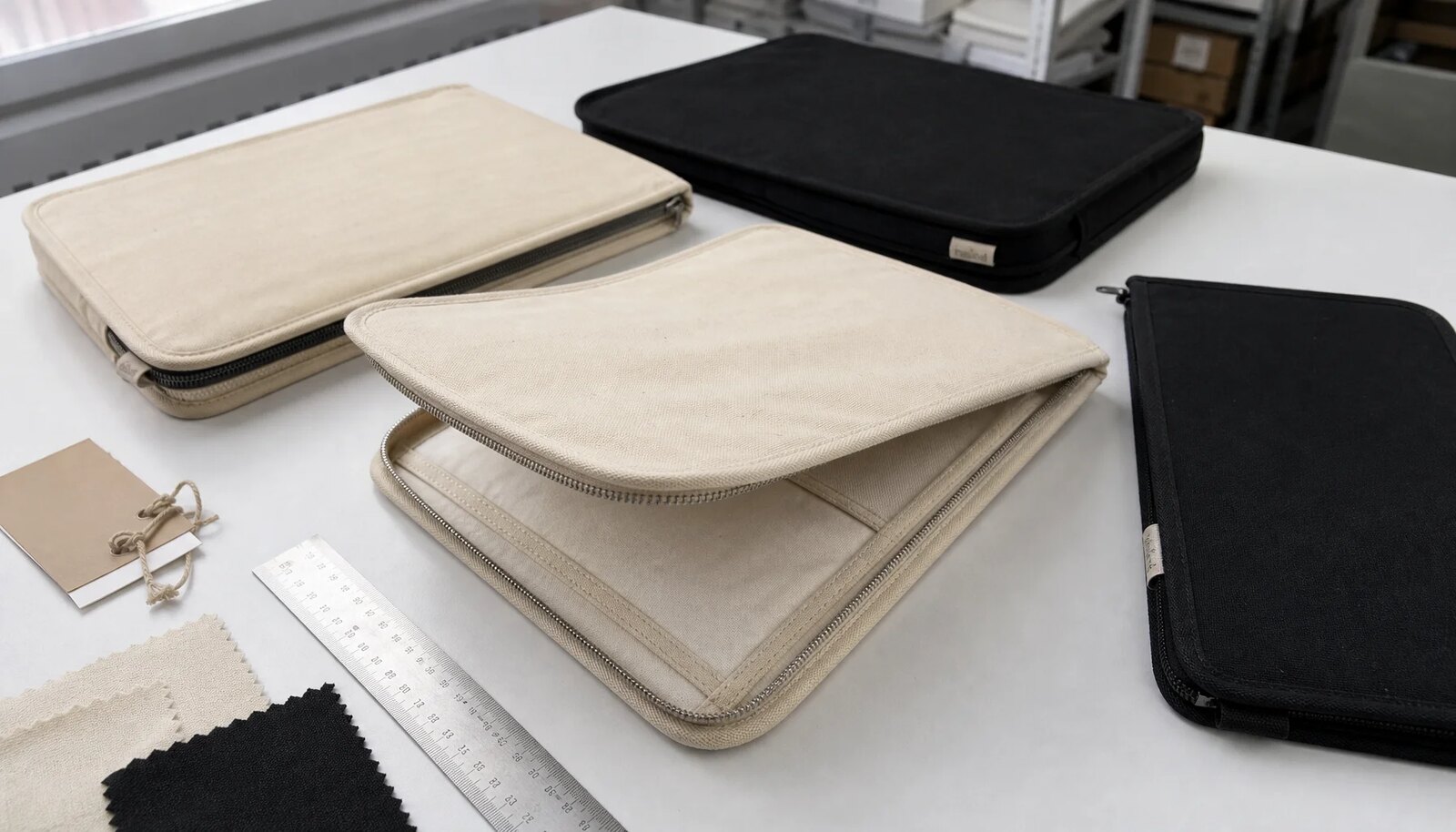
Start with the buying job, not the fabric name
For eco apparel brands, a canvas zipper portfolio is rarely just a flat pouch. It may hold wholesale line sheets, fabric cards, garment swatches, seasonal lookbooks, pricing documents, or a tablet used during showroom appointments. That job should drive the material choice. A one-time trade-show giveaway can be softer and simpler. A sales kit that travels through showrooms, distributor meetings, and retail offices for a full season needs more structure, cleaner stitching, and a zipper that still feels smooth after repeated use.
Procurement teams are often handed a design sketch and asked to find the lowest price. The sketch may show the silhouette and logo, but it usually does not define the canvas stack, zipper grade, lining behavior, print tolerance, or packing method. That is where margin and quality problems start. A stronger B2B brief states what will go inside the portfolio, where it will be used, how premium it needs to feel, which sustainability claims matter, and what cost range is realistic.
The first decision is simple but important: are you buying a soft document sleeve, a structured presentation portfolio, or a retail-ready branded accessory? A soft sleeve can use lighter canvas and little or no lining. A structured presentation item needs more body, better corner control, and a carefully installed zipper. A retail-ready item needs surface consistency, dust protection, barcode accuracy, and packaging that keeps the portfolio flat. Once the use case is clear, the canvas weight, lining, zipper, and branding method become procurement decisions rather than guesses.
- Document pouch: prioritize low weight, clean print, and flat packing
- Sales portfolio: prioritize structure, smooth zipper action, and internal clearance
- Sample kit: prioritize seam strength, lining durability, and corner reinforcement
- Retail gift: prioritize surface consistency, branding finish, packaging, and barcode accuracy
- Procurement risk: quoting before the use case is defined often leads to underbuilt samples and unstable bulk quality
Choose canvas weight by structure, cost, and sewing behavior
For most canvas zipper portfolios, 12 oz to 16 oz cotton canvas is the practical starting point. In GSM terms, that is usually about 340 to 470 GSM. This range gives enough body for a flat presentation piece without making the zipper line so stiff that it becomes hard to sew cleanly. Go much lighter, and the portfolio may feel limp, wrinkle in cartons, and lose the premium hand-feel buyers expect. Go much heavier, and fabric cost, freight weight, corner bulk, and sewing difficulty all rise.
Write the weight in GSM, not only in ounces. The phrase 12 oz canvas can vary by supplier convention, finish, and whether the weight is measured before or after washing. Ask for the fabric weight, the tolerance, and the route used for the sample and bulk fabric. If the supplier can support it, a tolerance such as plus or minus 5 percent is useful. It reduces the risk of receiving a strong, attractive sample made from heavier canvas while bulk production shifts to a cheaper lighter grade.
Size changes the ideal weight. A small A5 portfolio can feel structured with 340 to 380 GSM because the panels are short. An A4 or letter-size portfolio usually needs more body, often around 400 to 450 GSM, so it does not droop when held by one corner. If the portfolio will carry swatch cards, catalogs, or a tablet, do not judge the empty sample alone. Load it with the real contents, close the zipper, and check whether the panels twist, the corners bulge, or the zipper starts to wave.
- 300 to 340 GSM: suitable mainly for budget pouches or lightweight document sleeves
- 340 to 380 GSM: workable for small portfolios, giveaways, or lower-cost branded programs
- 400 to 450 GSM: balanced range for most B2B sales portfolios and retail gift packs
- 460 to 470 GSM: stronger hand-feel and shape retention, but higher sewing and freight risk
- RFQ wording: specify GSM, tolerance, finish, color, and whether the sample must use the exact bulk fabric
Review weave, finish, and color before the first full sample
Canvas quality is more than weight. Weave stability, yarn thickness, slub level, and finishing all affect how the portfolio looks after cutting, printing, sewing, and packing. A dense, even duck canvas gives cleaner cut edges and sharper print definition. A looser, more rustic canvas can match an eco apparel brand’s visual language, but it also makes fine logo details less crisp and can create panel-to-panel variation that looks like a defect once hundreds or thousands of units are packed together.
Natural canvas is popular because it feels aligned with lower-impact, textile-led branding and avoids the extra approval work of custom dyeing. Still, natural is not a single shade. It can read cream, beige, warm grey, or slightly yellow depending on cotton source, yarn, finish, and storage conditions. If the brand cares about exact tone, approve a shade band or request fabric approval before cutting. For black, navy, olive, and other dyed canvas colors, pay closer attention to shade variation, lint visibility, and rubbing performance.
Finish changes both feel and dimension. Pre-shrunk or enzyme-washed canvas may feel softer and reduce post-production movement, but washing can relax the fabric and change ink behavior. A stiffer finished canvas may hold shape nicely, yet crease marks can appear after tight packing. Swatches help, but they are not enough. Ask for a sewn sample because canvas behaves differently once it is folded around zipper tape, seam allowance, lining, and corners.
- Ask for swatches from the same fabric route planned for bulk, not only a generic canvas card
- Check natural canvas shade against labels, zipper tape, paper packaging, and brand color standards
- For dyed canvas, ask about colorfastness to rubbing, shade tolerance, and whether the zipper tape can match
- Avoid heavy coatings if the brand wants a natural hand-feel or reliable screen print adhesion
- Approve fabric in daylight-equivalent light and keep a signed reference swatch for production comparison
Build the lining and structure around the contents
The lining choice should follow what the portfolio carries. An unlined canvas zipper portfolio can work well for simple documents, internal staff kits, and cost-sensitive promotional programs. It keeps the construction lighter, lowers material cost, and makes the material story easier to explain. The tradeoff is visible: raw internal seams, fabric dust, and reduced shape retention may show when the user opens the portfolio.
For a more finished product, buyers often consider cotton drill, light canvas, or 210D recycled polyester. Cotton drill keeps the product in a natural textile direction and feels good in hand, but it adds thickness and may shrink differently from the outer shell. Recycled polyester lining can be smooth, lightweight, and easy to wipe, but if recycled content is part of the brand claim, documentation should be checked rather than assumed. Non-woven lining is usually a poor fit for premium portfolios because it can feel weak and may tear at corners.
Structure can be added with light backing, a canvas self-layer, or reinforced edge zones. Use it selectively. A portfolio does not need to become a hard case unless the contents require that. Overbuilding the body increases seam bulk, makes corners harder to sew, and can distort the zipper curve. In many programs, the better solution is to reinforce stress points while keeping the main panels flexible enough to pack flat.
- Unlined: lower cost, simpler material story, but less finished inside
- Cotton drill lining: natural hand-feel and good presentation, with possible shrinkage and thickness concerns
- Recycled polyester lining: smooth and light, but documentation and color matching should be checked
- Interlining: useful for flatness, but test corner bulk and zipper movement before bulk approval
- Fit test: place the actual documents, swatch cards, or tablet inside the sample and close the zipper without forcing it
Specify the zipper as a functional component, not a trim detail
The zipper is often the biggest functional risk on canvas zipper portfolios. It is a closure, a handling point, and a visible design line all at once. Nylon coil zippers are usually the safest default. They run smoothly, stay relatively light, flex around corners, and are less likely than metal teeth to scratch documents or devices inside the portfolio. Metal zippers can look premium, but they add weight, feel firmer in use, and need tighter sewing control to avoid uneven pull resistance.
A useful zipper specification includes type, size, tape color, slider finish, puller style, end stops, opening direction, and finished zipper length. If the RFQ only says black zipper or metal zipper, the supplier has too much room to choose cheaper parts. Tape color matters more than many buyers expect, especially on natural canvas. Off-white, cream, beige, and optical white can each change the final appearance. Ask the factory to place zipper tape against the approved canvas before sewing the sample.
Test the zipper before and after packing. A sample may run smoothly on the table, then become wavy after being stacked tightly in a carton or compressed at the corners. The puller should be easy to grip but not so heavy that it pulls the zipper line out of shape. For eco apparel brands, a self-fabric pull tab, simple cord pull, or restrained branded puller often supports the product language better than oversized hardware.
- Default recommendation: nylon coil zipper for smooth action and flexible sewing
- Consider metal only when the brand accepts added weight, cost, and alignment sensitivity
- Confirm zipper size, tape color, slider finish, puller style, and end-stop construction in writing
- Run the zipper at least 10 open-close cycles during sample review and first-piece inspection
- Reject samples with wavy zipper tape, rough slider movement, weak end stops, or lining that catches in the teeth
Match the branding method to canvas texture and order volume
Canvas is brand-friendly, but its texture has limits. Screen print is usually the most practical option for bold logos, block text, and one to three spot colors. It can give strong opacity on natural canvas and keeps cost under control when the artwork is simple. Fine type, gradients, thin rules, and tight registration are harder. Always review the artwork at the actual print size. A clean digital mockup does not prove the mark will stay sharp on a rough weave.
Minimalist eco apparel brands may get a better result from a woven label, cotton label, debossed patch, or small embroidery patch. Labels are useful when the mark is small or when the buyer wants consistent branding across multiple canvas colors. Patches can raise perceived value, but they add thickness, needle holes, and sometimes hard edges. If the patch sits near a bend, corner, or zipper curve, test whether it distorts the panel after packing.
Branding approval needs numbers, not only taste comments. Provide vector artwork, ink or Pantone references, print size, placement measurements, and tolerance. Pantone references help communication, but ink on natural canvas will not always match a coated-paper chip. When color matters, approve a strike-off on the actual canvas. For repeat orders, keep the print screen, placement jig, label standard, or patch reference consistent so each reorder does not drift slightly from the last one.
- Screen print: best for bold logos, strong opacity, and predictable cost at volume
- Woven label: best for small marks, repeat consistency, and lower risk on textured canvas
- Patch or debossed badge: useful for premium positioning, but test thickness and edge durability
- Embroidery: tactile and durable, but may pucker lighter canvas or show backing inside
- Approval rule: check actual-size artwork on actual canvas before releasing bulk production
Understand MOQ by separating fabric, trim, and setup drivers
MOQ is rarely one simple factory number. For canvas zipper portfolios, it is shaped by fabric availability, dyeing requirements, zipper tape color, print setup, label MOQ, packing materials, and sewing-line efficiency. A stock natural canvas with a standard zipper and screen print may support a lower trial order. A custom dyed canvas with matched zipper tape, branded metal puller, custom lining, and retail packaging usually needs a higher MOQ because several suppliers are involved before the portfolio reaches the sewing line.
Ask for price breaks at several volumes instead of only asking for the lowest MOQ. A 500-unit quote can be useful for a pilot, but setup cost per unit may be high and fabric leverage may be weak. At 1,000 or 3,000 units, cutting, printing, sewing, and packing may become more efficient. The point is not always to buy more. The point is to see where the cost curve changes, then decide whether the program can absorb the commitment.
Color is often the hidden MOQ driver. Natural, black, and common stock colors are usually easier to source. A custom Pantone canvas requires lab dips, shade approval, bulk dyeing, and sometimes additional wastage. If the brand needs a seasonal color, ask the factory to separate the base portfolio price from custom dye cost, approval time, and minimum fabric commitment. Otherwise, a stock-color quote and a custom-color quote can look comparable when they are not.
- Ask for pricing at 500, 1,000, 3,000, and 5,000 units using the same technical specification
- Separate stock canvas MOQ from custom dyed canvas MOQ
- Ask whether branded pullers, woven labels, or paper belly bands have their own MOQ
- Check whether mixed colors can share MOQ or must be ordered separately by color
- For pilot orders, prioritize stock canvas and standard zipper tape to reduce approval time and cash exposure
Write the RFQ so supplier quotes can be compared line by line
A good RFQ makes it difficult for suppliers to quote different products under the same name. Include finished size, tolerance, canvas GSM, fabric finish, color, zipper type, zipper color, lining, branding method, stitch details, packing, carton count, inspection requirement, and target order quantity. Without those details, one supplier may quote a light unlined pouch while another quotes a structured lined portfolio with branded pulls. The unit prices will not mean the same thing.
Commercial details matter too. Ask for carton dimensions, gross weight, units per carton, sample charges, mold charges, print setup fees, label fees, lead time, payment terms, and Incoterms. These items affect landed cost and planning. A low unit price can become expensive if the carton is oversized, the packing is weak, or barcode labeling and retail prep are excluded from the quote.
Also ask what will match bulk exactly. Some suppliers make polished sales samples using available materials, then produce bulk with different canvas, zipper, lining, thread, or packing. That is acceptable only if the change is disclosed and approved. The pre-production sample should become the real reference for bulk production, including material, color, zipper, print, label, stitching, packing, and carton format.
- Include a dimensioned sketch or tech pack, even for a simple rectangular portfolio
- Request a cost breakdown by fabric, zipper, lining, branding, sewing, packing, and carton where possible
- Ask suppliers to state exclusions, setup fees, and assumptions directly in the quote
- Require sample photos with ruler views, zipper close-ups, inside views, and packing photos
- Compare quotes only after confirming that fabric weight, zipper spec, lining, and packing are equivalent
Control sampling from swatch approval to pre-production sign-off
Sampling should move in stages. Start with fabric and trim swatches so the team can reject unsuitable canvas weights, zipper tapes, linings, labels, and packing materials before paying for full samples. Then develop a prototype to confirm size, construction, zipper path, and branding position. Finally, approve a pre-production sample made with the actual bulk materials and packing method. Jumping straight to a finished-looking sample often creates confusion because buyers cannot tell which details are final and which are temporary.
Measure the sample flat, without stretching it. Check finished width, height, corner radius, usable internal clearance, zipper opening, and any gusset or pocket dimension. If the portfolio must hold A4 sheets, letter-size documents, catalog pages, a tablet, or swatch cards, test the actual contents or a dummy board with the same size and thickness. A product can meet the outside measurement and still fail because the zipper opening is too short or the seam allowance reduces the internal space.
Sample comments should be written like production instructions. Instead of saying make it sturdier, specify the change: increase canvas from 380 GSM to 430 GSM, add edge reinforcement, or adjust stitch density. Instead of saying the logo is too low, specify move print center 12 mm upward and hold placement within plus or minus 3 mm from the approved reference point. Clear comments shorten sampling loops and reduce arguments before bulk production.
- Swatch approval: canvas weight, color, finish, zipper tape, lining, label, thread, and packing material
- Prototype approval: size, construction, zipper path, inside clearance, corner handling, and branding position
- Pre-production approval: exact bulk materials, exact logo execution, exact packing, and signed measurement sheet
- Do not approve bulk from photos alone when color, hand-feel, or zipper performance is critical
- Keep one approved sample with the buyer and one sealed reference sample with the factory
Set QC standards for visible, functional, and packing defects
A practical QC plan should focus on what buyers and end users will notice. Visible defects include stains, oil marks, heavy slubs, shade mismatch, print smears, logo drift, loose threads, skipped stitches, and uneven topstitching. Functional defects include rough zipper movement, slider failure, weak puller attachment, lining caught in the zipper, seam opening, and warped panels. Packing defects include crushed corners, dust contamination, wrong barcode labels, incorrect carton counts, and compression marks.
Inspection should begin before final packing. Fabric weight and shade need to be checked before cutting because finished-goods inspection is too late to fix the wrong canvas lot. First-piece inspection should confirm dimensions, stitch density, zipper installation, logo placement, and lining behavior before the factory continues bulk sewing. During final random inspection, the inspector should open and close zippers, compare print placement against the approved sample, review carton labels, and check packed goods against the approved packing method.
AQL language can help organize inspection, but the buyer still needs to define critical defects for this product. A non-working zipper, wrong logo, wrong fabric, wrong color, unsafe hardware, or wrong barcode should be treated seriously even if the general defect rate appears low. For international shipments, carton quality is not a side issue. A flat canvas portfolio can arrive creased or distorted if the carton size, stack height, or dust protection is wrong. Ask for carton photos, packed unit photos, and inspection evidence before final payment or shipment release on larger orders.
- Critical defects: wrong material, wrong logo, non-working zipper, unsafe hardware, wrong barcode, or wrong color
- Major defects: visible stains, print misplacement beyond tolerance, open seams, zipper waviness, lining snagging, or serious panel distortion
- Minor defects: small loose thread, slight natural slub within approved fabric standard, or minor removable dust
- In-process check: confirm cutting accuracy, first-piece sewing, zipper movement, and print placement before full production continues
- Final check: verify unit count, carton marks, barcode accuracy, dust protection, and product shape after packing
Specification comparison for buyers
| Spec decision | Recommended option | When it fits | Buyer risk to check |
|---|---|---|---|
| Outer canvas weight | 12 oz to 16 oz cotton canvas, usually about 340 to 470 GSM | Most eco apparel brand portfolios where structure, print clarity, and perceived value matter | Too light feels soft and wrinkles around the zipper; too heavy raises sewing difficulty, freight weight, and zipper distortion risk |
| Canvas construction | Plain-weave or duck canvas with stable yarn density and limited slub variation | Brand kits, sales documents, lookbook folders, sample-room use, and retail gift packs | Uneven weave can cause logo blur, panel skew, inconsistent shade, and visible quality differences between units |
| Surface finish | Natural, enzyme-washed, pre-shrunk, or lightly finished wax-free canvas | Brands wanting a clean sustainable look without shiny coating or synthetic hand-feel | Over-finished fabric can reduce ink grip, create crease marks, or hide fabric flaws until after sewing |
| Lining choice | Unlined for budget document use; cotton drill or 210D recycled polyester for cleaner structure | When cards, tablets, swatches, catalogs, or premium presentation materials need abrasion protection | Thin lining may pucker, non-woven lining can feel weak, and loose lining can catch in the zipper |
| Interlining or structure | Light backing, canvas self-layer, or reinforced edge panels only where needed | Portfolios that must stay flat for documents or hold shape in retail packing | Too much structure makes the item stiff and raises sewing defects at corners and zipper curves |
| Zipper spec | Nylon coil zipper with matched tape, reliable end stops, and branded or self-fabric puller | Frequent opening, smoother use, and lower break risk than metal for slim canvas portfolios | Cheap tape color mismatch, weak sliders, poor end stops, and wavy zipper installation cause returns |
| Print method | Screen print for bold marks; woven label, patch, or debossed badge for premium minimal branding | Simple logos, 1 to 3 spot colors, or eco brand identities that prefer tactile branding | Fine gradients and small type blur on rough canvas; poor curing leads to cracking or rub-off |
| Stitch construction | Single needle with controlled topstitching, reinforced zipper ends, and optional bound seams | Portfolios carrying samples, catalogs, tablets, or sales documents | Loose seam allowance causes warp; poor back-tacking and skipped stitches show quickly on dark canvas |
| MOQ route | Stock fabric with custom print for pilots; custom dyed canvas when brand color is critical | Market tests, seasonal assortments, recurring wholesale programs, and retail gifting | Custom color drives higher MOQ, longer approval time, shade variation risk, and possible lab dip rework |
Buyer checklist before sampling
- Define the intended use: document pouch, sales portfolio, sample kit, tablet sleeve, retail gift, or wholesale add-on
- Approve outer fabric by weight in GSM, weave, color, finish, shrinkage status, and tolerance range, not only by the word canvas
- Confirm finished dimensions, usable internal clearance, corner shape, zipper opening length, and whether documents must fit without bending
- Specify zipper type, zipper size, tape color, slider finish, puller style, end-stop detail, and zipper length with a sample reference
- Define lining as none, cotton drill, recycled polyester, or another option, including color, thickness, hand-feel, and anti-snag requirements
- Lock print artwork in vector format with Pantone or ink reference, print size, placement measurements, and acceptable placement tolerance
- State whether branding is screen print, woven label, patch, debossed badge, embroidery, or a combination, with exact placement drawings
- Write stitch density, seam allowance, thread color, reinforcement points, and corner handling into the RFQ or tech pack
- Set sample approval steps for fabric hand-feel, zipper run, logo clarity, logo placement, internal fit, lining behavior, and carton fit
- Request price breaks for at least three order volumes so setup charges, MOQ logic, and fabric commitments are visible
Factory quote questions to send
- Which canvas options can you offer between 300 and 500 GSM, and what is the price difference, MOQ, and lead time for each?
- Is the quoted canvas greige, dyed, pre-shrunk, enzyme-washed, or otherwise finished, and what shrinkage tolerance should we expect after sewing?
- Can you provide fabric swatches from the same quality and color route planned for bulk, not only a generic canvas reference?
- Which zipper type is included in the quote: nylon coil, metal, recycled tape, or another option, and what zipper size and slider grade are you using?
- Is the puller generic, branded, self-fabric, metal, cord, or recycled-content, and does that change MOQ, mold fee, or lead time?
- Can you quote screen print, woven label, embroidery patch, and debossed patch separately so we can compare branding cost and production risk?
- What is your MOQ for stock natural canvas, stock black canvas, custom dyed canvas, and custom zipper tape color?
- What price breaks can you provide at 500, 1,000, 3,000, and 5,000 units using the same technical specification?
- Which sample will match bulk exactly: fabric, zipper, lining, print color, label, stitch thread, packing, and carton format?
- What inspection standard do you use for sewing, print alignment, zipper function, fabric defects, shade control, and packaging accuracy?
Quality-control points to confirm
- Fabric weight verified against the approved GSM range before cutting, with records tied to the production lot
- Canvas color checked under daylight-equivalent lighting for shade consistency across front, back, gusset, and zipper-facing panels
- Fabric surface inspected for oil marks, heavy slubs, stains, weaving defects, needle contamination, and panel-to-panel shade difference
- Cut panels checked against pattern dimensions before sewing to prevent finished-size drift and zipper opening mismatch
- Zipper run tested fully open and closed at least 10 cycles on approved samples, first production pieces, and final inspection samples
- Zipper tape checked for waviness, color match, correct length, secure end stops, smooth slider movement, and puller attachment strength
- Logo placement measured from fixed edges such as top seam, side seam, or zipper line to avoid visible drift across the batch
- Print inspected for opacity, edge sharpness, curing, cracking, rub resistance, color consistency, and registration where multiple colors are used
- Stitch count, back-tack reinforcement, seam allowance, and thread tension inspected at zipper ends, corners, labels, and any handle attachments
- Lining checked for loose fabric, catching at zipper teeth, puckering at corners, visible raw edges, and color transfer risk