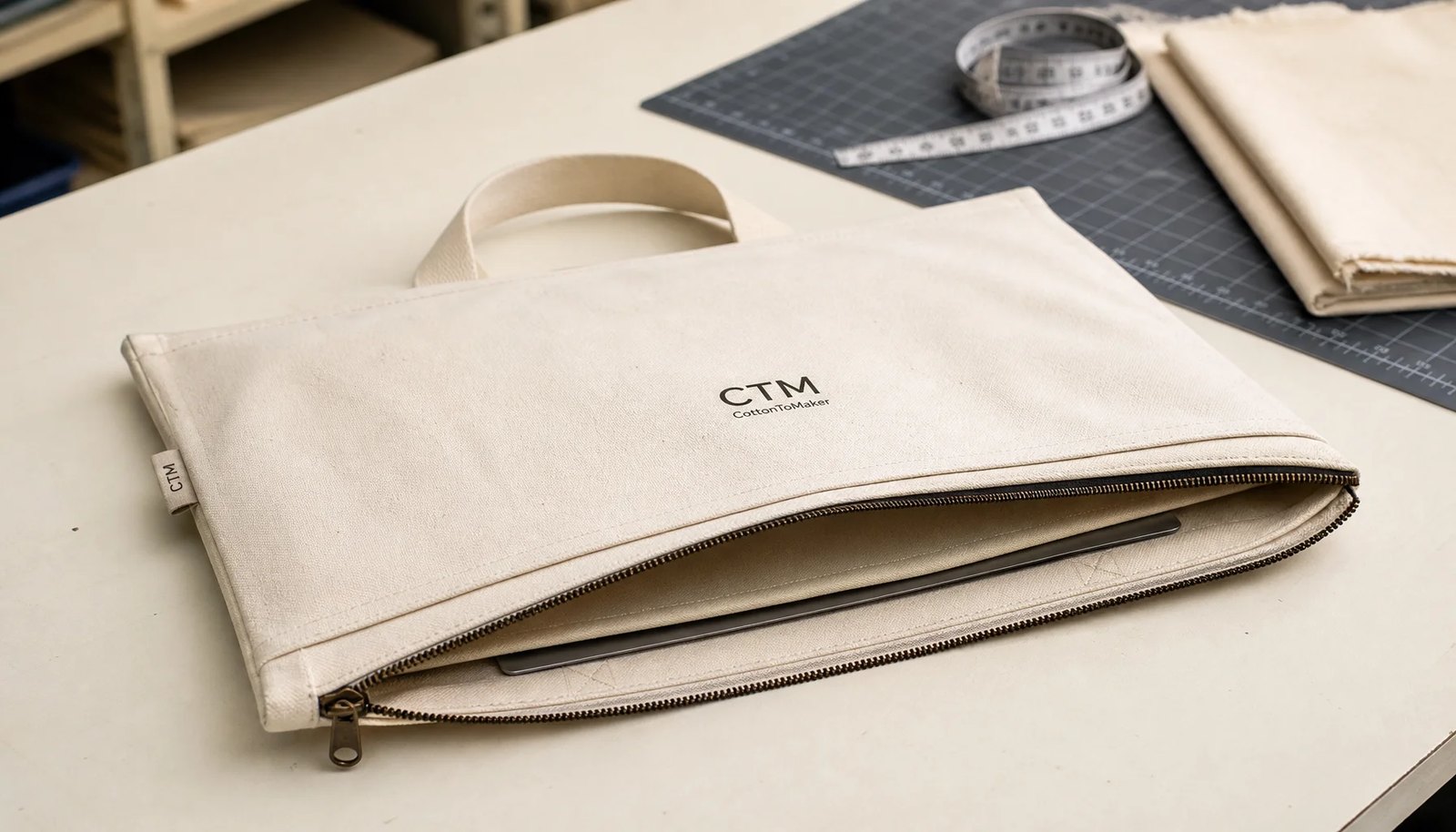
Start With the Trade Show Use Case, Not the Product Photo
A canvas zipper portfolio can look polished in a supplier photo and still disappoint at the booth. The real test starts after it is filled with brochures, zipped again and again, stacked in cartons, carried through a venue, opened on a counter, and handed to visitors or sales reps. Most failures are not dramatic. They come from small choices that were never specified: canvas that collapses when loaded, zipper tape that waves at the corner, a handle stitched for appearance rather than weight, print ink that cracks on a bend, or raw inner seams that shed lint onto documents.
For exhibitors and distributors, the loss is bigger than the unit price of the bag. A weak portfolio makes the literature inside look less valuable. It can reduce sponsor visibility, slow down booth staff, and create awkward moments when a zipper jams in front of a customer. If the order is part of a larger event kit, one poor component can hurt the perceived quality of the whole program.
A practical canvas zipper portfolios durability testing checklist for trade show exhibitors should connect design, quoting, sampling, packing, and inspection. The goal is not to make every portfolio expensive. The goal is to remove hidden shortcuts before they become visible at the event. Buyers should define the intended load, expected number of uses, branding method, appearance standard after shipping, and QC criteria before final price comparison.
- Treat the portfolio as an event tool, not just a printed giveaway.
- Test samples with the actual documents, catalogs, swatches, or weight equivalent.
- Review zipper, handle, seams, print, stiffener, and packing as one system.
- Separate functional requirements from optional branding upgrades before comparing quotes.
- Keep the approved sample as the reference for production and incoming inspection.
Translate the Load Into a Canvas Specification
Many RFQs still ask for “heavy canvas” or “durable cotton.” That language leaves too much room for interpretation. For zipper business bags and portfolios, buyers commonly compare 10 oz, 12 oz, 14 oz, and 16 oz cotton canvas. Approximate GSM ranges often run around 340 GSM for 10 oz, 407 GSM for 12 oz, 475 GSM for 14 oz, and 542 GSM for 16 oz. Actual numbers still vary by weave, finishing, washing, and mill practice, so oz and GSM should be stated together.
The best weight depends on what the exhibitor plans to pack. A flat folder for flyers can be lighter than a portfolio holding catalogs, notebooks, swatch cards, USB kits, or a lightweight tablet insert. Once the filled portfolio approaches or exceeds about 1 kg, the buyer should look closely at handle attachment, zipper strain, seam allowance, and corner wear. Heavier canvas helps, but it does not compensate for weak stitching or a poor zipper path.
For many trade show document portfolios, 12 oz canvas offers a useful balance of structure, print clarity, sewing efficiency, and freight control. For heavier sales kits, 14 oz or 16 oz is usually safer, especially if a handle is included. Very thick canvas can feel premium, but it can also create bulky corners, visible needle marks, higher carton volume, and extra stress at the zipper turn. A good spec chooses the lightest build that passes the load, abrasion, and presentation tests.
- Use 10 oz only for light folders, short campaigns, or cost-sensitive giveaways with no heavy inserts.
- Use 12 oz for most exhibitor document portfolios where structure and print appearance both matter.
- Use 14 oz for catalogs, notebooks, swatch cards, price books, or small sample packs.
- Use 16 oz when premium handfeel is important and the buyer accepts more sewing bulk and freight cost.
- Ask whether the canvas is natural, dyed, washed, coated, or otherwise finished.
- Include shrinkage and shade expectations when repeat orders or multiple event waves are planned.
Choose the Zipper System Before Approving the Shape
The zipper is usually the first part users judge. If it glides smoothly, the portfolio feels like a proper business bag. If it catches, waves, scratches the print, or forces the user to hold the fabric with two hands, the whole product feels cheap. For flexible canvas portfolios, a No. 5 nylon coil zipper is often the safest option because it turns corners more easily and has a lower scratch risk during packing. A No. 5 metal zipper can support a more premium look, but it needs tighter checks for pressure marks, tooth alignment, and slider smoothness.
Buyers should specify the zipper as a system, not just a line item. The system includes zipper size, tape material, tape color, teeth or coil type, slider finish, puller style, opening direction, end stops, seam allowance, and corner radius. A zipper may work on one hand-made sample but fail in bulk if the sewing operator stretches the tape, sews too close to the teeth, or turns the corner too tightly.
Post-compression testing matters for trade show orders because goods may be packed weeks before the show. When portfolios are stacked flat, zipper pullers and teeth can press into adjacent panels. After a 24-hour packed compression check, the zipper should still open without tooth separation, slider locking, tape waviness, or canvas caught in the teeth. If a sample already feels rough after compression, mass production is unlikely to improve it.
- Specify No. 5 zipper size unless the design requires a larger opening or heavier construction.
- Use nylon coil for frequent use and curved edges; use metal when the premium look justifies extra checking.
- Require reinforced zipper ends so the slider does not force the seam open.
- Reject samples where the canvas catches in the zipper path during normal closing.
- Check zipper smoothness empty, loaded, and after overnight packed compression.
- Choose a puller that is easy for staff to grab but not so bulky that it dents nearby panels.
Build Seams and Handles for the Actual Carry Weight
Strong canvas does not save a weak construction. The common failure points are zipper ends, side seams, corners, handle attachments, and the transition areas where thick layers meet thinner panels. Canvas naturally frays at cut edges, so internal seams should be bound, overlocked, or otherwise finished. Raw seams may look acceptable in a quick sample photo, but they can shed lint, loosen during handling, and contaminate the documents inside.
The handle decision should follow the load decision. If the portfolio is only a flat document case, a handle may be optional. If booth staff or visitors will carry catalogs, notebooks, or samples, the handle becomes structural. A short canvas webbing handle should use box stitching, bartacks, or an agreed equivalent. A decorative straight stitch at the top edge is not enough for loaded use, especially when people grab bags quickly while moving between booths.
Procurement teams should ask the factory to mark every reinforcement point in the quote and on the sample. This prevents one supplier from pricing a simple sleeve while another prices a true zipper business bag. The approved sample should be checked inside and out, including seam allowance and zipper-end stitching. If the design uses board or foam stiffener, corners need extra attention because stiffened panels concentrate wear at bend points.
- Require bound or overlocked internal seams instead of raw cut edges.
- Specify box stitching, bartacks, or equivalent reinforcement at handle attachment points.
- Confirm handle placement does not cover the logo or create uneven carton pressure.
- Inspect corner bulk so the zipper can turn without pulling the panel out of shape.
- Measure seam allowance on the approved sample and use it during production inspection.
- Load-test the handle with expected kit weight plus a reasonable safety margin.
Match the Logo Method to Canvas Texture
Canvas is not a coated paper surface. Slubs, weave gaps, absorbency, and color variation all affect the logo. Screen printing is usually the most dependable choice for solid one- to three-color logos on canvas zipper portfolios. It controls cost well at exhibitor quantities and works cleanly on larger front panels. Buyers should still confirm ink type, artwork size, print location, color tolerance, and whether printing happens before or after sewing.
Heat transfer can reproduce small text, gradients, or detailed graphics, but it must be tested on the exact canvas finish. Thick transfer films may crack, lift, or feel plastic on textured cotton. A transfer that looks sharp on a flat press sample can fail near a fold line, stiffener edge, or zipper corner after carton compression. If heat transfer is required, approve the final film and run dry rub, light damp rub, scratch, bend, and compression checks before bulk production.
Embroidery can work for premium positioning, but it is not automatically the strongest answer. Dense stitching on lighter canvas can pucker the panel, distort the zipper line, or create uneven stacking pressure. If embroidery is used, backing, stitch density, and placement should be tested before cutting bulk fabric. For larger event programs, a controlled screen print, woven side label, or smaller brand mark may deliver a cleaner result than oversized embroidery.
- Use screen print for solid logos, clear brand marks, and cost-stable bulk orders.
- Use heat transfer for detailed artwork only after peel, rub, scratch, bend, and compression checks.
- Use embroidery for premium positioning when backing and puckering are controlled.
- Avoid logo placement near zipper seams, handle stitching, high-bend corners, or stiffener edges.
- Approve artwork on final canvas color because natural cotton can shift perceived ink color.
- Check ink transfer when printed fronts are stacked against zipper sliders or darker panels.
Make Sample Approval Functional, Not Cosmetic
A showroom sample is useful for discussing shape, but it is not always a production standard. It may use available canvas, a stock zipper, approximate printing, or simplified packing. The pre-production sample should use the final canvas weight, zipper, thread, reinforcement, lining, print method, logo size, inner structure, and packing fold. If the buyer approves a substitute sample, later disputes become difficult because the final build was never tested.
Sample review should include measurements and use tests. Record finished size, usable document opening, zipper length, seam allowance, handle length, pocket size, logo position, and packing thickness. Load the sample with real materials or a weight equivalent, then carry it, zip it, unzip it, stack it, and compress it. Corrections should be written into the sample comments. A verbal note such as “make zipper better” is too vague for production.
A sealed approved sample is one of the cheapest controls in the order. It gives the factory a production reference, gives the inspector a judgment standard, and gives the buyer a comparison point if incoming goods differ. For orders with several artwork versions, clarify whether one construction sample covers all versions or whether each logo, color, or packing style needs its own approval photo and signed reference.
- Request a counter sample for construction review before final artwork is printed.
- Require a pre-production sample made with final materials before mass cutting.
- Photograph zipper ends, handle seams, inner seams, print area, pockets, and packing method.
- Keep one sealed sample at the factory and one with the buyer or inspection team.
- Close sample comments in writing before approving bulk cutting.
- For repeat orders, compare the new sample with the previous approved version and record changes.
Use Practical Durability Tests Buyers Can Repeat
The best test plan is clear, practical, and repeatable. Not every order needs a laboratory report, but every buyer should define conditions well enough that the supplier, inspector, and procurement team reach the same conclusion. For a trade show portfolio, the core tests are loaded carry, load hang, zipper cycling, seam review, corner abrasion, print rub, and carton compression. These checks should be performed on samples made through the same process as bulk production, not only on an early handmade prototype.
Acceptance criteria should be written in plain procurement language. After a loaded hang test, there should be no torn fabric, broken handle stitches, open seams, or visible panel distortion beyond the agreed limit. After zipper cycling, there should be no jamming, tooth separation, loose puller, uneven tape, or fabric catching. After print rub, minor surface dulling may be acceptable, but heavy ink transfer, cracking, smearing, or flaking should not pass for an exhibitor-facing product.
Timing matters. A development sample can screen out poor construction early, but buyers should also request in-line checks once bulk sewing starts and final inspection after packing. If a test damages the product or takes extra time, define the sample quantity and responsibility before production. That avoids disputes about whether tested pieces must be replaced or whether the inspector may open sealed cartons.
- Loaded hang test: suspend the packed portfolio at the agreed weight and check for seam or handle failure.
- Loaded carry test: lift and carry by the handle repeatedly with no tearing or thread popping.
- Zipper cycle test: open and close around corners with no jamming, skipped teeth, or separation.
- Corner abrasion test: rub high-wear corners and check whether canvas, print, or binding breaks down quickly.
- Print rub test: use dry and light damp rubbing to catch weak ink adhesion before shipment.
- Compression test: stack packed samples overnight and inspect for dents, zipper marks, and ink transfer.
Compare Quotes Line by Line, Not by Unit Price Alone
Two quotes can show the same product name and very different builds. Fabric weight, zipper grade, reinforcement, lining, print method, packing, inspection support, and sample stages all affect the price. A 10 oz stock-canvas portfolio with a basic zipper and simple polybag is not equal to a 14 oz version with reinforced zipper ends, screen print, inner pocket, tissue protection, and controlled export cartons.
MOQ follows the same logic. Standard natural canvas with screen print can often start at a lower MOQ than custom-dyed canvas, custom zipper pullers, woven labels, custom lining, or special retail packaging. Buyers should separate durability items from presentation extras. Proper zipper quality, seam reinforcement, and packing control protect the function. Custom pullers and elaborate packaging may support branding, but they can increase minimums and extend the schedule.
A fair comparison starts with one shared spec sheet. Ask each supplier to quote the same finished size, fabric level, zipper, print method, reinforcement points, inner structure, packing, carton data, Incoterm, sample cost, inspection requirement, and production lead time. If a supplier proposes a lower-cost alternative, keep it as a separate option. Then procurement can choose the saving knowingly instead of discovering later that the lower quote removed durability.
- Fabric cost changes with oz, GSM, color, finishing, shrinkage control, fabric width, and cutting wastage.
- Zipper cost changes with size, material, slider quality, puller design, plating, and color matching.
- Printing cost changes with artwork size, color count, setup screens, ink type, and reject risk on textured canvas.
- Labor cost changes with lining, pockets, binding, handle reinforcement, corner control, and inspection requirements.
- Packing cost changes with polybags, tissue, barcode labels, carton strength, SKU separation, and pallet requirements.
- Sampling cost changes when the buyer needs final materials, multiple artwork versions, or a full packing sample.
Control Packing Before It Damages a Good Portfolio
A portfolio can pass sewing inspection and still arrive looking poor. Flat canvas zipper portfolios are sensitive to zipper puller impressions, ink transfer, bent stiffeners, crushed corners, and moisture marks. Packing should be designed around final thickness and hardware placement, not guessed after production. Cartons should hold the goods firmly enough to prevent movement but not so tightly that zipper parts press into neighboring panels.
Flat packing usually works better than folding unless the design was made to fold. Tissue or thin separator paper near zipper pullers can reduce pressure marks. If the portfolio includes a board or foam stiffener, carton quantity should be conservative enough to avoid permanent bending. If dark ink is printed on natural canvas, compression testing should include ink transfer checks because event goods may sit stacked in a warehouse or venue receiving area before the booth opens.
Carton planning also affects landed cost and event operations. Overweight cartons raise drop damage and handling complaints. Weak or underfilled cartons can crush during pallet stacking. If the order ships directly to an event venue, distributor warehouse, or fulfillment center, confirm carton marks, SKU separation, barcode placement, and master carton labels before packing starts. These are procurement controls, not warehouse afterthoughts.
- Set pieces per polybag and pieces per carton before final quote approval.
- Keep carton gross weight practical for manual handling and trade show receiving.
- Use tissue or separator material around zipper pullers, metal parts, and printed panels when needed.
- Add moisture control for long ocean shipments, humid storage, or natural cotton canvas orders.
- Separate dark printed panels from light natural canvas areas if ink transfer risk exists.
- Run a packed carton drop or compression check before approving full production packing.
Protect the Event Date With a Realistic Production Calendar
The sewing line is only one part of the schedule. Fabric sourcing, dyeing, zipper color matching, print screen setup, sample revisions, packaging approval, inspection booking, and export handling can all add time. Buyers who work backward only from the show date often leave no space for corrections. A stronger calendar includes development sampling, pre-production sample approval, material purchasing, bulk production, in-line checks, final inspection, packing, freight handoff, and destination delivery buffer.
Standard natural canvas and screen print usually create fewer timing risks because factories may have regular material channels. Custom-dyed canvas, special zipper pullers, custom lining, retail packaging, and multiple artwork versions require earlier decisions. The buyer should also decide what happens if the first sample fails zipper, load, or print testing. A schedule with no correction window is risky for any new supplier or new design.
Ask suppliers to identify schedule risks before deposit. The RFQ should ask which materials are in stock, which must be ordered, when bulk fabric will be cut, when printing starts, when in-line inspection can happen, and when final carton data will be available. For a fixed trade show date, keep a decision calendar for artwork approval, sample sign-off, production release, inspection booking, and freight handoff.
- Reserve time for artwork proofing before sample printing begins.
- Confirm whether fabric is stock, incoming, or custom ordered for the project.
- Lock zipper color, puller style, thread, lining, and label details before bulk material purchase.
- Plan at least one sample correction window for new designs or new suppliers.
- Book inspection early if functional testing must happen before full packing.
- Keep event-delivery buffer separate from factory production lead time.
Specification comparison for buyers
| Spec decision | Recommended option | When it fits | Buyer risk to check |
|---|---|---|---|
| Canvas fabric weight | 12 oz to 16 oz cotton canvas, roughly 407-542 GSM depending on weave and finishing | Trade show document kits, sales folders, sample swatches, catalogs, lightweight tablet inserts, and distributor presentation packs | Under 10 oz may crease badly and collapse; over 18 oz can increase freight, sewing needle marks, corner bulk, and zipper stress |
| Canvas finish | Natural or dyed unwashed canvas for crisp structure; washed canvas only when a softer casual look is required | Corporate event folders, exhibitor handouts, seminar kits, and reusable business document cases | Washed canvas may shrink, wrinkle, and vary in shade; dyed canvas needs lot control and crocking checks |
| Zipper type | No. 5 nylon coil zipper for flexible portfolios; No. 5 metal zipper for premium visual positioning | Nylon coil fits frequent opening, lower scratch risk, and curved corners; metal fits executive gifting or higher perceived value | Metal teeth can mark printed panels during packing; low-grade coil zippers can wave at corners and jam after compression |
| Zipper end construction | Reinforced zipper stops, bartacked ends, sufficient seam allowance, and clean corner radius | Orders where portfolios will be repeatedly opened by sales teams or event visitors | Weak zipper-end stitching is a common failure point; tight corners can make the slider catch fabric |
| Panel construction | One main canvas body with reinforced zipper ends, bound inner seams, and bar-tacked handle points | Bulk exhibitor giveaways where failure rate must stay low across cartons and event handling | Unbound raw seams shed lint; thin seam allowance can fray after load and zipper cycling |
| Print method | Screen print for solid logos; heat transfer only for detailed artwork; embroidery only if backed and tested | Screen print works for most brand marks and larger front panels on cotton canvas | Thick ink can crack on folded portfolios; embroidery can pucker thin canvas and distort zipper alignment |
| Internal structure | Light non-woven lining, document pocket, and optional 1.5-2 mm board or foam stiffener | Buyers needing a flatter presentation folder rather than a soft pouch | Too much stiffener causes corner wear and carton volume; no stiffener may feel cheap for high-value event kits |
| Handle or no handle | Short canvas webbing handle with reinforced box stitch and bar tack when documents exceed 1 kg packed weight | Exhibitors distributing catalogs, samples, notebooks, price lists, or presentation materials | Decorative handles without load testing tear at the top seam; handle placement can cover logo or reduce packing efficiency |
| MOQ logic | 500-1,000 pcs for standard canvas and screen print; higher MOQ for custom-dyed canvas, woven labels, or molded pullers | Importers consolidating multiple event programs or distributors selling repeat seasonal stock | Low MOQ quotes may use stock fabric only, limited colors, and higher unit cost; custom materials need fabric dye lot control |
Buyer checklist before sampling
- Define the real load: documents only, catalogs plus samples, tablet insert, or full exhibitor kit, then set a target packed weight per portfolio.
- Specify fabric by oz and GSM, not only by the word canvas; include color, shrinkage tolerance, finishing, and whether washed or unwashed canvas is acceptable.
- Confirm finished size, usable document size, seam allowance, zipper opening width, handle drop, pocket size, and whether the portfolio must fit A4, letter, catalog, or custom inserts.
- State zipper size, material, tape color, slider finish, puller style, opening direction, and whether the zipper must pass repeated open-close testing after carton compression.
- Require reinforced zipper ends, handle bar tacks, corner control, and bound or overlocked internal seams with no loose threads longer than 3 mm.
- Approve a physical pre-production sample using the final fabric, final zipper, final thread, final print method, final logo size, final inner structure, and final packing fold.
- Run practical tests before bulk approval: loaded carry, load hang, zipper cycling, corner abrasion, print rub, seam pull, carton drop, and 24-hour compression recovery.
- Check logo placement against usable front panel area after seam allowance, zipper tape, handle position, document bulge, and natural canvas weave slub are considered.
- Lock packing details including flat or folded packing, polybag requirement, tissue placement, carton quantity, carton weight, barcode position, SKU separation, and moisture control.
- Compare quotes using the same spec sheet, sample standard, Incoterm, carton data, inspection level, and production lead time so the cheapest quote is not hiding a weaker build.
Factory quote questions to send
- What exact canvas weight are you quoting in oz and GSM, and is it greige, natural, dyed, washed, coated, or finished canvas?
- What fabric tolerance do you apply for weight, shade, shrinkage, and width, and can you keep one fabric lot for the full order?
- Which zipper size, zipper material, tape color, slider, and puller are included in the price, and can you send close-up photos of the quoted zipper stock?
- What reinforcement is included at zipper ends, handle attachment points, side seams, and portfolio corners?
- Which thread type and stitch density are included, and where will you use bartacks, box stitching, binding, or overlock finishing?
- Which print method is quoted for the logo size and color count, and what rub, scratch, bend, or adhesion test do you recommend for this canvas finish?
- What is the MOQ for stock canvas, custom color canvas, woven side label, custom zipper puller, printed inner label, and individual retail packaging?
- How many pieces per carton, what are the estimated carton dimensions, and what is the gross and net weight per carton?
- What sample stages are included: counter sample, artwork proof, pre-production sample, sealed production sample, and packing sample?
- What is the production lead time after sample approval and deposit, and which materials could extend the schedule?
Quality-control points to confirm
- Fabric weight should match the approved sample within an agreed tolerance, commonly plus or minus 5 percent unless the buyer approves a wider range.
- Canvas shade should be checked against the approved sample under consistent lighting, especially for natural cotton, dyed canvas, and repeat event programs.
- Finished size should hold practical tolerance, usually plus or minus 5 mm for small portfolios and plus or minus 8 mm for larger document cases.
- Zipper should open and close smoothly for the agreed cycle count with no skipped teeth, slider locking, loose puller, uneven tape, or fabric catching at corners.
- Zipper end stitching should be secure, with no open seam, weak stop, broken thread, or slider pressure that could force the end apart during use.
- Handle attachment should withstand the agreed static load test without seam tearing, thread popping, bartack failure, or visible panel distortion.
- Logo print should pass dry rub, light damp rub, and light scratch testing without heavy ink loss, smearing, edge lifting, or cracking at normal bend points.
- Embroidery, if used, should show no excessive puckering, broken thread, loose backing, needle damage, or distortion of the front panel and zipper line.
- Inner seams should be bound, overlocked, or cleanly finished with no fraying that can contaminate documents or retail packing.
- Cartons should protect flatness; finished portfolios should not arrive with permanent dents, zipper impressions, moisture marks, mold odor, ink transfer, or crushed corners.