Why Durability Fails on Seemingly Simple Canvas Portfolios
A canvas zipper portfolio is often grouped with basic promotional cotton bags, but procurement buyers for natural grocers usually need a more controlled product. These portfolios may carry vendor presentation decks, new-store onboarding packs, shelf-tag kits, community wellness materials, nutrition education folders, or meeting packets for regional teams. In practice, that means the item is not just stored flat on a table. It is opened many times, stacked in offices, transferred between stores, handled by category managers, and sometimes packed with heavier inserts than the factory ever expected.
That gap between intended use and quoted construction is where durability problems start. A low-cost sample can look acceptable when empty, then fail quickly once loaded with catalogs, paper inserts, pens, or sample sachets. The most common issue is not the canvas panel itself. It is concentrated stress around the zipper path, zipper end stops, corner binding, handle joints, and any internal pocket seam. If those details are weak, the portfolio may jam, twist, split, or lose shape even when the outer fabric appears sturdy.
For B2B buyers, the commercial risk is broader than a defective pouch. If the portfolio is part of a supplier summit, board packet, field team rollout, or wellness campaign, poor durability creates rework, complaints from receiving teams, repacking labor, and missed event timelines. That is why a canvas zipper portfolios durability testing checklist for natural grocers should be built into the RFQ from the start, not added after production has already begun.
A stronger buying process starts with treating the portfolio as a functional document carrier with load points, cycle points, and packing risks. When buyers specify fabric, zipper, reinforcement, test method, and export packing clearly, factories can quote the same product instead of making assumptions. That improves quote comparability and reduces the chance that the lowest price wins simply because it omitted necessary construction.
- Use this guide for zipper business bags that hold documents or buyer kits, not for drawstring pouches or produce bags.
- Write the specification around use conditions, handling frequency, and packed weight rather than logo size alone.
- Assess supplier capability through sample evidence, construction details, and QC controls, not only by unit price.
- Expect the highest stress at zipper corners, zipper ends, bound edges, and any handle or wrist-strap attachment point.
Define the Actual Load, Users, and Handling Environment Before You Request Quotes
The most useful first step is to define what will go inside the portfolio and who will use it. A procurement team that says only “canvas zipper portfolio, natural color, one-color logo” leaves too much to interpretation. One factory may assume a light document sleeve, while another may assume a reinforced business bag. Both may technically quote a canvas portfolio, but the finished products will not perform the same way.
For natural grocers, typical use cases vary widely. A category review folder may carry paper sheets only. A field merchandising kit may include catalogs, pens, clip cards, and a small device. A community event packet may be handed out once but still needs clean presentation. A vendor onboarding portfolio may be reused across meetings and stored in cars, offices, and back rooms. Each use profile changes the right specification for canvas weight, zipper grade, pocket design, and reinforcement.
It helps to describe the expected packed contents in plain operational terms. For example: “Holds A4 or letter-size documents plus one pen,” or “Holds 20-page booklet, sample cards, and a small tablet,” or “Used for one-time event handout with paper inserts only.” Buyers should also note whether the portfolio will be carried by hand, stacked in cartons for store distribution, or repeatedly opened during sales calls. These details matter more than many buyers expect because they determine where failure is likely to occur.
A practical RFQ should include a target load or simulated fill weight. If the portfolio will carry documents only, a 1.0-1.5 kg test may be enough. If it will carry a catalog, notebook, and samples, the factory may need to design around 2.0-3.0 kg. That does not mean the product is expected to function like a laptop bag. It means the factory must reinforce the zipper path and seams for realistic use instead of guessing.
Buyers should also define whether appearance or reuse life is the higher priority. Some natural grocer programs need a clean, premium look for a one-day executive or vendor event. Others need the portfolio to survive repeated internal use for months. The right answer is not always the heaviest canvas. It is the construction that matches the use cycle, packed load, and delivery format.
- State the insert type: loose papers, catalog, forms, coupons, tablet, samples, pens, or mixed kit.
- State the user group: buyers, store managers, vendor reps, community event staff, or new hires.
- State the handling frequency: one-time event, seasonal use, monthly meetings, or near-daily field use.
- Set a target packed weight for testing so seam and zipper performance can be checked against real conditions.
- Identify whether the portfolio must fit letter, A4, legal, or custom insert dimensions after binding and zipper loss.
Choose Fabric Weight, Finish, and Surface Standards That Match Natural Grocery Branding
For most projects in this category, 12 oz to 14 oz cotton canvas, roughly 400-475 GSM, is the safest starting range. It gives enough body for a business-appropriate portfolio while still allowing efficient sewing and export packing. Below that range, many portfolios feel too soft once the zipper is installed, especially if the bag is unlined. Above that range, the product may look premium but become harder to sew neatly at corners, bulkier in cartons, and more expensive in freight.
Procurement teams should always request both the ounce weight and GSM. The term “canvas” alone is not precise enough for quote comparison. Two factories can both offer canvas and still be far apart in actual density, weave compactness, and hand feel. If one quote is based on lighter stock fabric, the portfolio may look flatter, wrinkle more, or reveal insert edges through the panel after use. Clear fabric specification is one of the easiest ways to reduce apples-to-oranges quoting.
Natural grocers often prefer unbleached or natural cotton because it aligns with a practical, low-plastic, less synthetic brand image. That preference introduces a quality question buyers should address in advance: what level of natural variation is acceptable? Small seed flecks and minor shade movement can be normal on natural cotton canvas. Oil spots, mildew marks, weaving defects, strong odor, and major panel mismatch are not. The QC standard should distinguish between natural texture and true defects so inspection does not become subjective later.
If the portfolio is dyed instead of left natural, add controls for shade consistency and colorfastness. Dyed canvas may improve visual control, but it also raises MOQ and lot-variation risk. Buyers should ask whether the factory is using stock dyed fabric or custom dyeing to match a Pantone reference. For regional rollouts where replenishment orders may follow, keeping a color standard on file is important, especially if different batches will be shipped at different times.
Fabric finish also affects performance. A controlled-shrinkage or pre-shrunk finish can help maintain final dimensions after cutting and handling. This matters when the portfolio must fit standard documents closely. If the fabric is not stabilized, slight movement can compound when combined with zipper installation, binding, and lining. In a product with a close-fitting zipper perimeter, even small dimensional drift can make the opening feel tight.
Another practical check is hand feel versus print outcome. Rougher, more open-texture canvas can support the natural aesthetic buyers want, but it may reduce edge sharpness on logos and increase rub concerns on large ink areas. That is why print strike-offs should always be done on the actual approved fabric, not a similar swatch.
- Specify canvas by both oz and GSM, plus acceptable tolerance, such as +/- 5% if suitable for the project.
- Define whether natural flecks are acceptable and list unacceptable defects such as oil stains, mildew, holes, and major shade mismatch.
- Ask whether the canvas is stock greige, bleached, dyed, washed, pre-shrunk, or otherwise finished.
- For dyed fabric, confirm shade-lot control and whether future repeat orders can be matched to a retained standard.
- Test the exact canvas used for production because print behavior changes noticeably across fabric weights and textures.
Build the Portfolio Around the Highest-Risk Construction Points: Zipper, Corners, Edges, and Handles
The zipper system is usually the first functional component to expose weak construction. For most canvas zipper portfolios, a No. 5 nylon coil zipper is a practical default. It bends around corners more easily than a stiffer molded zipper, is widely available in stock colors, and generally offers the right balance of cost and function for document carriers. However, zipper size alone does not guarantee performance. Slider quality, tape quality, stitch consistency, end reinforcement, and corner radius all affect whether the portfolio opens smoothly under real use.
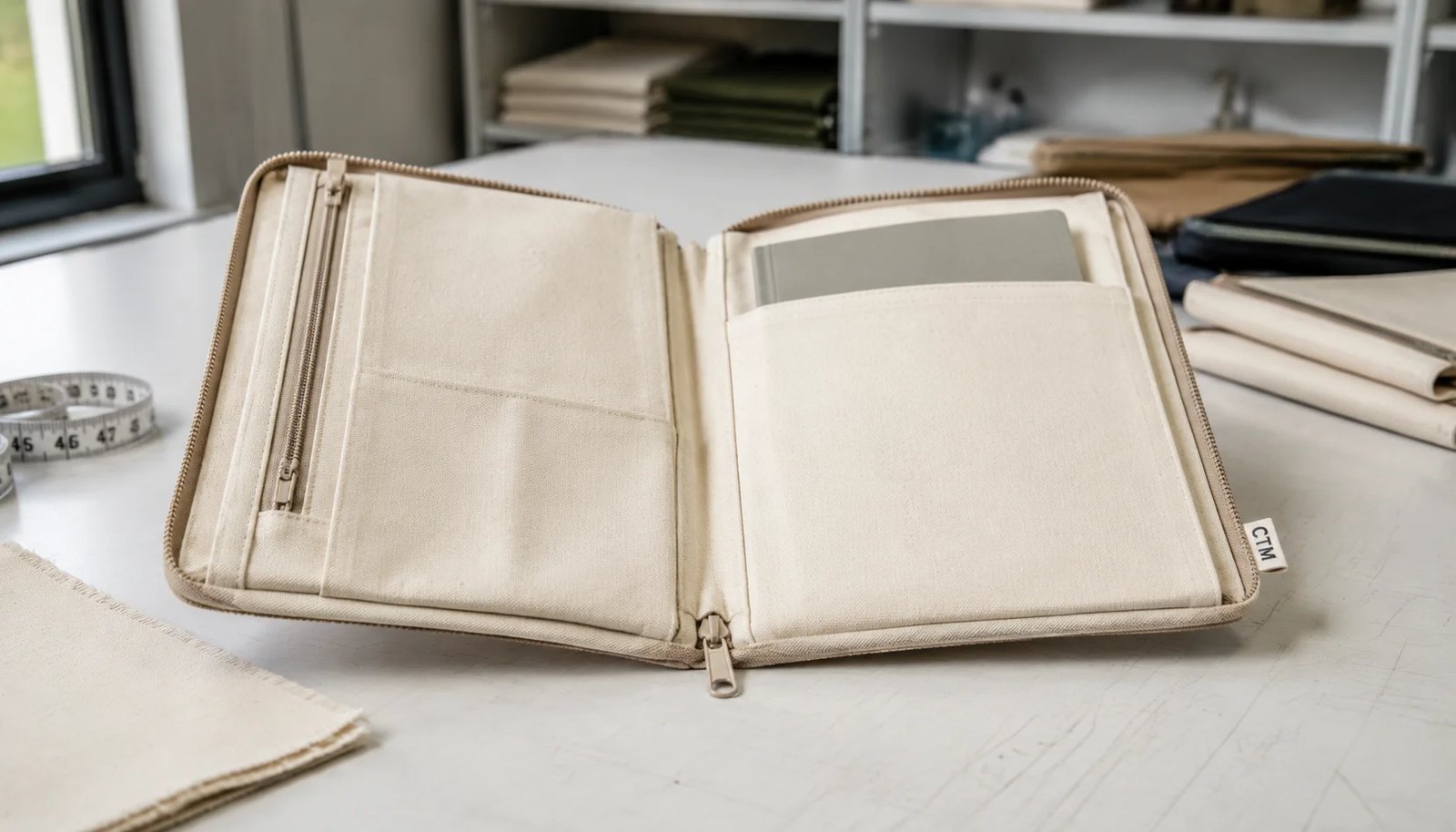
Three-side zipper opening is common because it gives easy access to papers, but that layout also creates stress at the turning points. If the zipper curve is too tight, the slider catches repeatedly in the same area. If the seam allowance is inconsistent, the zipper tape may wave or twist. If the binding is too bulky, the portfolio may never open cleanly at the corner. Procurement buyers should ask for close-up photos of zipper corners and request a live sample that can be opened and closed several times by hand, not just photographed while lying flat.
Zipper end reinforcement is especially important. Repeated pulling concentrates force at the top and bottom ends of the track. If those points are only lightly stitched, the zipper tape can begin separating from the body, creating fray, distortion, or eventual failure. A small reinforcement detail adds little cost compared with the cost of replacing bad goods after delivery.
Edge finishing matters too. Bound edges can improve a cleaner, more stable appearance, but they also add bulk if poorly handled. In an unlined portfolio, the internal seam finish should be neat enough that loose fibers, raw edges, or abrasive trim do not catch on documents or scratch coated inserts. If the product includes internal pockets, each pocket opening and side seam becomes another possible failure point and should be inspected as such.
If a handle or wrist strap is added, the whole load pattern changes. A portfolio designed only to be held under the arm can survive with simpler edge construction than one intended to be carried by a strap. Once a handle is added, the attachment points must resist repeated lifting with the actual packed contents. Buyers should require box stitch, back tack, or other clearly defined reinforcement and then test it with real weight, not assumptions.
The main sourcing lesson is that this is not a category where broad wording like “good quality zipper” is enough. The RFQ should identify zipper size, type, slider finish, puller style, opening layout, end reinforcement, and any handle reinforcement. Those details make quote comparison possible and reduce post-sample disputes.
- Default to No. 5 nylon coil zipper unless the use case clearly requires another construction.
- Specify zipper tape color, slider finish, puller type, and whether custom molded pullers are needed.
- Require reinforcement at zipper ends and other stress points instead of treating them as optional workmanship choices.
- Check that corner radii allow one-hand opening and closing without repeated catching.
- If a handle is used, test the attachment points with the agreed packed weight and carry motion, not just static hanging.
Select Branding Methods That Survive Friction, Stacking, and Natural Canvas Texture
Branding on canvas zipper portfolios should be chosen for both appearance and durability. Many natural grocer programs favor simple, understated graphics that align with a practical brand position, but even a minimal logo can underperform if the method is wrong for the fabric. Screen print is typically the most economical and functional option for this category. It works well for flat logos, department identifiers, event marks, and simple one- to three-color layouts. On canvas, however, buyers should expect some texture influence rather than paper-smooth surfaces.
Large flood areas or very fine line work are the most common design risks. Natural canvas absorbs ink unevenly compared with coated surfaces, so broad solid areas may show more variation, and tiny details may lose edge sharpness. That does not mean screen printing should be avoided. It means the artwork should be adapted for textile reality and approved through a physical strike-off rather than a digital proof alone.
Woven labels are often a smart complement for B2B buyer kits because they add a retail-quality detail without relying on large ink coverage. A side-seam label or internal brand tab can look clean, especially for understated corporate branding. Embroidery can also work, but buyers should use it carefully. On heavy canvas, dense embroidery can pull the panel, add stiffness, and create a visible reverse side that may need interior finishing. For flat document portfolios, that may not always be desirable.
Heat transfer is usually a weaker default on textured cotton canvas unless the supplier has proven the adhesion and flex performance for the exact material. The surface may not sit flat enough for a premium result, and repeated bending near the zipper can increase edge lift risk. If a buyer insists on transfer because of a detailed logo, a specific adhesion and flex review should be part of sample approval.
Natural grocer programs should also think about rub behavior during shipping. Printed portfolios are often stacked face-to-face in cartons. If the ink has poor crocking resistance, it may mark adjacent pieces or transfer onto inserts. This is particularly important on light natural fabric because rub marks and color transfer are easier to see. A basic dry-rub check using white paper or cloth can reveal problems before production moves ahead.
Artwork placement control is another overlooked issue. If the logo must align visually with the zipper line, a front pocket, or a side label, the placement tolerance should be written into the spec. A logo that drifts only a few millimeters may still look visibly off on a structured portfolio.
- Use screen print for cost-efficient branding, but approve it on actual production canvas, not a substitute swatch.
- Use woven labels for subtle retail-style branding that avoids large ink areas and rub concerns.
- Be cautious with dense embroidery on flat portfolios because it can distort the panel and interior surface.
- Test print rub resistance when portfolios will be stacked, face-packed, or shipped with paper inserts.
- Add artwork placement tolerance in millimeters if alignment with zipper, pocket, or label matters visually.
Set Practical Durability Tests Instead of Vague Quality Expectations
Many purchasing documents say the product should be “durable” or “good quality,” but those words do not tell a factory what must be proven. A better approach is to convert durability into a small set of repeatable checks tied to real use. For a canvas zipper portfolio, the key areas are zipper cycling, seam integrity, loaded handling, corner stability, print rub behavior, and shape retention after packing.
A zipper cycle test is usually the first requirement buyers should define. The exact target depends on the program. A one-time event handout does not need the same cycle expectation as a field portfolio used weekly. Still, even basic projects benefit from a set target such as 300, 500, or 1,000 open-close cycles. The important point is not to choose an impressive number for marketing purposes. It is to choose a realistic number that matches likely use and can expose weak sliders, tape distortion, or poor corner sewing before shipment.
Seam pull and stress handling should be connected to packed weight. For example, if the agreed contents create a 1.5 kg filled portfolio, the test should use that condition. The loaded item can be zipped, lifted, carried briefly, and reopened for inspection. Buyers should look for opening stitches, edge distortion, zipper tape separation, and panel warping near corners. If a handle is included, a repeated lift test is more useful than a purely static hold.
Print durability should also be practical. A basic rub check against clean white paper or cloth can reveal whether the print is likely to transfer during stacking or receiving. For natural grocer programs where the portfolio may sit against documents, this is not a cosmetic extra. It protects the contents and prevents complaints from internal users.
Packed-shape recovery is another useful field test. After sample items are packed flat in the proposed carton arrangement, remove them and assess whether the panels spring back acceptably or hold a permanent bend. Over-compression often damages portfolios in transit even when the sewing itself is acceptable. This is why packing and durability should be reviewed together rather than treated as separate topics.
For larger programs, buyers may add third-party inspection or external lab support, but not every order needs a complex laboratory protocol. What every order does need is a written test checklist, pass/fail understanding, and evidence retained with the approved sample file.
- Zipper cycle test: define target cycles and inspect for jamming, splitting, or puller damage afterward.
- Loaded handling test: fill with agreed contents or equivalent weight, zip fully, lift, carry, and reinspect seams and corners.
- Seam check: confirm no broken stitches, excessive seam opening, or zipper-tape pullout at stress points.
- Print rub check: verify no unacceptable transfer onto white paper, cloth, or adjacent portfolio surfaces.
- Packing recovery check: pack samples in proposed carton count and inspect for corner crush, zipper warp, or persistent creasing.
Control the Sample Approval Process So Bulk Production Matches What Was Tested
A frequent procurement mistake is approving production from an early visual sample that does not use final materials. In this product category, that shortcut is risky. The difference between one zipper tape supplier and another, or between 10 oz and 14 oz canvas, can materially change performance. A pre-production sample should therefore use final fabric, final zipper, final thread, final print method, final label, and final internal construction. Otherwise, the sample only confirms appearance, not the actual durability buyers are purchasing.
A useful sample process usually moves through stages. First comes a material swatch review to confirm canvas weight, color, texture, and any lining option. Next comes the print strike-off, which shows how the logo behaves on the real surface. Then the fit sample confirms dimensions, insert access, pocket layout, and zipper operation. Finally, the pre-production sample combines all final components and should be tested with the intended contents or agreed equivalent load.
Buyers should record objective comments during approval. That includes measured finished size, measured or certified fabric GSM, zipper specification, logo placement, interior details, and notes from any handling or rub test performed. If the portfolio is intended to hold standard documents, place those documents into the sample and confirm fit after the item is zipped closed. Flat cutting size alone does not tell you the usable internal space once binding and zipper curves are added.
It is also wise to approve packing at the sample stage. A single approved product sample is not enough if the actual shipping arrangement later causes deformation. Request a packing sample or at least a simulated carton pack with the planned quantity. That helps the buyer check whether corners crush, printed surfaces rub, or zipper tracks bow under compression.
To avoid disputes, one approved sample should remain sealed or clearly marked at the factory, and another should stay with the buyer or inspection team. Bulk inspection should compare goods against that physical reference, not against memory or a digital artwork PDF. This is especially important where natural canvas variation exists, because the approved sample becomes the practical standard for what is acceptable.
- Approve material swatches before artwork finalization if logo performance depends on fabric texture or shade.
- Require the pre-production sample to use final production components, not nearest-available substitutes.
- Measure usable internal size with inserts inside the zipped sample, not just outer dimensions on paper.
- Keep a written sample approval record covering construction, dimensions, print, tests, and comments.
- Review packing method before bulk production so shipping compression does not undo good sewing quality.
Compare Quotes by Construction and Total Program Fit, Not by Unit Price Alone
Canvas zipper portfolios can appear straightforward on a quote sheet, which makes them vulnerable to misleading price comparisons. One factory may quote lighter fabric, a weaker zipper, and no reinforcement while another includes heavier canvas, reinforced zipper ends, and better packing. If the procurement team looks only at unit price, those offers may seem directly comparable when they are not.
The main cost drivers are usually fabric weight, portfolio size, lining, zipper grade, reinforcement labor, print complexity, label details, and packing density. Adding a lining or internal pocket increases both material and sewing time. Upgrading from a basic stock slider to a custom puller affects trim cost and MOQ. Reducing pieces per carton may increase freight cost but lower damage claims. These tradeoffs should be reviewed as part of the total landed program, not in isolation.
MOQ logic also needs to be understood correctly. Standard natural canvas, standard zipper colors, and simple screen prints may allow lower MOQs, depending on factory planning. Custom dyed canvas, custom zipper tape, custom woven labels, special pullers, and unusual lining colors generally increase minimums because each component has its own production threshold. Buyers trying to launch a cautious first order often get better economics by using stock natural fabric and standard trims, then customizing more heavily on repeat orders.
A quote comparison sheet should separate material specifications and commercial assumptions line by line. That means listing fabric weight, lining yes or no, zipper type, print colors, labels, sample cost, inspection scope, carton quantity, and estimated lead time. When that detail is visible, procurement can see whether a lower quote reflects genuine efficiency or simply lower specification.
For natural grocers, “best value” often means the product that arrives clean, flat, and functional with minimal internal handling cost. A slightly higher FOB price can be the better commercial choice if it reduces repacking, complaint management, and replacement risk across stores or event locations.
- Request line-by-line quotes that separate material, trims, print, samples, inspection, and packing assumptions.
- Check whether lower pricing is tied to lighter fabric, lower zipper grade, no lining, or reduced reinforcement.
- Treat MOQ by component, not only by finished product, because custom trims often drive the real minimum.
- Evaluate landed risk, including damage, rework, and timeline pressure, not only ex-factory price.
- Use stock natural canvas and standard zipper colors for trial orders if budget and MOQ flexibility matter most.
Plan Export Packing, Moisture Protection, and Warehouse Handling as Part of Durability
Packing is often treated as an afterthought, but for canvas zipper portfolios it is part of durability control. A well-sewn item can still arrive bent, dusty, moisture-affected, or zipper-distorted if carton planning is weak. Structured portfolios are especially vulnerable to over-compression because the zipper path and corners can be forced out of shape when too many pieces are packed together.
Natural cotton canvas also absorbs ambient moisture and odor more readily than many synthetic materials. That does not mean the product requires excessive packaging, but it does mean the buyer should think through the shipping route, storage conditions, and receiving environment. Long ocean transit, humid warehouses, or mixed-goods storage can all affect the final condition. A minimal-plastic approach is possible for many natural grocer programs, but it still needs practical protection against dust, friction, and moisture.
The first packing decision is whether individual units need polybags, recycled-content bags, tissue wrap, paper bands, or no inner wrap at all. The answer depends on logo sensitivity, moisture risk, and customer sustainability expectations. For some programs, a paper band plus clean master-carton control is enough. For others, especially where print rub or long transit is a concern, some protective inner barrier is still sensible. The key is to test the proposed packing method instead of assuming the most eco-looking option is the safest one.
Carton quantity should be tied to final product structure, not a generic packing rule. Buyers should ask the factory to trial-pack the item flat at the intended count, then check whether the top and bottom layers deform. Gross carton weight matters too, especially for warehouse handling and pallet stacking. A carton that is too heavy may be mishandled, dropped, or crushed in storage.
Labeling accuracy is another part of practical quality. Cartons should clearly show SKU, PO number, color, quantity, destination, and any route or compliance marks required by the buyer. In multi-location programs, weak carton identification causes receiving errors that can be as disruptive as product defects.
If the portfolio includes print or labels on only one face, instruct the packing orientation as well. Face-to-face placement, interleaving, or alternating directions can reduce pressure marks and rub transfer.
- Test the proposed pieces-per-carton count with actual samples instead of relying on a generic estimate.
- Choose inner packing based on moisture, dust, and print-rub risk, not only on appearance or sustainability messaging.
- Keep cartons strong, dry, and within manageable gross weight for warehouse handling.
- Use moisture control when shipping route or storage environment creates real risk of odor or dampness.
- Specify carton labeling and face direction if mixed SKUs, print sensitivity, or store routing are involved.
Set a Realistic Lead Time, Inspection Plan, and Internal Decision Calendar
Lead time for canvas zipper portfolios should be counted from final approval of all production details, not from the first inquiry or even the first sample. Buyers often lose time not in sewing, but in artwork revisions, material confirmation, strike-off comments, and delayed approvals. When a natural grocer program has an event date or rollout deadline, procurement should work backward from the in-warehouse requirement and identify each decision gate clearly.
A realistic timeline may include material swatch review, print strike-off approval, fit sample, pre-production sample, fabric booking, trim preparation, cutting, printing, sewing, final inspection, packing, and export handoff. If custom dyed fabric, custom zipper tape, special labels, or molded pullers are involved, those components can add meaningful time. It is better to simplify trims early than to preserve a custom detail that later causes missed delivery.
Inspection planning should also be set upfront. For smaller, low-risk orders, factory inline checks plus final random inspection may be enough. For larger regional programs or fixed-date events, buyers should consider pre-shipment inspection based on an agreed AQL, with special focus on zipper smoothness, logo placement, stains, odor, size tolerance, and packed-carton condition. If defect sorting must happen before final sealing, the inspection timing should be written into the schedule.
Internally, buyers should keep a decision log that records approved artwork, final dimensions, fabric, zipper, print colors, and packing method. This avoids a common problem where the factory receives conflicting comments from different stakeholders. One late change to handle placement or insert size can trigger a chain reaction across cutting pattern, logo alignment, and carton count.
The best timeline is the one that reflects actual approval behavior. If multiple departments need to sign off, build that into the plan. A short nominal lead time is not useful if buyer-side approvals regularly add a week at each stage. For B2B procurement, schedule discipline is often as important as product specification discipline.
- Count production lead time from final approved sample and artwork, not from initial inquiry date.
- Flag schedule-sensitive components early, especially dyed canvas, custom trims, and special labels.
- Set inspection timing in advance if the buyer wants pre-shipment review before final carton sealing.
- Maintain a single source of truth for approvals so the factory does not work from conflicting comments.
- Work backward from the required warehouse date, allowing time for transit, customs, receiving, and contingency.
Specification comparison for buyers
| Spec decision | Recommended option | When it fits | Buyer risk to check |
|---|---|---|---|
| Outer canvas fabric | 12 oz to 14 oz cotton canvas, about 400-475 GSM, pre-shrunk or controlled-shrinkage finish | Most natural grocer programs where the portfolio must feel sturdy but still fit into cartons efficiently | Low GSM fabric may wrinkle badly, show contents through the surface, or lose shape after zipper stress testing |
| Structure and lining | Single canvas shell with reinforced panels, or canvas shell plus 210D/300D polyester lining | Use lining when the portfolio carries pens, samples, tablets, or repeated paper packs | Unlined bags can be acceptable, but raw seams and loose fibers must not contaminate documents or retail counters |
| Zipper grade | No. 5 nylon coil zipper with smooth slider and fabric tape color matched to canvas or brand trim | Good balance for document portfolios, onboarding kits, and event merchandise | Cheap zipper tape, weak sliders, or short zipper ends create failure during opening-cycle tests and store handling |
| Handle or wrist strap | Cotton webbing handle with box stitch and back tack, or no handle if the portfolio is used as an insert kit | Handle is useful for field teams and vendor showrooms; no handle reduces cost and carton volume | A handle changes the load point, so seam pull strength must be tested with the actual packed weight |
| Branding method | Screen print for flat logo areas; woven label or small embroidered patch for premium retail buyer kits | Screen print works for larger CTM or store brand artwork; labels suit understated natural grocery branding | Large ink blocks on textured canvas may crack, crock, or look uneven if the artwork is not adjusted for fabric texture |
| Closure layout | Three-side zipper opening with binding at corners and zipper end reinforcement | Best when staff need quick access to papers, coupons, catalog sheets, or event documents | Tight zipper radii can jam at corners unless the factory controls seam allowance and zipper curvature |
| MOQ planning | 500-1,000 pieces for standard fabric and print; higher MOQ for custom dyed canvas, custom zipper tape, or molded pullers | Suitable for regional natural grocer rollouts, distributor programs, and seasonal supplier meetings | A low MOQ quote may rely on stock fabric colors or mixed-batch trims that cause shade variation across cartons |
| Export packing | Each piece in recycled-content polybag or paper band if approved, then 25-50 pieces per export carton with moisture control | Use carton count based on final portfolio size, structure, and buyer warehouse handling limits | Over-compressed cartons can bend portfolios, crease printed panels, and distort zipper tracks before delivery |
Buyer checklist before sampling
- Define the actual packed use: paper documents only, product samples, tablet, coupon kit, staff onboarding pack, or retail event handout.
- Set fabric weight in oz and GSM, not only the word canvas; request tolerance for GSM, shrinkage, and color shade.
- Specify zipper size, zipper type, slider material, puller shape, and required opening-cycle test target.
- Require seam reinforcement at zipper ends, handle joints, corners, and any stress point that carries packed weight.
- Approve a physical pre-production sample with final fabric, final zipper, final print method, and final packed insert weight.
- Run a print rub test on light natural canvas and check ink transfer onto paper, shelves, and adjacent packed pieces.
- Measure finished size after sample packing, not only flat cutting size, because binding and zipper construction reduce usable space.
- Confirm carton quantity, carton dimensions, carton gross weight, and whether the portfolio can be packed flat without permanent creasing.
- Lock artwork placement with tolerance in millimeters, especially if the logo must align with a zipper, handle, or woven label.
- Include AQL level, inspection points, and rejection thresholds for zipper jamming, skipped stitches, stains, odor, and deformed corners.
Factory quote questions to send
- What exact canvas weight will be used in oz and GSM, and is it stock greige, bleached, dyed, or pre-shrunk canvas?
- What zipper size, zipper tape material, slider material, and puller style are included in the base quote?
- Which seams are reinforced with back tack, bar tack, binding, or extra tape, and can you show close-up sample photos?
- What is the MOQ for the quoted fabric, zipper color, label type, and print method separately?
- What print method is quoted, how many colors are included, and what is the expected result on textured natural canvas?
- What sample types are included before production: material swatch, printed strike-off, fit sample, and pre-production sample?
- What durability tests can be performed in-house, and which tests require a third-party lab or buyer-side inspection?
- What are the finished size tolerance, zipper smoothness standard, seam strength target, and acceptable defect limits?
- How many pieces per carton are quoted, what is the estimated carton size and gross weight, and how will creasing be prevented?
- What is the realistic production lead time after final sample approval, including fabric booking, printing, sewing, inspection, and packing?
Quality-control points to confirm
- Fabric GSM must match the approved sample within agreed tolerance, with no obvious slubs, holes, oil spots, mildew, or inconsistent shade across panels.
- Finished dimensions must stay within the approved tolerance after the portfolio is zipped, packed, and laid flat.
- Zipper must open and close smoothly through the full track without catching at corners, separating at the end, or twisting the tape.
- Seams at zipper ends, handle joints, binding corners, and pocket openings must show no skipped stitches, loose thread tails, or broken stitches after stress handling.
- Printed logo must match approved position, color range, edge sharpness, and rub resistance, especially on natural or unbleached canvas.
- Interior panels and pockets must be clean, trimmed, and free of loose fiber, exposed sharp zipper parts, or residue that can mark documents.
- Portfolio must hold the agreed packed weight without deformation beyond the approved sample level.
- Carton packing must keep pieces flat, dry, and clean, with carton labels matching SKU, PO, color, quantity, and destination requirements.