Define the buying problem before requesting prices
Canvas zipper portfolios for craft fairs are not the same as simple tote bags with a zipper. Buyers usually need a flat, structured organizer that can hold vendor documents, order forms, receipts, stickers, catalogs, samples, or workshop handouts. The product is handled many times at a fair, opened on a table, packed into bins, and often sold or given to makers who notice stitching and fabric quality. If the RFQ only says “canvas zipper portfolio, quote best price,” suppliers will quote different constructions and the price comparison will be almost useless.
The first procurement decision is the role of the item. A low-cost sponsor giveaway can use simpler interior construction and lighter canvas. A retail portfolio sold at a craft fair booth needs better zipper feel, cleaner finishing, and tighter print placement. A kit holder for workshops may need pockets sized for inserts and tools. These use cases change fabric weight, lining, MOQ, printing method, carton size, and inspection focus.
- For vendor organizer use, prioritize zipper durability, interior pockets, and stain resistance.
- For retail resale, prioritize fabric hand feel, print quality, packaging, and consistent dimensions.
- For sponsor giveaways, prioritize cost control, logo area, simple construction, and efficient packing.
- For workshop kits, prioritize pocket fit, quick opening, and protection of paper inserts.
Choose canvas weight by structure, not by habit
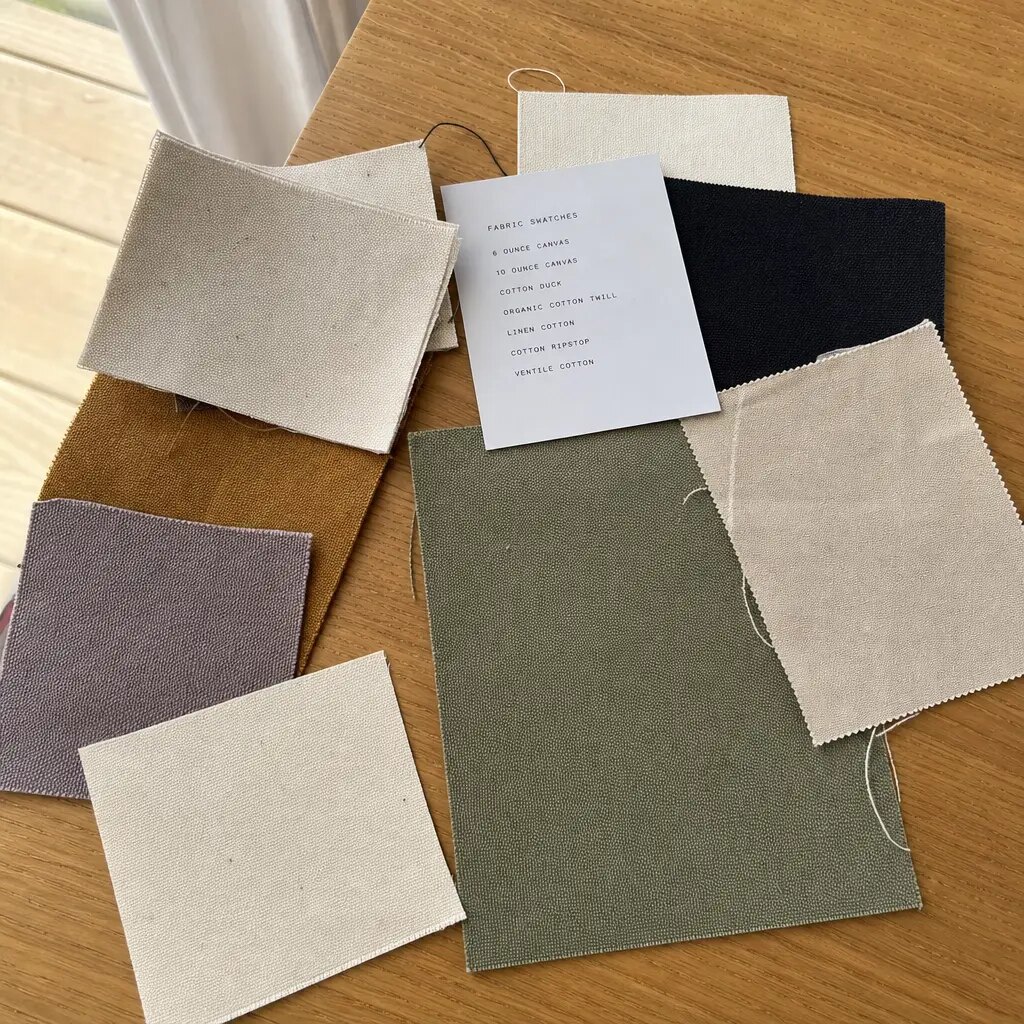
Most wholesale canvas zipper portfolios work well in 10 oz to 14 oz canvas, which is roughly 320 to 450 GSM depending on yarn count and weave. A 12 oz canvas around 380 to 410 GSM is often the practical middle point. It has enough body for a flat portfolio, still sews cleanly around zipper corners, and does not push carton weight too high. If the buyer wants a more premium hand feel, 14 oz canvas can be used, but the factory must adjust seam allowance, needle size, and corner construction.
Do not compare quotes only by the word “canvas.” A 10 oz canvas with tight weave may perform better than a loose 12 oz fabric. Natural canvas may show cotton seed flecks and weaving slubs, which some craft fair buyers like, but it can also interfere with small logo printing. Bleached canvas gives a cleaner print base but can look less handmade. Dyed canvas adds color value but usually increases MOQ because dye lots cannot be mixed freely across small orders.
- Budget fair giveaway: 10 oz canvas, about 320-340 GSM, simple lining or bound seams.
- Mainstream wholesale retail item: 12 oz canvas, about 380-410 GSM, stable and printable.
- Premium portfolio: 14 oz canvas, about 430-450 GSM, with zipper and corner sewing tested before bulk.
- Avoid vague fabric terms such as “thick canvas” or “heavy duty” without oz, GSM, and sample approval.
Set dimensions around the contents, then allow sewing tolerance
The portfolio size should start from the documents or inserts it must hold. For a US letter insert, the finished size often needs to be larger than 9 x 12 inches because the zipper seam, pocket seam, and fabric thickness reduce usable inside space. For A4 markets, buyers should not assume letter-size tooling will work. A common sourcing mistake is approving an outside dimension that looks correct, then discovering that the internal sleeve is too tight after binding and zipper sewing.
For a craft fair order, dimensions also affect display and packing. A large portfolio may look better on a retail table but costs more in fabric, increases carton volume, and can bend if packed without support. A compact version ships more efficiently but may frustrate vendors if paper corners curl. Write finished size, usable pocket size, and tolerance into the RFQ. For soft sewn goods, plus or minus 5 mm is usually realistic; tighter tolerances may increase rejection risk without adding real value.
- State outside finished size in width x height x depth or gusset, using millimeters for export clarity.
- State the largest insert size and whether it must fit inside a sleeve or only inside the main compartment.
- Include zipper opening width; a portfolio can be large enough outside but still hard to load.
- If a cardboard stiffener, foam layer, or padding is required, specify thickness and whether it is removable.
Specify zipper construction because it drives failure rates
The zipper is the main moving part and one of the first places users notice quality. For canvas zipper portfolios, a No. 5 nylon coil zipper is normally safer than a bulky metal zipper because it bends more smoothly around corners and keeps the product flatter. Metal zippers look premium, but they add weight, may scratch printed panels, and can be less forgiving if the portfolio is folded or compressed during shipping. Plastic molded zippers can work, but they may look too casual for an office-style portfolio.
Corner geometry matters. A sharp 90-degree zipper turn looks neat on a drawing but can create jamming and wavy sewing in production. A radius of about 20 to 25 mm at the corner gives the operator enough space to sew smoothly and gives the user a better opening action. Reinforcement at zipper ends is also important. If the zipper stop is weak, repeated opening at a fair booth can pull stitches loose even if the fabric itself is strong.
- Use No. 5 nylon coil zipper for most wholesale craft fair portfolios.
- Match zipper tape color to fabric for a clean retail look, or contrast it only when part of the design.
- Request a puller sample if the finish is antique brass, matte black, brushed nickel, or painted color.
- Inspect zipper ends, corner turns, and lining clearance, not only the center zipper run.
Keep interior layout useful but manufacturable
Interior pockets can make the portfolio more valuable, but every pocket adds cutting, alignment, sewing, and inspection time. A good craft fair portfolio usually needs one document sleeve, two smaller slip pockets, a business card pocket, and a pen loop. That layout supports vendor use without making the factory build a complicated office organizer. If buyers add many small pockets, elastic straps, transparent windows, and divided sleeves, the cost increase may be higher than expected because labor replaces material as the main cost driver.
Pocket sizing should be functional. A business card pocket that is too tight becomes a defect in use even if it passes visual inspection. A pen loop made from canvas may be too thick and stiff, while elastic can age or lose tension. For export orders, include pocket measurements and sample items where possible. If the portfolio is used for craft fair kits, send the actual insert sizes or a paper dummy pack to the factory before final sample making.
- Document sleeve should allow easy insertion without catching the zipper seam.
- Slip pockets need reinforced top corners if users will pull cards or tools repeatedly.
- Pen loops should be tested with the buyer’s typical pen diameter, not guessed from photos.
- Avoid transparent PVC pockets unless the market accepts PVC and the product will not be stored under heat.
Match print method to canvas texture and order quantity
Screen printing is usually the most stable branding method for canvas zipper portfolios when the design uses one to three solid colors. It gives good coverage and can be cost-effective at wholesale quantities. However, textured canvas is not a smooth paper surface. Fine lines, small reversed text, and light ink on dark fabric may lose detail. The artwork should be tested on the actual fabric weight and finish, not only on a digital mockup.
Heat transfer can handle small multi-color artwork or gradients, but it may feel less natural on canvas and can lift at edges if pressure, temperature, or curing is not controlled. Embroidery adds a premium look but may distort the panel and is not ideal near zipper areas or pockets. Woven side labels are efficient for repeat programs because they reduce print setup for small artwork changes, but they require their own MOQ and lead time. The buyer should decide whether the brand mark is the main selling feature or simply a subtle identification mark.
- Screen print: best for bold logos, fair names, sponsor marks, and simple artwork.
- Heat transfer: useful for multi-color art but requires wash and adhesion testing if long-term use matters.
- Embroidery: premium but adds needle holes, backing, and possible fabric puckering.
- Woven label: good for repeat retail lines, especially when the front panel artwork changes by season.
Understand MOQ logic before negotiating
MOQ for canvas zipper portfolios is not only a factory policy. It comes from fabric sourcing, cutting efficiency, zipper color, print setup, and labor line arrangement. If the factory has natural 12 oz canvas in stock, a 300 to 500 piece order may be workable. If the buyer wants custom dyed canvas, custom zipper tape, special pullers, or multiple printed designs, the real MOQ can rise quickly. Combining several colors into one headline quantity does not always reduce setup time.
A practical way to negotiate is to separate variables. Keep the fabric and zipper standard, then vary only the print if the program needs several fair names or sponsor logos. Or keep the print common and use different belly bands or hang tags for regional distribution. Buyers often get better unit cost by reducing construction variation than by pushing the factory to accept a lower MOQ on too many customized parts.
- Standard natural canvas plus standard zipper: often the lowest MOQ route.
- Custom fabric color: MOQ depends on dye lot and fabric mill minimum, not just sewing capacity.
- Custom puller or metal logo plate: may require tooling, longer sampling, and a higher order quantity.
- Multiple print designs: screen charges and print setup should be listed per design.
Compare quotes with a cost-driver view
Two quotes can show the same product name but include very different assumptions. One supplier may quote 10 oz unlined canvas with a standard zipper and simple screen print. Another may quote 12 oz lined construction with reinforced pockets, better puller, and individual retail packaging. The second quote is not automatically expensive; it may simply include the details the first quote skipped. Procurement teams should request quote sheets that expose the cost drivers instead of accepting a single unit price.
The most important comparison points are fabric spec, zipper grade, lining, pocket count, print method, packaging, carton data, sample terms, and Incoterm. For importers, carton size and gross weight matter because craft fair portfolios ship flat and can take more volume than expected. A low ex-factory unit price can lose advantage if the packing method creates oversized cartons, high dimensional weight, or extra warehouse handling.
- Compare prices under the same Incoterm, such as EXW, FOB, or CIF, and the same destination if freight is included.
- Request carton dimensions and gross weight before approving the supplier, not after production.
- Separate one-time charges such as print screens, label setup, sample fee, or puller tooling.
- Record whether the quote includes replacement allowance, spare packaging, or barcode labeling.
Use samples to lock construction, not just appearance
A nice-looking sample is not enough for a bulk order. The sample approval should lock fabric weight, fabric finish, zipper movement, inside layout, artwork placement, print color, seam type, packaging, and carton method. If the first sample uses substitute zipper or leftover canvas, it is useful only for size review. Before mass production, the buyer should approve a pre-production sample made from actual bulk materials. That sample becomes the reference for inspection.
For craft fair programs, timing is usually fixed by event dates. This creates pressure to approve samples quickly, but rushed sample approval often moves problems into bulk production. Print position, zipper corner movement, and pocket size are much cheaper to correct at sample stage. A simple sample comment sheet with photos, measurements, and acceptance decisions prevents confusion between the buyer, merchandiser, printing department, and sewing line.
- Measure finished size at three points because soft canvas can shift after sewing.
- Open and close the zipper at least 20 cycles on the sample to feel corner resistance.
- Place actual documents, cards, pens, or kit inserts into the pockets before approval.
- Rub the print lightly with a dry white cloth after curing to screen for obvious ink transfer.
- Photograph approved logo placement with a ruler from the top and side edges.
Plan packing for clean canvas and predictable distribution
Canvas products can pick up dust, oil marks, carton rub, and zipper scratches during packing. Natural and bleached canvas show handling marks easily, especially on the front logo panel. For wholesale craft fair orders, flat packing is usually better than folding because it protects the portfolio shape and keeps the zipper from pressing a crease into the front. Individual polybags protect cleanliness, while paper belly bands or glassine-style sleeves may fit buyers aiming for reduced plastic. The packaging choice should be quoted clearly because it affects labor and carton loading.
Carton planning matters for distributors shipping to multiple fair locations. If cartons are too heavy, warehouse teams may repack them. If cartons contain too many pieces, retailers may have inventory damage when opening and re-closing cartons for partial shipment. A common range is 20 to 40 pieces per export carton depending on size and thickness. The buyer should define maximum gross weight and require carton marks that match purchase order, SKU, color, print design, and quantity.
- Place zipper pullers so they do not press directly against printed logos in the carton.
- Use interleaving paper if dark zipper pullers or metal parts touch light canvas.
- Avoid over-compression that creates diagonal creases across the front panel.
- Confirm inner quantity and carton quantity for each SKU to support warehouse receiving.
- Include barcode, hang tag, or retail label placement in the approved packing sample.
Specification comparison for buyers
| Spec decision | Recommended option | When it fits | Buyer risk to check |
|---|---|---|---|
| Outer fabric weight | 12 oz canvas, about 380-410 GSM, with light starch or enzyme finish | Most craft fair retail programs where the portfolio must feel sturdy but still fold and ship efficiently | Too light can wrinkle and collapse; too heavy can increase sewing bulk at corners and carton weight |
| Lining construction | 210D polyester lining or unlined bound seams depending on retail positioning | Lined version suits office-style gifting; unlined version works for natural craft merchandise with lower target cost | Loose lining can catch the zipper; unlined seams need clean binding to avoid fraying complaints |
| Zipper type | No. 5 nylon coil zipper with metal puller or matte painted puller | Best balance for smooth opening, flexible folding, and bulk production stability | Cheap zipper tape may wave after sewing; sharp pullers can scratch printed artwork during packing |
| Closure direction | Top and side L-shape zipper with 20-25 mm corner radius | Useful for craft fair vendors who need quick access to order sheets, receipts, stickers, or small catalogs | Tight square corners slow sewing and can cause zipper jamming at the turn |
| Branding method | Screen print for 1-3 solid colors; heat transfer only for small multi-color artwork; woven side label for repeat programs | Screen print fits most wholesale fair merchandise and sponsor branding | Ink cracking on heavy textured canvas; transfer edges can lift if heat setting is not controlled |
| Interior layout | One document sleeve, two small slip pockets, one card pocket, and one pen loop | Covers practical craft fair use without overcomplicating sewing lines and QC | Too many pockets increase labor, misalignment risk, and sample-to-bulk variation |
| MOQ planning | 300-500 pcs per color for standard fabric and zipper; 800-1000 pcs if custom dyed fabric or zipper tape is required | Good for importers testing a fair-season assortment while keeping unit cost realistic | Combining many colors under one MOQ may not be accepted if dye lots, cutting, and sewing setup are separate |
| Packing method | Flat packed in individual recyclable polybag or paper belly band, 20-40 pcs per export carton depending on size | Protects zipper, keeps canvas clean, and supports retail distribution to multiple fair locations | Over-compressed cartons can create creases across the front print panel |
| Sample approval | Pre-production sample using bulk fabric, zipper, puller, lining, and final artwork placement | Necessary before any large craft fair order with retail-facing branding | A proto sample made from substitute fabric may look acceptable but fail on shrinkage, color, or zipper feel in production |
Buyer checklist before sampling
- Define the portfolio use case: vendor organizer, retail gift item, sponsor giveaway, workshop kit, or premium merch.
- Set finished dimensions in millimeters and include tolerance, not only A4 or letter-size descriptions.
- Specify outer canvas weight in oz and GSM, plus whether the fabric is natural, bleached, dyed, washed, or coated.
- Confirm zipper size, zipper material, puller finish, opening direction, and whether the zipper must turn around a corner.
- Decide whether the inside is lined, bound, or raw-edge finished; include pocket count and pocket measurements.
- Provide artwork files with Pantone references, print size, print position from edges, and acceptable print tolerance.
- Separate MOQ by fabric color, print design, zipper color, and packaging style so quotes can be compared correctly.
- Require a pre-production sample made with actual bulk materials before approving mass production.
- Define carton packing, individual packaging, carton marks, barcode placement, and maximum carton weight.
- Build lead time from sample approval date, not from first inquiry date, and reserve time for print proof correction.
Factory quote questions to send
- What canvas weight in oz and GSM are you quoting, and is it in stock or needs weaving or dyeing?
- Is the quoted fabric natural, bleached, dyed, washed, or coated, and what shrinkage range should we expect?
- Which zipper grade, zipper size, tape material, and puller finish are included in the price?
- Can the zipper run around the corner smoothly, and what minimum radius do you recommend for stable sewing?
- Are the inside pockets lined, bound, or double-layer canvas, and what seam allowance is used?
- Which print method are you quoting for our artwork, and what is the maximum printable area on textured canvas?
- Are screen setup charges, label charges, sample charges, and packaging charges included or listed separately?
- What is the MOQ per fabric color, per print design, per zipper color, and per packaging version?
- What are the sample lead time and bulk lead time after artwork and pre-production sample approval?
- How many pieces per carton, what carton size, what gross weight, and are portfolios packed flat or folded?
Quality-control points to confirm
- Finished size tolerance should normally be within plus or minus 5 mm unless the design includes a rigid board or foam padding.
- Zipper must open and close smoothly for the full travel length without catching lining, binding tape, or loose thread.
- Corner zipper sewing should be flat, with no puckering that prevents the portfolio from lying closed.
- Front print should be centered according to approved artwork, usually within plus or minus 3 mm for small logos and plus or minus 5 mm for larger prints.
- Canvas surface should be clean enough for retail sale, with no oil stains, dark weaving defects, heavy slubs on the logo area, or visible needle damage.
- Interior pockets should match approved measurements and allow the intended document, card, pen, or insert to fit without forcing.
- Seam strength should be tested by moderate manual pulling at zipper ends, handles if included, pocket corners, and label attachment points.
- Metal pullers, rivets, snaps, or sliders should not have sharp burrs that can scratch the product or injure users.
- Cartons should not exceed the buyer’s warehouse handling limit, commonly 15-18 kg gross weight unless otherwise approved.
- Bulk goods should match the signed pre-production sample in fabric hand feel, zipper color, print shade, pocket layout, and packing method.