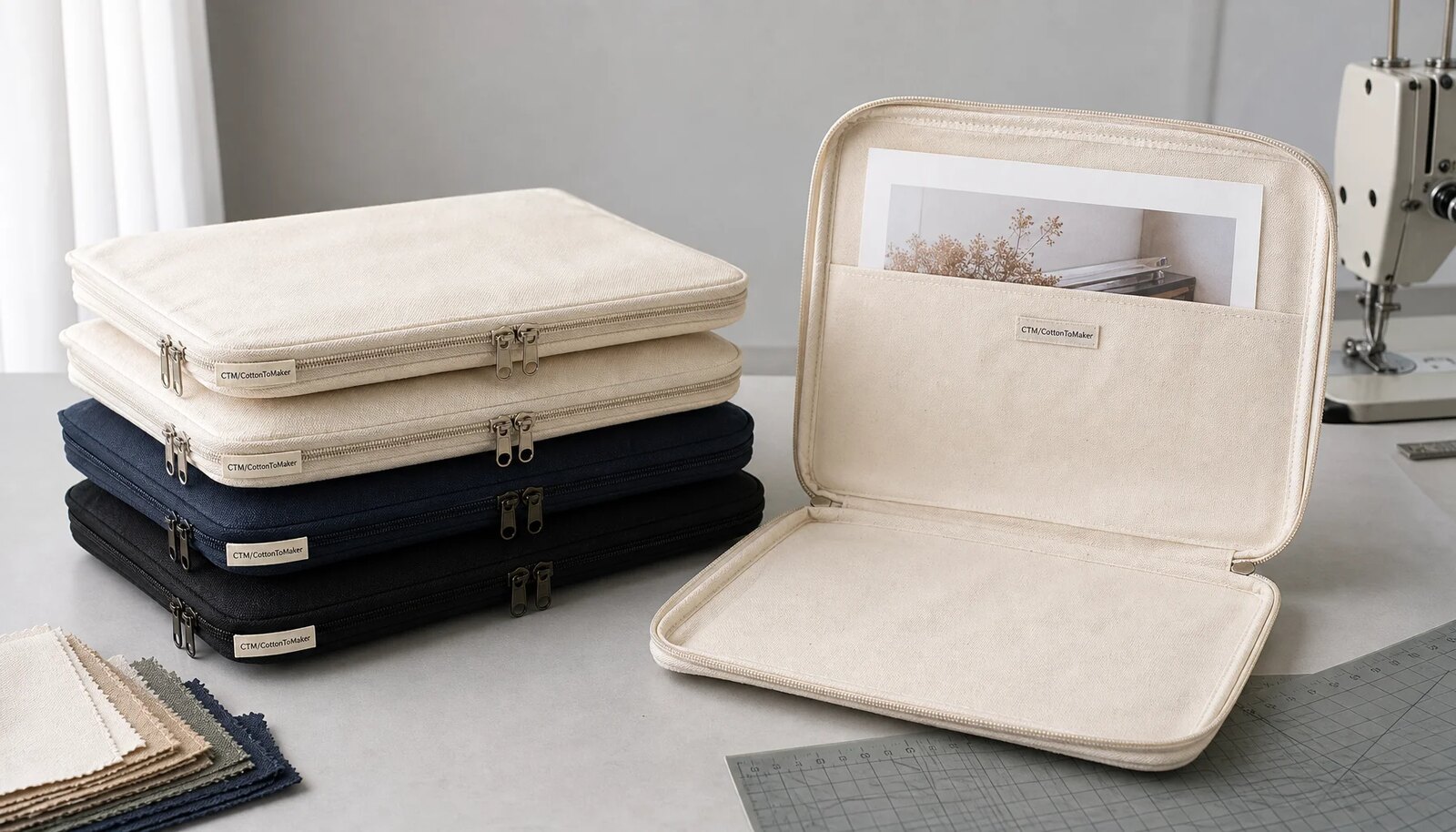
1) Why Procurement Should Treat This as a Controlled Product, Not a Simple Pouch
Canvas zipper portfolios for craft fairs look straightforward, but they combine several sourcing risks in one item: woven canvas quality, zipper hardware, print placement, sewn-panel accuracy, and packing presentation. A low unit price can look attractive until the first shipment arrives with stiff or misaligned zippers, off-center logos, uneven top edges, or cartons that are too heavy for event teams to carry comfortably. In the Zipper Business Bags category, this is not a generic pouch buy. It is a controlled sewn product with visible functional and branding requirements.
The first procurement mistake is comparing quotes before the spec is fixed. If one supplier is pricing unlined 10 oz canvas with a basic nylon zipper and another is pricing 12 oz lined canvas with reinforced corners and barcode-ready packing, the numbers are not comparable. A disciplined RFQ creates a level playing field, supports landed-cost comparison, and gives QC a measurable target instead of a sample photo and a hope.
The second mistake is assuming craft fair use is “light duty.” In practice, these portfolios may hold A4 forms, receipts, business cards, tablet accessories, swatches, payment tools, or product inserts. They are opened often, carried daily, and handled in front of customers. That means zipper smoothness, print durability, and neat edge finishing matter more than many buyers expect.
A buyer-ready supplier compliance checklist should answer four questions before a PO is released: what the product is for, what materials and trims are allowed, what evidence the supplier must provide, and what must be measured at inspection. Once those are defined, price becomes much easier to interpret. Without them, a cheap quote can become expensive after sampling, rework, or freight corrections.
Procurement should also think about the channel. A craft fair staff-use portfolio may prioritize durability and easy cleaning, while a retail version needs cleaner internal finishing, better packing presentation, and more consistent appearance from unit to unit. If the buyer does not define the channel, the factory will choose a construction path on its own. That often leads to a product that is technically usable but commercially wrong.
A strong buying habit is to source the portfolio as a configuration rather than as a loose idea. Once the configuration is fixed, the supplier can quote accurately, sample faster, and bulk production can be checked against the signed reference. That is how buyers reduce ambiguity and avoid repeated production arguments.
The rest of this guide focuses on practical controls that help shortlisting, RFQ comparison, and final acceptance. It is written for buyers who need a portfolio they can reorder, not just approve once.
- Send one controlled spec sheet to every supplier instead of a reference photo alone.
- Keep mandatory requirements separate from optional upgrades so suppliers quote the same construction.
- Ask for quoted carton CBM, gross weight, and pieces per carton before comparing landed cost.
- Treat zipper, logo, and fabric weight as compliance points, not decorative preferences.
- Use one measurement basis for all suppliers: outside flat size, internal usable area, or finished sewn size.
2) Define Use Case, Contents, and Measurement Basis First
The same canvas zipper portfolio can be used as a document organizer, checkout pouch, artist kit, catalog sleeve, tablet folder, or branded event accessory. Each use case changes the construction. A document folder needs accurate internal clearance for paper size and zipper tape. A craft kit may need more depth or a gusset. A retail accessory may need cleaner finishing and better shelf presentation. If the buyer does not define the use case, the supplier will make assumptions that can easily miss the market requirement.
The buyer should define function first, size second, decoration last. For A4 documents, the usable internal area must allow enough clearance for seam allowance and zipper tape. For US letter inserts, do not assume A4 sizing will work just because the outside dimensions look similar. A finished size that works on paper may still fail once the zipper curve, fabric thickness, and lining bulk are included.
It helps to describe the actual contents the portfolio must hold during normal use. A unit that carries 20 sheets of paper needs a different opening and internal height than one that carries a receipt pad, a calculator, and a few business cards. If the supplier knows the load, it can choose the right opening width and avoid making the portfolio technically correct but awkward to use.
For procurement teams buying across several channels, split the use case into two layers. The first layer is core function: document storage, sample carrying, or event organization. The second is market expectation: premium retail, giveaway, or staff utility. That separation helps the factory quote the right construction and prevents it from trying to satisfy every application with one vague spec.
The measurement basis must be written down. A common source of dispute is whether the size is taken flat outside, as usable internal space, or after sewing and pressing. The spec should state the method clearly, include a simple diagram if possible, and require the supplier to measure the approved sample the same way. That reduces back-and-forth later when the production line wants to use a different measuring point.
A useful RFQ sentence is more specific than a product category name. For example: “canvas zipper portfolio for craft fair checkout use, sized to hold A4 forms and a small calculator, with a flat profile for countertop storage.” That tells the supplier more than “portfolio for craft fairs” and usually produces a better first sample.
This stage is also where buyers should decide whether the product must stand up to repeated open-close cycles or mostly serve as a presentation folder. That one decision influences zipper grade, seam reinforcement, and fabric weight more than many procurement teams realize.
- Write the contents in the RFQ: paper size, calculator, swatches, cards, tablet, or other items.
- State whether the portfolio is for staff use, retail resale, or mixed use.
- Confirm size using one measurement method and keep it consistent in all supplier quotes.
- For A4 and US letter products, define usable space rather than only outside dimensions.
- If the item is for craft fair sell-through, include shelf appearance and packing needs in the brief.
3) Fabric Weight, Canvas Quality, and Shade Control
Fabric specification is one of the biggest hidden cost drivers in canvas zipper portfolios. Many buyers compare only the outer description, such as “canvas” or “cotton canvas,” but suppliers may use very different yarn counts, weave densities, surface finishes, and weights. In practical sourcing terms, 10 oz canvas is often a balanced choice for a structured but cost-conscious portfolio, while 12 oz canvas gives a more premium handfeel and better body. Very light canvas can lower price, but it also wrinkles more easily and may make the portfolio feel underbuilt.
Buyers should ask for composition, target GSM, and whether the fabric is washed, bleached, dyed, or left natural. The ounce label alone is not enough because factories may use different conversion assumptions. A cleaner spec is to define the target GSM and acceptable tolerance, then require a bulk fabric check before cutting starts. If the buyer plans repeat orders, the supplier should also state whether the same mill, yarn count, and finish route can be maintained later.
Natural canvas deserves special attention. Its shade usually varies slightly from lot to lot, and that is normal. But normal does not mean uncontrolled. Procurement should set an acceptable shade range, keep a signed swatch from the approved sample, and review the actual bulk cloth before production begins. If the product is printed, the contrast between the ink and the fabric must be checked on the real cloth, not only on a digital file.
Surface finish matters too. If the canvas is prewashed, steam-set, or water-resistant, the buyer should ask whether the finish affects print adhesion or sewing friction. Some finishes improve appearance but make bulk sewing harder. Others reduce lint but change the way ink sits on the fabric. These are small details until they create a reject issue or a customer complaint.
Fabric weight should match the use case. A low-cost giveaway portfolio does not need the same structure as a retail accessory. Over-specifying weight can create extra freight cost and bulk without adding value. Under-specifying it can lead to floppy edges, zipper distortion, and a product that feels cheap at the fair counter. The right answer is not the heaviest canvas possible; it is the canvas weight that fits the channel and the contents.
Canvas quality is more than GSM. Buyers should review weave tightness, yarn consistency, slub level, and how much lint the fabric releases during handling. A neat weave makes printing easier and gives the portfolio a cleaner look. A loose or fuzzy face can make even good sewing look less refined. If the product is sold where presentation matters, the fabric should be judged in daylight before approval.
A practical sourcing habit is to ask for a raw cut swatch, not only a finished sample. That lets procurement see the cloth before stitching hides the fabric behavior. It also makes repeat-order comparison much easier if the same style is reordered months later.
If the program uses dyed canvas, ask for dye lot control and the supplier’s approach to shade matching. If the order is split over time, you do not want the second delivery to look obviously different from the first simply because the dye bath changed.
- 10 oz canvas is often the practical middle ground for structured portfolios.
- 12 oz canvas is a better fit for premium retail or heavier-use programs.
- Require the supplier to state GSM and tolerance, not just ounce weight.
- Ask whether the fabric is washed, bleached, dyed, or natural before bulk cutting.
- Keep an approved swatch for future reorders and shade comparison.
4) Zipper, Lining, and Sewing Details That Separate Good Samples from Safe Bulk Orders
The zipper is the main functional complaint point on any portfolio. For most canvas zipper portfolios, a nylon coil zipper is the default commercial choice because it is flexible, economical, and runs smoothly across fabric edges. Metal zippers can look more premium, but they add weight, can scratch inserts, and are less forgiving on long flat openings. The supplier should quote the zipper type, tape width, slider style, puller style, closure direction, and whether the ends are reinforced with fabric tabs or internal stops.
Lining is the second major construction decision. An unlined portfolio is lower cost and lighter, but it exposes seam allowance and can shed lint onto paper goods. A self-lined version looks cleaner while staying in the same fiber family, but it adds bulk and can make corner sewing harder. A separate cotton or polyester lining can improve the interior appearance and reduce friction, but it changes labor time and requires better cutting control. If the buyer cares about a clean interior, lining must be defined before sample approval.
Sewing details determine whether the product feels well made or merely assembled. Stitch density, seam allowance consistency, corner turn quality, and zipper-end reinforcement all matter. Buyers should ask how many stitches per inch are used on the main seams, whether bartacks are used at stress points, and how thread trimming is controlled. On a rectangular portfolio, even a small wave in the top edge is visible when the item lies flat.
Zipper opening behavior should be checked as a real use test, not a photo test. The zipper should open fully without catching seam allowance, lining folds, or the edge of the panel. If the portfolio will hold inserts that are removed often, opening width matters as much as fabric quality. Buyers should request a full open-close test on multiple samples, not only on a hand-picked piece.
If the portfolio includes a wrist strap, pen loop, internal pocket, or divider, those features should be treated as construction items with their own tolerances. Added parts create new stress points and reduce usable internal space. They also change the sewing sequence, which affects lead time and defect risk.
Zipper tape color and puller finish should be locked down, especially on natural canvas. A bright silver slider may suit a crisp retail look; a matte black slider may fit a more understated brand. Neither is automatically better. The key is consistency with the brand brief and the rest of the trim package. Ask whether the finish is stock or custom, because that affects MOQ and delivery timing.
For repeat programs, define the acceptable zipper feel in practical terms: glide without snagging, puller sits flat, closure does not bow the panel, and the slider does not leave visible damage after repeated use. Those statements are easier to inspect than a vague note like “feels cheap.”
- Use a nylon coil zipper for most bulk craft fair orders unless the brief specifically calls for metal hardware.
- Specify stitch density and seam allowance in the purchase order where practical.
- Require reinforcement at zipper ends for frequent-use portfolios.
- Approve zipper opening behavior on the actual bulk sample with contents inserted.
- Treat any strap, loop, pocket, or divider as a separate inspection point.
5) Logo Method, Artwork Control, and Brand Placement
The decoration method should be chosen for both appearance and production stability. Screen printing is usually the most cost-effective option for bold, solid logos on canvas zipper portfolios. It works well for one to three spot colors and can hold up well when the ink is correctly cured. Heat transfer can reproduce fine details, gradients, and multi-color art, but it changes the handfeel and should be tested on textured canvas before mass production. Embroidery creates a premium look for small logos or emblems, but dense artwork can pucker the fabric and keep the portfolio from lying flat.
Artwork control is where many disputes begin. A rectangular portfolio makes misalignment much easier to see than a soft pouch. The logo should be positioned from fixed edges with a measured distance, not judged by eye. The buyer should provide artwork size, color reference, print position, and an allowed placement tolerance. If the design is printed before sewing, the cutting pattern must account for seam allowance so the logo does not sit too close to an edge. If the printing happens after sewing, the factory needs a reliable jig to keep the panel flat and consistent.
The quote should also identify the maximum printable area and how many logo colors are included. Buyers often assume a one-color price still covers a second accent line or a small back mark, but many factories treat each extra color or layer as a separate setup. Ask whether the logo is included on one side only, whether a woven label or side label is part of the price, and whether artwork setup is one-time or repeat. If the product is sold at retail, ask for a strike-off or proof that matches the intended method rather than only a PDF.
For premium programs, a printed front logo plus a woven side label can be a smart brand move. But it should not be added casually. Each branding element affects seam space, QC complexity, and label positioning. Metallic inks, puff inks, or specialty finishes are similar: if the effect is part of the selling point, the supplier should prove it on the correct canvas before bulk cutting begins.
The best artwork control process is straightforward: approve the file, approve the strike-off, approve the pre-production sample, and then lock the approved sample as the reference for bulk inspection. Each step prevents a different type of mistake, and each step is cheaper than fixing an entire shipment after packing.
One detail procurement teams often miss is print durability after handling. Canvas surfaces can carry lint, texture, or light finishing that changes how inks cure or how transfer films bond. Ask how rub resistance is checked and whether the print still reads clearly after repeated handling. If the portfolio is used at fairs, it will be touched, packed, unpacked, and carried often; the logo needs to survive that use.
Keep the artwork file simple where possible. Clean vector art, clear Pantone references if relevant, and one approved placement drawing reduce interpretation errors at the factory. The more precise the file package, the fewer last-minute clarifications the supplier will need.
- Screen print: best for bold brand marks and larger production runs.
- Heat transfer: useful for detailed graphics but needs rub and peel testing.
- Embroidery: suitable for small premium logos, not large dense artwork on thin canvas.
- Woven label: useful for subtle branding and repeat orders, but it has its own MOQ and lead time.
- Always approve a real strike-off on the intended canvas, not only a digital proof.
6) MOQ, Price Drivers, and How to Normalize Quotes Before Comparing Suppliers
MOQ is not a single number, and that is one of the most important procurement lessons for this product. A supplier may accept a small quantity for a stock-size natural canvas portfolio with a simple one-color print, but require a much larger order if the buyer wants custom dimensions, dyed fabric, special lining, custom zipper pullers, or retail packaging. If the buyer does not ask for MOQ by component, the quote can look flexible at first and then become restrictive once artwork or packing details are finalized.
Price changes quickly when the specification moves. Heavier canvas increases material cost and sewing difficulty. Longer zippers, custom pullers, or metal hardware increase trim cost. More logo colors add setup charges. A zipper portfolio that must arrive individually polybagged, labeled, and cartonized for retail takes more labor than bulk-packed cartons for internal distribution. Even inspection scope can change cost if the buyer needs carton photos, third-party checks, or detailed test records.
The safest practice is to normalize the quote before comparison. That means asking every supplier to quote the same dimensions, fabric weight, zipper type, logo method, packing, and Incoterm. Once all suppliers quote the same spec, procurement can compare apples to apples. Before that point, the cheapest quote is usually just the least complete quote. If the product will be reordered, ask whether the supplier can lock the same fabric source and trim source for repeat production, because changing materials later often breaks shade consistency and fit.
For larger programs, request a costed option table: blank versus printed, 10 oz versus 12 oz canvas, unlined versus lined, bulk packed versus retail packed. That makes it much easier to see where the real cost jumps are and where a cheaper package may still work for the channel. It also helps the buyer separate one-time setup charges from recurring unit-cost additions.
When reviewing quote sheets, separate unit price from total program cost. A low unit price can become expensive if it requires a high MOQ, expensive samples, long approvals, or freight-unfriendly packing. Buyers should ask the supplier to state any assumptions clearly: number of screens, sample charge policy, extra charge for color matching, custom zipper changes, and whether tooling or pattern costs are included.
A practical buying habit is to request price breaks at several quantities, not just one target volume. That shows whether the supplier’s price curve is stable or whether the quote only works at a very specific order size. If the craft fair program may grow over time, this information matters for future inventory planning.
When a quote looks unusually low, check whether the supplier has omitted packing inserts, label application, zipper pull customization, inspection photos, or other details that may appear later as extra charges. A complete quote is usually more useful than a cheap-looking one that hides assumptions.
- Ask for MOQ by component, not only for the finished portfolio.
- Separate setup charges from recurring unit price so the quote is readable.
- Request price breaks at 500, 1000, 3000, and 5000 pieces if the program may scale.
- Compare landed cost only after matching fabric, zipper, print, and packing scope.
- Watch for missing items in a low quote: labels, packing, inspection, and sample costs.
7) Supplier Evidence, Audit Red Flags, and Compliance Documents Worth Asking For
A compliance checklist should focus on evidence that is relevant to the exact product. A general factory profile is not enough if the buyer needs canvas zipper portfolios for craft fairs. More useful evidence includes photos or videos of similar zipper business bags in production, fabric weighing records, zipper inspection steps, cutting-marker photos, and packed carton examples. The goal is to confirm that the supplier can manage flat zipper construction, print placement, and export packing with control, not just that it can sew bags in general.
For compliance claims, separate marketing language from documentable proof. If the buyer plans to market the portfolio as recycled, organic, low-impact, or compliant with a specific retailer standard, the supplier must provide the relevant material statements and test documents. If no such claim is being made, the buyer may still need basic chemical compliance depending on the destination market and the retailer policy. Do not let a sales page replace the documentation review.
Audit red flags are usually practical, not dramatic. If the supplier cannot identify the actual factory, cannot show a similar item in production, or gives different answers about who signs off on QC, that is a warning. If the supplier says a logo, zipper, or fabric change is “no problem” but cannot explain how the change affects lead time or MOQ, that is another warning. If the quoted style has multiple outsourced steps—printing, labeling, or packing—but no one can explain where those steps happen, the risk is higher.
The buyer should also ask who owns the quality decision. In some sourcing models, a trading company manages the account but the factory makes production decisions. In others, the factory controls QC directly. Buyers should know who will answer when a zipper lot is inconsistent or when the print position is out of tolerance. If the supplier outsources printing or label application, that extra step should be visible in the quote and in the inspection plan.
A useful evidence request is short and practical: show the similar item, show the material source, show the QC process, show the packing standard, and show who signs off on production changes. Anything less invites uncertainty later. For repeat buyers, it is also helpful to ask for recent production batches of the same style. A stable repeat program is often a better signal than one polished sample photo.
If the supplier cannot provide direct evidence for the exact style, ask for the nearest comparable product and identify the differences. That makes the conversation more honest and helps the buyer judge whether the factory is adapting a proven item or inventing a new one from scratch.
The point is not to build paperwork for its own sake. It is to reduce ambiguity so the team managing the order can act quickly when something changes during production.
- Request photos or videos of zipper portfolio sewing, not only tote bag production.
- Ask for the factory name behind the quote and who controls QC decisions.
- Review the supplier’s defect categories and how they define major versus minor issues.
- Confirm whether printing is in-house or subcontracted, and who controls curing and color approval.
- Require material documentation before using sustainability claims in retail copy.
8) Sample Approval, Packaging Specimens, and What to Lock Before Bulk Cutting
A correct sample process saves money by preventing a flawed bulk run. The first sample usually confirms the pattern, size logic, and construction approach using whatever materials are available. The pre-production sample is the real approval point: it should use bulk fabric, bulk zipper, approved lining, the actual logo method, and the intended packing format. Bulk cutting should not begin until the buyer signs off on that sample or gives written approval for clearly defined deviations.
Sample feedback must be measurable. Phrases like “make it nicer” or “slightly more premium” do not help the sewing line. Better feedback says the zipper opening should be 15 mm wider, the logo should move 20 mm up from the bottom seam, the corner radius should be softened, or the lining should switch from white polyester to natural cotton. Use a ruler, a camera, and a written approval record. Keep one sealed approved sample at the factory and one with the buyer or inspector so there is no dispute later.
It is also wise to test the sample like a real user would. Open and close the zipper multiple times. Insert the actual documents, cards, or tools the portfolio is meant to hold. Check whether seam allowance catches on the contents. Look at the front panel under normal light to judge logo alignment. If the product will be sold at retail, evaluate how it folds, sits on a shelf, and presents in packaging. A sample that looks fine in a photo can still be frustrating in practice if the zipper is stiff or the panel bows.
Packaging should be approved with the same level of care as the sewn product. Buyers sometimes approve the portfolio but forget to approve the polybag, barcode label, or carton mark format. That creates avoidable confusion during shipment and receiving. For a repeat order, keep the approved sample, the signed spec, and the QC checklist together as one production reference package.
When possible, ask the supplier to identify what changed between the first sample and the pre-production sample. That change log is useful for future reorders because it shows where the factory had to adjust pattern, stitching, or trim. A supplier that can explain the differences clearly is usually easier to manage during production.
This is also the right time to check whether packaging expectations are realistic. A portfolio that looks premium in bulk may lose that impression if it arrives folded too tightly or without zipper protection. If presentation matters, approve the real packing method rather than assuming a warehouse can repackage later without issue.
For teams buying across several product lines, keep the sample notes in one format. That makes supplier comparison easier and makes it simpler to reopen a style for repeat purchase months later without rebuilding the specification from scratch.
- Measure finished outside size and internal usable size on the approved sample.
- Photograph logo placement with a ruler from two fixed edges.
- Run the zipper at least 20 open-close cycles during sample review.
- Check whether inserts slide in without catching seam allowance or lining folds.
- Approve packing using the same folding, polybag, label, and carton method planned for bulk.
- Keep a simple change log from first sample to pre-production sample.
9) Packing, Cartons, Freight, and Lead Time Controls That Matter After Approval
Flat products can still be damaged by poor packing. Canvas zipper portfolios are vulnerable to over-compression because the zipper slider, corners, and printed areas can show distortion if cartons are packed too tightly. On the other hand, underfilled cartons increase CBM and raise freight cost. Procurement should ask the supplier to propose a packing method that balances protection, carton weight, and transport efficiency rather than leaving the decision to factory habit.
The packing spec should define pieces per polybag, pieces per inner carton if used, and pieces per master carton. It should also define whether each unit needs a hangtag, barcode label, care label, or insert card. If the product will be shipped to a retailer, distributor, or event warehouse, the carton mark format and SKU separation matter as much as the sewn product itself. Ask for carton dimensions and gross weight before final production so freight quotes can be checked early.
Moisture protection is another practical control point. Natural canvas can pick up warehouse moisture, and paper inserts can curl if cartons sit in humid storage. If the shipment is sea freight or will spend time in transit, ask whether a dry carton spec, desiccant, or inner moisture barrier is appropriate. If metal zipper parts are used, moisture control becomes even more relevant. The buyer does not need overengineering; the buyer needs the right level of protection for the route.
For craft fair distribution, portability matters. Staff may need to carry these portfolios in boxes, set up displays, or split shipments into event kits. Heavy master cartons are harder to manage and can be more costly to move at the last mile. A good supplier will help the buyer decide whether fewer pieces per carton or stronger carton board is better for the channel.
Presentation also matters. If the portfolio is sold directly to consumers, the way it sits in the polybag, the visibility of the logo, and the position of the hangtag can influence shelf appeal. If the product is an internal tool for craft fair staff, the packaging can be simpler and more cost-effective. The key is to match the packing method to the channel rather than using one default style for every order.
Lead time should be planned from the approval gates, not just the sewing line. A typical order sequence includes RFQ clarification, artwork review, material sourcing, sample making, sample approval, bulk preparation, cutting, printing, sewing, trimming, inspection, packing, and shipment booking. Delays often come from incomplete artwork, late zipper color confirmation, fabric shade approval, print strike-off correction, or missing label files. If the supplier cannot show where the time is spent, the delivery date is not yet reliable.
For repeat orders, record the actual lead time by stage after the first shipment. That history helps later buying cycles because it reveals whether the supplier consistently hits the promised window or only does so under unusually favorable conditions.
- Define pieces per polybag and pieces per carton; do not leave packing to factory habit.
- Avoid over-heavy cartons that are hard for craft fair teams to move.
- Use corner and zipper protection if the portfolio has metal sliders or premium patches.
- Confirm carton dimensions and gross weight before freight booking.
- Ask for an early warning if bulk fabric, zipper tape, or packing labels are delayed.
10) Acceptance Checklist, Buyer Red Flags, and a Practical Close-Out Rule
The best acceptance checklist is one that can be used at the dock without argument. For canvas zipper portfolios for craft fairs, the buyer should inspect fabric weight, finished size, zipper function, logo position, seam quality, interior cleanliness, packing method, carton marks, and carton condition. If the order is retail-bound, add barcode legibility and unit presentation. If the order is staff-use, prioritize function, durability, and packing efficiency. The point is to check the things that customers and users will actually notice first.
Buyer red flags are usually visible early if you know what to look for. A supplier that refuses to define the zipper grade, will not name the factory, or keeps changing the spec after the quote is a risk. So is a sample that looks good in a photo but has no measurement record, no trim card, and no approved packing format. Another red flag is when the supplier says “same as sample” but cannot identify which sample or what changed. That is how reorders go off track.
At acceptance, use clear pass/fail checkpoints rather than vague impressions. Pass means the zipper runs smoothly, the print is within placement tolerance, the seams are clean, the internal surface is free of loose threads or stains, and the carton spec matches the agreed method. Fail means non-functioning zipper, missing logo, obvious fabric shade mismatch, stains, broken sewing, or carton damage that could affect resale or use. For minor issues, such as stray thread ends or small trim inconsistencies, decide in advance whether rework is required or whether a capped tolerance is acceptable.
A practical close-out rule helps procurement stay consistent: no bulk order is considered complete until the signed sample, the PO spec, the packing spec, and the final inspection record are all aligned. That sounds basic, but it prevents the common situation where the product itself is acceptable while the packing or carton data still does not match the order.
If the product will be reordered, save the production notes as part of the item file. Include fabric source, zipper source, print method, approved carton size, packing count, and the final inspection outcome. This history saves time on the next order and gives the buyer a better starting point when negotiating price or comparing new suppliers.
In short, a good procurement result is not just a good-looking portfolio. It is a portfolio that can be quoted consistently, sampled clearly, produced to tolerance, packed in the right way, and reordered without re-opening every decision from scratch. That is the standard buyers should use when buying in this category.
If you are screening suppliers now, the safest approach is to request one comparable quote sheet from each bidder, normalize the spec, and reject any quote that cannot show material, trim, packing, and compliance evidence in the same format. That single step will eliminate most weak candidates before you spend time on sampling.
- Use pass/fail criteria for zipper function, logo position, stains, stitching, and carton integrity.
- Set a pre-agreed limit for minor defects if you are willing to accept rework rather than rejection.
- Keep the signed sample, PO, packing spec, and inspection record in one item file.
- Reject any quote that cannot identify the material, zipper, packing, and compliance scope in writing.
- For reorders, save fabric source, zipper source, and approved carton data for future comparison.
Specification comparison for buyers
| Supplier option | What to verify | Commercial advantage | Buyer risk to control |
|---|---|---|---|
| Direct sewing factory | zipper source record, production-line zipper test photos, approved trim card, cutting marker photos, and final open-carton count | Better sample-to-bulk control and faster production feedback | May be weaker on export paperwork or branded packing unless checked early |
| Trading company | Factory name, production photos, trim-source proof, and who owns QC decisions | Can coordinate small mixed orders and extra services | Markup can hide real factory capability and slow defect decisions |
| Specialized bag workshop | zipper gauge, zipper tape width, puller finish, binding tape, corner reinforcement, seam allowance, and document-size tolerance | More practical for detailed construction, trims, and repeat programs | Capacity may be limited during peak seasons |
| Low-price general supplier | 300D-600D polyester, 10-12 oz canvas, or recycled PET with backing stiffness matched to document weight | Useful for simple promotional runs with loose specs | Material downgrades, weak packing, and vague inspection scope can erase savings |
| Retail-ready supplier | flat packing, insert board if needed, SKU bundles, carton weight limit, moisture protection, and barcode visibility | Can handle labels, SKU separation, carton marks, and receiving rules | Higher unit cost must be compared against reduced warehouse work |
| Compliance-focused supplier | Fabric records, labeling review, test plan, and production traceability | Safer for retail programs and repeat brand orders | Documentation claims need evidence, not only sales language |
| Local sample room plus bulk factory | Signed sample, bulk factory handoff, first-piece photos, and deviation owner | Good for complex branding before large production | Sample room quality may not match bulk line unless handoff is controlled |
Buyer checklist before sampling
- Define the end use in one sentence: document organizer, checkout pouch, artist kit, catalog holder, tablet sleeve, or retail accessory.
- State the exact internal usable size required, not just the outside dimension; include allowance for zipper tape, seam allowance, and any lining.
- Lock the fabric target by composition, weave, and weight, such as 10 oz canvas around 280-300 GSM or 12 oz canvas around 340-360 GSM.
- Specify whether the portfolio is unlined, self-lined, or separately lined, and name the lining material and color before sample approval.
- Choose the zipper style, tape width, slider finish, and opening direction; the zipper is the most visible functional risk.
- Define the logo method, placement, allowed tolerance, and whether the print is single-side or double-side.
- Require a pre-production sample made with bulk fabric, bulk zipper, approved artwork, and the final packing method.
- Agree the packing spec in advance: polybag or no polybag, insert card or not, barcode label placement, carton marks, and carton count.
- Set acceptable shade variation for natural canvas and define whether slight lot variation is allowed or must be matched tightly.
- Separate MOQ by item and by customization: blank, printed, custom size, custom zipper puller, custom label, and retail packing.
Factory quote questions to send
- What exact canvas composition, weave, and GSM are included in your quote, and can you keep the same mill and finish for repeat orders?
- Is the quoted size measured flat outside, internal usable space, or finished after sewing and pressing? Please show the measurement method on the sample.
- Which zipper type and grade are used, and what running test, open-close cycle test, or pull test do you apply during QC?
- Is the product unlined, self-lined, or lined with a separate fabric, and is lining included in the unit price and lead time?
- Which print method is included, how many logo colors are priced, and what is the maximum printable area from seam to seam?
- Does the price include artwork setup, screen cost, strike-off, sample cost, custom label, barcode label, inner insert, and individual polybag?
- What is the MOQ for the exact quoted spec, and what changes if the order quantity is 500, 1000, 3000, or 5000 pieces?
- How many days are needed for fabric approval, print strike-off, pre-production sample, bulk production, packing, and shipment booking?
- Can you provide pre-shipment inspection photos showing fabric weight check, zipper test, print position, carton marks, and packed cartons?
- Which Incoterms are quoted, and can you provide carton dimensions, carton count, gross weight, and total CBM for FOB, CIF, or DDP comparison?
Quality-control points to confirm
- Check bulk fabric GSM before cutting; a practical tolerance is typically plus or minus 5 percent unless a tighter range is written into the purchase order.
- Verify finished size after sewing and pressing, with separate tolerances for length, height, gusset depth, and zipper opening width.
- Test zipper travel across the full opening; the slider should not catch seam allowance, zipper tape, or lining folds.
- Check seam strength at zipper ends, corners, puller stress points, and any strap or pocket attachment points.
- Measure logo placement from fixed edges rather than judging by eye; rectangular portfolios make skew and offset easier to see.
- Perform rub testing on printed areas after curing, especially on textured canvas or fabric with water-resistant finishing.
- Grade needle holes, skipped stitches, loose threads, oil marks, fabric slubs, and edge waviness before packing.
- Inspect zipper closure symmetry; the top edge should not bow, twist, or wave when closed and laid flat.
- Check the internal clean finish for stray thread ends, exposed seam allowance, or loose lint that could transfer to documents.
- Inspect packing for zipper slider protection, corner protection, carton dryness, correct carton marks, and no over-compression during carton sealing.