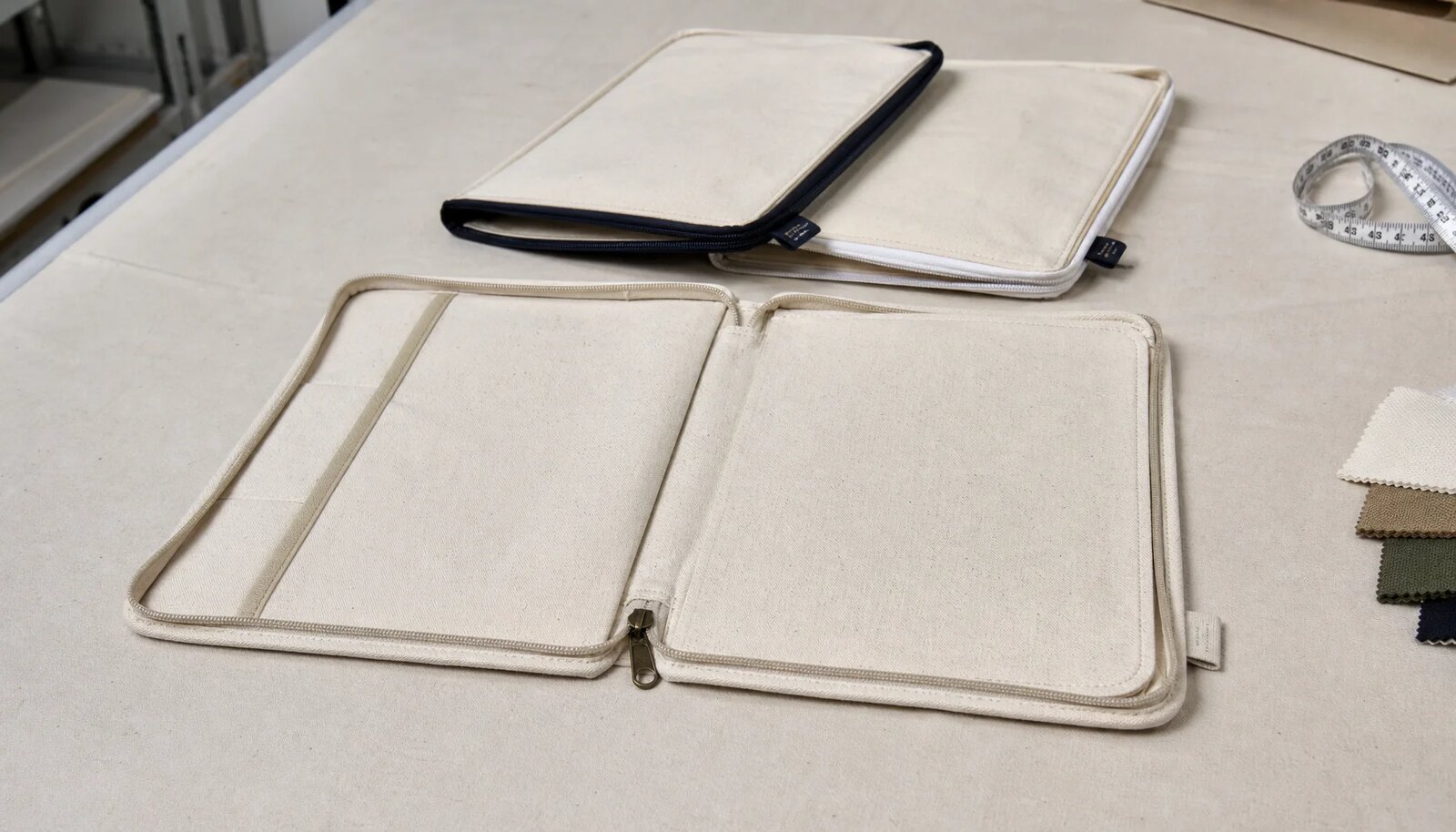
Buying Problem: Too Many Factories Quote Different Bags
A canvas zipper portfolio sounds simple until three suppliers return three different constructions. One quote may use 10 oz canvas, another 12 oz, and another a polyester-cotton blend described only as “canvas.” One supplier may include a lined interior and woven label, while another prices a single-layer pouch with a budget zipper. If the RFQ does not define the product clearly, the cheapest quote is often just a different bag.
For craft fairs, the portfolio has to survive handling by exhibitors, retail staff, and end buyers. It may carry order forms, postcards, art prints, swatch cards, invoices, small tools, or packaged accessories. That means the quote must control stiffness, zipper smoothness, print durability, and carton creasing, not only size and logo.
- Treat the item as a flat zipper business bag, not a generic pouch.
- State the intended contents so the factory understands load, stiffness, and gusset needs.
- Request the same construction from each supplier before comparing price.
- Do not compare a lined metal-zipper portfolio against an unlined nylon-zipper quote.
- Include photos or a reference sample, but still write the specifications in measurable terms.
Core RFQ Specification for Canvas Zipper Portfolios
A useful RFQ starts with finished size, fabric, zipper, seams, branding, packing, and inspection standard. For most craft fair programs, an A4 or letter-size portfolio is practical because buyers can store show paperwork without folding it. A common finished size is around 35 x 25 cm for A4-style use, or slightly wider if the portfolio needs to hold catalogs, sample cards, or a slim notebook.
The factory should not be left to decide whether the portfolio is flat or gusseted. A flat portfolio looks cleaner and packs efficiently, while a 2-4 cm gusset allows more volume but increases sewing complexity and carton cube. If the portfolio is sold as a retail item, also define the zipper opening length and whether the zipper runs across the top edge only or wraps around one side for easier access.
- Finished size: width x height x gusset, with tolerance.
- Fabric: cotton canvas weight in oz and GSM, color, finish, and shrinkage expectation.
- Zipper: type, size, tape color, puller finish, opening direction, and end-tab construction.
- Interior: unlined with bound seams, overlocked seams, or full lining.
- Branding: print, woven label, leather or PU patch, or mixed decoration.
- Packing: individual protection, carton quantity, carton marks, and export carton strength.
Fabric Weight, GSM, and Handfeel Choices
For canvas zipper portfolios, fabric weight affects perceived value more than many buyers expect. An 8 oz canvas can work for low-cost event giveaways, but it may feel soft and show contents through the body. A 10 oz canvas is usable for lightweight document pouches. A 12 oz canvas, roughly 380-410 GSM depending on weave and finish, is a common commercial balance for a portfolio that needs better structure without becoming difficult to sew.
Heavier canvas, such as 14 oz or above, can look premium but creates thicker zipper corners and higher needle stress. It also raises freight weight and may require larger cartons to avoid hard creasing. Natural cotton canvas varies in shade and seed flecks, so buyers who need a cleaner boutique look should specify bleached canvas, dyed canvas, or an agreed natural shade range approved by fabric swatch before bulk cutting.
- 8 oz canvas: lowest cost, softer hand, better for giveaway budgets than retail portfolios.
- 10 oz canvas: acceptable for flat document use when cost and weight matter.
- 12 oz canvas: stronger retail feel and better shape retention for craft fair resale.
- 14 oz canvas: premium stiffness but more sewing risk at zipper ends and corners.
- Dyed canvas: better brand color control but needs colorfastness and shrinkage checks.
- Natural canvas: authentic texture, but shade variation must be accepted or controlled by swatch.
Zipper and Sewing Details That Change Usability
The zipper is the working part of the product, so it deserves more detail than “zipper closure.” A No.5 nylon coil zipper is usually the safest choice for flat canvas portfolios because it is smooth, flexible, and less likely to scratch contents. Metal zippers create a stronger visual style but add weight and can feel rough if the teeth, slider, or puller are not well matched.
Sewing around zipper ends is a common failure point. If the portfolio corners are thick, the operator may reduce stitch consistency or leave bulky corners that do not lie flat. A proper RFQ should define zipper end tabs, back-tacking, seam allowance, and whether inside seams are bound. For craft fair buyers, neat internal finishing matters because end users often open the portfolio in public and judge quality immediately.
- Use No.5 nylon coil zipper for smooth daily use and stable bulk quality.
- Use metal zipper only when the visual hardware is part of the product value.
- Specify zipper tape color, slider color, puller shape, and whether custom pullers are required.
- Require reinforced stitching and back-tacking at both zipper ends.
- Avoid oversized pullers that press marks into printed panels during carton packing.
- Approve a physical sample to feel zipper drag, corner bulk, and opening width.
Branding and Print Method Selection
Screen printing is the usual starting point for canvas zipper portfolios when the artwork is solid color, the order quantity is reasonable, and the buyer wants a durable logo at controlled cost. On natural canvas, the yarn texture affects edge sharpness, so fine lines, small reversed text, and large ink blocks should be reviewed before bulk approval. If the artwork requires gradients or photographic detail, heat transfer or digital print may be discussed, but those methods change handfeel and wash resistance expectations.
For retail brands or distributors building a reusable product line, a woven side label, cotton label, PU patch, or debossed patch can carry brand identity without covering the front panel. This is useful when the same portfolio body will be used across several artists, boutiques, or event programs. The RFQ should state label size, fold type, placement, stitch color, and whether label production cost is included in the unit price or charged separately.
- Screen print: best for simple logos, solid colors, and repeatable event branding.
- Digital print: better for complex artwork but needs approval on canvas texture and color accuracy.
- Heat transfer: sharp graphics, but evaluate edge feel and long-term adhesion.
- Woven label: premium repeat-order identity with lower risk of print defects.
- PU or leather patch: higher perceived value but may affect needle choice and sewing speed.
- Large front branding should be tested for cracking, rub resistance, and carton pressure marks.
MOQ Logic and Cost Drivers Behind the Quote
MOQ is not only a factory preference. It is tied to fabric sourcing, dye lot minimums, zipper color minimums, screen setup, label weaving, cutting efficiency, and packing materials. If a buyer requests 200 pieces across four colors and four artworks, the supplier may either raise the price heavily or use stock materials with limited control. For a serious craft fair program, 500-1,000 pieces per main specification is often a more stable starting point for custom canvas, printing, and repeat production.
The unit price changes quickly when small details are added. A lined interior, custom zipper puller, individual barcode sticker, paper insert, reinforced patch, or multi-color print may each look minor on a spec sheet but create separate material, setup, and labor steps. Good quote comparison separates base construction from add-ons so the buyer can decide which features actually support sell-through or distributor requirements.
- Fabric color MOQ may apply when using dyed or custom-finished canvas.
- Zipper color MOQ may apply if tape is not black, white, natural, or stock color.
- Multi-color printing increases screen setup and registration risk.
- Lining adds material cost, cutting time, turning time, and inspection points.
- Custom labels have their own minimum, mold, weaving, or setup charge.
- Retail packing can cost more than expected when barcodes, inserts, or hangtags are included.
- Carton cube affects landed cost, especially when gussets or rigid inserts are added.
Sample Approval That Prevents Bulk Production Mistakes
A photo sample is not enough for this product. Buyers should handle at least one physical sample because canvas stiffness, zipper smoothness, seam bulk, and print handfeel cannot be judged accurately on screen. A practical sampling path is one blank construction sample first, then one pre-production sample using actual fabric, zipper, branding, and packing. This prevents the team from approving artwork on a body shape that later changes.
The approval record should include measured dimensions, weight per piece, fabric swatch, zipper photos, print position, label placement, and packing method. If the product will be sold at craft fairs or shipped to exhibitors, pack a few samples in the intended carton quantity for several days and inspect for creases or zipper pressure marks. This simple storage test often reveals whether the packing plan is suitable for real distribution.
- Measure finished size after sewing, not only cut panel size.
- Open and close the zipper repeatedly to feel drag and slider stability.
- Rub the print surface with a dry white cloth to screen for poor curing.
- Place sample contents inside to confirm opening width and gusset function.
- Check whether the portfolio lies flat after packing and unpacking.
- Approve one sealed pre-production sample as the reference for inspection.
QC Thresholds for Inspection Before Shipment
Inspection criteria should be written before production starts. For canvas zipper portfolios, major defects include broken zipper function, wrong size beyond tolerance, visible stains, serious print misplacement, loose seams, mildew odor, incorrect label, and carton damage that affects product appearance. Minor defects may include small thread ends, slight natural yarn variation, or very small print specks within agreed limits.
For importers and distributors, a standard AQL inspection can be used, but the defect list must match the product. Zipper function deserves a functional check on sampled pieces, not only visual review. Print position should be measured from fixed edges, such as top seam and side seam, because a centered logo can look off if the portfolio shape shifts during sewing.
- Dimension tolerance: commonly plus or minus 5 mm for width and height unless a tighter tolerance is agreed.
- Print placement tolerance: define acceptable movement, such as plus or minus 3-5 mm from approved sample.
- Zipper test: slider must run smoothly across the full opening without catching fabric.
- Seam strength: no skipped stitches, open seams, or unsecured zipper ends.
- Cleanliness: no oil, rust, water marks, mildew, or strong chemical odor.
- Packing: no heavy compression that creates permanent creases or hardware marks.
- Label accuracy: correct brand label, care label, barcode, and carton mark for each SKU.
Packing, Carton Data, and Distribution Practicalities
Craft fair distribution often means goods are split across event sites, retail buyers, or regional sales teams. Packing should protect the front print and zipper while staying easy to count. Individual polybags reduce dust and moisture risk, while paper bands or glassine-style paper may suit brands trying to reduce plastic. If using paper-based packing, the buyer should consider humidity, abrasion, and whether the portfolio may arrive with visible scuffs.
Carton data should be requested with the quote, not after production. A portfolio that looks inexpensive at FOB level may become costly if it ships in oversized cartons due to gusset depth or poor stacking. Ask for pieces per carton, carton dimensions, gross weight, net weight, and estimated CBM. This allows the buyer or freight forwarder to compare landed cost before approving a final specification.
- Use interleaving paper when metal pullers may press against printed panels.
- Avoid overfilling cartons with heavy canvas portfolios because creases can become permanent.
- Specify master carton strength suitable for export handling and warehouse stacking.
- Use carton marks that identify SKU, color, artwork, quantity, gross weight, and destination.
- Confirm whether cartons must be palletized, and whether pallet height limits apply.
- Request a packed-carton photo and carton drop condition check before shipment.
Lead Time, Schedule Risk, and Quote Comparison
Lead time should be tied to approval milestones. A supplier may say production takes 25-35 days, but that usually starts after deposit, artwork confirmation, material readiness, and pre-production sample approval. If dyed canvas, custom labels, custom pullers, or special retail packing are included, material preparation can add meaningful time before bulk sewing begins.
When comparing suppliers, separate factory capability from commercial convenience. A trading company may communicate quickly and support mixed SKUs, while a direct factory may offer stronger control over sewing and inspection if the order is focused. The best choice depends on the buyer’s order complexity, QC expectations, and need for consolidation. For an RFQ, ask each supplier to quote the same Incoterm and provide the same packing data, otherwise landed-cost comparison becomes unreliable.
- Sample lead time: usually depends on fabric availability, print setup, and label development.
- Bulk lead time: should start only after approved pre-production sample and material confirmation.
- Peak season risk: canvas, zipper, and printing capacity can tighten before major fair seasons.
- Split shipment risk: multiple artworks or colors may not finish at the same time.
- Landed-cost comparison: include FOB price, carton CBM, duty category, freight, and local handling.
- Quote validity: material prices can shift, so confirm how long the supplier will hold the quote.
Specification comparison for buyers
| Spec decision | Recommended option | When it fits | Buyer risk to check |
|---|---|---|---|
| Canvas body fabric | 12 oz cotton canvas, about 380-410 GSM, pre-shrunk if printing tight artwork | Best balance for retail-feel portfolios that must hold catalogs, order forms, small tools, or flat samples at craft fairs | Low quotes may use 10 oz fabric or loose weave canvas that wrinkles badly and loses shape after packing |
| Lining construction | Unlined body with bound internal seams, or 150D polyester lining for a cleaner inside | Unlined works for rustic craft positioning; lining fits corporate gift, boutique retail, or higher perceived value | Lining adds labor and can pucker near zipper corners if pattern allowance is not controlled |
| Zipper grade | No.5 nylon coil zipper for standard portfolios; No.5 metal zipper only when the brand wants visible hardware | Nylon coil is smoother for flat document-style bags and easier to pass pull tests at volume | Metal zipper increases unit cost and may scratch printed inserts or snag if teeth alignment is poor |
| Branding method | Screen print for solid CTM-style logos; woven label or PU patch for reusable retail positioning | Screen print fits event merchandising; label or patch fits private-label programs needing repeated seasonal designs | Large ink coverage on coarse canvas can crack if the factory uses the wrong ink viscosity or insufficient curing |
| Size and gusset | A4/letter document size around 35 x 25 cm, with 2-4 cm gusset only if contents are bulky | Flat size fits artist paperwork and order sheets; gusset fits samples, swatches, pens, and small accessories | A deep gusset changes the silhouette and carton cube, so landed freight cost may rise faster than unit price |
| MOQ structure | Start from 500-1,000 pcs per color/print for custom fabric, print, and zipper color stability | Suitable for craft fair distributors and retail brands testing one artwork across several events | Very small MOQs may use stock canvas and stock zipper only, limiting PMS accuracy and repeat-order consistency |
| Sample approval | One blank size sample, then one printed pre-production sample with actual zipper, label, and packing | Important when the buyer will photograph the product, sell online, or ship to multiple fair locations | Approving a photo only can miss zipper waviness, print handfeel, seam bulk, and actual fabric stiffness |
| Packing method | Each portfolio in a recyclable polybag or paper band, 50-100 pcs per export carton depending on size | Works for wholesale cartons, event kits, and distribution to multiple craft fair booths | Over-compressed cartons can crease canvas and leave zipper impressions on printed panels |
Buyer checklist before sampling
- Define the finished size in width x height x gusset, not only document size, and state tolerance such as plus or minus 5 mm for body dimensions.
- Specify canvas weight in oz and approximate GSM, plus whether natural, dyed, bleached, recycled, or organic cotton is required.
- State zipper type, zipper size, zipper tape color, puller shape, and whether the zipper must open from left to right or right to left.
- Provide artwork as vector files with Pantone references, print size, print position, and acceptable color tolerance on natural canvas.
- Decide whether inside seams are overlocked, bound with cotton tape, or covered by lining, because this changes both cost and appearance.
- List each packing level: individual bag or paper band, inner carton if needed, master carton quantity, carton marks, and pallet requirements.
- Require a pre-production sample using production fabric, production zipper, actual print method, and final packing before bulk cutting.
- Set inspection criteria for zipper function, seam strength, print adhesion, stains, odor, fabric shade, dimensions, and carton drop condition.
- Separate EXW, FOB, CIF, and DDP quote requests so supplier comparisons do not mix factory price with freight and duty assumptions.
- Ask the supplier to declare any MOQ split charges for multiple colors, multiple artworks, zipper color changes, or private-label packing.
Factory quote questions to send
- What canvas weight, GSM range, yarn construction, and shrinkage allowance are included in the quoted price?
- Is the zipper No.5 nylon coil, No.5 metal, or another grade, and what pull test standard can you support for bulk inspection?
- Does the quote include bound internal seams, lining, zipper end tabs, puller customization, woven labels, or only the basic stitched body?
- What is the MOQ per fabric color, per zipper color, per print artwork, and per packing style?
- Which print method is quoted, what is the maximum print area, and are setup screens, PMS matching, and curing tests included?
- How many samples are included before bulk production, what is the sample lead time, and will the pre-production sample use actual materials?
- What carton quantity, carton dimensions, gross weight, and estimated CBM are assumed in the quote?
- What production lead time starts after deposit, after artwork approval, or after pre-production sample approval?
- Which inspection level and AQL can be accepted before shipment, and who pays for re-inspection if the goods fail due to factory defects?
- Can the supplier provide photos of fabric rolls, zipper inventory, printing setup, inline inspection, and final packed cartons for this order?
Quality-control points to confirm
- Finished size tolerance should normally stay within plus or minus 5 mm for width and height, with consistent zipper placement across cartons.
- Zipper must open and close smoothly for repeated cycles without wave, skipped teeth, broken pullers, sharp edges, or fabric caught in the slider.
- Seams should use even stitch length, secure back-tacking at zipper ends and corners, and no loose threads longer than the agreed trim allowance.
- Print adhesion should pass a dry rub and tape pull check appropriate to the ink system, especially on heavy natural canvas with uneven yarn texture.
- Fabric shade should be checked by roll before cutting because natural canvas can vary from cream to grey-beige within one shipment.
- Odor, mildew, oil marks, dirt, needle holes, and water stains should be treated as major defects for retail or gift-channel orders.
- Carton packing should prevent hard zipper pullers from pressing into printed panels during sea freight or long warehouse storage.
- Final inspection should include open-carton checks from different production lots, not only top-layer pieces prepared for photos.