1. Treat print proofing as a procurement control, not a design formality
For canvas zipper portfolios sold at craft fairs, maker markets, art workshops, kit programs, and distributor events, the front print does more than decorate the bag. It may carry an artist’s name, a workshop title, an event logo, a private-label mark, or a retail collection graphic. If that print is dull, crooked, under-cured, or distorted by the zipper seam, the product may still hold paper, but it can fail the buyer’s brand standard.
A useful proof is therefore not just a PDF mockup with a logo placed somewhere on a rectangle. It should prove that the selected artwork can be reproduced on the selected canvas, at the selected size, with the selected print method, after the panel is sewn into a zipper portfolio and packed for transit. Many pricing disputes start here. One supplier may quote a small one-color screen print on natural canvas. Another may assume a larger multicolor transfer, substitute fabric, or no physical strike-off at all.
Good procurement language removes guesswork. Instead of writing "logo centered," say whether the artwork is centered on the visible front panel, measured from the zipper seam, or aligned between side seams. Instead of "heavy canvas," specify ounce weight, finished GSM if available, finish type, approved swatch, and finished piece weight. Instead of "smooth zipper," define zipper type, opening width, slider, puller, and end reinforcement. The proofing checklist should connect artwork, fabric, zipper, sewing, packing, and inspection before the factory cuts bulk panels.
- Approve print performance on actual canvas, not only logo appearance on a digital mockup.
- Lock logo measurement points before sampling so inspection is not based on opinion.
- Confirm print method, ink color, curing or adhesion route, and setup charges in writing.
- Hold bulk cutting until the pre-production sample matches the approved fabric, zipper, label, print, and packing method.
2. Size the portfolio around the real contents, not the catalog name
A canvas zipper portfolio is not one fixed product. It can be a document holder, art print pouch, sewing-pattern organizer, craft kit bag, class material case, swatch-card carrier, or branded giveaway. Each version asks for different dimensions and construction. A holder for US letter sheets does not need the same clearance as one for A4. A pouch for 9 x 12 in prints needs an opening wide enough that corners do not bend. A kit bag filled with tools, folded fabric, or workshop materials may need a light gusset and stronger zipper-end reinforcement.
Ask suppliers to quote finished outer dimensions and usable internal dimensions separately. Finished size is measured outside seam to outside seam. Usable capacity is smaller because seam allowance, zipper stops, rounded corners, binding, internal dividers, and gusset shape take up space. A nominal 13 x 10 in portfolio may look correct on paper but fail a 9 x 12 in insert if the zipper opening stops too soon.
The selling environment also matters. At a craft fair, portfolios may sit flat on a table, stand upright in a bin, slide into tote bags, or ship as part of a workshop kit. If they are stacked, flatness and print protection become important. If they carry bulkier contents, a gusset may justify the extra sewing cost. If they are a simple event giveaway, a flat construction may be the better choice. The right design is not the most complex one; it is the simplest version that performs in the buyer’s actual use case.
- List the exact contents to test: A4 sheets, US letter paper, art prints, patterns, swatch cards, booklets, or tools.
- State the largest insert size and the clearance needed for easy loading.
- Measure usable zipper opening separately from total finished width.
- For filled kits, test bulging, zipper stress, front-panel distortion, and corner strain.
3. Specify canvas weight, finish, and lot control in measurable terms
For many retail-facing craft fair portfolios, 10 oz to 12 oz cotton canvas is a practical starting range. It gives more body than light tote fabric without making the portfolio feel like a rigid case. Still, ounce weight alone can mislead buyers. Some suppliers refer to greige fabric weight. Others mean finished fabric weight, or use a market shorthand that does not match final hand feel after dyeing, washing, coating, or softening. Ask for finished GSM where available, finished piece weight, and a physical swatch from the same finish route planned for production.
Canvas finish changes both the look and the print result. Natural unwashed canvas often gives a clean base for simple screen printing, although its warm base color affects how ink appears. Dyed canvas can support stronger brand color options, but shade control matters from lot to lot. Washed or enzyme-washed canvas can create a softer handmade feel that suits maker markets, yet it can also increase shrinkage, shade variation, panel skew, and uneven ink absorption. If the portfolio is washed after printing or after sewing, the proof must reflect that full route.
Do not ignore grain, shrinkage, and panel stability. When panels are printed before sewing, seam take-up and sewing tension can shift the final visual position of the logo. Heavily softened canvas may crease more during packing. Very heavy canvas may create bulky corners and zipper seams, which can affect flatness and zipper action. Keep one approved fabric reference for inspection and reorders, and ask the supplier to notify you if the mill, finish, dye lot, or fabric standard changes.
- Write the fabric spec as composition, ounce weight, finished GSM if available, finish, color, and approved swatch reference.
- Record finished piece weight on the approved sample and compare bulk samples during inspection.
- Avoid approving a print strike-off on substitute fabric if bulk will use washed, dyed, coated, or heavier canvas.
- For natural canvas, define acceptable slubs and shade character so normal texture is not treated as a defect.
4. Treat the zipper as a functional component, not a trim afterthought
The zipper is one of the first things a retailer or end user touches. If it snags, waves, or feels weak, the whole portfolio feels cheaper, even when the print looks good. For soft canvas zipper portfolios, nylon coil zippers are commonly used because they are flexible and easier to sew into fabric edges than more rigid zipper types. The quote should do more than say "zipper included." It should identify zipper type, gauge if available, tape color, tape width, slider material, slider finish, puller style, zipper path, and end treatment.
The zipper path affects both usability and price. A straight top zipper is simple and efficient for slim documents. A zipper that turns a corner or follows a U-shaped opening improves access, but it requires tighter sewing control and can create corner puckering or tape waviness if poorly handled. For craft kits, easier loading may justify the added cost. For flat print-proof storage, a simpler opening may be enough as long as the usable width is verified with real inserts.
Test the zipper under the same conditions the customer will experience. An empty sample may zip smoothly, while a filled one exposes stress at the ends, catching at seam allowances, or misalignment around corners. Zipper ends should be secured with a documented method such as backstitching, folded tape ends, binding, bartacks, or another reinforcement appropriate to the design. Packing also deserves attention. Bulky or metal pullers can press into printed panels when products are stacked in cartons.
- Use nylon coil zipper as the default unless the design calls for another zipper type.
- Confirm zipper tape color against the canvas and thread using physical samples or controlled-light photos.
- Measure usable zipper opening and test it with the intended inserts.
- Inspect zipper-end reinforcement, slider smoothness, tape waviness, and puller pressure during packing.
5. Match the print method to the artwork and order route
Screen printing is often the best baseline for repeat one-color or limited-color branding on canvas zipper portfolios. It works well for bold logos, event names, simple illustrations, and solid graphics. Once screens are set, it can be efficient for bulk production if ink mixing, screen tension, print pressure, and curing are controlled. On natural canvas, pale ink colors need extra attention because the fabric base can make white, cream, yellow, pale pink, or metallic tones look weaker than expected.
Heat transfer can make sense when buyers need multicolor art, short-run seasonal designs, or variable names by artist, class, or event. The tradeoff is hand feel and edge behavior. A transfer may look crisp on a flat strike-off, then lift at the edge, crack over flex zones, or feel less integrated than ink on textured canvas. Digital print may also be available, but the buyer still needs to confirm color, rub resistance, fine-line clarity, and how the image interacts with slubs.
Commercial terms change with the print method. Screen printing often carries setup charges by color and position. Oversized art may require larger screens or different handling. Transfers may have minimum sheet quantities or price changes by print area. Digital routes may reduce setup but raise unit cost depending on artwork and production workflow. Ask suppliers to separate unit price, setup charge, strike-off charge, sample charge, and reorder assumptions. A vague all-in price is hard to compare and harder to audit later.
- Use screen print for repeat one-color or limited-color logos where consistency and hand feel matter.
- Use transfer or digital print only after testing adhesion, edge behavior, flexing, and packing contact on the selected canvas.
- Ask whether small type, thin lines, distressed textures, or halftones will hold clearly on canvas.
- Quote setup by color and position so artwork revisions do not become surprise charges.
6. Build the print proofing checklist with tolerances and failure rules
A factory-ready print proofing checklist should read like a production instruction, not a creative note. Start with file control: vector artwork where possible, fonts outlined, placed images embedded or supplied, file name recorded, and final print size stated in mm or inches. If the factory may not scale the artwork, write "no resizing without written buyer approval." If the design has small text or fine lines, ask the supplier to confirm whether those details are realistic on the chosen canvas.
Placement must be defined by measurement points. For example: top of artwork 60 mm below the zipper seam; left edge 95 mm from the left side seam; logo centered on the visible front panel after sewing, not centered on the unsewn cut panel. Tolerance depends on construction and factory capability. A practical target is often +/- 5 mm for centered logos. Edge-aligned graphics may need +/- 3 mm, but only if the supplier confirms the fabric, cutting, printing, and sewing process can hold it.
Color approval should use a physical reference whenever possible. Pantone references, brand color chips, prior approved samples, or physical strike-offs are more reliable than screen images. Canvas base color changes the perceived ink shade, so the same ink can look different on natural, dyed, washed, or coated fabric. The checklist should also say what happens when proofing fails. Can the factory adjust opacity? Must a strike-off be resubmitted? Who signs off on revised artwork? Clear failure rules keep production pressure from turning a rejected proof into a bulk problem.
- Record artwork file name, version date, print size, color reference, print method, and measurement points.
- Define placement from finished seams, zipper edge, or visible panel, not only from the flat cut panel.
- Set standards for opacity, edge sharpness, registration, pinholes, smudges, and curing or adhesion.
- Require written buyer approval before resizing artwork, changing ink, switching print method, or moving placement.
- Keep the approved strike-off and pre-production sample as inspection references.
7. Use samples to prove repeatability, not just appearance
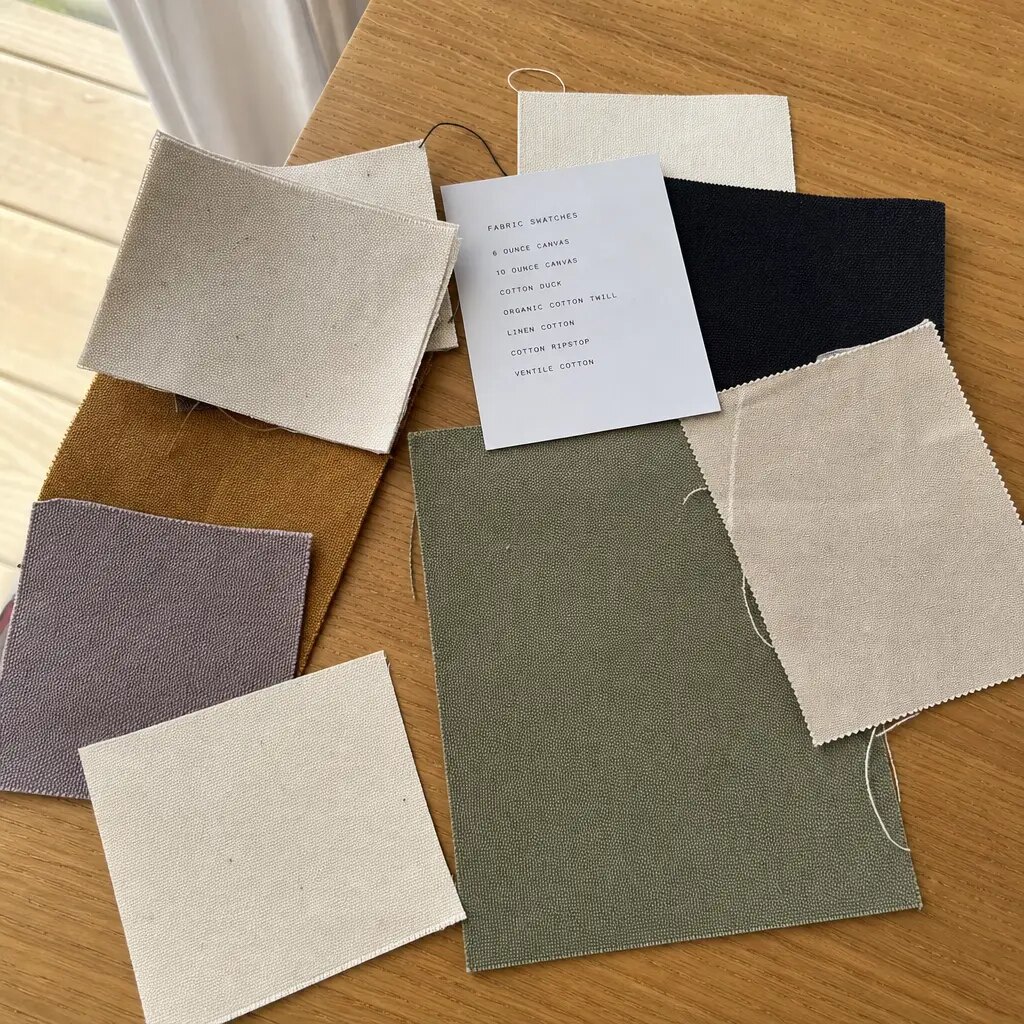
Sampling should reduce risk in stages. First, review a fabric swatch and trim card. This confirms canvas hand feel, weight, shade, zipper tape, slider, puller, thread, labels, hangtags, and barcode materials. Second, approve a print strike-off on the selected canvas. This proves color, opacity, line quality, hand feel, and curing or adhesion before the product is sewn. Third, approve the pre-production sample, which brings everything together: printed panel, zipper insertion, stitching, dimensions, internal capacity, labels, and packing.
Be careful with substitute samples. A shape sample made from available fabric is useful for early sizing, but it should not authorize bulk production. A sample with a different zipper cannot prove zipper performance. A print proof on smooth fabric cannot prove print clarity on heavy natural canvas. If timing forces a substitute, write down the remaining risk and close it before bulk cutting.
Review the sample as the customer will use it. Insert the real contents. Zip and unzip the portfolio several times. Lay it flat the way it may appear on a craft fair table. Check the logo from normal viewing distance and close up. Place several pieces in the proposed packing direction and see whether pullers, folds, tags, or adjacent prints can damage the artwork. Photograph the sample from the front, back, inside, zipper close-up, print close-up, label close-up, and packed condition. Those records make inspection and reorders much cleaner.
- Approve swatch and trim card before print strike-off when material feel and zipper color matter.
- Approve print strike-off before the final pre-production sample on branded orders.
- Use approved production fabric, zipper, thread, label, construction, and print method in the pre-production sample.
- Record measurements, photos, sample date, artwork version, and approved deviations in one approval file.
8. Compare supplier quotes without letting the specification drift
Two suppliers can both quote "canvas zipper portfolios" and still be pricing very different products. One quote may include 12 oz canvas, one-color screen print, reinforced zipper ends, individual polybags, and carton labels. Another may assume lighter canvas, a basic zipper, heat transfer, bulk packing, and no print strike-off. The lower number may disappear once missing items are added.
A strong RFQ package should include finished size, usable capacity, artwork file, print size and placement, canvas weight and finish, zipper requirements, label requirements, packing method, target quantity, delivery window, and inspection expectations. Ask each supplier to confirm deviations line by line. If a supplier cannot state canvas weight, zipper type, print method, or packing method, treat the quote as incomplete rather than as a valid low bid.
Version control matters when several teams are involved: buyer, designer, merchandiser, sourcing agent, factory merchandiser, print workshop, and packaging team. Every revision should reference a dated spec sheet and artwork file. If the logo moves after sample review, update the placement diagram. If the zipper puller changes, update the trim card. If packing changes from bulk pack to individual polybag, recalculate carton quantity and freight cube. This discipline prevents arguments at final inspection.
- Send every supplier the same RFQ package and require written confirmation of included specs.
- Separate unit price, print setup, sample charges, packing charges, and carton details for real comparison.
- Ask who prints the panels and who approves bulk color before sewing starts.
- Reject quote comparisons where canvas weight, zipper spec, print method, or packing are unspecified.
9. Plan packing and carton loading before approving the final unit price
Packing is not a small detail for printed canvas portfolios. The product is flat and fabric-based, so carton pressure, folding, zipper hardware, print-to-print contact, and dirt can all create visible damage. A portfolio may pass sewing inspection and still arrive with a creased logo, rubbed print, dented panel, or dirty natural canvas. Packing should be part of the quote, sample approval, and final inspection checklist.
Common options include flat bulk packing, individual polybags, tissue separation, paper bands, protective sheets, inner cartons, and retail-ready hangtags. Individual polybags help keep natural canvas clean and simplify warehouse counting, although some brands prefer reduced-plastic options. Tissue or a protective sheet may be useful when a zipper puller or the back of one print could touch the printed face of another unit. If the portfolio is folded, the fold line should not cross the logo unless the print method has been tested for that condition.
Carton loading affects both landed cost and claim risk. Ask for pieces per carton, carton dimensions, gross weight, net weight, and loading orientation. Overpacked cartons can press pullers into the print or create lasting creases. Underfilled cartons may collapse or shift during transit. Carton marks should include style number, color, quantity, PO number, carton number, destination, and barcode or marketplace labels if required. A packing photo or packing sample is especially useful for branded orders because it shows whether the print is protected in the actual shipping configuration.
- Confirm whether pieces are flat, folded, bundled, individually packed, or separated by tissue or protective sheets.
- Make sure zipper pullers and labels do not press directly into the printed front panel.
- Include barcode stickers, hangtags, retail labels, warning labels, and carton marks in the quote.
- Review carton dimensions and weights with unit price because freight cube changes landed cost.
10. Set inspection standards before bulk production begins
Final inspection should be based on written standards agreed before production, not negotiated at the loading dock. For canvas zipper portfolios, inspection should cover measurements, print, fabric appearance, zipper function, stitching, labels, packing, and carton count. Buyers may use an internal AQL plan, a third-party inspection service, or a buyer-supplier checklist. The sampling plan may vary by order size, but defect definitions should be clear before the order is cut.
Group defects by severity. Critical defects may include mold, sharp unsafe hardware, severe contamination, or a zipper that cannot open. Major defects may include wrong artwork, wrong print color, print position outside tolerance, broken zipper, open seam, wrong size, severe stain, missing label, or wrong packing. Minor defects may include small loose threads, slight natural slubs within the approved fabric standard, or tiny alignment differences within tolerance. This classification helps inspectors make consistent decisions and tells suppliers which problems require rework.
The inspection reference set should include the approved pre-production sample, fabric swatch, trim card, print strike-off, measurement diagram, packing sample or packing photo, and PO specification. Inspectors should pull samples from multiple cartons, not only the top carton. Print should be checked under neutral light and compared with the strike-off. Zippers should be opened and closed fully. Packing labels and carton marks should be verified before shipment release, because receiving errors can delay goods even when product quality is acceptable.
- Measure finished size, usable opening, print position, and gusset depth according to the approved diagram.
- Check print color, opacity, edge quality, curing, rub resistance, cracking after light flexing, and consistency across cartons.
- Open and close sampled zippers completely and inspect zipper ends, tape alignment, pullers, and seam allowances.
- Inspect fabric shade, stains, oil marks, excessive wrinkles, panel skew, stitching defects, and label accuracy.
- Document defects with photos, carton numbers, severity, and rework decision before shipment approval.
Specification comparison for buyers
| Spec decision | Procurement-ready baseline | Typical B2B tolerance or detail to request | Buyer risk to control |
|---|---|---|---|
| Finished size and capacity | Quote finished outer dimensions and usable internal dimensions. Confirm whether the portfolio must hold A4 sheets, US letter sheets, 9 x 12 in art prints, pattern sheets, swatch cards, booklets, or slim tools. | Use a written finished-size tolerance, commonly +/- 5 mm. Measure usable zipper opening separately from total outside width. | A portfolio can match the catalog size and still fail in use if seam allowance, zipper stops, rounded corners, or gusset shape reduce real capacity. |
| Fabric weight | Use 10 oz to 12 oz cotton canvas as a common starting point for retail craft fair portfolios. Request finished GSM and finished piece weight. | Ask whether the ounce weight refers to greige fabric, finished fabric, or fabric after washing, dyeing, or softening. Keep an approved swatch for bulk reference. | Loose fabric wording can lead to lighter hand feel, wrinkling, weak print opacity, panel distortion, or shade drift between sample and bulk. |
| Canvas finish | Natural unwashed or dyed canvas gives a cleaner base for most simple logo printing. Washed or enzyme-washed finishes should be used only after strike-off testing. | Confirm raw, dyed, pre-shrunk, washed, enzyme-washed, coated, softened, or other finish in the PO and sample approval record. | Washed finishes can shrink, soften, skew, or absorb ink differently. Digital approval photos often hide texture and shade variation. |
| Print method | Screen print is the usual baseline for repeat one-color or limited-color logos. Transfer or digital print may fit complex art, short runs, or variable graphics. | Request setup cost by color and position, print size in mm/in, ink color reference, curing or adhesion method, and placement tolerance. | Low-opacity ink, poor curing, oversized art, fine lines, or visible transfer edges can turn a functional portfolio into a retail reject. |
| Artwork proof | Use vector artwork with outlined fonts, final print size, fixed measurement points, color reference, and a no-resize rule unless the buyer approves a revision. | Practical placement targets often include +/- 5 mm for centered logos and +/- 3 mm for edge-aligned marks when construction allows. | Artwork can be centered on the cut panel but look off-center after zipper sewing, seam take-up, gusset shaping, or pressing. |
| Zipper system | Specify nylon coil zipper, color-matched tape, smooth slider, reinforced ends, and defined puller style as the baseline unless the design requires otherwise. | Ask for zipper gauge if available, tape width, slider material and finish, puller length, end stops, opening width, and zipper path. | Weak zipper tape may wave, snag, separate at ends, mismatch the canvas, or press into the printed panel during carton compression. |
| Stitching and reinforcement | Require consistent stitch density, clean seam allowance, backstitching at stress points, and bartacks where tabs, zipper ends, or gussets need reinforcement. | Request a stitch-density target such as 7-9 stitches per inch, or the supplier’s standard range, and approve it against a physical sample. | Skipped stitches, puckering, loose thread, and fraying near the zipper make even a clean print feel low value. |
| MOQ and quote route | Quote one finished size, one body color, one zipper color, one artwork, one print position, and one packing method as the baseline. | Ask MOQ and price breaks against the exact specification, not against a generic catalog portfolio. | Mixed colors, zipper substitutions, multiple logos, split shipments, or special packing may trigger new MOQ, setup, and handling charges. |
| Sampling route | Use fabric swatch and trim card, print strike-off, pre-production sample, then packing sample or packing photos before shipment approval. | The pre-production sample should use confirmed fabric, zipper, thread, label, print method, construction, and packing route. | A development sample made with substitute trims may look good, but it does not prove repeatable bulk production. |
Buyer checklist before sampling
- Define the end use before requesting price: craft fair merchandise, artist proof holder, workshop kit bag, pattern organizer, document pouch, distributor giveaway, or retail add-on. Each use changes capacity, construction, and presentation needs.
- Specify finished outer dimensions, usable internal dimensions, zipper opening width, gusset depth if any, and the largest insert size that must slide in without bending or force.
- State fabric as cotton canvas or cotton-blend canvas, target ounce weight, finished GSM if available, canvas finish, body color, approved shade reference, and whether pre-shrinking or washing is required.
- Request finished piece weight from the approved sample and compare it during bulk inspection so fabric downgrades or trim changes are easier to catch.
- Provide vector artwork with outlined fonts, final print size, number of colors, Pantone or physical color reference, print location, measurement points, and a written rule on whether the factory may resize or adjust artwork.
- Set artwork placement tolerance before sampling, such as +/- 5 mm for centered front logos. Use tighter tolerances, such as +/- 3 mm, only if the construction and factory process can realistically hold them.
- Confirm print method, ink or transfer type, print hand feel, curing or adhesion route, maximum print area included in the quote, and setup charges by color and position.
- Specify zipper type, gauge if available, tape color, slider finish, puller style, zipper path, usable opening width, end treatment, and reinforcement method.
- Confirm seam allowance, stitch-density target, thread color, label placement, corner finishing, zipper-end backstitching, bartacks, and loose-thread standard.
- Require a fabric swatch, zipper and trim card, print strike-off, pre-production sample, and packing confirmation before authorizing bulk cutting on branded or retail-facing orders.
Factory quote questions to send
- What finished outer size, usable internal size, zipper opening width, and gusset depth are included in your quote? Please show the exact measurement points.
- What canvas composition, finished fabric weight in oz, finished GSM, fabric finish, color reference, and expected finished piece weight are included?
- Is the canvas raw, dyed, pre-shrunk, washed, enzyme-washed, coated, softened, or otherwise finished, and will bulk use the same lot standard as the approved sample?
- Which print method do you recommend for this artwork on this canvas: screen print, heat transfer, digital print, or another route? What are the technical reasons?
- What maximum print area is included in the unit price, and what are the setup charges by print color, print position, and artwork revision?
- Can existing screens, films, or tooling be reused for reorder runs? Under what artwork-size or color-change conditions would new setup charges apply?
- What placement tolerance can you hold for this construction: centered on the visible front panel, measured from zipper seam, measured from side seam, or aligned to a label?
- Can you produce a print strike-off on the actual production canvas before sewing the pre-production sample? If not, what substitute will be used and what risk remains?
- What zipper type, zipper gauge if available, tape width, tape color, slider material, slider finish, puller style, zipper path, and end finishing are included?
- How will zipper ends, corners, tabs, divider seams, and label attachments be reinforced? Do you use backstitching, bartacks, folded tape ends, binding, or another method?
Quality-control points to confirm
- Verify finished outer dimensions, usable internal dimensions, gusset depth if applicable, and zipper opening width against the approved measurement diagram, not just against catalog size.
- Check print placement using the same measurement points written in the spec. Practical targets often include +/- 5 mm for centered graphics and +/- 3 mm for edge-aligned graphics when factory capability allows.
- Inspect print opacity, edge sharpness, registration, pinholes, smudges, ink buildup, transfer edge lift, color consistency, and whether canvas slubs interfere with small text or fine lines.
- Confirm curing or adhesion with method-appropriate checks such as dry rub, light flexing, tape test when suitable for the print type, and visual review after flat packing.
- Open and close sampled zippers fully from end to end. The slider should not catch on seam allowance, loose threads, fabric fray, divider edges, or zipper-end reinforcement.
- Inspect zipper tape for waviness, twisting, exposed raw edges, color mismatch, uneven topstitching, missing stops, weak zipper ends, or pullers that dent the printed panel when packed.
- Review stitching for consistent density, skipped stitches, broken thread, loose thread tails, seam puckering, crooked topstitching, and secure backstitching or bartacks at stress points.
- Check fabric panels for shade variation beyond the approved swatch, stains, oil marks, dirt, excessive creases, holes, unacceptable slubs, grain skew, and panel twisting.
- Confirm label placement, woven label orientation, care label if required, barcode accuracy, hangtag placement, and whether any label or tag rubs against the printed surface.
- Test filled samples with the intended contents to verify zipper stress, front-panel distortion, corner strain, and whether the portfolio still closes cleanly.