Start With the Fair Date, Not the Factory Lead Time
Canvas zipper portfolios for craft fairs are calendar-sensitive purchasing items. They may be used for exhibitor welcome kits, buyer document folders, artist presentation cases, sponsor giveaways, registration packs, or retail merchandise. The design matters, but the arrival date matters first. If the cartons land after vendor check-in, booth packet assembly, or the opening weekend, the order has failed its purpose even when the workmanship is acceptable.
Work backward from the date the goods must be in hand. Many event teams need 7-10 calendar days after warehouse receipt to count cartons, split versions, add badges or forms, relabel boxes, build kits, or forward stock to several fair locations. Add more time if the order has multiple logos, retail barcodes, or destination splits. Seasonal fairs leave little room for replacement production, so the safest plan includes a clear decision point before the schedule becomes unrecoverable.
Be precise about what the supplier means by lead time. A quote that says 30 days may mean 30 days after deposit, final artwork, material arrival, PP sample approval, or production-line start. Those dates are not interchangeable. The purchase order should name the production start trigger, latest sample approval date, planned final inspection date, cargo-ready date, and required warehouse arrival date.
- Set warehouse arrival at least 7-10 days before setup, longer if kits must be assembled or reshipped.
- Ask when lead time starts: deposit, artwork approval, material receipt, PP sample approval, or line start.
- Put quote approval, sample approval, material booking, bulk start, inspection, shipment, customs, and delivery on one calendar.
- Reserve time for receiving checks, SKU sorting, short-shipment resolution, barcode labeling, and destination allocation.
- Define a fallback date for simplifying the spec, reducing artwork versions, air-shipping part of the order, or moving stock to a later event.
Turn the Event Use Into a Product Spec
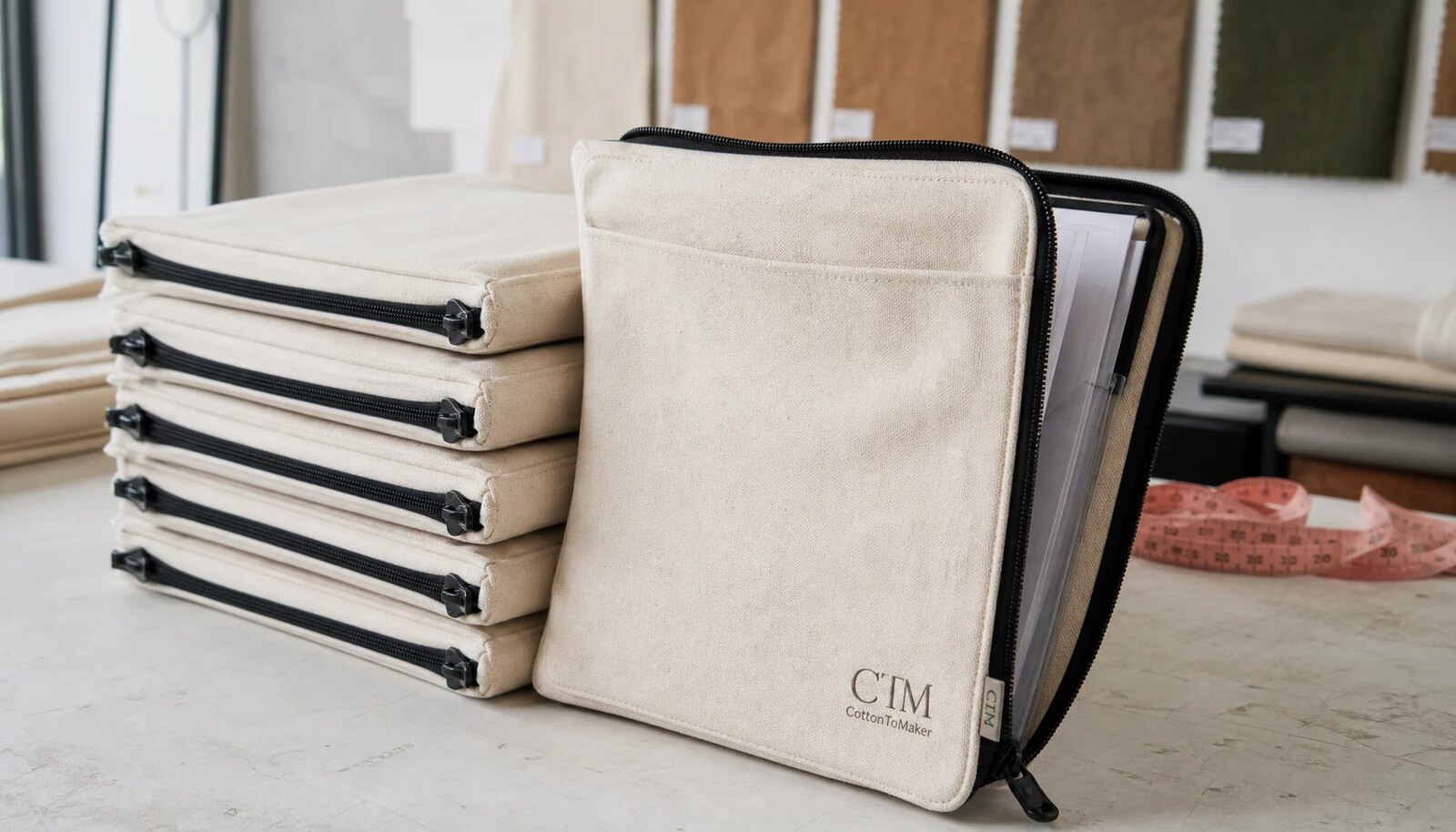
A canvas zipper portfolio is more than a flat pouch with a logo. At a craft fair, it has to protect paperwork, look organized on a registration table, and open quickly for staff, vendors, or buyers. A sponsor giveaway can be simple. A retail-ready artist portfolio needs better presentation. A preloaded vendor packet needs extra room and stronger stress points.
Begin with a load list. Measure the actual A4 sheets, US letter forms, line sheets, catalogs, maps, badges, wristbands, swatch cards, coupons, pens, and insert cards that will go inside. Thickness is the detail buyers often miss. A portfolio that looks fine with one sheet may strain when loaded with catalogs and badges. For thicker kits, a 10-25 mm gusset is often safer than forcing the contents into a flat shell.
Finished dimensions should account for document clearance, zipper intrusion, seam allowance, fabric thickness, and internal pocket seams. A4 paper is 210 x 297 mm; US letter is 8.5 x 11 inches. The finished portfolio should be tested with the real contents, not judged only by outside dimensions. Too tight, and users bend documents or force the zipper. Too large, and the item costs more to make, takes more carton space, and can look loose on display.
- Identify the role: giveaway, registration tool, buyer folder, artist case, retail SKU, or sponsor-branded kit.
- Measure the largest insert, tallest stack, and rigid items such as badges, swatch cards, or catalogs.
- Specify loaded thickness in millimeters and choose a flat shell or 10-25 mm gusset before quoting.
- Confirm opening style: top zipper for simple access, two-side zipper for easier loading, or three-side opening for presentation.
- If resale is planned, include barcode, hangtag, care label, retail sleeve, and carton SKU rules in the RFQ.
Specify Canvas With Numbers Buyers Can Check
Canvas weight drives hand feel, structure, printing, sewing speed, carton weight, and long-term usability. For most canvas zipper portfolios for craft fairs, 10-12 oz cotton canvas, roughly 280-340 GSM, is a practical middle range. It feels substantial enough for repeated handling and document protection while still sewing cleanly around zipper corners.
Lighter fabric can work for short-life promotional sleeves, but it has trade-offs. Fabric below about 260 GSM may wrinkle more, collapse with catalogs, and distort near zipper seams. Heavier canvas, such as 14-16 oz, can feel premium for artist portfolios or resale goods, yet it brings seam bulk, slower sewing, heavier needles, and higher gross weight. That matters if the buyer is considering air freight near an event deadline.
The RFQ should not say only cotton canvas. State oz, GSM, tolerance, color, finish, shrinkage expectation, and whether the fabric is stock or custom. Natural canvas can show seed flecks, slubs, and shade variation. These may be acceptable for a craft-market look, but the buyer still needs a physical swatch and a defect boundary for oil marks, mildew odor, holes, severe slubs, stains, or sharp panel-to-panel shade mismatch.
Shrinkage control becomes more important with full-panel printing, tight finished dimensions, washed fabric, or dyed canvas. Pre-shrunk fabric or controlled washing can improve dimensional stability, but it adds cost and material time. Dyed canvas should go through lab-dip or shade approval before bulk cutting, especially when several production lots must match.
- Use about 230-260 GSM only for low-load, budget promotional sleeves with limited reuse expectations.
- Use about 280-340 GSM for mainstream branded craft fair portfolios, vendor packets, and buyer folders.
- Use 400 GSM or heavier only when premium hand feel outweighs sewing complexity, carton weight, and landed cost.
- Ask for GSM tolerance, shrinkage range if applicable, shade standard, and bulk-roll inspection process.
- Approve fabric swatches under normal lighting instead of relying on screen images for natural or dyed canvas.
Control Zipper, Trim, and Sewing Details Early
The zipper is the part every user handles. For most canvas zipper portfolios, a No. 5 nylon coil zipper is the lowest-risk choice. It is flexible, commonly available, easier to sew around corners, and suitable for document pouches and business bags. Metal zippers can look premium, but they add weight, may scratch paper or printed inserts, and usually need closer control of plating, tooth smoothness, and sourcing time.
The zipper path should match the loading task. A top zipper is economical and simple, but thick catalogs can be harder to insert. A two-side zipper improves access without making construction too complex. A three-side zipper gives a presentation-style opening, though it uses more zipper length and raises the chance of corner defects. If registration staff must load hundreds of packets quickly, access may be worth more than a small trim saving.
Reinforcement should be written into the spec. Zipper ends need bartacks or secure stitching so the tape does not pull out after repeated opening. Buyers should confirm zipper size, coil or tooth material, tape color, slider finish, puller style, opening direction, zipper length, and end treatment. Custom pullers may need tooling, mold charges, plating approval, and higher MOQ. Close to a fair deadline, stock zipper tape and standard slider finishes usually create fewer surprises.
Because the portfolio is a simple flat product, sewing flaws are easy to see. Crooked seams, twisted zipper corners, skipped stitches, loose threads, and puckered panels quickly make the item look cheap. If the expected finish is business-bag quality, the PO should state stitch color, seam finish, bartack positions, and acceptable workmanship. First-line output should be checked before mass sewing continues.
- Name the zipper: No. 5 nylon coil, tape color, slider finish, puller style, opening direction, and zipper path.
- Add bartacks or reinforcement at zipper ends, pocket openings, divider tops, and repeated-stress points.
- Avoid custom zipper tape, rare plating, or branded pullers when sample approval is close to the event date.
- Request close-up sample photos of zipper corners, slider, puller, bartacks, seam finish, and pocket stitching.
- Test zipper operation with the real contents loaded, not only on an empty sample.
Choose Artwork for the Canvas Surface
Logo method affects price, sample timing, defect risk, and perceived value. Screen printing is usually the most practical option for one to three spot colors on canvas zipper portfolios. It suits event marks, sponsor logos, simple brand graphics, and moderate quantities. The quote should state color count, print size, placement, screen charges, strike-off cost, and setup fees per artwork version.
Canvas texture changes the result. Fine lines can fill in, small text can lose clarity, and large solid ink areas may print unevenly. Natural canvas can warm the color and reduce saturation compared with coated paper or a digital mockup. Pantone references help, but buyers should allow realistic variation on cotton and approve a strike-off on the actual canvas when brand color matters.
Heat transfer can help with multicolor artwork or short-run versions, but it must be tested on the exact fabric. Coarse canvas can reduce adhesion, and transfers near zipper seams, folds, or gusset corners may lift after bending or compression. Embroidery can look premium for small marks or patches, yet large embroidery can pucker the panel. Woven labels are neat and durable, but they introduce separate MOQ and approval timing.
Ask when printing happens. Printing before sewing gives a flatter surface and efficient production, but damaged printed panels create waste. Printing after sewing may align better to the finished shape, but zippers and seams can interfere with the print jig. The factory should explain the process, curing controls, and checks used before pieces are stacked or packed.
- Provide vector artwork, Pantone references, print size, placement distance from edges, logo orientation, and version list.
- Require a strike-off for first-time suppliers, brand-critical colors, fine text, large ink areas, or dyed canvas.
- Keep large solid prints away from zipper seams, fold lines, gusset corners, and compressed carton areas.
- For heat transfers, check edge lifting, bubbling, cracking after bending, and adhesion on the exact canvas surface.
- Confirm curing time plus dry rub or tape-pull checks before packing to prevent ink transfer.
Read MOQ as a Set of Minimums
MOQ is not only the number of portfolios sewn. Fabric purchase, dye lots, zipper tape, sliders, labels, print screens, barcode stickers, packing materials, and carton handling can each create minimums. A supplier may accept a 500-piece sewing order while a dyed fabric mill, custom zipper supplier, or woven label vendor requires more. If the quote hides these inputs, surcharges often appear later.
Craft fair programs often need several logos in one order: different city fairs, sponsor tiers, vendor categories, or artist-market editions. That can work well if the base product stays identical. The same canvas, zipper, size, thread, pocket layout, label position, and packing format can share cutting and sewing. Each artwork version still needs separate setup, printing control, counting, carton marks, and sometimes barcodes.
Price breaks should be compared against the real version plan. A 1,000-piece price may assume one fabric color, one zipper color, one logo, and one packing method. Ten designs of 100 pieces do not have the same efficiency. Ask for unit price, screen fees, sample fees, label setup, packing surcharge, and under-MOQ charges as separate lines.
The lowest-risk approach is to standardize the portfolio and vary only the front print. This gives marketing room for event-specific branding while keeping procurement, material approvals, and QC simpler. If different fabric or zipper colors are required, build in separate approval and segregation controls for every version.
- Break MOQ down by total units, fabric color, zipper color, artwork, label, barcode, packing format, and destination.
- Ask which charges are one-time fees and which repeat per logo, screen, label, barcode, or carton configuration.
- Use a shared base spec whenever possible to consolidate fabric purchase, cutting, sewing, and trim sourcing.
- Require carton marks and packing lists that identify each artwork version clearly for warehouse sorting.
- Confirm whether under-MOQ versions are accepted and whether the trade-off is surcharge, longer lead time, or simpler packing.
Build a Lead Time Map With Real Gates
A useful lead time plan breaks the order into operational gates. The path can include RFQ clarification, technical drawing, artwork preparation, quote revision, deposit, sample making, sample courier, buyer review, sample revision, material booking, cutting, printing, curing, sewing, trimming, inline QC, final QC, packing, third-party inspection, freight booking, export documents, customs clearance, inland delivery, and warehouse receiving. One production-days number hides too much.
Planning ranges help create the first calendar, although the supplier must confirm actual dates. RFQ clarification and quote revision may take 3-7 business days when the brief is complete. A basic prototype or PP sample may take 7-12 days after materials are ready. Courier transit can add 2-5 days. Buyer review can take 3-7 days if marketing, procurement, and event teams all need to sign off. Bulk production may take 25-45 days depending on quantity, complexity, and factory load. Freight and customs vary by route, mode, and destination.
Do not overlap high-risk gates unless the buyer accepts the consequences. Bulk cutting before PP approval may save time, but it can lock in the wrong size, pocket layout, print position, or zipper path. Printing all panels before strike-off approval can create unusable inventory. Final inspection should not sit on the same day as the cargo cutoff because there is no room left for rework.
Make calendar risk visible. Holidays, peak promotional seasons, fabric availability, port congestion, and end-of-month shipping pressure can all affect the schedule. If approval slips, the buyer should have a written fallback: stock natural canvas instead of dyed canvas, fewer logo versions, standard zipper trim, simpler packing, partial air freight, or release for the next fair.
- Map deposit, artwork approval, sample approval, material booking, bulk start, inline check, final inspection, shipment, and warehouse arrival.
- Ask whether production days are calendar days or working days and whether holidays are excluded.
- Add buffer for dyed canvas, custom zipper tape, retail packing, multiple logos, lining, complex pockets, or split destinations.
- Schedule inspection before the shipping window so sorting, rework, replacement, or partial release remains possible.
- Set a latest-approval date that triggers a simpler spec or freight change before the fair date becomes unreachable.
Make Samples Do More Than Show the Shape
Sample approval should control production, not simply reassure the buyer. For canvas zipper portfolios, the PP sample should use the bulk canvas weight, actual zipper type, final thread, real print method, approved pocket layout, final label position, and intended packing. If substitute materials are used, the sample can confirm shape, but it should not become the sealed standard without written limits.
Review the sample like an event team would use it. Load the portfolio with the actual documents, catalogs, badges, swatches, pens, or forms. Close the zipper several times and watch the corners. Insert and remove papers to see whether they catch on pocket seams, loose threads, zipper tape, or label edges. Lay the piece on a table and judge whether it looks clean, flat, and professional. If it will be sold, check the retail sleeve, barcode position, hangtag, and display presentation.
Approval comments should be measurable. Record finished dimensions, tolerance, print position, zipper specification, stitch color, pocket position, label position, packing format, and all requested changes. Avoid vague approvals that leave the factory guessing. If the factory changes material or construction after approval, request a revised sample, strike-off, or at least dated photos and a measurement report.
Sealed samples reduce disputes. One should stay with the factory, one with the buyer, and one with the inspection team if third-party QC is used. For multi-logo orders, one construction sample may be enough, but each artwork version should have an approved strike-off or signed print reference.
- Approve fit with real loaded contents rather than an empty sample only.
- Photograph size, print placement, zipper corners, pocket position, labels, and packing with a ruler visible.
- Keep sealed samples at the factory, buyer office, and inspection provider when possible.
- Record approved tolerances and deviations before bulk cutting starts.
- For multiple logos, approve each strike-off or artwork version even when construction is shared.
Plan Packing, Cartons, and Distribution
Packing affects presentation, defects, freight cost, and event handling. Canvas zipper portfolios can ship flat, but poor packing can still cause creases, ink transfer, deformed zipper corners, stains, or moisture odor. The right method depends on whether the goods are handed out at registration, preloaded into vendor kits, shipped to multiple fair sites, or sold as retail merchandise.
Individual polybags protect against dust and moisture, though they may conflict with plastic-reduction goals. Paper sleeves, belly bands, and kraft envelopes can look more natural, but they protect less during humid storage or long freight moves. Bulk packing lowers material cost and may speed unpacking, yet it increases contamination and mixed-version risk. Decide packing before PP approval because it can change carton count, labor time, barcode placement, and presentation.
Carton data is needed early. Canvas is dense, so gross weight can become a handling issue even when carton volume looks manageable. Overtight cartons can compress zipper corners and crease printed panels. Request units per carton, carton dimensions, net weight, gross weight, total carton count, and total CBM so procurement can compare courier, air, ocean, or split freight with better data.
Distribution instructions belong in the PO. If each carton must contain only one artwork version, say so. If mixed cartons are allowed, define the assortment and label format. Carton marks should include PO number, SKU, artwork version, quantity, destination, carton number, and gross weight if required by the warehouse. Clear marks save time during the busy setup period before the fair.
- Avoid folding across the main logo panel unless a fold test is approved.
- Choose polybag, paper sleeve, belly band, kraft envelope, retail insert, or bulk packing by channel and handling risk.
- Use desiccant or moisture-control measures when natural cotton canvas ships by sea or stores in humid conditions.
- Set a maximum carton weight the receiving warehouse can handle safely.
- Require carton marks showing PO, SKU, artwork version, destination, quantity, and carton sequence.
Inspect Before the Event Window Closes
Quality control should focus on failures that affect the event: wrong size, rough zipper operation, weak seams, dirty canvas, poor print, missing labels, incorrect quantities, and mixed artwork versions. Craft fair dates are fixed, so defects found after arrival may be impossible to repair. Agree inspection standards before production starts, not after cartons are packed.
Incoming material control is the first checkpoint. Canvas should be reviewed for shade consistency, GSM, stains, holes, oil marks, severe slubs, water marks, and odor before cutting. Zippers should be checked for length, tape color, slider finish, puller attachment, smooth running, and correct end treatment. Labels, hangtags, barcode stickers, and packaging should match approved references.
Inline QC protects the schedule. First pieces should be checked for finished size, zipper path, corner shape, bartacks, stitch tension, pocket alignment, label placement, and print position. If printing is done before sewing, printed panels should be inspected before assembly. If printing is done after sewing, the jig must hold the finished portfolio consistently so placement does not drift across the batch.
Final inspection should be specific enough to act on. Buyers may use AQL or another agreed random inspection method, but defect definitions must be clear. Critical defects can include safety hazards, wrong product, mildew odor, or unusable zipper. Major defects can include out-of-tolerance size, poor zipper function, print adhesion failure, missing labels, wrong artwork, or short count. Minor defects may include small loose threads or slight cosmetic variation within the approved standard. Book inspection early enough to allow rework, replacement, or partial shipment.
- Check fabric shade, GSM, visible defects, and odor before cutting.
- Inspect first-line output for size, zipper function, seam tension, bartacks, pocket alignment, and print position.
- Test print with dry rub, tape pull, visual curing review, and bending where transfers or patches are used.
- Verify SKU, artwork version, carton quantity, shipping marks, packing list, and destination split against the PO.
- Book final inspection before cargo cutoff so rework or partial shipment remains possible.
Specification comparison for buyers
| Procurement decision | Recommended specification | Lead time effect | Buyer risk to control |
|---|---|---|---|
| Canvas body fabric | 10-12 oz cotton canvas, about 280-340 GSM, with declared GSM tolerance, shrinkage expectation, shade standard, and pre-shrunk option when full-panel printing or tight size control is required | Stock greige or natural canvas is fastest; dyed, washed, certified organic, recycled blend, or custom GSM fabric can add material booking and lab-dip time | Underweight fabric may collapse with catalogs; overweight fabric increases seam bulk, carton weight, needle breakage risk, and zipper-corner defects |
| Finished size and loading | Finished dimensions based on real A4, US letter, catalogs, badges, inserts, and expected loaded thickness, with document clearance and optional 10-25 mm gusset | Accurate loaded-size testing reduces pattern revisions and recutting delays | Quoting only outside dimensions can produce portfolios that are too tight, deform paperwork, or stress the zipper when preloaded |
| Zipper construction | No. 5 nylon coil zipper for most programs, matched tape, approved slider finish, zipper-end bartacks, smooth pull, and confirmed opening direction | Stock nylon coil zippers are easier to source; custom tape, metal teeth, branded pullers, or special plating add trim lead time | Weak stops, narrow zipper substitution, sharp metal teeth, or untested pullers can cause returns, rework, and late event shortages |
| Internal organization | Flat shell, slip pocket, divider, card slot, pen loop, or lining confirmed in the technical spec before sampling | Simple shells are fastest; organizer panels add cutting, sewing, trimming, checking, and higher defect opportunity | Late pocket or label changes alter pattern, labor minutes, MOQ, unit price, and production start date |
| Logo and print method | Screen print for 1-3 spot colors; strike-off on actual canvas; heat transfer for small multicolor art only after adhesion testing; embroidery only for small marks or patches | Screens, strike-offs, curing, and artwork approvals must be scheduled before bulk packing; multiple logos add setup and sorting time | Large ink areas, small text, or transfers can crack, bleed, lift, or shift on coarse canvas without physical approval |
| MOQ structure | Quote MOQ by total order, fabric color, zipper color, artwork version, label version, packing format, and destination split | Shared base materials can consolidate production; multiple versions still require separate print setup, packing lists, and carton marks | A low total MOQ may hide separate minimums for dyed fabric, zipper tape, woven labels, barcode stickers, and retail packaging |
| Sample approval | Prototype for fit if needed, print strike-off on bulk fabric, and pre-production sample using final fabric, zipper, thread, label, artwork, and packing | PP approval is a gating item; courier time and buyer review time must be added to the calendar | Approving substitute materials can hide shrinkage, shade variance, zipper feel, print placement, and packing compression problems |
| Packing and carton data | Flat individual polybag, paper sleeve, belly band, or bulk pack; export cartons with moisture protection, carton marks, units per carton, gross weight, and CBM | Individual packing and retail labeling add labor and carton volume; confirmed carton data helps freight booking earlier | Overtight cartons can crease canvas, transfer ink, deform zipper corners, and create sorting errors at event warehouses |
| QC inspection | AQL-based or agreed random inspection covering size, zipper operation, seam strength, print adhesion, shade, cleanliness, odor, label accuracy, count, and carton marks | Inspection should be booked before shipping cutoff, with time for rework or partial release | Unclear standards lead to disputes when the fair deadline leaves no time to repair, remake, or reroute goods |
Buyer checklist before sampling
- Define the event use: exhibitor welcome kit, vendor paperwork pouch, buyer catalog folder, artist document case, sponsor giveaway, retail merchandise, or staff registration pack.
- List the real contents by size and thickness: A4 sheets, US letter forms, line sheets, catalogs, badges, wristbands, booth maps, swatch cards, coupons, pens, or inserts.
- Specify finished size, acceptable tolerance, opening style, seam construction, zipper intrusion allowance, and loaded thickness requirement before requesting price.
- Define canvas in oz and GSM, fabric color, dye or wash requirement, shrinkage tolerance, shade standard, and whether certified organic or recycled content documentation is required.
- Confirm zipper size, type, tape color, teeth or coil material, slider finish, pull direction, puller style, end stops, zipper length, and bartack reinforcement.
- Lock the internal layout before PP sampling, including slip pocket, divider, pen loop, card slot, lining, woven label, care label, hangtag, barcode sticker, or insert card.
- Send production-ready artwork with vector files, Pantone or brand references, print size, print placement, logo orientation, bleed limits, and accepted color variation on cotton canvas.
- Request the sample path in writing: fit prototype if required, print strike-off on actual canvas, and PP sample made with bulk fabric and final trim before bulk cutting.
- Build the calendar with RFQ, quote revision, deposit, artwork approval, sample making, courier transit, buyer review, material booking, production, inline QC, final inspection, packing, freight, customs, and warehouse receipt.
- Set measurable QC criteria for size, zipper cycles, seam strength, bartacks, print rub, tape pull, print placement, shade variation, loose threads, odor, packing count, carton marks, and carton condition.
Factory quote questions to send
- What canvas weight in oz and GSM is included, what GSM tolerance applies to bulk fabric, and will the fabric be tested before cutting?
- Is the quoted fabric stock natural canvas, bleached, dyed, washed, pre-shrunk, certified organic, recycled blend, or custom sourced for this order?
- What finished size is quoted, what finished-size tolerance is acceptable, and has the pattern been calculated from the buyer's intended loaded contents?
- Is a gusset included; if yes, what is the finished gusset depth, and how does it affect fabric consumption, labor time, carton quantity, and CBM?
- Is the zipper No. 5 nylon coil, No. 5 metal, resin, or another specification, and are zipper-end bartacks included in the quoted unit price?
- Which zipper tape colors, slider finishes, and puller shapes are stock; what MOQ, tooling charge, or extra lead time applies to custom zipper tape or branded pullers?
- Does the quote include inner pocket, lining, divider, pen loop, card slot, woven label, care label, hangtag, barcode sticker, retail sleeve, or only the outer canvas shell?
- Which logo method is quoted, how many colors are included, what is the maximum print area, and what screen, film, setup, or strike-off charges apply per artwork?
- Can you provide a print strike-off on the actual canvas, and what dry rub, tape pull, bending, or curing checks are performed before packing?
- What is the MOQ per total order, per fabric color, per zipper color, per artwork version, per label version, per barcode, per packing method, and per destination split?
Quality-control points to confirm
- Finished size should normally stay within +/- 1 cm for flat canvas zipper portfolios unless a tighter or looser tolerance is approved for gusseted, lined, or multi-panel construction.
- Document clearance should be checked with the buyer's real A4, US letter, catalog, swatch, badge, or insert load rather than only measuring an empty portfolio flat.
- Zipper operation should be tested across the full opening for repeated open-close cycles without skipped teeth, slider looseness, fabric catching, rough corners, or uneven tape tension.
- Zipper ends, pocket openings, divider tops, handle points if any, and high-stress corners should have bartacks or reinforced stitching with no popped stitches after manual pull checks.
- Canvas should be free from major stains, oil marks, holes, severe slubs, sharp shade mismatch, water marks, mildew odor, and visible contamination within the same carton.
- Stitching should be straight enough for business presentation, with balanced tension, secure backstitching, trimmed thread ends, and no skipped stitches around zipper corners or pocket seams.
- Print placement should remain within the approved tolerance, commonly +/- 5 mm for simple front-panel logos, with no tilt, distortion, ghosting, blocking, or ink transfer.
- Screen print should pass basic dry rub, tape pull, and visual curing checks before packing, especially on natural coarse canvas and large ink coverage areas.
- Heat transfer, patch, or label applications should be checked for edge lifting, bubbling, cracking after bending, stitch security, and safe placement away from zipper stress areas.
- Inner pockets, dividers, card slots, labels, hangtags, barcode stickers, and care labels should match approved sample position and must not catch paperwork during insertion.