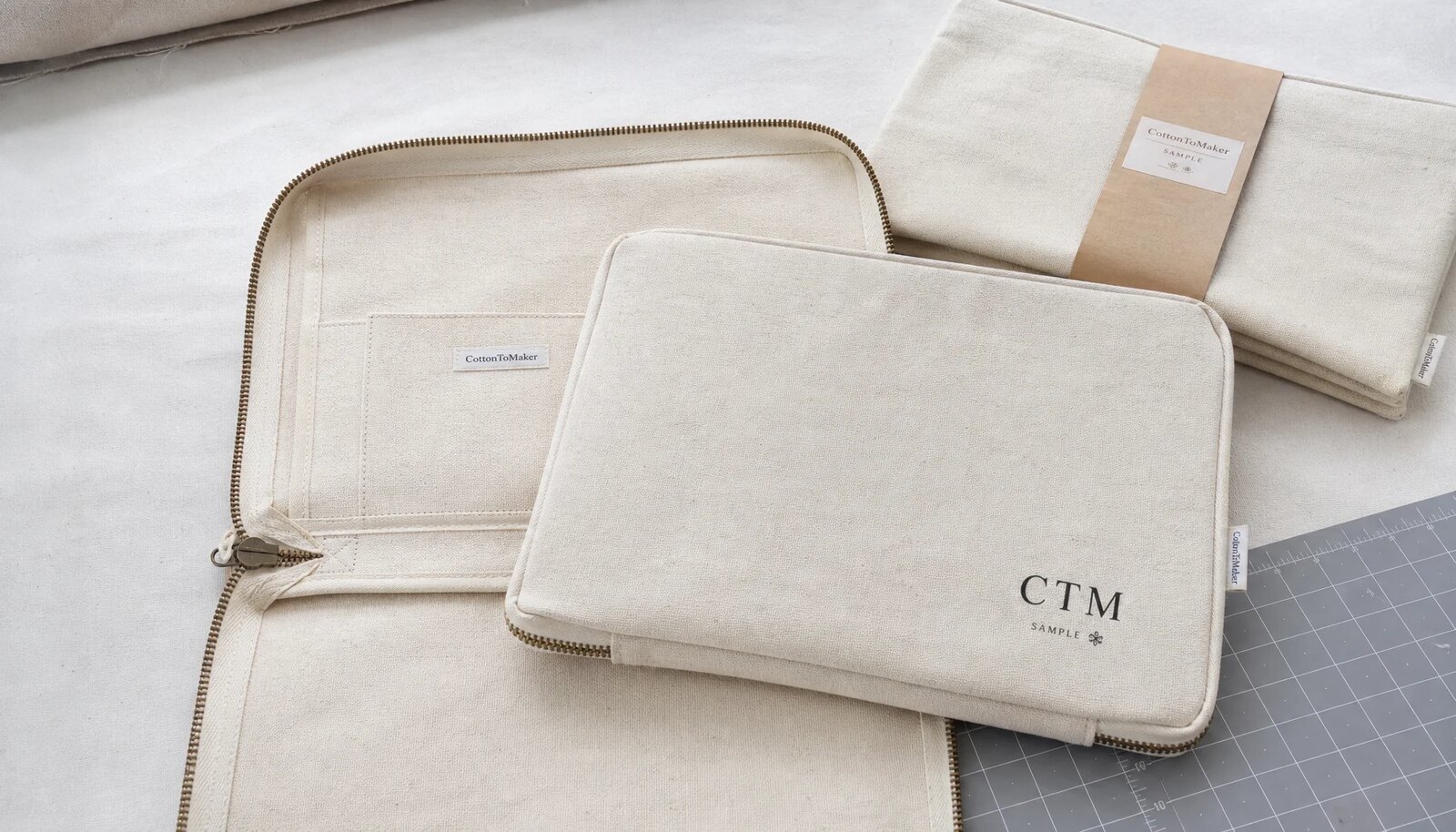
Start With the Job, Not the Canvas Weight
Canvas zipper portfolios for craft fairs can look simple in a product photo, yet the sourcing brief can go in several directions. One buyer may need a flat holder for prints and order forms. Another may want a branded maker kit for workshops. A retail team may need a reusable portfolio that feels substantial on a craft fair table. Those are different products, even if all of them are described as canvas zipper portfolios.
That is why fabric weight should not be the first decision. Start with the job the portfolio must do. Will it protect paper corners, carry embroidery patterns, hold sticker sheets, organize receipts, or contain light craft tools? Will it be handed out at an event, sold at retail, or included inside a wholesale starter kit? Once the use is clear, the right canvas weight, lining, interlining, zipper, logo method, packing, and inspection standard become much easier to define.
The main procurement risk is vague comparison. A factory can quote 10 oz unlined canvas with a basic zipper and bulk packing. Another can quote 12 oz finished canvas with lining, stabilizer, reinforced zipper ends, a woven label, screen print, individual packing, and export cartons. Both may answer the same RFQ, but the prices are not comparable.
A better RFQ uses measurable terms: outside finished size, usable internal size, target contents, canvas oz and GSM, fabric finish, lining, interlining, zipper size, decoration method, logo tolerance, packing, carton data, and QC points. It also asks suppliers to separate the base quote from optional upgrades, so procurement can see where money is being spent.
- Use 10 oz canvas with lining or stabilizer for budget paper-focused craft fair kits.
- Use 12 oz finished canvas as the balanced starting point for most B2B craft fair zipper portfolios.
- Use 14-16 oz canvas when premium feel, light tool storage, or retail positioning justifies the added cost and freight weight.
- Normalize quotes by lining, interlining, zipper grade, logo method, packing, carton quantity, and Incoterm before comparing unit prices.
- Ask suppliers to quote a base specification and list costed alternatives separately so trade-offs are visible.
Read Oz and GSM the Same Way Suppliers Do
Canvas is often described in ounces by bag factories and in GSM by procurement teams. Both are useful, but only when everyone is talking about the same fabric stage. As a practical sourcing reference, 8 oz canvas is often around 260-280 GSM, 10 oz around 330-350 GSM, 12 oz around 390-410 GSM, 14 oz around 470-480 GSM, and 16 oz around 530-540 GSM. These are working ranges, not universal standards.
The question to ask is simple: is the weight greige or finished? Greige fabric is unfinished. Dyeing, washing, coating, and finishing can change weight, handfeel, shrinkage, surface texture, and print behavior. Washed canvas may feel softer and more relaxed. Unwashed canvas may look crisper. Coating may add weight but make the fabric print, crease, or bend differently.
This matters in repeat buying. A 12 oz canvas from one mill may not sew or recover like a 12 oz canvas from another. A buyer who approves only the words 12 oz canvas leaves room for drift. A buyer who approves a swatch with a reference number, GSM basis, finish, shade, and date has a stronger production control.
For repeat programs, keep a swatch library. Label each swatch with supplier, order number, canvas composition, oz, GSM, color, finish, approval date, and production notes. It is a small discipline, but it prevents many later arguments about why the reorder feels thinner, stiffer, yellower, rougher, or harder to print.
- 8 oz canvas is usually too soft for a true portfolio unless the product is intentionally pouch-like or uses added stabilizer.
- 10 oz canvas can work for budget programs when combined with lining, interlining, and careful flat packing.
- 12 oz canvas is the practical starting point for balanced structure, sewability, print quality, and freight control.
- 14 oz canvas improves perceived substance but increases zipper-end bulk and can slow sewing.
- 16 oz canvas should be treated as a premium or tool-oriented option, not a default craft fair giveaway material.
- Put oz, GSM, finish, shrinkage expectation, and approved swatch reference on the purchase order.
Match Weight to Contents and Channel
The right fabric weight changes with the contents. Prints, stationery, catalogs, embroidery patterns, and small tools do not stress the portfolio in the same way. Paper goods need flat panels, clean corners, and enough structure to stop edges from bending. Light tools need stronger seams, better lining durability, and a zipper that does not jam under point pressure.
Sales channel matters too. A portfolio handed out at a workshop can be simpler than one sold at a craft retail table. Retail buyers notice shade consistency, panel flatness, corner symmetry, label placement, and how the product looks after unpacking. A 12 oz canvas portfolio with a 250-300 GSM stabilizer may look more professional than a 14 oz unlined portfolio because the panels stay flatter without making the zipper corners bulky.
Do not rely on outside dimensions alone. If the portfolio must fit A4 sheets, US letter sheets, 8 x 10 prints, or 9 x 12 art pads, specify the required contents and clearance. Zipper tape, seam allowance, lining thickness, interlining, and corner radius all reduce usable internal space. The sample should be tested with the actual insert, not just measured flat.
For tool-oriented portfolios, heavier canvas is not always the cleanest solution. More useful upgrades may be a No. 5 nylon zipper, reinforced zipper ends, polyester thread, bar-tacking at stress points, durable lining, and localized reinforcement where tools rub or press. The goal is controlled durability, not weight for its own sake.
- For prints and stationery, specify flat panels, protected paper corners, smooth zipper travel, and verified usable internal dimensions.
- For embroidery patterns and maker kits, prioritize clean lining, optional internal pocketing, and repeated handling durability.
- For small tools, reinforce zipper ends, side seams, bottom corners, and lining contact points instead of relying only on heavier canvas.
- For event giveaways, control cost with stock natural canvas, standard zipper tape, simple screen print, and efficient carton packing.
- For retail resale, prioritize consistent shade, neat stitching, barcode or hangtag placement, clean packing, and low visible defect rates.
Specify the Full Layer Stack
Many cost differences are hidden inside the portfolio. A 10 oz canvas portfolio with lining and a light stabilizer can feel firmer than a 12 oz unlined one. Lining improves the interior, protects paper from raw seams, and reduces the unfinished look. Interlining adds body and helps panels stay flat. They are not the same thing, and they should not be left to the factory to interpret.
For commercial production, 210D polyester lining is a practical choice. It is stable, clean, and less likely to shed lint onto paper goods. Cotton lining can support a natural-material story, especially for premium craft branding, but it needs tighter control for shrinkage, shade, lint, and color transfer. If cotton canvas and cotton lining shrink differently, the portfolio may twist, pucker, or lose shape.
Interlining should match the job. A 250-350 GSM nonwoven or light canvas backing can improve flatness for paper and table display. Too much stiffness, however, can create bubbling after turning, hard corners at the zipper, and warping after carton compression. If the buyer wants a board-like feel, the supplier should test sewing, turning, zipper movement, and packed recovery before the price is approved.
Write the layer stack in production language. For example: 12 oz finished cotton canvas outer, 210D polyester lining, 300 GSM nonwoven interlining on front and back panels only, no interlining inside the zipper seam allowance, enclosed inside seams, polyester thread, and reinforced zipper ends. That level of detail prevents quiet material substitutions.
- No lining gives the lowest cost but exposes interior construction and often lowers retail perception.
- Polyester lining suits distributor programs, event kits, and portfolios that need clean handling and stable sewing.
- Cotton lining suits natural branding but requires shrinkage, lint, shade, and color-transfer checks.
- Light interlining improves flatness for craft paper goods but must be tested after turning and carton compression.
- Heavy interlining or board inserts can increase defect rate, carton volume, and corner bulk.
- List every internal layer by composition, weight, color, placement, and purpose in the RFQ and sample approval record.
Control Logo Printing on Textured Canvas
Logo execution is one of the easiest places for a good portfolio to become a weak branded product. Canvas texture affects ink coverage, line sharpness, and perceived color. Screen printing is usually the most dependable option for simple one-color or two-color craft fair artwork. It is easy to inspect, scales well for repeat programs, and suits the natural canvas look.
Heavier canvas does not automatically print better. Deep weave texture can break fine lines and small text. Large solid areas may look uneven if ink deposit is not adjusted. Natural canvas shade can shift the appearance of white, cream, tan, pale green, or other soft colors. A digital mockup cannot prove print performance. A strike-off on the exact production fabric can.
Heat transfer can work for fine multicolor artwork, gradients, or small text, but it must be tested on the final canvas weight. Check edge lift, abrasion, cracking when the portfolio bends, surface feel, and whether the transfer looks too glossy for the brand. Embroidery can look premium for small marks, yet large filled embroidery areas can pucker lighter canvas and create a rough back side unless lining and stabilizer are planned.
The logo zone needs its own quality standard. Heavy slubs, stains, oil marks, shade bands, and seam distortion near the print should be treated as defects if they affect the mark. Placement should be measured from fixed seams, zipper edges, or bottom edge. For many fabric portfolios, plus or minus 3-5 mm is more realistic than zero tolerance, but the agreed limit should be written before bulk printing.
- Use screen print for solid craft fair logos, event marks, maker brands, and economical repeat orders.
- Use heat transfer only after rub, bend, edge-lift, and appearance tests on the final canvas weight.
- Use embroidery for small premium marks, not large filled designs on light or loosely woven canvas.
- Set logo placement tolerance, often about plus or minus 3-5 mm depending on panel size and construction complexity.
- Approve print color under consistent lighting and record whether Pantone matching is exact or approximate.
- Require a production-fabric strike-off before mass printing and keep it with the signed pre-production sample.
Lock the Zipper and Reinforcement Details
The zipper receives more stress than most buyers expect. It is opened repeatedly, pulled around corners, pressed during packing, and judged immediately by the end user. For most standard canvas zipper portfolios, a No. 5 nylon coil zipper is a sensible specification. It runs smoothly, controls weight, and handles frequent opening. A No. 5 metal zipper can look more premium, but it adds cost, weight, and possible scratch risk.
A quote that says zipper included is too loose. The RFQ should define zipper type, size, tape color, teeth color, slider finish, puller shape, zipper length, opening direction, and end-stop method. Tape color is especially visible on natural canvas. Slider finish affects the retail look. Puller shape can also leave pressure marks if the portfolios are flat packed tightly.
Zipper ends deserve close inspection on samples. Heavy canvas creates bulk where zipper tape, seam allowance, lining, and interlining meet. If the stop sits too close to a thick corner, the puller can jam. If the lining is loose, it can catch in the teeth. If seam allowance is narrow, zipper tape may pull out during use. Open and close the sample with the intended contents inside, not just while it is empty.
Thread and stitch density need written control. Polyester thread is commonly used for strength and consistency. Stitches that are too long weaken seams; stitches that are too dense can perforate heavy canvas and cause puckering. Back-tacking should appear at zipper ends, side seams, tabs, pocket openings, labels, and any point that receives pulling force.
- Specify No. 5 nylon zipper for most standard portfolios unless the retail brief requires metal.
- Define zipper tape color, teeth color, slider finish, puller style, zipper length, opening direction, and end-stop construction.
- Require reinforcement or back-tacking at zipper ends, side corners, pull tabs, pockets, labels, and stress points.
- Check that lining stays clear of zipper teeth during normal opening and closing with intended contents loaded.
- Test zipper travel around corners, especially on 14 oz and 16 oz canvas builds.
- For metal zippers, evaluate visual benefit against added cost, weight, scratch risk, finish variation, and possible corrosion concerns.
Understand MOQ and Lead-Time Drivers
MOQ is rarely just one factory number. It is shaped by fabric purchasing, dyeing minimums, zipper sourcing, printing setup, cutting efficiency, accessory purchasing, packing materials, and sewing line changeover. A natural 12 oz canvas portfolio with standard lining, stock zipper color, and one-color screen print is usually easier to quote than a custom dyed portfolio with special zipper tape, several artworks, woven labels, and retail sleeves.
Low MOQ and high customization pull against each other. If the buyer keeps every custom detail but asks for a small quantity, the unit price usually rises because setup costs are spread over fewer pieces. A more useful conversation is: which variables create the MOQ, and what substitutions reduce it? Stock natural canvas, standard zipper colors, fewer logo versions, and simple packing often reduce complexity without making the product feel cheap.
Lead time should be broken into stages: development sample, print strike-off, pre-production sample, material purchasing, bulk cutting, sewing, packing, inspection, and shipment. Custom dyed canvas may require lab dip approval. Metal accessories, custom pullers, woven labels, hangtags, or retail packaging may have separate schedules.
If the portfolios are needed for a fixed craft fair, work backward from the latest acceptable ship date and inspection date, not only the event date. Leave time for sample comments and a possible second sample. Many delays happen before bulk production starts, especially when artwork, fabric finish, zipper color, or packing format changes after the first quote.
- Natural canvas, standard lining, stock zipper, and one-color screen print usually support the most flexible MOQ.
- Custom dyed canvas needs lab dip approval and may create higher fabric minimums than the sewing factory controls.
- Multiple artwork versions increase print setup, sorting, packing, inspection, and carton-mark complexity.
- Retail sleeves, kraft bands, individual bags, and barcode labels can increase both unit cost and carton volume.
- Heavier canvas raises material cost, freight weight, needle wear, sewing time, and possible defect risk.
- Ask suppliers to show MOQ and surcharge by variable instead of giving one unexplained minimum quantity.
Build a Quote-Ready RFQ
A strong RFQ is detailed enough to compare quotes, but not so rigid that suppliers cannot suggest practical savings. Start with the commercial context: intended use, target contents, outside finished size, usable internal size, target quantity, destination market, event or retail channel, required delivery date, and preferred Incoterm.
Then define the product build. A base specification might read: natural cotton canvas zipper portfolio, 12 oz finished outer canvas around 390-410 GSM, 210D polyester lining, 300 GSM nonwoven interlining on front and back panels, No. 5 nylon zipper with matching tape, polyester thread, one-color screen printed logo, woven side label, individual OPP bag, and flat export carton packing.
Once the base is clear, ask for alternatives. For example: 10 oz canvas with stabilizer, 14 oz canvas without interlining, paper band instead of OPP bag, no woven label, stock zipper color, or simplified carton packing. This keeps the price conversation concrete. It also helps the supplier explain where cost, MOQ, lead time, or defect risk changes.
Drawings and annotated photos reduce interpretation. Show zipper path, logo position, seam allowance, zipper end treatment, label placement, pocket location, and measurement points. Mark which measurements are outside finished dimensions and which are usable internal dimensions. If the portfolio must hold a specific insert, include the actual insert size and required clearance.
- Include intended contents, outside finished size, usable internal size, quantity, delivery market, deadline, and Incoterm.
- Define canvas by composition, weave, oz, GSM, color, finish, shrinkage expectation, and weight measurement stage.
- List lining, interlining, zipper, thread, labels, pockets, print method, packing, carton marks, and inspection requirements.
- Attach artwork with file format, Pantone or approved color target, print size, placement measurements, and tolerance.
- Ask for a base quote plus optional alternatives that reduce cost, MOQ, lead time, or defect risk.
- Require sample timeline, production lead time, carton data, gross weight, and excluded charges in the quotation.
Approve Samples With Written Tolerances
Separate concept sampling from production approval. A development sample can confirm shape, size, and general direction. A pre-production sample should represent the real order: final canvas, lining, interlining, zipper, puller, thread, logo method, label, and packing. If the approved sample uses substitute fabric or a temporary zipper, the supplier still has room to interpret the bulk product.
Written tolerances keep the discussion objective. For many small and medium canvas portfolios, outside dimension tolerance of plus or minus 0.5 cm is practical. If the product must fit a specific document, insert, or retail tray, tighten or adjust that requirement. Logo placement tolerance is commonly about plus or minus 3-5 mm, depending on artwork size and sewing complexity. Fabric weight tolerance is often plus or minus 5 percent unless a stricter standard is negotiated.
Functional checks should be simple and repeatable. Load the sample with intended contents. Open and close the zipper several times. Check whether lining catches. Inspect zipper ends. Bend the portfolio lightly. Confirm that paper corners do not catch or crease. For decoration, run dry rub and light scratch checks on the approved canvas. For packing, place the sample in the proposed bag or sleeve, stack it under normal carton pressure, and check recovery.
The buyer and factory should each keep a signed sample or equivalent approval file. Photograph the front, back, inside, zipper ends, logo placement, lining, pockets, labels, and packing. For repeat orders, version control matters. A change from 10 oz to 12 oz canvas, nylon to metal zipper, polyester to cotton lining, or OPP bag to paper band can change cost, carton count, and inspection results.
- Approve a material swatch, decoration strike-off, and pre-production sample before bulk production.
- Keep one signed sample with the buyer and one matching approved sample or file with the factory.
- Record dimensions after the sample is packed, unpacked, and allowed to recover.
- Measure logo placement from fixed seams or zipper edges instead of estimating visually.
- Define acceptable and unacceptable slubs, stains, shade variation, odor, logo-zone defects, and loose threads.
- Do not approve bulk production from substitute canvas, lining, zipper, thread, or packing unless the deviation is documented.
Plan Packing, Freight, and Inspection Together
Packing is part of the product, not an afterthought. Natural, white, and light dyed canvas can pick up dust, oil, moisture, and carton marks during handling. Individual OPP bags provide strong protection and are practical for distributor or wholesale programs. Kraft bands, paper sleeves, and recyclable wraps may fit a craft-focused brand better, but they provide less protection against stains and moisture.
Flat packing is usually safer than folding because folds can crease canvas, distort interlining, and make a new portfolio look used. The trade-off is carton footprint. Heavier 14 oz and 16 oz portfolios also raise gross weight quickly. During quotation, ask for carton dimensions, pieces per carton, net weight, gross weight, stacking limit, and inner pack rules. These numbers affect freight, receiving labor, warehouse storage, and event distribution.
If the portfolio is part of a craft fair kit, define whether it ships empty, pre-packed with inserts, bundled with catalogs, or sorted by artwork version. Repacking at destination can cost more than adding correct labels, barcodes, or inner pack quantities at origin. Carton marks, SKU labels, barcode location, assortment rules, and hangtag placement should be finalized before packing starts.
Final inspection should combine visual, dimensional, functional, and packing checks. Inspectors should review fabric cleanliness, shade consistency, finished size, internal usable size, zipper operation, zipper end finishing, seam reinforcement, stitch quality, logo print, label position, odor, loose threads, and packing condition. Include loaded-use checks with the intended contents because a portfolio that passes flat measurement can still fail when actual paper goods or tools are inserted.
- Use individual protection for natural or white canvas when cleanliness claims would be costly.
- Avoid tight folding unless visible creases are acceptable for the sales channel.
- Request carton dimensions, pieces per carton, net weight, gross weight, and stacking limit during quotation.
- Define carton marks, SKU labels, barcode location, inner pack quantity, and assortment rules before packing.
- Check packed samples for zipper pull marks, panel bending, corner crushing, odor, moisture, and recovery after compression.
- Include loaded-use zipper and internal-size checks in final inspection, not only flat visual review.
Specification comparison for buyers
| Sourcing decision | Practical specification | Use case fit | Tolerance or QC point to confirm |
|---|---|---|---|
| Budget outer canvas | 10 oz cotton canvas, commonly about 330-350 GSM as finished fabric, with lining or a light panel stabilizer | Promotional craft fair kits, workshop handouts, catalog holders, sticker packs, light paper inserts, and price-sensitive event merchandise | Confirm whether the quoted weight is greige, dyed, washed, coated, or finished; approve a bulk swatch and set a weight tolerance, commonly plus or minus 5 percent |
| Balanced outer canvas | 12 oz cotton canvas, commonly about 390-410 GSM as finished fabric, with lining and optional 250-300 GSM interlining | Most B2B craft fair zipper portfolios, maker welcome packs, artist document holders, branded resale items, and repeat event programs | Approve handfeel, shade, finished GSM, shrinkage expectation, print strike-off, zipper sewing, and packed recovery before bulk cutting |
| Premium outer canvas | 14 oz canvas, commonly about 470-480 GSM, or 16 oz canvas, commonly about 530-540 GSM, with tested zipper-corner construction | Premium craft retail, limited-edition maker kits, portfolios carrying light tools, or brands wanting a heavier natural canvas feel | Check zipper-end bulk, turning difficulty, stitch balance, carton gross weight, freight impact, and whether the factory setup can sew the build consistently |
| Lining material | 210D polyester lining for stable commercial production, or 6-8 oz cotton lining for a natural-material positioning | Polyester suits distributor handling and clean interiors; cotton lining suits premium craft branding and natural product briefs | Check lining attachment, shrinkage, lint, shade transfer, loose fabric near zipper teeth, and whether inner seams are bound or enclosed |
| Interlining or stabilizer | 250-350 GSM nonwoven, light canvas backing, or localized reinforcement at front/back panels and zipper ends | Helps paper goods stay flat, improves table presentation, and reduces soft pouch-like collapse | Packed sample should recover without bubbling, warping, panel bowing, or hard crease lines after carton compression |
| Zipper specification | No. 5 nylon coil zipper for standard orders; No. 5 metal zipper only when the retail look justifies added cost and weight | Nylon supports smooth operation and cost control; metal supports a more premium appearance for higher-end craft retail | Define tape color, teeth color, slider finish, puller shape, zipper length, opening direction, end stops, and reinforcement method |
| Logo decoration | Screen print for simple 1-2 color artwork; heat transfer for fine multicolor artwork after abrasion and bend testing; embroidery only for small marks | Screen print fits most craft fair logos, event marks, maker brands, and repeat B2B programs | Require a strike-off on bulk fabric, Pantone or approved color target, minimum line width, dry rub test, light scratch test, and placement tolerance of about plus or minus 3-5 mm |
| Sewing and thread | Polyester thread, balanced tension, suitable stitch density, and secure back-tacking at zipper ends, tabs, pockets, side seams, and stress points | Essential for repeated opening, event handling, retail display, and customer reuse | Watch for skipped stitches, broken thread, loose thread nests, seam puckering, narrow seam allowance, and exposed raw edges |
| Packing format | Flat packed in an individual OPP bag, paper sleeve, kraft band, or recyclable paper wrap, then export carton by agreed inner quantity | Keeps natural canvas clean and supports event-kit fulfillment, wholesale distribution, or retail receiving | Check carton dimensions, pieces per carton, net/gross weight, stacking limit, barcode/carton mark requirements, zipper pull marks, corner crushing, and panel bending |
Buyer checklist before sampling
- Define the intended contents first. A4 sheets, US letter sheets, 8 x 10 prints, 9 x 12 art pads, postcards, sticker sheets, embroidery patterns, catalogs, order forms, receipts, and small tools all change size, stiffness, zipper stress, and lining needs.
- State outside finished dimensions and usable internal dimensions separately. For many small and medium portfolios, plus or minus 0.5 cm is practical unless the product must fit a strict insert, tray, or document size.
- Specify canvas by composition, weave, oz, approximate GSM, color, finish, and weight basis. Ask whether the weight refers to greige, dyed, washed, coated, or finished fabric.
- Choose the construction goal before choosing the fabric weight: soft organizer pouch, flat document portfolio, premium craft retail item, or light tool holder. Lining, interlining, zipper path, and packing pressure shape the result as much as canvas weight.
- List every layer in the RFQ: outer canvas, lining, interlining, pocket fabric, seam binding, reinforcement patches, zipper tape, thread, labels, and any foam, board, or nonwoven stabilizer.
- Define zipper details before comparing prices: zipper type, size, tape color, teeth color, slider finish, puller style, zipper length, opening direction, end stop type, and whether the ends are bar-tacked, tabbed, bound, or enclosed.
- Send logo artwork with file format, print size, print location, Pantone or approved color target, minimum line width, distance from seams and zipper, and placement tolerance measured from fixed reference points.
- Request a material swatch, decoration strike-off, and pre-production sample made with the exact quoted canvas, lining, interlining, zipper, thread, label, logo method, and packing format.
- Set written acceptance criteria for zipper smoothness, seam strength, stitch density, print adhesion, logo placement, fabric stains, odor, shade variation, loose threads, corner symmetry, lining control, packed recovery, and final dimensions.
- Confirm MOQ by canvas color, fabric weight, lining color, zipper color, print artwork, logo color count, label type, packing method, and carton assortment because each variable can create separate purchasing or setup minimums.
Factory quote questions to send
- What exact outer canvas are you quoting by composition, weave, oz, and GSM, and is the weight measured before or after dyeing, washing, coating, or finishing?
- Can you provide a bulk-available fabric swatch and state the expected weight tolerance, shade tolerance, shrinkage expectation, and finish description for this canvas?
- Is the quoted product lined, interlined, both, or neither, and what composition, denier or GSM, color, shrinkage, and placement apply to each internal layer?
- What outside finished dimensions, usable internal dimensions, seam allowance, zipper allowance, and dimensional tolerance are included in the quoted pattern?
- Which zipper type, zipper size, tape color, teeth color, puller shape, slider finish, end stop method, zipper length, and supplier grade are included?
- What thread type, stitch density range, needle size or sewing setup, and reinforcement points will be used for this canvas weight?
- How will the zipper ends be constructed: folded tabs, enclosed ends, bar-tacks, binding, or another reinforcement method, and can you show close-up sample photos?
- What logo method do you recommend for our artwork on this exact canvas, and can you provide a strike-off on production fabric before bulk printing?
- What are the decoration limits for this canvas: minimum line width, minimum text size, maximum solid ink area, placement tolerance, color tolerance, and expected wash or rub performance?
- What is the MOQ by style, size, canvas color, lining color, zipper color, print artwork, label, and packing method, and what surcharge applies below standard MOQ?
Quality-control points to confirm
- Outer canvas weight should match the approved swatch within the agreed tolerance, often plus or minus 5 percent unless the buyer sets a tighter fabric standard.
- Finished shade, handfeel, and surface texture should match the approved swatch under consistent lighting; natural canvas should still have a written acceptable range for slubs and yarn variation.
- Finished outside dimensions should remain within the agreed tolerance after sewing, turning, and packing recovery; plus or minus 0.5 cm is common for many small and medium portfolios.
- Usable internal dimensions should be checked with the intended contents because seam bulk, lining, interlining, and zipper tape reduce usable space compared with flat pattern measurements.
- Zipper should open and close smoothly for repeated cycles without catching lining, skipped teeth, broken pullers, rough slider movement, uneven tape, or tight corners.
- Zipper ends should be reinforced and neatly finished with no raw edge exposure, open seam, sharp metal burr, excessive bulk, loose end stop, or corner obstruction that blocks the slider.
- Seams at side corners, zipper ends, pocket openings, tabs, label positions, and stress points should show secure back-tacking with no skipped stitches, broken thread, or loose thread nests.
- Stitch density should be consistent and suitable for the selected canvas; overly long stitches weaken seams, while overly dense stitches can perforate heavy canvas and create puckering.
- Logo print should pass dry rub and light scratch testing on the approved canvas surface before mass production starts, with no major cracking, smearing, poor edge definition, or uneven ink coverage.
- Print placement should be measured from fixed reference points such as zipper edge, side seam, or bottom seam, not estimated visually on a flexible fabric panel.