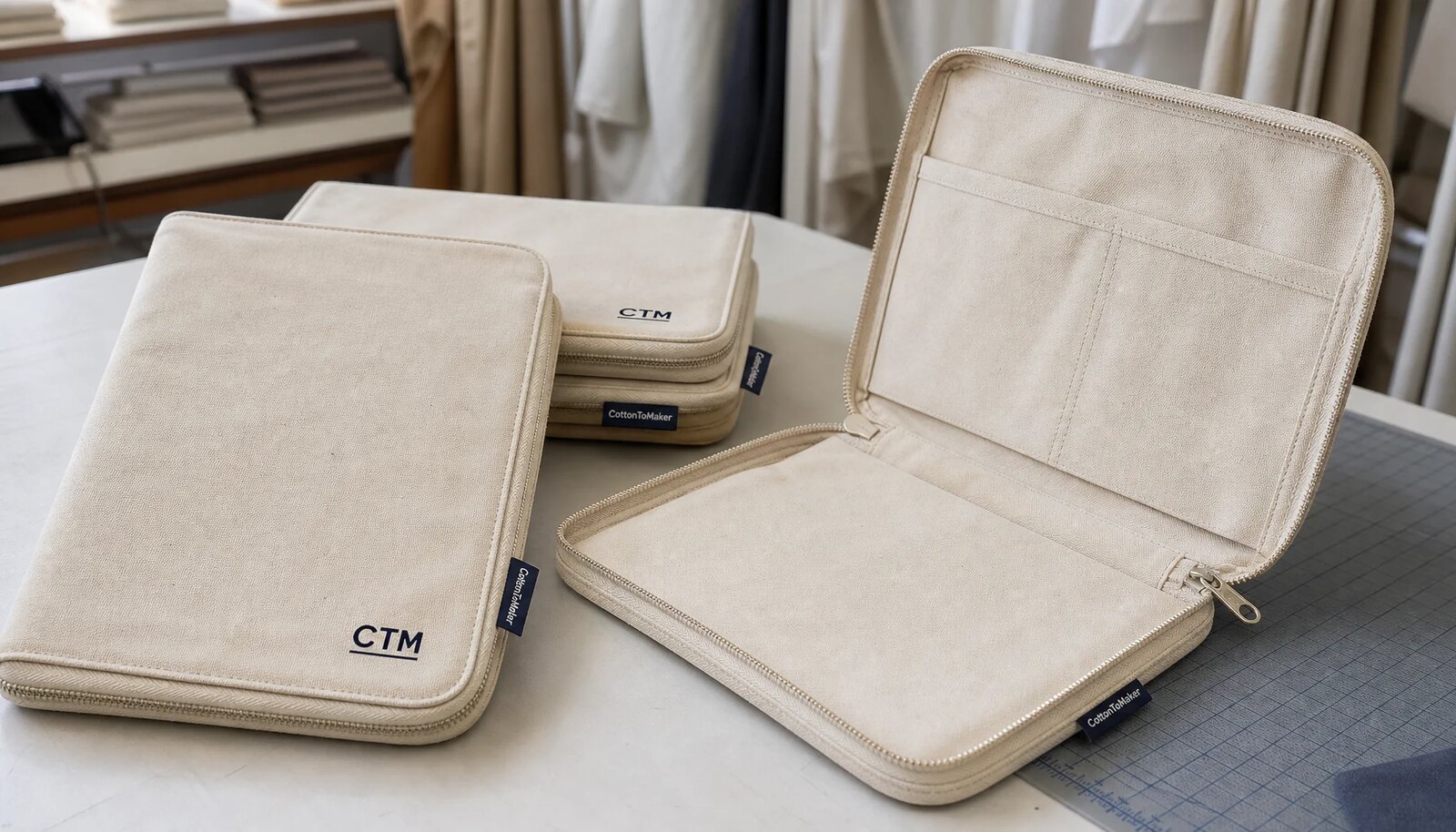
Why Craft Fair Portfolios Fail
Canvas zipper portfolios for craft fairs look simple, but they are handled harder than many office pouches. A buyer may use them to hold order forms, vendor brochures, art prints, pricing sheets, craft kit components, receipts, or small merchandise. At the booth, the same portfolio may be opened dozens of times per day, stacked in crates, pressed under display fixtures, and handled by customers who pull the zipper from the wrong angle.
The main buying problem is not whether the sample looks attractive on a table. The question is whether the bulk order can survive repeated zipper use, loaded corners, carton compression, and print abrasion without looking worn before the event season ends. A useful RFQ must translate that use case into measurable fabric, zipper, seam, print, and packing requirements.
- Typical failure point: zipper tape separates because the end seam has no reinforcement.
- Typical complaint: portfolio corners curl or crush after tight carton packing.
- Typical hidden cost: low GSM fabric saves unit cost but increases returns when loaded with catalogs.
- Typical approval mistake: buyers test an empty sample instead of a loaded sample.
Start With Actual Contents
The finished size should be based on what the portfolio must carry, not only on a catalog photo. A4 paper, US letter sheets, 8 x 10 art prints, folded craft instructions, sample cards, and small kits all need different clearance. If the zipper opening is too tight, users pull harder at the corners and shorten the zipper life. If the body is too large, the product looks loose and cheap on retail display.
For procurement teams buying for craft fairs, the safest method is to list the contents by size, thickness, and weight. A flat document portfolio may only need 10-15 mm clearance beyond the paper edge. A craft kit bag with cards, cords, beads, or tools may need more internal allowance and stronger stitching. The factory should pattern the sample around the loaded use, not the cheapest flat pouch pattern.
- For A4 documents, specify whether the bag must fit paper only or paper inside a sleeve.
- For US letter sheets, confirm the zipper side and opening clearance before tooling the pattern.
- For retail insert cards, define whether the card is packed inside the portfolio or attached outside.
- For kits, provide the loaded weight and thickness so corner stress can be tested.
Fabric Weight And Handfeel
For canvas zipper portfolios used at craft fairs, 10 oz to 12 oz cotton canvas is usually a practical range. In GSM terms, that is roughly 280-360 GSM, depending on weave and finishing. This range gives enough body for a portfolio to feel sellable, while still allowing the zipper seam to lie flat and the packed cartons to stay within normal handling weight.
Going lighter can work for giveaway portfolios, but it changes the buyer promise. A 220-260 GSM cotton fabric may be acceptable for low-cost event packaging, yet it will not feel like a durable organizer. Going heavier, such as 14 oz or 16 oz canvas, can look premium, but it increases sewing difficulty around the zipper and corners. Heavier fabric also raises carton CBM and may require stronger needles, slower sewing speed, and more careful pressing.
- Quote fabric in both oz and GSM to avoid supplier interpretation gaps.
- Natural cotton canvas may show slubs and shade variation; define the acceptable rustic look.
- Dyed canvas needs shade approval and may add MOQ due to dye lot requirements.
- Pre-shrunk or washed fabric costs more but reduces later size movement.
Zipper And Seam Durability
The zipper is the most visible mechanical part of the product, so it deserves more attention than color matching. For most canvas zipper portfolios, a No. 5 nylon coil zipper is a safer starting point than a very small zipper. It runs smoothly, handles repeated opening, and is easier to sew into cotton canvas than a bulky metal zipper. A lock slider is useful when the portfolio is carried vertically or packed with loose contents.
Seam construction matters as much as zipper grade. The zipper tape should not be stitched so close to the edge that it tears under angled pulling. Zipper ends should have backstitching, bar tack, or another reinforcement method agreed in the sample. Corners need clean seam allowance control because thick folded canvas can create skipped stitches. The factory should trim loose threads before packing because threads caught in the zipper are a common inspection issue.
- Use No. 5 zipper for standard durable craft fair portfolios unless the design is very small.
- Avoid exposed raw zipper tape ends unless the rustic style is intentionally approved.
- Require smooth zipper operation after the sample is loaded, not only when flat and empty.
- Add reinforcement if the design includes a wrist strap, handle, or hanging loop.
Print Method And Artwork Risk
Screen printing is usually the most reliable method for solid logos on cotton canvas portfolios. It gives good cost control for bulk orders and handles natural canvas texture better than many fine-detail processes. For craft fair retail programs, buyers often use one or two brand colors, event names, or maker logos. In that situation, screen print is normally easier to repeat consistently than a small-batch transfer process.
Heat transfer and digital print can be useful for multi-color artwork, gradients, or small MOQs, but they need extra durability checks. A portfolio bends along the body and is stacked print-to-fabric in cartons. Thick transfers may crack at fold lines, and under-cured ink may block against the next piece. The approval sample should be printed on the same canvas as bulk production, cured by the production method, then rubbed, folded, and packed under pressure before signoff.
- For solid logos, specify Pantone reference, print size, location, and ink type.
- For multi-color designs, request a production-method sample before accepting the quote.
- Avoid placing heavy ink directly over fold zones or thick seam areas.
- If a woven side label is used, define label size, fold type, position, and stitching color.
Durability Test Plan
A durability testing checklist should be simple enough for the factory to repeat and specific enough for the buyer to compare quotes. The goal is not to create a laboratory standard for every order. The goal is to catch predictable production failures before cartons leave the factory. For canvas zipper portfolios, the most useful checks are zipper cycling, loaded pull, seam inspection, print rub, corner compression, and packing pressure.
Set acceptance criteria in plain language. For example, after repeated zipper opening and closing, the slider should move smoothly without tape separation or loose thread blockage. After the loaded test, the corner seams should not open, distort severely, or show broken stitches. After print rub testing, the logo should not transfer heavily to white cloth or stick to the next piece. These practical thresholds help prevent arguments during final inspection.
- Zipper cycle check: open and close selected samples repeatedly, including after loading.
- Loaded hang or carry check: test with the expected content weight plus a safety margin.
- Corner compression check: stack packed samples under carton-like pressure and inspect shape recovery.
- Print rub check: rub dry cloth across cured print and inspect transfer, cracking, and smearing.
- Seam check: inspect skipped stitches, loose threads, stitch density, and reinforcement points.
MOQ Logic And Cost Drivers
MOQ for canvas zipper portfolios is driven less by the basic sewing shape and more by material commitments. Natural canvas in stock color may support a lower MOQ. Dyed canvas, custom zipper color, special lining, woven labels, branded pullers, and multi-color print all increase setup work or supplier purchasing minimums. Buyers comparing quotes should separate true factory MOQ from material MOQ.
Cost also changes with fabric weight, zipper grade, print coverage, lining, internal pockets, labels, packing method, and inspection requirements. A quote that is cheaper by using lighter fabric, No. 3 zipper, single stitching, and bulk loose packing is not the same product. For distributors and retail buyers, landed cost should include the carton volume impact of heavier canvas and flat packing, not only the unit price.
- Lower MOQ route: stock natural canvas, stock zipper color, one-color screen print, unlined body.
- Mid-range route: 10-12 oz canvas, No. 5 zipper, woven label, one inner pocket, export carton packing.
- Premium route: dyed canvas, lining, custom puller, reinforced corners, retail barcode packing.
- Hidden cost driver: carton CBM increases when portfolios must stay flat and protected.
Sample Approval Workflow
A photo sample is not enough for this product. Buyers should approve a physical sample because handfeel, zipper smoothness, corner stiffness, and print surface cannot be judged accurately from images. The first sample should confirm size, fabric weight, zipper position, construction, and branding location. If the order uses dyed fabric or special print, a second approval may be needed for shade and print quality on bulk material.
The pre-production sample should represent the mass production method. That means same fabric GSM, same zipper grade, same stitch type, same print process, and same packing concept. Do not approve a clean handmade sample if bulk production will use different fabric or a substitute zipper. Keep one approved sample with the buyer and one sealed sample at the factory for final inspection reference.
- Measure finished size at top, middle, and bottom to catch pattern distortion.
- Load the sample with actual contents and operate the zipper from both ends of the opening.
- Inspect inside seams for loose thread, lining catch points, and rough zipper tape ends.
- Compare logo placement against a measured artwork layout, not just visual centering.
- Record sample comments in a revision sheet before moving to bulk production.
Packing And Carton Protection
Packing affects durability because many failures happen before the product reaches the buyer. Canvas portfolios with zippers can leave pressure lines if they are compressed too tightly. Printed panels can block or mark if packed face-to-face before ink is fully stable. Corners can bend if the carton is oversized and the bundles move during shipping. A good packing plan protects both the print and the portfolio shape.
For export packing, many buyers use 25-50 pieces per bundle depending on size and fabric weight. Tissue paper, thin divider sheets, or alternating print direction may be needed for heavy prints. Carton weight should remain manageable for warehouse handling. If the portfolios are sold at retail, add barcode label, hangtag, belly band, or polybag requirements early because these change labor time, packing size, and quote accuracy.
- Define whether each piece is flat packed, folded, sleeved, or individually polybagged.
- Set a maximum carton gross weight suitable for distributor warehouse handling.
- Use moisture protection for sea freight, especially with natural cotton canvas.
- Confirm shipping marks, carton count, inner bundle count, and barcode placement before production.
- Test one packed carton for corner pressure, zipper imprint, and print transfer.
Lead Time And Schedule Risk
Lead time depends on approval speed as much as factory sewing capacity. A typical sourcing timeline includes RFQ clarification, material confirmation, artwork setup, sample making, sample shipment, buyer approval, bulk material preparation, cutting, printing, sewing, inspection, packing, and export handling. If the craft fair season has a fixed date, late artwork approval can create more risk than the actual sewing process.
The highest schedule risks are dyed fabric, custom zipper color, complex print, retail packaging, and repeated sample revisions. Procurement teams should build the RFQ around decision deadlines. If the buyer can accept stock natural canvas and stock zipper colors, the project is easier to control. If the program needs exact brand color fabric, custom labels, and individual retail packing, the timeline should include extra approval and material booking time.
- Fastest route: stock fabric, stock zipper, one-color logo, simple export packing.
- Higher-risk route: dyed canvas, custom zipper, multi-color print, individual retail packaging.
- Approval bottleneck: unclear logo placement or missing print color references.
- Production bottleneck: zipper sewing quality if heavy canvas and lining are both used.
- Shipping bottleneck: carton CBM if flat packing prevents tight consolidation.
Specification comparison for buyers
| Spec decision | Recommended option | When it fits | Buyer risk to check |
|---|---|---|---|
| Outer fabric weight | 10 oz to 12 oz cotton canvas, roughly 280-360 GSM, pre-shrunk if washing is expected | Best balance for craft fair portfolios that need structure but still fold into cartons efficiently | Below 260 GSM may feel promotional; above 400 GSM raises sewing bulk, carton weight, and zipper stress |
| Zipper construction | No. 5 nylon coil zipper with lock slider and reinforced end stitching | Suitable for repeated booth demos, customer handling, and quick document access | Cheap sliders can jam after print curing dust, seam lint, or tight packing pressure |
| Seam reinforcement | Double-stitched perimeter with bar tack or backstitch at zipper ends and pull tab points | Needed when buyers use the portfolio for catalogs, order forms, sample cards, or craft kits | Single stitching may pass visual inspection but fail during loaded pull testing |
| Lining choice | Unlined for low-cost flat portfolios; 150D-210D polyester lining for cleaner interior finish | Unlined works for rustic craft positioning; lined works for retail brands and corporate gifting | Lining adds labor and can wrinkle or catch in the zipper if the pattern is not controlled |
| Print method | Screen print for solid logos; heat transfer only for multi-color artwork with controlled testing | Screen print is stable for cotton canvas and economical after setup for bulk orders | Transfers can crack at fold zones; thick ink can mark opposite panels during tight packing |
| Size tolerance | Finished size tolerance within ±5 mm for common A4 or letter document formats | Important for retail buyers selling portfolios as stationery, kit bags, or vendor organizer bags | Loose tolerance causes mixed carton appearance and customer complaints about documents not fitting |
| Pull strength test | Loaded zipper pull cycle plus seam pull test at corners before mass production approval | Useful for craft fair inventory that will be opened repeatedly by shoppers and booth staff | A nice-looking sample may fail after 100-200 openings if zipper tape is sewn too close to the edge |
| Packing method | Flat pack with tissue or divider sheets, 25-50 pieces per inner bundle depending on size and GSM | Protects print face, reduces zipper imprint, and keeps carton dimensions predictable | Over-compression can create zipper ridges, print blocking, and bent portfolio corners |
Buyer checklist before sampling
- Define the finished size by actual contents: A4 sheets, US letter sheets, craft kits, order pads, swatch cards, or retail inserts.
- Specify fabric weight in oz and GSM, not only as “heavy canvas,” and state whether natural, dyed, or bleached canvas is required.
- Lock the zipper grade, slider type, puller shape, zipper color, and whether the zipper must open on the long side or short side.
- Require reinforcement at zipper ends, corners, and any handle or wrist strap attachment points if included.
- Approve the print on production fabric after curing, then test rubbing, folding, and carton pressure before confirming bulk production.
- Check one loaded sample with the heaviest expected contents, not an empty sample only.
- Confirm finished size tolerance, seam allowance, zipper tape exposure, and acceptable fabric slub level in the pre-production sample.
- Define carton packing by pieces per bundle, print face protection, moisture control, carton weight, and drop-test expectation.
- Compare quotes using the same GSM, zipper grade, print colors, packing method, and inspection standard.
- Set a realistic approval timeline for artwork, lab dips if dyed fabric is used, pre-production sample, production, inspection, and shipment.
Factory quote questions to send
- What exact canvas weight are you quoting in oz and GSM, and is it natural, dyed, bleached, or enzyme washed?
- Is the quoted zipper No. 3, No. 5, or another size, and is it nylon coil, resin, or metal?
- Where will you reinforce the portfolio: zipper ends, corners, pull tab, side seams, or inner pocket openings?
- What finished size tolerance can you hold after cutting, sewing, and pressing?
- Which print method are you quoting, how many colors are included, and what is the maximum printable area?
- Can you provide a printed pre-production sample on the same bulk fabric and zipper before production starts?
- What durability checks do you run in-line and before packing, including zipper cycling, seam pull, print rub, and load testing?
- How many pieces are packed per carton, what is the estimated carton size and gross weight, and how is the print surface protected?
- What is the MOQ for this construction, and which factors change the MOQ: fabric color, zipper color, print process, lining, or label type?
- What quote validity, production lead time, sample lead time, and peak-season capacity assumptions are included?
Quality-control points to confirm
- Fabric weight must match the approved range within the agreed tolerance, with no large stains, holes, severe weaving defects, or inconsistent shade panels.
- Finished size should stay within ±5 mm unless a different tolerance is agreed in the tech pack.
- Zipper must open and close smoothly without catching lining, loose threads, seam allowance, or printed fabric dust.
- Zipper end stitching should withstand repeated pulling without popped stitches or tape separation.
- Perimeter seams should be even, locked, and free from skipped stitches, broken thread, or exposed raw edges beyond the approved style.
- Print should pass dry rub and light scratch checks after curing, with no blocking between packed pieces.
- Loaded sample should hold the agreed test weight without seam distortion, corner tearing, or zipper wave.
- Cartons should meet agreed count, bundle format, moisture protection, barcode or shipping mark requirements, and maximum gross weight.