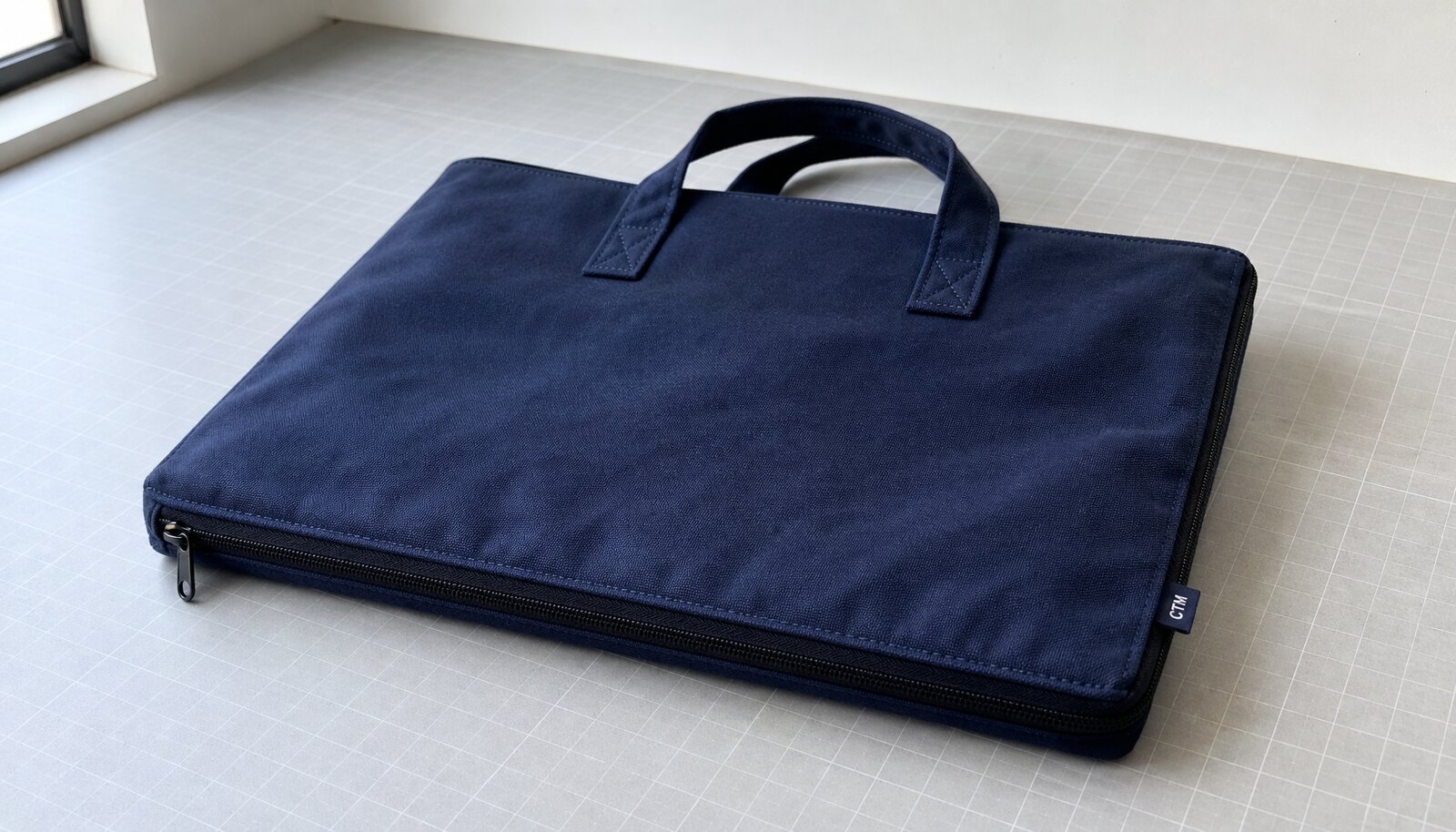
What Goes Wrong in Corporate Gifting Orders
Canvas zipper portfolios look simple until they are used as a corporate gift. Buyers are not only judging the logo. They are judging how the zipper feels in hand, whether the bag sits flat on a desk, and whether the whole item looks consistent across a thousand units. The common failure is not a dramatic defect. It is a cluster of small misses: a soft body that wrinkles after packing, a print that sits too close to the seam, or a zipper that pulls slightly off line after a few openings.
That is why a quality inspection checklist matters before bulk production starts. A good sample can still hide a bad production method if the factory used a better zipper, a heavier lining, or extra hand finishing only for the sample. For corporate gifting, the item has to survive transport, warehouse handling, and end-user presentation. If the first unit opens smoothly but the bulk order arrives with crooked pullers or thin corners, the product fails the gift moment even if the basic shape is right.
- The product is judged by presentation, not only by utility.
- Sample quality can be better than bulk quality if the sample is over-finished.
- Small sewing errors become visible fast on flat canvas surfaces.
- Corporate gifts need cleaner packing and more consistent color matching than a casual promo item.
Choose the Canvas Weight Before You Price It
The fastest way to distort a quote is to leave fabric weight vague. For canvas zipper portfolios, many buyers will land somewhere around 12 oz, about 340 gsm, for lighter programs, or 16 oz, about 470 gsm, for a more premium, structured feel. The lower weight is easier to carry and usually cheaper to ship, but it can look soft or sag once documents and inserts are added. The higher weight feels more substantial and gives better shape retention, but it raises sewing load, carton weight, and sometimes the risk of bulky corners if the pattern is not clean.
A buyer should define not just the fabric weight, but also whether the body is lined, interfaced, or lightly padded. A plain single-layer canvas shell can work for a simple gift set, but a business portfolio often needs better shape, hidden seams, and a cleaner inside finish. If the buyer wants the bag to stand upright on a table, the structure has to be built into the spec, not added after sample approval. A quote that omits lining or interfacing is not comparable to a quote that includes them.
- Use 12 oz / 340 gsm for lighter, cost-sensitive gifting where structure is not the main selling point.
- Use 16 oz / 470 gsm when the portfolio must feel premium and hold its shape better.
- Add lining or interfacing if the buyer expects a cleaner interior and stronger body.
- Treat heavier fabric as a freight decision too, not only a material decision.
Branding Method Should Match Wear, Not Just Artwork
Canvas takes branding well, but not every method behaves the same after handling. Screen print is still the most practical choice for a clean one-color or two-color logo because it sits well on canvas and is easy to repeat at scale. Woven labels and sewn patches are strong options when the buyer wants a sharper premium cue without risking ink wear. Heat transfer can work for complex artwork or full-color designs, but it needs tighter approval because the edge quality and surface feel vary more by supplier.
The logo decision should match how the portfolio will be used. If it will be carried daily, placed in conference rooms, or stacked with other gifts, abrasion matters more than artwork complexity. If the logo is small and subtle, a woven side label or embroidered mark can feel more durable than a large print field. If the artwork is large and graphic-heavy, the buyer should test print opacity on the chosen canvas color before approving bulk. A dark fabric with a light logo often needs more ink passes or a better underbase, which changes both cost and lead time.
- Use screen print for stable, repeatable logos with controlled color count.
- Use woven labels or sewn patches for a premium look and better abrasion resistance.
- Use transfer methods only when artwork complexity justifies the risk.
- Require artwork placement tolerance in the sample signoff, not only in the file.
Hardware and Stitching Decide Returns
Most quality complaints on zipper portfolios come from hardware and sewing, not the canvas itself. A standard #5 nylon coil zipper is often the right starting point for a portfolio because it runs smoothly and is light enough for a flat business bag. If the item is large, heavily filled, or expected to take more abuse, a heavier zipper may be justified. The puller should be comfortable to grasp, and its finish should not chip or feel sharp in hand. If the supplier is using an off-brand zipper, the buyer should ask for cycle testing or at least a bulk sample from the same lot.
Stitching needs to be judged with a production eye. Corners should have reinforcement, handles or finger tabs need bartacks where the load collects, and seam allowances should stay consistent so the bag does not twist when zipped shut. Loose threads are not a cosmetic problem only; they can indicate that tension control is poor and the seam may open later. On a flat canvas portfolio, any crooked topstitching stands out immediately, so acceptance criteria should be written down before production starts.
- A smooth zipper line matters more than decorative hardware.
- Bartacks belong at stress points, not just wherever the operator finishes the seam.
- Reject sharp pullers, chipped plating, or uneven tape insertion.
- Look for seam symmetry on both sides of the portfolio when it is closed.
Pick the Right Sourcing Route and MOQ
The sourcing route changes more than price. A direct factory is usually the best route when the order needs stable sewing, repeatability, and clear responsibility for cutting, printing, and packing. A trading company can help when the buyer is combining several product categories or needs one document set across multiple factories, but the spec must stay tight or details get diluted. A local decorator or domestic finisher is useful for short runs and rush orders, but it is rarely the lowest landed-cost option for a true bulk program. The best route depends on how much process control the buyer wants versus how much coordination overhead they can manage.
MOQ logic on canvas zipper portfolios usually follows the material stack, not just the bag shape. Standard canvas with a simple logo and stock zipper can often be quoted at a lower MOQ than a custom-dyed body, lined interior, custom puller, or special packaging. Buyers should expect MOQ to rise when they add color variants, complex branding, or nonstandard packing. If a quote claims a very low MOQ, look for where the cost is being hidden: in a larger setup fee, weak sample control, thinner fabric, or a less controlled subcontract step.
- Direct factory: best for repeatable bulk quality and clearer defect responsibility.
- Trading company: useful for multi-item procurement, but the spec file must stay strict.
- Local finishing: useful for speed, not usually for the lowest unit and freight cost.
- MOQ rises with custom dye, lining, special hardware, and retail-style packaging.
Approve the Sample Like a Production Buyer
A sample is only useful if it becomes a production reference. The buyer should ask for a pre-production sample that uses the same fabric weight, zipper type, logo method, and packing method intended for bulk. Once approved, keep a sealed golden sample and use it as the comparison point during inline and final inspection. Without that reference, teams end up discussing whether a defect is acceptable instead of whether it matches the approved standard. That is how bulk drift gets normalized.
The sample should be inspected like a working product, not like a display piece. Open and close the zipper multiple times, check that the body still sits flat, verify that the logo has the correct placement, and measure the finished size against the drawing. If the portfolio contains pockets or sleeves, load it with the type of documents the end user will actually carry. The point is not to find perfection. The point is to learn where the factory needs control before the full order is released.
- Use the same fabric lot, zipper type, and branding method planned for bulk.
- Keep one sealed golden sample for line and final inspection.
- Test the sample with actual documents or inserts, not only with empty handling.
- Reject samples that rely on hand finishing that the bulk line cannot repeat.
Packing and Carton Data Affect Damage Rates
Packing is part of quality, not a separate admin detail. A canvas zipper portfolio can arrive in perfect sewing condition and still fail if the logo rubs against a rough inner pack, if the zipper pull scuffs another unit, or if the carton is too large and the bags shift in transit. For corporate gifting, buyers usually want a clean first impression, so inner packaging should protect the front face and keep the item flat. If the product is going to retail shelves later, then the pack format also needs to support barcode labels, hanging holes, or shelf-ready carton logic.
Freight planning depends on carton data. A quote without inner pack quantity, master carton quantity, and carton dimensions is not usable for landed-cost comparison. Even a small change in fold direction can change the carton height and therefore the cubic meter cost. If the portfolio has a structured body or padding, folding too tightly can leave a permanent crease. The buyer should ask for the pack plan early because packing often changes not only the damage rate, but also the total shipping cost and warehouse handling time.
- Require inner pack details that prevent abrasion between units.
- Get master carton dimensions before comparing freight quotes.
- Confirm whether the bag can be folded without creating a permanent crease.
- Match carton markings and barcodes to the buyer's warehouse or retail process.
Lead Time and Schedule Risk Are Part of Quality
A realistic lead time is not just a production promise. It is a risk map. The factory should separate sample time, bulk sewing time, printing time, and packing time so the buyer can see where delays can happen. If the canvas is stock and the logo is a simple one-color print, the program is usually easier to schedule than a custom-colored body with special zipper tape and custom packaging. Seasonal load matters too. A factory that is responsive in the sample stage can still be slow if sewing lines are full or if print capacity is booked out.
The buyer should also watch dependency order. If the logo approval is late, the whole line waits. If the zipper or lining is sourced externally, the bag schedule now depends on another supplier's lead time. That is why the quote should name all critical materials and include the assumption behind the schedule. A clean schedule is not the one with the shortest date. It is the one where every step is visible and the buyer knows what will slip first if the artwork changes.
- Ask for separate timing on sample, bulk, packing, and dispatch.
- Treat custom materials as schedule risk, not just style upgrades.
- Late artwork approval often causes more delay than sewing itself.
- Peak season can extend lead times even when the first sample is fast.
Compare Quotes by Landed Cost, Not Unit Price
Unit price alone hides too much. A low quote can become the expensive option if it uses a heavier carton, a larger folded size, a slower print method, or a higher reject rate. For canvas zipper portfolios, landed cost should include sample charges, tooling or plate charges, inner packing, carton volume, and any extra handling the supplier adds after printing. If the buyer is comparing suppliers across regions, freight and duty assumptions also matter because a slightly cheaper unit price can be erased by a bulkier carton or a longer transit lane.
A usable quote should let procurement compare apples to apples. That means the same size, the same canvas weight, the same zipper type, the same logo method, and the same pack count. If one factory includes a woven label and another includes a printed logo, those are not equivalent offers. The buyer should also look for what is not listed. When a quote is vague about sample charges, color matching, or subcontracted processes, that usually means the risk is being carried somewhere else in the chain.
- Compare fabric weight, zipper grade, and packing format before looking at unit price.
- Include sample charges and packaging changes in the cost model.
- Use carton volume, not only gross weight, when comparing freight.
- Treat missing quote detail as a risk, not as a bargain.
Build the RFQ Packet So Factories Quote the Same Thing
The cleanest way to avoid quote noise is to send one RFQ packet with all the decision points already fixed. That packet should include a dimension sketch, artwork file, canvas weight target, zipper spec, lining or padding callout, pack format, destination market, and the required inspection standard. When the factory gets the same structure from every buyer, the quotes become comparable. When the packet is loose, every supplier fills the gaps differently and the buyer ends up comparing assumptions instead of offers.
For this product category, the best RFQ packet is short but complete. It does not need a long brand story. It needs measurable data and a clear approval path. If the buyer wants the factory to quote quickly and accurately, the packet should state what can be substituted and what cannot. For example, a buyer may allow an equivalent zipper source but forbid any change in logo placement or fabric weight. That kind of boundary keeps the quote usable and makes the sample review much faster.
- Include a dimension drawing with all visible and hidden pockets marked.
- Specify the target GSM or oz weight, not just the word canvas.
- Attach the logo file and the exact print area with placement tolerance.
- State what may be substituted and what must stay fixed.
Specification comparison for buyers
| Spec decision | Recommended option | When it fits | Buyer risk to check |
|---|---|---|---|
| Source route | Direct factory with in-house sewing and printing | Repeat programs, 500+ units per style, and buyers who need stable specs | Confirm who actually cuts, prints, and packs the order; outsourced steps can drift between sample and bulk |
| Source route | Trading company or sourcing agent | Mixed-SKU orders, multiple factories, or buyers who need one quote file | Margin can hide the real factory spec; require the same sample reference and a full materials list |
| Source route | Local decorator or domestic finisher | Rush orders, short-run events, or last-mile branding support | Unit cost and material choice can limit fabric weight, zipper grade, and size flexibility |
| Fabric weight | 12 oz / about 340 gsm canvas | Lighter gifting portfolios, lower freight, and price-sensitive programs | Body can feel soft or thin after packing; watch for show-through and weak structure |
| Fabric weight | 16 oz / about 470 gsm canvas with lining | Premium corporate gifts, document carriers, and products that must stand upright | Heavier cartons and higher sewing load; verify seams, handles, and zipper alignment |
| Branding method | 1 to 2 color screen print or woven label | Clean logos, repeat orders, and sharp brand control | Large print areas can crack or misregister if the print base is not stable |
| Branding method | Heat transfer or digital transfer | Full-color artwork, gradients, or small test programs | Lower abrasion resistance; reject if the print edge lifts or the artwork feels brittle |
| Sample path | Pre-production sample plus sealed golden sample | First orders, new vendors, or any custom shape or pocket layout | Bulk must match the sealed sample on size, zipper feel, print location, and stitching density |
Buyer checklist before sampling
- Lock finished size, document capacity, and orientation before sending the RFQ.
- Specify canvas weight in gsm or oz, plus whether the body is lined or interfaced.
- Choose the logo method, color count, and print area, not just the artwork file.
- Define zipper type, puller finish, and whether the zipper tape must match the body color.
- Request a pre-production sample and keep one sealed approval sample for bulk comparison.
- Ask for inner pack, carton count, and carton dimensions before comparing freight quotes.
- Confirm sample charges, tooling charges, and whether plates or screens are reusable.
- Require a written lead time for sample, bulk production, and dispatch separately.
- Ask which steps are done in-house and which are outsourced.
- Compare landed cost, not just unit price, using weight, carton volume, and packing method.
Factory quote questions to send
- What is the exact canvas weight, weave, and shrinkage allowance used for this portfolio?
- Is the zipper #5 or #8 coil, metal, or plastic, and who supplies it?
- Which logo method is included in the quote, and what is the maximum print size?
- Is the bag lined, padded, or reinforced at stress points, and what material is used?
- What is the MOQ by color and by artwork, and does custom packaging change it?
- What sample stages are included, what do they cost, and how long does each stage take?
- What are the inner pack quantity, master carton quantity, and carton dimensions?
- Which operations are done by your factory, and which ones are subcontracted?
Quality-control points to confirm
- Fabric weight matches the approved swatch and does not feel underbuilt for the declared GSM.
- Finished dimensions stay within a practical tolerance, typically within 5 mm on key edges for smaller portfolios.
- Zipper opens and closes smoothly for at least 20 cycles without snagging, wave, or tooth damage.
- Zipper tape, puller finish, and body color match the approved reference under daylight.
- Topstitching is even, loose threads are trimmed, and no skipped stitches appear at corners or zipper ends.
- Bartacks or reinforcement stitches are present at handles, stress points, and pocket ends.
- Logo placement is centered and aligned, with no cracking, halo, or visible press marks.
- Panels stay flat with no twisting, bubbling, or lining exposure at the edges.
- Pockets and document sleeves are functional, aligned, and not sewn shut by mistake.
- Carton count, inner pack count, labels, and shipping marks match the purchase order.