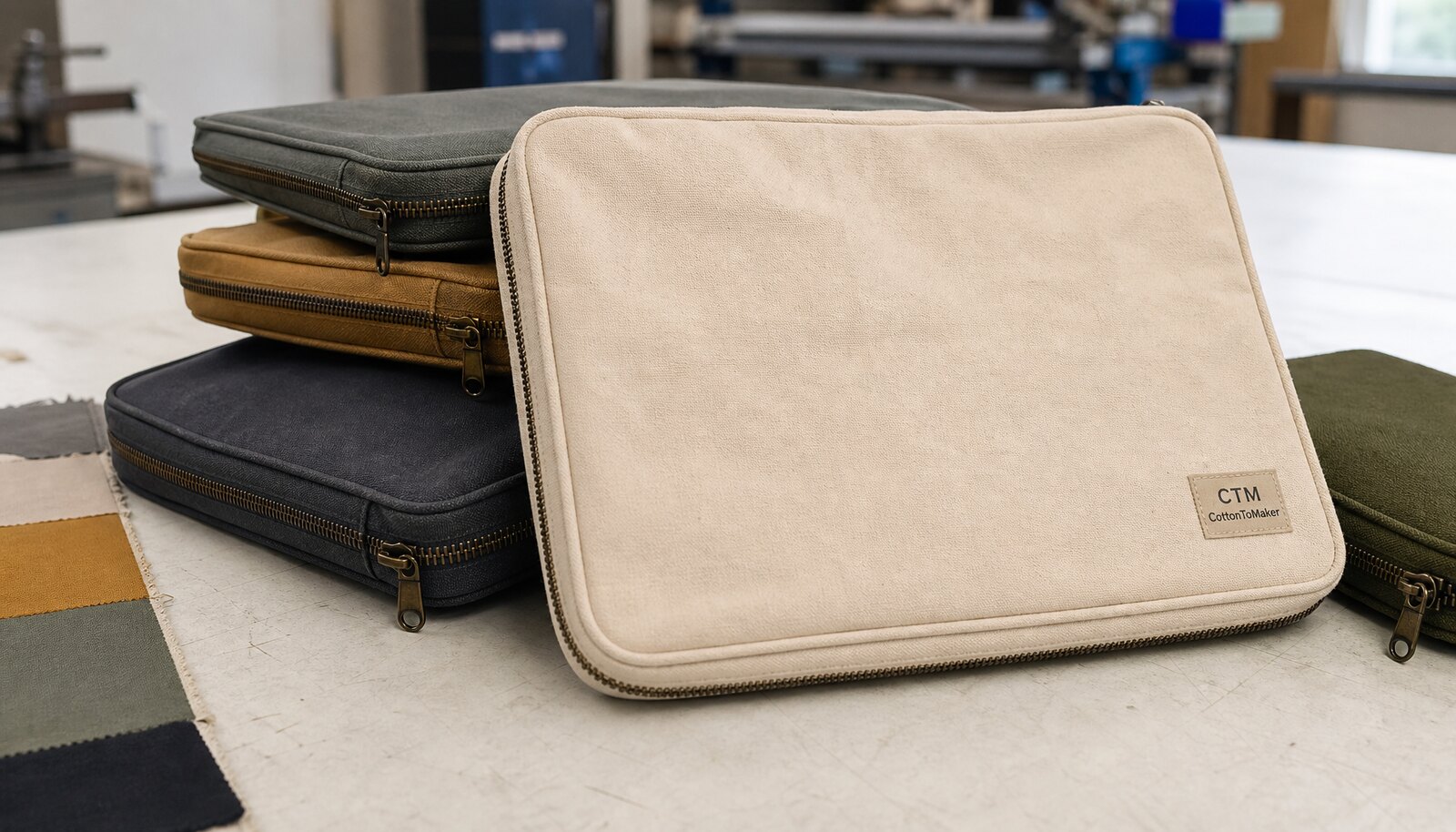
Why MOQ matters more on zipper portfolios than buyers expect
For canvas zipper portfolios, MOQ is not just a factory policy issue. It controls how many fabric rolls, zipper colors, print screens, and packing labels the factory has to commit to before cutting starts. That is why a small MOQ can still produce a high unit price if the supplier has to break down materials into too many variants.
Corporate gifting buyers often focus on the logo and ignore the structure behind the quote. A portfolio with one body color, one zipper color, and one print location is far easier to price than an order split across multiple Pantone shades, personalized names, and separate packaging requirements.
- One artwork, one fabric color, one zipper color usually gives the cleanest MOQ outcome.
- Each added variable may trigger a separate setup cost or a higher minimum per color.
- If the event date is fixed, protect the schedule before negotiating a lower quantity.
Start with the right canvas spec, not the lowest price
Most buyers land on 12 oz canvas for standard corporate gifting because it balances appearance, print clarity, and cost. It feels substantial without becoming too rigid for document storage. If the portfolio needs a more premium hand feel or will carry heavier inserts, 14 oz is often the safer option, but it also raises sewing resistance and freight weight slightly.
The canvas finish matters as much as the nominal weight. A loose weave can distort the logo edges, while an overprocessed surface may look too glossy for a serious business gift. Ask the factory for the actual fabric sample, not only the spec line, because the hand feel and weave density often explain why one quote is much cheaper than another.
- 12 oz: common, printable, lower risk for general corporate use.
- 14 oz: better structure and premium perception, but higher cost and slightly longer sewing time.
- Natural canvas should be checked for batch-to-batch tone variation before print approval.
Choose the zipper specification before comparing supplier quotes
A zipper portfolio can look simple, but the zipper system is where many quality problems begin. Metal zippers create a more corporate, durable impression, while nylon coil zippers are usually smoother and more forgiving on stitching alignment. The right choice depends on the intended use and the design, not just the image you want in the catalog.
Buyers should define the zipper tape color, puller style, and stop finish in the RFQ. If the supplier fills in those details on their own, you may receive a nice-looking sample that cannot be repeated economically in bulk. Zipper replacement after sampling is one of the easiest ways to blow the MOQ logic and restart the cost model.
- Metal zipper: premium look, but inspect smoothness and tooth alignment.
- Nylon coil zipper: practical for frequent opening, lighter, and often easier to source consistently.
- Always require a full open-close test on the sample, not a partial pull.
Print method affects MOQ, unit cost, and visual control
For corporate gifting, one-color screen print is still the most economical route when the logo is clean and the quantity is decent. It gives sharp results on canvas and keeps the setup manageable. If the artwork has multiple colors or small gradients, heat transfer can save the design, but the finish may look less integrated into the fabric.
Embroidery on a zipper portfolio is possible in limited zones, but it is not always the best route for thin document-style products. Dense embroidery near the zipper line can stiffen the panel and distort closure. Buyers should compare not only the decoration cost, but also how the decoration affects usability and repeatability in bulk.
- Screen print: best for simple corporate logos and repeat orders.
- Heat transfer: useful for short runs or multi-color graphics, but inspect edge adhesion.
- Embroidery: only if the product design allows a safe stitch zone away from seams and zipper stress.
How factories build MOQ: where the hidden cost really sits
When a supplier says the MOQ is 1,000 pieces, that number is usually shaped by fabric roll usage, print setup, zipper sourcing, and labor efficiency. If your order is 600 pieces but you want three colors and two print positions, the real manufacturing complexity can be higher than a clean 1,000-piece single-SKU order. That is why buyers should negotiate on the structure of the MOQ, not only the total number.
A practical negotiation approach is to hold the spec stable and reduce variants first. For example, you may keep the total quantity the same but simplify from three colors to one, or from personalized names to a single logo location. That often lowers the real factory burden more effectively than pushing for a slightly smaller quantity.
- Simplify color count before asking for a lower MOQ.
- Reduce print locations before splitting the order across many SKUs.
- Ask whether the MOQ is driven by fabric, zipper, or print setup so you know what to negotiate.
A clean supplier comparison saves more than a cheap quote
For procurement teams, the safest comparison is not factory versus factory on unit price alone. Compare the supplier route: direct factory, local trader, or integrated sourcing company. A direct factory usually gives better control over fabric, zipper, and packing, while a trading route may help if you need mixed items for one campaign shipment. The wrong route can create false savings because the quote excludes the details that matter later.
The table below shows how sourcing routes typically differ for canvas zipper portfolios. Use it to decide who should quote first, who should be used as a backup, and where a low MOQ offer may be masking a weaker production setup.
Supplier route comparison for corporate gifting orders
The best route depends on how much control you want over the product and how stable your specifications are. Buyers with fixed artwork, clear carton instructions, and repeat demand usually benefit from going direct to the factory. Buyers still refining the gift set may prefer a sourcing partner who can bundle items, but they should insist on the actual production source before committing.
Do not compare a factory quote with a trading quote unless the spec is fully normalized. One may include a real sample process and export packing, while the other may leave those items to be charged later.
- Write decisions in measurable language, not only descriptive wording.
- Ask for sample photos plus one physical approval sample for important orders.
- Keep quotation, sample approval, and inspection notes tied to the same spec version.
Pre-production sample approval is where most MOQ mistakes are caught
A good sample should use the final canvas weight, actual zipper model, final print location, and the same label or packaging plan as the bulk order. If any of those elements are substituted, the sample becomes only a visual reference, not a production approval. For zipper portfolios, the difference between sample and bulk often shows up in the zipper pull, stitch line, or canvas tone.
The approval standard should be measurable. For example, the logo can be allowed a small placement tolerance, but the zipper must still close without force, the fabric must lie flat without warping, and the portfolio must fit the intended insert size. Buyers who approve only by photo tend to discover problems at packing stage, when changes are expensive.
- Use the final artwork file, not a draft image, for sample printing.
- Match sample zipper color to the intended bulk source, or the sample loses value.
- Keep one approved physical sample signed or annotated by procurement and brand teams.
Packing, carton count, and freight planning change the landed cost
Canvas zipper portfolios are flat products, so packing can look simple, but poor carton planning still causes damage and extra freight cost. If the items are packed too loosely, corners rub and the zipper heads may press into the canvas. If packed too tightly, the portfolio can crease permanently or distort the zipper line. The right balance depends on size, fabric stiffness, and whether the items are individually polybagged.
Ask the supplier to quote packing by unit, inner carton, and master carton. For a gift order, individual polybags with a clean barcode sticker are usually enough. If the order will be distributed by branch offices or stored before use, carton count and outer carton strength become part of the buying decision, not an afterthought.
- Define whether each unit needs a polybag, desiccant, insert card, or barcode label.
- Confirm how many pieces go into one carton and whether carton markings match SKU data.
- Check carton size early because oversized cartons can push freight cost higher than expected.
Lead time risk is usually caused by artwork, not sewing
Many buyers think production delay comes from stitching, but the larger risk is late artwork approval, zipper substitution, or packaging changes after the sample stage. Once the factory has cut canvas and printed panels, even a small logo change can require a new setup. That is why a realistic schedule should include time for sample revision, not only the final bulk run.
A practical plan is to reserve a sample window first and lock the bulk timeline only after the sample is approved. For a standard order, seven to ten days for sample preparation and about 25 to 35 days for bulk after approval is a common planning range, assuming material availability and no last-minute changes. If your event date is immovable, the buffer belongs on the buyer side, not in the factory promise.
- Do not release PO before artwork, packing, and zipper spec are frozen.
- Allow time for one sample correction if the logo placement is critical.
- Keep a buffer before the event or distribution date, especially for first orders.
Specification comparison for buyers
| Spec decision | Recommended option | When it fits | Buyer risk to check |
|---|---|---|---|
| Fabric weight | 12 oz canvas for most corporate gifting; 14 oz if you need a stiffer premium feel | Branded internal events, onboarding kits, conference gifts, and premium mailer packs | Too-light fabric can wrinkle under print and make the portfolio feel low-value; too-heavy fabric raises cost and sewing time |
| Closure style | Metal zipper with fabric tape in matching or contrast color | When documents, tablets, brochures, or certificates need secure closure and a cleaner corporate look | Cheap zipper chain or weak zipper stops cause snagging, especially after logo print and edge binding |
| Print method | 1-color screen print for volume, heat transfer for multi-color small runs, embroidery only on limited areas | Corporate logos with simple shapes, event branding, and repeated bulk orders | Fine text, gradients, or small reverse elements may blur or fill in; ask for actual artwork limits before approval |
| MOQ route | Consolidated MOQ across one or two fabric colors and one print location | When the buyer wants a lower entry quantity without opening too many SKUs | If MOQ is split across too many variables, the supplier may quote low but add high setup charges later |
| Sample type | Pre-production sample with final fabric, zipper, print, and packing spec | Any order where color match, logo placement, or zipper feel matters | Sales samples often differ from bulk goods in fabric weight or zipper grade; do not approve from catalog samples alone |
| Packaging | Individual polybag with barcode sticker, bulk packed by carton count | When items will be distributed at events or stored in warehouse inventory | Over-packaging increases cost; under-packaging causes scuffing, dirt marks, and carton compression damage |
| Supplier route | Factory-direct if you need custom spec control; trading route only if you need mixed item consolidation | Buyers who want direct control over quality, lead time, and artwork approval | Trading quotes may hide the actual factory MOQ, lead time, or print limitations |
| Lead time structure | Reserve 7-10 days for sampling and 25-35 days for bulk after sample approval | Normal corporate gifting calendars with fixed event dates | If artwork is not final or materials are not in stock, the calendar slips fast; build a buffer before dispatch |
| Cost focus | Compare total landed cost, not only unit price | When deciding between two suppliers with similar visual samples | A cheap FOB quote can become expensive once packing, inner cartons, overrun policy, and export carton size are added |
Buyer checklist before sampling
- Final artwork with logo size, placement, Pantone targets, and one-color vs multi-color print defined
- Target fabric weight selected, usually 12 oz or 14 oz canvas, with a note on color and shrinkage expectations
- Zipper specification written down: metal or nylon coil, puller style, tape color, and smoothness requirement
- Sample approval standard set for panel size, stitching density, zipper run, and print registration
- Packing requirement defined: individual polybag, barcode label, master carton count, and carton test expectation
- Required MOQ, acceptable split by color, and any allowed overrun or underrun range confirmed
- Target shipment date and latest acceptable sample approval date written into the RFQ
Factory quote questions to send
- What is your MOQ per color, per print design, and per zipper color for a canvas zipper portfolio?
- Which fabric weight do you quote by default, and what is the actual finished GSM after coating or washing, if any?
- Is the zipper a metal zipper or nylon coil zipper, and what is the puller and stopper specification?
- What setup charges apply for screen print, heat transfer, or embroidery, and are they one-time or per order?
- Can you provide a pre-production sample using final fabric, zipper, print location, and packing format before bulk production?
- What is your standard overrun or underrun tolerance, and how do you handle carton count if the order is short-packed?
- What is the bulk production lead time after sample approval, and what delays usually happen if artwork changes late?
- How do you pack the goods for export: units per polybag, pieces per inner carton, and cartons per master carton?
- Can you share a spec sheet or production photo showing stitch density, zipper tape, and label placement on a similar item?
Quality-control points to confirm
- Fabric weight should match the approved range: for example, 12 oz canvas should not drift so far that the portfolio becomes limp or overly stiff
- Zipper should run smoothly from end to end without catching at the top stop, pocket seam, or binding edge
- Logo print should be aligned within the agreed tolerance and should not crack, smear, or ghost after normal folding
- Stitching should be even at stress points such as zipper ends, corners, and handle attachment if handles are included
- Portfolio opening should sit flat enough for document insertion without the zipper distorting the panel shape
- Packing count should be exact by carton, with barcode or size label matching the approved SKU and color code
- Sample and bulk color should stay within an agreed shade tolerance, especially for natural canvas dyed or overprinted colors