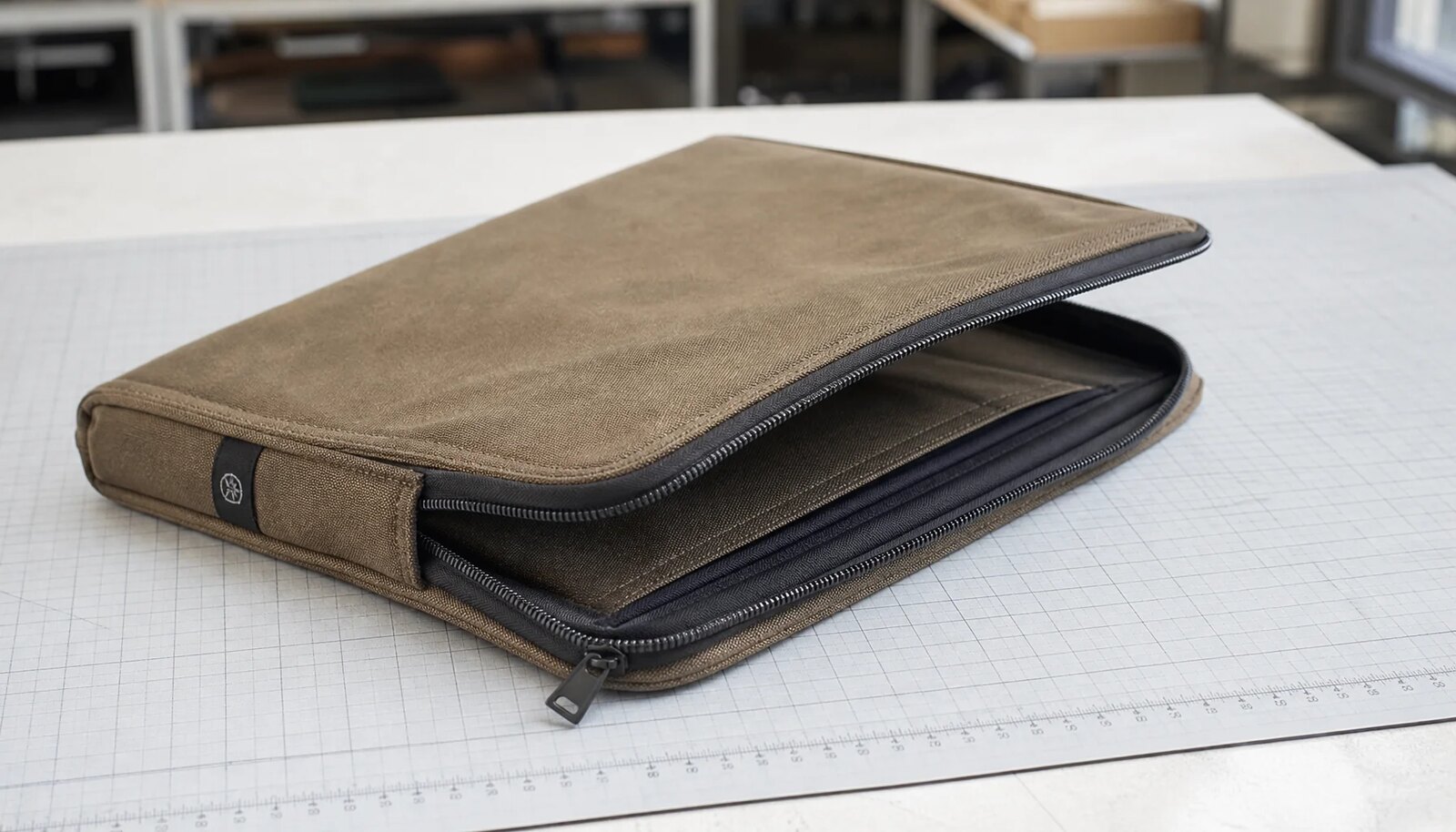
Start With the Gift Use Case
Canvas zipper portfolios look simple, but small specification choices change cost, carton volume, presentation, and inspection risk. A portfolio used for a conference agenda does not need the same structure as one carrying contracts, a tablet, a notebook, and a pen. Before asking suppliers for price, define what the recipient will actually receive inside the portfolio and how the item will be distributed.
For B2B procurement, the useful starting point is not only finished size. Specify loaded thickness, opening direction, zipper side, whether the portfolio must lie flat when zipped, and whether it will be handed out individually, inserted into a gift box, or packed with other items. Many sampling problems appear only after the real insert set is placed inside the portfolio.
The canvas zipper portfolios for corporate gifting carton packing plan should be connected to this use case from day one. A thin unlined event folder can tolerate denser packing than a lined portfolio with a metal puller and raised woven patch. If procurement separates product specification from carton planning, the approved sample may look good while bulk cartons still arrive with crushed corners or marked logos.
- List the actual inserts by size and thickness before sampling.
- Define empty size and loaded closure performance.
- Decide whether the product is a one-time giveaway or a reusable business item.
- Match the carton plan to the structure, hardware, logo method, and distribution channel.
Specify Materials Without Guesswork
A quote-ready fabric line should include canvas weight, color standard, finish, and hand feel. A 12oz / 340gsm canvas is a typical starting point for lighter document portfolios and cost-sensitive gifting. A 14oz / 400gsm canvas can add structure for notebooks or thicker insert packs. A 16oz / 475gsm canvas may feel more premium, but it should be tested because it increases sewing resistance, product thickness, carton weight, and sometimes zipper edge waviness.
These weights are not universal rules. They are practical starting points for sampling and cost comparison. The final choice should be confirmed through a physical sample, loaded-use test, and packed-carton review. A buyer that only asks for heavy canvas may pay for extra material without improving the recipient experience.
Color control also matters. Natural canvas may allow visible texture and slight shade variation, while a strict corporate color needs clearer standards. Ask whether the supplier will match Pantone, a fabric swatch, a lab dip, or a signed sample. For larger orders, confirm whether all fabric comes from one dye lot or whether shade bands must be separated by carton.
- Quote fabric by ounces or GSM, not vague terms such as thick or premium.
- Ask for 12oz, 14oz, and 16oz price options when cost and hand feel are still open.
- Define acceptable slubs, shade variation, shrinkage, and surface texture.
- Use the approved production sample as the practical color and hand-feel reference.
Control Construction Details Early
Construction choices should support the contents and presentation standard. An unlined portfolio is lighter, usually simpler to sew, and may be enough for bulk event gifting. A lined construction gives a cleaner interior and can hide seam allowance, especially when the recipient will open the portfolio in a meeting setting. Extra pockets, card slots, pen loops, and tablet sleeves should be added only when the brief requires them.
Reinforcement can help, but it can also create pressure points. Insert board may improve flatness on a desk, yet a hard board edge can mark neighboring units during carton stacking. Raised labels and thick seams can do the same. The buyer should ask the factory to identify all raised areas before confirming carton orientation and inner protection.
The RFQ should include seam allowance, thread color, stitch density target if your company uses one, corner shape, zipper side, pocket dimensions, and reinforcement locations. These details reduce the chance that suppliers quote different builds while appearing to answer the same request.
- Choose unlined construction for simple, low-bulk programs.
- Use lining when interior presentation matters to the recipient experience.
- Keep pockets and loops tied to real contents, not generic feature lists.
- Ask whether reinforcement boards or raised seams can create pressure marks in cartons.
Choose Logo Method by Risk
For simple one-color or two-color corporate marks, screen printing is often the most practical logo method on canvas. It can be clean and cost-efficient, but the buyer should check ink coverage, curing, registration, and how fine lines behave on the fabric texture. Large solid areas and very small type need special attention during sampling.
Woven labels and sewn patches are useful when the brand should feel more permanent or when direct printing is not ideal on textured canvas. They also create a controlled branding area, but placement tolerance becomes visible; a tilted patch can make the whole gift feel poorly made. Heat transfer may work for gradients or detailed artwork, but buyers should check gloss, edge lifting, cracking, and rub resistance.
Logo approval should be measurable. Replace instructions such as centered on front with exact logo size, distance from top edge, distance from side edge, and allowed tolerance. If zipper pullers or metal hardware face the logo panel inside the carton, packing must prevent scratches and pressure marks.
- Use screen print for bold, limited-color artwork.
- Use woven labels or patches for durable, restrained branding.
- Use heat transfer only when the artwork needs detail that printing cannot hold cleanly.
- Inspect logo position in millimeters against the approved artwork and sample.
Compare Supplier Quotes on Equal Terms
Supplier quotes vary because assumptions vary. One factory may price 12oz canvas, no lining, basic puller, individual polybag, and 50 pieces per carton. Another may price 14oz canvas, lined interior, better puller, divider card, and 25 pieces per carton. The lower unit price may not be the lower landed cost if it creates presentation defects, heavier claims, or receiving problems.
Ask each supplier to quote the same finished size, fabric option, zipper specification, logo method, lining option, inner packing, carton count, incoterm, and destination. If you want alternatives, request them as separate lines rather than allowing each supplier to choose its own standard.
A trading company or consolidator can be useful for mixed gift sets or multi-SKU shipment coordination, but the quote should still disclose the factory-level bill of materials and packing assumptions. For a direct factory, verify which steps are actually controlled in-house and which are subcontracted, especially logo application and packing.
- Normalize quotes before comparing unit price.
- Require carton dimensions and gross weight for landed-cost review.
- Separate optional upgrades instead of mixing them into one vague price.
- Ask who owns correction cost if artwork, packing, or material assumptions were quoted incorrectly.
Build a Practical Carton Plan
The carton plan should be approved before the purchase order or, at the latest, before bulk packing begins. Start with unit protection: polybag for dust control, tissue or release paper for print protection, divider card for raised hardware, and puller wrap when metal or molded pullers can touch the logo panel. Confirm whether barcode stickers, hangtags, or insert cards are applied before packing.
Pack count should be tested, not copied from another product. As starting scenarios, 25 pieces per carton may suit lined or premium portfolios with raised hardware; 40 pieces can work for many standard flat builds; 50 pieces may fit thin unlined portfolios when pressure risk is low. These counts must be checked against carton size, gross weight, product flatness, and logo condition after stacking.
Ask for concrete carton data. For example, a standard flat portfolio might be tested in cartons around 45 x 35 x 30 cm or 50 x 40 x 35 cm depending on finished size and stack height. Keep gross weight manageable for warehouse handling; many buyers prefer cartons under about 15 to 18 kg, but the receiving warehouse may set its own limit. For export cartons, ask the supplier to state board strength, such as ECT or burst strength where available, and confirm whether compression or stacking checks are needed for the route.
- Compare 25, 40, and 50 pieces per carton during sample or pilot packing.
- Check carton dimensions, gross weight, net weight, carton bulge, and stack shape.
- Use ECT/BCT or local carton strength standards when the warehouse or freight route requires them.
- Approve carton marks with PO number, SKU, color, quantity, carton number, destination, and barcode if needed.
Approve Samples and Packed References
A pre-production sample should use actual fabric, actual zipper, actual logo method, actual lining, actual pocket layout, and the proposed inner packing. Substitute materials can help in early development, but they should not become the final approval basis. The golden sample should be documented with photos, measurements, artwork placement, stitch details, material notes, and signed approval.
Test the sample like the recipient will use it. Load the real paper set, notebook, pen, badge, or tablet dummy. Zip and unzip repeatedly. Check whether corners pull, the zipper edge waves, lining twists, pockets distort, or the exterior panel becomes lumpy. These simple checks are often more revealing than a flat product photo.
Then test the packing. Place several units in the proposed orientation with the actual polybag, divider, tissue, or puller wrap. Look for logo contact, zipper tracks, patch pressure, and corner deformation. For larger orders, request a packed master carton reference or detailed packed-carton photos before the full run is sealed.
- Approve the product sample and packing method together.
- Record the golden sample as the standard for factory, buyer, and inspector.
- Load-test the sample before approving dimensions and zipper performance.
- Hold one approved packed carton reference for final inspection comparison.
Set Procurement-Grade QC
Inspection should be more specific than general workmanship. For canvas zipper portfolios, the QC plan should cover material condition, dimensions, logo, stitching, zipper function, interior layout, cleanliness, odor, moisture, and packed-carton accuracy. A common approach is AQL General Inspection Level II, with critical defects not accepted and major/minor limits agreed in the PO, but buyers should use their own standard when stricter controls are required.
Inspection timing matters. Material checks before cutting can catch shade, odor, zipper, and lining problems early. Inline checks during sewing can catch zipper alignment and pocket distortion before the whole lot is finished. Final inspection should include both loose units and packed cartons. If the order is event-critical, do not wait until sealed cartons are ready to discover that labels, pack count, or carton marks are wrong.
Packed-carton inspection should include carton quantity, unit orientation, barcode accuracy, carton marks, sealing method, carton condition, and product condition after handling. For export or long warehouse storage, add moisture and odor checks. Where required, ask for carton drop or compression checks, or at least a controlled internal handling check before shipment release. Packed-carton approval should be treated as part of product acceptance.
- Use the approved sample for color, logo, hand feel, and construction comparison.
- Inspect at material, inline, pre-packing, and final packed-carton stages when risk is high.
- Verify carton labels against the packing list and warehouse receiving rules.
- Release shipment only when product defects and packed-carton defects both meet the agreed standard.
Freeze Decisions to Protect Lead Time
Lead time is often lost in artwork changes, material substitutions, and packing revisions. A realistic schedule includes artwork review, sample making, sample freight, approval, material booking, logo setup, cutting, printing or label production, sewing, finishing, packing, inspection, documentation, freight booking, and warehouse receipt.
Artwork freeze is especially important. If the logo changes after screens are made or woven labels are produced, cost and timing can shift quickly. Carton decisions also need a freeze date. Changing from 50 pieces to 25 pieces per carton may protect presentation, but it changes carton count, warehouse labels, freight cube, and shipment documents.
For corporate gifting, the delivery date is usually tied to an event, onboarding wave, campaign launch, or dealer meeting. Production completion is not the same as delivery readiness. Procurement should reserve time for inspection, carton correction, export documents, customs, domestic delivery, and receiving. A tight calendar can work only when specifications and packing approvals stop moving.
- Freeze artwork, sample standard, carton marks, and pack count before bulk production.
- Identify long-lead items such as custom fabric, zipper tape, pullers, labels, and packaging.
- Allow time for final inspection and carton correction before shipment handoff.
- Use one written spec sheet, one artwork file, one golden sample, and one packing plan in the PO.
Specification comparison for buyers
| Option to compare | Typical starting point | Best fit | Procurement checks before approval |
|---|---|---|---|
| 12oz / 340gsm canvas | Light to medium hand feel, lower material weight, easier high-count carton packing | Conference giveaways, document sleeves, onboarding kits with paper inserts, cost-sensitive corporate gifting | Confirm shrinkage, shade tolerance, opacity, print coverage, and whether the portfolio still feels substantial enough after sewing |
| 14oz / 400gsm canvas | More body than 12oz while still flexible for zipper sewing and stacked packing | Dealer gifts, sales meeting packs, reusable office document portfolios, programs with notebooks or thicker inserts | Check zipper edge waviness, needle marks, carton gross weight, and whether added fabric weight changes freight cube |
| 16oz / 475gsm canvas | Premium hand feel and stronger shape retention, but higher cost and thicker packed profile | Executive gifts, premium employee kits, programs where the recipient is expected to reuse the portfolio | Run sample and packed-carton testing; heavier canvas can increase sewing resistance, compression marks, and carton count |
| Unlined construction | Single-layer canvas with visible interior seams finished cleanly | Simple giveaways, flat document packs, lower freight weight, faster production | Inspect seam finish, loose threads, inside appearance, and whether the unlined build looks acceptable when opened |
| 210D lined construction | Cleaner interior with lining and optional document pocket | Meeting portfolios, HR kits, sales folders, programs where recipients open the item in front of others | Check lining twist, pocket distortion, trapped threads, added labor cost, and whether lining affects zipper closure |
| 25 pcs per carton | Lower stack pressure and easier manual handling; often used for thicker or premium builds | Lined portfolios, insert boards, raised patches, metal pullers, high-presentation gifts | Confirm carton cube, freight impact, carton label count, and whether the lower count is needed after compression review |
| 40 pcs per carton | Middle-range pack count for many flat portfolios after testing | Standard 12oz or 14oz builds with controlled zipper orientation and basic inner protection | Check max gross weight, pressure on logo panels, carton strength, and whether the stack stays flat after 24 hours |
| 50 pcs per carton | High-density packing for thin, unlined units when presentation risk is low | Large event giveaways where freight cube matters and the portfolio has minimal raised hardware | Use only after packed-carton approval; verify no zipper tracks, corner crush, print transfer, or carton bulging |
| Individual polybag only | Dust protection with low added material and labor | Simple direct distribution where logo abrasion risk is low | Confirm bag thickness, barcode/sticker needs, suffocation warning requirements, and moisture risk for the shipping route |
Buyer checklist before sampling
- Define the finished size, zipper opening length, corner shape, seam allowance, and whether the portfolio must close easily when loaded with the intended inserts.
- State canvas weight in ounces or GSM, fabric color standard, acceptable hand feel, and whether shade variation will be judged against lab dip or approved sample.
- Specify logo method, artwork file, logo size, print colors, placement distances from edges, and tolerance in millimeters.
- Choose zipper size, tape color, slider type, puller finish, top-stop treatment, and whether pullers need wrapping or alternating orientation in the carton.
- Confirm lining material, document pocket size, card slot, pen loop, tablet sleeve, insert board, and reinforcement points only where they support the real use case.
- Set stitching expectations: thread color, stitch density target if required, bartack positions, loose-thread trimming, and seam strength at stress points.
- Request carton dimensions, pieces per carton, gross weight, net weight, board strength or ECT/BCT target if available, and maximum acceptable carton bulge.
- Require inner packing details: polybag, tissue, release paper, divider card, barcode sticker, hangtag, insert card, and carton label format.
- Approve a pre-production sample made with actual fabric, zipper, logo method, lining, reinforcement, and packing materials.
- Approve one packed carton reference before bulk packing so carton count, orientation, inner protection, labels, and sealing method are clear.
Factory quote questions to send
- What exact canvas weight, color standard, finishing treatment, and shrinkage expectation are included in the quoted price?
- Can you quote 12oz, 14oz, and 16oz canvas versions so we can compare unit cost, hand feel, carton cube, and gross weight impact?
- Which production steps are handled in-house: cutting, printing, embroidery or label sewing, zipper attachment, final sewing, finishing, packing, and carton sealing?
- What zipper size, tape material, slider type, puller finish, and top-stop reinforcement are included, and can you provide a component photo or physical sample?
- What logo setup charges, screen charges, label mold fees, color-change fees, sample charges, or packing charges are excluded from the unit price?
- What finished size tolerance, logo placement tolerance, stitch tolerance, and shade tolerance do you normally apply to this product category?
- Can you quote lined and unlined versions, plus optional document pocket, insert board, puller wrap, divider card, and barcode sticker as separate cost lines?
- What carton pack count do you recommend, and what are the proposed carton dimensions, gross weight, net weight, board specification, and sealing method?
- For a carton packing plan, can you compare 25, 40, and 50 pieces per carton with estimated carton cube, gross weight, and presentation risk?
- Will zipper pullers, raised patches, labels, or reinforced seams touch the printed front panel during packing, and how will you prevent marking?
Quality-control points to confirm
- Use the agreed AQL plan, commonly General Inspection Level II with critical defects at 0 acceptance and major/minor limits set by the buyer, unless the PO specifies another standard.
- Inspect raw materials before cutting for canvas weight, shade, odor, moisture feel, surface slubs, stains, zipper tape color, slider finish, lining color, and label quality.
- Check finished dimensions against tolerance, including width, height, zipper opening length, pocket depth, logo position, corner symmetry, and loaded closure fit.
- Confirm the portfolio zips closed smoothly without stress, panel distortion, zipper edge waves, slider jump, broken top stops, or sharp puller edges.
- Inspect logo quality for placement, edge sharpness, ink coverage, pinholes, broken lines, smearing, registration, heat-transfer lifting, patch tilt, and stitch security.
- Check stitching for even seam lines, secure bartacks or reinforcement at zipper ends and pocket corners, proper thread color, no skipped stitches, and clean trimming.
- If lining is used, verify it lies flat with no twisting, puckering, trapped threads, exposed seam allowance, or distortion visible on the exterior panel.
- Open packed cartons to verify actual quantity, unit orientation, polybag use, divider placement, puller protection, barcode or sticker accuracy, and carton marking accuracy.
- Check carton approval criteria: no bulging, no crushed corners, secure tape, readable marks, correct PO/SKU/color/count, acceptable gross weight, and stackable shape.
- Run practical packed-carton checks before shipment release, including moisture or odor review, short compression hold, and controlled edge/corner drop checks where required by the buyer.